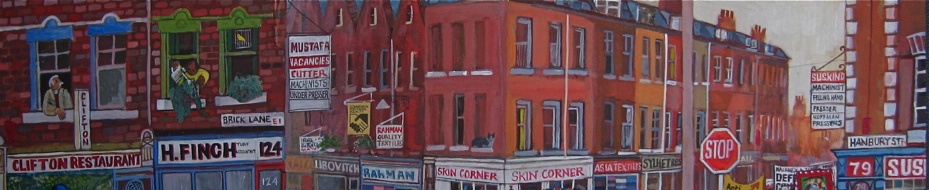
Solidarity On The Streets
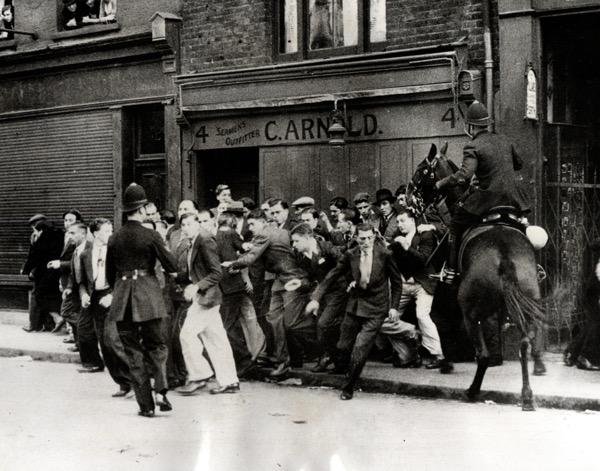
Police disperse anti-fascist protestors at the Battle of Cable St, 4th October 1936
Commemorating the ninetieth anniversary of the Battle of Cable St, Solidarity on the Streets an exhibition documenting East Enders’ enduring resistance to racism and fascism opens today at Four Corners in Bethnal Green and runs until 31st October, Wednesday-Saturday 11am-6pm.
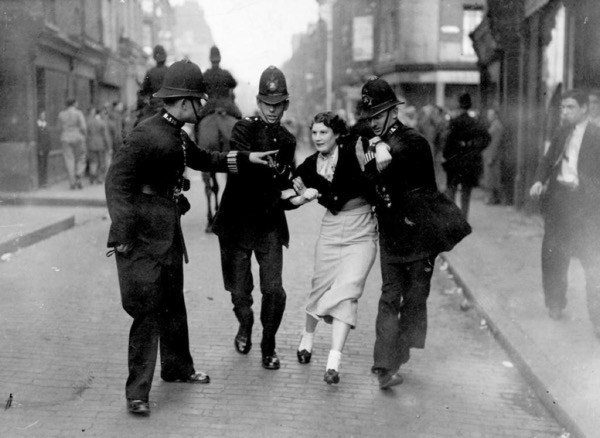
Policemen arrest a protestor at the Battle of Cable St, 4th October 1936. Courtesy Topical Press Agency/ Hulton Archive/Getty Images
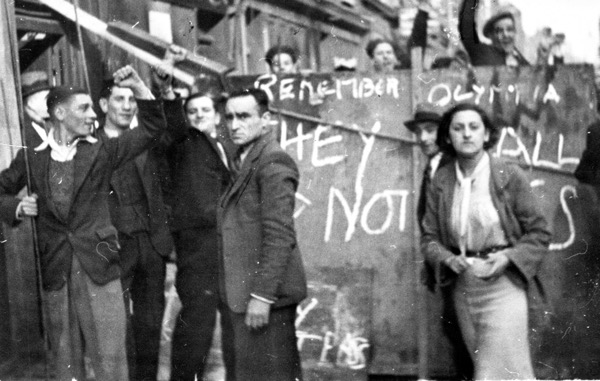
Protestors stand by a barricade with the slogans ‘Remember Olympia’ and ‘They Shall Not Pass,’ Battle of Cable St, 1936. Courtesy People’s History Museum
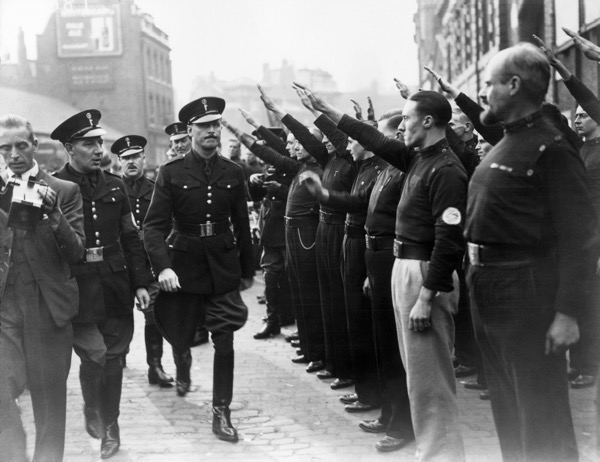
Fascist leader Oswald Mosley inspects his blackshirts in Royal Mint St prior to the Battle of Cable St, 4th October 1936. Courtesy Hulton Archive/Getty Images
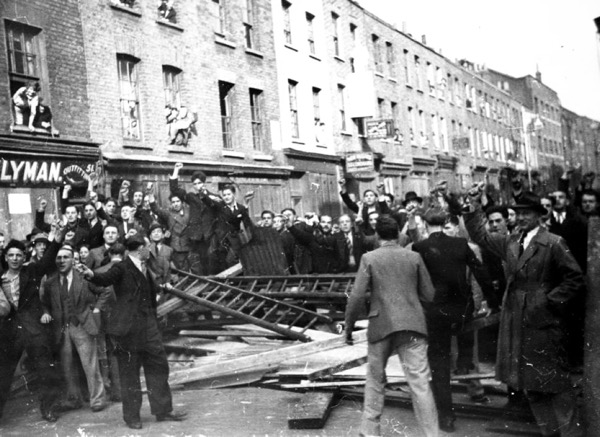
Protesters on the barricade in Cable St, 4th October 1936. Courtesy People’s History Museum
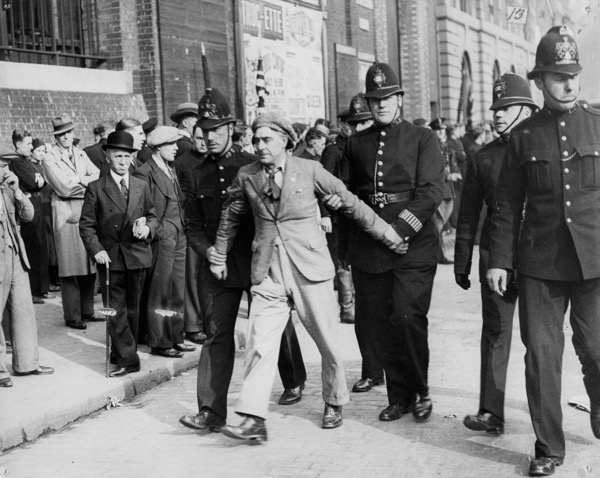
Policemen arrest a protester in Royal Mint St, 4th October 1936. Photography by Planet News Ltd. Courtesy People’s History Museum
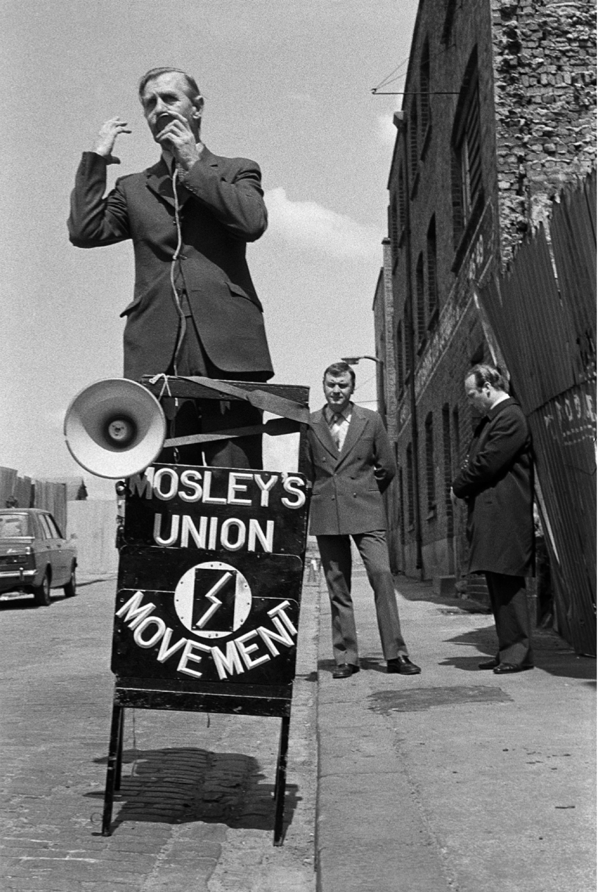
Moseley supporter in East London, 1976. Photograph copyright Paul Trevor
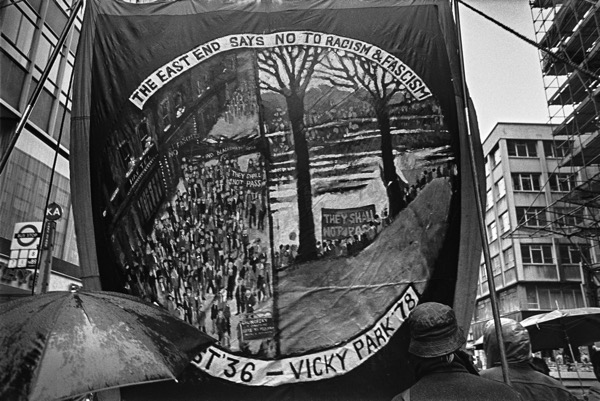
March after the racist murder of Altab Ali with banner designed by Dan Jones, Whitechapel, 14th May 1978. Tom Learmonth. Courtesy Four Corners/Bengali Photo Archive
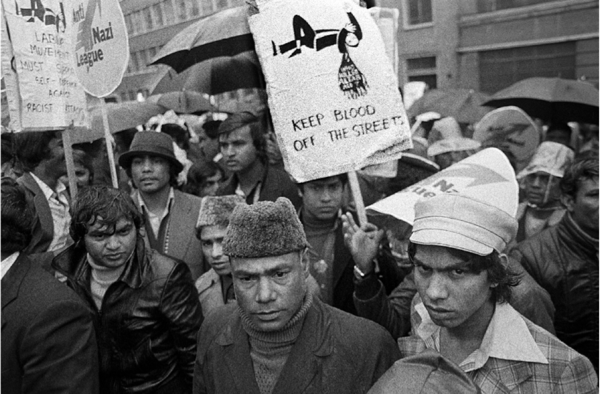
Procession behind the hearse of Altab Ali, 14th May 1978. Photograph copyright Paul Trevor
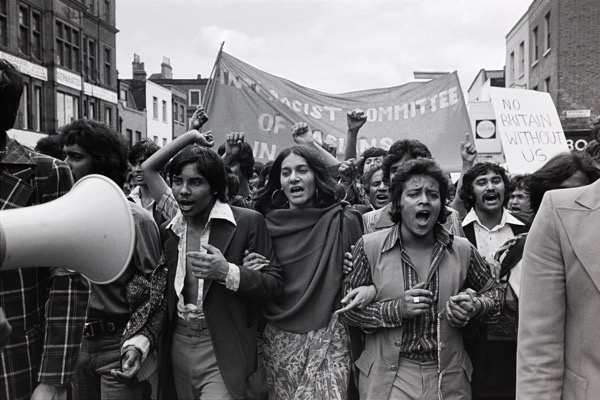
Demonstration by the Anti-Racist Committee of Asians in East London. Centre: Mala Sen, right: Chomok Ali Noor, to right and behind: Islam Uddin. Commercial Rd, June 1976. Photograph copyright Paul Trevor
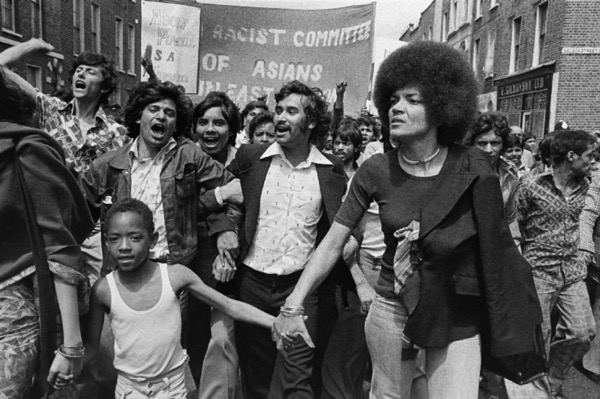
Anti-racist demonstration with Barbara Beese and her son Darcus Howe, June 1976. Photograph copyright Paul Trevor
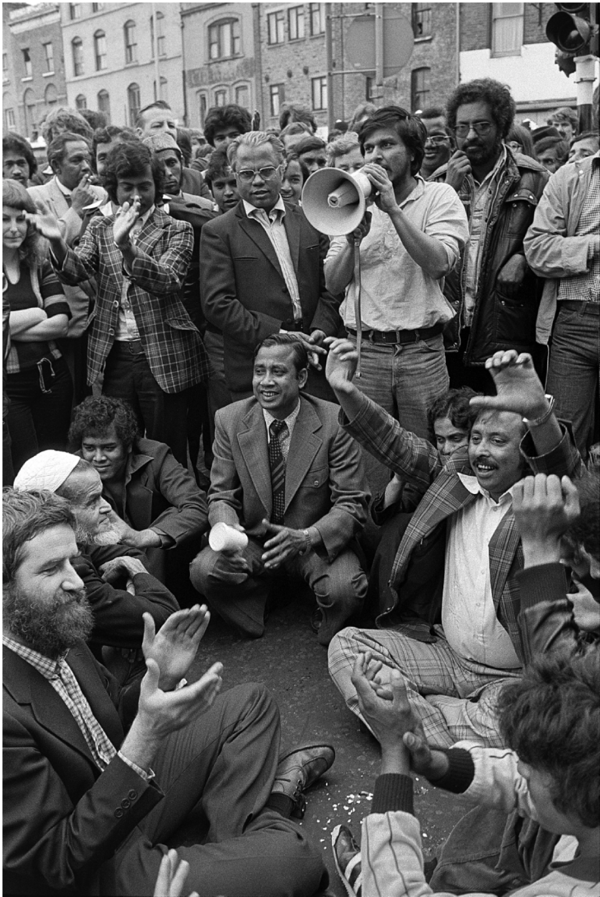
Anti-racist sit down protest to stop the National Front selling their papers at the top of Brick Lane, 16th July 1978. Aloke Biswas speaks through a megaphone, Patrick Kodikara stands on his left, Abdul Monnan holds a cup, Shams Uddin sits with arms raised and Dan Jones is clapping. Photograph copyright Paul Trevor
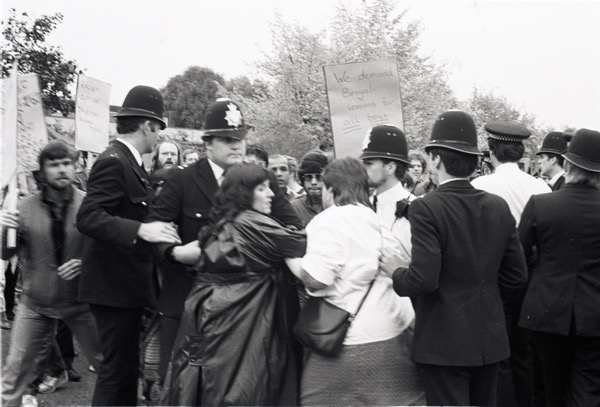
Police clash with teachers from Daneford School who were picketing the Inner London Education Authority to demand anti-racist action in their school, October 1985. Photograph by Lloyd Gee. Courtesy Four Corners/Bengali Photo Archive
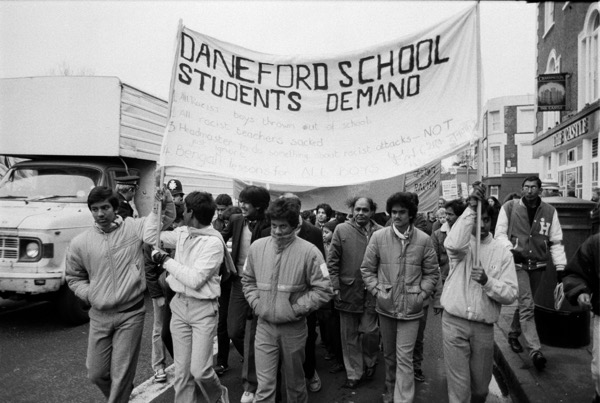
Students and teachers from Daneford School march up Holloway Rd demanding anti-racist action in their school, November 1985. Photograph by Lloyd Gee. Courtesy Four Corners/Bengali Photo Archive
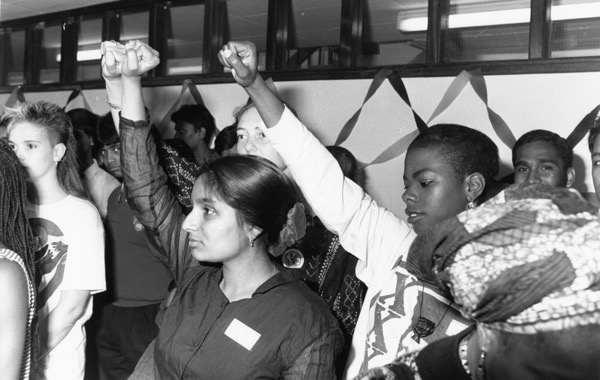
Reception for anti-apartheid activists Adelaide Tambo and Winnie Mandela at Daneford School, Bethnal Green, 1990, including Julie Begum, Jennifer Fear, Abdul Rob, Maya Alexander and Anne Knox. Courtesy Four Corners/Bengali Photo Archive
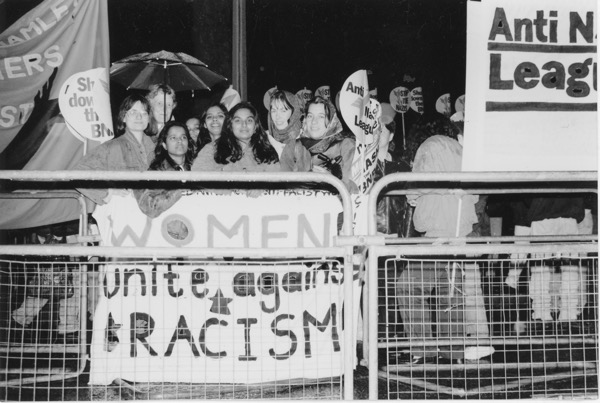
Women Unite Against Racism protest outside London Borough of Tower Hamlets town hall against the British National Party, 1993. From left: Rhea, Jill, Amina, Ahea, Julie Begum, Georgie Wemyss and Danielle. Courtesy Four Corners/Bengali Photo Archive











There isn’t a day at work or outside it that we don’t have to fight hope our rights .
Well done all those who have or will do it .
I had to on my life many times .
Andy
Especially after last October’s Stand Up to Racism counter-protest against UKIP, I hope Sunday remembers all of Cable Street’s history rather than retrofitting it to suit the politics of 2026.
Last October I found it rather dispiriting to see what ought to have been a straightforward stand against extremism submerged beneath Socialist Worker banners and Palestinian flags. There was also a fairly extraordinary visual irony in groups of men dressed head-to-toe in black invoking Cable Street while apparently oblivious to the historical photographs of Mosley’s Blackshirts.
More importantly, something that increasingly seems to get blurred out is that Cable Street was, at its heart, a defence of a heavily Jewish East End community against an explicitly antisemitic fascist movement. Jewish residents were central to it, joined by Irish dockers and many others.
So, in the spirit of all that diversity, inclusion and open-mindedness we hear so much about, I very much hope that Jewish Londoners and the specifically Jewish history of Cable Street are given rather more than a walk-on part this Sunday.
And today, on BBC raodio4, at “Question Time” the crooked fascist Tice will be speaking.
We are back to where we started from
QUOTE: “Within Reform UK, he’s the Trotsky to Nigel Farage’s Lenin. Also a property magnate, private equity guy, and fractional billionaire. Doesn’t believe in anthropogenic climate change, vehemently opposes renewable energy projects, wants to drill for oil and revive coal mining, Gaza genocide denialist … are you getting a clear picture yet?”
“They shall not pass..” so proud of London’s East Enders’ history of anti-racism protest.
Great photos & a must see exhibition, thank you!
Gentle Author, I would suggest a corruption in your description of some of the photographs. The Police do not normally ‘clash’ with any group/protesters. The group/protesters clash with the Police a subtle difference. The Police are always ‘piggy-in-the-middle’, whether it be between various groups/protesters or against the law/the state. Quite simply they are there to maintain the status quo/the peace as decided by our politicians in parliament. In this context, imagine for one moment if there were no laws, no police no controls at all. Demonstrations, protests by opposing groups would soon turn violent and possibly into riots, with many people injured and killed. Then you introduce the police to prevent this and all of a sudden it turns to your phrase, ‘the police clash with the protesters’.
In a previous life, I lived in Bromley-by-Bow and worked in the Commercial St. Spitalfields area.
Thank you for sharing these powerful images of ordinary local people standing up to fascism and racism in the East End.
What struck me most is how the exhibition connects Cable Street in 1936 with later East End activism, from the protests after Altab Ali’s murder in 1978 to the Daneford School demonstrations in the 1980s. Seeing those moments side by side makes the neighbourhood’s history of organised community action feel much more continuous.
I can’t stand any form of racism or bigotry. Please let us all work on peace whatever the colour of your skin is, and whether its on the streets we all share, between your neighbours, or in the workplace.