
The Oxford Sausage

I am proud to publish these excerpts from THE OXFORD SAUSAGE by a graduate of my writing course. The author set out to write a spicy mix of Oxford stories from a house once belonging to a city sausage maker.
I am taking bookings for the next writing course, HOW TO WRITE A BLOG THAT PEOPLE WILL WANT TO READ on February 6th & 7th. Come to Spitalfields and spend a winter weekend with me in an eighteenth century weaver’s house in Fournier St, enjoy delicious lunches and eat cakes baked to historic recipes, and learn how to write your own blog.
If you are graduate of my course and you would like me to feature your blog, please drop me a line.
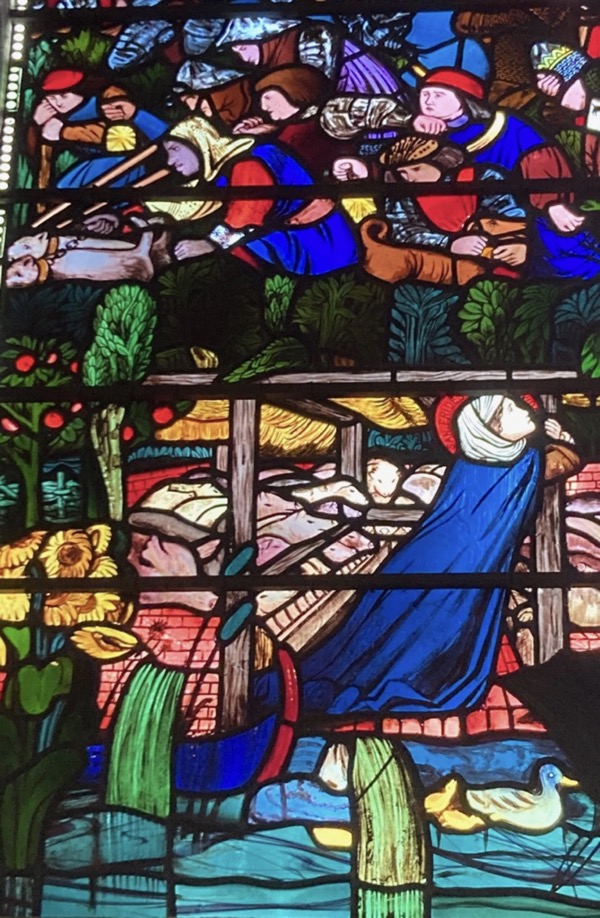
Saint Frideswide hiding from pursuit in a pigsty
Of Saints & Sanitaryware
I have come early to Christ Church to avoid the crowds and check out some alarming new intelligence. Something that I thought – as I make my way under Tom Gate and across the vast main quadrangle of the college where thirteen of our prime ministers were educated – could not possibly be true. For it is rumoured that within one of its most prized stained glass windows, created by the Pre-Raphaelite artist Edward Burne-Jones and dedicated to St Frideswide the patron saint of Oxford, is secreted a modern lavatory. I want to see this for myself.
I am greeted by a man who with his long black robes and grey beard, looks exactly as you might imagine an Old Testament prophet. He introduces himself as Bede, as in the Venerable Bede, the Anglo Saxon scholar who lived at roughly the same time at St Frideswide. I thought this a good omen. It turns out he was so christened after he was born on the same day as the feast of his namesake (May 25th). He is between shifts and offers to tell me all about the lavatory in question. I feel blessed.
The Frideswide Window is on the east side of the Latin chapel. Made up of sixteen panels it tells the story of Frideswide, a Saxon princess brought up in a convent who decides to devote herself to God and become a nun herself. However she is expected to marry and when Algar, the King of Mercia turns up to claim her hand by force, she makes her escape by boat and hides in a pigsty. Catching wind of her return to Oxford to see her father, Didan, King Algar races back to the city but when he tries to enter he is blinded by a thunderbolt. Frideswide feels sorry for him and prays for his sight to be restored, which by a miracle it is and he agrees to leave her be. A healing spring appears in Binsey and Frideswide sets up a priory just inside the city walls on the site of Christ Church. There are archaeological remains of a seventh century graveyard here so there is almost certainly some truth to the latter part of the story.
Looking up at the window with Bede, as the morning sun transfers a luminosity and vibrancy to the colours, it is hard not to feel moved. The detail is exquisite, ducks chaperone their babies, pigs jostle for position in a crowded sty, King Algar’s men crouch behind hedges, the folds and patterns on the gowns of Fridewide’s nurses surrounding the saint as she lies dying are beautifully applied. And that is when I see it with my own eyes in the very last of the story panels. Seat up, handle and flush pipe behind, curtain drawn back, a lavatory for all to see. The height far too low for the washstand some claim it to be. Definitely a toilet. And what is more it is pink!
But whatever is it doing in the portrait of Anglo Saxon England when the best that could be hoped for was a hole in the ground?
The window was made by Burne-Jones in 1859, the year after ‘the Great Stink’ when the hot weather in London exacerbated the smell of human waste in the river Thames to unbearable levels. In late 1857 Burne-Jones himself fell ill, probably malaria caused by insanitary conditions. Maybe what he is saying in this picture designed so soon after, is that had Frideswide been supplied with access to more hygienic conditions, a modern toilet for example, she might had survived the fever that killed her?
Bede, however thinks that there are more prosaic reasons for its inclusion. The WC is product placement, he argues, in recognition of the window’s financial investors, who were porcelain manufacturers! I can see the link between the purity of a saint and the purity of clean water is one that would have appealed to the Victorians.
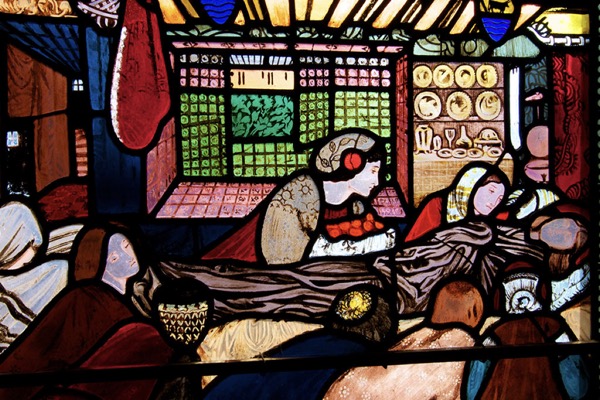
The death of St Frideswide with a pink flushing toilet in the background
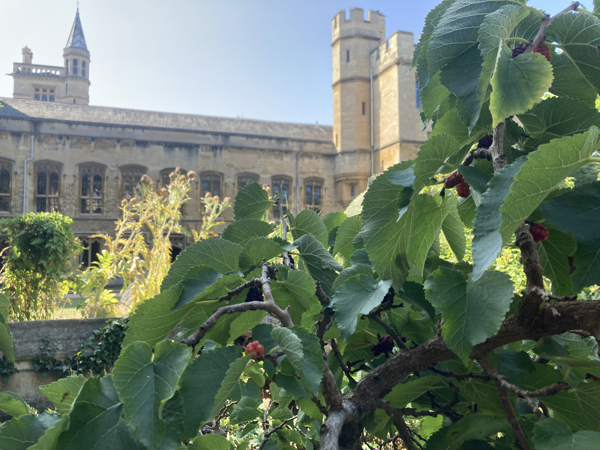
Mulberries at Balliol College
A Jar Of Jam From James I
I had scrawled the word mulberries across the pages of my calendar for the first week of August. It was to remind me that this was the short window of time that these delicious knobbly clusters more muscular than a blackberry, sweeter than a raspberry, fully ripen and fall from the tree. For I wanted to make jam. Not any old jam mind. A conserve created from the darkened crop of an ancient black mulberry tree. Planted in the gardens of Balliol College over 400 years ago and still bearing fruit.
Lying prostrate in a flowerbed, its trunk gnarled, its branches propped, this is one of the very few mulberries that have survived from the thousands of saplings imported from Europe in 1609 by King James I. He’d wanted to create a domestic silk industry, instead of buying the stuff from abroad at vast expense. And as the leaves of the mulberry were the silk moth caterpillar’s only food, he persuaded rich landowners to plant them on their estates. Some Oxford and Cambridge colleges also bought into the idea and he planted hundreds in the grounds of his Royal Palaces at Greenwich and St James Park. Our National Collection of Mulberries is still held at Buckingham Palace. He even appointed a Keeper of the King’s Silkworms.
There are lots of suggestions as to why the project failed. Some say it was because James I imported the wrong kind of mulberry. For it is the white mulberry (morus alba), not the black mulberry (morus nigra) we have here at Balliol, that is native to East Asia and has been nurtured as food for silkworms in China for over four millennia. And it was the white mulberry that was planted by James’ great rival Henry IV of France in the Tuileries gardens of the Louvre, that created the raw materials to manufacture what became known as ‘woven wind’. The most likely explanation is that both were delivered but only the black survived. And so it was that the hardy black mulberry triumphed and trees are still found in country houses and Oxford colleges.
Though I am sorry that King James never secured a thriving silk trade I am grateful to him for today’s harvest. Soon my hands are bloodied from their seeping juices – they are not called blood fruit for nothing – my lips a ruby red. And carrying them carefully home I boil them up in the pan with a little sugar and lemon (they are low in pectin so you will need something to thicken) and I have enough to make a jar full. It is a dark burgundy colour, sweet, pippy and delicious on toast. Like the season, it disappeared all too quickly. I must write myself a note in the calendar for next year, this time pick more mulberries.
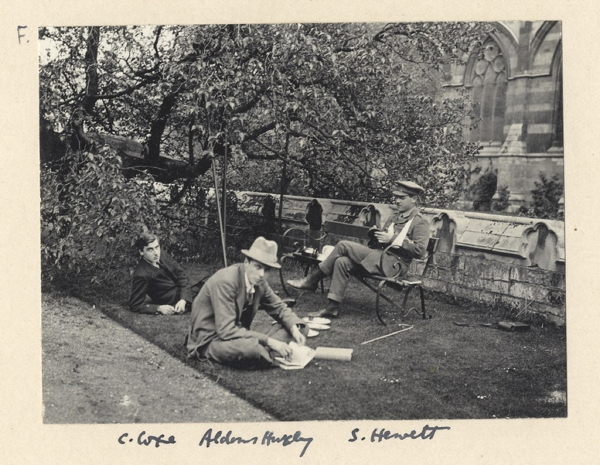
This photograph was taken in 1913 of three Balliol students including Aldous Huxley sitting under the mulberry tree. Courtesy of Balliol College Archive














In my hometown of Burton upon Trent there are four mulberry trees in the Memorial Grounds in the town centre. The two original ones are collapsed to the ground and are propped with wood supports but still fruit, there are two younger ones which have been planted in my lifetime and are also bearing fruit, in August I stood under the trees eating the delicious mulberries as I have done since being a small child, oh the memories, my grandmother was responsible for my introduction, I have picked small amounts for decades to make a pot of jam or just eat, as you rightly say they are delicious, there are always people curious as to what I am doing. Thank you for sharing your thoughts. Jan
Love your blog!
Thank you so much for sharing the story of St Frideswide.
I visited the site of her well, and include the story here: https://www.sallykindberg.co.uk/notebook/2022/06/sally-kindbergs-museum-of-dust-dust-from-the-treacle-well/
Dust from the well is included in my small, travelling Museum of Dust and should you be interested I’ll be displaying and talking briefly about it on 28th October at Swedenborg House
https://www.swedenborg.org.uk/events/museum-of-dust-presentation-and-workshop-with-artist-sally-kindberg/
Charming! Although I’ve been to Oxford once or twice, I’d never heard of Saint Frideswide, so I never knew that Burne-Jones created a window around her myth. What a fun, whimsical read to go with my morning coffee. And I now know two pieces of –not trivia, but esoterica, perhaps–to amaze and amuse friends. Thank you!