
Marion Elliot’s Pictorial Guide To Rural Crafts
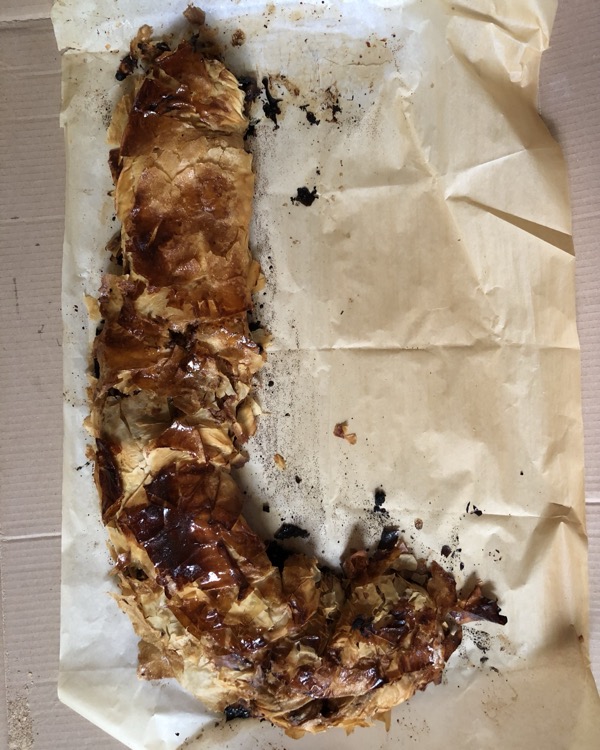
Magnificent Apple Strudel kindly baked by Farokh Talati, Head Chef at St John Bread & Wine for the lucky guests on this Sunday’s tour of Whitechapel. Click here to book for Whitechapel tours on Sundays 23rd August, 6th and 23rd September, and 18th October
We are delighted to show these splendid cut paper collages by favourite illustrator Marion Elliot which are the subject of her exhibition MAKING GOOD at Tinsmiths in Ledbury, opening this weekend and running until 4th September. For those of you unable to make the trip to Herefordshire, I publish them here today.
‘While I was working on fabric designs based on mochaware pottery for Phoebe Clive, owner of Tinsmiths, we discussed how we wanted to celebrate traditional crafts. Many of the themes of my collages, such as smocking, come from ideas sparked by my visits to rural museums, agricultural fairs, flower shows and also traditional customs including Lammas Day celebrations. When Phoebe offered me an exhibition to launch the fabric and show a collection of these collages, I was delighted to accept.’ Marion Elliot
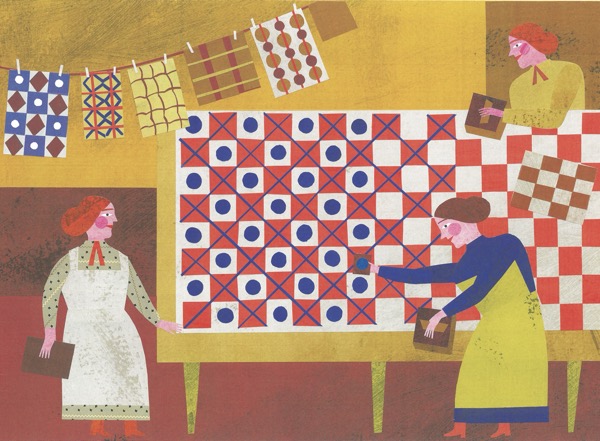
At the Block Printers
The production of block-printed fabrics in the British Isles was inspired by hand-printed fabrics imported from Asia. Early blocks were carved from pear or sycamore wood and used to print fabric by hand before the arrival of mechanisation. Interest in hand block-printing was revived by William Morris in the nineteenth century and continued in the twentieth century by designers such as Barron & Larcher, who shared Morris’ interest in natural dyes, and their pupil Enid Marx.
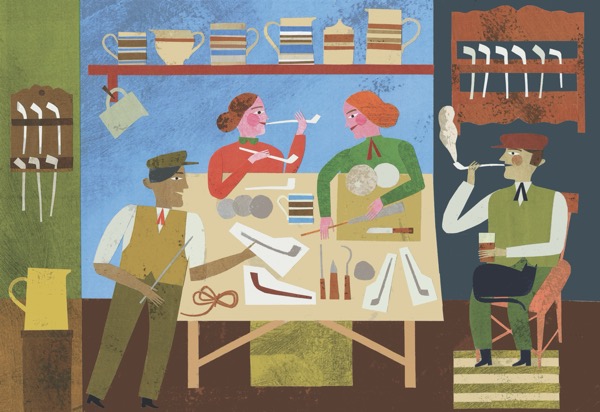
At the Clay Pipe Factory
Clay pipes were made from the middle of the sixteenth century in London and the craft spread rapidly throughout England. Family groups often made pipes together which were formed by pushing white earthenware clay into two-part plaster moulds. Some moulds were ornate and produced highly decorative pipes. The central channel was achieved by feeding an oiled wire through the body of the pipe which met a stopper at the bowl. Clay pipes were cheap and disposable, but they were replaced by wooden pipes in the nineteenth century and cigarettes during the First World War.
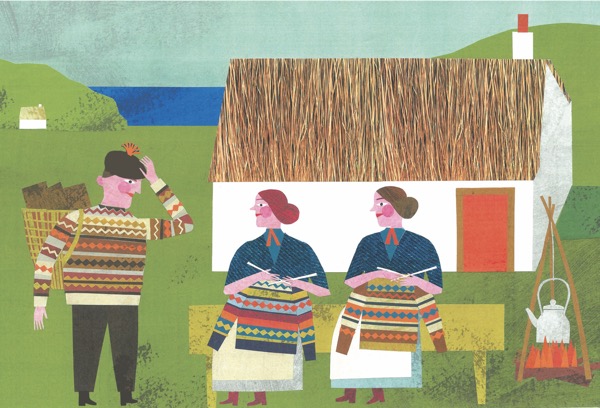
The Fair Isle Knitters
Fair Isle knitting comes from a tiny island situated between Orkney and the Shetland Islands, north of Scotland. It is created using double ended needles and knitted in the round, using two colours at a time, with around four colours being used in the whole garment. In this picture two sisters knit sweaters. Their neighbour has been cutting peats and carries them in a traditional handmade kishie woven from straw, dockens and marram grass.
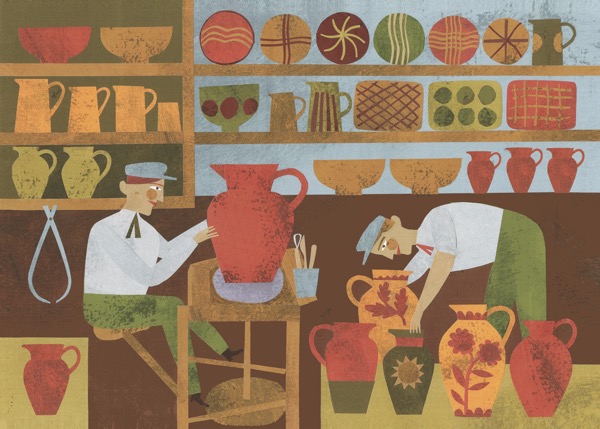
At the Slipware Factory
Popular from the seventeenth century onwards, slipware pottery was decorated by applying contrasting slip, or liquid clay, to unfired clay. This was poured, trailed or brushed onto the surface and could also be scratched away to reveal the colour of the clay beneath by a technique known as sgraffito. There were some very notable English slipware makers, such as Thomas & Ralph Toft, who made pottery with biblical and royal themes.
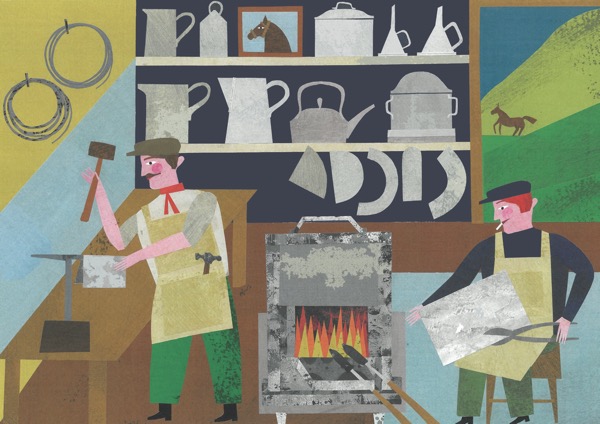
At the Tinsmiths
Tinware was produced in London from the middle of the seventeenth century. Unlike blacksmithing, it was a cold metal craft although fire was used to heat tools and solder. Tinsmiths made metal containers and utensils entirely by hand, using tinned steel sheet and wire. They hammered the metal sheets over iron stakes to bend them into shape and ran solder down the joints to seal them. Many tinsmiths, tinkers, were itinerant and returned to their customers to make repairs and patch up holes.
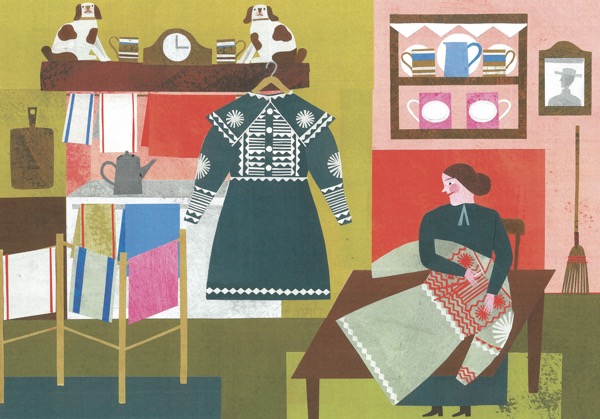
The Smock Maker
Before the invention of elastic, smocking stitches were used to gather fullness in smocks worn by agricultural labourers. This technique offered a bit of ‘give’ across the chest and shoulders, allowing movement when working. Different trades and skills often had distinctive smocking patterns, making the wearers easy to identify.
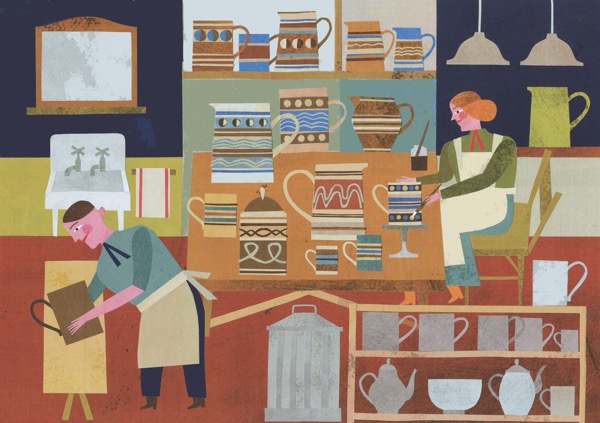
At the Mochaware Factory
Mochaware was a cheap variety of decorated tankards, bowls and jars in earthenware pottery, featuring bands applied with liquid clay, achieved by turning each piece on a lathe while applying even lines of slip. The most common styles were earthworm, a trailing, wavy design and cats’ eyes, comprising dotted multicolour motifs. Tree-like patterns were achieved by dropping an acidic mocha tea mixture onto the wet slip so that it spread across the surface in a pattern resembling branches.
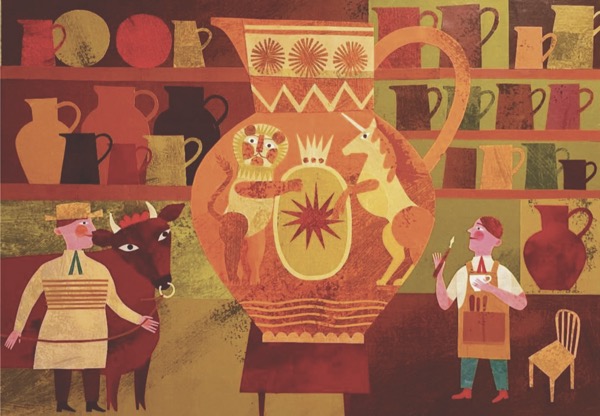
The Harvest Jug Maker
Harvest jugs are large earthenware pitchers decorated with contrasted slip and embellished with scratched sgraffito designs celebrating fertility, the abundance of nature, royal coats of arms, sailing ships and other traditional motifs. They were employed to serve ale and cider to farm workers at harvest time and at celebrations for the end of the cut, when the crops were safely home. There is a strong tradition of harvest jug making around Bideford and Barnstaple in North Devon with some spectacular examples at the Burton Museum in Bideford.
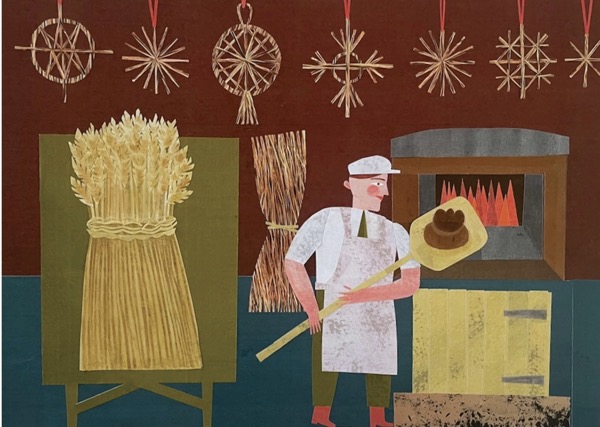
The Harvest Loaf Baker
The baker takes the Lammas loaf – made using wheat from the first cut of the new harvest – out of the oven. Behind him is a traditional harvest loaf in the form of a wheatsheaf and above him, corn tokens or dollies made with the last of the old harvest. Lammas Day falls on 1st August, when the new loaf is taken to church and blessed to give thanks for the harvest. The enormous harvest loaf is employed as the centrepiece of harvest festivals throughout the late summer and early autumn.
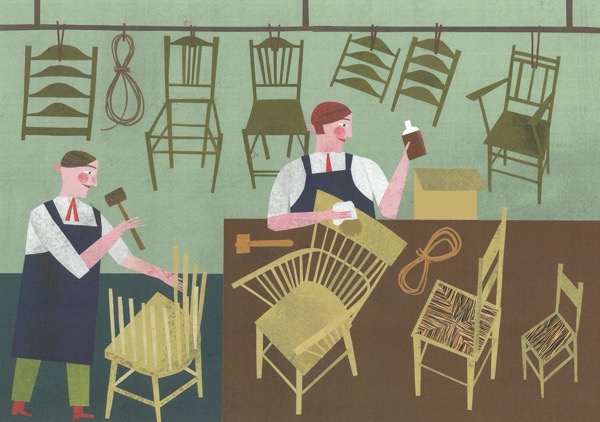
At the Chair Makers
Making chairs by hand is still widely practised, continuing the tradition of the Arts & Crafts makers such as Ernest Gimson, who was heavily influenced by rural chairmaker Philip Clisset. His company made the original ladder-back, rush-seated chairs – still used at the Art Workers’ Guild – in their workshop in Bosbury near Ledbury, Herefordshire.
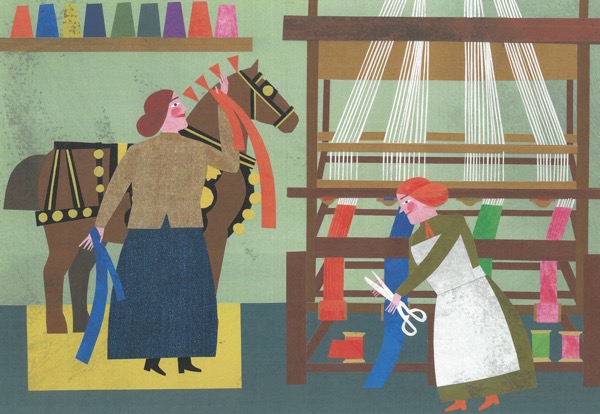
The Silk Ribbon Maker
In Spitalfields, silk ribbon weaving was established in the late seventeenth century by Huguenot refugees. Then, from the early eighteenth to the middle of the nineteenth century, silk ribbon weaving became Coventry’s main industry. At one stage around 13,000 hand looms were in operation and half the population of Coventry was associated with the trade. The jacquard loom, shown here, wove several widths at once. An alternative method was to weave the ribbons as a broadcloth, with gaps between, so they could be cut and separated after production.
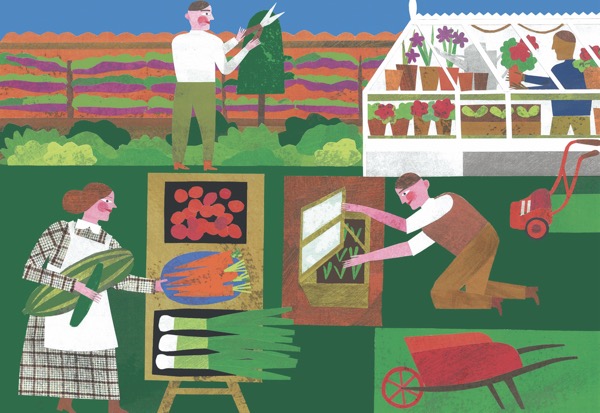
Preparing for the Flower & Produce Show
Even before the show takes place, there are weeks of anxiety as flowers and vegetables are lovingly tended and fussed over by their growers. Customarily, judgment at flower and produce shows is strict and there are many rules governing display of exhibits which, if disregarded, can result in disqualification.
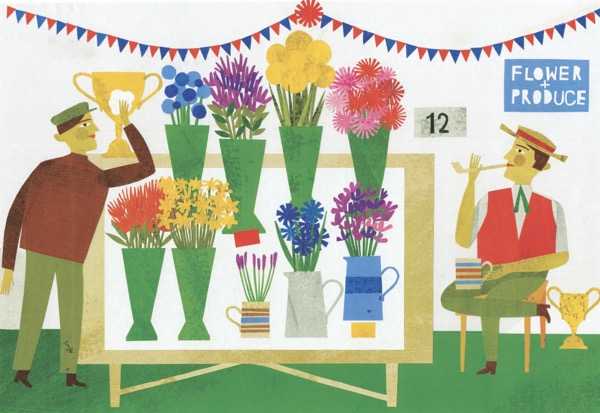
At the Flower & Produce Show
Agricultural Fairs traditionally take place during the month of August, when farmers bring their champion beasts to compete for glory in the ring. The Flower & Produce Show is a fiercely contested part of the fair, taking place in enormous marquees, where prize vegetables and flowers are displayed alongside jams, pickles, cakes, knitted items and children’s vegetable sculptures. Other attractions include sheep shearing, horse jumping and dressage, traction engine and tractor rallies, beer tents and very often, fairground rides.
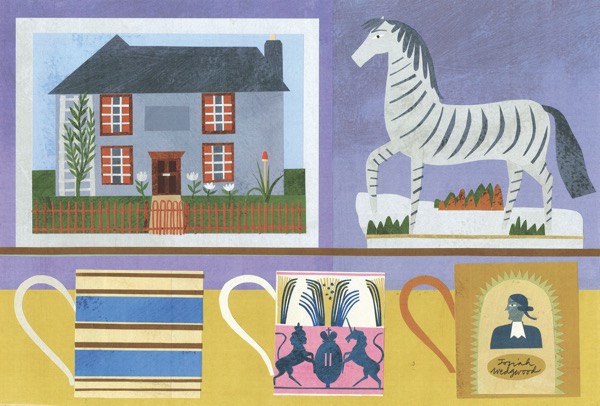
At the Fry Gallery 1
This collage was made in response to Fry’s Popular Delights, an exhibition curated by Mark Hearld & Colin Wilkin at the Fry Gallery in Saffron Walden, featuring items from the collections of the Great Bardfield artists. Here is an image of a house by Tirzah Garwood, a Staffordshir zebra, two Wedgwood pottery mugs by Eric Ravilious and a mochaware mug.
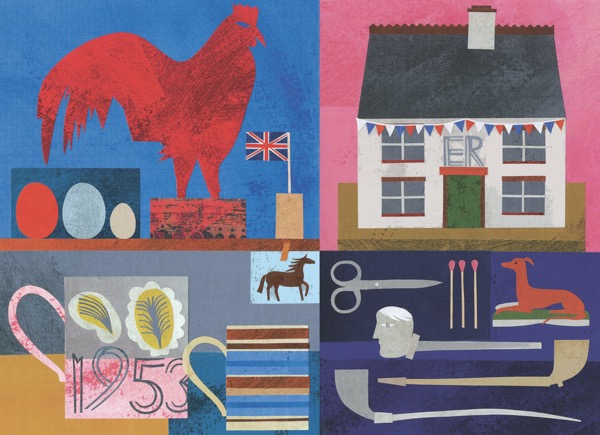
At the Fry Gallery 2
More inspiration from Fry’s Popular Delights, featuring a Wedgwood Elizabeth II coronation mug by Eric Ravilious, a coronation money box, a mochaware mug, a collection of clay pipes and a few other bits from my own collection.
Illustrations copyright © Marion Elliot













I am not sure about the strudel – to be honest I like mine a bit more traditional – just plain apples raisins, nutmeg…..
but I love the look of Marion’s collage pictures of different crafts which capture ‘traditional’ beautifully.
Be assured, Karen , our apple strudel is traditional, apple raison and nutmeg
Beautiful collages. Full size they must be striking.