
At The Smithfield Institute
Click here to book for The Gentle Author’s Tours
Jack Hanlon gives a rare insight into the fascinating lost world of the Smithfield Meat Trades Institute…
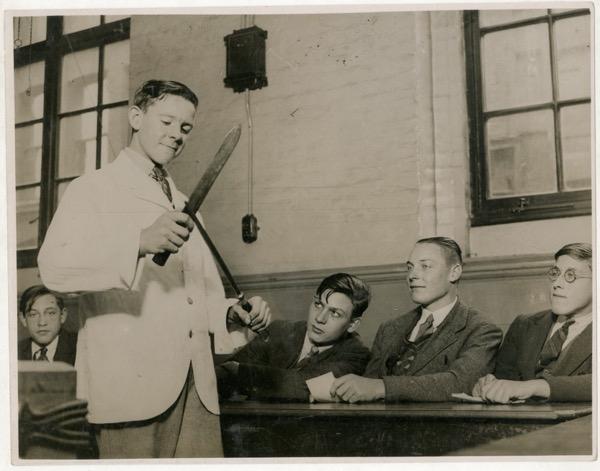
The correct way to sharpen a knife
From the twenties until the eighties, Britain’s foremost technical college for butchers operated in an unassuming building on the corner of Saffron Hill just round the corner from Smithfield Market.
Opening in 1924 and becoming part of the London County Council’s broader technical education project, the Smithfield Meat Trades Institute provided a range of courses ‘for persons engaged in the various branches of the meat trades, and also youths desiring to enter these trades’. The Institute offered a three-year course for over-sixteens resulting in a diploma from the National Federation of Meat Traders, alongside a range of short courses for younger students, and evening classes – on topics such as the theory and practice of refrigeration – for meat industry professionals looking to enhance their skills after-hours.
In its early years, the Institute was at the forefront of formalising education in butchery at a time when the fading out of apprenticeships left a vacuum in the trade’s intergenerational transfer of knowledge and skill. Meanwhile technological developments including the rapid rise of the chilled and frozen meat industry, and a growing field of scientific knowledge about perishable foods, were altering the ways butchery and the meat trade operated.
As one industry commentator reflected in 1928, the previous decade had seen a significant shift in the industry’s means of recording and sharing knowledge: ‘The question of textbooks is a serious difficulty. Hitherto knowledge of the trade has been rather handed down by word of mouth rather than set down in black-and-white. The exigencies of organised teaching require that various practices be made clear on paper. This means that a collection of notes, which will subsequently be elaborated into text-books, is now being prepared and augmented daily [at the Smithfield Institute], together with a number of excellent diagrams.’
In the accompanying photographs of the Institute’s classroom these diagrams of carcasses in various stages of disassembly line the walls, accompanied by three dimensional models of skeletons. At the Smithfield Institute students enjoyed a range of teaching spaces: there were practical butchery classes in the cutting room, everyday business arithmetic and shop etiquette in a model butcher’s shop, and scientific demonstrations in a well-equipped laboratory.
In the interwar years the Institute’s students cut up the meat that would be used for catering in the LCC’s schools and colleges, providing a constant supply of carcasses for practice. Students might spend the morning doing a class in sausage-making before sitting down in the afternoon to study history, biology or accounting. The school’s laboratory was particularly prised, ‘equipped with microscopes and all the appliances necessary for bacteriology and the allied sciences’.
Although not formerly related, the Institute was intimately tied to the neighbouring Market from which it took its name. Many of its lecturers were retired meat traders. Ken Clements, a ‘commodity lecturer’ at the college in the seventies, recalls taking groups of his most committed students on extra-curricular early morning trips to the Market. After testing their knowledge, he would take them to the Cock Tavern for a ‘wozzer’ – a cup of tea with the addition of a shot of whisky (it was-a tea, now it’s a wozzer).
In the fifties, the Institute briefly became the National College of Food Technology, a name that appeared to signify an ambitious future. Yet its decline mirrored that of the Market. In the seventies, the Institute became increasingly reliant on day-release students from supermarkets, including Sainsburys and the Co-operative. But over the coming years these companies, alongside the chain butchers like Dewhurst, took their meat education in-house. Meanwhile, the rise of pre-packed meat led to a rapid decline of the high street butcher and the need for lengthy technical training in meat industry jobs, and the Institute closed in the eighties.
These photographs capture the Smithfield Institute in its heyday, from the twenties to the fifties. While early prospectuses specify male students only, this policy evidently shifted over the decades because there are several images of women taking classes at the college. There are also a few photographs which have been lightly etched and edited with ink and white paint, most likely as part of the process of creating ‘photogravure’ style prints, perhaps for newspapers, textbooks or promotional material.
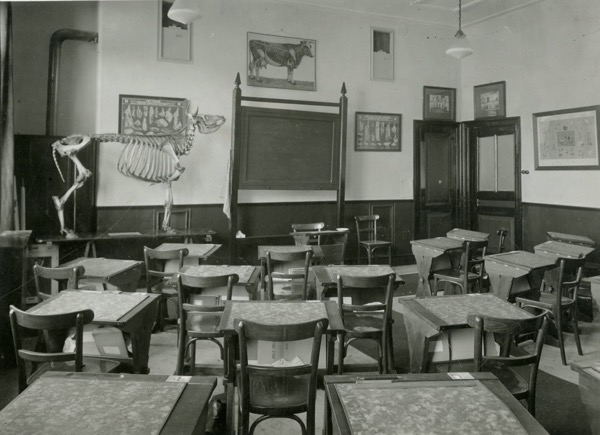
Diagrams and skeletons were used as teaching aids in the art of butchery
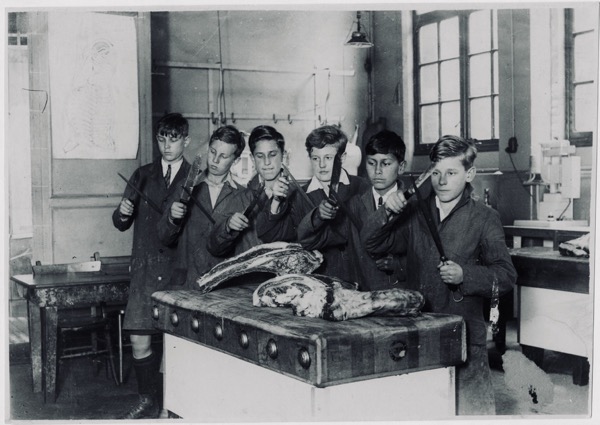
Boys sharpening their blades in the cutting room
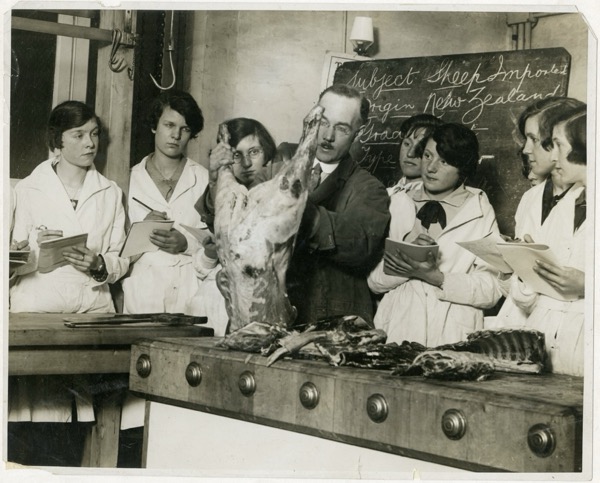
Female students study New Zealand lamb in the cutting room
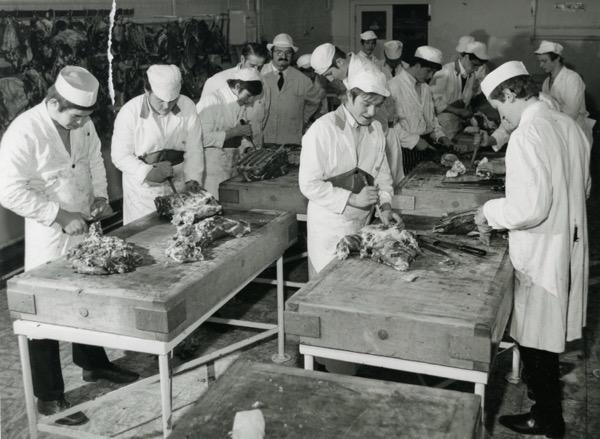
A lone female student amongst a class of male butchers
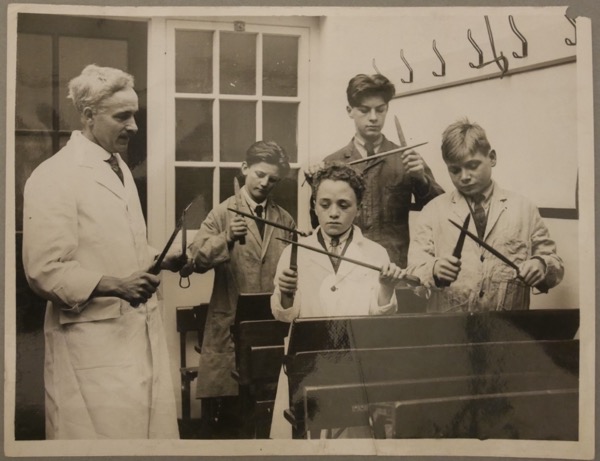
Boys practice their knife sharpening skills
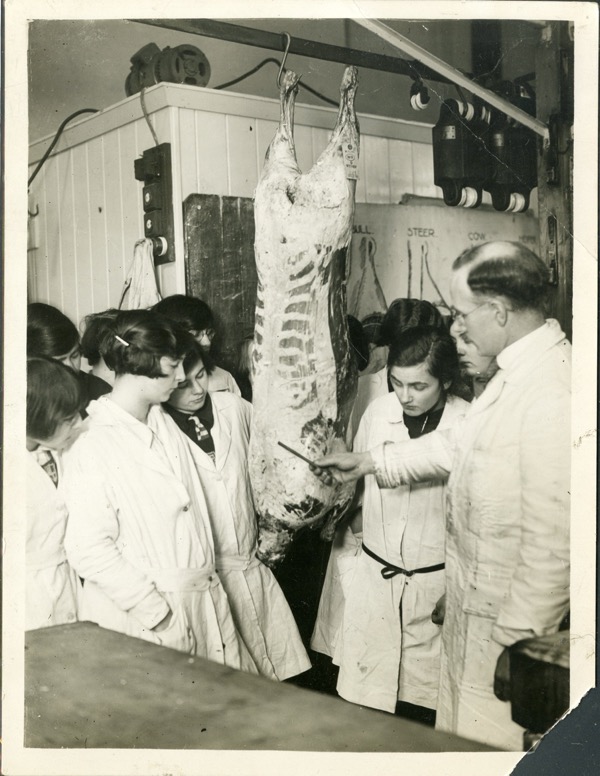
Female students study the anatomy of a carcass
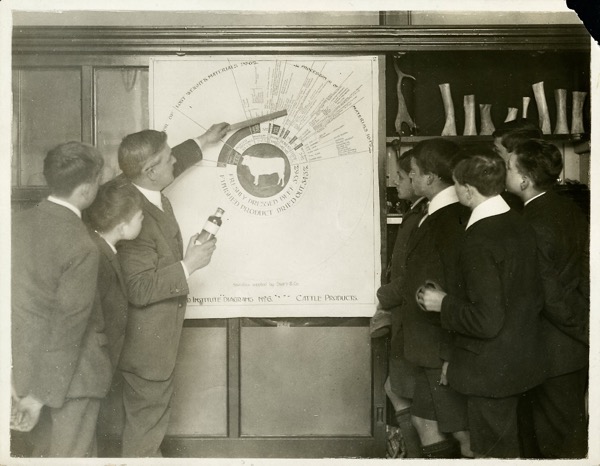
Boys study the range of products to be derived from beef
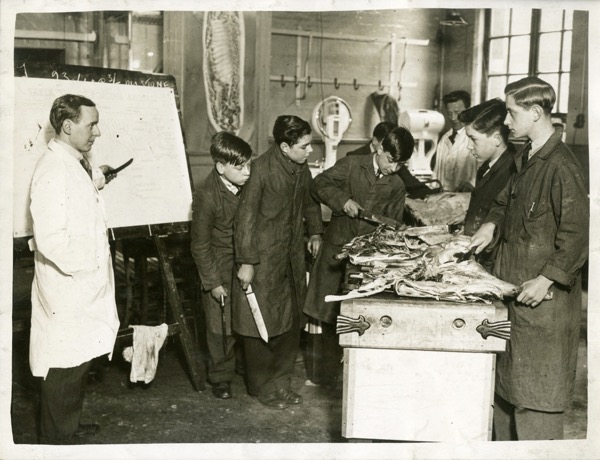
Instruction in butchery skills
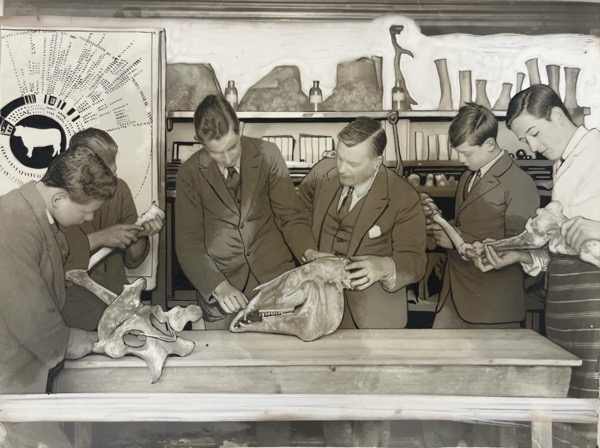
A retouched photograph of boys studying bones for photogravure reproduction
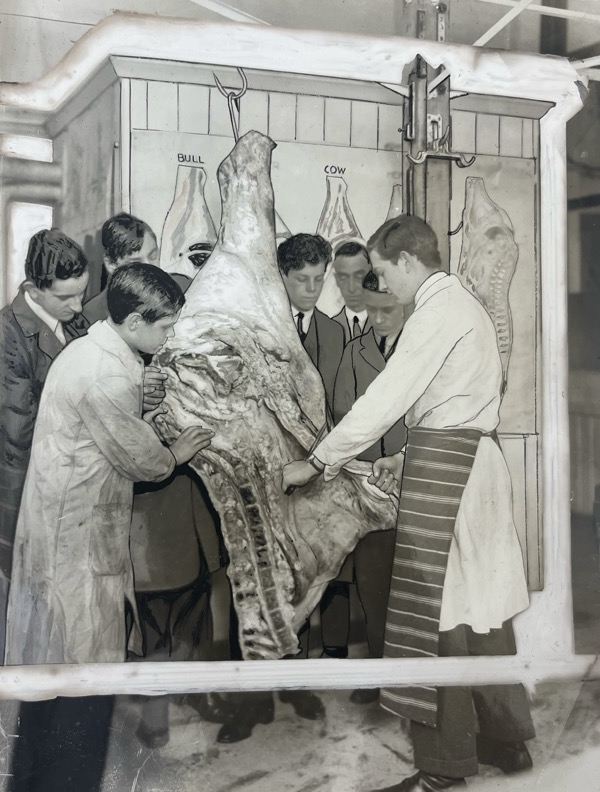
A retouched photograph of boys studying a carcass for photogravure reproduction
Images courtesy of London College of Communication Archive with permission from University of the Arts Archives & Special Collections Centre
You may also like to take a look at
Joan Brown, the First Woman in Smithfield Market
The History of Smithfield Market
Orlando Gili at Smithfield Market
Sarah Ainslie at Smithfield Market
David Hoffman at Smithfield Market
At the Smithfield Meat Auction













I had to smile when reading this article. I recall Ken Clements very well when he was my tutor for meat commodity at Eagle Court. As you say early morning visits to the market ended up in The Cock.
Great days,…….
I did day release on a Monday at The College For The Distributive Trades in Briset Street EC1. This was an off shoot of the institute. Everyone called it Smithfield College. A two year course. Year One was Meat Industry General Certificate and year two was Meat Trades Final/Craftsman Certificate. This was in 1975. Ive still got my “Meat Technology” work books. Fun times!