
At Cranbrook Community Food Garden
Click here to book for my tour through July, August & September
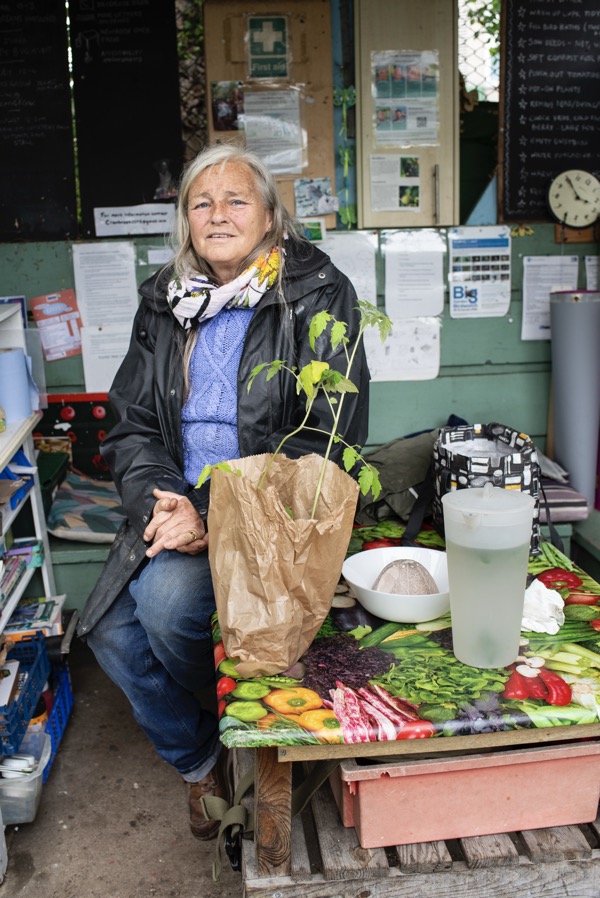
Laura Buckley
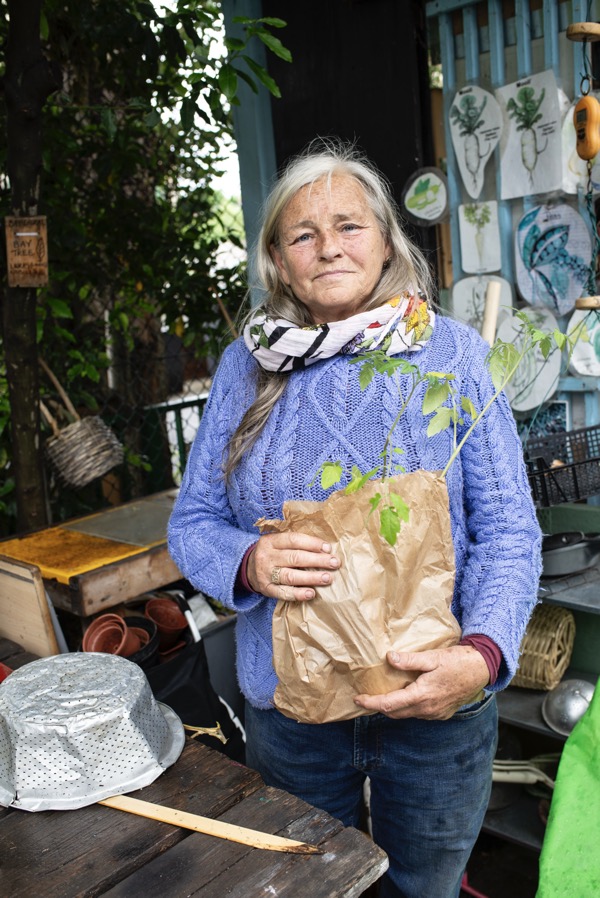
Contributing Photographer Sarah Ainslie & I were delighted to shelter under a tree and share a cuppa with Head Gardener Laura Buckley at the Cranbrook Community Food Garden in Bethnal Green during a recent downpour.
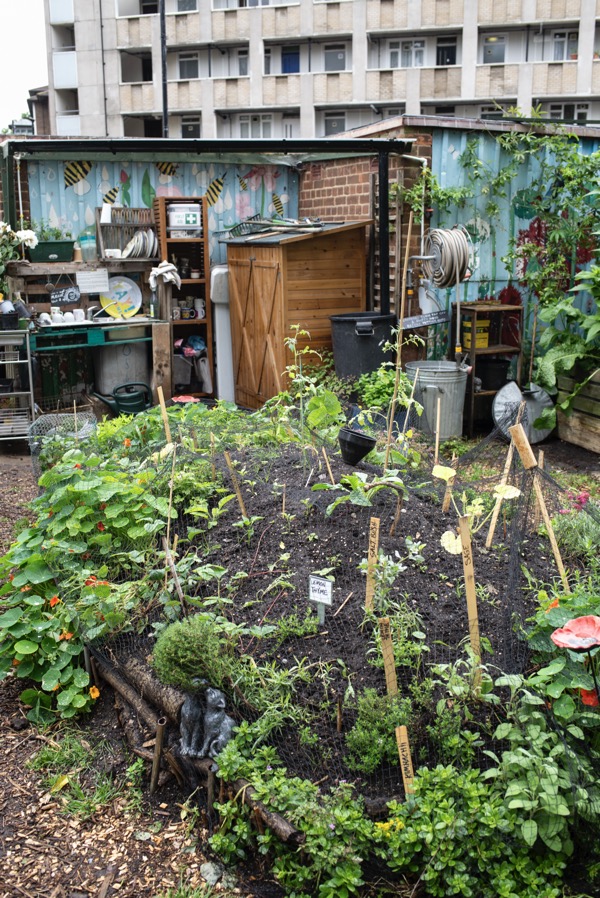
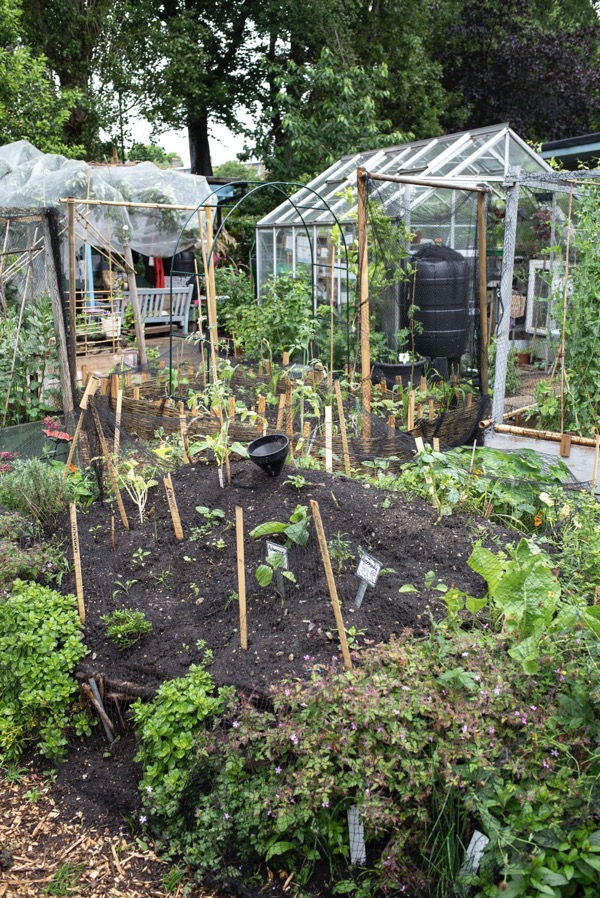
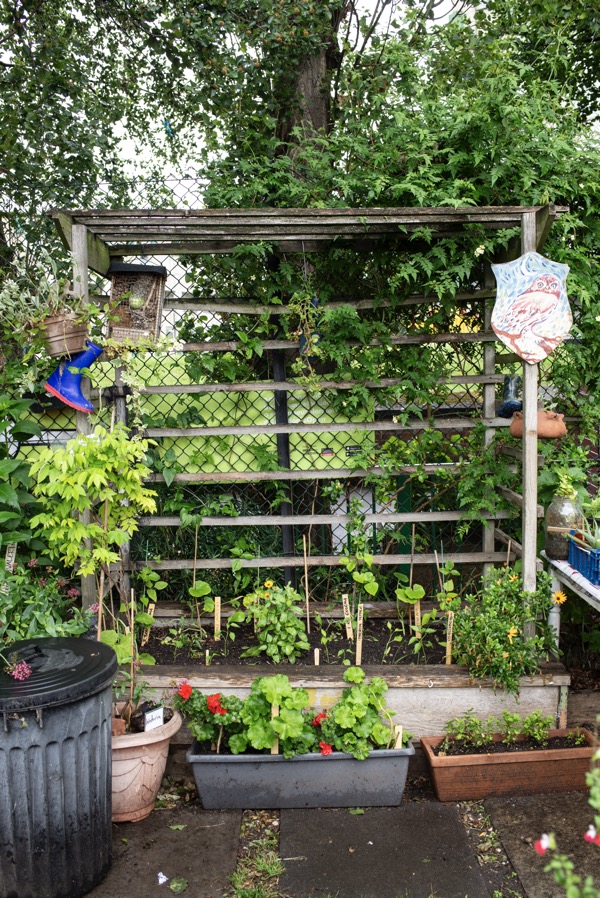
Surrounded on all sides by the modernist towers of the Cranbrook Estate designed by Francis Skinner, Douglas Bailey & Berthold Lubetkin in 1963, the Garden is an unlikely and welcome enclave of rural greenery where residents grow vegetables, fruit and flowers, and cultivate community.
Laura was one of the pioneers of the garden and we were curious to hear of its origins seventeen years ago, and learn of her love of horticulture which took root in her childhood in the sixties in Watney Market.
‘I have lived on the Cranbrook Estate for thirty years but at first I did not have much involvement – I live on the outskirts, in one of the blocks facing out onto the main road. Then, one day, I was convalescing at home after a big operation and I saw a notice pinned up in the lobby of the flats, inviting residents to get involved in some guerrilla gardening around the Estate. My mobility was restricted so I thought, ‘A bit of gentle gardening, that’d be lovely.’ So I got together with some others, planting bulbs, a couple of times. Then the council got in touch and asked ‘Since you’ve already formed a group, would you be interested in starting a garden?’ So they offered us this space and we had a chit-chat.
That was 2009, but before that there was a family that organised open days from the community centre on the Estate with races up and down the avenue and there was entertainment on the greens. I remember thinking, ‘It’s really lovely to see that in this day and age.’ So when I saw the sign about guerrilla gardening, I realised there was a bit of a community here.
When we started, the garden was just a brown triangle of wood chips with a fence round it and a set of climbing bars. It was supposed to be a play area but it was completely empty. So a little band of seven of us from the guerrilla gardening group, we got on our computers and we sourced materials. We put up a banner – ‘Come and help us transform this dead land into a garden’ and I reckon maybe eighty people turned up. They didn’t all live in the Estate, quite a few people came from the more gentrified areas around Victoria Park – they showed up with their tools, forks for digging and suchlike. They just wanted to help us get started, improving the view down the avenue, and then they said ‘Good Luck’ and off they went.
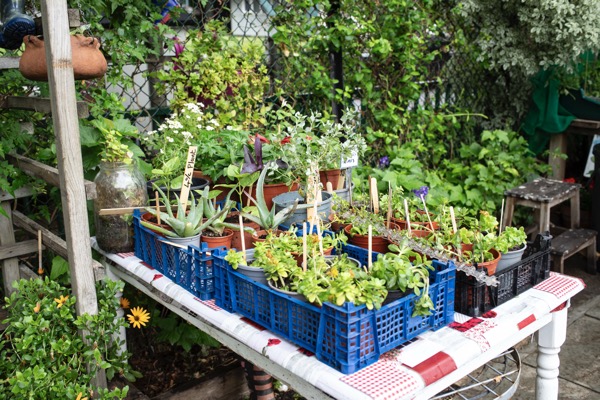
We got a lot of inquiries about making it into allotments but obviously only a few people would benefit from this precious space. So me and a few others decided, ‘Let’s make it a community garden.’ I think we envisioned it would work a lot like allotments except that we would share what we grew in all of the beds and it would be a consistent group of gardeners. But we have found a lot of the participants are transient. We have also had a lot of students studying environmentalism. There is a core of gardeners now but the membership does change from year to year and we constantly get new people joining. Even though people may return to their home country or another part of Britain that is their home, they are always reluctant to leave the membership list. Out of our total membership of eighty, there are probably thirty who we see very regularly. Once we realised that most people cannot come every day to look after their beds, we started to do Saturday drop-in sessions when anyone can come by for an hour during the day. And we invite people with skills and pair them up with newcomers.
My job is coming up with ideas to keep the garden interesting and safe, working out the lists of tasks that members are recommended to do while they are here. After being a member for a while, gardeners get the code to the gate and are free to come and go as they please out of hours. The gate is open most days and anyone passing is welcome to come in and look around. Our gardeners are very happy to give tours. We’d like to see more families. We give children a watering can or a magnifying glass and off they go. We are proud to show off our garden.
Over time, the garden has matured. This massive bay tree overshadowing us was in a five inch pot when we got it. We got a small grant a few years ago and planted berries – blackcurrants, blueberries and raspberries – along the exterior fence under the poplars, so children can pick berries as they pass by and then drag their parents into the garden.
I live on the fourth floor and sometimes – as I have got older and infirm – I can’t get here if the lift is broken. For me this is my access to the outdoors and fulfils my desire to grow things and create a garden. This is my social life and I have made lots of friendships, acquaintances too. We drink tea together and we organise outings. There is a strong social element to the garden. I take a lot of pride in how the garden has come along. It inspires my artwork, I go home and make paintings of it.
I was one of the few here that had a garden as a child and practised a bit of gardening with my parents. I was born in the London Hospital as were most of my siblings. I am one of eight children. My mum’s from Birmingham and my dad was Irish, from Dublin. They set up home in Chapman St near Watney St Market in the fifties, surrounded by bomb sites. Originally, we lived in tenement blocks in Brady St but then we got offered a brand new maisonette in Chapman St, it had four bedrooms, an upstairs and a downstairs, and a small garden. We had pets, and I remember we grew chrysanthemums and we had lots of attempts at growing lettuces and suchlike. So lots of flowers but also lots of children. We pitched tents and had a swing that my grandma sent down from Birmingham. Of course, we played out on the street and we spent most of our time digging on bomb sites and smashing windows of derelict buildings. A few years later, Dan Jones set up Betts St adventure playground and we spent a massive amount of time there. He also set up the E1 Festival which was really exciting.
There was community. Our school was fifty yards from home and everybody played out on the street. All the dads drank together and all the mums went to the community centre in the church hall. We used to go on lots of outings, beanos. Everybody you knew piled into coaches and went to Southend for the day. Everyone seemed to know each other. Lots of parties and the hokey-cokey and all kinds of silly things. It seems such a long time ago now.’
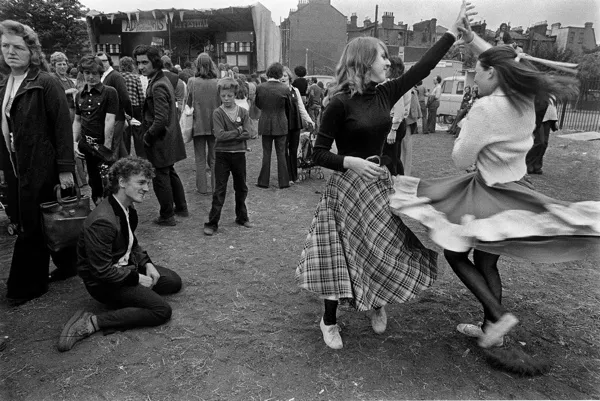
Laura dancing at the E1 Festival, Bigland Green 1975, photo by David Hoffman
Colour photographs copyright © Sarah Ainslie
Black and white photograph copyright © David Hoffman













Laura has aged very gracefully; as is only right for someone who does such good work.