
Eva Frankfurther, Artist

There is an unmistakeable melancholic beauty which characterises Eva Frankfurther‘s East End drawings made during her brief working career in the nineteen-fifties. Born into a cultured Jewish family in Berlin in 1930, she escaped to London with her parents in 1939 and studied at St Martin’s School of Art between 1946 and 1952, where she was a contemporary of Leon Kossoff and Frank Auerbach.
Yet Eva turned her back on the art school scene and moved to Whitechapel, taking menial jobs at Lyons Corner House and then at a sugar refinery, immersing herself in the community she found there. Taking inspiration from Rembrandt, Käthe Kollwitz and Picasso, Eva set out to portray the lives of working people with compassion and dignity.
In 1959, afflicted with depression, Eva took her own life aged just twenty-eight, but despite the brevity of her career she revealed a significant talent and a perceptive eye for the soulful quality of her fellow East Enders.


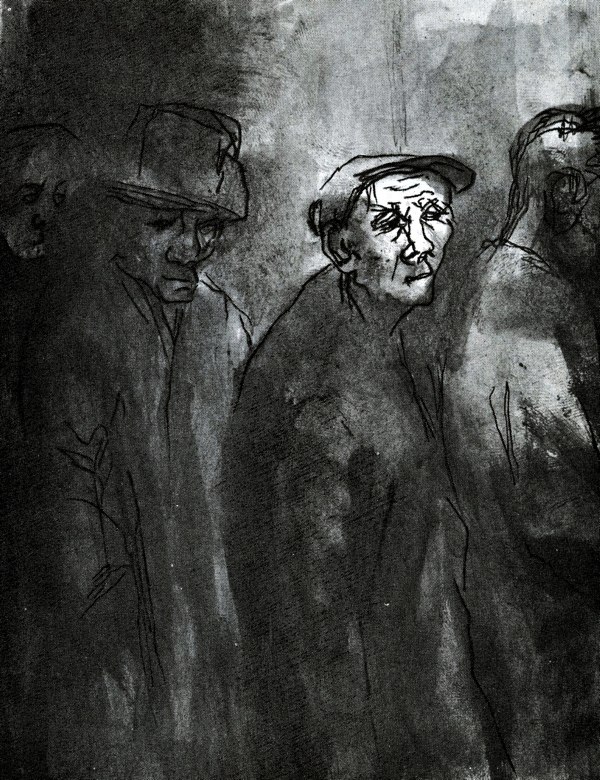


“West Indian, Irish, Cypriot and Pakistani immigrants, English whom the Welfare State had passed by, these were the people amongst whom I lived and made some of my best friends. My colleagues and teachers were painters concerned with form and colour, while to me these were only means to an end, the understanding of and commenting on people.” – Eva Frankfurther
Images copyrigh t© Estate of Eva Frankfurter
You may also wish to take a look at


I loved seeing Eva’s quiet work which glowed at the Barbican
exhibition of Twentieth Century art a few years back.
Her portraits inspire my attempts at drawing!
An amazing collection of images, but what a sad end to the Artist; understandable however from what she and her family might have gone through during that period in history.
Powerful faces, and new to me. I would seek to buy such images.
In my mind’s eye I see a treasured Spitalfields Life book about Jewish artists that would include Eve Frankfurter and many others, some of whom are listed at the end of the post. It is from vivid portraits like these and other visual images [and the buildings that remain]…as well as photographs that we can recall and access a world that is almost gone but not forgotten. I realize creating each book is a labor of love for you and that they are a lift in terms of fundraising….
How sad .. especially since I suspect she fared much better than the relatives that she and her parents must have left behind in 1939.
She was lucky she had her parents with her. I had a friend, Edith Jacobowitz, who was put on a train and came over on the Kindertransport in July 1939. She was 11, and had with her a suitcase and her younger brother, and nothing else at all. She never saw any one of her family again.
She wrote a small book about it, which is very moving:
https://www.amazon.co.uk/Memories-Reflections-Refugees-Edith-Bown-Jacobowitz/dp/149533662X
We should not forget those times.
I’m struck by the fleeting quality of these images; they’re people solid yet ephemeral. Like people half-seen. I’ve no doubt that most of them were only half-seen for much of their lives.
I’m glad Eva captured them on paper. Perhaps they are more seen now than they were then.
Excellent work, poignant.
In my mind’s eye I see what would be a treasured “Spitalfields Life” book about Jewish artists that would include Eve Frankfurter and many others, some of whom are listed at the end of the post. It is from vivid portraits like these and other visual images [and the buildings that remain]…as well as photographs that we are able to recall and access a world that is almost gone but not forgotten. I realize creating each book is a labor of love for you and that they are a lift in terms of fundraising….