
At Waltham Abbey

Click here to book for my tours through August, September and October
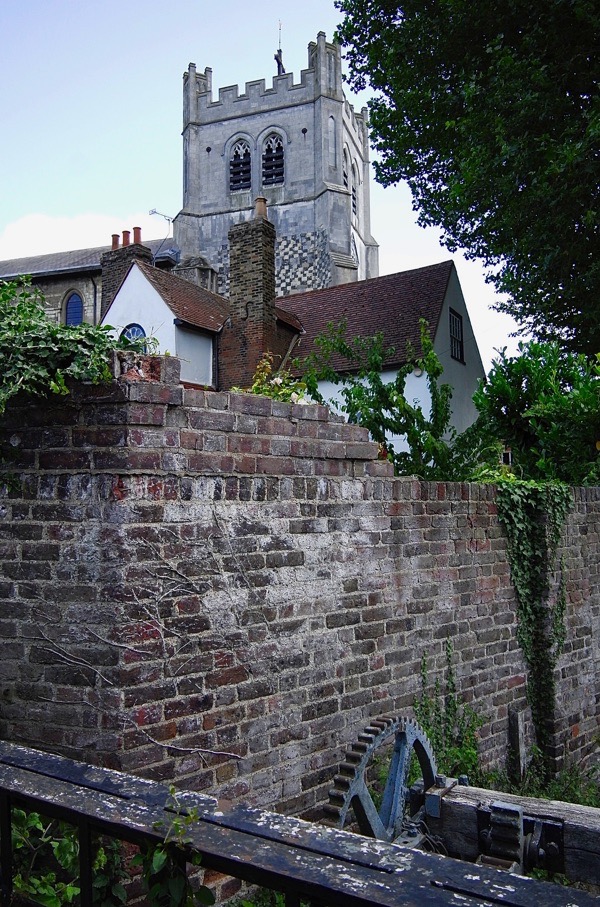
I cycled along the River Lea to Waltham Abbey. On my approach, even from the riverbank, I could see the majestic tower rising over the water meadows as the Abbey has done for the past thousand years, commanding the landscape and undiminished in visual authority.
Once you see it, you realise you are following in the footsteps of the innumerable credulous pilgrims who came here in hope of miraculous cures from the holy cross, which had reputedly relieved Harold Godwinson of a paralysis as a child before he became King Harold.
To the south of the Abbey church lies the market square, bordered with appealingly squint timber frame buildings punctuated by handsome eighteenth and nineteenth additions. Despite the proximity of the capital, the place still carries the air of an English market town.
Yet the great wonder is the Abbey itself, founded in the seventh century, built up by King Harold and destroyed by Henry VIII. Despite the ravages of time, the grandeur and scale of the Abbey is still evident in the precincts which have become a public park. Although the church that impresses today is less than half the size of what it was, it is enough to fire your imagination. An imposing stone gateway greets the visitor to the park where long, battered walls outline the former extent of the buildings. A tantalising fragment of twelfth century vaulting, which formerly served as the entrance to the cloisters, encourages the leap to conjure the cloisters themselves where now is merely an empty lawn. A walled garden filled with lavender and climbing roses draws you closest to the spirit of the place.
The outline of the former Abbey church is marked upon the grass and at the eastern end lies a surprise. A plain stone engraved with the words ‘Harold King of England Obit 1066,’ indicating this is where legend has it that he was laid to rest after the Battle of Hastings. I realised that maybe the remains of the man in the tapestry, killed by the arrow in the eye, lay beneath my feet. Coming upon his stone unexpectedly halted me in my tracks.
This was one of those startling moments when there is a possibility of history being real, something tangible, causing me to reflect upon the Norman Conquest. A thousand years ago, their power found its expression in the vast complex of buildings here, which were destroyed five hundred years ago as the expression of another power.
We too live in a time of dramatic transition, emerging from the shadow of the pandemic and accommodating to our country’s divorce from Europe. The equivocal consolation of the historical perspective is that it reminds us that empires rise and fall, but life goes on.


Effigy of King Harold

Harold cradles Waltham Abbey in his arm


The Lady Chapel

Victorian villa in the churchyard

The Welsh Harp


These vaults are all that is left of the twelfth century cloisters


Here lies Harold, the last Anglo Saxon King of England

Waltham Abbey
You may also like to read about


Statues of notable characters “cradling” cities in their arms? — This has always intrigued me.
How did this fascinating tradition begin? And what are the most note-worthy examples? I seem to remember a painting that showed a Saint cradling the city of Venice. And I’ve seen several anonymous “angel”-like statues cradling cathedrals and such. I’ve clipped some of these images for my inspiration files — but the background of this tradition eludes me.
Maybe I am wrong to assume there is some kind of fascinating origin story — and perhaps it is just a compelling juxtaposition of human scale and miniaturized locale? Either way, the Abbey is such a bucolic, restful place …….. I am grateful for the tour.
In the fifties I was a teenager living in Stoke Newington near the terminus of the New River and one of my weekend walks (I had the teenager’s craze for walking far and fast) saw me walking up the Lea and/or the New towards Waltham Abbey. But my research was weak and I did not discover, for instance, that King Harold lay at the Abbey. So my weekend walks were diverted by other targets and I never did get to the Abbey.
Now, I can only regret my lost opportunities. Sic transit gloria mundi, as the saying goes.