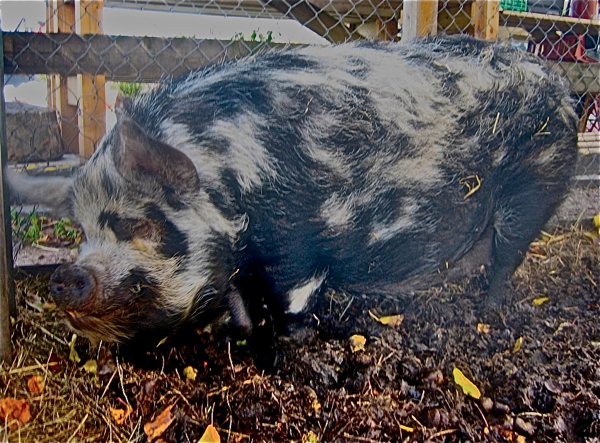
Itchy, the Spitalfields pig
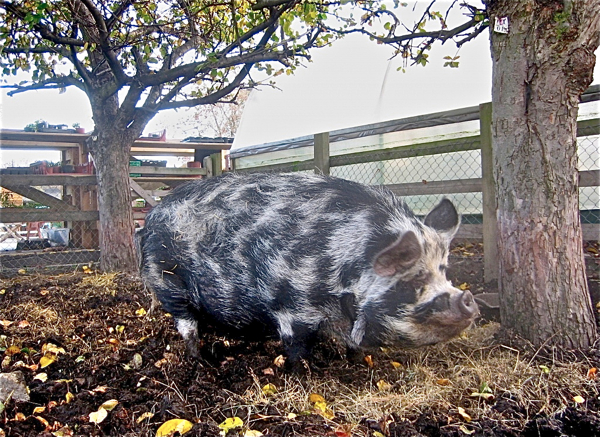
May I introduce you to one of Spitalfields’ most popular residents, Itchy, the black and white sow at the City Farm in Buxton St? Itchy is an official registered Kune-Kune pig, hailing from New Zealand where in the nineteen seventies her breed came close to extinction. She is proudly descended from just eighteen hardy survivors. The name Kune-Kune means “fat and round” in Maori, and is Polynesian for “plump” too, hinting at the breed’s earliest origins.
Itchy had weight issues on account of all the delicious scraps brought to her by the adoring residents of Spitalfields. But thanks to Jenny Bettenson, the farmyard co-ordinator, Itchy is now on a strict regime of no snacks between meals and has slimmed down radically over the last three years. No “spanx” are necessary to support and lift Itchy’s nether regions.
Kune-Kune pigs are a relatively small variety but Itchy has exceeded expectations by growing tall, which caused her some painful shoulder problems in the heavy snow of last winter. However, Itchy has a cosy sty to snuggle up in at night and after a month’s bed rest she was as right as rain. The distinguishing characteristic of the Kune-Kune breed are a pair of tassels or “Piri-Piri” which hang from the lower jaw as an evolutionary curiousity and, as you will see, Itchy has a fine pair dangling.
I hope Itchy will forgive me if I reveal her age, which is approaching ten years old, with a birthday coming up on the 4th January 2010. This is a mature age, verging on old for a pig, that may live up to fifteen years. Many readers will remember Itchy’s sister Scratchy who sadly passed away in 2005, but Jenny assures me that Itchy is not lonely on account of her many visitors, especially children, drawn by her gentle nature and endearing traits. You only have to rub Itchy’s belly and she will roll over on her back in playful affection and if you offer a treat, she will sit up and beg eagerly. Since the loss of Scratchy in 2005, Itchy had a new batchelorette pad constructed with a peaceful run under the apple trees at the city farm and she is at home to visitors most days – if you fancy dropping by to say hello, as I always do whenever I am passing.
Given the usual fate of pigs, it is an extraordinary privileged existence that Itchy enjoys, though in her innocence she will never know it.
Everyone in Spitalfields loves the old sow.
The politics of porridge

Each morning when I wake here in Spitalfields, I lie for a few moments contemplating the squirrels gambolling in the yew tree outside my window before climbing from my bed to start another day. Once in the kitchen, without any conscious decision, I set about making porridge. This automatic daily ritual extends from autumn until spring every year and is one of three constant elements in my life that are residuals of my years in the Scottish Highlands where, as well as acquiring the porridge habit, I learnt to drink whisky and I began to write too.
Most people know Samuel Johnson’s definition of oats from his famous Dictionary of the English Language 1755, “A grain which in England is generally given to horses but in Scotland supports the people.” It is often quoted as an example of his famous wit, but if you place it into the context of the slaughter of nearly two thousand Highlanders by the English army at the battle of Culloden in 1746, it entirely loses its charisma. Here in the south, we may consider these events as history but in the north of Scotland their consequences still dominate the lives of those living there today. The Highland Clearances and the introduction of sheep created a devastated deforested depopulated landscape – a place that visitors enjoy for its soulfulness.
I was aware of none of this when I accepted a job in the Highlands at the age of twenty three and set out in a train from Kings Cross. I shall never forget the greeting of some of my work colleagues when I offered my hand, introducing myself, “Oh my God, you’re English!” they exclaimed in horror. But the Scots are a magnanimous people and these same colleagues were proud to introduce me to a local celebrity when he paid a visit. It was the heroic shot put veteran from the Highland Games whose fine portrait adorns every “Scotts Porridge Oats” box, and I was honoured to shake his hand. I knew I had truly arrived when, after several whiskies with a distinguished poet at the Dounreay Nuclear Power Facility Social Club in Caithness, I received an intimate piece of advice.” Never trust the English” he told me,“when you go down south, be polite, and smile and nod when they speak to you but never believe a word they tell you.”
The Highlands are inspiring place where, in spite of everything, the oral culture of generations remains alive, most people still carry a repertoire of traditional songs, and I shall never forget meeting the great bard Sorley MacLean, a seventh generation poet. It was the playwright Norman Malcolm Macdonald who started me writing, asking what stories I had myself. He lived on a croft that his family had acquired outside Stornaway on the Isle of Lewis at the time of the 1886 Crofting Act. Out of all the conversations I had with Norman, I recall him now talking about porridge, how his forefathers filled themselves up with it before going out to fish for herring in small boats. He showed me the porridge drawer (a traditional feature in many Highland homes) where they poured the surplus porridge to cool and slice up to eat like cake.
In those days I ate my porridge neat, but nowadays the Sassenach in me has resurfaced and I enjoy it with a spoonful of honey and a little milk.

Columbia Road Market 13

The rain kept me awake during the night, so I was surprised to wake and find the pavements dried out in time for the market this morning, though that deep puddle under the railway bridge is still there. There were some lovely natural pine wreaths and garlands in the market today, but I averted my eyes because these treats are reserved for closer to Christmas.
Last week, I pruned this fig which grows in a nineteenth century feed bin that I bought for a couple of pounds at the car boot sale in the Exeter Cattle Market years ago. Now the fig just looks like a bare twig stuck in the ground, so today at the market I bought four pots of miniature daffodils (tete a tete) for a fiver, already sprouted, to alleviate the wintriness, and as a small antidote to the sleeting melancholia of late November. Some gardeners might consider this intervention cheating but I if I plant bulbs any other way the squirrels eat them. The stones in the pot are to prevent the foxes digging out the fig as they did last summer. Between the squirrels and the foxes, there is a remarkable amount of wildlife to circumvent for such an urban garden.
Mr Pussy’s viewing habits
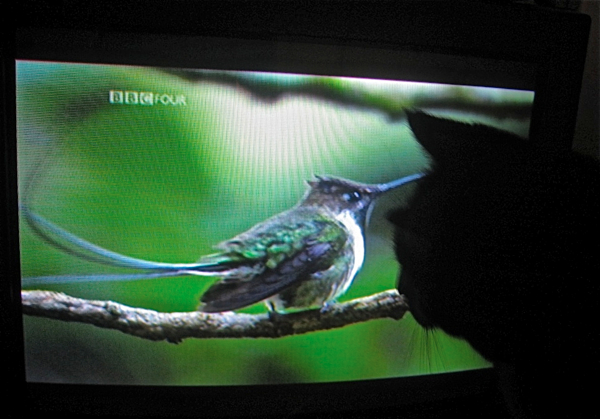
Mr Pussy does not care for Current Affairs, Sport, Reality TV, Quiz Shows, Property Programmes or Drama. All those wonderful HBO series like “Six Feet Under” and “True Blood” pass him by, he was not even interested in “Little Dorritt” last year. Mr Pussy reserves his enthusiasm exclusively for Wildlife Programmes and he is particularly fond of those BBC documentaries narrated by David Attenborough.
I think if he was human, he would invest in one of those big widescreen televisions with a powerful home cinema sound system attached because, as you can see above, it is an entirely immersive experience he is seeking. Something he can only achieve at present by pushing his face up against the screen in order to engage fully with the drama of being right there in the Amazonian jungle with David Attenborough.
It would be easy to draw simple conclusions from the picture above and assume that he could not control his blood lust when he saw the outline of a bird on the screen, implying that he is a creature incapable of transcending his base animal instincts. Anyone making such a judgement would dismiss all David Attenborough’s wildlife documentaries featuring birds as mere feline porn, but to do so would be an unjust assumption, because the picture below tells a different story.
In this picture, you see Mr Pussy watching an enchanting documentary about the secret life of India’s snow tigers that live a reclusive existence high in the mountain ranges of the Himalayas. You cannot say that he is in the grip of a hunting instinct here, though it is clear that he recognises the image upon the screen. The curiosity that he manifests, so characteristic of his species – which in this case is directed towards his own distant relatives who lead larger more heroic, majestic lives – is surely evidence of a capacity for aspiration. For Mr Pussy, as for the rest of us, television is the window to open his eyes to the greater world beyond his immediate domestic existence.

Dennis Severs, the house of silence

There is a house in Folgate St that is famous for the quality of its silence. As you enter the door, you receive a stern instruction to restrain from speech, which is a strangely liberating experience. Let me admit, much as I love a good chat, I have many times wished that I never had to speak again. So when you seek consolation from the fierce jabbering inconsequentiality of talking, when a gnawing hunger for silence comes upon you, as is not unlikely during the imminent Christmas season, 18 Folgate St is the place to go. I can vouch that the silence there is of a rare and ancient vintage.
Just as a good meal requires salt and pepper, silence thrives off peripheral sound. In the absence of talking, your ear becomes attuned so that as you descend the wooden staircase in the candlelit gloom of this fine eighteenth century house, the subtle music of the creaky old boards attends your progress. You find yourself in the kitchen and stand for a moment, listening to the crackle of the fire and the ticking of the clock, in the distance the bells of Christ Church, Spitalfields are pealing.
As a writer, I can testify that when you do not speak, your thoughts take flight, and so it is here, as you ascend the winding stairs up and up into the velvety darkness. Without sound, your sense of smell grows keener too, as the fragrances of sweet perfume, tobacco and oranges mingle in the stairwell – compounded by the immense visual detail, it is an intense experience for all your senses.
This is Dennis Severs’ house, he created this fantastical environment as his lifetime’s work, his passion and his legacy. For many years, he collected old things from the local markets when no-one else was interested and recreated the furnishings of the house from different periods of its habitation. But this is not a museum, it is an extravagant fantasy. All the paraphenalia here are properties from the drama of the lives of successive generations of the Jervis family, a Spitalfields Huguenot dynasty of silk-weavers spun out of Dennis Severs’ imagination. In each room, you will find evidence that they just left, eggs in a mixing bowl on the kitchen table, an overturned chair in the drawing room, a cup of tea on the dressing table, a glass of wine on the dining table, a rumpled bed in the attic, and so it goes on.
The writers referenced here are Beatrix Potter in the kitchen dresser straight out of “The Tailor Of Gloucester” and Charles Dickens in the attic writing desk and heavily curtained bed from “A Christmas Carol,” but the sensibility is closer to Lawrence Sterne and Lewis Carroll in this house of games and paradoxes. As you walk from the eighteenth century dining room into the nineteenth century parlour your relative sense of time dissolves, so that it is no surprise at all to discover a New York Yankees cap sitting on a chair. Within the all encompassing silence of this house, everything is present tense.
Silent nights at 18 Folgate St will take place on weekdays throughout December until Twelfth Night between the hours of 6pm and 8pm. Tickets must be booked in advance www.dennissevershouse.co.uk

Justin Piers Gellatly, baker and pastry chef

One day last week, I took a walk through the empty streets of Spitalfields in the early morning before the schoolchildren were even about. I slipped in through the tall double doors of St John Bread & Wine in Commercial St to meet Mr Gellatly, my bakery hero – the towering genius responsible for the delicious sourdough bread that I have been enjoying daily for the last couple of years, not to mention the extraordinary custard tarts and doughnuts too.
Justin joined St John ten years ago as a chef under the tutelage of Fergus Henderson and discovered his aptitude for baking while covering when members of the baking team took holidays. As a result of his talent, he has now risen -in the manner of his own baking- to become Head Baker and Pastry Chef for both St John restaurants or, as he terms it, in charge of “all things sweet and yeasty.” He speaks of Fergus Henderson, the founder of St John, in glowing terms, explaining Fergus’ ability to create a dedicated team based upon mutual respect. At St John you will hear none of the angry people shouting and swearing common to many West End kitchens, and he ascribes the enduring success of the restaurant to the resulting high quotient of long-term permanent staff who are able to give of their best in an attitude-free environment.
The same cannot be said for the wild yeast that Justin uses for the sourdough bread – my particular favourite. Apparently, it is not cultivated and as a consequence can be problematic. “It doesn’t behave very well” admits Justin who is familiar with emergency phone calls in the middle of the night when the yeast doesn’t prove. “It is very sensitive to heat and cold,” he confides in defence of the capricious micro-organism. Though when I question him further about the alchemy of baking he reveals an unsentimental nature, emphasising the discipline of a process that requires scientific exactitude. Baking is clearly both an art and a science too.
In spite of his fresh features, Justin claims his working hours are midnight to midnight, sometimes working twenty four hours at a stretch. Moving back and forth between both restaurants, he has four pastry chefs and two bakers working under him to create the baking and all the desserts. “I love what I do” he declares and anyone who has read my review of his doughnuts will know this is a statement with which I concur, I love what he does too. In fact, I could not resist an invitation to spend a night reporting to you live on the bakers at work, early next year.
Justin confirmed a rumour that one of his colleagues was spotted making vast quantities of mincemeat in preparation for the festive season and agreed to set some aside for me from the very first batch on 1st December. Justin’s mum created the recipe and, in an act of pure altruism, I shall be writing up the mince pies in detail for you on 2nd December.

A sense of proportion

In “Mrs Dalloway” when an unhappy young woman takes her shell-shocked husband to a clinic, the psychiatrist declares that he is not mad, he just lacks a sense of proportion. Virginia Woolf is generally considered a grim heavyweight novelist but personally I have always found her work irresistably comic and full of exhilarating caustic irony, of which this incident I quote here is a prime example.
I bought this copper Roman coin in the Spitalfields Market in 1997 to remind me to keep a sense of proportion. It only cost £2.30 and, with the millenium approaching, I wanted a thousand-year-old item to give me a sense of chronological perspective. When I took it to the British Museum, they told me it was in fact fourth century, made here at the time of the Emperor Arcadius and of very little value. You can see Arcadius’ head on the coin in the picture above, he was among the earliest emperors to rule from Constantinople, a minor emperor. I was delighted to learn that on the reverse is Minerva, the goddess of wisdom – this suited my aspiration well.
Most interesting, was to discover that the piercing of the coin at the back of the head was original. The custom was for lovers to wear them as tokens of affection, keepsakes. Since then, I have worn it round my neck every day on a leather thong and never ceased to wonder who wore it here in Britain all those years ago and what was the story. This coin and I have now have innumerable stories that I would like to tell the original owner. I was wearing it in New York on 11th September 2001 and again in Holborn on 7th July 2005. There was the time I stepped from the ocean on a remote beach at the western end of Cuba in 1998 to discover the wallet containing my money, cards, passport and tickets was stolen. The only coin I had left was this one.
At the time I bought the coin in the market, they were excavating the Roman cemetery in Spitalfields that now lies beneath the new development. The antiquarian John Stow described how in 1576, in a brick-field near the Spital-churchyard, there were discovered Roman funeral urns, containing copper coins of Claudius, Vespasian, Antoninus Pius and Trajan. It is possible that my coin was from that cemetery.
In 2006, I added the two gold wedding rings that my mother had worn up until her death. One was her own wedding ring and the other was her mother’s. I have never worked out which is which but since my grandfather was a bank manager whereas my father was an engineer working on the shop floor, I assume that the thicker one was my grandmother’s and the other was my mother’s.
These rings are a powerful reminder of how I came to be, my personal relationship to the passage of time as I understand it, through the succession of generations in my family. Wearing the rings beside the Roman coin affords a broader perspective, setting family history against the span of history itself. The function of these keepsakes is to help me hold these thoughts in mind, to sustain me in the constant human struggle to maintain a sense of proportion.