Orhan Pamuk, The Museum of Innocence

“It was the happiest moment of my life, though I did not know it”. With this opening sentence begins Orhan Pamuk’s new novel that is published today. It is a book that has sustained me over the last few wintry months here in Spitalfields, as I have rationed myself through its five hundred and thirty-one pages. Rarely in my life have I ever read something new and known for sure that it is of such quality that it will still be read and celebrated a hundred years from now. The Museum of Innocence is such a book.
Sometimes I feel I have read too much and it has made me overly-critical of new books that come my way. I do wish I could enjoy more, but often I am simply embarrassed by literary fiction, embarrassed in sympathy for the authors, straining awkwardly for self-consciously literary effect (you are at liberty to include me in this category). So please forgive me if I confess that, as I write in these posts only about what I like personally, I have had little cause to write to you about recent fiction, until now.
Let me admit though, even before I read his new novel, Orhan Pamuk was one of my favourite living writers. It was his emotional autobiography of Istanbul that became one of my inspirations to begin writing Spitalfields Life, and I love his earlier novel “My Name is Red”, a lyrical murder mystery set amongst the miniature painters at the court of the Topkapi Palace in the sixteenth century. Consequently, it was with immense expectation that I came to this new book after waiting several years since his last novel “Snow”.
From the opening sentence of “The Museum of Innocence” you are swept up into a compelling drama, and before you know it you have discovered a whole new world and a complete society of characters – this is the upper middle class milieu of Istanbul in the nineteen sixties and it is the tale of a secret love, in which the protagonist is Kemal, indolent son of a wealthy family of industrialists. He is engaged to the docile Sibel from an equally well-off family but the woman he truly loves is Fusun, a distant cousin from an impoverished branch of his own family. Fusun is poetry incarnate, with grace and mystery and an irresistible natural beauty, so the two embark upon a raging affair.
How lively and idiosyncratic these people are, how vivid is their world and how appalling are their actions. You are hungry to know where it is going and you know it is going to go wrong. Then you take a breath, and realise that in the midst of all this ugly social manipulativeness, these characters are blind to the implications and outcomes of their actions – they are each innocent in differing degrees. You love them, and you want to shake them too, and you have to keep reading to discover just how much of a mess is going to result.
At first, I had the feeling I was reading a Muriel Spark novel with its delicate irony and acute observation of middle class foibles, then as the sensuousness of the illicit affair came to dominate I had the thought it could be a John Updike novel. Such is the elegant fluid quality of Pamuk’s writing that it transcends these comparisons, even if Vladimir Nabokov came to mind as the narrator tells of his obsessive love in appropriately obsessive interior monologues. Ultimately, “The Museum of Innocence” speaks of the specific truth of human experience in a style and form that is both the inevitable outcome of the story and entirely its own.
With this book, it is not simply a case of an inspired piece of writing by a novelist at the height of his powers, the book carries such reality that I felt afterwards as if I had lived through these events myself, and I shall never forget it. Orhan Pamuk’s achievement is to create an effective reconciliation of a contemplative literary voice with an exciting story that can never be second guessed. “Let everyone know, I’ve lived a very happy life,” these words of Kemal are the final sentence of Orhan Pamuk’s best book to date.

Photograph of Orhan Pamuk by Jerry Bauer
Twelfth Night in Spitalfields

Today is the day for clearing out all the Christmas clutter, sweeping up the pine needles, and tossing the dried up holly and mistletoe onto the fire and watching it crackle. Once upon a time, I used to throw all my cards in the bin, but somewhere over the years I had a change of heart on Twelfth Night and now I keep the ones I love best and put them up again next Christmas. Thus began a process that has continued ever since and my affection for some of these special cards that get put up on the chimneypiece year after year has grown and grown.
People do not send cards as much as they used to, in fact my best festive missive this year was a beautiful animated email from Rob Ryan of moving papercuts, which you can see here. Oftentimes, friends apologise to me for not having “got round to sending cards this year”, and I can cheerfully say “That’s fine! I have a half-dozen of yours that I put up every year.” For some friends, I have a complete archive of their cards going back years and years. Above you can see a small selection of my favourites. On the right is a card of Peter Blake’s Toy Shop Window in the Tate Gallery which he sent me himself in 1990. On the left is a handmade card from Lindsay Porteous, the Scottish Jaws Harp Champion. In the centre is a more recent hand painted portrait of Mr Pussy. I will not burden you with the sentimental story of every card.
Visitors sometimes gasp at the impressive array of my cards. “Goodness you are popular!” they exclaim and I have to disenchant them by explaining that most are old ones. I like it when friends recognise cards they had forgotten sending me, years ago. Inevitably, as time goes by, some of the cards in my collection are now from people who have died and I place these prominently as poignant reminders of those who have been important to me in my life – to be fondly remembered at Christmas.
Once I left home to go to college, my parents began sending me cards that would arrive the week before I returned for Christmas. As the years went by, their choices of card became more banal and routine as they picked up whatever was to hand at the Post Office near to the house in Devon where I grew up. Eventually, they stopped sending them at all, instead they would hastily scribble them out on Christmas Day and hand them to me with an apologetic smile. It gave me a sinking feeling. I put them all in a drawer, and I have around a dozen of these, that you can see below, some still with their envelopes. A couple are duplicates, where they bought boxes of cards and made them last several years, presumably unaware that they were giving me the same card every Christmas. At the time, these duplicates filled me with disappointment but now there is something especially touching about them, manifestations of their unchanging love for me.
Spanning the years between me leaving home and when my parents died, they reveal the passage of time in their declining handwriting – these cards are now the most treasured. All have almost the same message “Love Mummy and Daddy x”, though later as I grew into adulthood and my parents felt the imperative to modernity, the text was streamlined to “Love Mum and Dad x”. Significantly, they are almost always in my mother’s handwriting. Any form of writing was a chore to my father and I can hear him now, sighing and saying “Oh no, you do it!” to my mother. There are also a couple of revealing individual ones from each of them. I have a lonely girl selling mistletoe from a sentimental nineteenth century painting with “Love from Mummy x” inside the card and a painting of pheasants in bold masculine colours with the elliptical “From Dad” inside. I am grateful now for this rare example of his vigorous old school handwriting.
As my collection of cards has grown, it has become necessary on Twelfth Night to decide which to keep for next year. That is what I am doing today.

Marianna Kennedy, Designer

Behind this enigmatic facade – lettered W&A Jones – at 3 Fournier St, directly across from Christ Church Spitalfields is the showroom, workshop and home of designer Marianna Kennedy. You can even see Nicholas Hawksmoor’s spire reflected in the crown glass panes of her shopfront.
For years, I have walked past this place and wondered what goes on here, so I was very excited to go inside and meet Marianna in person. Entering through the door on the right, I found myself in a bare eighteenth century hallway, the austerity punctuated by a single bunch of mistletoe hung above the foot of the old stairwell, where I was greeted by a woman dressed in elegant charcoal tones who spoke with a soft Canadian accent. Marianna invited me upstairs and I followed in her footsteps until we arrived in her beautifully proportioned panelled living room. As I craned in wonder at the window, looking down onto Fournier St and raising my eyes to the steeple towering overhead, Marianna busied herself screwing up newspaper with professional aplomb. She was lighting a fire in my honour, so we could enjoy a fireside chat.
Observing my curiosity, Marianna offered me a tour of the house and then, with a playful levity, she was off again, vanishing from the room like the White Rabbit. I followed her up more stairs, round and round, with each storey offering a new perspective backwards into all the secret gardens and yards that comprise the spaces between these ancient houses in the shadow of the church. There are so many of these wonderfully irregular old staircases in Spitalfields, each with their own creaking language and each leading to surprises. I hope to explore them all, in time. At the top of this one, we turned sharply and ascended a final narrow flight, barely two feet wide, to pass through a door and arrive on the roof where, hidden behind the parapet, Marianna has created an astounding secret garden with a wildflower meadow. The rooftop is on a level with the bell tower of the steeple across the road, and Marianna stood patiently in the frosty meadow with all the mysterious poise of a heroine in a Wilkie Collins novel – while I gazed across the rooftops of Spitalfields, admiring the ramshackle irregularity of the old tiled roofs and chimney pots.
Once we were back by the fireside, Marianna settled into a wing chair illuminated by the morning sunshine and became eloquent in her affection for Spitalfields and the architecture of the old houses here. She explained that she first came to stay in Fournier St twenty five years ago while a student at the Slade. Marianna and her husband renovated 42 Brushfield St (the house with the sign “A. Gold, French Milliners”) before taking on the current property in a derelict state, prior to their repairs, ten years ago. Working with the Spitalfields Trust over all this time, Marianna has developed a sympathetic instinct for the enhancement of these wonderful spaces through the subtle use of traditional paint colours and careful choices of finish for panelling and old floors. “It is all about lack of ego, restraint and humanity,” she admitted to me. “You can make something look so natural, like it has always been there,” she explained, before adding significantly “- that is a very hard thing to do.” Certainly, Marianna’s home confirms this aesthetic, a working house with elegant functional spaces which serves as the ideal showplace for her snazzy furniture designs, that she delighted to show me (and which you can see on her website by clicking on her name at the top of this feature).
Above the fireplace in her living room is a huge bronze foliate mirror with tinted mercury glass to Marianna’s design, here in a corner is a chic little lacquerwork table with cast bronze legs, hanging against the stairwell window is a dazzling collection of colourful transparent resin casts of old plasterwork details and in each room there are the lamps of traditional design, also cast in brightly coloured resin – these lamps are her signature pieces. All these designs are unmistakeably contemporary and yet, because they are skillfully made by craftsmen using techniques that have been around for centuries, they compliment the interior of the old house perfectly.
As we made our way down to the shop to say goodbye, Marianna showed me her two prized chairs that she rescued from The Market Cafe when it closed and then, as we parted, I congratulated her on her achievement in recreating such a beautiful house. “It still has its magic,” she said with understatement, and, after my unforgettable experience that day, I can happily confirm her assertion.
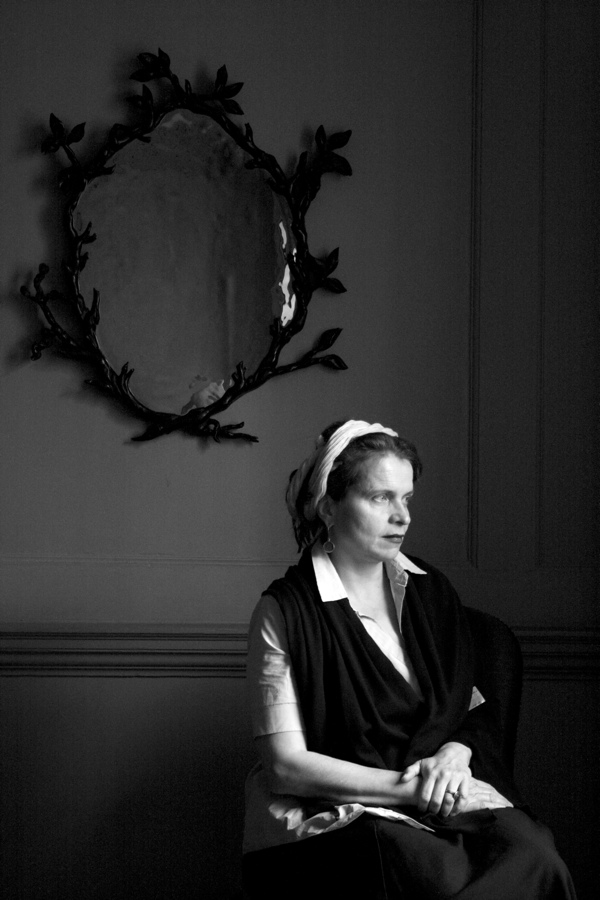
Marianna Kennedy
Portrait copyright © Lucinda Douglas Menzies
Taj Stores, then & now

The gentleman on the right is Abdul Khalique, standing with his shop assistant, in the early nineteen fifties outside the very first Taj Stores in Hunton St (now Buxton St, where Allen Gardens is today). Abdul Khalique’s brother Abdul Jabbar, the founder of the grocery store, commonly known then as “Jabber’s Shop”, was a seaman who came here from Bengal (as it was called at that time) to Spitalfields in 1934 after leaving the navy. He worked in textile sweatshops for two years before opening his store, which he ran with his Irish wife Cathleen.
These sparse facts, which I learnt from Abdul Jabbar’s nephew Jamal (who never met his uncle), are all that is known of this brave man (pictured below) who travelled across the world and undertook the risky venture of starting a business in another continent, working so hard to build it up until his death in 1969. I think he would be quite amazed to visit the Taj Stores today in Brick Lane and see how his modest enterprise has blossomed.

I enjoyed the privilege of a tour of the aisles recently in the company of Jamal (Abdul Quayum), who has been involved in the family business since he was 17 years old, and now runs the store jointly with his elder brother Junel (Abdul Hai) and younger brother Joynal (Abdul Muhith). It is a wonderful experience simply to explore here and savour the rich selection of produce on offer from all over the world in the Taj Stores. I love to study the beautifully organised displays of exotic fruit and vegetables, printed sacks of rice, tall stacks of brightly coloured cardboard packages, cans, bottles and jars – each with their distinctive fragrances. Then there is the cooking equipment, towers of plastic jugs and bowls, steel pots and pans, and scourers. There is a compelling poetry to the vast intricate diversity of all the attractive things collected here and it is a phenomenal feat of organisation that the brothers have pulled off, bringing this huge range of supplies together from the different corners of the globe.
Jamal explained to me how the business is run nowadays between the three brothers. Jamal does the hiring and the paperwork, while Joynal takes care of the day-to-day buying and selling, and Junel runs the catering supply and wholesale side of the business. “The beauty of it is, we have different responsibilities. We are a modern muslim family and we treat each other like friends.” says Jamal proudly.
Their father Alhaj Abdul Khalique first came to the United Kingdom in 1952 as a student, before becoming involved in running the business with his brother. In 1956 the grocery shop moved to larger premises at 109 Brick Lane (opposite where Eastside Books is now), and then when Abdul Jabbar died in 1969, Abdul Khalique ran it with his brother Abdul Rahman. The pair are seen here looking every bit the sharp business men they were, in this handsome studio portrait taken at that time.

As the Taj Stores prospered, they moved again in 1979 to the current site at 112 Brick Lane and an era ended in 1994 when Abdul Khalique died – then the family business passed from the brothers who had emigrated to this country, into the stewardship of the current generation who were born here.
In recent years the stores have continued to expand with the purchase of the premises next door and this year sees the launch of the online business. When I took my portrait of Joynal, Junel and Jamal recently (reproduced below), the brothers explained to me that they now look back to their roots and, in the tradition of nineteenth century businessmen turned benefactors, they are funding a school and a mosque, building social housing, investing in irrigation and two cancer clinics back in Moulvibazar, Sylhet, Bangladesh – the home town where Abdul Jabbar set out from all those years ago when this story began.

Doulton Lambeth ware

More than twenty years ago, I bought a teapot almost identical to this one for £18 in a junk shop next to the Naval Academy in Greenwich. It caught my eye because it was in the same style as a jug in my grandmother’s house in Chard. This was how my collection of Doulton Lambeth salt glaze pottery began, and now I have innumerable jugs, mugs, teapots, pots and bowls, cluttering up my house in Spitalfields.
I like the modesty of these vernacular designs and, as they are completely out of fashion, I have acquired them cheaply over the years in markets, fetes, charity shops and ebay – where nobody bothers to bid for them. The large blue jug below went for just £5, and I bought the small two-handled bowl in Coppermill Market, Cheshire St for £8 last summer. Even the teapot above, which is in perfect condition with the original price still written in pencil inside the lid was just £22 on ebay, only £4 more than the one from Greenwich, with barely any appreciation in value in the intervening years.
I am fascinated by the small relief images which are made in moulds and applied to the form before firing. There is always a windmill and always a tree, and vignettes of life worthy of Thomas Bewick. The huntsman with a bugle chasing a stag around the bowl is perhaps the reason why no-one likes this stuff now, but I am not offended by this motif of past rural life, whenever it catches my eye I always think the stag is at the moment of escape. Most interesting to me are the recurring domestic scenes with an implied narrative or allegory. In one, a young man is pouring beer down his throat while a woman feeds her baby with a spoon and the other children gather round. Meanwhile, behind his father’s back, a boy prises open a barrel for himself and in the background a pig sleeps, underscoring this picture of the dangers of intemperance (or simply of the chaos of a young family), pertinently placed upon an ale jug. Equally, there are also images of an older fellow in a tricorn hat, sitting alone with a pipe and pint of ale, with a cat at his feet or a wise owl in a little bush, by contrast these figures speak of the contentment ( or loneliness) of age.
Beginning as Jones, Watts & Doulton in 1815, the company of potters founded by John Doulton and taken over by his son Henry, evolved to become Doulton & Co, Lambeth in 1827 when they acquired a property in Lambeth High St, where they continued to manufacture salt glaze ware until 1956. The sprigged jugs that I have collected are sometimes credited to Joseph Mott, Doulton’s art director from 1897, he had his own collection of old London ale jugs and based his designs upon these. However, there are similar jugs made earlier by Doulton from the 1830s onwards and many other London potteries including Deptford, Mortlake, Vauxhall, Fulham, T.Smith and Stiff, produced jugs in this style too.
So there you have my collection of Doulton Lambeth ware. I am aware that these jugs are a bizarre hybrid, essentially a form of seventeenth century retro created in the nineteenth century. But in their limited variety of colour and form, these austere pieces are also the culmination of a long tradition of salt glazed ware that has its origins in the domestic earthenware pottery that was once the standard for daily use by all Londoners. And I enjoy using them every day, though I am not expecting the Doulton Lambeth salt glaze ware revival will start any time soon.

The Spitalfields Bellringers

Last night, the sound of bells was blowing in the wind as I walked out of my door into the rainy street, passing a line of visitors with umbrellas on a tour in the dark, before I entered the tall gates at the rear of Christ Church Spitalfields – where at the back door, Alan Regin (pictured below), who has been the Steeple Keeper here for the past twenty years, was waiting for me. Alan led me through the dark empty church, up a wide wooden staircase and through a small door leading to a narrow stone staircase, spiraling upwards through the thick wall of the tower. At the top of the steps, we passed through a tiny exquisite eighteenth century wrought iron gate and walked along a short shadowy passage to discover the bright loft, high in the steeple, where eight bellringers stood in a circle, swinging the ropes up and down with concentrated skill.
Mary Holden who stands central in the picture above and is Master of the Society of Cumberland Youths (a society of bellringers founded in 1746), took a break to come over and explain that her ringers are responsible for ringing the bells in three London churches, St Leonards Shoreditch, St Martin-in-the-Fields and here. She told me they have rung the bells at Christ Church Spitalfields since the eighteenth century and the circular plaque you see in the photo commemorates a three-hour and twenty-four minute peal of bells they rang in this tower in 1845. “The bells here are lovely, they have a really nice tone, and are well-maintained so they are quite easy to ring” enthused Mary, who is a passionate third generation bellringer. Then, within minutes, the two-hour session was over and the thirsty ringers all vacated the loft at once, making their way swiftly to The Pride of Spitalfields, which I am informed is the bellringers’ long-standing destination afterwards – where they like to meet with the employees of the Whitechapel Bell Foundry to enjoy a professional debate of the niceties of campanology over a few pints.
Alan and I were left alone to stand for a moment, and savour the resonance of this beautiful space with its single half-moon window, which indicates the position of the loft if you are looking up at the tower from the street. I learnt there have been three sets of bells here in its history. The original peal of twelve was destroyed in the great fire of 1836, to be replaced by a peal of eight cast in Whitechapel that lasted until the nineteen twenties, then the tower became silent until 1971 when the current peal of eight bells (cast by Gillet & Johnston in 1919) was acquired second-hand from the demolished church of St Stephens in Clapham.
As we switched out the lights, closed the little iron gate and descended the narrow stone staircase, Alan accounted for the wear upon the steps by telling me that in olden times the ringers wore hobnailed boots. “You get into some very interesting places,” he said, elaborating on his delight in bellringing. Then, continuing, as we reached the foot of the stairs, “I started when I was seven at Otterham in Surrey”, he confided, “I had an elder brother who was a bellringer and he encouraged me, and as soon as I got hold of a rope I was hooked!” We paused on the landing for a moment and he pointed out a panel commemorating The London Surprise Major when the bells were rung by eight ringers for eleven hours and thirty-five minutes non-stop in 2005 with Alan himself ringing the tenor. I expect they were thirsty afterwards that day.
Finally, as we walked back through the dark church, Alan told me about The Golden Heart Surprise Major. “We really feel part of the community here in Spitalfields, and I remember talking to Denys Esquilant and he said how much he enjoyed hearing the bells here on a Sunday morning.” said Alan, explaining the origin of this composition – which celebrates the life of Denys Esquilant who died last year, and the thirty years that he and Sandra ran the Golden Heart together in Commercial St. You can watch a film of Sandra Esquilant (whom I have dubbed the Queen of Spitalfields) up in the tower, attending the inauguration of The Golden Heart Surprise Major by clicking here. Be sure to look out for Alan ringing on the right of the circle of ringers.
I would like to salute Alan Regin who has undertaken the honorary role of Steeple Keeper here in Spitalfields with good humoured equanimity for two decades, he has obviously done his job well because the steeple looks better now than it ever did, and it was a rare honour for me to end the year by visiting the inner enclave of this famous edifice in such good company.

James Mason in Spitalfields, the London Nobody Knows

One day in the early spring of 1967, when the first leaves were showing but snow was still piled up in yards, James Mason came knocking on the door of 29 Hanbury St (where the Upmarket building now stands) and in this picture you see him asking the householder if he can look in her back yard, which was the site of the second Ripper murder. I think she makes a fair show of being surprised at his request, when he can hardly have been the first Ripper tourist to knock on her door. It was all part of the filming of The London Nobody Knows based upon Geoffrey Fletcher’s book of the same title.
In a series of books and a regular column in the Telegraph that added up to a life’s work, Geoffrey Fletcher set out to make an affectionate record of all the corners of old London that were being neglected and devalued while the cultural focus was upon modernity at any cost. He wanted to record these precious fragments of the past before the wrecking ball destroyed them forever. Illustrated with his own delicate line drawings, copies of Geoffrey Fletcher’s books can still be found in public libraries and make fascinating guides today because – in spite of everything – most of the London nobody knows is still there. He doubted very much that the house I live in today here in Spitalfields would survive more than a few years – this was at least thirty years ago. Geoffrey Fletcher was an unashamed sentimentalist and I love him for seeking out the poetry in ordinary common things. In fact, reading his books was one of my inspirations to begin writing these posts to you every day.
Brandished an umbrella, with well-polished handmade brown shoes and a cloth cap to signify class solidarity, James Mason makes an amiable guide to Geoffrey Fletcher’s sixties London. He takes us from the old railway goods yard and a tragically abandoned music hall in Camden Town to the perky Kings Rd fashion parade, by way of a Salvation Army hostel and Kensal Green Cemetery, before ending up in Spitalfields. Here they filmed meths drinkers fighting on the steps of the synagogue in Brick Lane, old men collecting discarded cabbages at the Market, garment workers outside their workplaces in Fournier St, and tenement children playing raucous singing games and scrapping on the pavement.
Director Norman Cohen’s film is an unlikely charismatic amalgam of sixties whimsy and realist documentary footage of markets, street performers, hostel dwellers and drunks. These last two subjects are the most memorable, as candid yet humane testimonies of the hopeless and the dispossessed. It is in this rare footage that the film achieves its lasting value, tenderly witnessing the existence of these seemingly innocent lost refugees from an earlier world, who became casualties in the postwar years.
If you wonder what it was like here forty years ago. If you would like to be personally escorted around Spitalfields in the spring of 1967 by James Mason, it can be arranged this weekend. Make your way to the ICA Cinema in the Mall where there is a rare opportunity to see “The London Nobody Knows” on a big screen on 2nd and 3rd January.