
Paul Gardner’s collection
You will recall that I wrote about Paul Gardner, the fourth generation paper bag seller, recently. Gardners’ Market Sundriesmen is the longest established family business in Spitalfields, trading in the same building for one hundred and forty years. Yesterday, I went back to Paul’s shop at 149 Commercial St to photograph some of the unique collection of artifacts that have accumulated there since his great-grandfather James Gardner first opened in 1870, trading as scalemakers. We took down some things from the walls and photographed them on the floor, we arranged other items on the worn counter-top and I stood upon Paul’s chair to take my pictures. Let me say, both Paul and his customers were extremely gracious, continuing their transactions and buying their bags as usual, politely disregarding the morning’s photographic mayhem.
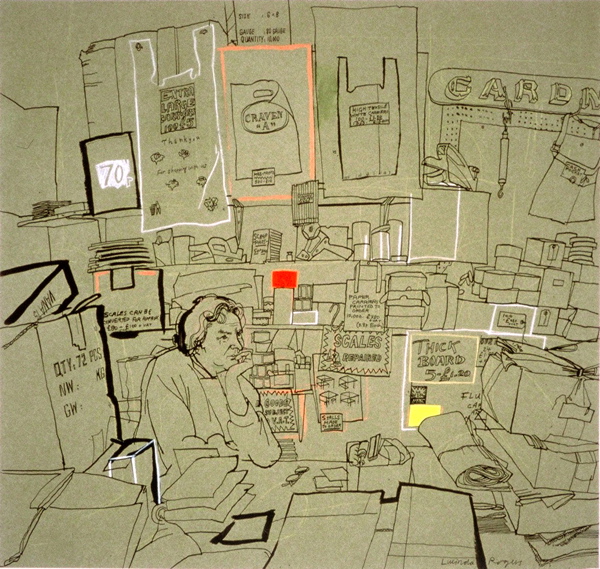
Paul told me that if he were a paper bag, he would be a brown paper bag because they are his bestsellers – multi-purpose bags, and the ones he has made most money out of over the years. So it is entirely appropriate that when Lucinda Rogers drew this portrait of Paul in his shop a few years back, she drew it on brown paper. Now it hangs in pride of place high up on the wall behind the counter.
Coming upon the artifacts pictured below in a museum would be intriguing but not surprising. In a museum they would be removed from life and arranged. But the only arrangement you see below was created for these photos. Discovering these items still remaining in the living working place where they belong is enthralling in a different way. In Paul’s shop they retain their full functional quality as objects that were once in use here (the coin tray and Oxo tin are still in use), now acquiring an intoxicating poetic meaning as the relics of the three antecedents who pursued the same trade in this place where Paul works today. Quite simply, these are the things that James, Bertie and Roy left behind, and their presence lingers in these everyday possessions as the evidence of their working lives and as evocations of the world they knew. Today, Paul is his predecessors’ unselfconscious living representative and the custodian of their stuff. I do not think Paul thinks twice about his wooden coin tray that is worn by four generations of use, unless someone points it out to him. And there is something profoundly beautiful about this.
You will recognise the style of the price labels from the one which Paul was holding up in my portrait of him. I love the varieties of apples and pears specified here, Comice, Ripe Williams, Dunn’s Seedlings, Choice Worcesters and Ellison’s Orange, names as lyrical as a Betjeman verse. Equally, there is a powerful magic to the simple phrase “morning gathered” that fills my mind with images of dawn in the orchards, though I do wonder what kind of world it was that could be enticed by the pale allure of “Worthing grown”.
Most fascinating to me was the Day Book begun by James Gardner on 1st January 1892 with some bold calligraphic flourishes. We all recognise that auspicious sense of possibility when you write your name to inaugurate a new book, revealing the future as a sequence of blank pages, ripe with potential. James used this sturdy book with fine marbled endpapers to record all the different East End greengrocers where he serviced the scales on a regular basis. James’ elegant italic hand can readily be deciphered to read many familiar addresses in Spitalfields. It is remarkable that he could maintain such poised handwriting when you consider how many customers James visited in a single day sometimes, though as business increased through the life of this ledger, his handwriting becomes hastier and more excited.
There was so much more I could show you, the family bible “Won by the Bugler James Gardner of the 1st Tower Hamlets rifle Brigade for shooting. Presented by Lady Jane Taylor, December 21st 1882”, with the entire family tree over five generations (revealing James’ year of birth as 1847 and his origin as Thaxted in Essex), the catalogues of scales, the insurance certificates, various family military cards from the different wars, and the modern receipt books with their blue carbon pages that end in 1968 on the day Paul’s father Roy Gardner died – all the pamphlets and pieces of paper that add up to four generations of trading for Gardners.
As you know, Paul Gardner’s business is now under threat as the landlord threatens to raise his annual rent from £15000 to £25000 in June. For a business with a small turnover, this is an untenable increase. Meanwhile, hundreds of the smallest businesses and market traders, that are the basis of the economy in East London, rely upon Paul – because no-one else is prepared to sell such small quantities of bags at a time. I am relieved to report that he has commenced renegotiation of the increase and we have to hope that Messrs Tarn & Tarn, the managing agents, recognise their wider social responsibility to the neighbourhood in their handling of Gardners, because I am sure they would not wish to become responsible for sending Spitalfields’ oldest family business to the wall.
I never want to see Paul Gardner’s collection in a museum, I want to see it stay where it belongs in his shop, scattered among all the different stacks of coloured paper bags, and hidden among the tapes and tags, to be discovered on shelves and racks, behind the modest green facade of this celebrated business in Commercial St.


Dickens in Spitalfields 3, in the streets

In the first installments of Charles Dickens’ article “Spitalfields,” published in his weekly journal “Household Words” on 5th April 1851, we accompanied Dickens and his sub-editor W.H. Wills to a silk warehouse where they met Mr Broadelle, the manager. In this third installment, they set out with Mr Broadelle as their guide to explore the narrow streets of Spitalfields, illustrated by this engraving of Pelham St (now Woodseer St) off Brick Lane, lined with weavers’ cottages, distinguished by the long windows of the weaver’s lofts upon the top floor. Let us hurry to keep up with, Dickens, Wills and Broadelle as they make their way…
From fourteen to seventeen thousand looms are contained in from eleven to twelve thousand houses – although at the time at which we write, not more than nine to ten thousand are at work. The average number of houses per acre in the parish is seventeen; and the average per acre for all London being no more than five and a fifth, Spitalfields contains the densest population, perhaps, existing. Within its small boundaries, not less than eighty-five thousand human beings are huddled.
“They are,” says Mr Broadelle, “so interlaced, and bound together, by debt, marriage, and prejudice, that, despite many inducements to remove to the country establishments of the masters they already serve, they prefer dragging on a miserable existence in their present abodes. Spitalfields was the Necropolis of Roman London; the Registrar- General’s returns show that it is now the grave of modern Manufacturing London. The average mortality is higher in this Metropolitan district than in any other.”
“And what strange streets they are, Mr Broadelle! These high gaunt houses, all window on the upper story, and that window all small diamond panes, are like the houses in some foreign town, and have no trace of London in them – except its soot, which is indeed a large exception. It is as if the Huguenots had brought their streets along with them, and dropped them down here.
And what a number of strange shops, that seem to be open for no earthly reason, having nothing to sell! A few halfpenny bundles of firewood, a few halfpenny kites, halfpenny battledores, and farthing shuttle-cocks, form quite an extensive stock in trade here.
Eatables are so important in themselves, that there is no need to set them off. Be the loaves never so coarse in texture, and never so unattractively jumbled together in the baker’s dirty window, they are loaves and that is the main thing. Liver, lights, and sheep’s-heads, freckled sausages, and strong black puddings, are sufficiently enticing without decoration. The mouths of Spitalfields will water for them, howsoever raw and ugly they be.
Is its intellectual appetite sharp-set, I wonder, for that wolfish literature of highly-coloured show-bill and rampant wood-cut, filling the little shop-window over the way, and covering half the house?
Do the poor weavers, by the dim light of their lamps, unravel those villanous fabrics, and nourish their care-worn hearts on the last strainings of the foulest filth of France?”
“I can’t say,” replies Mr Broadelle; “we have but little intercourse with them in their domestic lives. They are jealous and suspicious. We have tried Mechanic’s Institutions, but they have not come to much.”
“Is there any school here?”
“Yes. Here it is.”
An old house, hastily adapted to the purpose, with too much darkness in it and too little air, but no want of scholars. An infant school on the ground floor, where the infants, as usual, drowsily rubbing their noses, or poking their fore-fingers into the features of other infants on exploratory surveys. Intermediate school above. At the top of it all, in a large long light room (occupying the width of two dwelling-houses, as the room made for the weaving, in the old style of building, does) the ‘Ragged School.’
“Heaven send that all these boys may not grow up to be weavers here, Mr Broadelle, nor all the girls grow up to marry them!”
“We don’t increase much, now” he says, “We go for soldiers, or we go to sea, or we take to something else, or we emigrate perhaps.”
Now, for a sample of the parents of these children…
It seems incredible to imagine eighty-five thousand people living in Spitalfields a hundred and fifty years ago, and surprising to recognise that our neighbourhood was a much more densely populated place in the past than it is today. “Ragged School” was the name given to primitive schools set up by private individuals and organisations to teach slum children. Dickens was passionate about the movement and wrote about it many times.
When I read of the coarse bread, liver, lights, sheep’s heads, freckled sausages and strong black puddings on sale, I thought Fergus Henderson might be quite fascinated to explore Spitalfields with Charles Dickens and would certainly contradict Dickens’ dismissal of these “raw and ugly “foods.
In the next installment, we shall follow Dickens and Wills further as they climb the steps to a weaver’s loft and learn at first hand of life of a family who support themselves through the weaving industry.

This engraving, kindly supplied by Tower Hamlets Local History Collection, shows the Ragged School in Georges Yard, St Jude’s, Whitechapel, as pictured by The Illustrated London News in 1859.
One Hundred Penguin Books


I found these first hundred Penguin books in my attic over the weekend, as I was unpacking a box that has been sealed since I moved in. With their faded orange, indigo, green, violet and pink spines they make a fine display and I am fond of this collection that took me so many years to amass.
When I left college, I wrote to companies all over the country seeking work and asking if they would give me an interview if I came to see them. Then I travelled around on the cheap, through a combination of buses, trains and hitchhiking, to visit all these places – the industrial towns of the North and the Cathedral cities of the South – staying in bus stations, youth hostels and seedy B&Bs, and going along filled with hope to interviews that were almost all fruitless. It was the first time I encountered the distinctive regional qualities of Britain and in each city, to ameliorate the day of my interview, I took the opportunity to visit the museums, civic art galleries, cathedrals and castles that distinguish these places. Arriving at each destination, I would consult the directory and make a list of the second-hand booksellers, then mark them on a tourist map and, after the job interview, I would visit every one. There were hundreds of these scruffy dusty old shops with proprietors who were commonly more interested in the book they were reading behind the counter than in any customer. Many were simply junk shops with a few books piled in disorder on some shelves in the back or stacked in cardboard boxes on the pavement outside.
In these shabby old shops, I sometimes came upon Penguin books with a podgy penguin on the cover, quite in contrast to the streamlined bird familiar from modern editions. These early titles, dating from 1935 had a clean bold typography using Eric Gill’s classic sans typeface and could be bought for just twenty or thirty pence. So, in the manner of those cards you get in bubblegum packets, I began to collect any with numbers up to one hundred. In doing so, I discovered a whole library of novelists from the nineteen thirties and reading these copies passed the time pleasantly on my endless journeys. In particular, I liked the work of Eric Linklater whose playful novel “Poet’s Pub” was number three, Compton Mackenzie whose novel of the Edwardian vaudeville “Carnival” was ten, Vita Sackville-West whose novel “The Edwardians” was sixteen, T.F.Powys whose “Mr Weston’s Good Wine” was seventy-three and Sylvia Townsend Warner whose novel “Lolly Willowes” was eighty-four. After these, I read all the other works of these skillful and unjustly neglected novelists.
Eventually I found a job in Perthshire and then subsequently in Inverness, and from here I made frequent trips to Glasgow, which has the best second-hand bookshops in Scotland, to continue my collection. And whenever I made the long rail journey down South, I commonly stopped off to spend a day wandering round Liverpool or Durham or any of the places I had never been, all for the purpose of seeking old Penguins.
The collection was finally completed when I moved back to London and discovered that my next door neighbour Christine was the daughter of Allen Lane who founded Penguin books. She was astonished to see my collection and I was amazed to see the same editions scattered around her house. From Christine, I learnt how her father Allen was bored one day on Exeter St David’s Station (a place familiar to me), changing trains on the way to visit his godmother Agatha Christie. When he searched the bookstall, he could not find anything to read and decided to start his own company publishing cheap editions of good quality books. I presume he did not know that, if he had been there half a century earlier, he could have bought a copy of Thomas Hardy’s first published novel “Desperate Remedies”, because Exeter St David’s was where Hardy experienced that moment no writer can ever forget, of first seeing their book on sale.
I do not think my collection of Penguins is of any great value because they are of highly variable condition and not all are first editions, though every one predates World War II and they are of the uniform early design before the bird slimmed down. While I was collecting these, I thought that I was on a quest to build my career – a fancy that I walked away from, years later. Now these hundred Penguin books are the only evidence of my innocent tenacity to create a life for myself at that time.
Allen Lane’s idealistic conception, to use the mass market to promulgate good writing to the widest readership in cheap editions that anyone could afford, is one that I admire. And these first hundred are a fascinating range of titles, a snapshot of the British public’s reading tastes in the late thirties. Looking back, the search for all these books led me on a wonderful journey through Britain. If you bear in mind that I only found a couple in each city, then you will realise that my complete collection represents a ridiculously large number of failed job interviews in every corner of these islands. It was a job search than became a cultural tour and resulted in a stack of lovely old paperbacks. Now they sit on my shelf here in Spitalfields as souvenirs of all the curious places I never would have visited if it were not my wayward notion to scour the entire country to collect all the first hundred Penguins.


Columbia Road Market 22

The market was full of life early again this week with many more varieties of plants now on sale including Camellias and Witchhazel (Hamamellis) in flower, and tall Lemon trees hanging with Lemons, as well as lots of garden perennials sold as bare root plants. I was tempted by these as my garden looks entirely blasted and I am eager to bring it back to cultivation and life after the winter chills, but I am not quite ready to risk planting anything new yet.
Several stallholders showed their faces for the first time this year and I was especially pleased to welcome back Mick and Sylvia, the herbsellers, who have their nursery in Hainault and are highly respected stalwarts of Columbia Rd with their outstanding selection of herbs. I was impressed their fresh Mint (Mentha Spicata) plants, grown outdoors under nets, and I bought one Garden Mint for mint sauce and salads and one Moroccan Mint for tea. It cost me a fiver for the pair. I planted them in this pot (Garden Mint on the left Moroccan Mint on the right) on my kitchen window sill, which means I can bring them hastily inside if the temperatures should plunge again.
Anna Skrine, custodian

You may recall that I had the pleasure of paying a visit upon Tamzin Griffin recently, the last tenant to depart from 27 Fournier St, the exceptional eighteenth century silk merchants’ house that was sold recently.
I never expected to go back, but then I had a call to meet Anna Skrine who was instrumental in saving the house when she worked for the Spitalfields Trust and who has been its custodian ever since. It was Anna’s last day clearing out the final bits and pieces of crockery and glass, putting them in boxes that she was going to place on Fournier St later, to allow people to help themselves. Two weeks ago, there was still a little furniture left but now I was surprised to find the place entirely bare and the house sits empty this weekend before the new owner arrives to claim it on Monday morning.
A direct woman with an attractive bright energy, Anna fished two old cups from boxes and made us tea with a few leaves straight in the cups. Then we walked upstairs with cushions tucked under our arms and found a corner of the expansive first floor drawing room to settle upon the polished boards in a pool of February sunlight. Thirty years ago, Anna worked as an assistant at the Spitalfields Historic Buildings Trust, founded by Douglas Blain, Mark Girouard and Dan Cruickshank to save the old houses that were under threat. As well as secretarial duties, Anna organised a petition save the buildings in Cheshire St and before long her role evolved into direct action too. “I was the one who said, ‘The bulldozers are coming!’ so we all piled into the Board School in Spital Sq.” volunteered Anna enthusiastically, describing how she and other members of the trust staged a sit-in, occupying the place with sleeping bags in winter, locking themselves into the condemned building to draw attention to its importance. The story became front page news and the building was saved. But most importantly, this event became the tipping point when national opinion altered and the preservation of old buildings became a greater priority in the face of the thoughtless demolition and redevelopment that had become the rule.
It was due to the actions of these few pioneering individuals that the historic houses survived to be cherished in Spitalfields today. Talking with Anna, I began to get a sense of the excitement of that moment when there was so much potential to reclaim the beauty of these neglected edifices that went unappreciated, and a vigorous social life engendered by this shared enterprise undertaken by a colourful bunch of personalities.
“Dennis Severs‘ Christmas parties at his house in Folgate St were the most beautiful, magical events that I ever knew. It wasn’t only how it looked which was magic – but also the smells, because he used to clean the floor with lavender, so you had that mixed in with the other wonderful Christmassy smells of cinnamon and oranges with cloves. He was a master at it. It was just so beautiful.” remembered Anna with pleasure.
Anna’s sister Fiona bought an eighteenth century silk merchant’s house at 14 Wilkes St. “Only two or three houses in the street were inhabited at that time and the locals thought we were completely mad. We lived in it and did most of the work we could to renovate it ourselves,” said Anna.
“After a few years, 27 Fournier St came up for sale. It was full of workshops, people working in indescribably bad conditions – with water coming through the roof. The trust bought workshops in Heneage St and created workplaces with decent conditions, moving the remaining tenants there.” Explaining the modus operandi of the Spitalfields Trust, Anna continued, “The trust created these back-to-back deals, buying property and selling it under covenant to a new owner – and I managed to find someone who would buy the house, Henry Barlow, which is how we were able to save it.”
Anna looked around the magnificent panelled room, absorbing the familiar space and reminding herself of its place in her life, because, although she is distinguished by her placid composure, it was apparent that this was somewhere for which Anna has great emotional attachment.
“I met my husband here, he was the head builder, Jim Brunton.” she revealed. “He did the houses in Elder St that were the first to be renovated. Jim was brought here by Mark Girouard. He could put back panelling where it was missing and you wouldn’t know. Douglas (Blain) and Jim would investigate houses and decide how they should be saved.”
Anna’s thoughts flitted around the neighbouring streets as she described how Jim and Douglas explored the house of a bird dealer in Hanbury St that had a floor entirely full of exotic birds in cages and a cellar full of guano, and how they were also the first to enter the abandoned synagogue at 19 Princelet St, discovering the locked top floor where the occupant Mr Rodinsky had departed never to return, leaving his cereal bowl on the table.
“I lived in this house for a while as caretaker while the builders were working,” said Anna, returning the conversation to 27 Fournier St, before explaining that she left to live in Wales when she had her first child and subsequently moved to Ireland where she resides today. Through all this time, Anna has continued as custodian of 27 Fournier St, managing the tenants, fulfilling Henry Barlow’s notion that the house should be let to young artists and actors at rents they could afford. She talked fondly of those who became friends, including Marianna Kennedy, the very first tenant, who lives today at the other end of Fournier St. Now, I was meeting Anna on the final day of her duties as custodian after a quarter of a century and it was my privilege to be party to her emotions at this moment.
“I have all sorts of feelings – gratitude, that I’ve been allowed to be part of this amazing place, tinged with a little sadness too, but it’s time to move on. We had such fun here. The Market Cafe was the centre of everything because we all used to meet up there for lunch, and be in and out of each other’s houses – it was an incredible community.”
As we descended the crooked staircase, Anna invited me to help myself to any of the things that were left behind. But – as I abandoned deliberating over old cups – I realised that the real gift had been the opportunity to meet Anna herself, the worthy custodian of 27 Fournier St, and hear her evocations of those passionate young people, and the brave lively events that incarnated the moment when Spitalfields was saved.

Alan Hughes, Master Bellfounder

If I confide to you that my favourite sound in all the world is that of bells pealing, you will understand why the Whitechapel Bell Foundry has been such a source of fascination for me over all these years. Every time I walk past the ancient walls of the foundry (which is the oldest manufacturing company in the land – founded in 1570), I wonder about the alchemical mystery of bellfounding that is taking place inside. One summer’s day, as I passed on my way walking down from Spitalfields to the Thames, the steel doors at the rear of the foundry were open and, peeking in from the harsh sunlight outside, I was afforded a tantalising glimpse of huge bells glinting in the the gloom of the engineering shop.
You can imagine my excitement when I received the invitation to meet the current master bellfounder in an unbroken line of master bellfounders that stretches back to 1420. Stepping inside, out of the rain in Whitechapel Rd, I found myself in the foundry reception lined with old photographs and compelling artifacts, like the wooden template (displayed over the entrance as if it were the jaws of a whale) that was used when Big Ben was manufactured here. Among all the black and white photos, my eye was drawn by some recent colour pictures of a royal visit, with her majesty in a vivid shade of plum and Prince Philip looking uncharacteristically animated. I was just thinking that the bell foundry must work a very powerful magic upon its visitors indeed, when a figure emerged from the office and I turned to shake the hand of Alan Hughes, the master bellfounder. Alan’s great-grandfather Arthur Hughes bought the business in 1884, which makes Alan a fourth generation bellfounder.
The sense of awe that filled me as I shook hands with this unassuming man in a natty blue suit can only be compared to that when I was first taken to meet Father Christmas in a department store grotto. I composed myself as best I could, as Alan led me through a modest office where two people worked behind neat desks and one of those fake cats dozed eternally in front of the stove, to arrive in the boardroom where a long table with a red cloth upon it occupied the centre of a modest but elegantly proportioned Georgian dining room. We drew up chairs and commenced our conversation as the Whitechapel drizzle turned to dusk outside.
I was immediately beguiled by Alan’s fine manners and elegant light tone, which kept me guessing whether everything he said might actually be a proposal, contingent, as if he was simply trying out thoughts to see how I would react. I took this as an indicator of his relaxed courtly assurance. Alan wears his role with the greatest of ease, as only someone born into the fourth generation of an arcane profession could do, and it did occur to me that maybe the royal visit had actually been an occasion for mutual recognition between those born into family businesses.
Up above, I could hear music. It was Alan’s daughter and her friend, both music students, practising the piano and the trumpet. The prevailing atmosphere was that of a work place but yet it was domestic too. When Alan’s predecessors set up the business on this site, before the industrial revolution, they attached the factory to the house so they could walk from the dining room into the foundry at their convenience. The feeling today is akin to that of the quiet living quarters of an old public school or an Oxford college or Bishop’s Palace.
Alan has worked here for forty-four years and, describing the changes he has seen, he glanced over my shoulder to the window several times, as if each time he glanced upon a different memory of the Whitechapel Road. The East End was a busy place in the nineteen fifties, as Alan first recalled it, not only because of the docks but because of all the factories and the manufacturing that happened here. “Whichever way it was blowing, you got this lovely smell of beer on the wind – from Trumans or Watneys or Charringtons or Courage or Whitbread…” Alan told me, explaining the locations of the breweries at each point of the compass. In the nineteen seventies and eighties, when the docks and factories had closed, Alan found the place desolate, he peered from the window and there was no-one in the street. “And then things started getting trendy. Instead of closing they started opening – and now, suddenly, it’s ok to be in Whitechapel!” said Alan, clasping his hands thoughtfully on the table and looking around the room with a philosophical grin, “But this place hasn’t changed at all. I always find it vaguely amusing.”
Tentatively, I asked Alan what it meant to him, being part of this long line of bellfounders. Alan searched his mind and then said, “I don’t think about it very often. I would like to meet some of those people, Thomas Mears (master bellfounder from 1787) who would know the place today and Thomas Lester (master bellfounder from 1738) who had this part built. It would be nice to have a conversation with him. He would recognise most of it.” Then the gentle reverie was gone and Alan returned to the present moment, adding, “It’s a business,” in phlegmatic summation.
“Our business runs counter to the national economy,” he continued, “If the economy goes down and unemployment rises, we start to get busy. Last year was our busiest in thirty years, an increase of 27% on the previous year. Similarly, the nineteen twenties were very busy.” I was mystified by this equation, but Alan has a plausible theory.
“Bell projects take a long time, so churches commit to new bells when the economy is strong and then there is no turning back. We are just commencing work on a new peal of bells for St Albans after forty-three years of negotiation. That’s an example of the time scale we are working on – at least ten years between order and delivery is normal. My great-grandfather visited the church in Langley in the eighteen nineties and told them the bells needed rehanging in a new frame. They patched them. My grandfather said the same thing in the nineteen twenties. They patched them. My father told them again in the nineteen fifties and I quoted for the job in the nineteen seventies. We completed the order in 1998.”
Alan broke into a huge smile of wonderment at the nature of his world and it made me realise how important the continuity between the generations must be, so I asked him if there was pressure exerted between father and son to keep the foundry going.
“My great-grandfather never expected the business would outlive him. He had three sons and the sale of the business was arranged, but my grandfather refused to sign the contract, so the other brothers left and he took over. My grandfather ensured his sons had good jobs and even my father wasn’t convinced the business could succeed, so he studied foundry technology for four years at every foundry in the south – thinking he could work for them – but every single one of those has now closed.” Then Alan looked out the window again, gazing forward into time. “As a master bellfounder, you never retire. We go on until we die. My grandfather, my father and my uncle all died of a heart attack at eighty.”
The implications of Alan’s conclusion are startling for him personally, even though he has many years to go before eighty. “You’re a very eloquent man,” I said in sober recognition, “No, I’m not!” he retorted cheekily. “You have such interesting things to say,” I replied lamely, “No, I don’t!” he persisted gamely, obstinately raising his eyebrows. Nevertheless, Alan’s life as a bellfounder is remarkable to me and maybe to you too. Seeing his life in comparison to his predecessors, Alan embraces the patterns that prescribe his existence, for better or worse, and his personal mindset is the result of particular circumstances, the outcome of four generations of bellfounding. Even if it is his nature to maintain a stubborn levity, Alan is entirely for real and he has my greatest respect for his immodest devotion to bells.
Now, it was time to take a picture of Alan, the master bellfounder, so I followed him with rising excitement through old doors, along passages, crossing a courtyard stacked with bells and into the vast workshop where the bells are made. There were huge bells and moulds for bells, bells-in-progress and bells completed, and piles of metal dust everywhere and pieces of heavy lifting equipment lowering over us. This is where the sound of bells pealing originates, I thought. I felt like an astronaut on the moon, it was dusty and wondrous yet strange, but this was Alan’s home planet. He strolled happily around the filthy workshop in his neat blue suit, scrutinising progress on the bells and proud to be photographed among his sublime creations that will be pealing to delight the ear of generations yet unborn, when we are all gone.
Below you can see Arthur Hughes (master bellfounder from 1904), Albert Hughes (master bellfounder from 1916), William Hughes (master bellfounder from 1945) and Alan Hughes (master bellfounder from 1972).


Photographs of Alan Hughes by Sarah Ainslie.
Rochelle Cole, Poulterer

It never crossed my mind that being a poulterer might be a glamorous profession until I met Rochelle Cole at Liverpool St Chickens in Leyden St. When Rochelle bounced into her shop from the rain outside (wearing wellingtons and a flat cap at a jaunty angle), she appeared through the chain link curtain to greet me with a confident smile. Taking me in with a single glance of her huge eyes, as she pulled the cap from her head allowing her dark flowing locks to fall in a cascade around her shoulders, I was completely mesmerised. Rochelle has presence, she is the top bird at Liverpool St Chickens and a fourth generation poulterer too.
I was grateful for the excuse to walk over and explore the web of little streets where the Petticoat Lane Market happens on Sunday. This is the hidden, more utilitarian side of Spitalfields where I commonly go to admire the African shops with their colourful displays of Batik fabrics, when I am taking a shortcut down towards London Bridge. My instinct is that these streets are among the oldest parts of Spitalfields but they do not declare their history readily in the way that the silk merchants’ houses do on the other side of the market.
I was fascinated to learn that it was Rochelle’s great-grandmother Janie Cohen who established the poulterer’s around 1890. An exceptional undertaking for a woman at that time, an exceptional undertaking for any woman that had six children at any time. On her death in 1920, the business passed to her two sons Isaac and Sydney who adopted the name Cole. They passed it to Rochelle’s father Joe Cole and, after Joe died, Rochelle took sole responsibility two years ago. Coles have always bought their bags from Gardners, the paper bag sellers in Spitalfields and Paul Gardner remembers Joe Cole paying with banknotes stained in chicken blood with feathers attached.
As a child, Rochelle often came to the shop with her dad Joe, “My memory of coming to the East End is sleeping all the way in the car and when we arrived I’d wake to ‘cock-a-doodle-do!’ The shop was like a farm, you’d be surrounded by chickens and it stank to high heaven! When I was a little girl, I used to come in and stroke a chicken and then my dad would pick it up and slaughter it in front of me. Once I was eight or nine, he’d say ‘You go and get one’ and then I held the chicken for him to kill it. In our house we only ate chicken, it was – eat chicken or starve. After that I went vegetarian for seven years.” Considering Rochelle’s emotional disclosure, I began to wonder how it was she had come to embrace her profession in the way she has now.
In the 1890s, Cohens was one of many kosher butchers among a plethora of Jewish food stores in the heart of the East End ghetto. Those original customers bought the hard chicken (Cohen’s/Cole’s speciality) to make chicken soup. As the Jewish people moved out, Muslims arrived to buy halal chicken, often taking the chickens alive to bless them at home. Today, Rochelle has many African customers who prefer the hard chickens she sells that are the basis of their cuisine. Rochelle told me the African clientele love chickens’ feet, “‘Can we have extra feet for the children?’ they ask.” she said. It is curious how this humblest of chicken, the boiler, bred primarily to lay eggs, has been adopted by different cultures in the same location through different times. A trick of fate that has ensured the survival of Coles’ poulterers when all the other Jewish food stores that once defined these particular streets have long gone.
“They couldn’t wait to leave,” said Rochelle, commenting on the exodus of people who wanted to escape the poverty and struggle that the place characterised for them. Indeed, Rochelle’s mother never wanted to come from the family home in North London to visit and, two years after Joe’s death, she consented to the sale of the original premises (at the junction of Cobb St and Leyden St) fifty yards down the road from the current shop. This was the catalyst for Rochelle’s change of heart. “I said, ‘You cannot close this business.’ I was the only one who was passionate. I couldn’t let the family business die. We had customers who been coming for forty or fifty years. My father had a horrible time when the animal rights protestors came on the scene. We had death threats! It contributed to his early death at sixty-one.” And so, like the loving daughter that she is, Rochelle started up the business again in these new premises driven by her mission to keep alive her family’s enterprise for another generation. Rochelle recognised that if her great-grandmother, Janie, could it in 1890 with six children, she could do it now.
“It was a big struggle to get the new shop up and running”, Rochelle declared, getting emotional again describing an experience her great-grandmother would recognise. Only this time Rochelle’s emotion was triumphant because all the loyal customers followed her to her shiny yellow shop where she sells fresh chicken six days a week (closed Saturdays and Yom Kippur). Now Rochelle is positively glowing with pride at the thriving poulterer’s business and her only regret is that she has no old photos to tell the story – just the painting you see below. But after our conversation, I had the feeling that I had encountered in Rochelle the living spirit of Janie, that bold woman who started out on her own in 1890.












