
Linda Carney, Machinist

This is the lovely Linda Carney working at her machine in Spitalfields in 1963 and looking glamorous in the same way Lynn Redgrave, Julie Christie, Rita Tushingham, Judy Geeson and Barbara Windsor did playing happy-go-lucky girls in all those films of London in the nineteen sixties, that are currently enjoying a big revival in popularity today. There is something about the combination of the kooky glasses, the stylish outfit and the optimistic humorous attitude in a mundane workplace that is so attractive, becoming an act of youthful defiance in itself.
Linda worked in factories making clothes all over Spitalfields, in Brune St above the Jewish soup kitchen, in Fournier St in what is now Gilbert & George’s studio and in Fleur de Lys St. It was at the latter address, she once spotted the long-haired seventeen-year-old Dan Cruickshank giving an interview to reporters on the doorstep, explaining why he was squatting an old building there, “I’m saving our heritage.” he declared. But Linda, with irrepressible ebullience, pointed her finger and called out, “You just don’t want to pay rent!” It was a scene worthy of the opening sequence of one of those sixties comedies and I can imagine Linda, tottering off down Fleur de Lys St, arm in arm with her girlfriends, all laughing like drains.
I met Linda at the raucous party in Shadwell, so this week she kindly walked over from her home in Cable St to meet outside the Jewish soup kitchen on Brune St and give me a picture of the neighbourhood in her time. “It still is busy here, but it was much more busy then because people started out earlier and worked longer hours.” said Linda, excited to return to her former workplace,“If you worked all night, you never felt on your own because you had all-night cafes servicing the market.”
Looking up and down Brune St, Linda got carried away describing the characters among the Jewish paupers coming to the soup kitchen from the surrounding streets of derelict tenements, while bales of cotton were carried in and our of the warehouse next door, supplies were delivered to the food warehouses in Tenterground, trucks caused chaos in the streets around Spitalfields Market night and day, hatters and buttonmakers and purveyors of ribbons and trimmings all worked frantically, pubs opened at dawn, furriers in Whites Row compared pelts by daylight, Coles’ poulterers in Leyden St slaughtered fowls to order, and further afield, the shoemakers of Hoxton and the furnituremakers of Bethnal Green were all at work too. Obviously this was only a fraction of the activity, but I think you can understand what Linda meant by saying Spitalfields was busier then.
Linda earned three pounds a week doing piecework for companies in Cutler St, who provided the cut pieces of cloth ready to sew. She and her co-workers made a hundred pairs of trousers in a day in the factory on the top floor of the soup kitchen. Assembling the clothes, one girl would sew the seams, another the buttonholes, another the buttons, the zipper and so on. “You couldn’t let anybody down. You couldn’t even go to the toilet” admitted Linda with a frown, showing me the scar where she caught her finger in a machine once and recalling in wry amusement that, in spite of her injury, the others were reluctant to stop the belt that drove all the machines, crying out, “Don’t turn it off! I haven’t finished my piecework yet!” “And that’s what made you a machinist” said Linda, in robust summary of her occupation.
“My mother was a seamstress for Savile Row, a tailoress from home, collecting her work from the West End. My grandmother rolled cigars at home, there was a big industry. It was a skill. Those skills are coming back, I think, because you see the girls today that are making their own clothes and selling them in the market. We used to make our own clothes too, because you need to have something a little different.”
Although Linda’s father worked in the Truman Brewery, his family were all dockers. She told me about the two floors of vaults beneath Wapping High St that stretch as far as Tobacco Dock, built by French prisoners of war imprisoned at the Tower of London. Apparently, these cellars were sealed up just as they were when the docks closed and remain untouched to this day, full of a vast stock of the best wine and champagne waiting to be discovered. “We’d go down to the lock-ups,” said Linda with a rapturous grin,“All the best stuff was there, cinnamon, paprika, saffron, rum, ivory, tea and champagne. I’ve drunk all the best teas in the world. If some spilt from a broken chest, you could get a handful for yourself.”
At this point in our pavement chat upon this sunny morning, Kweku, an African-American who lives in the ground floor flat of the converted soup kitchen, came outside for a cigarette and joined the conversation – which prompted Linda to turn to the subject of race, much to Kweku’s amusement. “We always had mixed race here because it was a port,” she declared, producing a photo of her multiracial school netball team from 1959 to show Kweku. “So we all got brought up together. I used to go to clubs to listen to ska and reggae, where coloured groups like the Stylistics were playing to a mixed audience, which the musicians liked because they couldn’t do it in America. We mixed a lot more than our parents thought, because we were enjoying life and we didn’t have any money. We had stop-overs, and a lot of us married Afro-Carribeans, Asians and Chinese. We were a melting pot.” I could see Kweku’s eyes widening at Linda’s open-hearted enthusiasm. With her exuberant humanity and brave liberal nature, Linda is the real life manifestation of the free-thinking fictional heroines of those nineteen sixties movies, incarnating the best of that remarkable era when youth found its voice in this country.
Touched by Linda’s monologue, Kweku generously invited us into his flat to take a look. We entered the central door that once led to the factory floors up above, rented out to support the soup kitchen. This was the door Linda passed through when she came to work every day. She was entranced, “It feels strange but homely, because it is so familiar” she said. Clasping her hands in delight and raising her eyes to explore the space, Linda explained to Kweku that, when it was the soup kitchen, one side of his flat was used for distributing clothes and the other side for food.
To my surprise, Linda recalled the familiar smell of bacon here in the early mornings, as the Jewish workers in the kitchen used to enjoy making themselves illicit bacon sandwiches, she confided. Then before we left, completing the sentimental pilgrimage, Linda revealed that she last walked through this hallway in 1968, causing Kweku to blush, because I suspect this was long before he was born. Mesmerised by each other, as Linda and Kweku shook hands in farewell, two worlds met for a moment, distant by birth yet united in natural sympathy and mutual curiousity.


Linda Carney in Brune St


Colour photographs by Sarah Ainslie ©
The Heroes Of Postman’s Park

Taking the opportunity afforded by the Spring sunshine yesterday, I enjoyed a stroll from Spitalfields through the City of London to visit Postman’s Park, a tiny enclave of green between St Bartholomew’s Hospital, the Barbican and St Paul’s Cathedral. Created in 1880 as a place of recreation for postmen, it is across the road from where the statue of Sir Rowland Hill, inventor of the postage stamp, stands outside the former sorting office. Of itself this is a quaint notion but it is not what attracts me to this melancholic shady corner, full of ferns, evergreen shrubs and dark fishponds. I have been a regular visitor here ever since I first discovered it years ago when I had an office in Clerkenwell where I used to go and write. Whenever I did not know what to write, I went out for walk. So, as you can imagine, I went for a lot of walks and this was how my curiosity for the City arose.
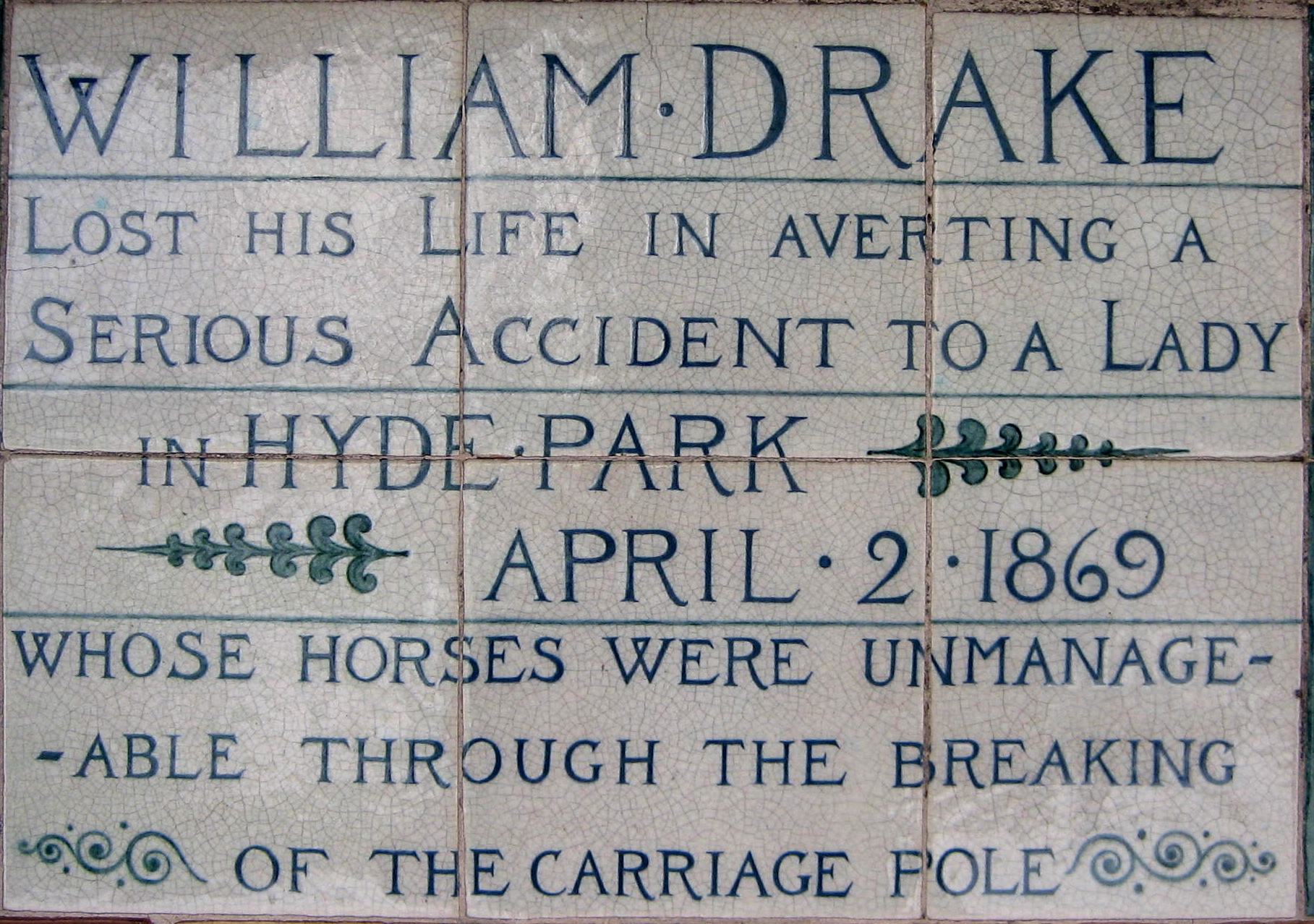
In 1900, the Victorian artist George Frederick Watts created a Memorial to Heroic Self-Sacrifice here, a wall of ceramic plaques with a lean-to shelter, commemorating those who lost their lives trying to save others. Undoubtably, it is a noble enterprise but I am not sure that my fascination with this strange Memorial is entirely noble. The Memorial is a catalogue of calamity, in which people meet their deaths in a variety of dramatic ways that induce awe and wonder. As you scan the plaques, taking in the fires, drownings, poisonings and other accidents, each appears more extraordinary than the one before, encouraging a certain morbid instinct that is innate to human nature. Before long, you are connoisseur of calamity and you have shuffled the plaques into a hierarchy of strangeness.
To my eyes,“Sarah Smith, the Pantomime Artiste at Prince’s Theatre, who died of terrible injuries received when attempting in her inflammable dress to extinguish the flames which had enveloped her companion, January 24 1863,” will always be in the limelight in death, just as she was in life, because of the theatrical nature of her demise which evokes those famous images of Loie Fuller, only with flames replacing the billowing dress. This Memorial, commemorating events that are reminiscent simultaneously of both the Final Destination movies and Hillaire Belloc’s Cautionary Tales, appeals to me because every plaque is an elliptical drama which allows my imagination scope to conjure the images and imagine the whole story for myself. Edward Gorey might have illustrated a handsome book picturing these memorable disasters.
Watts believed that his heroes provided models of exemplary behaviour and character but I think that this amassing of examples proposes a certain ambiguity. Inevitably, you ask yourself whether this is a Memorial to courage or to foolhardiness. You might even go further and suggest that these dramas illustrate the porous line between courage and stupidity, which by its nature is a fine distinction. I have brought people here to this Memorial who have been overcome with laughter at the outrageousness of it. The surfeit of tragedy tips over to become high comedy, like too many tabloid disaster headlines side by side.
Death spares no dignity, and a sewage works is an unfortunate place to drown just as an explosion in a sugar factory has undeniable bathos. Looking at the dates, which are primarily from the second half of the nineteenth century, you wonder if this was an especially dangerous time to live. Though, if you dwell on the Memorial further you cannot but conclude that life itself is dangerous, human existence is frail, and we live in a world where arbitrary accidents happen continously. All of which is quite normal and self-evident, as the news reminds us daily.
If the facts are sparse, as they are here, they can take on an unintentional significance when, for example, people are reduced to their professions. Police Constable George Funnell was a hero because he went back to rescue a barmaid after saving two others from a fire in Hackney Wick, which prompts the question – Was he a hero specifically because he saved the barmaid? Further questions arise with John Cranmer, a clerk for the London County Council, who rescued a stranger and a foreigner at Ostend. Is this stranger and foreigner, one or two individuals? And was it more or less heroic, to rescue a person (or persons) who was (or were), by implication, merely a stranger and a foreigner?
I do not wish to diminish the seriousness of these real tragedies that are only rendered bizarre by our distance in time and the unique context of their collective presentation. The many tragic deaths of children and young people recorded here speak poignantly across the years, Elizabeth Boxall of Bethnal Green, aged seventeen, who died trying to save a child from a runaway horse, William Donald the nineteen-year-old railway clerk who drowned in the River Lea saving a lad from “a dangerous entanglement of weed” and eleven year old Solomon Galaman who died of injuries after saving his little brother from being run over in Commercial St, “Mother I saved him but I could not save myself.”
My grandmother had a print of George Frederick Watts’ painting “Hope” in her dining room and it fascinated me as a child. Here was a woman, representing hope, blindfolded and swathed in a muslin dress, carrying a lyre with just one string, while sitting on a rock in the lonely ocean as the tide rose around her. It was an absurdly aestheticised image that spoke of hopelessness as much as hope. George Frederick Watts chose a certain moment in the narrative to present as “poetic”. If the sequence were animated, then the water would rise and the woman would struggle and die while fighting for her last breath. But the reality of drowning would not be a desirable image that my grandmother could put on her dining room wall to glance at each Sunday before she carved her joint of beef.
The same disconnect exists in this Memorial in Postman’s Park. There is an uneasy disparity between the notion of tasteful remembrance of individuals, who demonstrated lofty ideals of courage and self-sacrifice, and the absurd catalogue of real accidents. However, this disparity does not make these people any less heroic, it just reminds us of the untidy and undignified nature of death, over which we have little control, but which permits certain people to reveal brave spirits and sometimes get remembered for it too.
Be assured, I took extra care in crossing the busy streets as I walked back on my return journey through the City to Spitalfields.




Philip Pittack & Martin White, cloth merchants

When Charles Dickens visited this corner of London in 1851, he wrote an account of visiting a silk warehouse, so I was intrigued when Miss Willey of Old Town, told me about the last remaining cloth warehouse in Spitalfields, Crescent Trading in Quaker St run by Philip Pittack & Martin White, who describe themselves as clearance cloth merchants. Between them, these two agreeable gentlemen possess more than one hundred and twenty years of experience in textiles. Philip is the third generation to work in the industry and Martin’s mother’s family were in the same trade too.
Philip Pittack, the handsome fellow pictured above with the scissors, began working for his father at the age of fourteen, pursuing the same trade as his grandfather from a premises in Mare St, Hackney. Together they travelled around the country, buying up waste textiles from cloth mills and selling it on to be reconstituted and woven into new fabric. It was in effect recycling, before the term was invented. Fifty years ago, he moved into his current business, being a clearance cloth merchant, buying surplus from mills when too much was manufactured or when it came out the wrong colour. For the past eighteen years, he has been working in partnership with Martin White, operating out of an old stable block backing onto the railway, just of Brick Lane. When they opened here, there were as many as thirty other cloth warehouses in Spitalfields but today Crescent Trading is the only one.
These two men, Messrs Pittack & White, should be on the stage because they both have such a natural gift for repartee, keeping the funnies coming and flirting outrageously with all the fashion students and young designers that are their primary customers, and who are reduced to helpless giggles by the jovial routines. Ten years ago, Crescent Trading sold wholesale, no order less that £100 was accepted and they would not cut a roll of cloth, but today everyone is welcome. And, although Philip and Martin regret the scaling down of the trade, I can see that they enjoy the endless parade of youngsters who come through the door, eyes boggling at the possibilities offered by all this cloth.
Because Crescent Trading only deal in clearance, including clearance stock from their competitors’ warehouses elsewhere in London, this really is the cheapest place to buy fabric – while equally, much of it is excess from mills’ special orders, often for companies like Prada and Chanel, which means you can discover cloth of the highest quality that might not be available anywhere else, and much of it is manufactured in this country too. In fact, Crescent Trading is a key part of our local economy because this is where all the smaller fashion companies and designers-starting-out come, relying on being able to buy tiny amounts of superfine quality at rock bottom prices.
I was honoured to be invited into the inner sanctum of the office, a makeshift construction of a room with a wide window looking out onto the warehouse, a cosy homely place with worn carpet tiles, bottles of HP sauce, jars of cashew nuts, tabloid lovelies taped to the wall, a great big map of Britain with pins in it, Philip’s son’s graduation photo and collecting boxes for Jewish and other charities. This is where I enjoyed the privilege of a conversation with Martin White, who described himself as the Sorcerer of Fabrics. I hope Philip will forgive me if I say that Martin is unquestionably the more stylish of the pair, obviously taking a great deal of care with his appearance, quiffed grey hair, dark raincoat, monocle dangling and pearl tiepin glinting. Philip introduced his business partner affectionately thus, “Rather than sit at home, Mr White prefers to work, utilising his expertise in the textile industry.” which caused Martin to smile regally, raising his eyebrows with pride.
Describing his years in the trade from the pinnacle of his current position, Martin said, “I started in 1946, when there were still coupons on fabrics and I have seen all the changes since that time. I was dealing in fabrics, my mother’s family were always in the business. I started on my own buying and selling. There used to be a lot of cloth mills in this country then, producing woollens, cottons, silks and synthetics but now almost all of them have gone. There are no cotton mills anymore and just a few woollen mills. A linen mill we dealt with in Ireland sold all their looms to India recently. China will take over the textile industry because they can copy anything, but they will never be able to match the quality of wool suiting from the mills in Huddersfield and Bradford which is the best in the world, because of the water. You’ve heard of ‘the old mill by the stream’ ?”
At this point, a female customer arrived and Martin raced out to the warehouse floor, leaving me puzzling over this enigma. So I followed him, to witness the performance, entering mid-dialogue, “You look like an honest girl” quipped Philip, graciously. “I was told about these two charming gentleman,” replied the girl, holding her own creditably. “My friend told me about this brilliant place.” she added with a broad smile, rolling her eyes to take in the vast array of textiles piled in every corner. Then, before she could say another word, Philip turned to me with a gleeful smirk, spreading his arms in extravagant triumph at this spontaneous expression of the evidence of their own fabulousness, “Hear that – Out of the horse’s mouth!” Turning back in an instant to the woman with a theatrically subservient gesture, he said, “No offence intended to the young lady…” The apology was duly accepted with a quiet nod of appreciation and once the comedy overture was complete, and the participants were now as old friends, trading commenced, rolls of fabrics flew around, measured and cut into shape with expert grace.
The young woman sauntered from the warehouse in satisfaction at her unbelievable bargains, just turning at the door as she entered the Spring sunlight, to give a sentimental wave to the fine gentlemen who had made her afternoon. It was a wave reciprocated in unison by the comedy duo, who turned back to me rubbing their hands in satisfaction at the exchange, though I could not tell if it was due to the transaction itself or simply in delight at the social encounter, or both. It was a moment from a classic British sit-com.
I seized the chance to enquire about the specific quality of the water in the North of England that plays such a significant party in the exemplary quality of the wool suiting produced in Huddersfield and Bradford. My query was the cue for an elaborate charade in which Philip and Martin enacted each stage of the process of textile production, from the spinning of the woollen yarn, through the dying and the weaving, every aspect of which requires washing. “Even we don’t understand it,” admitted Philip with uncharacteristic modesty, “It’s like the whisky in Scotland, the water is everything.” taking the opportunity to show me the stack of crates of Springbank malt whisky from the Campbeltown distillery that is his personal supply, stowed in a discreet corner, as a tested and reliable method to keep warm in the bone-chilling climate of the old warehouse. “In Summer, people think we have air-conditioning,” declared Philip breezily, “but it’s just the eighteen-inch thick walls!” always looking on the bright side, even standing swaddled in his duvet coat, as we shivered together in the office that seemed even colder than the rest of the building, if that were possible.
As you may have already surmised, the next chapter in the history of Crescent Trading is already dawning, because the venerable building that makes such a beautiful cloth warehouse is to become a hotel and Philip and Martin have no choice but to leave in a matter of months. This is in spite of an undertaking by the powers-that-be that the area is zoned as for light industrial use, “Money talks and bullshit walks, if you pardon my French!” said Philip, in desultory summary of the circumstance. There is a possibility Crescent Trading can move across the road to a modern unit, with half the space at twice the rent, where maybe they could share with Paul Gardner, the paper bag seller, who is also under pressure to leave his building in Commercial St, where his great-grandfather James Gardner commenced trading as a Scalemaker in 1870.
The rise of the neighbourhood has given landlords an appetite to increase revenue from properties, but if as a result we lose crucial businesses (like Crescent Trading and Gardners) that support the unique small enterprises in the East End, then we destroy a community which gives the place part of its distinctive life. Over all the years, these dignified small tradesmen of Spitalfields have been earning a modest living while providing an essential service to many, and I cannot resist admitting to you that I feel they deserve better now.
In coming weeks, I will report developments in this story but in the meantime you can enjoy this lively short film about Crescent Trading by clicking here.

Bolts of superfine quality wool suiting.

Rolls of silk.

Martin measures out cloth.

The last pallet of silk in a warehouse in Spitalfields?

Happy Birthday, Edward Bawden!

Edward Bawden, the artist who made the famous linocut of Liverpool St Station that I featured last year, would have been one hundred and seven years old last week, and curator Bridie Hall made these cakes to celebrate the opening of the small retrospective exhibition in his honour at Ben Pentreath‘s tiny gallery in Rugby St off Lambs Conduit St, that runs until Saturday 20th March. Bridie is pictured here with Neil Jennings of Jennings Fine Art, co-presenter of this appealing show that has an intriguing variety of prints, paintings, books, posters and ceramics by Edward Bawden, Eric Ravilious and their contemporaries.
I often stop off in Rugby St when I am walking back to Spitalfields from the West End and I am always charmed by the unlikely collection of things you can find here, from antique mochaware, old enamel teapots and exquisite pieces of coral, to plastercasts, fine woodcuts and Pollocks Toy Theatre prints. With great imagination, Bridie turned the whole place into a Cabinet of Curiosities last Christmas and now to discover Edward Bawden’s works hung cheek by jowl among all the other stock creates a fascinating and sympathetic mixture.
The birthday party became a bun fight as hordes of enthusiasts descended upon the gallery to raise a glass of champagne and a slice of cake to toast Edward Bawden, and there was plenty to celebrate because his reputation has been steadily ascendant over recent years. Today, many contemporary artists readily acknowledged his influence, including Rob Ryan and James Brown, both of whom I have featured in these pages.
After the crowded party, I was happy to return, taking a stroll over to Rugby St on a quiet morning to meet Edward’s son Richard Bawden and his wife Hattie, who came up for the day from East Anglia to take in the show. Dressed in subtle tones of grey and brown, I recognised them at once, Richard in a grey herringbone tweed coat and sporting a white beard worthy of Don Quixote and Hattie with the deepest sharp blue eyes, like marbles.
Richard and I stood together, admiring one of the Curwen Press edition of Edward Bawden’s print of Smithfield Market from 1967, reproduced below, and he pointed out the drama between the figures in this picture, that his father was so adept at capturing. Apparently, Bawden cadged a lift off the local butcher in Great Bardfield in Essex, where he lived, travelling up to Smithfield early one morning to make sketches while the butcher loaded the van with meat. I know Smithfield Market well and I think the shade of pink Bawden chose in this print is especially evocative of the livid tone of carcasses of meat. Richard explained that his father used linocut to achieve a certain quality of edge to blocks of colour but then liked to have them reproduced by lithography because he preferred the finish, as in this example.
In common with the Liverpool St Station print, there is an interesting dynamic in the Smithfield print between the vast iron building and the people who inhabit the dramatic space it creates. The Liverpool St Station print was one of the largest linocuts ever made, almost six foot long, composed of multiple pieces of lino. Far too long for the press, Edward Bawden had to make the prints on the ground and invite art students to stand on the blocks to press them down. It was a small edition, because in 1967 no-one was interested in a huge print of a smoke-blackened Liverpool St, though recently one sold for £25,000.
I was delighted to meet Richard, who is a distinguished artist and printmaker in his own right, because I have one of his linocuts of a cat hanging in my house in Spitalfields. It has a wonderful sprung energy that I recognise in my cat, Mr Pussy – as if he has just arrived or is about to run off. You can see it below in contrast with Edward Bawden’s linocut of a cat, and this pair of feline images by father and son make a fascinating comparison that speaks both of the difference and the common qualities between the two artists. In Edward’s print, his homespun modernism is immediately apparent in the bold geometric lines that give his cat a strange alien quality, whereas the realism of Richard’s creature exists in relation to a historical tradition of printmaking that includes Thomas Bewick, demonstrating anatomical study. Both prints are full of poetry in different ways and are remarkable for their vivid graphic qualities, two top cats. As Richard observed, scrutinising a linocut by his father of a scene from Morte d’Arthur, commenting as if for the first time,“He could do so much with just black and white.”

Smithfield Market
 Edward Bawden’s cat
 Richard Bawden’s cat
A Raucous Party in Shadwell

My friend Anne Smith (who I met in Whitechapel last year, when she was wheeling her cat Oscar in a pram) took me to a party in Shadwell last Friday and photographer Sarah Ainslie came along too. A few weeks ago, I visited Anne in the small flat just off Cable St that she shares with her two docile cats Oscar and Cruella whom she likes to dress up in suits and ruffles. Anne is a free spirit with an instinctive sympathy for animals. And the preponderance of leopard and tiger skin prints on the soft furnishings, combined with the pet portraits, fluffy animals and the largest single fish I ever saw in a domestic tank, all in her living room, reflect Anne’s passion for our fellow creatures.
Once Cruella was comfortably installed in the pram, we set out for the community centre next door where there is a social gathering every Friday. On arrival, we were greeted by the master of ceremonies, John Wright, who shepherded us inside to join the happy throng. If you can imagine Larry Grayson, John Inman, Bruce Forsyth, Julian Clary, Paul O’ Grady and Graham Norton all morphed into a single individual, that would be John. With his resplendent blonde locks, immaculate manicure, easy charisma and relentlessly exuberant spirit, it is no exaggeration to say John is the life and soul of this party.
Everyone pays rapt attention to John’s mischievously blue humour and polished repartee, while he keeps everything moving along smoothly. After a career touring the world as a drag artist with his act “The Guys in Disguise”, John has now retired to bring a little necessary glamour to this quite corner of Shadwell, putting his years of professional experience to good use as host of this appealingly upbeat weekly afternoon of chatter, bingo and raffles. And it is much appreciated by the lively posse of local men and women who are under his spell, reciprocating John’s open-hearted affection with a loyal appreciation of his flamboyant rhetoric and idiosyncratic personality.
Many were making merry, quaffing ale, but I settled down to enjoy a quiet cup of tea and biscuits with Betty and Ted Rothon who revealed they have been married over sixty years, since they met when she was twenty-two and he was twenty-four. “We have lived in this neighbourhood over eighty years, our whole lives within a quarter of a mile. We are always together.” said Betty proudly, “We know no other life but we know everyone here!” Continuing enthusiastically, “I was a dress machinist in Ford Square. I started work on the Monday after I left school on the Friday. In the East End nearly all the girls were machinists making coats and dresses. I never got the sack from any job, and I still do it if anyone needs something altered. I worked with Ted’s sister, so when he came out the army, I started going with him and that was it. He was very handsome then and had lovely wavy hair…”
At this point, the conversation broke up into laughter as Betty qualified her statement, stroking Ted’s white hair and protesting that he retains his looks today. Then, with a broad grin, putting his arm around Betty to ease her blushes, Ted told me he worked at East India Dock, “Once upon a time nearly every man in the East End worked in the docks. I liked the friendly atmosphere.” The warmth of this engaging East End couple, still in love after all these years, was tangible.
Next I spoke with Ruby Gordon who came here as a youngster from Jamaica and worked for the “Daily Star”, then as a typesetter at a printing works, a hairdresser and teaching assistant. “I didn’t know anything about snow and smog until I came here,” she admitted to me, widening her eyes to illustrate her amazement, “You couldn’t see a hand in front of your face. I used to get lost in the smog sometimes.” Then with a vivid mime, re-enacting the experience, “You blew your nose and the cloth was dirty with soot from the coal fires.” she told me, shaking her head in amused disapproval. Ruby is a fine lady with a dignified style of her own, elegant features, coiffed hair and attractive gold teeth. It is a style indicative of a justly deserved self-respect, “I never stopped working since I came to this country,” she confessed with a weary smile.
My last conversation was with Doris Jeffrey. Just a few months short of ninety-four years old now, Doris was born in a Peabody flat round the corner that has seen four generations of her family. Full of life and droll understated humour, she looked a picture in her blue floral dress and red cardigan. When I enquired if she had a husband, Doris told me she had been a widow for forty years so I asked if she had ever thought of remarrying but Doris assured me she was quite happy on her own. Like Betty, Doris was also a machinist making clothes though nowadays, she confided, she has no-one left to sew for. Looking around the room and surveying the party, Doris explained to me authoritatively, “Most of the other people here have always lived in this area. It’s very central, convenient for the West End, and the streets are cleaner with better lighting these days. I wouldn’t move out of Shadwell now.” she said, summing it up with the thoughtful disclosure, “I think it grows on you.”
The time had arrived for John to commence calling the bingo numbers, in his distinctively amusing style, and all my interviewees were compelled to silence, concentrating upon their cards, hoping to win as much as four hundred and fifty thousand pounds that afternoon in the special currency that is exclusive to Shadwell.
Later, once the excitement of the day was over, Anne wheeled Cruella in the pram up Cable St, kindly accompanying me partway on my walk back to Spitalfields. But, as we said our goodbyes in Commercial St, I knew it would not be long before I should be paying a return visit back to Shadwell in the hope of meeting some more of the unique personalities that make these raucous Friday afternoon parties so special.


Photographs copyright © Sarah Ainslie
Columbia Road Market 26

Today, it was the busiest I have seen it early in the morning at the market this year and there was an equal increase in the variety of plants available too, which set my imagination racing. I was particularly attracted by the wide of perennials now available as seedlings and I deliberated over trays of Poppies, Erygium and Aquilegia, although there is still a keen edge to the wind, which instinctively caused me to withhold my enthusiasm for commencing Spring planting this weekend, in spite of the dazzling sunlight.
Meanwhile, for the past month, I have cast my eye each Sunday over the stalls selling all the varieties of Tulips and today, for the first time this year, I saw what I have been seeking, these Parrot Tulips. Only available for a few weeks of the year, these are one of my all-time favourite cut flowers, especially for an old house – evoking all those seventeenth century Dutch still-life paintings that dramatise the ephemeral nature of our existence with such grace. I love the lush extravagance of these Tulips’ rich silken colours and feathery pleated edges, getting even better as the languorous flowers open wide and the petals fall.
Remarkably, when I placed them on my sideboard, the morning sunlight collaborated with my painterly notion, delivering this phenomenal moving chiaroscuro, which caused the Tulips to open before my eyes, even as I was photographing them. And it led to me to wonder if many of those still-lifes were painted at this time of year when the Tulips come, and that maybe the distinctive quality of European sunlight in early Spring is itself part of the subject of these paintings?

Sandra & Dennis at The Golden Heart

On a Monday evening recently, Christ Church Spitalfields was alive to the sound of a big band playing show tunes. It was the night of the memorial arranged by Sandra Esqulant, landlady of The Golden Heart in Commercial St, to commemorate the life of her husband Dennis. They ran the pub together for over thirty years until he died a year ago. Sandra and Dennis’ friends and family were all present to pay tribute, supported by many residents of Spitalfields and, as I sat in the church while everyone was taking their seats, I wondered if there was anywhere else in London where the entire community would turn out in this way to celebrate their beloved publican.
Tracey Emin was the first to stand up and speak, affectionately recalling the first time she met Dennis, when he rescued her from the attentions of an unwanted admirer who mistook her for a prostitute. Expressing a sentiment shared by the majority in Spitalfields, Tracey closed her tribute with a declaration of the love commonly felt for Sandra among the populace here, who look to her as a community figurehead and inspiration. Kerry Phillips, one of Dennis’ contemporaries from his time working at the Truman Brewery, fondly recalled shared family holidays and confirmed Tracey’s story, describing Dennis’ ability to grab troublemakers by the scruff of the neck and eject them from the bar without even a break in the conversation. Then Stephen Craig spoke of running the marathon to raise £12,500 for the Dennis Esqulant Lung Foundation and a surgeon from St Bart’s collected the cheque on behalf of the cancer clinic, which drew emotional applause from the congregation.
True to Dennis’ reputation as a magnanimous host, the event concluded with drinks served in the church as the band played and guests mingled by candlelight beneath Hawksmoor’s awe-inspiring ceiling. It was the perfect culmination to a contemplative evening as both the volume and our collective spirits rose under the influence of a few glasses. And when the time came to leave, in a spontaneous gesture, Sandra distributed bunches of the vast number of white tulips that decorated the church to guests as they departed. Walking home through the dark streets with my tulips in hand, I realised the tribute had been conceived with a great deal of care and passed off with a relaxed professionalism that was entirely characteristic of Sandra.
Over the year since Dennis died, Sandra has worn black as an expression of her mourning and everyone in Spitalfields has empathised with the depth of her grief, because over all these years we have grown used to her as our inspired mistress of ceremonies at The Golden Heart. Until this year, we thought of Sandra as the woman who knew better than anyone else how to throw a party and who could always be relied upon to crack open an unexpected bottle of champagne on cue. Consequently, while we share her loss, we have been doubly saddened to see her brought down. We cherish Sandra for her hula-hoop dancing on the traffic island in the middle of Commercial St and for returning to the pub after an event in the West End with Elton John’s backing dancers in tow, to dance upon the bar in full costume at her invitation.
It was a week after Dennis’ memorial when I went round to The Golden Heart late one afternoon to have a quiet chat with Sandra at the fireside in the back bar before the evening’s trade got underway. “Me and my family are especially grateful to the Sisters of Charity and Father Tom of St Mary & St Michael who have given us so much support.” Sandra told me, describing the solace she has received from the counsel of those at the church in Commercial Rd where she and Dennis were married.
“Dennis worked in the brewery and understood the brewing process. He knew everything, particularly about his bitter. Fundamentally, it was one big family, the draymen to the company directors used to drink in here.” she recalled warmly, indicating the direction of the Truman Brewery that closed in 1989. “When we were first married we used to open at six in the morning for the market.” she added, with a glance in the direction of the Spitalfields Fruit and Vegetable Market that closed in 1991. During the lean years following these closures, it was Gilbert & George who were the first artists to bring their patronage to The Golden Heart, thereby initiating the new identity for the pub that it enjoys today, as a magnet for young artists to whom Sandra graciously extends her maternal affection.
Turning her gaze back to the fire, Sandra’s thoughts returned to Dennis, still troubled by the cancer that afflicted him, “I protected him from so much but I couldn’t protect him from that. It’s heartbreaking to see someone you love go like that. Where does this disease come from? I don’t know.” After a silence, she raised her eyes to mine,“We had so many fabulous times in the past, not many people have that.” she said, reminding herself of the salient truths,“I brought up our three children here and they turned out all right.” Then, as if on cue, Sandra’s daughter Kate appeared, she had been watching the bar during our conversation, and has shown dignified resilience through this whole episode.
It cannot be easy leading your life in public and with the relentless imperative to open every day, but Sandra’s answer to this challenge is simple,“I work very hard because I love people.” she said plainly. Then our brief conversation was necessarily at an end because she had to go upstairs and make steak pie for her dinner, a modest notion which nevertheless appeared to fill Sandra with an enthusiasm and delight, indicative of the spiritual consolation of familiar meals.
A few days later, I was back at The Golden Heart to celebrate an art opening and as she came round to our table collecting glasses, Sandra’s eye fell upon a collapsible top hat belonging to a friend of mine. She could not restrain herself from taking the silk topper in hand and causing it to spring back into shape in an instant, with the necessary flick of the wrist and a sophisticated grin worthy of Liza Minelli. In this playful act, itself a tiny moment of happiness, I realised something had changed now and I had been granted a glimpse of the old Sandra we have all missed so much.













