
Paul Bommer, illustrator & printmaker

A mysterious tube arrived unexpectedly in the mail last week. Inside was a screenprint by illustrator Paul Bommer of the old nursery rhyme “Oranges & Lemons.” You may recall I wrote about Richard Ardagh and Graham Bignell’s version using nineteenth century wooden type, so I was fascinated to see Paul Bommer’s take on this venerable rhyme. Paul sent me a copy of the large print he has made in attractively gaudy colours of orange and blue with sixteen images in squares, reminiscent of a chapbook or a child’s alphabet chart, filling each square with clever notions. The work has a lively graphic texture with bold areas of flat colour and vigorous compositions of figures within squares that remind me of the Beggarstaff Brothers, only a lot funnier and more pop.
“I am passionate about London, especially the things that people don’t usually see, but which bring lost worlds to life. I love the fact that in Bishopsgate there are still old alleys like Rose Alley and Catherine Wheel Alley from Shakespeare’s time.” Paul declared to me, his eyes widening in delight, when we sat down for a quiet cup of tea in my garden yesterday. Now, he describes himself as “a London boy,” but says,“I didn’t feel I was in London,” speaking of when he grew up in Wembley. In those days, he recalled “coming into London,” when he was brought on trips, as a child, to the West End. Today, I think of Paul as a distinctive East London character, someone I am always delighted to greet in the street, always full of jokes and stories and good ideas.
As a busy and successful illustrator, with a jaunty bemused attitude, a pocket watch and a handsome flat cap, Paul is reliably clothed in a certain appealing mode of old school proletarian dapper. He is an artist who inhabits the universe of his pictures. Looking as if he has stepped from one of his drawings, or rather, as if his drawings record the world he has stepped from, where everyone dresses like Paul and his clothes and drawings are the evidence of it. Most importantly, Paul has the bravura to carry it off with ease. In fact, I could never imagine Paul dressed any other way.
Paul is a member of The Print Club in Dalston, a collective of artists for screenprinting. As part of Pick Me Up, the graphic art fair at Somerset House where I visited Rob Ryan, Paul was invited to design a print to be printed live at the event. He picked “Orange & Lemons,” reflecting his interest in London history and because St Clement Danes is next to Somerset House in the Strand. He chose to illustrate an earlier, more idiosyncratic, version than the one everybody knows. Suiting his purpose, this variant of 1830 has more arcane poetry, more verses – allowing more scope for pictures – and includes more East End churches too.
“Gay go up & gay go down to ring the bells of London Town
Bull’s eyes & targets say the bells of St Marg’rets
Brickbats & tiles say the bells of St Giles
Halfpence & farthings say the bells of St Martins
Oranges & lemons say the bells of St Clements
Pancakes & fritters say the bells of St Peters
Two sticks and an apple say the bells of Whitechapel
Old father bald pate say the slow bells of Aldgate
You owe me ten shillings say the bells of St Helens
Pokers & tongs say the bells of St Johns
Kettles & pans say the bells of St Annes
When will you pay me? say the bells of Old Bailey
When I grow rich say the bells of Shoreditch
Pray when will that be? say the bells of Stepney
I am sure I don’t know says the great bell of Bow
Here comes a candle to light you to bed
Here comes a chopper to chop off your head”
Illustrating each of the chimes, Paul referenced the history of the parish in each case, through exercising a cunning mixture of detective work and imagination. He discovered that “Old father bald pate, say the slow bells of Aldgate,” refers to images of a tonsured St Botolph, the patron saint of travellers. Churches were often dedicated to St Botolph at points of departure and arrival, which is why there are several in the City of London. “Pokers & tongs say the bells of St Johns,” St Johns is the chapel in the Tower of London, and the pokers and tongs refer to torture. “When will you pay me? say the bells of Old Bailey,” the Old Bailey was the debtor’s prison, Newgate. These chimes are each rooted in different historical realities of the City.
On a more personal note, Paul told me his mother’s aunt was born in a ship off India but was registered as being born in Stepney, as all British people born at sea were at that time. So, for “When will that be? say the bells of Stepney,” Paul has chosen to illustrate the sailor’s farewell, in accordance with the maritime association of that parish. To Paul, “When I grow rich say the bells of Shoreditch,” is an example of London irony, the wry pathos of poverty. A young illustrator looking at old London, he has producing an ingenious work that is fresh and new, yet done with affection and wit, and I shall enjoy having it on my wall now for a long time to come.
A few copies of Paul Bommer’s “Oranges & Lemons” are still available from The Print Club


Paul studies a copy of “The Cries of London”.
On the rounds with the Spitalfields milkman

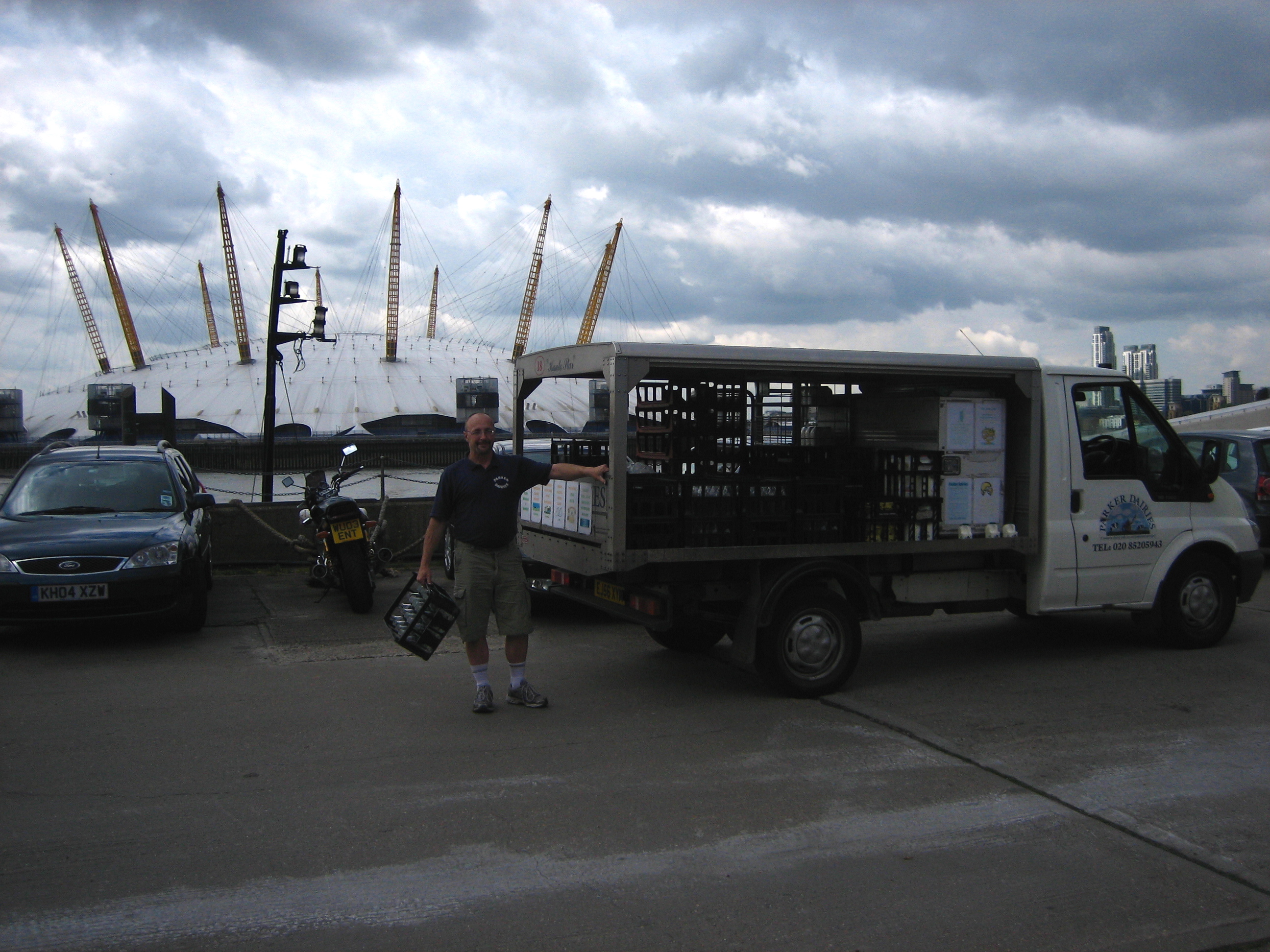
Dawn has broken over the East End and there goes Kevin, the agile milkman, sprinting down the street with a pint of milk in hand. With enviable stamina, Kevin Read gets up at two thirty each morning, six days a week, and delivers milk in a round that stretches from the Olympic Park in the East to Hoxton Square in the West, doing the whole thing on the run.
The East End is a smaller, more peaceful place in the morning, before all the people get up, and I was inspired to see it through Kevin’s eyes, when I joined him on the round yesterday at four thirty. As we careered around the streets in the early sunshine, travelling effortlessly from one place to another down empty streets that are Kevin’s sole preserve for the first three hours of daylight at this time of year, landmarks appeared closer together and the busy roads that divide the territory were quiet. Kevin’s East End is another land, known only to early birds.
“I never look at it as a job, it’s my life,” admitted Kevin, still enthusiastic after thirty years on the rounds. “Born in Harlow. Educated in Harlow. Top of the class at school. Bunked off at fourteen. Failed all my exams. Moved to London at fifteen. Started as a rounds boy at the Co-op Dairy, just at weekends until I got a proper job. Left school at sixteen. Junior Depot Assistant at Co-op, swept yard, parked milk floats and made coffee for the manager. Don’t know what happened to the proper job!” said Kevin with a shrug. It was the prologue to the story of Kevin’s illustrious career, that began in Arnold Circus, delivering milk to the Boundary Estate in 1982, where he ran up and down every staircase making a long list of calls for each block. Today, Kevin still carries his vocabulary of Bengali words that he picked up then.
In the intervening years, an earthquake happened. The Co-op Dairy was bought by Express Dairies, then Kevin worked for Unigate until that was sold to Dairy Crest, next working for Express Dairies until that was also sold to Dairy Crest, and finally working for Hobbs Cross Farm Dairy until they went out of business. Quite a bumpy ride, yet Kevin persevered through these changes which included a dire spell in the suburbs of Chingford. “They complain if you put the milk on the wrong side of the doorstep there!” he revealed with caustic good humour, outlining a shamelessly biased comparison between the suburb and the inner city streets that were his first love.
While we drove around in the dawn yesterday, Kevin told me his life story – in between leaping from the cabin and sprinting off, across the road, through security doors, up and down stairs, along balconies, in and out of cafes, schools, offices, universities and churches. No delivery is too small and he will consider any location. Yet it is no small challenge to work out the most efficient route each day, taking into account traffic and orders that vary daily. Kevin has two fat round books that describe all the calls he must do, yet he barely opens them. He has it all in his head, two hundred domestic calls (on a system of alternating days), plus one hundred and thirty offices, shops and cafes. “A good milkman knows how to work his round,” stated Kevin with the quiet authority of a seasoned professional.
Setting a fierce pace, always quick, never hurried, he was always thinking on his feet. With practiced dexterity Kevin can carry six glass bottles effortlessly in his bare hands, with the necks clutched between each of his fingers. He makes it all look easy, because Kevin is an artist. The wide chassis of Kevin’s diesel milk float permits him to cross speed bumps with one wheel on either side – avoiding chinking milk crates – if he lines up the float precisely, and during our seven hours together on the round, he did it right every time.
Yet, before he embraced his occupation, Kevin rejected it. When the industry hit a bump, he tried to find that “proper job” which haunted him, working in a kitchen and then a bakery for three years. But one day he saw a milk float drive by the bakery and he knew his destiny was to be in the cabin. Taking a declining round on the Cattle Road Estate, he built it up to hundred calls, and then another and another, until he had five rounds with four milkmen working alongside him. A failed marriage and an expensive divorce meant he had to sell these rounds, worth £10,000 a piece, to Parker Dairies. But then in 1999, the dairy offered him his old territory back – the East End. “I realised the only time I was happy was when I was working for myself,” confided Kevin with glee, “It was my favourite round, my favourite area, my favourite pay scheme, commission only – next to my first round Arnold Circus! The best of everything came together for me.”
But, returning to East End, Kevin discovered his customers had become further apart. Where once Kevin went door to door, now he may have only one or two calls in a street, and consequently the round is wider. Between three thirty and eleven thirty each morning, Kevin spirals around the East End, delivering first to houses with gardens and secure locations to leave milk, then returning later to deliver milk to exposed doorsteps, thereby minimising the risk of theft, before finally doing the rounds of offices as they open for business. During the day Kevin turns evangelical, canvassing door to door, searching for new customers, because many people no longer realise there is a milkman who can deliver.
Kevin is a milkman with a mission to rebuild the lost milk rounds of the East End, and he has become a local personality in the process, celebrated for his boundless energy and easy charm. Now happily settled with his new partner, whom he met on the round, he thinks he is delivering milk but I think he is pursuing life.
If you want Kevin to deliver milk or yoghurt or eggs or fresh bread or dogfood, or even compost, to you, contact him directly by phoning 07940095775 or email kevinthemilkman@yahoo.co.uk


Steve Benbow, Beekeeper at Tate Modern

This is my pal Steve Benbow, the enterprising urban beekeeper, tending his newly installed hives upon the roof of Tate Modern. You may recall last year Steve was appealing for homes for bees through Spitalfields Life. One enterprising reader forwarded the story to the trustees of the gallery and, as consequence, Steve now has bees on the roof of Tate Modern, with hives shortly to be installed upon the roof of Tate Britain too. At present, there are just six hives, but if all goes well the number will grow and you will be able to buy jars of honey from the gallery shop.
Ten years ago, Steve who runs the London Honey Company, had a regular stall in the Spitalfields Market selling the honey he produces in the city. In those days, the notion of urban honey was a curiousity but events have caught up with Steve. Today, with the crisis in the bee population, Steve’s mission to install beehives in the city has acquired a pertinence that everyone recognises. Bees need all the help they can get, and Steve has become the visionary beekeeper who saw the possibility for bees in the city before anyone else did.
I joined Steve on his weekly trip to service the bees on the roof of Tate Modern, last week. As we cleared security and made our way up to the roof in the elevator, Steve was eager to discover if any of his bees had absconded. On his previous visit, he had seen tell-tale signs in one hive, the formation of queen cells in a queenless hive and no eggs. If unchecked, these indicators could lead to the swarming and departure of the bees. So, producing a small transparent box from his pocket, Steve showed me the new queen he had brought from Wales to introduce to the hive in question and restore harmony – much to the fascination of the members of the Tate Gallery staff who were sharing the elevator with us.
Once we were out of the elevator, carrying our beekeeping paraphernalia, we walked along a white corridor up in the roof, entered a door and passed through a plant room to come out into an even narrower space at the rear of the building, high above the turbine hall. A line of glowing translucent windows stretching into the distance emitting warmth absorbed from the sunlight outside, and we followed them until we came to a room where Steve keeps his locker of beekeeper’s garb. You might think that Steve, the Professor Branestawm of beekeepers, might feel at odds in such a vast sterile environment, but with raffish charisma, he delights in the anachronistic irony of pursuing his chosen profession in the modern city.
Suited up like astronauts, we opened one of the translucent panels with an ominous caution sign warning of bee stings and walked onto the roof. Looking through the gauze of my hat, I craned my head to find the chimney to orientate myself, before Steve led me over to the South East corner of the roof, where in a sheltered well sat the first six hives. This was high-rise living for bees, and down below I could see the gardens and trees of Bankside, that would sustain them. With his hive tool, Steve prized the crown off the first hive, injecting smoke to subdue the bees and instructing me to stand on one side while taking photographs, to avoid blocking the flight path of the bees entering the hive and drawing their wrath. It was good advice, because the unseasonal cold temperature and high winds made the bees grumpy. They circled petulantly around Steve as he disassembled the hive.
A hive comprises a stack of boxes, each of which serves a different function. Under the crown sits the feeder box filled with straw, then the crucial honeybox with a mesh at the base, which serves as an excluder to keep the queen in the brood chamber below. The hives had only been on the roof a few weeks, so Steve pulled out the racks in the honeyboxes to check progress. None of the bees had absconded. Satisfied with the evidence, he shuffled some of the racks between the hives to encourage the bees and discovered the formation of the very first Tate Gallery honey.
I have never been in such close proximity to bees and it was a curious novelty to stand among a cloud of them. A novelty that disintegrated entirely when a grumpy bee got inside my hat. Returning from extricating the bee, I found Steve with his gloves off, introducing the new queen into the queenless hive with his bare hands. At first horrified, I recalled I had once been told that bees do not sting the keeper, but Steve dismissed this myth, “I get stung loads,” he admitted philosophically. Carefully placing the queen among the nurses, Steve ensured she would be cared for and not exposed to the other bees immediately. More than proprietorial, Steve is tender and respectful with his bees, though he was also capable of being unsentimental too, when it became unavoidable to kill those we found harboured in our protective suits later.
For the rest of the Summer, Steve will visit his hives weekly, buzzing around London in an endless circular journey that mimics the path of his bees. Almost always cheerily on the run between one place and another, he follows his relentless occupation that offers no rest for the indefatigable worker bee.
Steve is still looking for new sites in the East End for his bees, large gardens, yards or rooftops, secure locations where owners will permit him to install hives and have regular access to service the hives – with rent paid in jars of honey. If you can help provide homes for Steve’s bees please email steve.benbow@btinternet.com


Columbia Road Market 35

This week at Columbia Rd, I was looking for some plants to add detail to a border at the edge of the expanse of pebbles in my garden and I discovered this Veronica Gentianiodes Variegata for £3. It has a sprightly arch to each stem, with flourishes of modest creamy white flowers that possess fine blue stripes, and long variegated leaves. My other purchase this morning was this Phlox Subulata Candy Stripes with irresistibly effervescent pink and white striped flowers. It cost £6 for a large specimen from David Williams, who supplied both of today’s discoveries and is always a reliable seller of healthy and vigorous plants. This Veronica and Phlox are perennial varieties that grow close to the ground, and I hope they will spread to form ground cover at the front of the beds, spilling out across the shingle path. In my tiny Spitalfields garden, I need plants that draw the eye closer and both these flowers reward examination with their delicate stripes and intriguing details.

Mohammed Tayyab, restauranteur

For many years now, I have been walking down Fieldgate St regularly to enjoy the spicy lamb chops which are my favourite dish at Tayyabs in Whitechapel. My heart always leaps with delight to see the waiter carrying the sizzling iron dish upon a wooden tray, weaving his way through the crowded restaurant towards my table, laden with a satisfying pile of these spectacularly delicious chops that leave my mouth singing with a thousand spicy flavours for the rest of the night. As time has passed Tayyabs has grown and grown as fast as its reputation has risen, acquiring more and more premises, stretching down Fieldgate St, while the lines have lengthened too, but the lamb chops have remained consistently brilliant.
This week, it was my pleasure to walk down Fieldgate St and, after all this time and so many lamb chops, finally shake the hand of the unsung genius behind the celebrated Punjabi restaurant that is pre-eminent in the East End – Mohammed Tayyab himself, who founded the restaurant more than thirty years ago.
I love the drama of Tayyabs. First you join the garrulous line of hungry customers waiting for tables, then you cast your eyes upon the diners preoccupied by the intense culinary experience that this food delivers, becoming even more ravenous at the sight of others eating. Then, once you have been assigned a table, you walk through all the separate properties that have been joined up to create the restaurant, until you reach the former Queen’s Head public house, where you turn right. Here you get a glimpse of the kitchen in the far distance, through a helter-skelter of waiters running to deliver the dishes, especially the sizzling lamb chops, as fast as they can. If you want to go somewhere and feel at the centre of life, this is a wonderful place to come. The cacophony of sound and the variety of spices drifting in the air add up to an intoxicating disorientation of the senses. Yet, even if it may seem like chaos at first glance, there is an exquisite harmony to it all.
Mohammed Tayyab’s three sons run the business today, Aleem manages operations jointly with his brother Saleem, while eldest son Wasim is the head chef. Aleem welcomed me and ushered me into the private dining room for a brief audience with the great man himself. Mohammed cuts a delicate figure these days, a man of slight structure with benign lively eyes and fine nimble hands. In fact, I recognised him from my previous visits, but such is the modest presence and retiring nature of this remarkable man, I should never have guessed that he was the proprietor. Yet the combination of his undemonstrative demeanour and sharp eyes permit him to notice every detail of what is going on and, although his presence is quiet, there is a shrewd intelligence to the man. I have no doubt he has opinions. Placid and fulfilled now, Mohammed Tayyab let his son Aleem talk on his behalf, nodding and smiling at the salient points in the telling of his story, familiar through affectionate retelling within the family circle.
In my portrait of Mohammed, you can see, over his shoulder, an image of his diffident younger self, when he set out bravely as a young man to come to London in 1964, leaving his wife and three daughters behind in Pakistan. Since he would be alone in a foreign land and fending for himself, his mother taught him how to cook before he left. He learnt to prepare the traditional Punjabi food that sustained his family, so that he could feed himself while working in the garment trade in London. No-one could have realised then, that these modest cookery lessons would become the basis of the family’s fortune and the future menu of one of London’s most celebrated restaurants.
When he arrived in 1964, Mohammed lived just across the road in Fieldgate Mansions in a tiny flat that he shared with other Pakistani garment workers, who all worked long hours together in the sweatshop at Victor & Mark’s factory, quilting and stitching, at the top end of Fieldgate St. Everyone took turns to cook, but I am told that they all looked forward to Sundays when Mohammed cooked the dishes his mother had taught him in Pakistan. In those days, there was a newsagent and a cafe upon the location of the current restaurant where Mohammed bought his newspaper and a cup of tea each day.
One day, when the cafe closed down, Mohammed decided to take it over, but such was the modest nature of his beginning, that he only had two loaves of bread and tea when he opened. Tea and toast was the extent of the menu in Mohammed Tayyab’s first culinary enterprise. It could not have been plainer. Before long, he expanded to serve breakfasts, but he always made a bowl of curry for himself at lunchtime, just as his mother had taught him in Pakistan. Once the customers smelled Mohammed’s curry, everybody wanted some, and soon he was doing a roaring lunch trade in curries. Bangladeshi and Pakistani people came at first, but before long doctors and nurses from the Royal London Hospital became regular customers too.
Mohammed’s wife arrived from Pakistan to join him in 1970 and once the family was reunited, she worked alongside him, making chapatis while he made curry. The three daughters helped in the cafe too and as the years passed Mohammed and his wife had three sons, who grew up working in the cafe, after school and during holidays. “Once Saleem got old enough, he trained my brother, showing him all the secrets.” explained Aleem proudly, introducing the fifteen year apprenticeship that each of the brothers served, mastering the art of curry. It was a statement that Mohammed himself qualified sagely with an incontrovertible wider truth, looking me straight in the eye, he declared, “Everyone in my family knows how to make a curry.”
“My dad comes in everyday and keeps an eye on us,” revealed Aseem deferentially, with an indulgent smile, because although Mohammed still presides, his sons oversaw the expansion in the nineteen nineties to become the large-scale operation it is today. The particular Punjabi cuisine that is the success of their restaurant, also manifests the cultural essence of the Tayyab family. Celebrating Tayyabs, we celebrate the unified identity of this family and their food, that are one and the same.


Beating the Bounds in the City of London

Yesterday, I joined my old friends from the Lord Mayor’s Parade, the Portsoken Militia, along with a host of City worthies and the children of Sir John Cass Primary School at the annual Beating of the Bounds ceremony, setting out from St Botolph-without-Aldgate to walk the boundaries of the Portsoken ward in the City of London. As we set forth with the Ward Constable in front, followed by the Beadle leading the Potsoken Millitia and the Aldermen of Portsoken, ahead of the mass of schoolchildren straggling along at the rear, we made an unlikely procession, but one impressive enough to stop the traffic, cause every office worker to reach for their camera phone and generally bring the City to a halt around us.
First stop was Mitre Square, where a bunch of tourists on a Jack the Ripper tour had the shock of their lives as we all came round the corner, walking out of history with a mob of children in tow. “Get your cameras ready!” quipped the Ward Constable, with a smirk of pride, occasioning a dramatic moment seized by Laura Burgess, the Rector of St Botolph, to announce the first stop on our circuit, causing everyone to gather round in a crowd.
There is a curious mixture of civility and anarchy about the Beating the Bounds ceremony, held annually on Ascension Day, which the Rector explained dates from a time when maps were rare and the community joined together to mark the boundaries of the parish, and to pray for God’s blessing to ward off evil from the territory. Civility is represented by the dignitaries and anarchy is introduced when the children are handed sticks and given liberty to use them. Although, in the absence of boundary stones, lampposts, bollards, signs, railings and a wall had to stand substitute, none of the children seemed disappointed. Without hesitation, they all embraced the absurdity of this extraordinary moment, in which the adults distributed long sticks and stood around in approval, as the children worked themselves up into a state of great excitement, battering the designated inert objects with gleeful enthusiasm. In fact, I can confirm a proud consensus held by the adults present that the children all played their part well.
Naturally, there is a certain necessary ritual that precedes this invitation to violence. In each location, as a precursor, the Rector delivered a brief history lecture followed by a quiet prayer. Then the Alderman gave the instruction, “Now let us beat this boundary!” and everyone chanted “Cursed be he that removeth his neighbours’ landmark.” while wielding their sticks, and the children cried, “Beat! Beat! Beat!”
We moved on swiftly through Devonshire Place, Petticoat Lane, across Aldgate High St, down to Portsoken St, St Clare St and back up the Minories to St Botolph’s Church in an hour’s circuit, stopping off for the ritual beatings as went. As the journey progressed, the various constituencies in our procession mingled, acknowledging that we were fellow travellers upon some kind of pilgrimage with our particular chosen purpose, that set us apart from the present day world around us. During the Rector’s history lectures we all nodded in reverence to the waves of immigrants in Petticoat Lane, the memory of Wat Tyler and the Peasants’ Revolt, in whose footsteps we trod when in Aldgate High St, and William the Conquerer, who entered the City through Portsoken St and is known to this day here as William I, because he negotiated a truce with the City of London, he did not conquer it.
Arriving back at St Botolph, the children were invited to beat upon the churchyard railings one last time, and then the sticks were summarily removed from their sweaty hands and locked away in a vestry cupboard until next year, before the possibility of any improvised high jinks could occur.
When the children went home, the adults, who were now feeling rather playful – catching the infectious holiday spirit engendered by all the excited children – had their pictures taken on the steps of St Botolph. This was followed by tea and iced cakes inside and, for the duration of the party, the atmosphere was of a parish tea in a small village. The bounds had been truly beaten for another year. We were celebrating. We all felt we have achieved something, although no-one quite knew what. Children and adults together, we had left our daily routines for an hour and shared our delight in the romance of the great city, enacting a ritual that drew us closer to each other and to all those who went before.
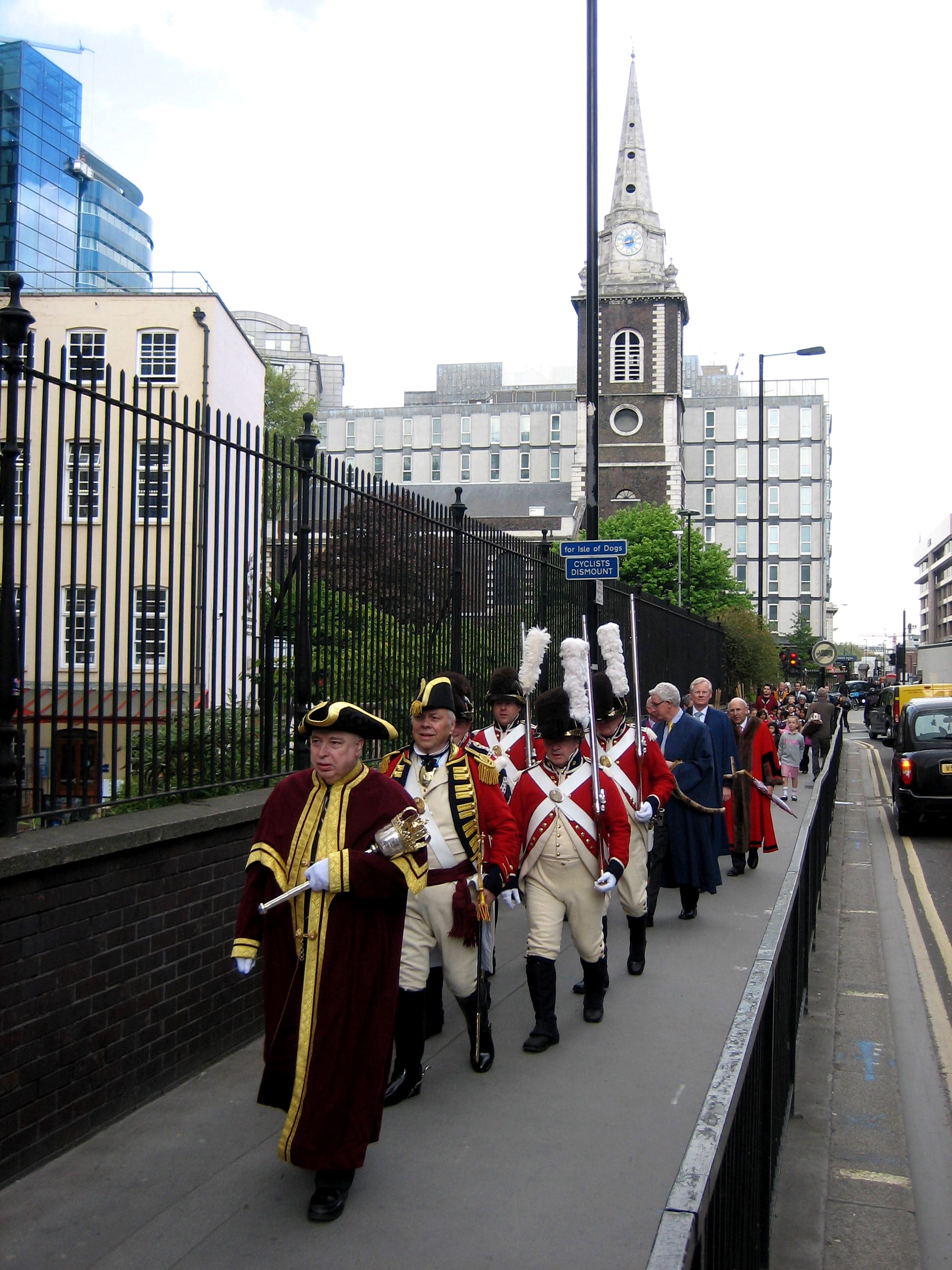


Brian Buckington, the Commanding Office of the Portsoken Militia, enjoys a well deserved cup of tea, served by the ladies at St Botolph without Aldgate, after leading his troops around the City of London.
Spitalfields Antiques Market 8

This is Harvey Derriell, a lean and soulful Frenchman of discriminating tastes, and a connoisseur of tribal art from West Africa, with his prized collection of sculptures, textiles and beads, including my own personal favourite, chevron trading beads. “Fourteen years ago, I went to Mali, and I fell in love with the place and the people and I wanted to return. Now I go back four times a year.” revealed Harvey, brimming with delight. I was dismayed to learn that the Golonina bead market is closed but Harvey reassured me that beads are still to be found. “In Bamako, they ask ‘What do you want? Drugs, gold, diamonds, girls, boys or beads?’ “ he explained.

This is Anna Karlin who is moving to New York and selling off all her things before she departs these shores permanently. “I still have a house full!” she admitted with a cheerful shrug, carefree yet shivering in the May sunshine, as she pulled the blanket round her, in unconscious evocation of the woman in Ford Madox Brown’s painting of nineteenth century emigrants The Last of England. Anna is a designer who is moving from Hackney to Manhattan’s fashionable Lower East Side, so once she has disposed of her things here, she can go to the Chelsea Flea Market each Sunday in the West Village and start all over again.

This dignified fellow is Alex McHattie, a book dealer, who has been trading in markets on and off since 1978. “I’ve had jobs in between but I always come back to having a stall,” he confided to me with a gentle smile, acknowledging the intangible magnetism of the market place that everyone here recognises. A quietly cultured man, I have no doubt Alex has read every volume in his fascinatingly varied stock, which he characterised tersely as, “Mainly arts books, illustrated literature, and a few pieces of junk.” – revealing that Alex has mastered both the appealingly droll understatement and the cool learned aura, which distinguish nobility among the second-hand book dealers of London.

This is Elizabeth Bartley who deals in jewellery and old tins.“It’s a good thing to buy things you like and hold onto them for a while before passing them on,” explained this generous-spirited Australian woman, who teaches children with special needs for three days every week. Holding up a sparkly nineteenth century ring with stones in the shape of a heart, she used this to illustrate “the sentiment that is attached to things,” which touches her. Every single thing on Elizabeth’s stall has particular meaning for her personally, especially the commemorative biscuit tins that people treasured once, yet have become disposable items today.
Photographs copyright © Jeremy Freedman












