
C.A.Mathew, Photographer
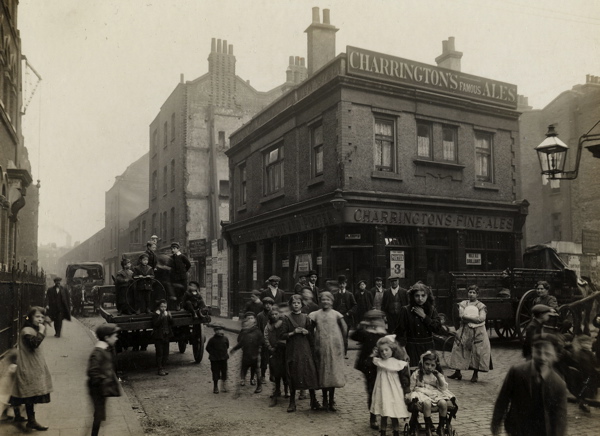
In Crispin St, looking towards the Spitalfields Market
On Saturday April 20th 1912, C.A.Mathew walked out of Liverpool St Station with a camera in hand. No-one knows for certain why he chose to wander through the streets of Spitalfields taking photographs that day. It may be that the pictures were a commission, though this seems unlikely as they were never published. I prefer the other theory, that he was waiting for the train home to Brightlingsea in Essex where he had a studio in Tower St, and simply walked out of the station, taking these pictures to pass the time. It is not impossible that these exceptional photographs owe their existence to something as mundane as a delayed train.
Little is known of C.A.Mathew, who only started photography in 1911, the year before these pictures and died eleven years later in 1923 – yet today his beautiful set of photographs preserved at the Bishopsgate Institute exists as the most vivid evocation we have of Spitalfields at this time.
Because C.A.Mathew is such an enigmatic figure, I have conjured my own picture of him in a shabby suit and bowler hat, with a threadbare tweed coat and muffler against the chill April wind. I can see him trudging the streets of Spitalfields lugging his camera, grimacing behind his thick moustache as he squints at the sky to apprise the light and the buildings. Let me admit, it is hard to resist a sense of connection to him because of the generous humanity of some of these images. While his contemporaries sought more self-consciously picturesque staged photographs, C.A.Mathew’s pictures possess a relaxed spontaneity, even an informal quality, that allows his subjects to meet our gaze as equals. As viewer, we are put in the same position as the photographer and the residents of Spitalfields 1912 are peering at us with unknowing curiosity, while we observe them from the reverse of time’s two-way mirror.
What is immediately remarkable about the pictures is how populated they are. The streets of Spitalfields were fuller in those days – doubly surprising when you remember that this was a Jewish neighbourhood then and these photographs were taken upon the Sabbath. It is a joy to see so many children playing in the street, a sight no longer to be seen in Spitalfields. The other aspect of these photographs which is surprising to a modern eye is that the people, and especially the children, are well-dressed on the whole. They do not look like poor people and, contrary to the widespread perception that this was an area dominated by poverty at that time, I only spotted one bare-footed urchin among the hundreds of figures in these photographs.
The other source of fascination here is to see how some streets have changed beyond recognition while others remain almost identical. Most of all it is the human details that touch me, scrutinizing each of the individual figures presenting themselves with dignity in their worn clothes, and the children who treat the streets as their own. Spot the boy in the photograph above standing on the truck with his hoop and the girl sitting in the pram that she is too big for. In the view through Spitalfields to Christ Church from Bishopsgate, observe the boy in the cap leaning against the lamppost in the middle of Bishopsgate with such proprietorial ease, unthinkable in today’s traffic.
These pictures are all that exists of the life of C.A.Mathew, but I think they are a fine legacy for us to remember him because they contain a whole world in these few streets, that we could never know in such vibrant detail if it were not for him. Such is the haphazard nature of human life that these images may be the consequence of a delayed train, yet irrespective of the obscure circumstances of their origin, this is photography of the highest order. C.A.Mathew was recording life.
Looking at these pictures makes me want to be there with C.A.Mathew, exploring these alleys and byways of old Spitalfields. So now I am going to take my camera, walk out of door and through these same streets in the footsteps of my new acquaintance, to revisit the places he photographed, taking my own pictures to allow you a comparison. And tomorrow you will see my photographs of these locations as they are today.
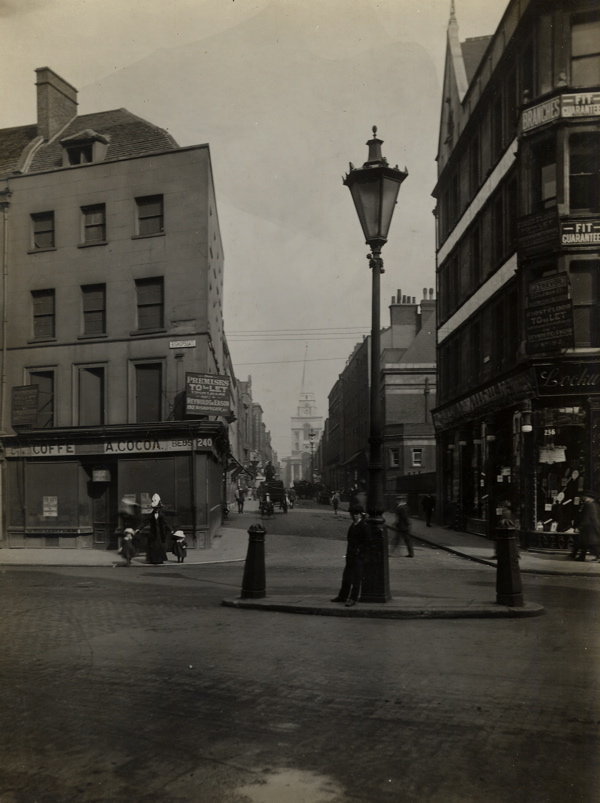
Looking down Brushfield St towards Christ Church, Spitalfields
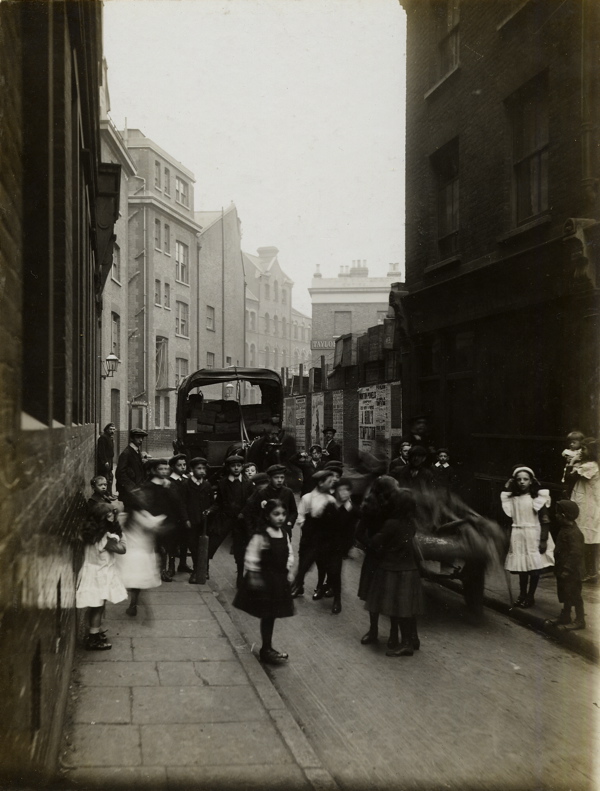
Bell Lane looking towards Crispin St
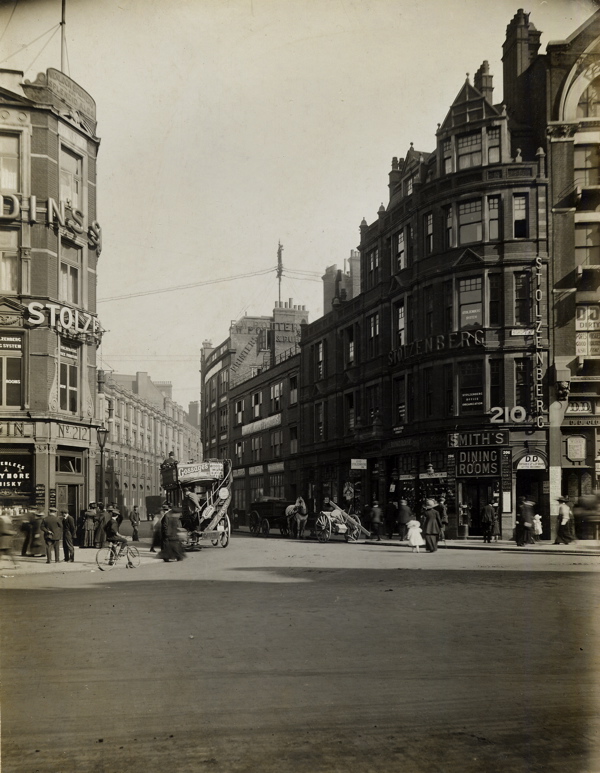
Looking up Middlesex St from Bishopsgate
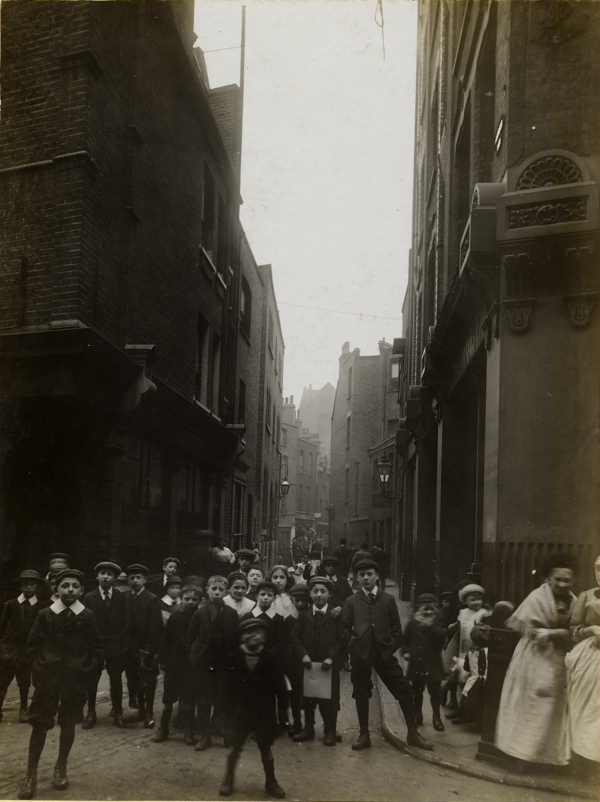
Looking down Sandys Row from Artillery Lane – observe the horse and cart approaching in the distance.
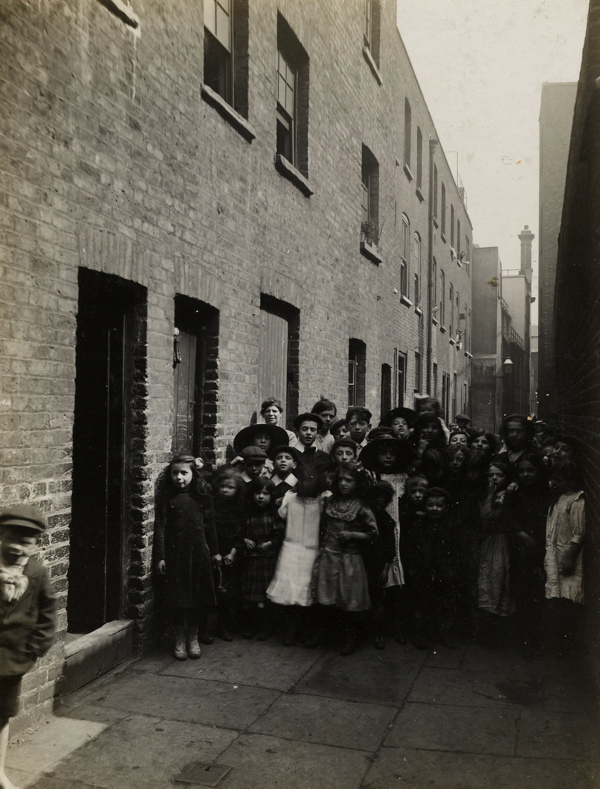
Looking down Frying Pan Alley towards Sandys Row
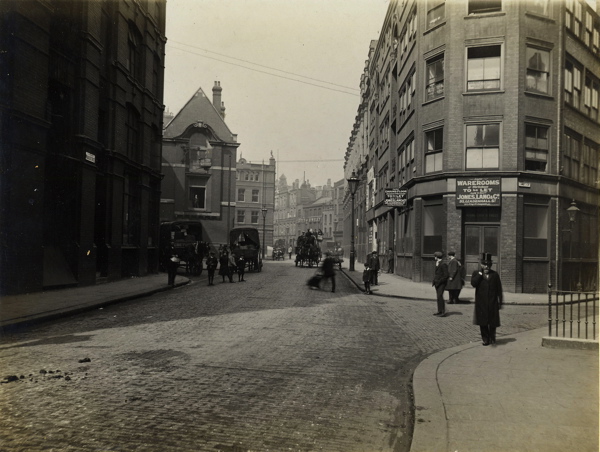
Looking down Middlesex St towards Bishopsgate
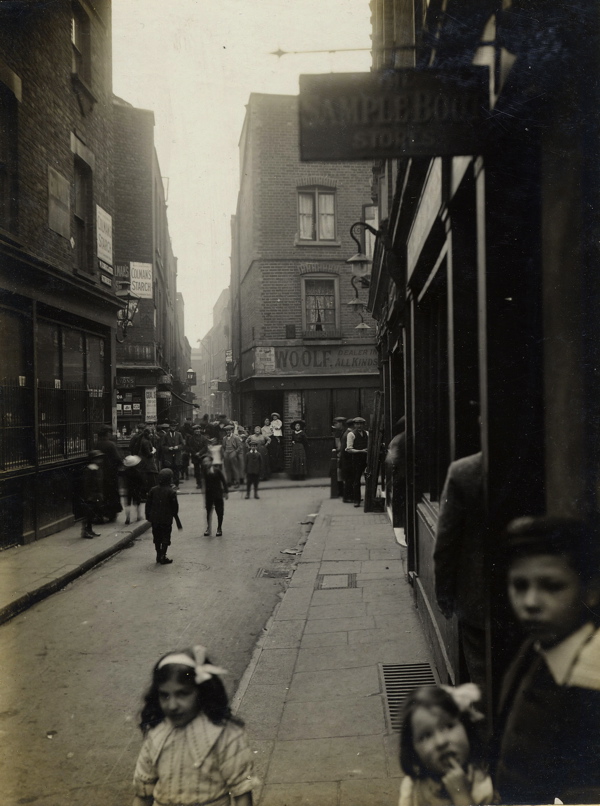
Widegate St looking towards Artillery Passage
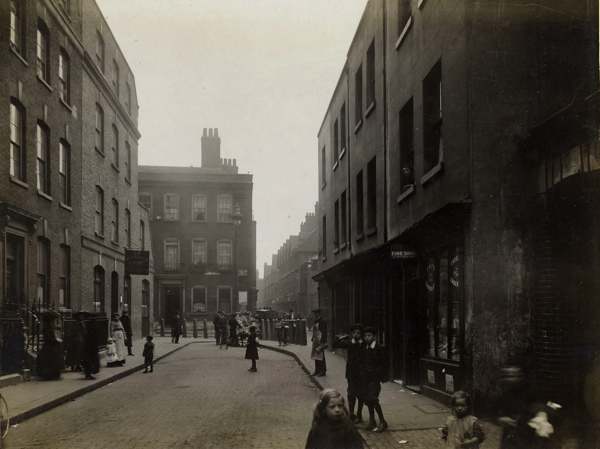
In Spital Square, looking towards the market
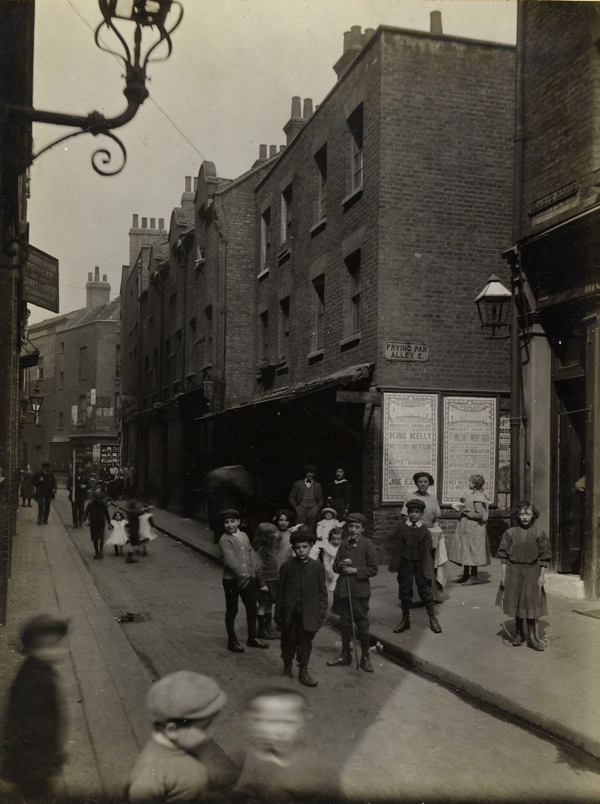
At the corner of Sandys Row and Frying Pan Alley
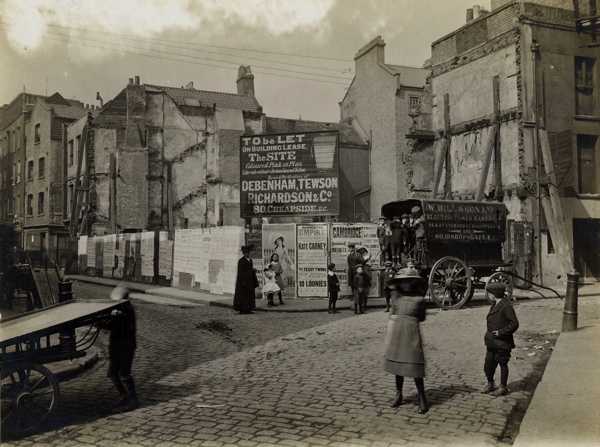
At the junction of Seward St and Artillery Lane
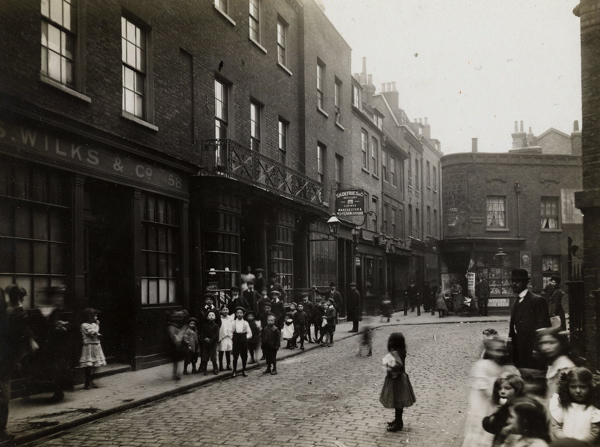
Looking down Artillery Lane towards Artillery Passage
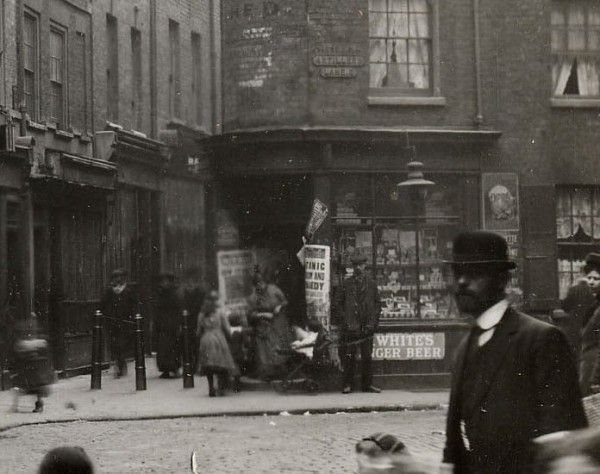
An enlargement of the picture above reveals the newshoarding announcing the sinking of the Titanic, confirming the date of this photograph as 1912.
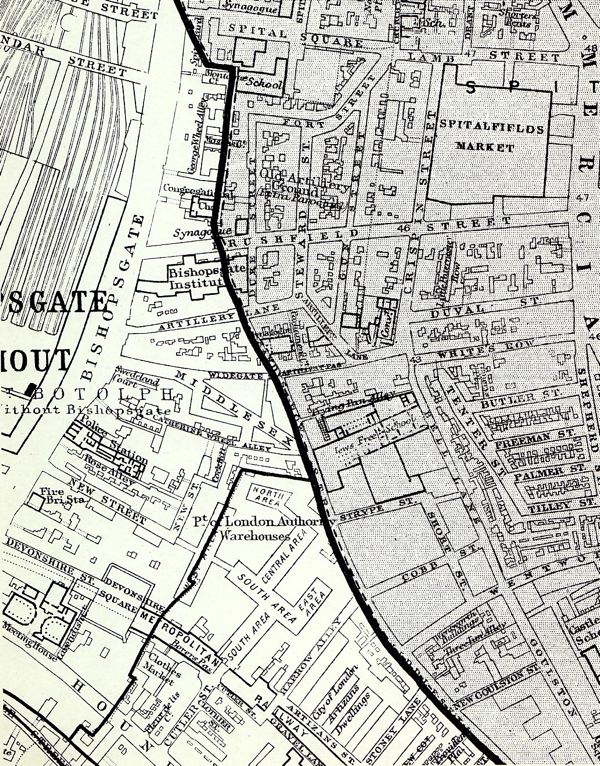
Spitalfields as C.A.Mathew found it, Bacon’s “Citizen” Map of the City of London 1912
All photographs copyright © Bishopsgate Institute
So long, Jimmy Cuba

Yesterday, Jimmy Cuba left the market for ever. He is a widely respected and popular figure who has traded here continuously since 1992, after the fruit & vegetable market left. This Sunday, as Jimmy packed up his stall of Latin & World Music for the last time in Spitalfields, the other traders came over to shake hands and make their regretful farewells. Old friends of Jimmy and a string of musicians had been turning up all through the day to greet the man who has become a legend in the Spitalfields Market.
It was an emotional moment, but everyone maintained a dignified composure and let the soulful lyricism of the music express what we were feeling. Yet when Jimmy increased the volume and took the rhythm uptempo, a party broke out spontaneously as people submitted to the irresistible Latin beat, with couples dancing in the market. There was a surreal delight to this extraordinary spectacle, which incarnated the passion and idiosyncratic poetry which Jimmy brought to this market that he loved over all these years.
We shall miss his mischievous good natured presence, his witty slogans on cardboard signs and, of course, we shall all miss that Latin pulse which has been the soundtrack to market life for the last two decades. We learnt something from Jimmy Cuba, because through his open-hearted manner he constantly reminded us that Spitalfields is more than a marketplace, it is a community of people and an arena for cultural exchange.
Months ago, Jimmy summoned me for breakfast to Dino’s Cafe in Commercial St to reveal his sober intention to quit on the last Sunday of trading before the stallholders are temporarily moved out of the market into the street while another event takes their place in the building. It was the last straw for Jimmy who has endured the whims of successive managements in the market over two decades. Growing up in Romford Market and beginning trading in music when he sold his record collection in Leather Lane thirty years ago, Jimmy has a strong feeling for markets as a collective human enterprise. He understands the drama of chaos and banter that brings the best markets alive.
With an inborn sense of levity, Jimmy is an unrepentant free agent who is never afraid to speak his mind. An innately decent person, he has a personal sense of justice that has led him to stand up for the traders on innumerable occasions over the years. And the corporate style of the new management – with executives who stick to their offices and will not even make eye contact with traders when they walk through the market – was too much for Jimmy. They did not like his cardboard signs, they thought his music was too loud and they did not like his attitude. Jimmy rolled his eyes in outrage to recount a recent incident when the traders arrived to set up their stalls in the morning, only to discover that the management had “forgotten” to tell them there was a promotional event happening, and they were sent away, losing a day’s income. “The market management, they only care about making money and they don’t see people, they are just interested in pounds per square foot. Spitalfields Market had so much more than that, but it’s been sanitised,” he admitted to me reluctantly on Sunday, as if it hurt to speak this way of a place that meant so much to him.
“I’m going to buy a boat and live on it for half the year,” continued Jimmy, looking to the future with brave confidence, “And I’m going to get back into DJing.” Because, as everyone who knows Jimmy Cuba is aware, he has become friends with many of the legendary performers of Latin Music, creating a mutual respect that has led to some dropping in on his stall in Spitalfields when they come through London. “I’m going to be spending a lot of time in the States because that’s where the artists are going to be.” explained Jimmy with a sprightly grin, looking forward to being able to travel once he is not stalling out every week, and can spend more time pursuing his three passions, boating, fishing and Latin Music.
On Sunday, Jimmy had a double size stall with all his favourite record sleeves on show and it made a fine display. I stayed on with him as the crowds thinned out and he went through the modest routine of packing up his CDs in their boxes while the music played and all around him other weary stallholders were closing up at the end of a long day. Jimmy cast his eyes around taking in the familiar picture, privately gathering his memories and emotions to carry them away with him. We all wish Jimmy Cuba well – one of the great characters of of Spitalfields Market – even if we regret that a little of the soul of the place has gone too. As one of the market traders said to me, “It’s going to be quiet without him around.”
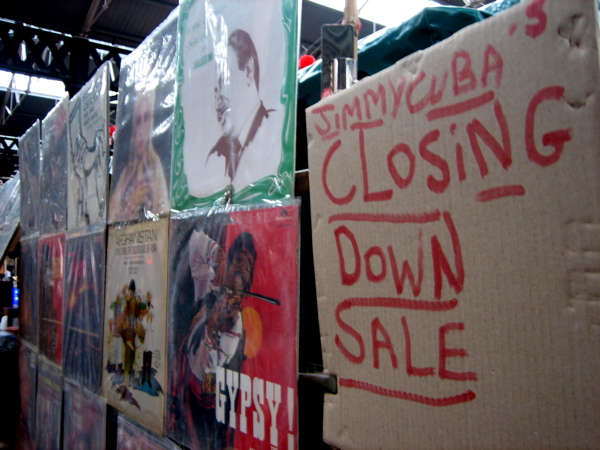
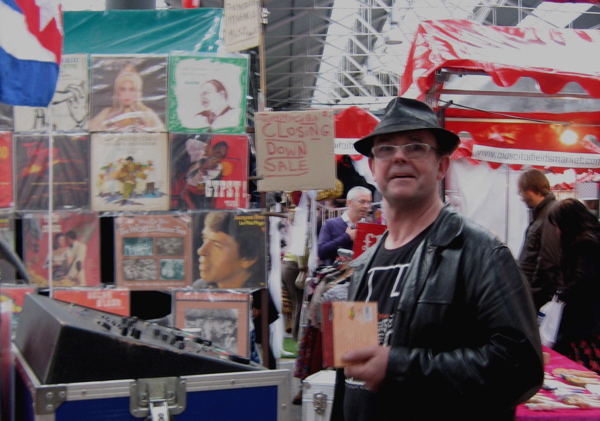
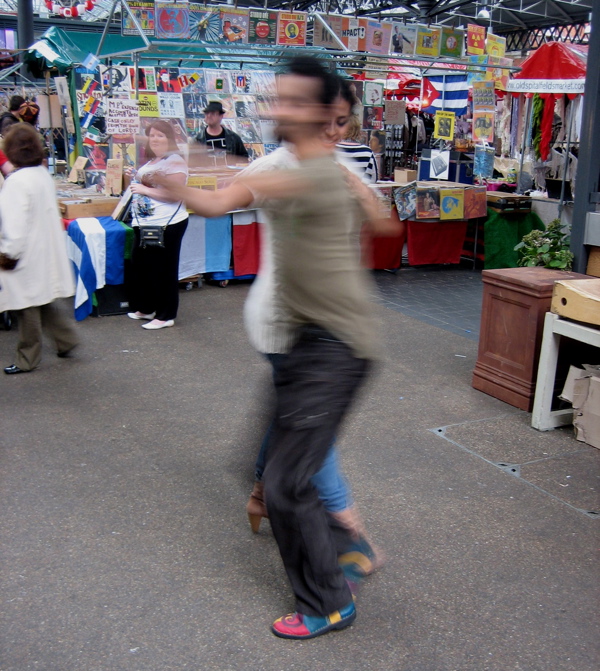
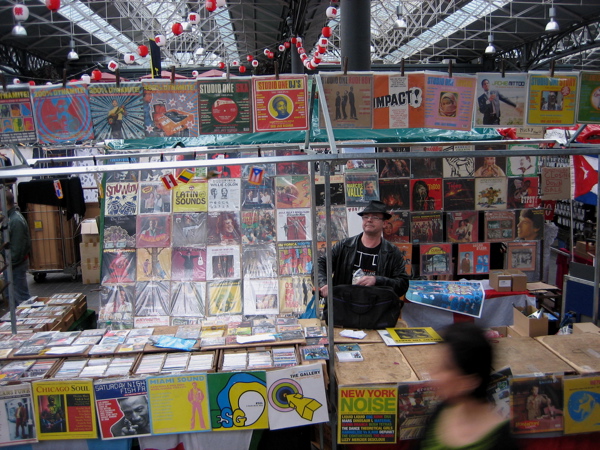
Jimmy Cuba packed up his stall in the Spitalfields Market for the last time on Sunday.
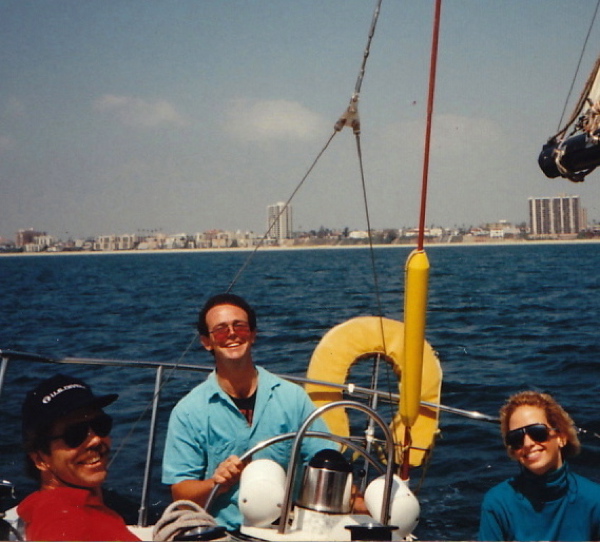
Off Long Beach, California, 1986. An image from the past that gives a vision of Jimmy’s future.
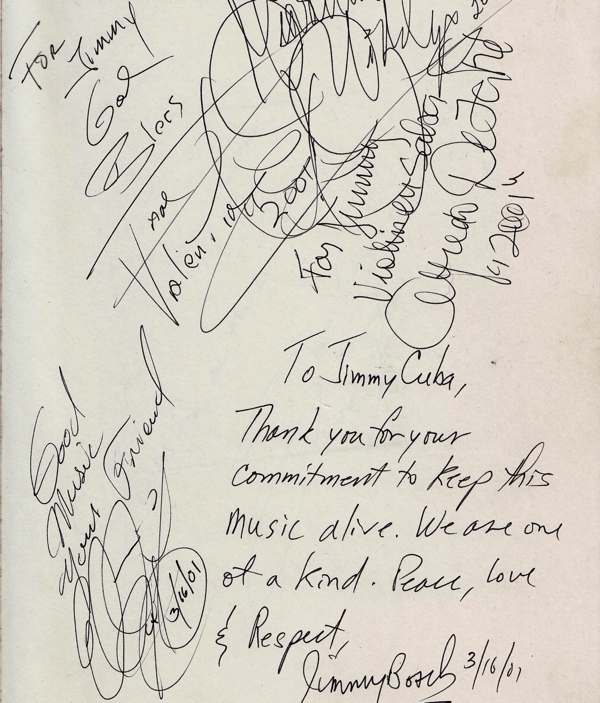 Jimmy’s copy of “Tito Puente & the Making of Latin Music” autographed by Jose Alberto, Giovanni Hildalgo, Davie Valentine, Alfredo de la Fe and Jimmy Bosch – all legends of Latin Music.
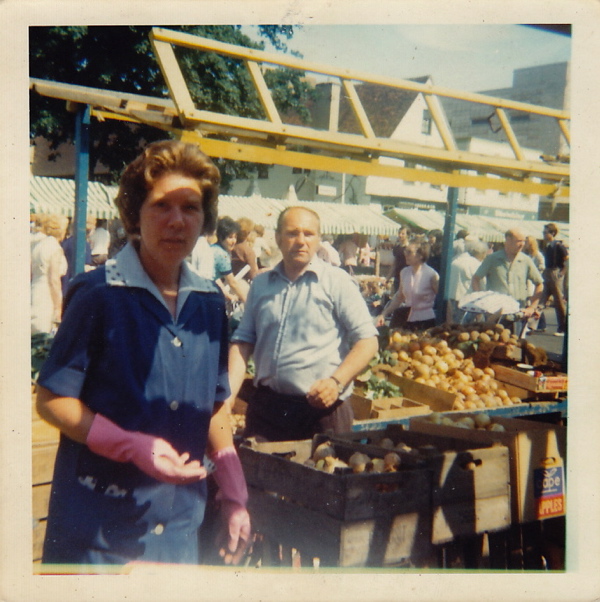
Teddy Manhood & his wife at Romford Market, 1974. Jimmy worked on their stall from the age of twelve and Teddy, who became a second father to Jimmy, used to bring him up to Spitalfields to buy stock.
Columbia Road Market 51

This cheerful fellow is Carl Grover, flowerseller – son of herbsellers Mick & Sylvia Grover whom I featured last week as the first in my series introducing you to all the street traders of Columbia Road Market. Occupying the pitch next to his parents, Carl started over thirty years ago in the market, working with his uncle Bob, his dad and his uncle Lee. “I used to go to the old Covent Garden Market with my father to buy flowers, and I can still smell the scent of freesias upon the cobbles today,” he recalled fondly.
“East London markets have always been such vibrant places, and Columbia Road Market at full pitch is one of the most vibrant places in London.” said Carl, turning evangelical in his declaration of affection for this beloved Sunday institution.”My customers are from all over London, from all backgrounds and walks of life. We may be English and not speak in the railway carriage, but in markets people engage with one another. Markets are proof that we’ve still got the art of conversation. We’ve still got the banter!”
Carl gets up at one in the morning each Sunday to make an early start setting up his stall, ready for the first customers arriving from seven o’clock onwards. Few realise that he also works from early Saturday, preparing the flowers ready to load up his van last thing on Saturday night before he goes to bed. Yet in spite of the early starts and relentless pace, working in all winds and weathers at unsocial hours, Carl delights in his chosen trade.“What a wonderful thing it is, to grow your own plants and flowers and bring them up to sell. We are the original farmer’s market.”, he said, reminding me that these stalls in the market each Sunday are the outcome of a whole world of horticultural endeavour which goes on every day through all seasons of the year.
Having seen the demise of Covent Garden market, Carl is understandably protective of Columbia Rd and the culture that attends it, built up over generations.“We’ve seen other places with great atmosphere lost,” he confided ominously, admitting a heartfelt concern for the future of the market.“We have no need of think tanks and consultants brought in by the Council, we just need places for the traders to leave their vans and for customers to be able to park without fear of fines. The Local Authority have a duty to provide for the needs of the traders.” This is Carl’s modest request, for this celebrated market drawing thousands of people from all over London each week, simply to be able to continue without interference.
As a fourth generation flowerseller, Carl Grover incarnates his role wholeheartedly, full of exuberant energy and easy charm which transforms his business into charismatic street theatre. Carl is proud to be part of the venerable tradition of London flowersellers, as he explained to me, “Over the years since I began in the market, I have been very fortunate to work with some great characters, some no longer with us unfortunately, and what I learnt from those people has enriched my life.”
Photograph copyright © Jeremy Freedman
Ian Harper, Wood Grainer

In recent days, while making my way to and fro along Princelet St, I have had the delight observe the progress of wood grainer Ian Harper at work upon the frontage of an eighteenth century house which is being restored by Chris Dyson. The project took two weeks from start to finish and permitted me the opportunity of some conversations with Ian, who retained an enviable composure throughout the accumulating drama of his epic undertaking – chatting amiably as he worked and managing the endeavour with such ease that he almost succeeded in drawing attention away from the skill and mastery of technique involved. Yet from the first day – starting with a mustard coloured ground – the assurance of Ian’s work and the uncanny realism of his wood grain drew admirers like myself who could not resist taking daily detours through Princelet St to wonder at this rare display.
Laying a thin coat of dark oil paint on top of the paler base coat, Ian used combs to create the grain and pliable slivers of rubber to add cross grain in satisfyingly random forms, working methodically on each of the separate panels of the frontage’s construction. Ian explained to me that the combs which make such convincing grain were a nineteenth century invention when the aspiration was to create a surface indistinguishable from wood. “I like to be more painterly. It was the Victorians who wanted verisimilitude.” he declared with delicate satire, playfully brandishing a paintbrush for emphasis. Ian’s personal taste is closer to that of a previous period when graining was freer, illustrated by the original Georgian graining upon Dan Cruickshank’s front door that Ian has been called upon to repair and which is the earliest surviving wood graining in Spitalfields.
For this frontage in Princelet St, Ian painted the facade with an oak effect and the front door with a contrasted burr walnut. In each case, he adopted a pleasing degree of stylization derived from different paint techniques, using combs for oak and a soft brush twirled with a turn of the wrist to create the pattern of walnut. “Finding the brush you like gives you great confidence,” he admitted, holding up an example affectionately, “This little brush, I bought it in France. Very soft and it saved the day, it was just what I was looking for.” I was intrigued to understand how such a technical approach came to render these different woods so gracefully, and Ian’s two weeks in Princelet St served as an impressive demonstration of the patience and steady hand that are prerequisites of this singular endeavour. Then,once the graining was complete, he applied a coat of tinted glaze to add depth. And the finished result is an honourable addition to the growing number of examples of Ian’s wood graining in the neighbourhood, including at 3 Fournier St, the Market Coffee House, the Whitechapel Bell Foundry and Jones Dairy in Ezra St.
Ian was first introduced to Spitalfields in 1982 by Marianna Kennedy who was a fellow student at the Slade and then he became a lodger in Fournier St. Simon Pettet portrayed both of them on one of his delft tiles in Dennis Severs’ House recording local personalities at that time. Yet although Ian only lived here for seven years, he remembers it as an inspirational period of formative experiences, discovering his aptitude in creating traditional paint finishes that complements his work as a fine artist. At the top of his profession today, with work in 10 Downing St, Manor Des Quatre Saisons and Lord Rothchild’s house on Corfu, Ian retains an abiding affection for Spitalfields that keeps bringing him back to the place where it all began.
“It was a great time to be here as an art student then, in a place with so many artists. There was an energy and openness because so many of the people were young. Those who had houses here had bought them for not too much money and were doing the restoration with their own hands, so everyone helped everyone else. It seemed everyone was busy, teaching each other and sharing tools. In those days the fruit & vegetable market was still here too, and Fournier St was busy all night with people shouting and selling cabbages. When I finished art school, people were asking ‘Did I do marbling?’ It was quite the thing at the time, so I went to work with a friend who had a job doing a restaurant in New York and then Fiona Skrine got me a job assisting a decorative painter she was working for, and I’ve been doing it ever since.
Spitalfields has been consistently in my life because I keep coming back to do work here. You would think there wasn’t anything left to paint after all these years, but whenever I walk down the street here I meet people who say, ‘Will you come and do something for me.’ I should never have guessed twenty-five years ago that I would still be coming back to these three streets beside the church. It’s a lynchpin. All my best friends are here. It’s still a great place for meeting people with ideas. I’ve lost track of all the amazing people I’ve met in Spitalfields.”
Now that the scaffolding is down, Ian’s work is fully exposed to Princelet St, bringing gravity to the freshly restored house. The fascination of Ian’s work comes from the trick it plays upon your eye which, in spite of the stylization of the wood grain, tells you it is real just as your brain reminds you it is painted. Now the frontage only needs a little weathering, and everyone will assume it was always like that.

Burr walnut to the left, on the door, and oak to the right, on the surround.

Some of Ian’s tools.

The earliest wood graining in Spitalfields is on Dan Cruickshank’s front door, dating from the eighteenth century, with some subtle repair work by Ian Harper.

The frontage of the Whitechapel Bell Foundry by Ian Harper, painted in an oak grain to match the earlier graining inside.

Jones Dairy in Ezra St, off Columbia Rd, wood grained by Ian Harper.

The newly completed frontage in Princelet St, Ian Harper’s piéce de resistance in Spitalfields.
Portrait of Ian Harper & working photographs copyright © Jeremy Freedman
Edward Greenfield, Music Critic

The entire ground floor of Ted Greenfield’s house in Folgate St is given over to an archive of thousands upon thousands of CDs. Stretching from floor to ceiling in each room are shelves of utilitarian design, lined with meticulously labelled brown archive boxes containing them all, while down in the cellar is stored his collection of over thirty thousand LPs. When you first walk through the door, it feels as if you have entered the storeroom of a music shop or the hidden stack of music library, but climbing the stairs to the first floor leads you into the more congenial atmosphere of Ted’s domestic arena. He lives up above, in the top three storeys of his magnificently tottering eighteenth century house, in rooms stacked with more CDs, musical biographies, back copies of The Gramophone, programmes from concerts and opera – and innumerable notes and cards of good wishes that testify to his many friends and admirers.
“I once had a flat in Highgate but the LPs got me out!” he admitted to me as we enjoyed a reviving mid-morning vodka and lemon in his sunlit panelled living room, lined with striking modernist portraits by Jeffrey Spedding of Ted’s musical icons, Mahler, Sibelius, Brahms, William Walton, Leonard Bernstein and Beethoven.
“I have been here in Spitalfields for thirty-two years and it seems like no time at all. The whole place has changed, yet largely for the better I think. In those days, there was nothing between me and the church, nowadays you’d barely recognise it. My friends were shocked when I bought this house with a hole in the roof in 1979, but I could see the potential and so could my architect, because it was he who suggested I come to live here.
The builders were in for over two years, and then it took another ten years to get the panelling sorted out. This room alone took over a year. In the nineteen thirties, they thought ‘horrible old panelling’ and lined it with fibreboard and covered the walls with miles of bellwire attached to alarms, because this was the Co-operative Fruit & Vegetable Department and they kept all their valuables here, using staples for the wire that created thousands of tiny holes we had to fill. And they installed a particularly nasty nineteen thirties ceramic fireplace that looked like it should have china rabbits over it – behind that we discovered this original coved fireplace recess.
Then I had a disaster when I moved in and only stayed fifteen minutes because there was a fire! Later, I had just moved my record collection of thirty thousand odd LPs into the cellar when there was flood. After the fire and the flood, I was expecting an earthquake. At that time, the two plots next door were vacant, where the houses had fallen down, and there were baulks of timber holding this one up. I had a party for one hundred and fifty people when I finally moved in and there were so many people the building was rocking!”
Ted Greenfield dramatises his own life with an endearing humour borne of a life of fulfilment at the heart of the British music scene as longtime music critic at The Guardian and subsequently as editor of the Penguin Guide to CDs. A trusted authority who, now into his eighties, continues to review regularly for The Gramophone, Greenfield forged friendships with many musicians who were the subject of his writing – from William Walton (“My great hero and a dear friend”), Michael Tippett, Benjamin Britten, Yehudi Menuhin and Mstislav Rostropovich to Leonard Bernstein (“The most charismatic man I ever knew”.). Ted Greenfield’s magnanimous optimistic temperament partly accounts for this, but it is further explained by his philosophy of criticism, which he outlines thus,“The first duty of a critic is to appreciate, to try to understand what the artist is trying to do and how far he has succeeded. You just have to try and sympathise.” As a critic, Ted Greenfield wrote to explore the intentions of the work he was reviewing, rather than sitting in judgement.
“I always wanted to write about records, but then I thought ‘I’ll never be able to keep myself,’ so I did Law at Cambridge where I wrote the Cambridge Union reports, and then when I went to the Appointments Board, they said, ‘Why not journalism?’ I think I’ve been very lucky, but equally I know you have to make your own luck to an extent. I try to look for the best side of things and to make things happen. I’ve written about a lot of people and they’ve become good friends. I’ve known many of the greats in music and politics over the years.”
When I asked Ted what music he listens to for recreation, he opened Who’s Who’s and showed me his entry which lists his recreations as “music and work,” and I understood that music is simply his life. Looking around, I realised that it is unquestionably a bachelor’s dwelling he inhabits, with few luxuries and comforts, and an atmosphere that is collegiate as much as it is domestic, displaying the charismatic disorder of books and papers you might expect in an undergraduate’s chambers overlooking an old quad.
Indeed many of Ted’s Cambridge contemporaries remained lifelong friends including ex-Chancellor of the Exchequer Geoffrey Howe (“When he came to my party here, before all the buildings were put up, we were able to look across and see St Pauls”), ex-Archbishop of Canterbury Robert Runcie ( “When I first visited him at Lambeth Palace, his wife had him doing the washing up”) and ex-Prime Minister Edward Heath with whom he shared a love of music. “Ted became a dear friend, especially when Margaret Thatcher took over and he famously was in the big sulk – he was a frequent visitor to Spitalfields in those days. I realised how vulnerable he was. Although he was entirely incapable of expressing human emotions, whenever he saw me he was plainly delighted. It was very amusing to tease him and have him tease me back.”
In spite of his immense knowledge and his friendships with all these establishment types, Ted is refreshingly lacking in pomposity and even a little subversive, wearing britches and nicely polished riding boots when he has no intention of going riding or even leaving the house. Drinking spirits in the morning is a rare experience for me but I recognised at once it was a habit I could get accustomed to – What could be more civilised than to sit in an old house in Spitalfields sipping vodka with lemon and listening to classical CDs? This is the life of Edward Greenfield.
You can read excerpts from Edward Greenfield’s memoires at www.edwardgreenfield.co.uk

Photographs copyright © Lucinda Douglas-Menzies
Ainsworth Broughton, Upholsterer

My interview with master upholsterer Ainsworth Donovan Broughton of 14 Calvert Avenue (commonly known as Mike) was perforce a swift one because he had three sofas, four chairs, a day bed and a Chesterfield to upholster before the end of this week. Although I arrived at the beginning of the working day, Ainsworth had been in since seven, stealing a march on time, and, as you can see from the picture, he had already made swift work of the day bed. Once I arrived, he sat down on his work bench, crossed his arms and displaying his good-humoured accommodating smile, declared, “Right, let’s get this done!”– with the same workmanlike sense of purpose that he would approach a challenging piece of upholstery.
Not so long ago, Shoreditch and Bethnal Green were the home of a thriving furniture industry that has almost entirely disappeared now. While there are people in the neighbourhood who may call themselves upholsterers these days, Ainsworth is the only one that has done the full apprenticeship in traditional upholstery and qualified under the Association of Master Upholsterers. More than this, Ainsworth is the living connection to the time when furniture-making flourished here. Although he is not self-conscious about it, he carries that history on his shoulders, which enables him to carry it lightly – because as the factories closed down and the other traditional upholsterers retired, Ainsworth simply carried on resolutely upholstering chairs and making an honest living at it while the world (and the East End) transformed around him. It was the natural thing for him to do, and it is this ease with his work, and commitment to his craft which makes Ainsworth such a dignified figure today.
“I specialise in traditional upholstery, although I can do whatever people bring along. Traditional upholstery is the old way of doing it, with stuffing and stitching and horsehair. I love it. The modern stuff is just foam! When I found traditional upholstery, I knew I had found my vocation in life. At the London College of Furniture, they banned me from the workshop because I used to stay behind after hours, always stuffing and stitching. Traditional upholstery is just quality – you know it will last thirty years or more. Working out from a frame how to do everything, that’s the joy of it. I’ve always liked to build something up, take it from frame to finished job and see people appreciate my work. There’s pieces of mine I have done for interior designers at Liberty, Sketch and Manolo Blahnik but the people there don’t know my name.
At fifteen, I did a day release from school at the London College of Furniture, and the head of the department saw what I was doing and said, ‘You could be good at this.’ After college, I was apprenticed to furniture makers A&E Chapman of Crouch End for five years and then I had the opportunity to stay on for another couple of years and be an ‘improver’ – before that you were just prepping. One day they took me into the office and said, ‘We’re going to let you loose,’ and it didn’t take much longer before I was able to work at the bench, but I always wanted to be self-employed. So in 1981, I took a studio in the Cleve Workshops in Boundary St and I used to do a day’s work before coming here to do a few ‘copper jobs’ – on the side.
Then one day I took a chance and left, and for six months I had hardly any work but slowly it picked up. I had one customer and then another and it continued like that. Back in the day, every shop in Shoreditch was an upholsterer but they’ve all gone now. In 1984, when the Cleve Workshops were sold, I managed to get one of the derelict shops in Calvert Avenue. The whole area was completely desolate then, there wasn’t anybody living here, but it enabled me to have a workshop because it was cheap. I never took my shutters down until seven years ago, because there was no passing trade, but recently it’s been different, there’s people here who are into traditional upholstery and so I get work locally now. “
Ainsworth does not even have a sign outside his shop, yet customers come and go all the time. In the window you simply see a photocopy of his certificate presented to the most outstanding student at the London College of Furniture in 1976/77. Looking through the metal grille into the crowded workshop where Ainsworth works from seven until seven each day, you see a high shelf up above where bare frames of furniture await his attention, while the walls are lined with racks of tools, cloth swatches and innumerable calculations pencilled directly onto the plaster, and the lino tiles from the shop that Ainsworth superseded in 1984 still cover the floor. In front of the window is a shelf to display his finished handiwork – only Ainsworth is so inundated that it is always piled with incoming work. “I could do even more, if I had an assistant – but I never want to employ anyone.”, he said, shrugging his shoulders dispassionately and revealing the enviable self-reliance that is the source of his tranquil manner.
I did not want to take any more of his working day. So once he was assured that I was satisfied with his interview, I asked Ainsworth if he thought he would finish the three sofas, four chairs, day bed and Chesterfield this week. “We’ll give it a go!” he declared with a smirk as he stood up from the work bench with energy rising, eager to set to work again. Even if anyone that has done a course can claim to be an upholsterer nowadays, it seems that there are plenty who recognise that the noble Ainsworth Broughton is the genuine article – an artist whose technique is stitching and medium is horsehair, practicing a skill acquired through an apprenticeship of five years, with an expertise honed over thirty years, and executed with a satisfaction and delight that is his alone.

Ainsworth in 1973, when he first started at London College of Furniture.

Ainsworth at work on his graduation piece, London College of Furniture, 1976.

Ainsworth Broughton, Master Upholsterer of Calvert Avenue, commonly known as Mike.

At the Bunny Girls’ Reunion

On Sunday night, I attended the most glamorous party of my life. It was a Bunny Girls & Playboy Models’ reunion hosted by ex-Bunny Barbara Haigh, esteemed landlady of The Grapes in Limehouse. Never have I encountered more voluptuous charismatic ladies per square metre than were crammed joyfully together in the tiny bar-rooms of this historic riverside pub that night. With Sarah Ainslie, Spitalfields Life contributing photographer, as my chaperone, I was thrilled to join this exuberant sisterhood of more than a hundred garrulous alpha females for a knees-up. Squeezing my way through the curvy bodies – fine specimens of their sex who have all got what it takes to succeed in life – I arrived on the river frontage where waves were crashing theatrically over the verandah as if, in reenactment of Botticelli’s Venus, each of these goddesses had just emerged triumphant from the Thames’ spray to delight the souls of mere mortals like myself.
The first Aphrodite to catch my eye was cheeky Bunny Sandie (pictured above), the seventh Bunny to join the newly opened Playboy Club in Park Lane in 1966, who is more formally known these days as Lady Sandra Bates. Within seconds of our introduction, Sandie gleefully revealed she had bedded Sean Connery, Frank Sinatra, Warren Beatty and Telly Savalas, emphasising that her most important conquest was Sir Charles Clore, owner of Selfridges and Mappin & Webb. “I was living in a house in Mayfair at the time, but the owner put it up for sale and wanted to throw me out, so I told Charles and he bought it for me!” she declared with a glittering smile, rolling her chestnut eyes, batting her eyelashes and clutching her hands in girlish pleasure. “You should see my art collection!” she proposed recklessly now that her husband Sir Charles is no more, as we shared a glass of wine on the verandah and the setting sun lit up the clouds, turning the river livid pink.
It was a remarkable overture to an unforgettable evening, because these girls all know how to party. Bunnies had flown in from all over the world, Tasmania, Las Vegas, the Bahamas, Egypt and as far away as Australia to celebrate the glory days of the British Playboy Club that ran from 1966 until 1980. As Marilyn Cole (the first full frontal nude in the history of Playboy in 1972) put it so elegantly in her speech of welcome, “When people ask ‘Where did you go to school?’ I say, ‘Fuck that, I went to the University of Playboy! You learn much more about life.’” An astute comment that drew roars of approval from the assembled Bunnies.
Marilyn, resplendent in a quilted leather miniskirt and thigh length high-heeled boots, ushered me over to meet her famously reclusive husband Victor Lownes, who opened the London Playboy Club. Formerly in charge of all Playboy’s gaming operations, Victor Lownes is a bon-viveur who was once Britain’s highest paid executive, counted Francis Bacon and Roman Polanski as friends and reputedly had five girls a day, sometimes two at once. He looked at me benignly from under a mop of white hair across the chasm of our different experiences of life. “Do you miss it?” I enquired tentatively, and Victor rolled his twinkly eyes in good-humoured irony. “What do you think? I am eighty-two years old!” he replied with dignified restraint.
There was a giddy atmosphere in the Grapes that night and so I chose to embrace the spirit of the occasion and mingle with as many Bunnies as possible. “I was a young girl from a very religious strict background in Birmingham who ran away from home.”admitted Bobbie, one of first black Bunnies, who worked at the Playboy Club from 1975-80, “I was shopping one day and I went along to ‘a cattle drive’ and out of fifty girls was one of a handful accepted to be a Bunny. I had four wonderful years that totally changed my life. It was a terrific experience. I have run my own business for the past twenty years and the things I learnt at Playboy set me on the road to be able to do that.”
“There was only one rule,’Don’t touch the Bunnies!’”explained Bunny Erica, raising a finger of authority,“Membership of the Playboy Club came with a key, which members handed in when they arrived and collected when they left. If somebody went too far the management took away their key. So the men always behaved respectfully. You were never forced to do anything. It’s made to seem cheap now – but we wore two pair of tights, our costumes were fitted and stiffened with whalebone, we even put toilet rolls down the front as padding – it was an illusion. We were supposed to share tips, but I put mine down my costume and when I took it off all the banknotes would fall out. The money was fabulous. Playboy gave us the most amazing part of our lives. It gave us freedom. It gave us a love of humanity. It enlightened us.”
“I was the very first UK Bunny to be hired in 1966,” declared Bunny Alexis, still glowing with pride over forty years later, “I was a dancer at the Talk of the Town in Leicester Sq on £12 a week, but at Playboy I earned £200. I was already married with a child and on the strength of my two years as a Bunny I was able to buy our first house in Wood Green. It was the hardest work, eight hours a day on five-inch heels with just one half hour break. But it was good fun and we met all the most amazing people. 1966 was a very good year!”
People often ask what happened to the nineteen sixties, yet here the evidence was all around me. It was a buzz to be in a room full of such self-confident women who knew who they were and were supremely comfortable with it too, women with their wits about them, who counted brains amongst other natural assets when it came to interactions with the opposite sex. Women who knew how to make the best of the situation they found themselves in at the Playboy Club – unashamedly constructed as an arena of male fantasy yet, paradoxically, as all these women testify thirty years on, provided opportunities for them to take control of their lives.
Undoubtably there were those that, as Bunny Serena put it succinctly, “screwed their way to the top,” but equally there were many who, as Bunny Lara confirmed, found it, “An empowering experience. They sent us on management training courses, and I learnt how to handle people and manage staff. All of which has come in useful ever since in everything I have done.” She now runs a young offenders’ programme, training staff in conflict management. Many women I spoke with occupy senior management roles in the gaming and entertainment industry today – including one who manages a chain of casinos – in jobs that would have been closed to them previously.
Above all, these were women who were full of life, they had seen so much life and had so many stories to tell, that it was wonderful simply to be amongst them, confirming Bunny Lara’s fond verdict on her experience working at the Playboy Club, “The camaraderie was phenomenal.”

Bunny Cleo, with evidence of her encounter with Sid James at The Playboy Club.

Marilyn Cole, “Whatever else happens in life, good, bad or indifferent, we can always say we had this!”

Bunny Maretta & Bunny friend

Bunny Marisa is now an artist painting in oils.

Bunny Dilys & Bunny friend.

Bunny Alexis, ex-Windmill Girl was the very first UK Bunny to be recruited in 1966.

Bunny Serena & Bunny Jane.

Bunny Bobbie

Bunny Brenda, Bunny Nancy & Bunny Marion

Victor Lownes, “What is a playboy? It is someone who is getting more sex than you are.”
Photographs copyright © Sarah Ainslie












