Abdul Mukthadir, Waiter
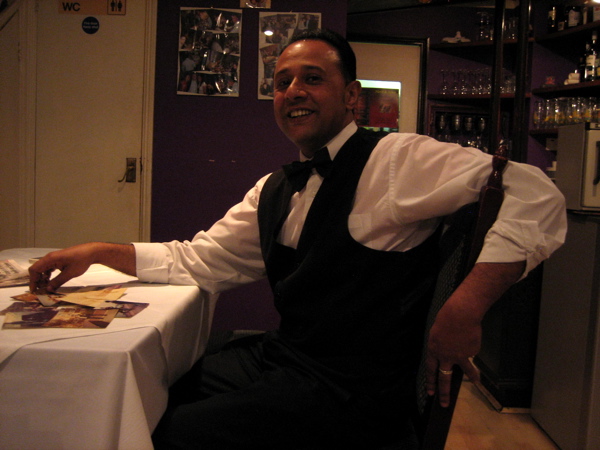
The charismatic Abdul Mukthadir – widely known as Muktha – is a born storyteller, blessed with a natural eloquence. As I quickly discovered when I sat down with him yesterday in the brief stillness of the afternoon, while the last diners emptied out of Herb & Spice Indian Restaurant in Whites Row. The businessmen were still finishing off their curry in the other half of the restaurant, whilst in a quiet corner Muktha produced a handful of old photographs and discreetly spread them out on the table to begin. Our only interruption was a request for the bill and once it had been settled, in the silence of the empty restaurant, Muktha’s story took flight.
“I came to Spitalfields in 1975 when I was ten years old. My father got married one day when he went back home to Bangladesh, it was an arranged marriage. At the time I was born, he was working in this country. He didn’t see me until two years later when he came back again and stayed for three months. I have another two sisters, and a brother born here.
My father missed his family, so once he got his British citizenship and he had the right to stay in this country, he made a declaration to bring us over and my mother had a big interview at the British consul in Dhaka. When we came we had nowhere to stay, my father shared a room with three others in Wentworth St. The other gentlemen moved into the sitting room and gave one room for us all to live there. After three weeks my father went to the GLC office in Whitechapel (where we used to go to pay the rent), and they gave us a one bedroom flat in the same street without a bathroom, and a loo in the passageway shared by two households, for £1.50 a week. My father earned £55 as a presser in the tailoring industry, and supporting a family on it was really difficult. On Saturday, he gave us each 10p and we used to go to the Goulston St Public Baths. They gave you a towel, a bar of soap and a bottle of moisturiser, and you could change the bath water was often as you liked. Six hundred people used to line up. It was very embarrassing for the Asian ladies, so one day my mother called all the ladies in the building into our flat. She said, “We can buy a tin tub so we can bath ourselves at home.” Everyone contributed, and they bought a long tin bath and took it in turns. But there was no hot water, so they worked out a rota, eight ladies put their kettles on at the same time. They put the bath up on the flat roof, and sent the smallest boys round to collect all the kettles and fill the bath. Only the women could do this.
We were not allowed to play outside alone, because of the racist movement. The skinheads used to prowl around the area. We could not go out to play football in the Goulston St playground until after the English boys had gone home, but even then we had to watch out for their return – because anyone might come and snatch our ball or beat us up. One day, my mum came out swearing at them in Bengali, “Leave my boy alone! Let them play!” We had that sort of problem every week, and for us that was the only playground we had. Although we were not allowed out after dark, we used to go to Evening Classes in Bengali on Saturday and Arabic on Sunday. At that time, there was a man who went round with a sack and if he found anyone, he would capture them and ask for a ransom. There were one or two incidents. One day he pounced upon our neighbour’s daughter as she was coming from Arabic. He caught her and tried to put her in the sack and carry her away. She was screaming and we were all at home, everyone came outside and I saw. We saw this three or four times. Between the English kids and the man following us to rape or take us, fourteen was very tough. My people were scared in those days. At that time you couldn’t even go out, it wasn’t safe.
We had to move because they were expanding the Petticoat Lane Market, it was really famous then. So the GLC offered my dad a flat in Limehouse but my father thought it wasn’t safe because there were no other Bangladeshis. Then he refused Mile End, even worse for a Bangladeshi family. Finally, he was offered a flat in Christian St off Commercial Rd. It had four bedrooms and a bathroom, and he fell in love with it. This was in 1979, after the six of us had lived in a one bedroom flat for four years. He was over the moon. I can remember the day we moved. He moved all the furniture in an estate car in five or six trips.
That was how we lived in England in those days. It was tough but it was fun and everyone was more sincere, people spoke to each other. No-one worked on Saturday and everyone used to invite each other round, saying “Come to my home next Saturday, my wife will cook!”
I have hundreds of stories because this is my playground. I belong here, I have so many memories, where I played and where I practised football. If I see a mess in this street, I clear it up because it matters to me. I am a poor man, if I was a millionaire I would do something here – but I am just a waiter, working to pay my mortgage.”
The first of Muktha’s family came to Britain in the nineteen forties to work in the Yorkshire cotton mills and he married an English woman, a sailor lured by tales of Tower Bridge, the miraculous bridge that rose up to let the ships pass through. And when he returned to East Pakistan, crowds followed him shouting, “He comes from England. Wow!” They nicknamed him “Ekush Pound” because he earned £21 a week as a foreman at a cotton mill in Keighley, and at the request of the mill owner he sponsored eight men to return with him. Thus Muktha’s father and uncle came to Britain, setting in train the sequence of events that led to Muktha working for today in Herb & Spice Indian Restaurant in Spitalfields serving curry to City businessmen.
A waiter since the age of fifteen, Muktha is distinguished by a brightness of spirit that makes him a popular figure among regular customers, who all hope that he may join their table at the end of service and regale them with his open-hearted stories. He becomes enraptured to speak of Spitalfields, because the emotional intensity of his childhood experiences here have bound him to this place forever, it is his spiritual home.
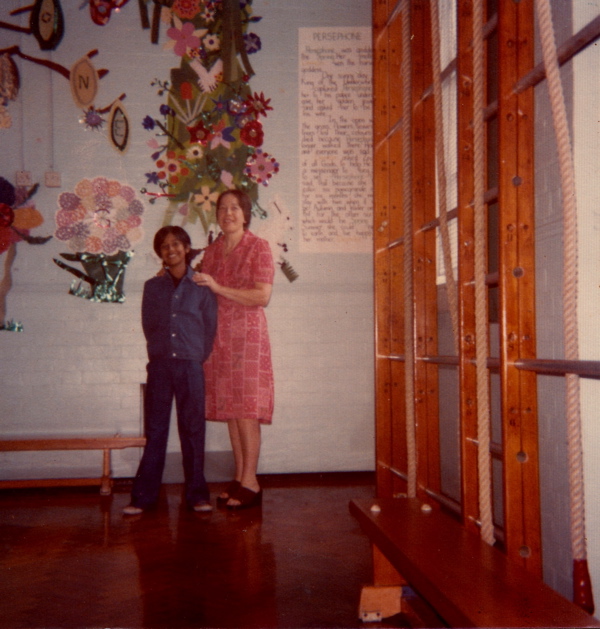
Muktha with his beloved teacher Miss Dixon, “She was like a mother to me.”
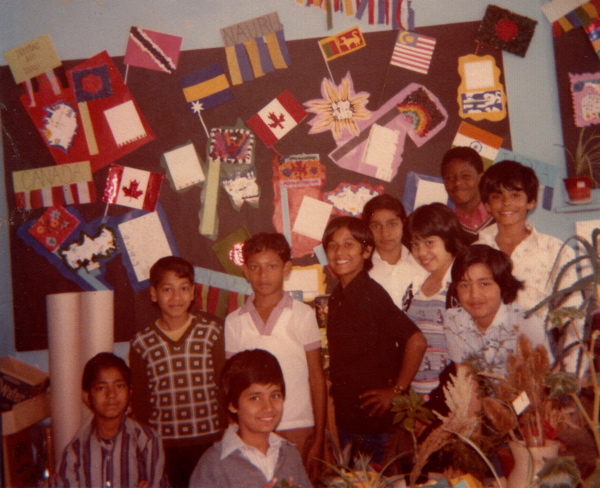
Muktha (centre) with his class at the Canon Barnett School in Commercial Road, 1976.
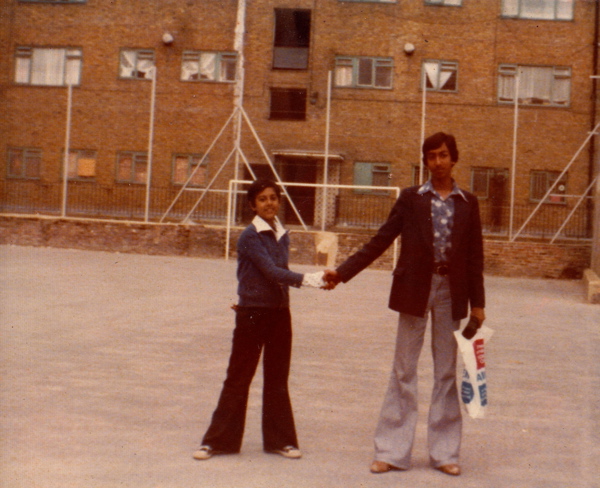
Muktha at the Goulston St playground, with his friend Sukure who became a pop singer and is currently one of the judges of the Bangladeshi X Factor.
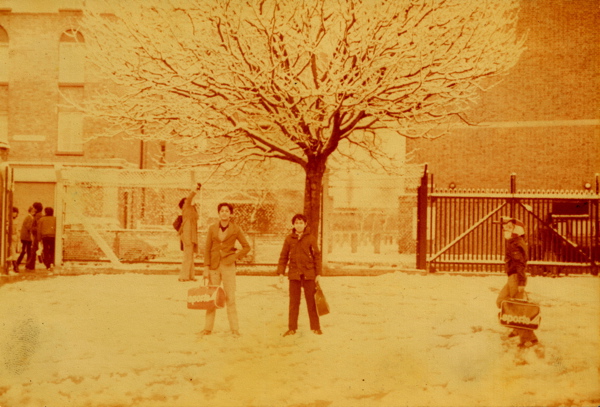
Muktha recalls that the winter of 1979 brought thirteen weeks of snow. (He stands to the left of the tree.)
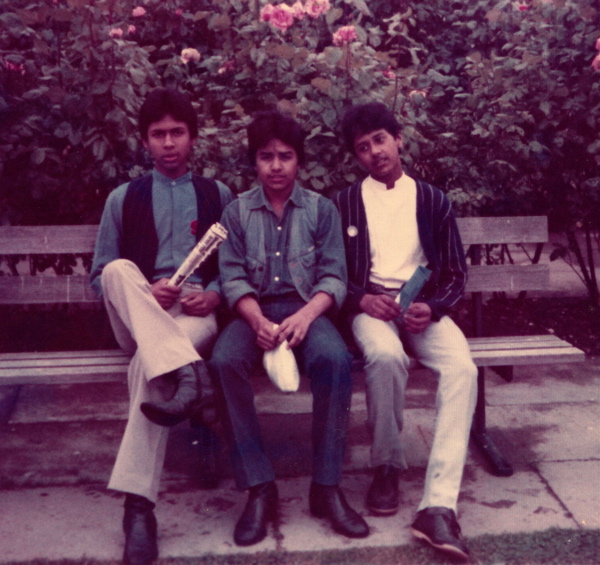
Three friends sitting in the rose garden in Christian St – from left Akthar, Hussein and Mukthar.
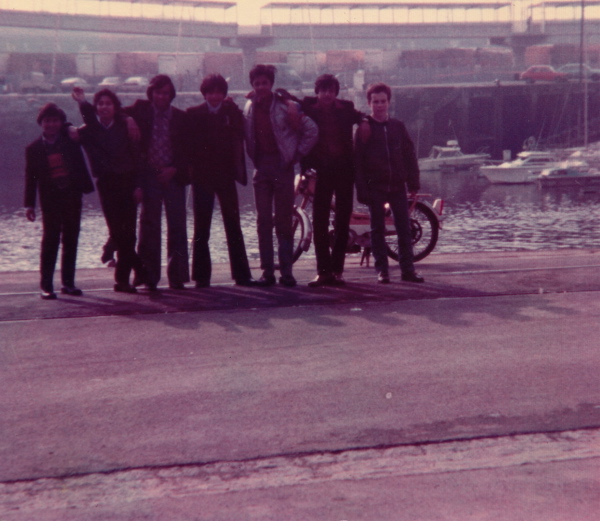
On a day trip to France from the Montifiore School, Vallance Rd in 1980. (Mukthar is in the pale jacket)
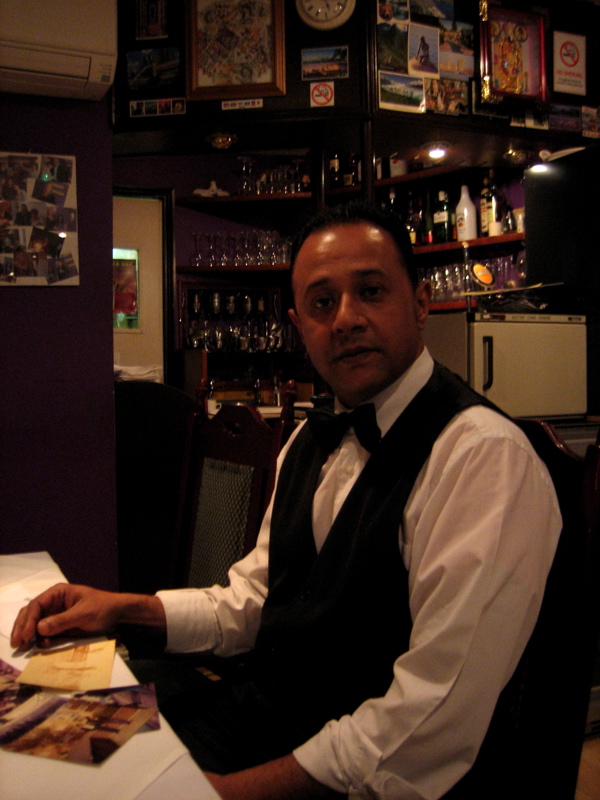
Abdul Mukthadir
Molly the Swagman
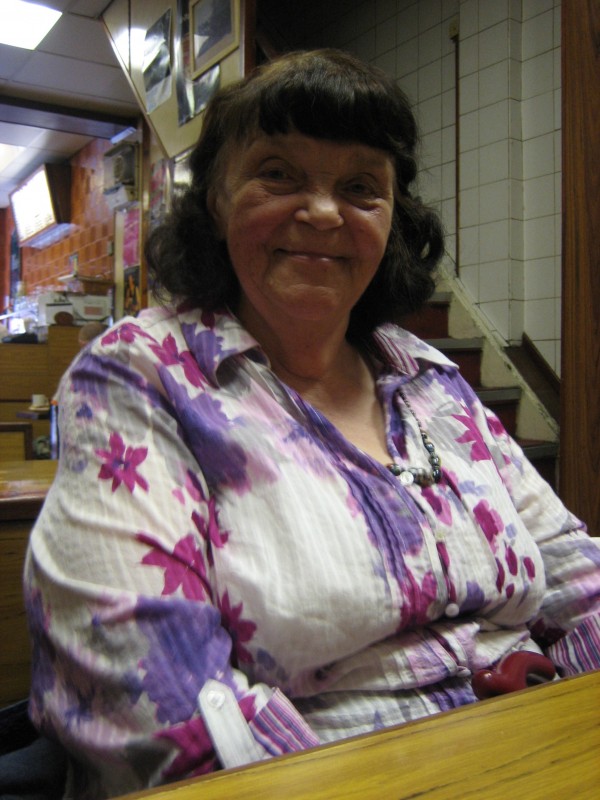
Make no mistake, Molly is a swagman. It is a title that carries its own raffish assertion of independence, there are no swagwomen, only swagmen and Molly is a proud swagman. She told me it all began with her great-grandfather who was a swagman on Petticoat Lane and he lived to be ninety-nine. And now I shall expect no less from Molly herself – because there is no doubt that, as a fourth generation swagman, she is the shrewd inheritor of the good humoured perseverance which is required to achieve longevity in market life.
Although I always knew the word “swag” from comic books where masked burglars have it written on their sacks, it was Molly herself who first explained to me that, “Swag is when you are selling a variety of goods, from clothes to jewellery – anything you can find.” And she gave me a significant glance of complicity, which led me to assume there might be a shady history, before returning to her plate of bacon and egg accompanied by a pile of toast, that formed the primary focus of her attention at that moment. We were enjoying a hearty breakfast in Dino’s Cafe in Commercial St, huddled together round a small table at the back with Molly’s old friend Jimmy Cuba and Ellen, her loyal associate from the market, completing the party.
“My first market was down the lane,” Molly confided in tender reminiscence, pushing the empty plate to one side and lifting her mug of tea,“I was about three, toddling around on my first day in Petticoat Lane where we lived. The house where I was born, it was in Leyden St, number six. My great-grandfather had the pitch and it went down through the family, that’s how it was in those days. Anything you could sell, he would sell it. He was a dodgy dealer, he used to do deals. My grandfather, my father and uncle were all in it too. They used to hire a cab for the day and go to the races together sometimes. Uncle Bob and grandad used to front the stall, while my father was the money behind the scenes. My father had the advantage of going to school, my grandmother was in films so she sent her two sons to boarding schools. He was a very snappy dresser, when he had some money he used to go and get two new suits made. He had the whole look, the cufflinks and the polished shoes. ‘You have to dress up to do business,’ he said. Grandad sold linens off the back of the van and Uncle Bob was the one with china, he threw it up in the air. And I used to take the money, it’s where I learnt to add up.”
Molly’s pedigree as a swagman imparts a certain singularity of attitude which baulks no condescension, and graces her with a sharp line in back chat to accompany it. “If they say, ‘You’ve got to give me a discount.'” recounted Molly, raising her eyebrows in delight and assuming a hoity-toity voice, “I say ‘Why? Do I know you?” Then she chuckled to herself, recalling another recurring dialogue. “Those yuppies, they ask ‘If I buy this, can I get this free?’ So then I put on my best Cockney voice…” she continued, placing a hand on my forearm and assuming an archly demure manner, “and I say, ‘Here love, come back next week, when you’ve got a bit more money.'” Chuckling, again and launching into a raucous self parody, “They’ve got to be hedge-ucated!” she declared with a triumphant grimace, pressing the ball of her hand on the table in response to the general mirth of those of us who comprised her audience.
I learned that Molly’s experience is not restricted to market life, because for five years, she worked as girl-Friday to Peter Grant, the manager of Led Zeppelin and, as we sipped tea and digested our breakfasts, she regaled Jimmy, Ellen and me with her tales of the rock and roll years. “The boys used to call me ‘ma’.” she revealed shyly, “I knew them all, Mickie Most, Adam Faith and the rest. They all came down to the country where I used to cook breakfast for the guests, walk them round the house and make up these fantastic ghost stories. When I was down there, I treated them just like anybody else. One day this tall blond guy came down with his laundry, so I showed him how to work the machine – that was Robert Plant.” At this point, Jimmy Cuba contained himself no longer, interposing, “This was when Led Zeppelin were the biggest band on the planet!” and Molly smiled bashfully, blushing a little to recall her days as a rock chick now.
Each Wednesday, Thursday and Friday, you will see Molly stalling out in the Spitalfields Market with Ellen at her side, the lone swagman with her modest swag spread out before her on the table. Even after all these years Molly cannot predict each day’s trading, market life is akin to gambling in that way. The two self-effacing women preside like sentinels, whispering together about the ceaseless spectacle passing before them. For Molly, it is a fleeting show, because she is the living representative of the three that came before her and it gives her a unique sense of perspective. Market life has made her circumspect and she would not tell me her full name or even reveal the name of her great-grandfather who lived to be ninety-nine. Yet I was honoured to speak with her because Molly is an extraordinary woman, dignified, witty and with great strength of character, and she is the last of the Spitalfields swagmen.
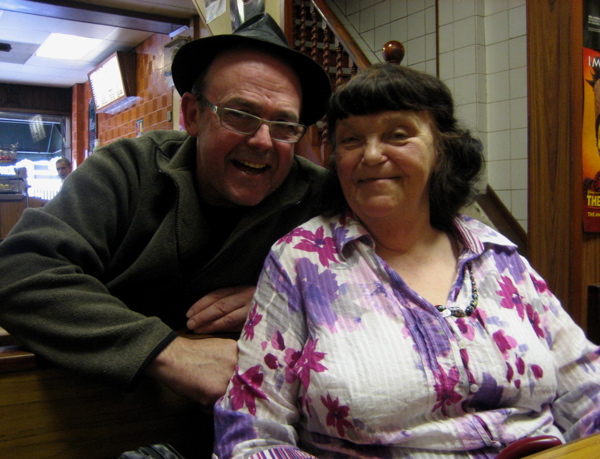
Jimmy Cuba & Molly
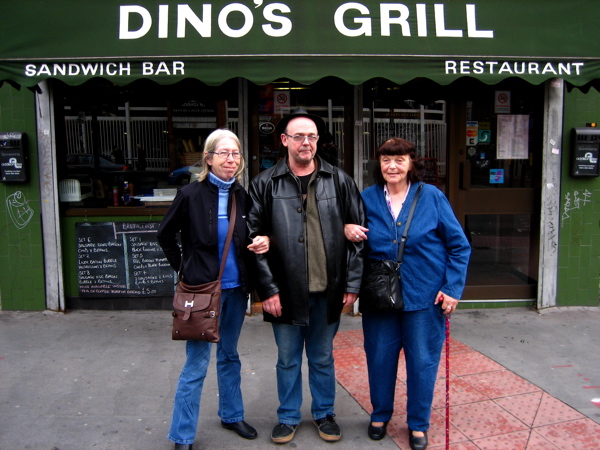
Ellen, Jimmy & Molly outside Dino’s in Commercial St.
Eric Reynolds, Creative Regenerator
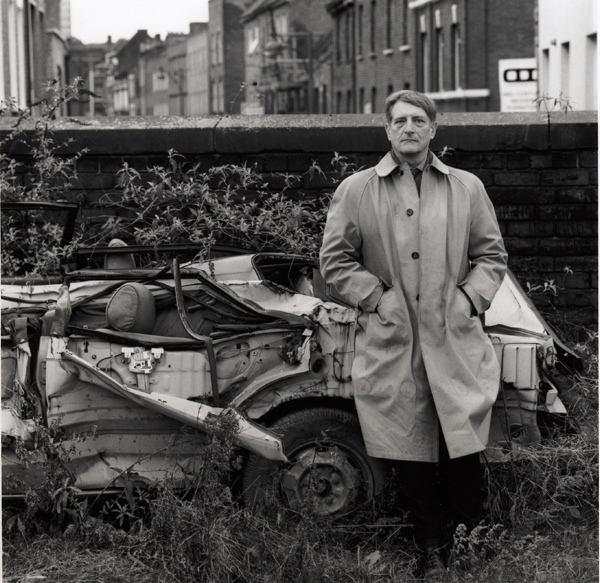
Eric Reynolds has statuesque presence – a tall man with strong features and beady eyes – he is someone who is transfixing when he walks into a room, though I doubt if he is aware of it because he is so wrapped up in his chosen purpose. You must understand that Eric is a man who has got schemes, they are his mission and his life, as I quickly discovered when I paid him a visit recently. Alive with thoughts,while striding up and down his office in a steel container at Trinity Buoy Wharf, overlooking the Thames and the Millennium Dome opposite, he demonstrated a restless intelligence, a caustic humour and a natural authority which led me to conclude that if I were ever to contemplate going into battle, I should want Eric Reynolds to lead the charge.
Trinity Buoy Wharf with its sympathetic mixture of old buildings put to new uses and inspirational contemporary architecture constructed of recycled sea containers is the most recent of Eric’s urban regeneration projects that have changed the face of London over the past thirty years. Others include originating the markets at Camden Lock and on the South Bank at Gabriel’s Wharf, while in the East End he is remembered as the man who created the new market in Spitalfields when the fruit & vegetable market moved out. The dog shows, the model train and the opera house which Eric brought in are all recalled today in Spitalfields as fond examples of the exuberant idiosyncrasy and imagination that he brought to the rebirth of the market.
Eric told me that the new owners, the Spitalfields Development Group, hoped they could simply demolish the nineteenth century market when the fruit & vegetable traders left in 1991, but once they discovered this was not an immediate option, he was approached to create a proposal for the vacant four and a half acre site. “It was absolutely clear, when they moved out, that the City Corporation did a great job because they left the market clean, and just one person overlapped the two managements, Bill the security guard, who lived in the market in one of the flats. I remember the first day I went to pick up the keys and make a survey, it was a Saturday, and Bill and his wife took pity on me, inviting me into their flat for a cup of tea because nothing opened around there on a Saturday, everything was closed.”
“The first thing I did was to draw a one mile circle around the Spitalfields Market on a map and make sure we had ways to reach all the people within the circle. My policy was to tread lightly upon the ground, not break anything I didn’t have to break, leave room for other people to be involved creatively, and recycle hard – try to create a place that related to its location. We had to make it so that people of all ages would want to go. We launched things like the Alternative Fashion Market and the Organic Market, a long time before they did it at the Borough. Over four years of steady refurbishment, we got most of the shops open, as well as creating the sports pitches, the opera house and the swimming pool. We got artists to paint all the dark shutters with flowers and fruits. Eventually two thousand people worked there and we ended up with a successful living market.”
Eric sees 1994 as the apogee of this period of the market, when the place flourished with an authentic vigorous life that had a momentum all of its own. And many have affectionate memories of this time in Spitalfields, when community events co-existed alongside sporting contests and concerts, when the place was full of artists’ studios, when a model train ran round the perimeter, when hot food of all kinds could be bought from scruffy wooden huts and Roland Emett’s glorious fountain was the centre of this crowded hubbub, which became a meeting place where everyone enjoyed an equal sense of ownership.
Yet Eric’s regime was always contingent and his contract ended when the redevelopment and partial demolition of the old market commenced. There is quite a difference of style nowadays and I asked Eric if would characterise it for me. With his tongue in his cheek, “The difference is between corporate management as opposed to fairly hippyish management,” was one way he put it. Another was to say, “It is the difference between property development in a structured way, as opposed to property development as husbandry – more akin to market gardening than bricks and mortar.”
“I was very sad that it was decided to knock half the place down because these temples to food will never be built again,” confided Eric with a grimace of regret. Today he is evangelical for what he terms “human scale less-capital-intensive development” which means adapting buildings to suit new purposes rather than scrapping them. He explained to me that the immense increase in the capital value of the Spitalfields Market site since it was rebuilt has now created an imperative to earn a high return on the investment, which means that rents have become expensive, resulting in more chain stores and less independent traders.
When I asked Eric about the legacy of his time in Spitalfields, he proudly cited the pedestrian crossing in Commercial St outside the Ten Bells, because he was responsible for putting it there. One day he saw a wedding party struggling to negotiate the traffic, crossing the road from Christ Church to the Spitalfields Market where the reception was to be held and realised that a crossing was needed. Yet beyond the Eric Reynolds Memorial Crossing, the spirit of his work lives on in all the diverse businesses and markets that have colonised the Truman Brewery and hidden corners of Brick Lane today.
I was both delighted and inspired to meet Eric, looking every inch the pillar of the establishment in a conservative suit, and yet talking the language of liberal subversion and possibility, seeing neglected spaces as opportunities for new manifestations of culture in all its chaotic creative variety. Eric told me about a shopping centre in Manchester that shut down recently, which he is being asked to regenerate. “I’m taking a shopping shed and recycling it into football pitches!” he announced – his eyes gleaming with anarchic glee – proposing an appealing vision of what could happen one day everywhere when all the shopping malls die.
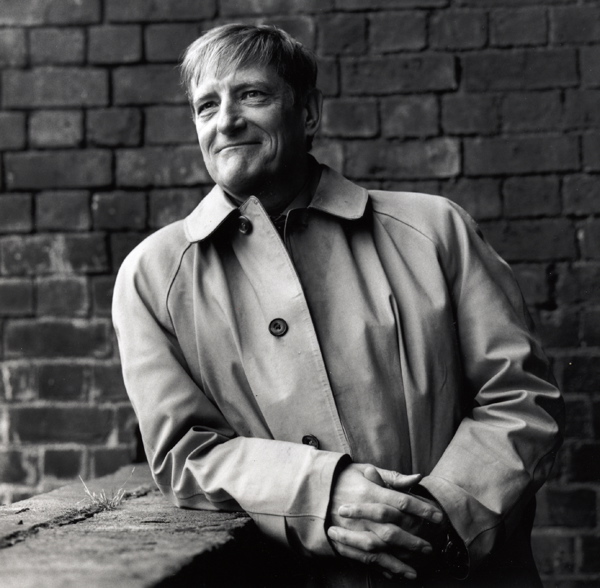
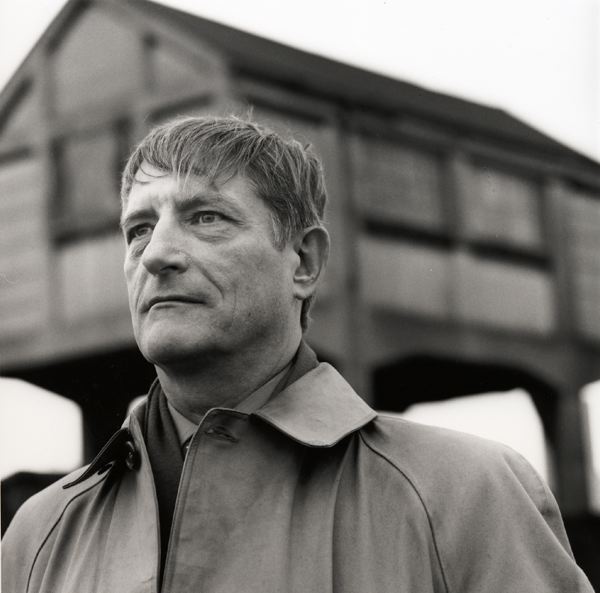
Photographs copyright © Lucinda Douglas- Menzies
At Ezra Street Market
Rambling round the markets of the East End has long been one of my favourite pastimes. It is a curious terrain, a constantly shifting landscape, with the potential for new discoveries ever present. So I was delighted when Spitalfields Life contributing photographer Jeremy Freedman sent me this set of six portraits of traders from Ezra St Market that he took last Sunday. He stumbled upon it in the early morning after taking Columbia Rd portraits, and this is his note that accompanied the pictures,“As dawn broke this morning, I found myself coffee less and in need of nicotine, so I followed my nose. In a lovely yard off Ezra St is quite possibly the friendliest market I ever ventured into. I couldn’t help myself. I was flashed up and at war with the rising sun – notice the crisp Autumn sky!” Captivated by the appeal of these spontaneous portraits, I set out to find the subjects for myself.

This the alluring Renee Duffy, a Hoxton native who brings a certain delicate movie star glamor to the market, which occupies a modest yard hidden behind a battered corrugated iron fence, nestling beneath old workshops and warehouses. As I took her thin cold hand in mine to warm it, she batted her eyelashes delightedly and welcomed me to her cherished market which she shares with just a handful of other select traders. “Late in life I decided to do it,” she admitted flirtatiously, while gesturing to her stock of fine galvanised steel watering cans and planters, before confiding to me in a whisper,“Hoards of people want to have stalls in here, there’s over a hundred on the waiting list!”
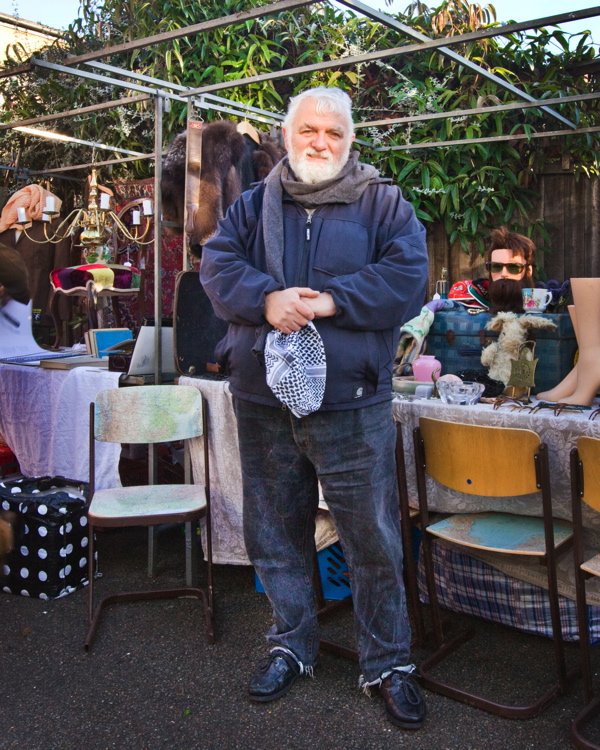
This is Shaun Barnett, who has been here the longest, trading for the last fifteen years of the market’s thirty year history and presiding over it today with Falsftaffian largesse. “We all come here every Sunday as regular as clockwork and we all get on, that’s why everyone likes it.”, he explained from behind his stall piled with an eccentric mix of stock, including some rather underpriced early pearl ware and old ladderback chairs. “I’m looking for madness!” Shaun declared recklessly with a smirk, “I buy whatever I like and if it doesn’t sell, I have to live with it.”
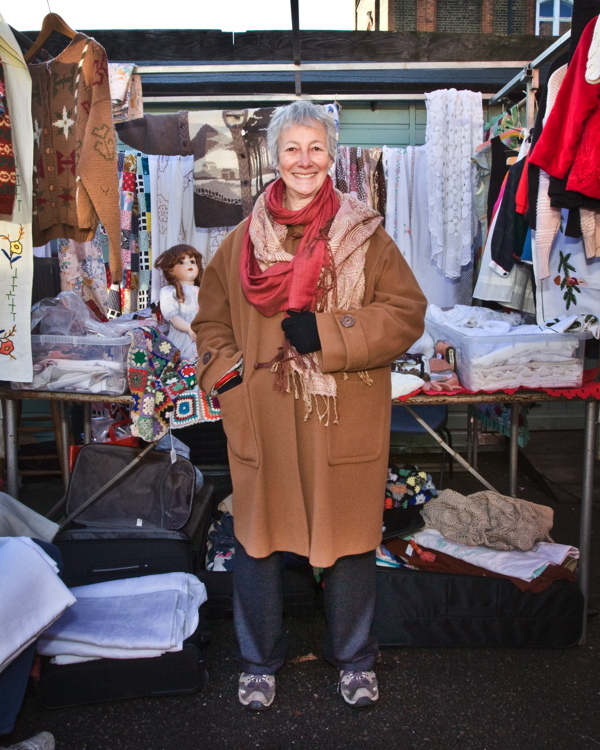
This is Suze Hails who deals in antique textiles and linen. “I am a grandmother and a mother and a carer for my husband, so this is a fun day out for me coming here,” she revealed excitedly, “I came from Kenya originally to study Fine Art & Etching at the Central School of Art, but then before I got going I found myself bringing up three children.” A natural enthusiast, Suze brings her artist’s eye to the selection of vintage fabrics and knows how to wear a duffle coat better than anyone I know.
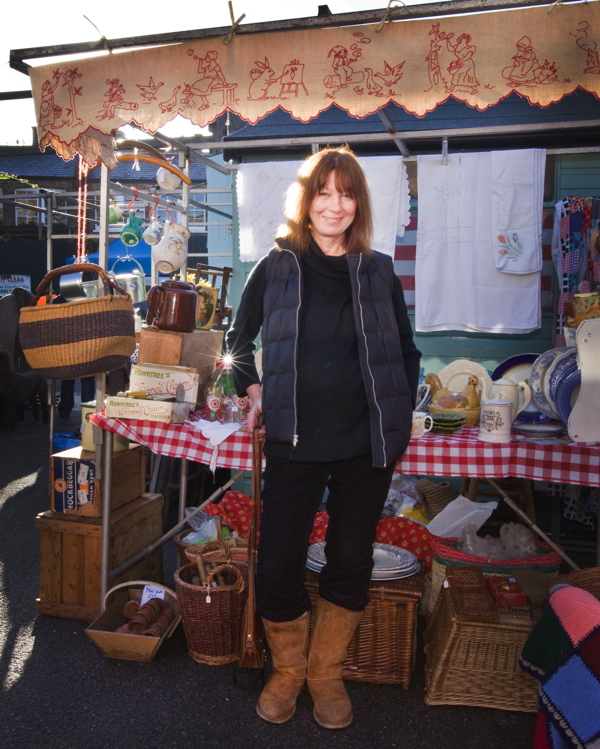
This is distinguished gardening writer Caroline Foley in her Sunday guise as a trader in old china, baskets and gardening equipment. “This is a sideline,” she told me, “since I spend so much time on my own writing, it is lovely to get out in the world meeting people.” Caroline has published nine books in the past ten years, and her latest, The Allotment Source Book is published today. She also edits “On Topiary” magazine for the European Box Hedge & Topiary Society. Yet I found Caroline most passionate about Ezra St Market, “In this bit, there’s great camaraderie. We all stick together through the good times and the bad.” she said. You can read Caroline’s monthly allotment column for the Observer by clicking here.

This is Ezra himself. Ezra of Ezra St Market, Ezra Quinn. Even from his demeanour, I surmise he is a gentleman of singular personality, quite possibly a raconteur. From his trousers, I also presume he is either a cyclist or a style eccentric, if not both. The fancy silk scarf and wonderfully weathered fishing jacket are characteristic of the swanky hauteur with which he wields his cigarette. A dealer in Peruvian knitwear and metal curios, carriage lamps, scales and cameras, Mr Quinn remains an enigma to me – because I never met him. He was not there when I visited Ezra St Market.
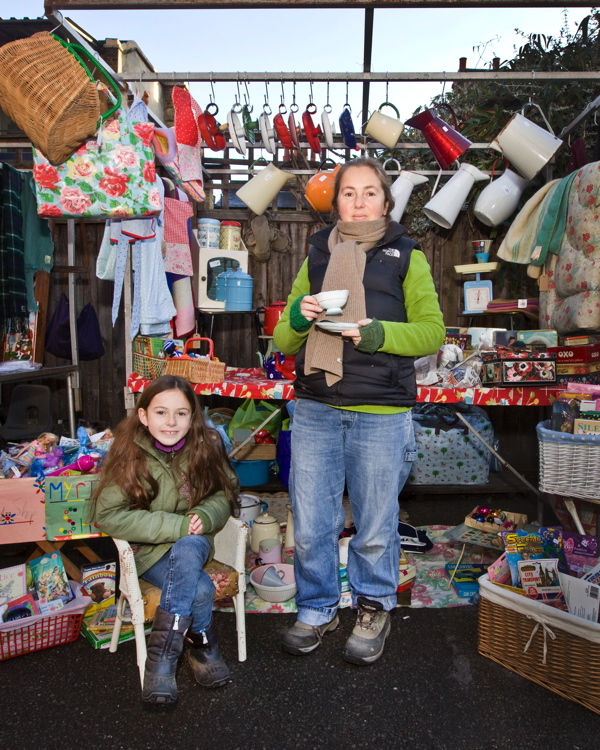
This is Jo Watts & her daughter Mytle who deal in kitchenalia, comprising the old china, kitchenware and enamelled pots that fill both their stalls and their home in South Woodford. Be advised, Jo has the best selection of enamel teapots in the East End.“I love market life, I wouldn’t want a shop – except maybe when it’s raining,” confessed Jo with a good natured shrug, looking up through her plastic canopy. “I’m training to my daughter up and I let her have a little stall,” she continued, delighting in her chosen routine,“All week I go sourcing, in between going to the gym and being a mother and a wife. This started as a business but now it feels like a hobby rather a job.”
In a charismatic shabby yard in a hidden corner of Ezra St, a group of unlikely characters have created their own lively community that exists for just one day every week. Let me admit, I was innocent of the intrigues and gossip, but now I have introduced the appealing personalities of the leading characters in the weekly drama that is Ezra St Market, be sure to pay them a call next Sunday and introduce yourself.
Photographs copyright © Jeremy Freedman
Columbia Road Market 57

There was a misty haze over the City and the distant sound of gulls as I left home this morning early to speak with the redoubtable Josephine Ferguson who celebrates half a century of trading at Columbia Rd this year. When I arrived she was nursing an injured foot that had been run over by a trolley, but as soon I introduced myself, she rose to the occasion, dismissing it as nothing, her glittering grey eyes lifting to meet mine. “I’ve been here since I was twenty-two and now I ‘m seventy-two,” she declared with a gracious smile, framed by her long straight red hair emerging from a knitted cloche hat.
Josephine’s first husband was Herbert Burridge, one of the proud family that above all others has defined the nature of this market for generations. And although he is no longer alive, Josephine is supported today on her stall by her two energetic daughters Denise and Daphne who hovered protectively as we spoke, and by her son Stephen Burridge who has a stall at the other end of the market. Additionally, Josephine’s grandson, who is in floristry, supplies the handsome gourds you can see in the picture, which are in season now.
Personally, Josephine specialises in cacti and succulents, as well as a range of ferns, bulbs, and cyclamen. “Mostly it’s a thing that men don’t sell, because you need to lay out a lot of money for a small profit. You’ve got a lot of your money tied up in them and if it’s severely cold you could lose them.” she explained cautiously, casting a maternal glance of affection over all her bizarrely shaped, spiky yet tender, cacti nestling in their trays.
Although in retirement, Josephine still gets up at five to come here from Enfield every Sunday, and in the week she helps out her son with his business.“It doesn’t seemed to have changed much,” she said, glancing around and reflecting on her fifty years trading in Columbia Rd, “My husband used to say that years ago they had to run with baskets on their heads to get a pitch. Somebody blew a whistle and they ran. Lady Burdett-Coutts set it up and she tried to get a railway here to help the traders. Now it can get a little petty, the market inspectors come along and say, ‘Move this, move that.'”
“I like it, we all like it.” admitted Josephine, confirming her statement with a smile, and contemplating the chaotic scene that surrounded her with sublime equanimity, “It gets you out and it’s an adrenalin rush. Even if you don’t make a lot you’ve achieved something and it gets you by for another week. The only thing I don’t like is the rain.” And then, as if Josephine had tempted the gods, with a wry grin Denise reached out her hand to the gentle raindrops that had begun to fall from the low cloud which hung over the East End this morning. Mother and daughter exchanged a momentary affectionate glance of recognition, before setting to work eagerly, preparing the stall for yet another Sunday’s trading, confident in their shared belief that the rain would pass presently.
Photograph copyright © Jeremy Freedman
Further Adventures of Ben Eine

I was sitting on the top of a number fifty five bus going along Old St recently when I saw the word “CHANGE” flash before my eyes in six foot high multicoloured capitals – it was Ben Eine at work on his latest painting – so I took the word as a literal instruction and leapt off the bus to join Ben and his friends in their sunny afternoon painting party. It was one of the last warm afternoons at the end of Summer, and Ben and his assistants were happily at work in the dappled light beneath the plane trees, where they welcomed me into their midst. And as the afternoon wore on towards rush hour, a certain drama accumulated as crowds of passersby, drivers and passengers on buses seized the opportunity to photograph and film Ben at work with their phones.
He was at sublimely at ease with all the attention and swaggering a little, his eyes flashing with absurd delight as he confided to me that Islington Council have actually granted planning permission for this painting. Eighteen months in the planning, it was commissioned by the Flavasum Trust to commemorate the life of Tom Easton, a twenty-two year old who was killed in a knife attack nearby in 2006. Placed here on this major thoroughfare, the painting is a direct appeal to young people to stop carrying knives and a call to everyone to help make our East End a safer place. Painted in lush vibrant colours, this is an inspirational work that will the confront millions who come through Old St daily, reminding us all of the possibility of change for the better.
Just a few weeks later, I was halted in my tracks in Redchurch St by another new painting of Ben’s that filled the whole of Ebor St with the text, “ANTI ANTI ANTI ANTI.” There was strident quality to these vigorous monochrome letters dancing across the uneven wall surface and appearing out of Ebor St to crowd my field of vision unexpectedly. At once, it set me thinking how two negatives make a positive – if you are anti-anti something it means you are pro it. Since there are four antis here in a row this adds up to an enthusiastic endorsement, even if superficially it sounds a little negative. Subsequently, I discovered the painting had been commissioned by the Anti-Design Festival that was held in the building in the question, leaving my theorising quite redundant.
Then a startling development occurred! I went back and Ben had painted “PRO PRO PRO” on the facing side of the street in richly flamboyant circus letters, commissioned by the advertising agency based in the building on that side, in response to the “ANTI ANTI ANTI ANTI” on the other side of the street. I stood in the middle of the road and looked from one side to the other and could barely believe my eyes. It was an exemplary example of the drama that Street Art can bring to the cityscape, making a side street -possessing architectural discontinuity and little identity – alive with compelling poetry. I watched people turn the corner and break into a smile as they saw the words, because just walking down this street is an exhilarating visual experience now.
Ben invited me along to a discussion about Street Art that was dominated by dealers pontificating about the market possibilities of selling work to new collectors – all missing the point which it was left to Ben to articulate, that this is an egalitarian form which only exists in the street and belongs to everyone. The very best Street Art enlivens the urban landscape by its presence, enriching the experience of all those who pass by, and this is exactly how the sly inventiveness of Ben Eine’s painting excels.
You can watch a film of Ben Eine painting in Ebor St by clicking here.
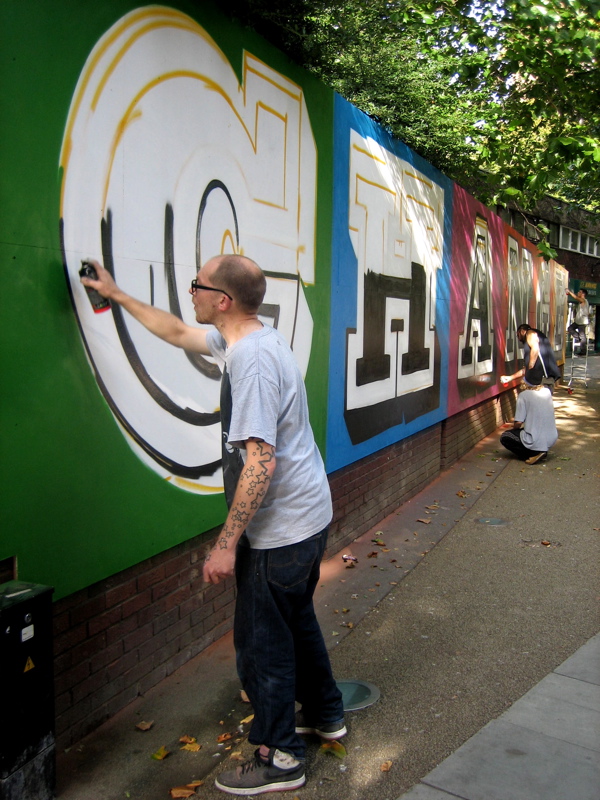
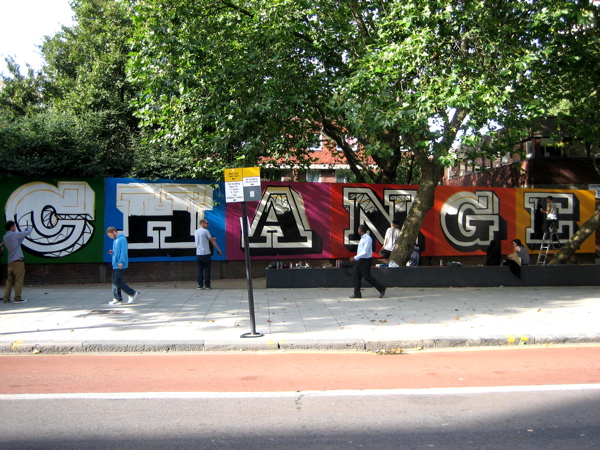
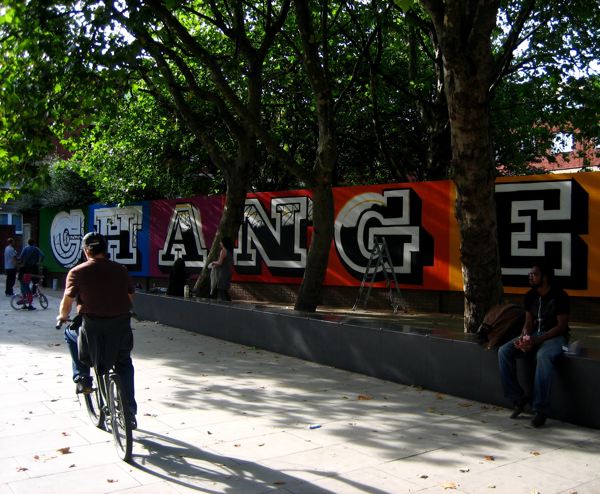
In Old St
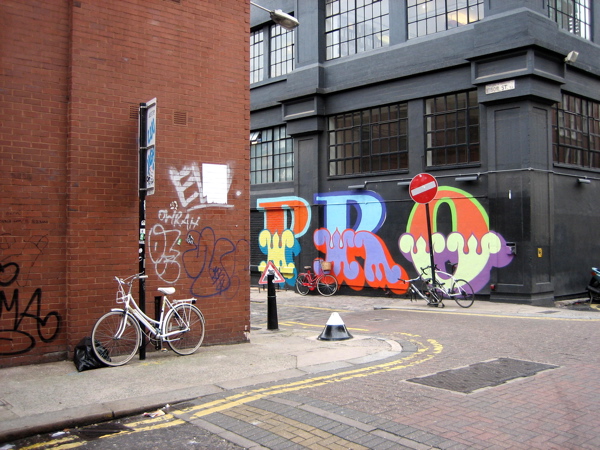


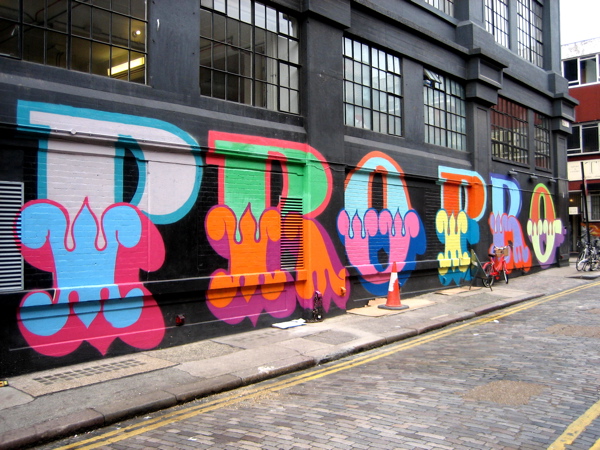
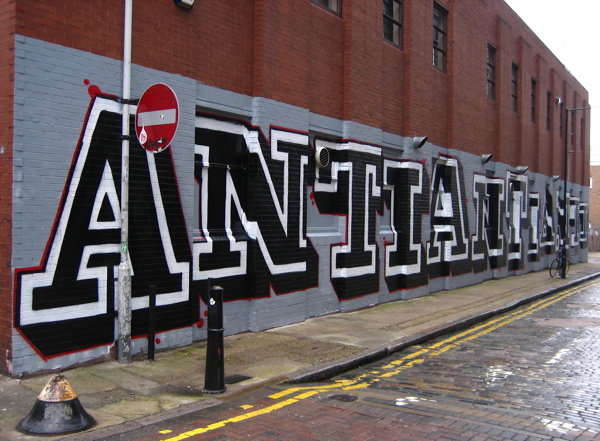
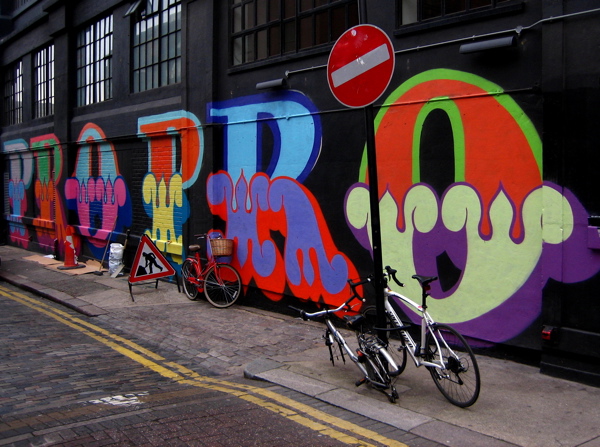
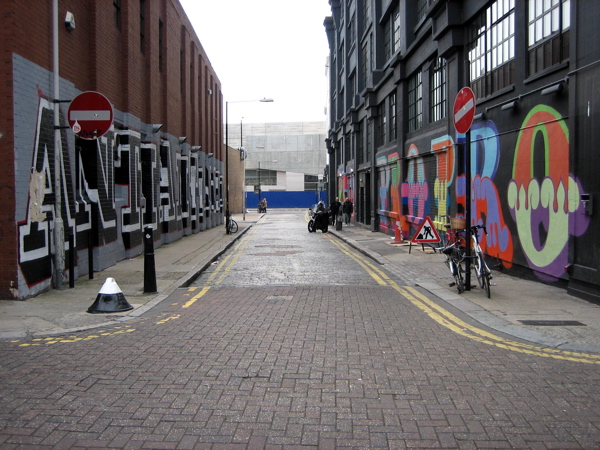
In Ebor St.
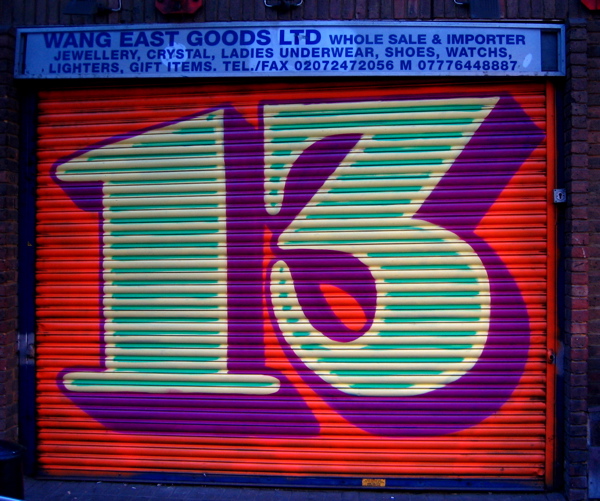
Ben painted this number thirteen in Goulston St, Spitalfields, recently for the cover of a magazine. The owner gave Ben permission although his shop is not number thirteen.“They’re always going to get the mail for number thirteen now!” whispered Ben to me mischievously afterwards.
You may like to read my other stories about Ben Eine
The Return of Ben Eine, Street Artist
The Rise of Ben Eine, Street Artist

As you may know, Hackney Council are threatening to paint out Peter Roa’s wonderful Rabbit on the Hackney Rd, even though it was painted at the invitation of the owner of the building. If you would like to sign the online petition to save it, you can do so by clicking here.
At Truman’s Brewery, Spitalfields, 1931
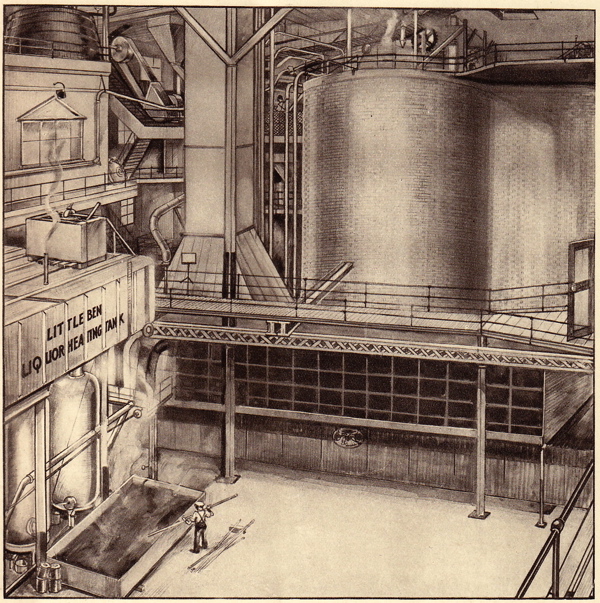
There is a bizarre drama in the presence of the two brewers in overalls in this picture of the Truman Brewery in Brick Lane, looking like ants by comparison with the tall Coppers towering above, each with the capacity for boiling four hundred barrels of liquid. Can you even find the second brewer, high on a gantry up above his colleague busy stirring with a long pole? This is an illustration of the crucial stage in the brewing process when the hops are added to the boiling “wort,” as the malt infused liquor is called before it becomes beer. Yet in spite of the awe-inspiring modernity of this vision, you can still see the smallest of the Coppers in the top left corner within the shell of the seventeenth century brewhouse, itself enclosed by the vast brewery that grew up around it.
The tension between the heroic scale of the brewing operation and the modest figures of cloth-capped workmen scurrying around appears comically absurd today. The industrialisation of the process which this sequence of pictures celebrate is unremarkable to us, it is the presence of the wooden barrels and use of horsepower that we find exotic. This is a quaint English modernity which has more in common with W. Heath Robinson than Fritz Lang, while the agricultural illustrations of the cultivation of barley show a haywain reminiscent of the work of John Constable and stooks of corn upon the hillside just as you would see in a landscape by Samuel Palmer.
These intriguing pictures were created as a supplement to The Black Eagle Magazine, published by Truman Hanbury & Buxton in 1931, and I am grateful to Tony Jack, ex-chauffeur at the Truman Brewery for bringing them to my attention, because they grant a rare glimpse into the working life of the brewery that flourished here for over three hundred years. Like many in Spitalfields, I have long been fascinated to understand the precise activities which once occupied all the spaces that today are filled with new media companies, shops, markets, clubs and bars. Twenty years after brewing ceased in Brick Lane, the presence of that earlier world still lingers in these enigmatic utilitarian structures, even if their original usage is already obscure.
Let me admit that although these pictures were designed to elucidate the brewing process, to me they merely serve to romance the alchemical mystery of it even further. The text of the accompanying brochure contains some elegant obfuscation too, “Living things have ever an individuality of their own which defies mere rule of thumb government. Brewing is not merely an elaborate process of manufacture, but it includes in it the application of man’s brain power as scientist and technician, to guide the processes of nature, and to help understand something of life’s basic but baffling problems: food, health and clean surroundings.”
Compounding the surrealism, when you examine the sequence below, you will discover that the images at the beginning and the end are photographs while those within the brewery are mostly artist’s impressions. This may be simply because good photographs were not possible within the brewery, but it does give the impression that the brewery contained another reality, stranger the outer world and containing magical possibilities. A notion enforced by references to the use of the Jacob’s Ladder, the Archimidean Screw and the Dust Destroying Plant, while the language of “sparging” the “wort” evokes a universe as strange as anything Tolkien imagined.
Yet it was all real, a discrete society with its own arcane language and culture that evolved during three centuries in Brick Lane until it modernised itself out of existence as master brewer Derek Prentice explained to me. What touches me in these curious pictures are the small human figures – often hidden or partially concealed in the background – and the few artifacts on their scale, the sinks, buckets, barrels and jugs, which appear miniature beside the industrial scale brewing equipment. As mysterious today as a lost tribe, now fled from Spitalfields, it is my project this Winter to interview as many as I can of these fleeting characters and recreate this vibrant world for you from their testimonies.
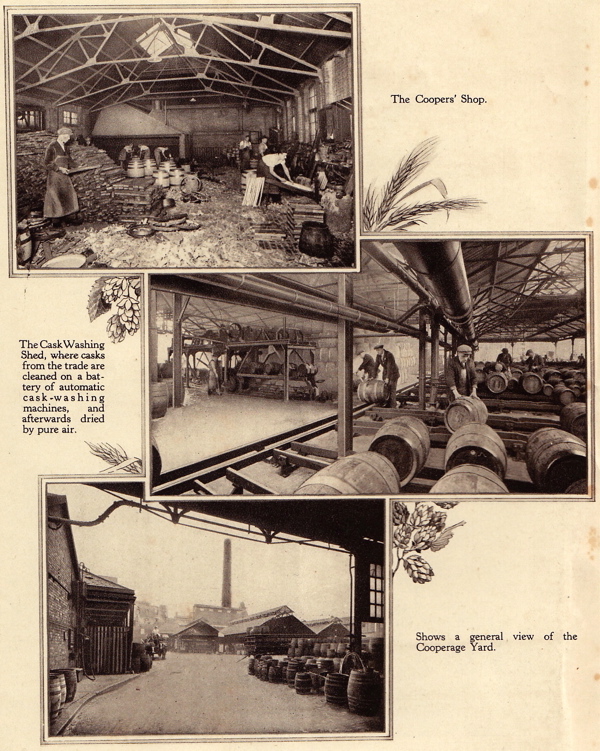
Watch this film of Trussing the Cooper, an initiation ritual for cooperage apprentices.
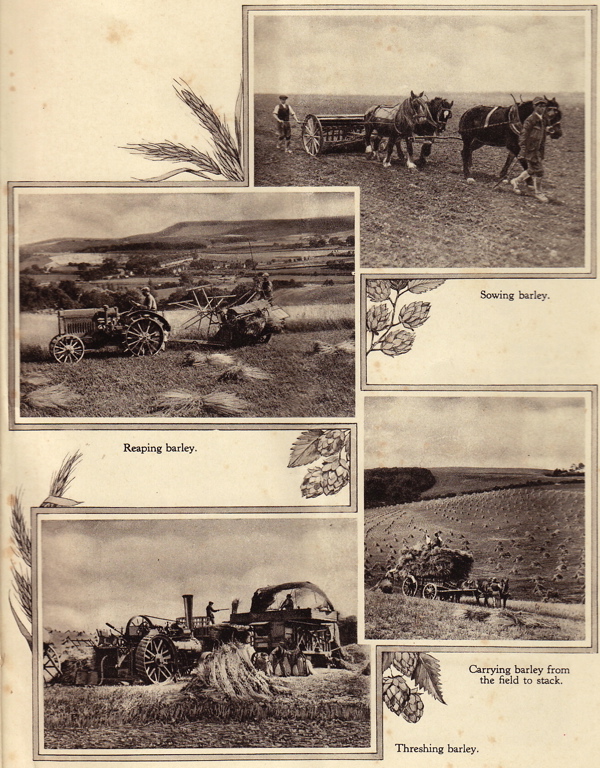
A mixture of machinery and horsepower was used in the production of Barley in 1931.
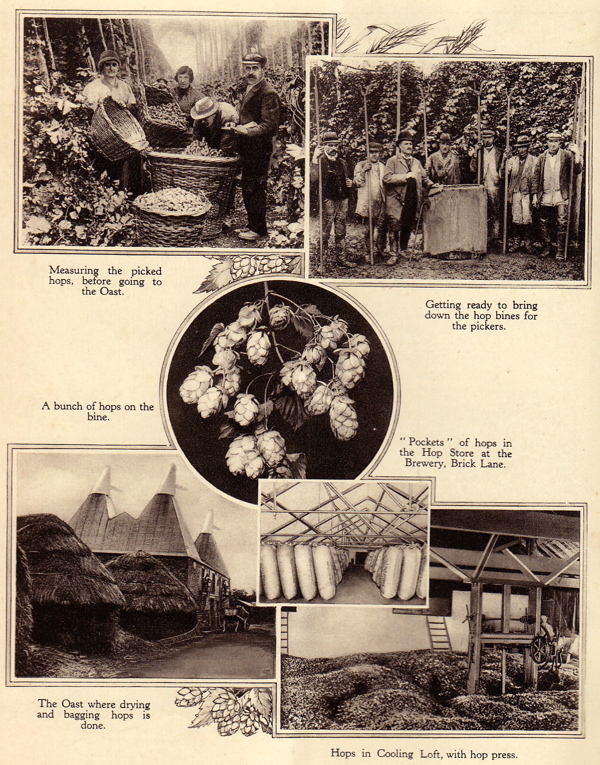
Many East Enders travelled down to Kent each year to work as hop pickers.
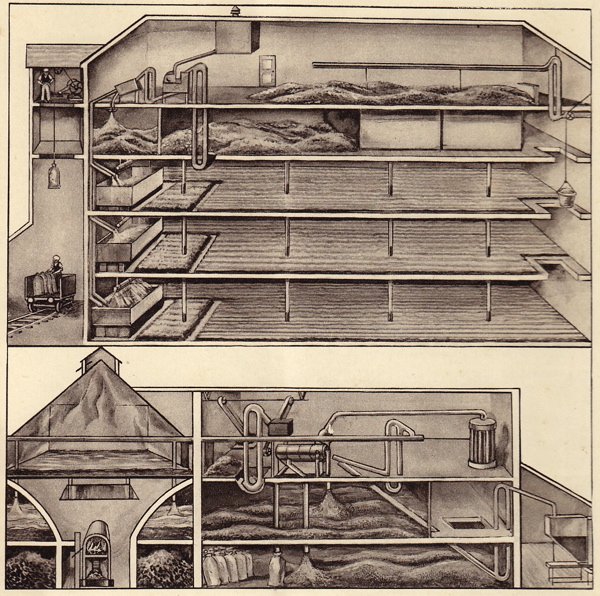
Barley arrived at the Maltings, where it was hauled up to the top storey, spread out onto the floor and covered with water, turned daily for ten to twelve days, and thinned out when it began to germinate. Then the Barley was transfered to the Malt Kiln and heated until it reached two hundred degrees farenheit. The Malt, as it now was, came from the Kiln and was cooled before being stored.
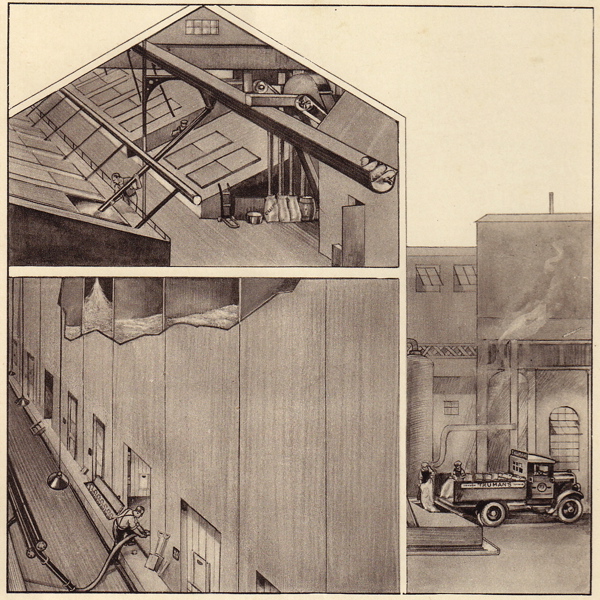
On the right you can see the Malt is being delivered at the Brewery in Brick Lane, then elevated to the Malt Loft by means of a Jacob’s Ladder, which you can see top left, and distributed by means of a Screw to Malt Bins with a capacity of 12,000 quarters. At the bottom, you can see the Malt being transferred from the bins for the day’s brewing by means of an Archimedean Screw. The movement of the Malt caused dust to rise and thus a connection with a large Dust Destroying Plant was required.
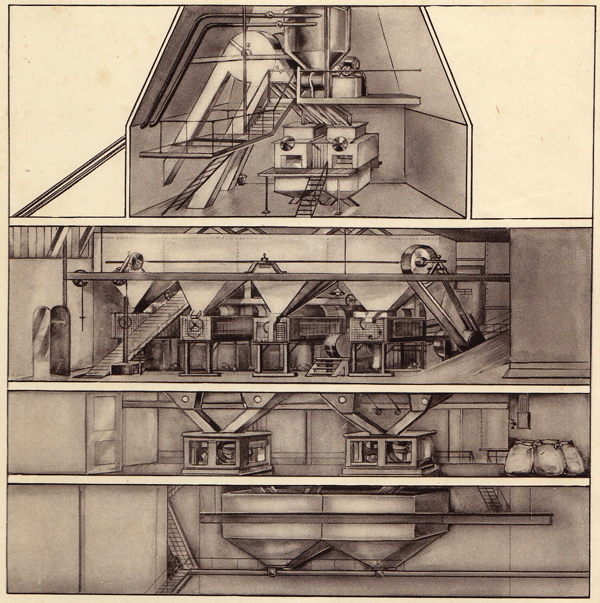
The Malt was received from the Malt Bins in the Malt Tower and Weighing Room at the top of this picture, before being passed through the Malt Screens on the floor below to remove any foreign matter. Then the Malt was weighed again before going into the Hoppers beneath, from whence it was again lifted by suction to the Tower in the New Brewery.
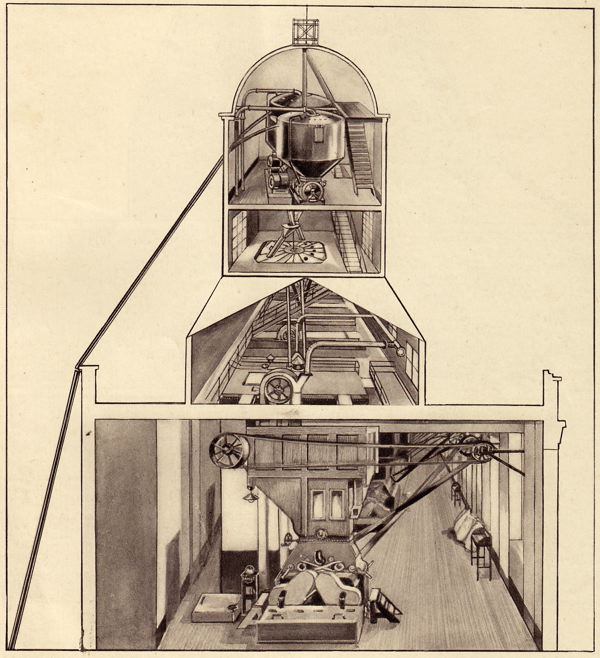
This is the Malt Tower, from where the malt was distributed down through various Blending Hoppers and then ground in the Malt Mills below.
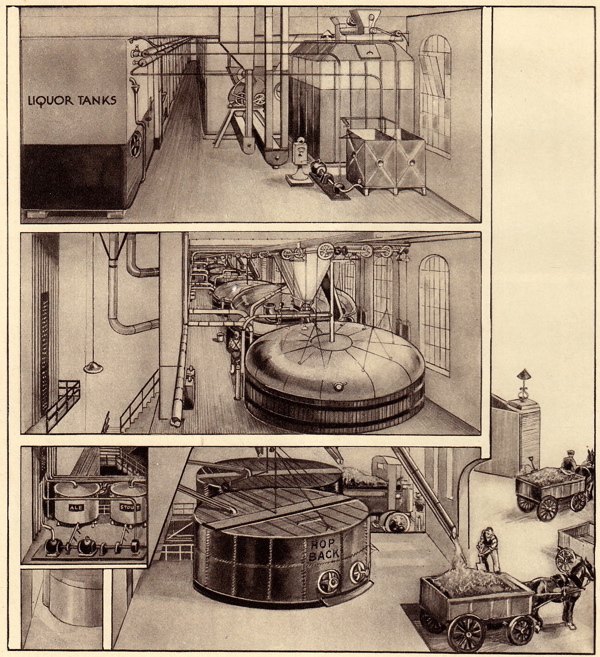
In the top picture, the Malt passes to the Grist cases ready for the Mash Tun. In the next picture you see the Mash Tun Stage. On entering the Mash Tun, the Malt was mixed with Liquor, allowed to stand and then “Sparged” at a rate of one hundred and twenty barrels per hour to create a substance resembling porridge. The resulting liquid, referred to as “Wort” was run off into the receivers you can see bottom left, labelled Ale and Stout, while on the right you can see the used Malt being removed by farmers. The Wort was then boiled in the Coppers, that you see in the picture at the very top, where the Hops was added.
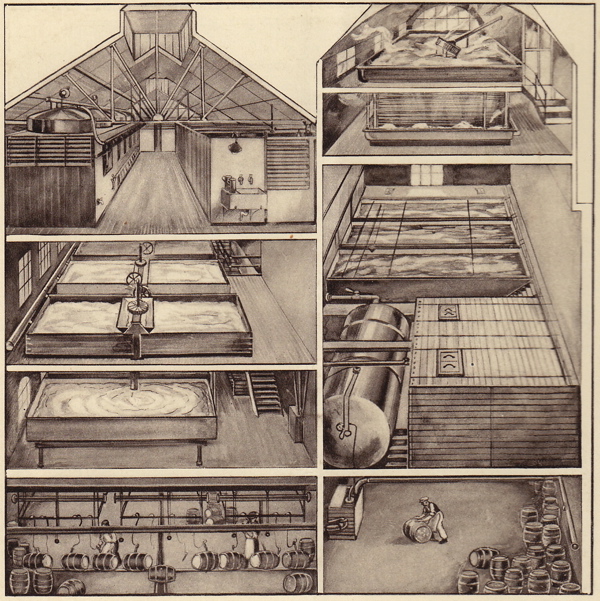
In these pictures you see how the Wort was pumped from the Coppers through the Refrigerator Room at the top and then into the Fermenting Squares on the floors below where the Yeast was added and fermentation took place. Finally, the Yeast was collected in the vessel in the top right and the Beer was run to the Racking Square and put into casks.
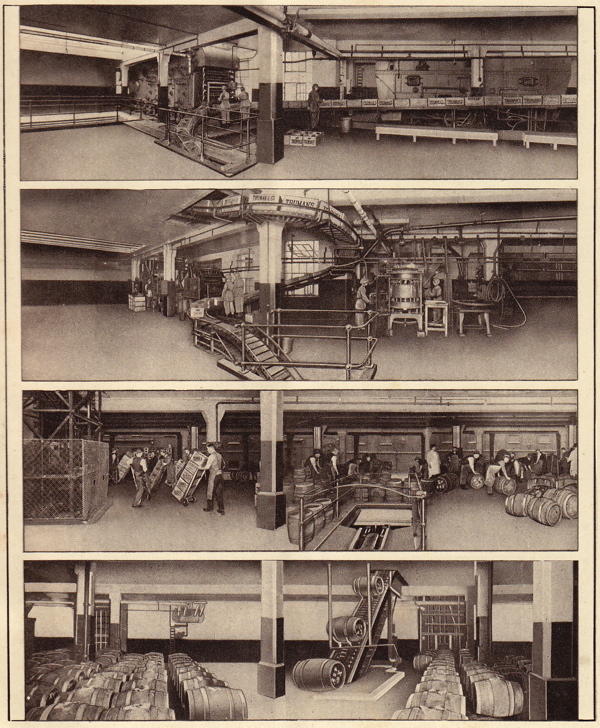
Above, in descending order, you see the Bottle Washing Floor, the Bottle Filling Floor, the Loading-out Stage and then the barrels in the cellars ready for loading.
Read the story of how Michael-George Hemus & James Morgan are bringing back Truman’s Beer.