
The Secret Gardens of Spitalfields
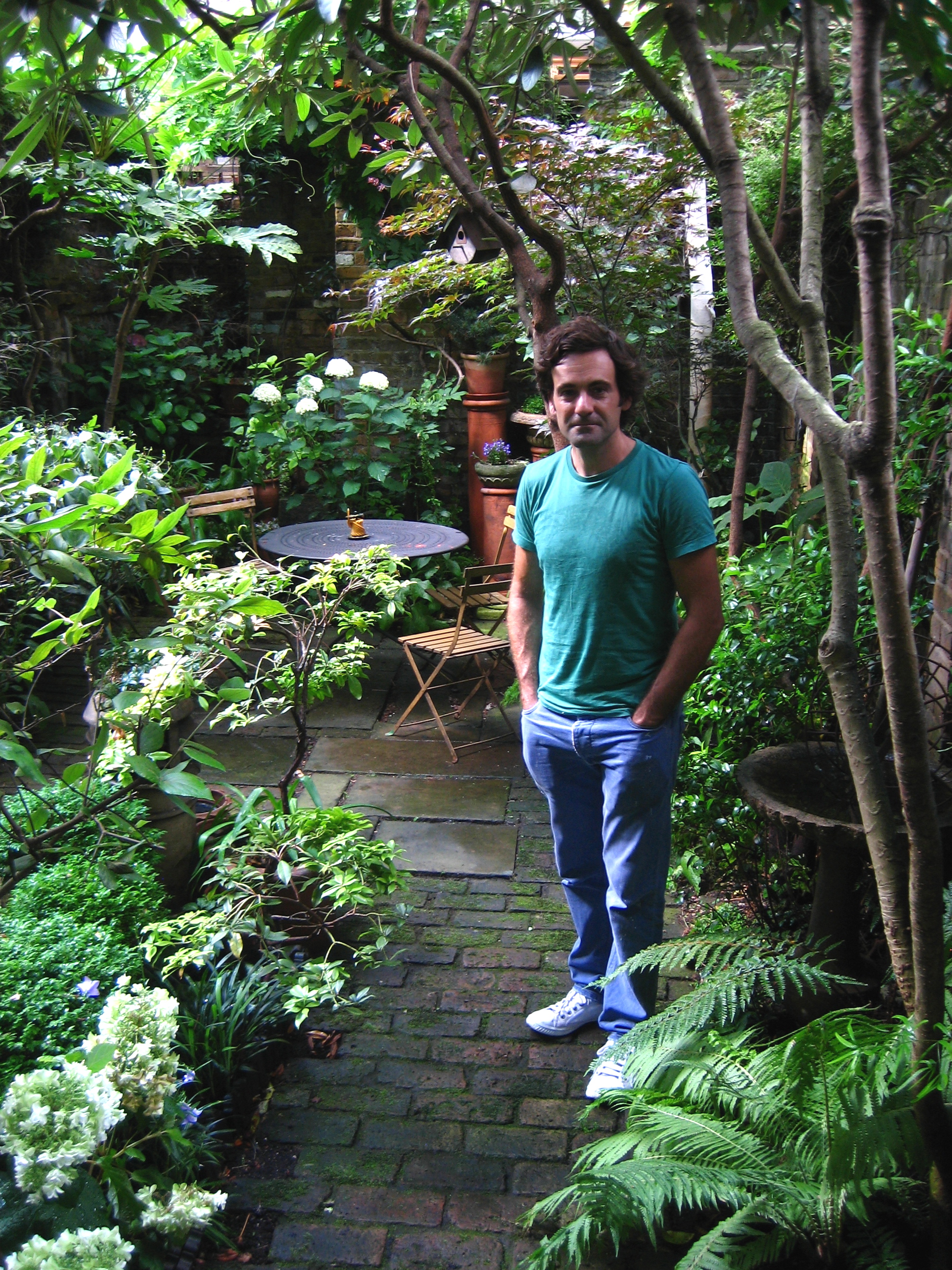
During these last months of Summer, Luis Buitrago called me each time he came to tend the gardens of Spitalfields. With the gracious permission of the owners, I was able to visit these hidden enclaves of green that are entirely concealed from the street by the houses in front and the tall walls that enclose them. If you did not know of the existence of these gardens, you might think Spitalfields was an entirely urban place with barely a leaf in sight, but in fact every terrace conceals a string of verdant little gardens and yards filled with plants and trees that defy the dusty streets beyond.
Luis Buitrago is a gardener and landscape architect who came to Spitalfields ten years ago and lived here for four years while working on the renovation of 7 Fournier St, where he created his first garden which you can see above. In subsequent years, as the news of the charming Luis’ unique talent to conjure horticultural magic has spread, he has become the preeminent gardener in Spitalfields, designing and maintaining the gardens of many of the resident luminaries that discretion prevents me from naming. It makes for a very satisfactory arrangement, because Luis has become uniquely experienced in the special challenges posed by these shady humid locations and when he comes over to do the weeding and watering, he can simply run up and down the street going in and out of all the doors, moving from one garden to the next.
The incarnation of modesty, Luis did not reveal that he has a degree in classics from the University of La Mancha, instead he simply explained that he found himself teaching at a school in South London and had an itch for something more. His three passions were languages, architecture and gardens and so he chose to study landscape architecture at the University of Greenwich.
“In Spitalfields the gardens are quite particular, they are micro-climates that are very shady and very sheltered.” explained Luis, in the gentle tone that is his characteristic mode of speech. “My approach to number 7 Fournier St, which is quite a small garden, was to create the feeling of a hidden woodland glade. I used large ferns to create the shade and planted birch and, over the years I have worked on it, I have added pieces of architectural salvage I have picked up.” I visited this garden one hot July afternoon when Luis had just watered it and I was astounded to walk from the street through the house and be transported into the cool of the garden where shafts of sunlight penetrated the green shade and every leaf glistened. The most mature of Luis’ Spitalfields gardens, this has a such diversity and detail that I could happily have passed my afternoon in this peaceful retreat.
Over in Princelet St, I discovered a much larger more formal garden with a playful cat that insisted on being photographed. “The nice thing about this garden is that you think it’s finished when you get to the end of the path but then there’s more.” said Luis, as he led me down the path with the cat following along behind us.“The tall walls make it mysterious and the owner has placed pieces of statuary to be discovered that give it a magical atmosphere. But in such humid conditions you have to be very careful with planting and you tend to go for texture rather than flowers.” he added. There was no sound of the city to be heard, birdsong filled the air and I loved all the deep contrasted foliage of this extraordinary lyrical garden full of shadow and drama.
Back in Fournier St, Luis showed me a shady courtyard between the house and a guesthouse. “There is a symmetry of structure here but the planting is asymmetric,” he informed me as I inhaled the heavy scent of Jasmine that lined the walls, “On this side I planted Hydrangea and on this side is a Strawberry Tree. The garden is simple but very effective because it is enclosed like a box.” Again, I wondered at this secret space that, paved with shining marble and sheltered from the blinding sunlight, could be anywhere in Italy or Spain.
Down in Walden St, we walked through a terrace of nineteenth century cottages to discover a garden exposed to the sun, “This is just four years old, quite a hot garden, and the owner wanted it to feel bright and enjoy the sunshine, so big structures were out.” revealed Luis, gesturing at the blue sky,” I had to choose plants that thrive in dry sunny conditions, sheltered all around by walls, so I was able to grow Echiums that are quite tender and Verbascum have been successful here. They have seeded themselves and there have been more each year.” Let me admit, I especially enjoyed the modest informality of this garden, sitting upon the oak bench here I could easily imagine I was in the Cotswolds rather than Whitechapel.
Each of the four was distinctive, yet all of Luis Buitrago’s gardens share his self-effacing charm – in the sense that they are not demonstrative, lacking in ostentatious conceptions, instead by complementing the environment and the architecture they offer relaxing spaces to seek solace. These are landscape designs that are responses to the architectural space, which have evolved through canny choices of plants that suit the respective locations. I admire Luis’ sense of poetry and romance in gardens, balanced by his practical delight in the act of gardening. I love the way that each of his gardens is like a magic box, playing upon the surrealism of their urban location, and exploiting their high walls to construct alternative worlds that are outside time.

In Fournier St

In Princelet St

The owner of this garden has placed pieces of statuary among the plants for the visitor to discover.

In this courtyard in Fournier St the walls are covered with a curtain of Jasmine, giving a intense fragrance that is strongest at night and lingers all Summer long.

In Walden St


Luis Buitrago with the smallest garden in Spitalfields, that he contrived in two granite troughs in Fournier St.
Frances Mayhew, Wilton’s Music Hall

When I first walked into Wilton’s Music Hall I thought I had entered a derelict building by mistake. With its austere crumbling facade and reception rooms stripped back to bare brick, it is quite the opposite of the plush Victorian grandeur I equate with Music Hall. Yet once I stepped into the cavernous auditorium with its gleaming barley sugar twist pillars and elaborate gilt balcony, I was captivated by the romance of this shabby old theatre. Alone in the gloom of the oldest surviving music hall in the world where as many as fifteen hundred pleasureseekers once came nightly to celebrate, the warm intensity of the atmosphere arrested me in my tracks. And I stood to gaze upon this sublimely resonant space – conjured for delight by John Wilton in 1859 – evoking familiar images of audience and performers by Sickert, Lautrec and all the other great painters of theatre and stage entertainments.
I had come to meet Frances Mayhew and, from her reputation as the rescuer of Wilton’s, I was expecting a latter day Joan Littlewood. So I was pleasantly disarmed when she arrived and proved to be a glamorous young woman, lighthearted in a vintage crimplene dress and plimsolls – though as our conversation developed Frances revealed a shrewdness and resolve that make her a worthy successor to Miss Littlewood.
As she took me around, Frances explained the chequered history of her beloved theatre. The area was a busy cosmopolitan dockland when John Wilton built his Music Hall – constructed in the back yard of five houses dating from the seventeen twenties housing The Prince of Denmark, an enormous pub renowned for its fine mahogany bar and named in honour of the Danish Embassy situated nearby in Wellclose Square. In the days when it was reputedly a landmark as famous as St Pauls, Champagne Charlie performed at Wilton’s and top acts from Covent Garden would race in carriages across London to give a second performance of the evening there. Constructed as an extension to the bar, it was among the earliest London music halls to open, yet it was superseded by custom built theatres by the end of the century.
Taken over as a Methodist Mission in the eighteen eighties, two thousand meals a day were served there in the Dockers’ Strike of 1889, later it became a safe house for those escaping the fascists during the battle of Cable St in 1936 and during World War II served as a refuge for people bombed out of their homes. In spite of the building’s significance, it was only the intervention of Sir John Betjeman in 1960 that saved Wilton’s from demolition when all the surrounding streets were flattened.
When Frances came along in 2004, Wilton’s had been empty for two years and the bank gave the management six months notice before repossessing the building in lieu of £250,000 debts – the outcome of a series of brave attempts to give the it new life as a performance venue. Learning of the plight of Wilton’s, with extraordinary courage and insight, Frances quit her job as a producer for International Management Group staging classical stadium concerts and came to work for no salary at first, as she attempted to save the shambolic old theatre that everyone else had abandoned.
“The building was going go to bankrupt and Wetherspoons were planning to take it over, so I came along and said, ‘May I put on some gigs and things and try and pay off your debts?’ I was on my own for the first sixth months booking in weddings and photoshoots, but it was very successful as a location for film and photography, and now five years later we have almost paid it off. It’s been a frugal enterprise. Loads of volunteers have given their time. We’ve had to earn our keep without public subsidy, yet it’s been good for the building to earn it’s own stability. I hope we’ve laid down a philosophy for the future that will last. We’ve had to listen to our audience and it’s been important to understand their feelings because they are the ticket buyers.”
Frances’ resourceful mixture of romantic idealism and modest pragmatism is an appealing one that has saved the building from the receivers, but now she has the Victorian drains to contend with. Soaking away unseen beneath the houses that comprise the street frontage, they are creating subsidence moving the theatre away from the rest of the building, and she needs to apply for a capital grant from the National Lottery Fund to rectify this problem if the building is to remain open. Yet with the enterprise financially stable and Wilton’s re-established at the heart of its community, presenting plays, opera and music hall, Frances has proved herself the worthy custodian of this venerable music hall and is prepared for the next challenge.
The place was full of young actors, rehearsing, warming up and being flamboyant in that bold carefree way which is characteristic of their profession. The place was alive, demonstrating that the world of the theatre is a one of youth and fleeting spontaneity. Yet while performance requires a space where imaginative freedom can be enacted, Frances knows that the architecture of romance also requires an income, debts paid and drainage that functions. I wondered what motivated her to take it on, working behind the scenes and dealing with the mundane offstage drama.
She became guarded, looking daunted when I asked if Wilton’s Music Hall is her life’s work, but then she confessed, “I suppose it is quite personal because it’s become a big responsibility. I can’t repair the building at the rate it is crumbling. When I first came here I just wanted to see if it could be rescued, but now I have ambitions for what I want it to be.” Hearing this last admission and sensing her withheld emotion, I realised that after five years Frances is just beginning her work at Wilton’s Music Hall and this story is not just about the past but about the future too.

A rare image of a performance in the early days of Wilton’s Music Hall.


By the 1970s, Wilton’s had fallen into neglect.

The auditorium today

Frances Mayhew at the entrance to Wilton’s Music Hall in Graces Alley.

Fifty yards from Wilton’s, these ten bollards are all that remain of the Royal Brunswick Theatre, one of the East End’s many lost theatres.

The weathervane on St Paul’s School, Wellclose Square, reminds us this was once dockland.
New photographs © Sarah Ainslie
Tubby Isaac’s Jellied Eel Stall, Aldgate

At the furthest extent of Spitalfields where it meets Aldgate is Tubby Isaac’s Jellied Eel Stall, run today by Paul Simpson, fourth generation in this celebrated business founded in 1919, still selling the fresh seafood that was once the staple diet in this neighbourhood. Here where the traffic thunders down Aldgate High St, tucked round the corner of Goulston St, Tubby Isaac’s stall shelters from the hurly burly. And one morning this week, Paul told me the story of his world famous stall as he set up for the day, while I savoured the salty sweet seaweed scent of the seafood and eager customers arrived to eat that famous East End delicacy, jellied eels for breakfast.
“I’ll be the last one ever to do this!” Paul confessed to me with pride tinged by melancholy, as he pulled a huge bowl of eels from the fridge,“My father Ted Simpson had the business before me, he got it from his Uncle Solly who took over from Tubby Isaac, who opened the first stall in 1919. Isaac ran it until 1939 when he got a whiff of another war coming and emigrated to America with his boys, so they would not be conscripted – but then they got enlisted over there instead. And when Isaac left, his nephew Solly took over the business and ran it until he died in 1975. Then my dad ran it from 1975 ’til 1989, and I’ve been here ever since.”
“I began working at the Walthamstow stall when I was fourteen – as a runner, cleaning, washing up, cutting bread, getting the beers, buying the coffees, collecting the bacon sandwiches. and sweeping up. The business isn’t what it was years ago, all the eels stalls along Roman Road and Brick Lane – they were here for a long, long time and they’ve closed. It’s a sign of the times.” he informed me plainly. Yet Paul Simpson is steadfast and philosophical, serving his regular customers daily, and taking consolation from their devotion to his stall. In fact, “Regular customers are my only customers” he admitted to me with a weary smile, “and some of them are in their eighties and nineties who used to come here with their parents!”
Understandably, Paul takes his eels very seriously. Divulging something of the magic of the preparation of this mysterious fish, he explained that when eels are boiled, the jelly exuded during the cooking sets to create a natural preservative. “Look, it creates its own jelly!” declared Paul, holding up the huge bowl of eels to show me and letting it quiver enticingly for my pleasure. The jelly was a crucial factor before refrigeration, when a family could eat from a bowl of jellied eels and then put the dish in a cold pantry where the jelly would reset preserving it for the next day. Paul was insistent that he only sells top quality eels, always fresh never frozen, and after a lifetime on the stall, being particular about seafood is almost his religion. “If you sell good stuff, they will come,” he reassured me, seeing that I was now anxious about the future of his stall after what he said earlier.
Resuming work, removing bowls of winkles, cockles, prawns and mussels from the fridge, “It ain’t a job of enjoyment, it’s a job of necessity,” protested Paul, turning morose again, sighing as he arranged oysters in a tray, “It’s what I know, it’s what pays the bills but it ain’t the kind of job you want your kids to do, when there’s no reward for working your guts off.” Yet in spite of this bluster, it was apparent Peter harbours a self-respecting sense of independence at holding out again history, after lesser eel sellers shut up shop. “When it turns cold, I put so many clothes on I look like the Michelin man by the end of the day!” he boasted to me with a swagger, as if to convince me of his survival ability.
Then Jim arrived, one of Tubby Isaac’s regulars, a cab driver who wolfed a dish of eels doused in vinegar and liberally sprinkled with pepper, taking a couple of lobster tails with him for a snack later. Paul brightened at once to greet Jim and they fell into hasty familar chit-chat, the football, the weather and the day’s rounds, and Jim got back on the road before the traffic warden came along. “It’s like a pub here, the regulars come all day.” Paul confided to me with a residual smile. And I saw there was a certain beauty to the oasis of civility that Tubby Isaac’s manifests, where old friends can return regularly over an entire lifetime, a landmark of continuity in existence.
It is a testament to Paul Simpson’s tenacity and the quality of his fish that Tubby Isaac’s is still here, now that this once densely populated former Jewish neighbourhood has emptied out and the culture of which jellied eels was a part has almost vanished. Tubby Isaac’s is a stubborn fragment of an earlier world, carrying the lively history of the society it once served now all the other jellied eels stalls in Aldgate are gone and the street is no longer full with people enjoying eels. But leaving all this aside, Paul is open seven days a week selling delicious and healthy non-fattening food, so please seek him out and try it for yourself.

The earliest photo of “Tubby” Isaac Brenner who founded the stall in 1919.

Tubby and one of his sons in the 1920s

Ted Simpson, Solly and Patsy Gritzman in the 1940s, after Tubby and his sons left for America.

In Petticoat Lane, 1960s

Ted serves jellied eels to Burt Reynolds and American talk show host Mike Douglas in the 1970s

Ted shakes hands with Ronnie Corbett

Joan Rivers helped out at the stall in the 1980s

Paul Simpson at the stall in 1989, before it became refridgerated.


Tubby Isaacs stall in Aldgate today.
In the footsteps of C.A.Mathew


It is eighteen months shy of a hundred years since C.A.Mathew visited Spitalfields in April 1912, but yesterday he was my invisible guide as I walked through the close-knit streets to take new pictures in the same locations, and make a photographic assessment of the changes that a century has brought. I had copies of his pictures with me, and in each instance I held them up to ascertain the correct alignment of buildings and other landmarks that told me I was in the same spot exactly.
Being in his footsteps revealed that C.A.Mathew composed his photographs to expose the most sympathetic play of light and shade, demonstrating a subtlety of tone that I dare not attempt to replicate in a different season at another time of day, in another age. Yet there was the delight of recognition when I knew I had found the right place and a sense of dislocation when there was no clue left. Disoriented, I found myself half in the world of a century ago and half in the present day.
When I discovered locations that cross-referenced precisely with the pictures, I felt a sense of elation because the street acquired a whole new dimension and the people in the old photographs took on a more tangible reality, as I contemplated the places where they stood. I relished being party to this secret knowledge and I knew C.A.Mathew was with me. But equally, I recognised an emptiness in the areas that are unrecognisably changed, and recent buildings appeared mere transient constructions to my eyes that had grown accustomed to the world of 1912. C.A.Mathew forsook me in these places, and I refrained from taking photographs when I could find no visible connection. Yet I told myself to resist sentimentality, because the world that C.A.Mathew photographed two years before World War I was one of flux too, only in his pictures could it be fixed eternally.
All streets belong to cars today and we cannot linger on the roadway or step off the pavement without risking our lives. A fact that became vividly apparent to me when I stood momentarily in the middle of the Bishopsgate traffic, risking my life in my attempt to discover C.A.Mathews’ vantage point upon Middlesex St, before following his path Eastward. I have always been fascinated by the change of scale and atmosphere, walking from the expanse of Bishopsgate through into the medieval streets at the edge of Spitalfields. And in C.A.Mathew’s pictures this change is also emphasised by social contrast, because he found these small streets full of people that lived there. There is a domestic quality that continues to draw me back to these streets, alleys and byways which still evoke their previous inhabitants through scale and form. A century ago, Bishopsgate was a major thoroughfare as it is now – and both my pictures and C.A.Mathews’ of it show people going somewhere. However in the alleys which are no longer inhabited as they once were, people do not occupy the space with the same sense of belonging as their predecessors in these photographs. They were more at home in these streets than we are today.
Unlike C.A.Mathews, my walk was on a working day and I found myself surrounded by suits, participants in the omnipresent corporate drama of the City, as hundreds of anxious business men took to the streets for a lunchtime walk in the September sunshine. They had escaped the office for a furtive cigarette, to make a private call or have confidential discussions about problems at work. Some passersby spied me with suspicious fleeting curiosity as I stood to take my pictures, very different from the people of a century ago who stood in groups to participate in the novelty of a photograph. Yet I delighted in the exotic drama of everyday life in the twenty-first century, seeing it from the perspective of C.A.Mathew.


In this photograph, only the bollard on the left hand side remains from the earlier picture.
C.A.Mathew’s photographs © copyright Bishopsgate Institute
C.A.Mathew, Photographer

In Crispin St, looking towards the Spitalfields Market
On Saturday April 20th 1912, C.A.Mathew walked out of Liverpool St Station with a camera in hand. No-one knows for certain why he chose to wander through the streets of Spitalfields taking photographs that day. It may be that the pictures were a commission, though this seems unlikely as they were never published. I prefer the other theory, that he was waiting for the train home to Brightlingsea in Essex where he had a studio in Tower St, and simply walked out of the station, taking these pictures to pass the time. It is not impossible that these exceptional photographs owe their existence to something as mundane as a delayed train.
Little is known of C.A.Mathew, who only started photography in 1911, the year before these pictures and died eleven years later in 1923 – yet today his beautiful set of photographs preserved at the Bishopsgate Institute exists as the most vivid evocation we have of Spitalfields at this time.
Because C.A.Mathew is such an enigmatic figure, I have conjured my own picture of him in a shabby suit and bowler hat, with a threadbare tweed coat and muffler against the chill April wind. I can see him trudging the streets of Spitalfields lugging his camera, grimacing behind his thick moustache as he squints at the sky to apprise the light and the buildings. Let me admit, it is hard to resist a sense of connection to him because of the generous humanity of some of these images. While his contemporaries sought more self-consciously picturesque staged photographs, C.A.Mathew’s pictures possess a relaxed spontaneity, even an informal quality, that allows his subjects to meet our gaze as equals. As viewer, we are put in the same position as the photographer and the residents of Spitalfields 1912 are peering at us with unknowing curiosity, while we observe them from the reverse of time’s two-way mirror.
What is immediately remarkable about the pictures is how populated they are. The streets of Spitalfields were fuller in those days – doubly surprising when you remember that this was a Jewish neighbourhood then and these photographs were taken upon the Sabbath. It is a joy to see so many children playing in the street, a sight no longer to be seen in Spitalfields. The other aspect of these photographs which is surprising to a modern eye is that the people, and especially the children, are well-dressed on the whole. They do not look like poor people and, contrary to the widespread perception that this was an area dominated by poverty at that time, I only spotted one bare-footed urchin among the hundreds of figures in these photographs.
The other source of fascination here is to see how some streets have changed beyond recognition while others remain almost identical. Most of all it is the human details that touch me, scrutinizing each of the individual figures presenting themselves with dignity in their worn clothes, and the children who treat the streets as their own. Spot the boy in the photograph above standing on the truck with his hoop and the girl sitting in the pram that she is too big for. In the view through Spitalfields to Christ Church from Bishopsgate, observe the boy in the cap leaning against the lamppost in the middle of Bishopsgate with such proprietorial ease, unthinkable in today’s traffic.
These pictures are all that exists of the life of C.A.Mathew, but I think they are a fine legacy for us to remember him because they contain a whole world in these few streets, that we could never know in such vibrant detail if it were not for him. Such is the haphazard nature of human life that these images may be the consequence of a delayed train, yet irrespective of the obscure circumstances of their origin, this is photography of the highest order. C.A.Mathew was recording life.
Looking at these pictures makes me want to be there with C.A.Mathew, exploring these alleys and byways of old Spitalfields. So now I am going to take my camera, walk out of door and through these same streets in the footsteps of my new acquaintance, to revisit the places he photographed, taking my own pictures to allow you a comparison. And tomorrow you will see my photographs of these locations as they are today.

Looking down Brushfield St towards Christ Church, Spitalfields

Bell Lane looking towards Crispin St

Looking up Middlesex St from Bishopsgate

Looking down Sandys Row from Artillery Lane – observe the horse and cart approaching in the distance.

Looking down Frying Pan Alley towards Sandys Row

Looking down Middlesex St towards Bishopsgate

Widegate St looking towards Artillery Passage

In Spital Square, looking towards the market

At the corner of Sandys Row and Frying Pan Alley

At the junction of Seward St and Artillery Lane

Looking down Artillery Lane towards Artillery Passage

An enlargement of the picture above reveals the newshoarding announcing the sinking of the Titanic, confirming the date of this photograph as 1912.

Spitalfields as C.A.Mathew found it, Bacon’s “Citizen” Map of the City of London 1912
All photographs copyright © Bishopsgate Institute
So long, Jimmy Cuba

Yesterday, Jimmy Cuba left the market for ever. He is a widely respected and popular figure who has traded here continuously since 1992, after the fruit & vegetable market left. This Sunday, as Jimmy packed up his stall of Latin & World Music for the last time in Spitalfields, the other traders came over to shake hands and make their regretful farewells. Old friends of Jimmy and a string of musicians had been turning up all through the day to greet the man who has become a legend in the Spitalfields Market.
It was an emotional moment, but everyone maintained a dignified composure and let the soulful lyricism of the music express what we were feeling. Yet when Jimmy increased the volume and took the rhythm uptempo, a party broke out spontaneously as people submitted to the irresistible Latin beat, with couples dancing in the market. There was a surreal delight to this extraordinary spectacle, which incarnated the passion and idiosyncratic poetry which Jimmy brought to this market that he loved over all these years.
We shall miss his mischievous good natured presence, his witty slogans on cardboard signs and, of course, we shall all miss that Latin pulse which has been the soundtrack to market life for the last two decades. We learnt something from Jimmy Cuba, because through his open-hearted manner he constantly reminded us that Spitalfields is more than a marketplace, it is a community of people and an arena for cultural exchange.
Months ago, Jimmy summoned me for breakfast to Dino’s Cafe in Commercial St to reveal his sober intention to quit on the last Sunday of trading before the stallholders are temporarily moved out of the market into the street while another event takes their place in the building. It was the last straw for Jimmy who has endured the whims of successive managements in the market over two decades. Growing up in Romford Market and beginning trading in music when he sold his record collection in Leather Lane thirty years ago, Jimmy has a strong feeling for markets as a collective human enterprise. He understands the drama of chaos and banter that brings the best markets alive.
With an inborn sense of levity, Jimmy is an unrepentant free agent who is never afraid to speak his mind. An innately decent person, he has a personal sense of justice that has led him to stand up for the traders on innumerable occasions over the years. And the corporate style of the new management – with executives who stick to their offices and will not even make eye contact with traders when they walk through the market – was too much for Jimmy. They did not like his cardboard signs, they thought his music was too loud and they did not like his attitude. Jimmy rolled his eyes in outrage to recount a recent incident when the traders arrived to set up their stalls in the morning, only to discover that the management had “forgotten” to tell them there was a promotional event happening, and they were sent away, losing a day’s income. “The market management, they only care about making money and they don’t see people, they are just interested in pounds per square foot. Spitalfields Market had so much more than that, but it’s been sanitised,” he admitted to me reluctantly on Sunday, as if it hurt to speak this way of a place that meant so much to him.
“I’m going to buy a boat and live on it for half the year,” continued Jimmy, looking to the future with brave confidence, “And I’m going to get back into DJing.” Because, as everyone who knows Jimmy Cuba is aware, he has become friends with many of the legendary performers of Latin Music, creating a mutual respect that has led to some dropping in on his stall in Spitalfields when they come through London. “I’m going to be spending a lot of time in the States because that’s where the artists are going to be.” explained Jimmy with a sprightly grin, looking forward to being able to travel once he is not stalling out every week, and can spend more time pursuing his three passions, boating, fishing and Latin Music.
On Sunday, Jimmy had a double size stall with all his favourite record sleeves on show and it made a fine display. I stayed on with him as the crowds thinned out and he went through the modest routine of packing up his CDs in their boxes while the music played and all around him other weary stallholders were closing up at the end of a long day. Jimmy cast his eyes around taking in the familiar picture, privately gathering his memories and emotions to carry them away with him. We all wish Jimmy Cuba well – one of the great characters of of Spitalfields Market – even if we regret that a little of the soul of the place has gone too. As one of the market traders said to me, “It’s going to be quiet without him around.”


Jimmy Cuba packed up his stall in the Spitalfields Market for the last time on Sunday.

Off Long Beach, California, 1986. An image from the past that gives a vision of Jimmy’s future.
 Jimmy’s copy of “Tito Puente & the Making of Latin Music” autographed by Jose Alberto, Giovanni Hildalgo, Davie Valentine, Alfredo de la Fe and Jimmy Bosch – all legends of Latin Music.

Teddy Manhood & his wife at Romford Market, 1974. Jimmy worked on their stall from the age of twelve and Teddy, who became a second father to Jimmy, used to bring him up to Spitalfields to buy stock.
Columbia Road Market 51

This cheerful fellow is Carl Grover, flowerseller – son of herbsellers Mick & Sylvia Grover whom I featured last week as the first in my series introducing you to all the street traders of Columbia Road Market. Occupying the pitch next to his parents, Carl started over thirty years ago in the market, working with his uncle Bob, his dad and his uncle Lee. “I used to go to the old Covent Garden Market with my father to buy flowers, and I can still smell the scent of freesias upon the cobbles today,” he recalled fondly.
“East London markets have always been such vibrant places, and Columbia Road Market at full pitch is one of the most vibrant places in London.” said Carl, turning evangelical in his declaration of affection for this beloved Sunday institution.”My customers are from all over London, from all backgrounds and walks of life. We may be English and not speak in the railway carriage, but in markets people engage with one another. Markets are proof that we’ve still got the art of conversation. We’ve still got the banter!”
Carl gets up at one in the morning each Sunday to make an early start setting up his stall, ready for the first customers arriving from seven o’clock onwards. Few realise that he also works from early Saturday, preparing the flowers ready to load up his van last thing on Saturday night before he goes to bed. Yet in spite of the early starts and relentless pace, working in all winds and weathers at unsocial hours, Carl delights in his chosen trade.“What a wonderful thing it is, to grow your own plants and flowers and bring them up to sell. We are the original farmer’s market.”, he said, reminding me that these stalls in the market each Sunday are the outcome of a whole world of horticultural endeavour which goes on every day through all seasons of the year.
Having seen the demise of Covent Garden market, Carl is understandably protective of Columbia Rd and the culture that attends it, built up over generations.“We’ve seen other places with great atmosphere lost,” he confided ominously, admitting a heartfelt concern for the future of the market.“We have no need of think tanks and consultants brought in by the Council, we just need places for the traders to leave their vans and for customers to be able to park without fear of fines. The Local Authority have a duty to provide for the needs of the traders.” This is Carl’s modest request, for this celebrated market drawing thousands of people from all over London each week, simply to be able to continue without interference.
As a fourth generation flowerseller, Carl Grover incarnates his role wholeheartedly, full of exuberant energy and easy charm which transforms his business into charismatic street theatre. Carl is proud to be part of the venerable tradition of London flowersellers, as he explained to me, “Over the years since I began in the market, I have been very fortunate to work with some great characters, some no longer with us unfortunately, and what I learnt from those people has enriched my life.”
Photograph copyright © Jeremy Freedman


