
Olive Besagni, Assistant Film Editor

This is Olive Besagni at eighty-five displaying a portrait of herself at nineteen. I think I can detect a hint of swagger in her eye, but let us grant Olive this indulgence because she has embraced existence with such exuberance and good humour over all these years that it is her right to a little chutzpah.
Olive is standing in her flat in Myddleton Sq in Finsbury where she has lived since 1956, just half a mile North of Clerkwenwell where her grandfather Giovanni Ferrari arrived from Borgotaro in 1880 to teach English to the Italian immigrants. Giovanni was a clever young man who loved to teach, and since most of the Italians needed to learn English if they were to advance, he became a very popular figure, known as Maestro Ferrari.
Giovanni’s eldest son Guiseppe (known as Joe) married Netta Oxley, an Englishwoman, and they moved to Gospel Oak where Olive was born in 1925. Then, when Olive was eleven they moved to Hampstead and at fourteen, upon the outbreak of war, she was evacuated to Rutland where she delighted to write sketches for performances in the village hall. Consequently, Olive grew up knowing little of the crowded Italian slum centred around Back Hill in Clerkenwell, that was the focus of the Italian community in London.
When I finished school, my parents wanted me to go to work in an office but I preferred to spend my time at Parliament Hill Lido and so I went for a few interviews that I messed up purposely. Finally, my father got a letter from a friend who ran a factory making religious statues, saying “Do either of your sons want a job?” It was in Great Sutton St in Clerkenwell and I went to work there, painting the lace and the gold lines onto the statues. Since I grew up in the suburbs, this was the first time I saw Italians in the raw but, once they discovered I was Maestro Ferrari’s granddaughter, they were very kind to me. And amongst the younger men was a sixteen year old boy called Bruno Besagni who worked as an artistic sprayer.
But I got bored with it there, and I found a job as a trainee negative cutter at a small documentary company in Dean St called Realist Films. They made mostly black and white films for medical students with close-ups of operations. I was only eighteen and there was a film of triplets being born, in colour, that I found especially traumatising, even more so than people having their legs removed. Yet I became an assistant film editor eventually, and from there I went to the best job I ever had – at Pathé Films in Wardour St.
I worked for Alexander Wilson Gardner making short pieces of film that could be inserted into news reports. We made a sequence about Christian Dior’s “New Look.” They had a model to wear the short hem and I had to appear as the legs of the woman in a long skirt. While I was there we discovered all these old reels, from the nineteen twenties and earlier, in the basement. We had to sort them out and I remember finding the film of Churchill dodging the bullets at the Battle of Sidney St. It was quite something, all these old cans of film, and it was exciting because it was all new to me.
I loved it, I absolutely loved it, but when I married Bruno Besagni and had two children, I was at home for five years as a housewife and mum. Then Alexander Milner Gardner rang me up and said “Do you want a job?” So I said, “I’ll ask my mum,” and she came and stayed with my children each day, and I went back to work. But very shortly, Alexander Milner Gardner died and my mother decided to go to America to see her other daughters, and I had to leave again. I pottered about doing freelance work. Commercials started then and I edited Butlins’ first adverts. But I resented leaving Pathé and I never became an editor because you had to do six years as an assistant editor before you could qualify.
I did all sorts of bits and pieces until I got a job in the Media Resources department at Kingsway College in Sans Walk, Clerkenwell. I had to work this horrible dirty old printing machine, and the boss didn’t like me because he thought I wasn’t young and he wanted a glamorous girl – but I didn’t mind because I have a sense of humour. I said, “I write plays, I can be a bit of a nuisance sometimes.” And he said, “Never mind, do it here!” So I wrote my plays there and they printed them for me and life was a ball.
I love razzmatazz and I used to write stuff for my friends, old time music hall etc, to entertain the old people at my church. Then one of the youngsters said, “Can’t we do a proper play?” So I said, “I can write something about the Second World War – if I don’t know anything about anything, I know about that.” I wrote a play, “Blitz & Peaces” with a cast of thirty and I produced, directed and acted in it. It was easy for me, and it was so successful, it was full every night. After that, I was offered the theatre at the St Luke’s Conference Centre in Central St. And I wrote and directed shows, one each year, for twenty years – I had this lovely theatre, some very talented actors and we played to two hundred people a night.
These plays, that Olive wrote and directed, dramatised aspects of the experiences of the Italian people in Clerkenwell and were in effect a collective history, performed by descendants of immigrants in front of an audience of their community. Yet in spite of the accomplishment and popular emotional import of these epic dramatic works that occupied Olive for twenty years, the culmination of her talents was yet to come.
This year Olive Besagni published A Better Life, a collection of oral histories telling the story of Italian families in Clerkenwell going back over generations into the nineteenth century. In this authoritative book, Olive tells the story of an entire society, allowing people to speak for themselves yet supplying pertinent historical material to give background to the testimonies. With her experience as an editor and her trained ear as a playwright, Olive was the ideal person to make a record of her people. The only shortcoming – if it may be called that – is that Olive modestly includes very little of her own story, which is why I have endeavoured to tell it here.
I met Olive at the Italian Parade in Clerkenwell on Sunday which she has attended every year since it recommenced in 1946, except for 1948 – because Olive got married to Bruno on the day before the parade that year and she was away on her honeymoon. As a consequence, Olive & Bruno’s wedding anniversary is always the day before the parade and this year they celebrated their sixty-third. “I can’t believe it,” she confessed in wonder, “So many good things have happened to me.”

Olive looking like a Hollywood movie star in the nineteen forties

Olive & Bruno

Wedding at St Peter’s, the Italian church, in Clerkenwell, July 1948.

Olive arrives at the church with her father Guiseppe Ferrari (known as Joe).

Olive & Bruno on their honeymoon, 1948.


Olive & Bruno with their children Anita & Tony at Brambles Chine on the Isle of Wight.

Olive & Bruno with their children, Anita, Tony & Nicolette.

On New Year’s Eve

Bruno and Olive celebrated their sixty-third wedding anniversary this week.
 Olive Besagni
New portraits copyright © Colin O’Brien
Copies of A Better Life by Olive Besagni are available from the publisher Camden History Society
You might also like to take a look at the 126th Italian Parade in Clerkenwell
At Wood St Stables

Just occasionally, I hear distant horses’ hooves in the street outside when I am sitting writing at my desk in Spitalfields. It always causes me to stop and consider this evocative, once familiar sound, that echoes down through the centuries. When horses were the primary mode of transport, there would have been hundreds of stables in the City, but today there is only one. So yesterday, I decided to follow the sound of the hooves back to their source in Wood St and pay a visit to the last stable, the home of the City of London Mounted Police – and Spitalfields Life contributing photographer Patricia Niven came along with me.
Passing among the shining glass towers of the City and then entering Wood St Police Station, we were ushered behind the desk, past a sign that said “Level of threat: normal,” down a passageway, through a courtyard and into the stables where the magnificent beasts are kept. Leather harnesses hung from the walls, straw was scattered upon the floor and the acrid smell of the farmyard prevailed here in this quiet enclave, a world apart from the corporate financial culture that surrounds it.
These are the last working horses in the City, out on the street in pairs for four hours at a stretch as they undertake patrols three times a day. Exchanged fortnightly, the troupe of ten is divided equally between here and Bushey Park where they get to run free and where training takes place. Mounted police officers double up as stable hands, cleaning kit and mucking out, grooming and feeding their charges. And, consequently, the stable is a scene of constant activity from seven each morning, when they arrive to wake the horses before setting out on the first patrol at eight thirty.
“I never envisaged, when I joined the police, I’d end up riding a horse,” admitted Sergeant Nick Bailey, greeting us eagerly, “I joined the police to ride motorbikes, but I suppose you could say I found a different horsepower.” Yet, in spite of his alacrity, Sergeant Bailey is a passionate horseman who grew up riding and competed in equestrian events before the demands of police work caused him to choose between his career and sporting endeavours. Now with thirty years service behind him, he came to the City of London to take charge of the mounted police just twelve months ago from Bridgend in Wales, where he set up the equestrian department. “My wife and family are still in Wales, I go back every third week” he confessed with a shrug, yet he was keen to outline his busy year that began with the Lord Mayor’s Show and included the student protests, an English Defence League demo in Luton, football matches at Watford and Arsenal, and a Heavy Metal festival.
Before the mounted police were created in 1946, horses were drafted in from the cavalry and recently the stable had a visit from blind ninety-seven-year-old who had lead the last cavalry charge in battle – an event which filled Sergeant Bailey with awe. “I can’t imagine what that was like,” he confided, as a vision of a distant harsher world, even if he admitted that “if a bomb went off, we would have horses out on the streets for seven hours at a stretch.”
Sergeant Bailey introduced his four horses in the stalls that morning. Trader, a powerful white stallion quivering with life, reached over to scrutinise us while Little Dave, a smaller dark horse, eyed us from a distance – weary from the traffic patrol that morning. Opposite, Finn, the oldest horse, with ten years service, stood composed and dignified and then Roxie, the only mare, pushed her glossy striped head over the gate to greet us enthusiastically.
There are one hundred and twenty five horses in the Metropolitan Police today where twenty years ago there were over two hundred and fifty. A fact which makes Sergeant Bailey evangelical on behalf of his charges, advocating the horses’ credentials as cheaper and greener than motorcars. “In the Summer, cafe owners bring out a bucket of water for them,” he told me, “People feel safer when they see horses on the street.”


Photographs copyright © Patricia Niven
Adam Dant’s Hackney Treasure Map
With the dog days of Summer upon us, what could be better diversion than this treasure map of Hackney newly drawn by Adam Dant? Inspired by the discovery of the Hackney Hoard by Terry Castle and informed by the knowledge of Stephen Selby the Hackney Antiquarian, this map describes the pre-industrial riches of the borough and is conveniently marked with suitable spots to dig. (Click to enlarge and study it further)

Prince Rupert’s Mill. Prince Rupert’s secret died with him – it was a composition from which indestructible cannons were cast and bored here in Hackney.
Temple Mills. Once belonging to the Knights Templars, these mills were used for grinding points on pins and needles, sent on to Worcestershire to receive eyes.
Beresford’s White House. Occasional residence of highwayman Dick Turpin, attached to the house was an extensive fishery, offering sport for one shilling.
Roman Burial Ground. Discovered under Hackney Marsh, part of the Roman stone causeway to Essex, and a marble sarcophagus at Brooksby’s Walk.
Lord Zouch’s House. A peer who sat in judgement on Mary Queen of Scots, Edward Lord Zouch amused himself with experimental gardening.
The Mermaid Tavern. 12/8/1811, Mr Sadler ascends in a balloon above Mr Holmes’ pleasure gardens, bowling greens and Hackney brook.
Sutton House. Known as “Bryck House,” it was built for Henry VIII’s courtier Ralph Sadleir who sold it to cloth merchant John Machell. The house still stands.
The Black & White House. Home of Robert Vyner, drinking partner of Charles II, its name “Bohemia Place” arising from the residence of the Queen of Bohemia.
Loddige’s Nursery. George Loddige’s forty foot palm house and orchid houses maintained tropical heat. Many of his plants and houses were removed to Crystal Palace.
Barber’s Barn. Home of the low-born John Okey, sixth signatory of Charles I’s death warrant, its grounds later cultivated by John Busch, nurseryman to Catherine II of Russia.
St John’s Place/Beaulieu. Said to have been home the priory of of St John, it later acquired the name “Shoreditch Place” after Jane Shore, lover of King Edward IV.
Brook House. Granted by Edward VI to the Earl of Pembroke, the house passed to the Earl of Warwick then to Dr Monro as a ‘recepiticle for insane persons.’
Gothic Hall. Mr Thomas Windus fitted out his house as a museum containing china, grecian pottery and six hundred drawings and paintings by Rubens, Van Dyke etc.
Shacklewell House. The ancient seat of the Herons, and residence of Cecilia, Thomas More’s daughter, later home of regicide Owen Rowe.
Abney House. Built for Thomas Gunstone to hymn writer & divine Isaac Watts’ plans. Gunstone died on its completion.
Brownswood House. The Hornsey Wood Tavern was formed out of the old Copthall and the Manor House of Brownswood. Victoria halted here in 1848.
Newington Green Manor. An area home to dissenters in the seventeenth century, Daniel Defoe unsuccessfully bred civet cats nearby.
Palatine House. Built to house protestant refugees from the Rhine Palatinate, later used as a retreat by John Wesley, friend of owner C. Greenwood.
Whitmore House. A moated house adapted by London haberdasher Sir William Whitmore for his son Sir George Whitmore.
Francies House. Built by William Francies, a merchant tailor, in 1706, owned by the Tyssens family and leased to carpenter Richard Tillesley.
Baumes House. Built by two Spanish merchants in 1540, it became known as Sir George Whitmore’s house and in 1691 hosted King Charles I. It later was used as a madhouse.
Alderman John Brown’s House. Home of the serjeant, painter to Henry VIII.
Nag’s Head. A coaching inn and haunt of robber & highwayman Dick Turpin.
The Theatre. Home of Shakespeare & Burbage’s Lord Chamberlain’s New Acting Troupe. The timber was dismantled and used to construct the Globe.
Holywell Mount. Nearby the priory of St John the Baptist, plague burials were said to take place at Holywell Mount.
The Rectory, Hackney. Site of the Manor of Grumbolds and home of John & Jane Daniel, accused of blackmailing the Countess of Essex.
Geffrye Almshouses. Paid for by Sir Robert Geffrye in his will of 1703 which declared his remaining fortune to the Ironmongers’ Company for provision of almshouses.
Map copyright © Adam Dant
The original of Adam Dant’s map can be seen in an exhibition entitled Hackney Hoard which opens this evening with an introduction by Terry Castle (6-9pm) and runs until 28th August at Galerie 8 in the Arthaus Building, London Fields.
You may also like to take a look at
Adam Dant’s Redchurch St Rake’s Progress
or his Map of the History of Shoreditch,
or his Map of Shoreditch in the Year 3000,
or his Map of Shoreditch as New York,
or his Map of Shoreditch as the Globe,
or his Map of Shoreditch in Dreams,
Swan Upping on the Thames

Since before records began, Swan Upping has taken place on the River Thames in the third week of July – chosen as the ideal moment to make a census of the swans, while the cob (as the male swan is known) is moulting and flightless, and before the cygnets of Spring take flight at the end of Summer. This ancient custom stems from a world when the ownership and husbandry of swans was a matter of consequence, and they were prized as roasting birds for special occasions.
Rights to the swans were granted as privileges by the sovereign and the annual Swan Upping was the opportunity to mark the bills of cygnets with a pattern of lines that indicated their provenance. It is a rare practice from medieval times that has survived into the modern era and I have always been keen to see it for myself – as a vision of an earlier world when the inter-relationship of man and beast was central to society and the handling of our fellow creatures was a important skill. So it was my good fortune this week to join the Swan Uppers of the Worshipful Company of Vintners’ for a day on the river from Cookham to Marlow, just one leg of their seventy-nine mile course from Sunbury to Abingdon over five days. The Vintners Company were granted their charter in 1363 and a document of 1509 records the payment of four shillings to James the under-swanherd “for upping the Master’s swans” at the time of the “great frost” – which means the Vintners have been Swan Upping for at least five hundred years.
Swan Upping would have once been a familiar sight in London itself, but the embankment of the Thames makes it an unsympathetic place for breeding swans these days and so the Swan Uppers have moved upriver. Apart from the Crown, today only the Dyers’ and Vintners’ Companies retain the ownership of swans on the Thames and each year they both send a team of Swan Uppers to join Her Majesty’s Swan Keeper for a week in pursuit of their quarry.
It was a heart-stopping moment when I saw the Swan Uppers for the first time, coming round the bend in the river, pulling swiftly upon their oars and with coloured flags flying, as their wooden skiffs slid across the surface of the water toward me. Attended by a flotilla of vessels and with a great backdrop of willow framing the dark water surrounding them, it was as if they had materialized from a dream. Yet as soon as I shook hands with the Swan Uppers at The Ferry in Cookham, I discovered they were men of this world, hardy, practical and experienced on the water. All but one made their living by working on the Thames as captains of pleasure boats and barges – and the one exception was a trader at the Billingsgate Fish Market.
There were seven in each of the teams, consisting of six rowers spread over two boats, and a Swan Marker. Some had begun on the water at seven or eight years old as coxswain, most had distinguished careers as competitive rowers as high as Olympic level, and all had won their Doggett’s coat and badge, earning the right to call themselves Watermen. But I would call them Rivermen, and they were the first of this proud breed that I had met, with weathered skin and eager brightly-coloured eyes, men who had spent their lives on the Thames and were experts in the culture and the nature of the river.
They were a tight knit crew – almost a family – with two pairs of brothers and a pair of cousins among them, but they welcomed me to their lunch table where, in between hungry mouthfuls, Bobby Prentice, the foreman of the uppers, told me tales of his attempts to row the Atlantic Ocean, which succeeded on the third try. “I felt I had to go back and do it,” he confessed to me, shaking his head in determination, “But, the third time, I couldn’t even tell my wife until I was on my way.” Bobby’s brother Paul told me he was apprenticed to his father, as a lighterman on the Thames at fifteen, and Roger Spencer revealed that after a night’s trading at Billingsgate, there was nothing he liked so much as to snatch an hour’s rowing on the river before going home for an hour’s nap. After such admissions, I realised that rowing up the river to count swans was a modest recreation for these noble gentlemen.
There is a certain strategy that is adopted when swans with cygnets are spotted by the uppers. The pattern of the “swan voyage” is well established, of rowing until the cry of “Aaall up!” is given by the first to spot a family of swans, instructing the crews to lift their oars and halt the boats. They move in to surround the swans and then, with expert swiftness, the birds are caught and their feet are tethered. Where once the bills were marked, now the cygnets are ringed. Then they are weighed and their health is checked, and any that need treatment are removed to a swan sanctuary. Today, the purpose of the operation is conservation, to ensure well being of the birds and keep close eye upon their numbers – which have been increasing on the Thames since the lead fishing weights that were lethal to swans were banned, rising from just seven pairs between London and Henley in 1985 to twenty-eight pairs upon this stretch today.
Swan Upping is a popular spectator sport as, all along the route, local people turn out to line the banks. In these river communities of the upper Thames, it has been witnessed for generations, marking the climax of Summer when children are allowed out of school in their last week before the holidays to watch the annual ritual.
Travelling up river from Cookham, between banks heavy with deep green foliage and fields of tall golden corn, it was a sublime way to pass a Summer’s afternoon. Yet before long, we passed through the lock to arrive in Marlow where the Mayor welcomed us by distributing tickets that we could redeem for pints of beer at the Two Brewers. It was timely gesture because – as you can imagine – after a day’s rowing up the Thames, the Swan Uppers had a mighty thirst.


Martin Spencer, Swan Marker


Foreman of the Uppers, Bobby Prentice


The Swan Uppers of the Worshipful Company of Vintners, 2011

The Swan Uppers of 1900


The Swan Uppers of the nineteen twenties.


In the nineteen thirties.


The Swan Uppers of the nineteen forties.


In the nineteen fifties.

Archive photographs copyright © Vintners’ Company
You may also like to read about
Colin O’Brien Goes Back To School

This is Colin O’Brien, head boy at Sir John Cass School in Aldgate, on the day he left the school in 1955, proudly holding aloft the Lord Broughshane Cup and making a fine show of facing the future with confidence. Standing up straight, with his hair neatly brushed, he is the incarnation of youthful optimism.
So, as you can imagine, Colin was a little tentative when he returned to his old school yesterday, more than half a century later – for the first time since that day – to attend the leavers’ evening and meet the class of 2011.
“I think I was eager to please, and I was very happy,” was Colin’s self-effacing explanation when I asked how he became head boy, as we walked up Aldgate to Sir John Cass School, “I was always top of the class, even though I am not academic and I left with no qualifications.”
While still at school, Colin had shown flair in photography, recording the life around him in Clerkenwell where he grew up and even the car crashes that he witnesses from his window, so it was perfectly natural for him to take a set of pictures of his classmates to record the moment when they knew each other best – before they went their separate ways for ever.
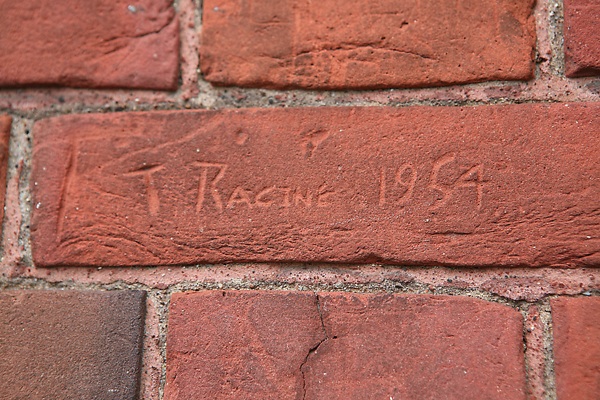
I joined Colin on a sentimental quest to discover his youthful self of this photograph taken in July 1955 at the Sir John Cass School. We looked first in the school trophies cabinet for the Lord Broughshane Cup but it was no longer to be found and, to Colin’s surprise, when he climbed up to the rooftop playground where the picture was taken, he discovered that a garden had grown there, with beehives in a row, and flowers and vegetables sprouting where once he used to play. Yet, unexpectedly, evidence of his youthful presence remained in the form of indentations in the bricks, where Colin and his pals used to polish pennies by rubbing them into the wall, creating round notches that remain half a century later. And, to Colin’s delight, there were names graven into the brick too, among them “S.Worthington 1955” and “Tony Racine 1954.” – names that he remembered as those of his classmates.
Once these unforseen discoveries confirmed that Colin’s memory was not a dream, his photographs not mirages and his youthful self not a spectre, we were emboldened to enter the assembly hall where, beneath the gaze of eighteenth century worthies that lined the walls, the current pupils of Sir John Cass School were gathered with their parents to say farewell to the leavers. Unlike Colin, who left at fifteen to face the world, these pupils were only completing their Primary education at ten or eleven and going on to Secondary education in the Autumn. Yet they were each required to stand up and complete a sentence that began, “When I leave university, I want to be…” and they did so with admirable resolve and ambition, even the ten-year-old realist who rewrote the sentence declaring, “I don’t know yet what I want to do when I leave university.”
Colin was there to give out the prizes to his youthful counterparts at the culmination of the evening, after performances by members of the school string orchestra and drama presentations. He shook hands with each of the leavers as they were given their bible, dictionary and thesaurus – revealing to me later that he still had his own leavers’ bible at home. And then, as the event drew to its close and all the achievements both individual and collective had been celebrated, the equivocal emotional nature of the event became apparent, as in the melee a few gave way to quiet tears. Meanwhile, there were a host of others running around with digital cameras to collect pictures of classmates as keepsakes, just had Colin had done all those years earlier.
As we descended a staircase afterwards, Colin pointed out the spot where he was first told about sex, admitting that he did not believe it at the time. In the playground, he confessed that this was where he felt the tingling sensation inspired by the object of his nascent affection Olive Barker, the daughter of the caretaker of the Bishopsgate Institute. “She never even looked at me,” recalled Colin fondly, “It was my first experience of love.”

Colin O’Brien, 18th July, 2011

Colin O’Brien, July 1955


Olive Barker, the object of Colin’s unrequited youthful affection is on the right.


Colin & the girls


Mr Hunt with members of his class.



S. Worthington, Colin O’Brien and Ingrams.


Sir John Cass School leavers, 2011.

The notches in the wall where the class of 1955 once polished pennies.
Photographs copyright © Colin O’Brien
More photographs by Colin O’Brien
Colin O’Brien’s Clerkenwell Car Crashes
Travellers’ Children in London Fields
At the 126th Italian Parade in Clerkenwell

In spite of the volatile weather, alternating downpours with blazing sunshine, I set out (with my umbrella in hand) to Clerkenwell yesterday, where photographer Colin O’Brien invited me to join him at the Italian Parade that he first attended in 1946. For one Sunday each year, the narrow backstreets are transformed when the descendants of the immigrants who once lived in here in London’s “Little Italy” return to participate in a procession honouring Our Lady of Mount Carmel, and, such is their love for their culture and custom, they were not to be discouraged by a few drops of rain.
Growing up in Victoria Dwellings at the corner of the Clerkenwell Rd and Farringdon Rd, the Italian Parade was an annual fixture in Colin’s childhood and in 1946, at six years old, he marched in the procession as a little blond boy dressed in white – the picture of innocence – to celebrate his confirmation. Later, as a precocious child photographer, some of Colin’s first pictures were of the parade and when I saw these recently I suggested that he might like to return, a lifetime later, to photograph the event this year.
There is a certain magic that reigns on these occasions, when a Neapolitan atmosphere presides upon these London streets where for one day of each year, only Italian is spoken, and the recorded mellifluous tones of sentimental songs echo between tall old buildings towering over a full blown Festa taking place in the secret enclave of Warner St, between the major roads of Clerkenwell on either side. Here, on this special day in July, polenta is cooked in a barrel and served with sizzling sausages and Chianti, old ladies offer homemade cakes, veterans of the Alpine brigade from the nineteen fifties run a coconut shy and old friends meet to enjoy ceaseless embraces, recounting the passing years with sentimental delight.
Walking a little further, you come to Back Hill where the floats assemble and encounter those who will feature in the tableaux, all toshed up in robes thrown together from pairs of old curtains, with unnatural orange makeup applied to their skin and sporting bad wigs and dodgy facial hair, all to give an authentic effect of life in Biblical times. Like a fantasy sequence from some mid-century Italian neo-realist movie, I once saw Jesus step from his car with his crown of thorns already in place. And, as you weave your way through the alleys and byways on this day, it is not uncommon to glimpse angels in tinsel nighties fleeting in the distance.
I joined the hushed crowds outside St Peter’s in the Clerkenwell Rd as the dark clouds gathered overhead and three doves were released into the lowering sky. Then, in an explosion of glitter, came the procession of saints, borne aloft and bobbing over the heads of the crowd, each with their attendant retinue of dignified matriarchs from Woking, Aylesbury, Ponders End, Epsom and Hoddesdon – to name but a few of the Italian communities represented.
When the heavens opened and the rain fell upon us, a forest of umbrellas came forth and the saints were swathed in an additional layer of polythene robes, floating ethereally upon the breeze. And, since the commentator reminded us of the afflictions of these medieval holies, like St Rita of Cascia – the patron saint of the impossible – who suffered from a splinter of the cross lodged in her forehead, we were able to draw consolation that a shower of rain was an inconsequential discomfort by comparison. Yet there was an additional poignancy to the tableau of Jesus nailed to the cross, shivering in a loin cloth, as the rain poured down upon him, and to observe the devout concentration of those who maintained their static postures whilst holding trumpets aloft in frozen moments of religious transfiguration, seemingly oblivious of the wet.
With floats and marching bands, and the latest batch of newly-confirmed little children in white, the procession approached its climax, and along came St Michele with one figure raised heavenwards to a sky that was visibly lightening. Then, sure enough, as the figure Our Lady of Mount Carmel appeared, the clouds parted and a ray of sunlight descended upon the church, the catalyst for a spontaneous round of applause from the crowd and even for some, among the credulous, to wipe away a tear.
Once the procession had walked up Rosebery Avenue, down the Farringdon Rd and returned to Ray St, the Italian community had unified for another year in celebration of its common ancestry. It was time for the devout to attend mass, crossing themselves and dipping their fingers in holy water as they entered St Peter’s, London’s oldest Italian church. While for the rest, including Colin (who is a longtime lapsed Catholic these days) and myself, it was time to savour the temporal delights of the Festa before the rain came down again.

Colin O’Brien marches in the Italian procession in 1946


The procession photographed by Colin O’Brien in the early nineteen fifties from the flat where he grew up at the junction of the Clerkenwell Rd and Farringdon Rd.


Photographs copyright © Colin O’Brien
More photographs by Colin O’Brien
Colin O’Brien’s Clerkenwell Car Crashes
At the Rag Fair in Houndsditch

This Sunday – for a change – let us walk over to the ancient Rag Fair in Houndsditch.
In 1503, when Houndsditch was first paved over, it was already the haunt of brokers and sellers of old apparel. Ben Jonson refers to it in “Every Man in His Humour,” first performed at the Curtain Theatre in Shoreditch in 1598 – Wellbred: Where got’s thou this coat? Brainworm: Of a Houndsditch man, Sir, one of the devil’s near kinsman, a broker.
The anonymous writer of “Wonderful London: its lights and shadows of humour and sadness” 1878 has offered to be our guide, but beware, I am informed “there is an atmosphere about old clothes rather distasteful to the uninitiated nostril.” Yet we must accept the stench, because we shall have no other opportunity of visiting this lost market which disappeared over a century ago – superseded by the charity shops. vintage clothes stores and online auction sites of our day.
Summer and Winter and all year round, there can be found nowhere such an uproarious assemblage, such a scene of buying and selling, of bargaining and bating as takes place at what is almost the heart of the City of London – at the Rag Fair, in a triangular patch bounded by Houndsditch, Leadenhall St, and St Mary Axe.
At the back of the tall houses of the highway are the narrow ways, the filthy lanes and the the tortuous alleys, the open squares and the roofed-in spaces, the mighty domains of “old clo,” the headquarters of cast off habiliments, and of tatters and flinders, a shade too good for the rag merchants – coats, waistcoats, trousers, shirts, socks and stockings, and all manner of female skirts and frippery and finery, which have passed through the desperately ingenious hands of professional renovators and patchers and “translators” and cobblers, and made to appear as though fit for another spell of active service, or at any events, preferable to the utterly worn-out apparel of the poor wretches who come to the old-clothes fair on a Sunday morning to make their halfpenny bargains. And let it be understood that “twopence-halfpenny,” as it is used here, is not a figure of speech but a grim fact.
With the rest, we push our way through the dense crowds that throng Cutler St, and the Old & New Clothes Exchange, and Phil’s Buildings and Moses Sq. I can say to you that I had been hard up for a waistcoat – very hard up, I mean, of course – and had but fourpence in the world to provide the urgent requirement, I might buy one here and come away with three-halfpence to spare, with which to treat myself to a glass of beer on the strength of my bargain.
I might have purchased a pair of not so very shabby side-sprung boots for sixteen pence, and had I been in want of a tall hat, there is a vendor of these articles with a great bunch of them held above the heads of the mob at the end of a clothes prop – a judicious arrangement and one which saves them from collisions of a crushing and ruinous nature – and I might have fitted one to my head on the spot for the trifling sum of ninepence.
And then comes the oddest and, considering the enormous difficulties, the most wonderful part of the trafficking. In a dozen different spots, within twice as many yards, may be seen men and lads, provokingly scant of elbow room, struggling to divest themselves of portions of their attire and sell it, for all the world as though so many offhand pugilistic encounters were imminent, while others are down on their knees in the mire, fitting on the patched old boots, acknowledgedly but a few pence better than the wrecked rags of leather they are meant to supersede.
In due course, we find ourselves in the theatrical costume department. No matter what the newly fledged actor may be in search of he will find it here. Elizabethan “shapes,” “square-cuts,” burlesque and pantomime dresses, doublets, trunks, tights, fleshings, russet and velvet shoes, uniforms, swords, daggers, pistols and wigs of every description. To comic singers, this section of the Rag Fair commends itself as a very treasure trove when in quest of eccentric stage attire. Indeed, it is not uncommon for half a dozen of the most popular artistes of the music hall to be recognised in the Rag Fair on a Sunday morning.
Hither, too, come restaurant and coffee room waiters to buy themselves a dress coat when their old one has become too shabby for respectable service. Enterprising tradesmen, desirous of imparting an additional respectability to their establishment come also, to fit their errand boys with a cast off page’s suit.
But let us not tarry here. Around the three sides of this emporium of old clothes are long pegs literally groaning under the weight of old coats which have seen better days, but which for aught one knows may have been worn by the wealthiest in the land. At all events, many betray evidence of having been made by a fashionable snip. In front of these, on a raised platform, are piles of vests and inexpressibles, neatly folded up, as if they had just been handed down from the shelves of a clothier’s stall.
We have picked up more slang in the course of a couple of hours study of life and character around the City Clothes Exchange than could be gleaned during a month’s residence among the costermongers of Hoxton and Bethnal Green. But then, the Rag Fair is scarcely where one would expect to become imbued with lofty ideas.

“Old boots and shoes are brightly polished, doubtless to conceal their defects.”

Phil’s Buildings & Clothing Mart consisted of four houses, two on each side, packed to the roof with old clothes of which a large proportion were put on sale and disposed of in the mart on Sunday mornings.

The Rag Fair in Houndsditch drawn from the life by Paul Renouard

Dealers in the Rag Fair drawn by A. Van Assen, 1793
Images copyright © Bishopsgate Institute
You might also like to read about Richard & Cosmo Wise, Rag Dealers


