
At Grenson’s Shoe Factory

Starting in 1866, a shoe factor by the name of William Green came regularly from Northamptonshire up to the City of London to get orders and then take them back to Rushden where, in 1874, he opened his first factory as William Green & Son, founding the company we know today as Grenson.
Now that Grenson have opened two shops in Spitalfields, I set out to follow William Green’s footsteps back to where it all started. In his time – and until quite recently – Northamptonshire was renowned as the centre of the British shoe industry. Yet although those days are gone, the red brick Grenson factory, turreted at one end, still stands majestic among the little terraced streets at the heart of Rushden, just as it did when William Green opened it in 1895.
The appealingly named Roger Tuffnail, pattern cutter, was my guide –“My grandparents were blacksmiths,” he explained by way of introducing himself,“and I always understood the surname originated from that.” I could not help admiring Roger’s venerable brogues, cut from his own patterns. “Because I work in a shoe factory, I do not polish my shoes,” he confessed with a blush and a shy smile in response to my compliment. In fact, Roger is a key employee at the Grenson factory where he has worked since 1981.“I cut the patterns that make the uppers of the shoe, creating the style from a drawing,” he explained.
“I just naturally do it,” Roger added – just in case I should get an inkling how skillful he is – opening an old ledger full of drawings of shoes as he cast his mind back, “I was seventeen when I joined the shoe trade – in the clicking department.” Minutes later, we stood in the clicking department where foreman Robert Taylor – who knows a trick or two with a knife – revealed that this name derives from the sound the blade makes when you pull it out from thick leather, once you have finished cutting round the patterns.
Here at the centre of the old factory, intoxicated by the smell of new leather, I took a moment to appreciate this extraordinary industrial structure, designed to admit Northern light from rows of windows in the roof, creating an interior space almost ecclesiastical in its luminosity. Ancient photographs, ledgers, racks for time cards and most importantly old machines – well-maintained and working as well as ever – attest to more than century of shoemaking within these walls.
Nearby, a bevy of local ladies manned sewing machines and other cunning devices, joining pieces of the uppers together and punching those wonderful patterns that characterise the brogues which are a speciality here. This is known as the closing department. On the floor below, these uppers are moulded around the last and attached to the sole using the famous Goodyear Welting process. Sewing a strip of leather around the upper to join it to the sole makes it more waterproof and permits the option of removing the entire sole in years to come which means the shoe can be refurbished almost endlessly. This takes place in the lasting and making department. Once the heel is attached, the “making” of the shoe is complete and then after careful finishing, trimming, stamping, waxing and buffing, it arrives in the boot room where Sharon Morris fits the laces and Mavis Glen gives it a good polish. The whole process has taken three weeks to make as beautiful a pair of shoes as you could wish, in the traditional manner.
Yet this magnificent factory is not, as you might assume, some arcane endeavour quietly fading into obsolescence, like so many of the other Northamptonshire shoe factories that have gone forever. Instead, Grenson is enjoying a renaissance. Breaking his customary reserve, Roger turned positively declamatory to assure me “The future is very good for us.”
Today, he works very closely with new proprietor Tim Little to create shoes he describes as “traditional footwear with a little bit of a twist – a livelier look,” and the result has been that Grenson shoes have become popular with a whole new generation of younger customers, alongside those who have always bought their classic English styles.
“We were the first to bring out platform shoes for men in the seventies,” Roger reminded me, just in case I had assumed he was complete fogey. In fact, the current evolution of Grenson has been achieved through more subtle means, retaining the integrity of Roger’s classic shoe patterns while introducing different colours and soles to make them contemporary.
From his modest office on the top floor, Tim Little is evangelical to uphold the Grenson tradition and make it relevant in the twenty-first century. “There’d be no point, if I didn’t love English shoes and the way they have evolved,” he confided to me, committed to keep William Green’s business alive in Rushden, and to be selling shoes in London where his predecessor took orders a hundred and fifty years ago.


Rachel Brice has been here ten years and Jane Norman thirty-two years.

Lainie Alcock has been here fourteen years.

Robert Taylor, Clicking Room Foreman, has worked at Grenson since 1969.


Peter Neagle in the lasting room.


Dave Alcock ( Lainey’s husband) has worked here thirteen years.


Sharon Morris and Mavis Glen in the boot room.

Roger Tuffnail, pattern cutter


Roger shows an old Grenson pattern book.


Archive photographs copyright © Grenson
You may also like to read about
At Rayner & Sturges, Shirtmakers
At Drakes of London, Tiemakers
At the Regis Snack Bar, Leadenhall Market

These are the Rapacioli brothers – Sergio & Dinos – who run the celebrated Regis Snack Bar, nestling at the foot of the Lloyds Building beside the entrance to the Leadenhall Market in the City of London. As a point of reference, Sergio is the one who resembles George Clooney while Dinos has the rugged Bruce Willis features.
Now you know which is which, in the same manner that Sergio & Dinos like to keep tabs on their regular customers with nicknames such as Million Dollars, Queen Mum, Bill Clinton, Muscles, Lady Victoria, Carlos the Jackal, Kitten, Sir Robin, Black Eye, Mulder, Hovis, Dr Legg, Loophole and the Commander. And it is testament to the charisma of the Rapaciolis and the reputation of the Regis Snack Bar in the City that patrons delight to be addressed in this way when they come to buy their lunch – appreciating that the acquisition of a colloquial term of endearment here indicates they have truly arrived in the Square Mile. As Sergio proudly confirmed for me, “They all answer to their nicknames, they won’t answer to any other.”
“I’ve been here thirty-five years, since the mid-seventies, and Dinos – my younger brother – he’s been here a couple of years less. My father and mother, Guiseppe & Angela Rapacioli, they bought the place in 1968 from one of my father’s uncles who had it since the fifties. I think there has been a cafe here over eighty years.
I did a couple of things before I came here, I was a diamond cutter in Hatton Garden, and I worked at Browns in South Molton St, buying and selling fashion. At that time, we were the only people in London stocking Armani and Versace. I used to go the shows in Milan and Venice, and it was a great time – all the parties with models and the designers. I did it from twenty to twenty-four and I enjoyed that part of my life. But my father kept saying, “You’ve got a great business here,” and the pay wasn’t great, so I gave it up and came to work at the Regis Snack Bar. It was a sure thing and it’s what I’m good at, and it’s very satisfying when people come back again and again. We start at six and go home at four, five days a week. The customers here are pleasure to deal with, it’s a buzz, and the day goes by.
I was born in Holborn. When we were children, my parents had a restaurant in Theobalds Row but in 1969 we moved out to East London. When I started here in the City there were still a few old guys in bowler hats and we used to open until six because you’d get the Lloyds’ crowd in for tea and a slice of cake in the late afternoon. This market had two butchers then and a couple of fishmongers, they had been here for years but they all left because of the high rents. It was fabulous at Christmas with all the pheasants hanging up.
The boom was in the eighties, people stuck credit cards behind the counter and drank champagne all day. Now, there are some people don’t come in to buy sandwiches any more, they’re bringing packed lunches from home, but most of the people in the Square Mile, their spending hasn’t changed. It got quieter at one point because people got made redundant and a few regulars disappeared yet, for those who kept their jobs, it’s business as usual. It’s a busy little community here and we still have plenty of regulars who are keeping us going through the recession because we’ve been here such a long time. They all know us by our first names.
It’s hard, you’re up early and you’re on your feet all day, my knees and ankles have gone. After the years, it takes its toll on your legs. I have no regrets because it’s been good to us, but there are easier ways to make money nowadays.”
Sergio told me his grandmother, Domenica, was born in London but the family returned to Italy when war broke out. As the only English speakers in their remote rural community, any British or Allied soldiers and airmen who needed to hide were brought to them, and the family offered shelter until these men could escape to safety. A framed certificate of commendation hangs today in the Regis Snack Bar in remembrance of this extraordinary act of bravery and Domenica’s grandsons uphold the Rapacioli tradition in their own way by offering a refuge of civility in a very different world.
Around one o’clock, the men and women in suits come piling out of Richard Rogers’ stainless steel Lloyds building, escaping to cross Leadenhall Place into the cosy wood-panelled chalet-style Regis Snack Bar with its Gill typeface upon the fascia. Hungry for hot toasties and breaded escalopes in ciabatta, and hungry for the affectionate daily ritual of name-calling at the last classic cafe in the City of London.


“I should have been on stage, I’m wasted in here!”


Sergio & Dinos’ grandmother Domenica Rapacioli was a war hero, sheltering airmen shot down in Italy.


You may also like to read
Tom Ridge & the Jewish Maternity Hospital

For over twenty years, historian Tom Ridge has been fighting selflessly to save significant buildings that tell the story of the East End. A noble warrior who has single-handedly pursued a relentless campaign, writing letter after letter – waging what he terms “an endless battle” – Tom’s latest combat is to prevent the demolition of the former Jewish Maternity Hospital in Underwood Rd in Spitalfields.
Beyond its significance as part of the history of the Jewish East End, the edifice is important as the last example of its kind in the country. Operating from 1911 until 1940, this pioneering institution was the personal mission of Alice Model who started and ran the hospital to help the sick among the poor and women at home with babies. Popularly known as Mother Levy’s Nursing Home, it was the first organisation in this country to provide home helps and maternity nurses, and among the many generations of East Enders who came into the world within the walls of this dignified Arts & Crafts building were Alma Cogan, Arnold Wesker and Lionel Bart.
The possibility of converting the elegant structure – which resembles a painting by Vermeer upon its street frontage – has not been entertained, instead it may shortly be destroyed in a development by Peabody that is being hastened through without any significant consultation of the immediate residents, most of whom are entirely unaware of the plans. Meanwhile, Angela Brady of Brady Mallalieu – the architectural practise designing the new building – who is the current RIBA president, said in The Guardian on 5th October, “Let’s ask what people want,” emphasising that she is, “enthralled by the ‘rich mix’ of the capital’s culture.”
In harsh contrast to these sentiments, the developers have already sent a Prior Notification of Demolition to Tower Hamlets Council Planning Department and a decision whether or not to approve this will be made before this Wednesday 19th October. Obtaining this approval in advance of any public consultation in November will mean that Peabody can demolish the buildings irrespective of what the people of the East End have to say, and without any assessment of the historical importance of the existing structure or the environmental impact of a fourteen-storey block upon this quiet corner of Spitalfields. The only chance to stop this now is if readers write at once to Owen Whalley, Head of Planning at Tower Hamlets Council, to object to the demolition and request both heritage and environmental assessments: owen.whalley@towerhamlets.gov.uk
Regrettably, this alarming set of circumstances is a familiar story for Tom Ridge, just the latest episode in a conflict in which for too long he has been a lone warrior, chasing bureaucrats around and becoming expert at deciphering their game of weasel words, as large organisations pursue their own interests at the expense of the culture of the East End. Occasionally, Tom will confess the weight of emotional responsibility he carries for his “failures” – those instances where he has lost the battle against developers and part of our history has gone forever – but it almost impossible to get him to disclose his successes.
Yet we all owe Tom Ridge a debt of gratitude for those important facets of the East End that have survived thanks to his heroic campaigning. It was he who discovered that an old building by the canal had been used by Dr Barnardo and was responsible for saving it, and creating the Ragged School Museum there – “because there should be a museum of the East End in the East End.” It was he who led the successful campaign to save the Bancroft Rd Local History Library when the Council would have preferred to close it down and sell off the collection. It was he who prevented buildings being constructed upon the small public park at the heart of Bethnal Green, by ensuring it was listed as of historic importance.
When Tom arrived in the East End from Liverpool in 1965, at the age of twenty-three, and asked the way to St Saviour’s School where he had been employed to teach geography, he was told to go over Stinkhouse Bridge and the walk down to cross Gunmakers’ Arms Bridge. Entranced by the poetry of these names – dating from 1818 – Tom did not at first realise their significance as part of a six mile ring of waterways, originating from the time when, “London was the greatest industrial city in the world with the greatest port in the world.” Years later, Tom set up the East End Waterways group to preserve the canals and their attendant structures – “because the Waterways are the last places of peace and tranquillity in the East End.”
“I fell in love with the East End and its people – maybe it’s because I come from Liverpool which is also a port city.” Tom confided to me, tracing the origins of his passion, “I was born on a council estate in Everton, and my greatest excitement was travelling on the overhead railway along seven miles of dockland and looking into each of the docks, and seeing all the things there.”
Working in a post-war bomb-damaged East End as a young teacher, he witnessed the social effects of the closure of the London docks and the rebuilding of the territory. “I shall never forget the old cleaning ladies at the school saying to me, ‘Mr Ridge, we do miss our cottages. They took our cottages away.'” Tom recalled in sombre reminiscence, speaking of his days at St Saviour’s in Bow, –“what they were talking about were their terraced houses, that were almost entirely swept away.”

The Jewish Maternity Hospital in Underwood Rd. This elegant crow-stepped gabled building is reminiscent of a streetscape by Vermeer. Although it has lost its diamond-paned leaded windows, it retains its original doors and ironwork.


The Arts & Crafts style cottage in Underwood Rd designed by John Myers in 1911.


The three bay flat-roofed block designed by Messrs Joseph Architects in 1925.

The original coalhole glazed with prisms by Hayward Bros of Union St, Borough.
Portraits of Tom Ridge copyright © Lucinda Douglas Menzies
Sign the petition to save the Jewish Maternity Hospital by clicking here
You may also wish to write to Stephen Howlett, CEO of Peabody, to object to the demolition: stephen.howlett@peabody.org.uk
Ashley Jordan Gordon’s Street Styles

You might think that it is in the nature of photography to reveal the present moment. It should be easy to take a picture and say, “This is how we look now,” yet one of the most elusive subjects to reveal in photography is the distinct reality of the present day.
Mostly, the qualities that define the time we are living through are invisible to us because we lack the sense of perspective which only appears later, when we look back up0n the pictures in a few years time and – discovering the photographs in a drawer – we experience with the familiar shock of recognition, as what was once contemporary is shown to be of its period.
The challenge for any photographer is to recognise subjects that characterise the present moment and capture them in pictures, making tangible the world as it is today. This is a task of particular fascination for Spitalfields Life Contributing Photographer Ashley Jordan Gordon, especially when it comes to photographing people in the street and recording their clothing. A native of San Francisco, and one who loves to travel, Ashley has the advantage of being able to observe what is distinctive about how people dress in London by contrast with other cities and countries.
Returning after a time away, Ashley set out to photograph the here and now of street styles. “I was looking to pick out patterns that seemed very ‘London’ to me,” Ashley revealed, “I wanted to discover what made you look at a person and see that they are truly part of the living organism of the London streets – an aesthetic emblem – each with their unique interpretations, but who have all grown to feed off the history of the city and had it bleed into their sartorial choices, so that when you look at them you don’t just think ‘London fashion’ you think ‘London.'”
Scrutinised with an anthropologist’s eye, two trends are emergent in these pictures recording a particularly stylish and occasionally narcissistic tribe of East Enders. The first is of young women appropriating the leather biker jacket as an assertion of masculine power and protective armour against the rigors of urban life. The second is the influence of the clothing of Londoners of years gone, apparent either in the wearing of old clothes, like the girl (pictured above) in granny’s tweed cost in Bishopsgate, or through reference to styles of earlier times such as the literary chap outside Leila’s Cafe with the elaborately tied neckerchief of a nineteenth century student.
The special quality of Ashley Jordan Gordon’s pictures is that they transcend the commonplaces of street style photography to become portraits of individuals, revealing the personalities of which their clothes are an integral expression. As one who spends a lot of time looking at old photographs, it is a strange experience looking at Ashley’s work because the clarity of her vision makes me I feel I am looking through the lens of time, yet being shown a world that still exists outside my own front door in Spitalfields.

In Brick Lane.

At London Fields.

Beside the Regent’s Canal.

At Leila’s Cafe, Calvert Avenue.

In the City of London.

Beside the Regent’s Canal.

At Broadway Market.

At Broadway Market.

By Haggerston Park.

By London Fields.

At Cowling & Wilcox, Shoreditch High St.

In Dray Walk, Truman Brewery.
Photographs © Ashley Jordan Gordon
You may also like to look at
Maurice Evans at Compton Verney

At the end of last Winter, when the snowdrops were out, I went down to Steyning in Sussex to meet Maurice Evans who, at eighty-three years old, has amassed the most comprehensive collection of fireworks in Britain. Upon my departure, we shook hands in the cellar beneath Maurice’s house where he keeps his precious secret hoard and I did not know if we should meet again. Yet such was my delight in the encounter that – now the leaves are falling and as we begin another Winter – I travelled up to Warwickshire this week to attend the opening of the exhibition of Maurice’s fireworks organised by the Museum of British Folklore.
Gravel crunched beneath the wheels of the car as it swept along the curved drive approaching Compton Verney, travelling through grounds laid out by Capability Brown – where an ornamental lake glinted in the last rays of the sun and giant cedars loomed from the shadows – delivering me to the portico of the great mansion in the dark. I hurried through stately rooms, hung with fine old paintings in golden frames, to enter a magnificent hall designed by Robert Adam, where champagne was being served to a crowd of local worthies in all manner of gold chains, and flaunting badges of office.
At the centre of the gathering, I found Maurice Evans, dapper in a mid-grey lounge suit, clinking glasses with Simon Costin who masterminded the show, dressed up like a dandy coster. Although attended by his wife Kit and their grown up children – all amazed at the places fireworks can lead you – Maurice was as restless as a mischievous imp, demonstrating the liberated soul of one who has spent his life doing what he loves, which is collecting and setting off fireworks. So, once the speeches were out of the way, we set off along passages and up staircases to enter the midnight blue rooms where Maurice’s collection was displayed.
“It all started when I was a little boy, I had asthma and couldn’t go out to see the fireworks,” Maurice reminded me, as if simply to explain it away, before he walked into the exhibition that is the culmination of his lifetime of collecting.
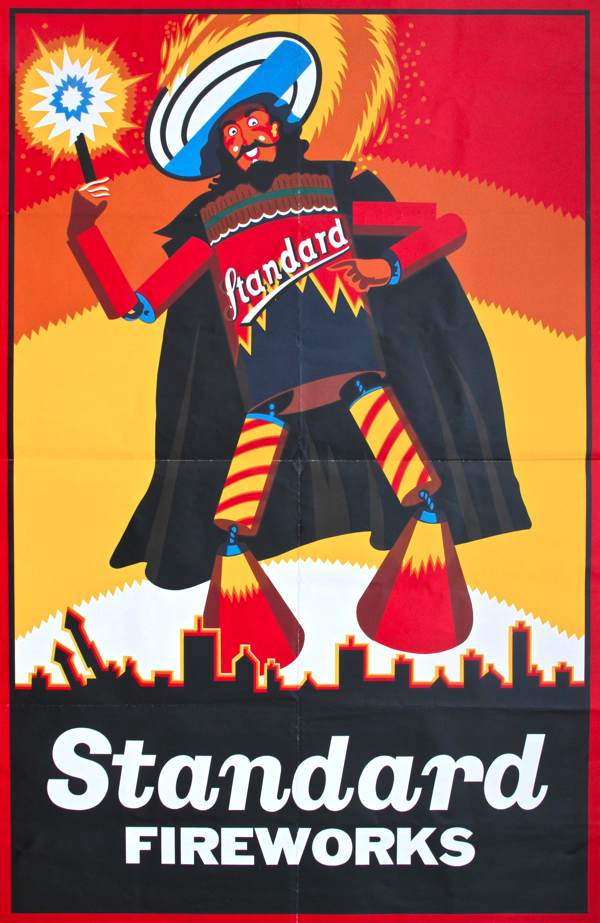
Earlier this year, Maurice first showed me his box of exploding fruit that he has kept safe for decades in a niche in his cellar, crowded among hundreds of other dusty old fireworks that tell the history of pyrotechnics in this country – because, since the firework companies never held archives and their creations vanished into smoke each Bonfire Night, it was left to Maurice to become the self-appointed custodian of this beloved yet largely unacknowledged area of our culture.
Coming upon Maurice’s exploding fruit displayed in a glass museum case, we exchanged a glance of wonder. Then I followed the line of Maurice’s tender gaze to his treasures, nestling there in their original box. “Those are just like mine,” he said, placing a hand affectionately on the glass and looking back to me with a twinkle in his eye. “They are yours,” insisted Kit as she arrived, and Maurice gave me a complicit smile, turning and gazing in pleasure upon the huge firework posters on the walls. Slowly, we walked among the cases of fireworks, some designed like crates of gunpowder, others like roman candles and rockets, yet Maurice did not look too closely because the contents were familiar to him. “I’ve got a lot more than this at home,” he confided to me in a pantomime whisper, a little baffled as he cast his eyes around at the excited throng flocking into the gallery behind us.
Unable to resist looking at a case of indoor fireworks, I stepped away through the crowd and then my attention strayed from one item to another, until an attendant warned me it was time to go outside for the firework display. The blue rooms had emptied out when Kit asked me if I had seen Maurice, so we did another circuit of the exhibition together but he was not to be found. As we descended the stairs, Kit was concerned lest Maurice miss the display in his honour. “This is a very important day for him,” she assured me. Joining Maurice’s children, we all walked around the side of the mansion in the deep darkness to the wide lawn where, we were advised, we should enjoy the most advantageous view of the fireworks.
Maurice was already there, eagerly waiting on the grass at the front of the crowd, looking over his shoulder with a cheery smile to welcome us late-comers. Once, Kit and her children would have stood alone while Maurice ran around in the dark with the fuse, through the years he organised displays for a living. Now they stood together -after all this time, still enraptured by the fireworks that have never lost their magic.




Maurice & Kit at the firework display.

Maurice Evans, firework collector extraordinaire, and Simon Costin of the Museum of British Folklore.
[youtube GvsM5XRA138 nolink]
The Museum of British Folklore’s exhibition Remember, Remember featuring Maurice Evans’ firework collection runs at Compton Verney until 11th December.
You may also like to read my original profile of Maurice Evans, Firework Collector
Maurice Evans, Firework Collector
I am republishing my pen portrait of Maurice Evans today to celebrate the opening of the exhibition of his collection of fireworks entitled Remember, Remember presented by the Museum of British Folklore at Compton Verney.

Maurice Evans has been collecting fireworks since childhood and now at eighty-two years old he has the most comprehensive collection in the country – so you can imagine both my excitement and my trepidation upon stepping through the threshold of his house in Steyning. My concern about potential explosion was relieved when Maurice confirmed that he has removed the gunpowder from his fireworks, only to be reawakened when his wife Kit helpfully revealed that Catherine Wheels and Bangers were excepted because you cannot extract the gunpowder without ruining them.
This statement prompted Maurice to remember with visible pleasure that he still had a collection of World War II shells in the cellar and, of course, the reinforced steel shed in the garden full of live fireworks. “Let’s just say, if there’s a big bang in the neighbourhood, the police always come here first to see if it’s me,” admitted Maurice with a playful smirk. “Which it often isn’t,” added Kit, backing Maurice up with a complicit demonstration of knowing innocence.
“It all started with my father who was in munitions in the First World War,” explained Maurice proudly, “He had a big trunk with little drawers, and in those drawers I found diagrams explaining how to work with explosives and it intrigued me. Then came World War II and the South Downs were used as a training ground and, as boys, we went where we shouldn’t and there were loads of shells lying around, so we used to let them off.”
Maurice’s radiant smile revealed to me the unassailable joy of his teenage years, running around the downs at Shoreham playing with bombs. “We used to set off detonators outside each other’s houses to announce we’d arrived!” he bragged, waving his left hand to reveal the missing index finger, blown off when the explosive in a slow fuse unexpectedly fired upon lighting. “That’s the worst thing that happened,” Maurice declared with a grimace of alacrity, “We were worldly wise with explosives!”
Even before his teens, the love of pyrotechnics had taken grip upon Maurice’s psyche. It was a passion born of denial. “I used to suffer from bronchitis and asthma as a child, so when November 5th came round, I had to stay indoors.” he confided with a frown, “Every shop had a club and you put your pennies and ha’pennies in to save for fireworks and that’s what I did, but then my father let them off and I had to watch through the window.”
After the war, Maurice teamed up with a pyrotechnician from London and they travelled the country giving displays which Maurice devised, achieving delights that transcended his childhood hunger for explosions. “In my mind, I could envisage the sequence of fireworks and colours, and that was what I used to enjoy. You’ve got all the colours to start with, smoke, smoke colours, ground explosions, aerial explosions – it’s endless the amount of different things you can do. The art of it is knowing how to choose.” explained Maurice, his face illuminated by the images flickering in his mind. Adding, “I used to be quite big in fireworks at one time.” with calculated understatement.
Yet all this personal history was the mere pre-amble before Maurice led me through his house, immaculately clean, lined with patterned carpets and papers and witty curios of every description. Then in the kitchen, overlooking the garden where old trees stood among snowdrops, he opened an unexpected cupboard door to reveal a narrow red staircase going down. We descended to enter the burrow where Maurice has his rifle range, his collections, model aeroplanes, bombs and fireworks – all sharing the properties of flight and explosiveness. Once they were within reach, Maurice could not restrain his delight in picking up the shells and mortars of his childhood, explaining their explosive qualities and functions.
But my eyes were drawn by all the fireworks that lined the walls and glass cases, and the deep blues, lemon yellows and scarlets of their wrappers and casings. Such evocative colours and intricate designs which in their distinctive style of type and motif, draw upon the excitement and anticipation of magic we all share as children, feelings that compose into a lifelong love of fireworks. Rockets, Roman Candles, Catherine Wheels, Bangers, and Sparklers – amounting to thousands in boxes and crates, Maurice’s extraordinary collection is the history of fireworks in this country.
“I wouldn’t say its made my life, but its certainly livened it up,” confided Maurice, seeing my wonder at his overwhelming display. Because no-one (except Maurice) keeps fireworks, there is something extraordinary in seeing so many old ones and it sets your imagination racing to envisage the potential spectacle that these small cardboard parcels propose.
Maurice outgrew the bronchitis and asthma to have a beautiful life filled with fireworks, to visit firework factories around Britain, in China, Australia, New Zealand and all over Europe, and to scour Britain for collections of old fireworks, accumulating his priceless collection. Now like an old dragon in a cave, surrounded by gold, Maurice guards his cellar hoard protectively and is concerned about the future. “It needs to be seen,” he said, contemplating it all and speaking his thoughts out loud, “I would like to put this whole collection into a museum. I don’t want any money. I want everyone to see what happened from pre-war times up until the present day in the progression of fireworks.”
“My father used to bring me the used ones to keep,” confessed Maurice quietly with an affectionate gleam in his eye, as he revealed the emotional origin of his collection, now that we were alone together in the cellar. With touching selflessness, having derived so much joy from collecting his fireworks, Maurice wants to share them with everybody else.

Maurice with his exploding fruit.

Maurice with his barrel of gunpowder.

Maurice with his grenades.

Maurice with a couple of favourite rockets.


Firework photographs copyright © Simon Costin
The Museum of British Folklore’s exhibition Remember, Remember featuring Maurice Evans’ firework collection runs at Compton Verney until 11th December.
You also like to read about Simon Costin, Museum of British Folklore
Polly Hope, Jobbing Artist

Polly Hope does not go out too much. And why should she, when she has her own dreamlike world to inhabit at the heart of Spitalfields? Step off Brick Lane, go through the tall gate, across the courtyard, past the hen house, through the studio, up the stairs and into the brewery – you will find Polly attended by the huge dogs and small cats, and a menagerie of other creatures that share the complex of old buildings which have been her home for more than forty years.
Here, Polly has her sculpture workshop, her painting studio, her kiln, her print room, her library and her office. It goes on and on. At every turn, there are myriad examples of Polly’s lifetime of boundless creativity – statues, paintings, quilts, ceramics and more. And, possessing extravagant flowing blonde hair and the statuesque physique of a dancer, Polly is a goddess to behold. One who know who she is and what she thinks, and one who does not suffer fools gladly.
So, while I was on my mettle when I visited Polly’s extraordinary dominion, equally I was intoxicated to be in the presence of one so wholly her own woman, capable of articulating all manner of surprising truths, and always speaking with unmediated candour from her rich experience of life.
“I don’t know where it comes from. My father was a general in the British Army with generations of soldiers behind him. There were no artists on the family, and I have never found any great grandmother’s tapestry or grandfather’s watercolours.
I went to Chelsea and the Slade, and hated it. They wanted to teach you how to express yourself, but I wanted to learn how to make things. So I went to live in a tiny village in Greece because it was cheap, and I supported myself and my family by writing novels under a pseudonym. That was where I discovered textiles because they still make quilts there, and I was looking for a way to make large works of art which I could transport in my car. So I used the quiltmaker to help with the sewing. Today there’s various wall hangings of mine in different places around the world.
My second husband, Theo Crosby, and I liked East London, and Mark Girouard – who was a friend – showed us this place and we bought it for tuppence ha-penny in the early seventies. At that point, the professional classes hadn’t realised Spitalfields was five minutes walk from the City, but we cottoned onto it. This was one of the little breweries put up in the eighteen forties to get the rookeries off gin and onto beer, and make a few pounds into the bargain. Brick Lane was not the area of play it is now, it was a working place then with drycleaners, ironmongers, chemists, all the usual High St shops – and I could buy everything I needed for my textiles.
I decided it was time to do some community work, so I got everyone involved. Even those who couldn’t sew for toffee apples counted sequins for me. I did all the design and oversaw the work. The plan was to make a series of tableaux to hang down either side of Christ Church but we only completed the first two – the Creation of the World and the Garden of Eden – and they hang in the crypt now. I’ve done a lot for churches, I was asked to design a reredos for St Augustine’s at Scaynes Hill, but when I saw it – it was a perfect Arts & Crafts church – I said, “What you need is a Byzantine mosaic,” and they said, ‘”Yes.” And it took six years – we offered to include people’s pets in the design in return for five hundred pounds donation and that paid for the materials.
I am jack of all trades, tapestry, embroidery, painting, ceramics, stained glass windows, illustration, graphics, pots, candlesticks and bronzes. My ambition is to be a small town artist, so if you need decorations for the street party, or an inn sign painted, or a wedding dress designed, I could do it. I can understand techniques easily. When I worked with craftsmen in Sri Lanka, or with Ikat weavers, I learnt not to go into the workshop and ask them to make what you want, instead you get them to show you their techniques and you find a way to work with that. Techniques that have been refined over hundreds of years fascinate me. I don’t see any line between craft and art, I think it’s a mistake that crept in during the nineteenth century – high art and low craft.
I’m a countrywoman and I grew up on a mountain in Wales where there were always animals around. Living here, I play Marie Antoinette with my pets which all have opera names. My step-daughter Dido even brought her geese once to stay for Christmas. I have a mixed bag of chickens which give me four or five eggs a day – one’s not pulling her weight at the moment but I don’t know which it is. When they grow old, they retire to my niece in Kent. She takes my geriatric ones. I used to have more lurchers but one died and went to the big dog in the sky, now I have a new poodle I got six months ago and a yorkie who always takes a siesta with the au pair, as well as two cats. And I always had parrots, but the last one died. I got the original one, Figaro, from the Club Row animal market. One day I found him dead at the bottom of his cage. I just like living with animals, always have done all my life. A house is not a home without creatures in it.”
By now, we had emptied Polly’s teapot, so we set out on a tour of the premises, with a small procession of four legged creatures behind us. Polly showed me her merry-go-round horse from Jones Beach, and her hen house designed after the foundling Hospital in Florence, and her case of Staffordshire figures with some of her own slipped in among them, and the ceramic zodiac she made for Shakespeare’s Globe Theatre, complementing the building designed by her husband Theo Crosby. And then we came upon the portraits of Polly’s military ancestors in bearskins and plaid trousers, in images dating back into the nineteenth century, and then we opened the cupboard of postcards of her work, and then we pulled box files of photographs off the shelf to rummage.
We lost track of time as it grew dark outside, and I thought – if I had created a world as absorbing as Polly Hope’s, I do not think I would ever go out either.

Monty & Fred, deer hound brothers, 2009.

Oscar, golden retriever.

Portrait of Theo Crosby, with one of the Club Row parrots and a lurcher.

Portrait of Roy Strong and his cat.

Portrait of Laura Williams depicted as Ariel.
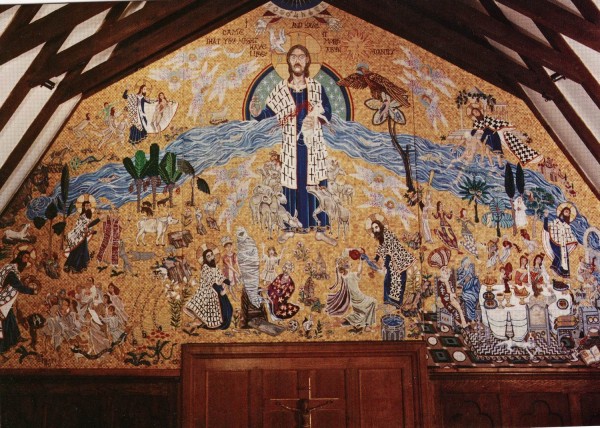
Wall hanging at St Augustine’s, Scaynes Hill, West Sussex.

The Marriage at Canaa.

The Feeding of the Five Thousand.

The Red Flower, applique and quilting.

Archaeological Dig, applique and quilting.
Portrait of Polly Hope copyright © Lucinda Douglas Menzies
Artworks copyright © Polly Hope


