Carol Burns, Dogsbody
I was shocked when Carol Burns told me she was a dogsbody, because I could not believe it of such an astute woman. “I am surrounded by men telling me what needs to be done,” she confided to me with a hint of theatrical affront, speaking just loud enough for the males in the vicinity to overhear, and raising one eyebrow with cool irony.“In the end, it’s easier for me to do what they ask, just for the sake of a quiet life.” she added, wagging a cigarette with a sweet smile of weary compliance.
Yet it would be wrong to assume that Carol is another example of oppressed womankind – you may rest assured she can hold her own in any situation. The truth is that Carol can afford such a self-deprecating quip because she is unquestionably in charge at C.E. Burns Ltd, her father’s waste paper business, still operating from Bacon St where her great-grandfather John Burns started it in 1864.
In the blue Micra parked at the kerb, sits Carol’s ninety-five-year old dad, Charlie Burns. A legendary East End waste paper merchant and boxing entrepreneur. His entire life has been enacted on Bacon St and he cannot keep away now, observing the ongoing saga each day from his discreet vantage point in the passenger seat, interrupted only by greetings from passersby. Carol brings Charlie here every day, keeping one eye on him while greeting customers and making sales of secondhand furniture, carpet tiles and job lots of toiletries and fertilizer.
Whenever there is a lull, Carol retreats to her strategically placed garden shed, lined with family photos, where she can snatch a moment’s peace to gather her thoughts before negotiating the next bulk sale of toilet rolls. It was here that I joined Carol on a slow Summer’s afternoon while she reflected upon her half century on Bacon St.
My brother Edward told me, when I was eighteen, that I’d still be here at forty and I’m fifty-nine now. I stayed because of my dad, and I’m quite happy with what I’m doing. I don’t even think any more about what else I might have done. You meet different people every day. I walk down the Bethnal Green Rd and the traders in the market all know me.
My dad’s mum, Alice, died on 29th March 1952 and I was born that June – I was the one that lived out of a pair of twins. And I always thought that she died for me to be born. I was born at home in Redmill House, Headlam St, Whitechapel, and I came down here to Bacon St at eight years of age. When I left school at sixteen in 1964, I came here to work, I sat and answered the phones. I came down each day around six to join the boys for a proper breakfast, before they went off to collect waste paper at nine thirty.
We used to keep a horse and cart then, and we had three geese to act as guard, they were worse than any guard dog if they went for you. But then someone reported them and they were taken away. We only had them because somebody asked us to take care of them and never came back. It was better that what it is now, you had a lot more trade even though it was on a smaller site. People was happier. Nobody had to worry about what they had, because they didn’t have anything!
We moved to Sharon Gardens when I was fifteen, and I got married for the first time when I was eighteen. Then I separated and moved back to Sharon Gardens, until I got married again and moved to Bethnal Green – I only moved across the Cambridge Heath Rd to go from E1 to E2, when I moved into Canrobert St in 1978, and I’ve been there ever since.
My dad found something you could sell and then others followed, but he was the leader in our eyes. This has always been our family business. My sister used to work down the lane before me, and my mum worked Wednesdays and Fridays, and my brothers were always on the vans. There’s seven or eight of us altogether.
Everything’s negotiable here, because if we a stuck a price on it, we’d be gone years ago. We have a laugh, we have a joke with our customers, we give a little and they give a little, then you meet in the middle and they buy it. And they tell their friends, and they come along too.
It’s my life and it’s been a good life. I get by through talking. We are the East Enders that stayed in the East End, not some that moved out to Ilford. We’re not going anywhere. We’re not out to impress. We don’t buy mansions or drive expensive cars, we are how we are. We don’t want the champagne lifestyle, we want lemonade. We’re just proud to still be here.
Carol is one of a family of innovators, recycling waste paper for nearly a hundred and fifty years, before the notion of recycling became virtuous. Today, the Burns family are patrons of the arts and you will find a constantly changing gallery of street art outside their Bacon St premises, thanks to Carol’s enlightened generosity – “They’ve got to start somewhere.” she says cheerily.
Carol takes pleasure in all her negotiations as an opportunity to exercise her considerable skills of rhetoric, and the codes of civility and respect that attend these conversations are close to heart of what this old family business is about. It presumes a society in which everyone can talk to each other as equals, based upon mutual respect, and Carol delights to tell me of those customers to whom she says they can pay her later, who invariably do. Shrewd and without sentiment, Carol Burns runs her family enterprise based upon assuming the best rather than the worst of people.
Carol Burns in her shed lined with family memories.
Charlie and Carol Burns, snapped a few years ago in their beloved Bacon St warehouse.
Carol’s father Charlie Burns in the car where he sits each day on Bacon St – at ninety-five years old, he is the oldest man on Brick Lane.
You might like to read my original portrait of Charlie Burns, the King of Bacon St
or of Charlie’s nephew Tony Burns, Chief Coach at the Repton Boxing Club.
More Dogs of Spitalfields
Spitalfields Life contributing photographer Sarah Ainslie and writer Andrew McCaldon have been out on the streets again to continue their survey of East End canines. These inner city dogs are equally at home on street corners, in alleyways and along busy roads, as they are in the parks and green spaces which are designated as their playgrounds.
Coco (Papillon) & Keith Chilvers
“Coco’s my best friend. She’s very bright and a good watch dog.
Around here there’s always a lot of noise. Hammering and drilling, she’ll sleep through – but one knock on my door and she’s off!
I was born in London, although I have travelled around as a landscape gardener. At that time, in the late sixties, it was all very hippy and back to the earth. While some people have got worn down, I’ve kept my values, of wanting to be close to nature. I’m learning wood carving now and I would like a garden – I’ve crammed as much in here as I can.
The last walk of the day sometimes ends up in the pub, The Perseverance or Nelson’s Head. Coco likes the foam from my Guinness, she’ll lick it off my finger. She’s a damn good beggar in the pub!”
Marvin (Staffordshire Bull Terrier) & Karolina Kolodziej
“Marvin is all about sexual healing. Marvin Gaye had such a positive energy and so does our Marvin. He makes me so happy. He loves everybody, always licking them and, well, he doesn’t hump anymore – but he used to!
My partner and I both work in theatre, and Marvin’s a regular in the West End. He’s often waiting at the stage door for us and, if he’s invited, he likes visiting the dressing rooms.
Some of the Muslim children on my estate are taught to think that dogs are dirty. They are scared and panicky, they think Marvin will eat them. They come, very frightened but excited, to see him sometimes. I say, “If you would like to touch him you can.” They pat his back and then run away. They ask hundreds of questions about him and I answer them all.
I think, on my floor, the children – just the children I suppose – are changing their minds about Marvin.”
Gizmo, Tricksy (Chihuahuas) & Des Johnson
“I’ve had a lot of big dogs over the years but now little dogs have come into my life.
They are really my daughter’s but they prefer to be with me. She puts them in her handbag, whereas I treat them like dogs.
I’m an architect, and they like to sit up in my van and look out at all the other dogs. They may have pea brains but they’re very intelligent. And they can look after themselves – they’ll go for anything that moves. They’ve got small-man-syndrome.
My wife liked orchids and Chihuahuas. She died when my daughter was aged three. My daughter never knew her and yet now she loves them too.”
Archie (Golden Retriever) & Andy Rider, Rector of Spitalfields
“Archie’s my second Golden Retriever. My wife and I had to give away our first dog when we moved to a flat in the West End years ago. But when I became Rector here at Christ Church, my son stood in the garden of the Rectory and said “Dad, I think this is dog country!”
He’s gentle and friendly, although he does eat everything and leave hair everywhere. If you’re wearing a black jumper, you don’t want to start stroking Archie.
He’s very popular with the congregation and sometimes comes to prayers with me in the morning.
But it’s when I take Archie to the Lake District every year that he’s at his happiest.”
Edwin (Lakeland Terrier) & Grace Dant
“I play a game with Edwin, when Daddy has a lie-in – I open the door and say “Edwin! Look!” and he runs up the stairs and pounces on him.
I walk Edwin around the bandstand in Arnold Circus and sometimes the fox will walk alongside him in the morning. They don’t seem to mind each other.
And we go past AZ Grocers where Edwin’s enemy Lily the Cat lives. She once scratched him in the face. When we go by Edwin stretches at the lead, he really wants to bite her.
He was tied up outside my school one day and could see me in my classroom. He started howling – “owwwwooo!” – outside. I had to pardon myself from the class and give him some biscuits I had in my satchel.
I remember when I first met Edwin, Daddy let him go and he ran straight towards me. From Edwin’s face I knew he was thinking “She looks fun!”
Harvey, Chai (Staffordshire Bull Terriers), Missy (Pekingese) & Mandy King
“I do three walks a day. This is number two.
I’ve lived in London Fields all my life and I’ve been walking dogs in the Fields since I was a child. Everyone knows me around here, probably as the Mad Dog Lady – well, I say “hello” to everyone and to all the dogs too. And I’m not quiet – if I see abuse being done to another dog I won’t keep my mouth shut.
All my dogs are rescued dogs. At one time I had five dogs. Now it’s just these three and my cat who’s called “Mr Samuel Beckett.” They all get along fine.
I love dogs, they’re great companions. They’re not stupid like people.
I had to retire from work for medical reasons and my world has become very small – but these dogs are what keep me going.”
Banjo (Cocker Spaniel) & Vanessa Caswill
“He just loves this hoop.
And puddles too. He’s a real water dog. When I first saw Banjo’s profile online, I read about how he loved to lie on his back in a bowl of water in the sunshine. We borrowed a neighbour’s car, drove to Canterbury, and brought him home that day.
I’m due in five weeks. Banjo’ll put his paw on my belly, because I think he knows something is different. Things may change.
To get him used to the idea, I’ve started to have friends with babies coming round. They move, they make weird noises, they’re on his eye level – I think he finds them freaky.
It’s because of Banjo that we decided to have a kid. We loved him so much, he turned us from being a couple into a family. He gave us the confidence to have a child.”
Chase (Shih Tzu-Bichon cross) & Eddie Philpot
“He’s a good companion, he makes me go out.
I was born in Bethnal Green, I know these streets well. I ran up and down ladders all my life, cleaning windows. My father did the same job.
Oh, it’s changed. I walk round the same streets with Chase, where I used to clean windows, and sometimes I don’t know where I am – what with the security gates and all that.
My first two dogs were laid back but Chase is a comedian, full of energy. He is very protective of my daughter Kim – she carried him around when he was young. And he’s naughty when he wants to be.
He’s a devil, but a loving little devil.”
Pan (Whippet-Bedlington cross), Peggy (Scottish Deerhound) & Jess Collins
“Peggy fell in the canal today.
She went out of her depth, her head went under and I had to help by pulling her out. Some passersby saw us struggling but Pan just stood and watched while we both got soaked.
We had Pan first, he’d been a working dog, a ratter. When we got Peggy, for a while Pan absolutely hated her and he wouldn’t look at me for weeks.
My partner Oliver and I run The Vintage Emporium, and we love dogs in the shop. They sit on the couch and get lots of attention. I’m lucky that I get to have Pan and Peggy with me all the time.
On my days off we all go to Hampstead Heath, which is such a beautiful place for dogs – and human beings too!”
Martha, Missy (Miniature Dachshunds), & Steven Dray
“Missy is named after Missy Elliot. My partner, Steven, and I are both big fans. She’s only three and a half months old but she’s getting longer by the day.
I had an Alsatian when I was a teenager growing up on Columbia Rd. My mother still lives in the Guinness Trust Buildings there. Now I’m writing a book called “Shoreditch Unbound” which has been an important thing for me to do.
Dachshunds were originally bred to go down badger sets – though I can’t imagine these little madams going down a badger hole, they’re too precious. They’re perfect city dogs though and they’re super-affectionate.
Steven, me and both the dogs all sleep together – we’re going to have to get a bigger bed!”
Photographs copyright © Sarah Ainslie
You may also like to read the original Dogs of Spitalfields feature.
Brick Lane Market 14
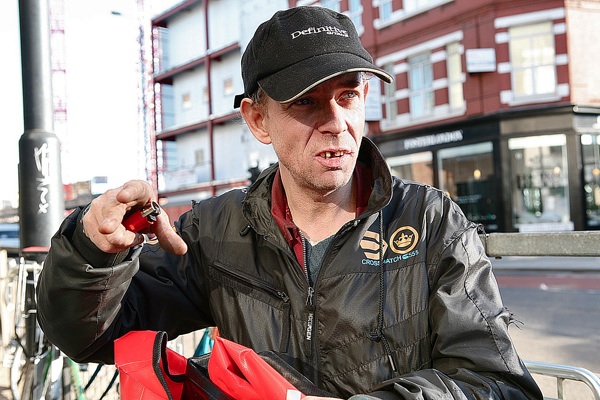
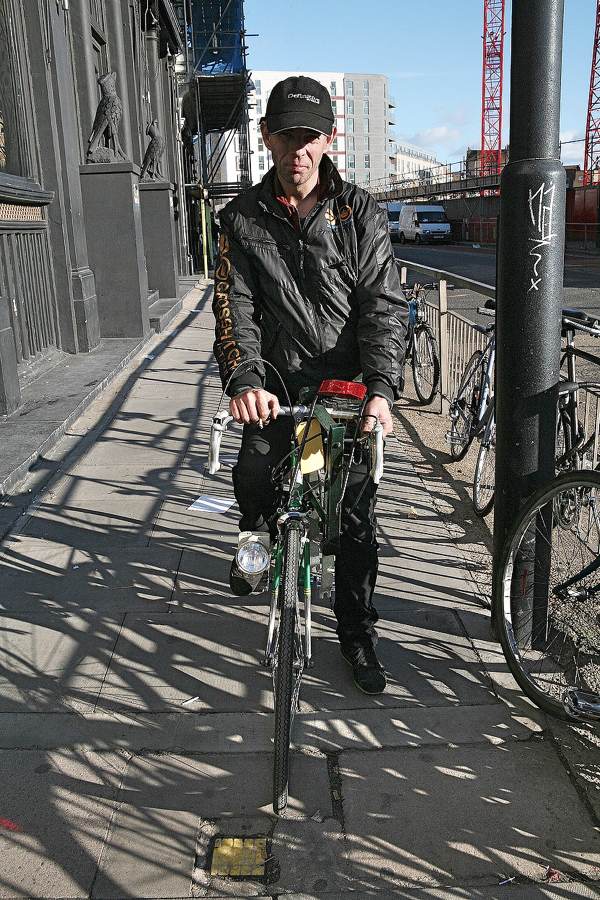
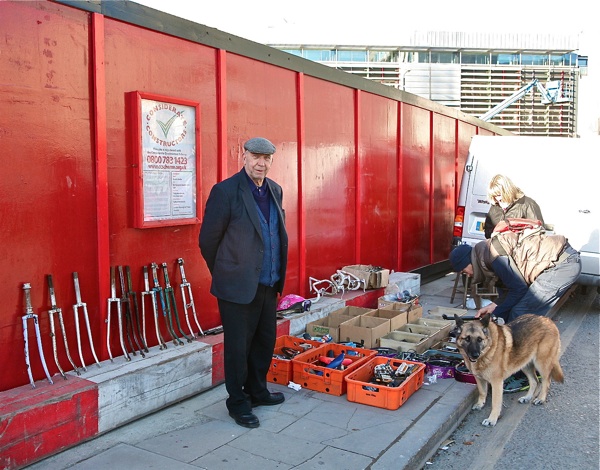
Victor Otigbah runs a bicycle repair workshop, doing on-the-spot repairs with his pal Rob, each Sunday morning under the railway bridge, where he also sells old bikes they have fixed up. You can buy some of the cheapest bicycles in London here. “A friend of mine gave me a bike when I first moved to Brick Lane in 2005 and I sold it for forty-five pounds.” explained Victor, as we stood among the sea of bicycles for sale, “With that money, I bought three more bikes, and fixed them up and sold them too. Then the council got hold of me and said it was illegal to sell on the street, so I got a licence and I’ve been here ever since.” A Glaswegian by origin, “I used to cycle up around Loch Lomond, when I was young and cycling was my life,” Victor admitted to me,“But I didn’t know anything about bikes until I did a course in cycle maintenance, and that’s when it all took off.”
Kal Newby & Bettina Gallizzi, on the Sclater St yard, were trading together for the first time. In fact, Kal confided to me it was her first day in the market, as she handed over an old but still serviceable Venetian blind to a customer for three pounds. “Betty’s been up here before, and she gave me a call asking if I fancied coming and joining her, so I took it as an opportunity to clear out my parents’ garage.” she said, “It’s been up and down today, but we’ve sold a lot.” Kal is a sign language interpreter by profession, while her friend Bettina is a sports instructor who teaches cycling – and she reminded me that each London borough offers four hours of free cycling tuition to every resident. Bettina also runs www.velo-re.com where she sells belts and wallets she makes out of old bicycle tyres and inner tubes.
Sneizana & Justin both came from Lithuania to Brick Lane. Sneizana has worked as a trader her whole life, but when the markets began to die in her country, she realised she could do better in London and took the brave decision to move here. “This is my holiday!” Sneizana declared to me with a weary smile, since she works the other six days of the week as a cleaner. And “This is my day off,” Justin announced too – not to be outdone – because he works all week on a building site. Yet in spite of this relentless routine of work, both were keen to emphasise how much they enjoy selling old clothes in the market. “It’s relaxing. People like us, and we’ve made lots of friends,” Justin informed me enthusiastically,“There are Italians, French, Portuguese, Polish, Serbians and Croatians – every country is here and this is good!”
Photographs copyright © Jeremy Freedman
Sally Flood, Poet
“I had always written, as a child,” admitted Sally Flood with a shrug, “but it wasn’t stuff you showed.” For years, when her thoughts wandered whilst working in the factory in Princelet St, Sally wrote poems on the paper that backed the embroidery in the machine she operated – but she always tore up her compositions when her boss appeared.
Then, when she was fifty years old, Sally took some of her poems along to the Basement Writers in Cable St and achieved unexpected recognition, giving her the confidence to call herself a poet for the first time. Since then, Sally’s verse has been widely published, studied in schools and universities, and she has become an experienced performer of her own poetry. “At work, I used to write things to make people laugh,” she explained, “I used to say, ‘Embroidery is my trade, but writing is my hobby.'”
“I’ve got draws full of poems,” she confided to me with a blush, unable to keep track of her prolific writing, now that poetry is her primary occupation and she no longer tears up her compositions. “I’ve got so much here, I don’t know what I’ve got.” she said, rolling her eyes at the craziness of it.
Ambulance helicopters whirl over Sally’s house, night and day, the last in a Georgian terrace which is so close to the hospital in Whitechapel that if you got out of bed on the wrong side you might find yourself in surgery. Sally moved there nearly fifty years ago with her young family, and now she has three grandchildren and five great grandchildren. Framed pictures attest to the family life which filled this house for so many years, while today boxes of toys lie around awaiting visits by the youngest members of her clan.
“In 1975, when my children were growing up and the youngest was fifteen, I decided that I need to do something else, because I didn’t want to be one of those mothers who held onto her children too much.” Sally recalled, “So I joined the Bethnal Green Institute, and it was all ballroom dancing and keep fit, but I found a leaflet Chris Searle had put there for the Basement Writers, so I decided to write a poem and send it along to them. Then I got a letter back asking me to send more – and I was amazed because the poem I sent was one I would otherwise have torn up. Of your own work, you’ve got no real opinion.”
“On my first visit, I went along with my daughter, but there were children of school age and I was turning fifty. I wasn’t sure if I should be there until I met Gladys McGee who was ten years older than me. She was so funny, I learnt so much from her – she had been an unmarried mother in the Land Army. I started going regular, and the first poem I read was published.”
“I think my life is more in poetry than anything else. I sometimes think my writing is like a diary. Chris Searle of the basement writers made such an impression on my life, he gave me the confidence to do this. And when I did my writing, my life took off in a certain direction and I met so many fantastic people.”
Sally’s house is full of cupboards and cabinets filled of files of poems and pictures and embroidery, and the former yard at the back has become a garden with luscious fuchias that are Sally’s favourites. After all these years of activity, it has become her private space for reflection. Sally can now get up when she pleases and enjoy a jam sandwich for breakfast. She can make paintings and tend her garden, and write more poems. The house is full with her thoughts and her memories.
“My grandparents were from Russia and they brought my father over when he was four years old.” Sally told me, taking down the photograph to remind herself,“He became cabinet maker and he was one of the best. In those days, they used to work from six until ten at night, so they knew what work was. I was born in Chambord St, Brick Lane, in 1925, and I grew up there. From there we moved to a two-up two-down in Chicksand St and from there to Bethnal Green, just before the war broke out. We had a bath in the kitchen with a tabletop. It was the first time we had a bath, before that we went to bathhouse. I’m telling you the history of the East End here!
I was evacuated to Norfolk at first. We took the surname Morris from father’s first name, so that people wouldn’t know we were Jewish. The people up there had a suspicion against Londoners and they thought we were all the same. But I was lucky, we ended up in a hotel on the river in Torbay in Devon. Life was fantastic, we used to go fishing. It was a different experience from my life in London. I joined the girl guides, I could never have done that otherwise. Where I was evacuated, they wanted to train me to be a teacher, but my mother came and took me back and said, “They’re going to exploit you, you’re going to be a machinist.”
“Being evacuated meant I went outside my culture, and I saw that English people were nice. I think that’s why I married outside my religion. We were together fifty-five years and I always say it wasn’t enough. If I hadn’t been evacuated I wouldn’t have done that.”
Sally put the photograph of her parents back on the shelf carefully, and turned her head to the pictures of her husband, her children, her grandchildren and great-grandchildren, on different sides of the room. I watched her looking back and forth through time, and the room she inhabited became a charged space in between the past and the future. This is the space where she does her writing. And then Sally brought out a book to show me, opening it to reveal it short poems in her handwriting accompanied by lively drawings of people, reminiscent of the sketches of L. S. Lowry or the doodles of Stevie Smith.
Sally is a paradoxical person to meet. A natural writer who resists complacency, she continues to be surprised by her own work, yet she is knowledgeable of literature and an experienced teacher of writing. Appearing at the door in her apron and talking in her tender sing-song voice, Sally wears her erudition lightly, but it does not mean that she is not serious. With innate dignity and a vast repertoire of stories to tell, Sally Flood is a writer who always speaks from the truth of her own experience.
Maurice Grodinsky, Sally’s father is on the left with Sally’s mother, Annie Grodinsky, on the right, and Freda, Maurice’s mother, in between. At four years old, Maurice was brought to Spitalfields from Bessarabia at the end of the nineteenth century. The two children are Marie and Joey – when this picture was taken in 1925, Sally was yet to be born.
Sally with her first child Danny in the early nineteen fifties.
Sally’s children, Maureen, Jimmy, Pat and Theresa in the yard in Whitechapel in 1962.
Sally’s husband, Joseph Flood.

Sally in Whitechapel, early sixties.
Sally with her children, Danny, Theresa, Jimmy, Maureen, Pat and Michael.
Sitting by the canal in the nineteen seventies.
Sally with Gladys McGee at the Basement Writers.
You may also like to read about

Chris Searle & the Stepney School Strike
or
Henry Mayhew’s Street Traders
The Long-Song Seller
There is a silent ghost who accompanies me in my work, following me down the street and sitting discreetly in the corner while I am doing my interviews. He is always there in the back of my mind. He is Henry Mayhew, whose monumental work,”London Labour & London Poor,” was the first to give ordinary people the chance to speak in their own words. I often think of him, and the ambition and quality of his work inspires me. And I sometimes wonder what it was like for him, pursuing his own interviews, one hundred and fifty years ago, in a very different world.
Mayhew’s interviews and pen portraits appeared in the London Chronicle and were published in two volumes in 1851, eventually reaching their final form in five volumes published in 1865. In his preface, Mayhew described it as “the first attempt to publish the history of the people, from the lips of the people themselves – giving a literal description of their labour, their earnings, their trials and their sufferings in their own unvarnished language.”
These works were produced before photography was widely used to illustrate books, and although photographer Richard Beard produced a set of portraits to accompany Mayhew’s interviews, these were reproduced by engraving. Fortunately, since Beard’s photographs have not survived, the engravings were skillfully done. And they are fascinating images, because they exist as the bridge between the popular prints of the Cries of London that had been produced for centuries and the development of street photography, initiated by JohnThomson’s “Street Life in London” in 1876.
Primarily, Mayhew’s intention was to create a documentary record, educating his middle class readers about the lives of the poor to encourage social change. Yet his work transcends the tragic politics of want and deprivation that he set out to address, because the human qualities of his subjects come alive on the page and command our respect. Henry Mayhew bears witness not only to the suffering of poor people in nineteenth century London, but also to their endless resourcefulness and courage in carving out lives for themselves in such unpromising circumstances.
The Oyster Stall. “I’ve been twenty years and more, perhaps twenty-four, selling shellfish in the streets. I was a boot closer when I was young, but I had an attack of rheumatic fever, and lost the use of my hands for my trade. The streets hadn’t any great name, as far as I knew, then, but as I couldn’t work, it was just a choice between street selling and starving, so I didn’t prefer the last. It was reckoned degrading to go into the streets – but I couldn’t help that. I was astonished at my success when I first began, I made three pounds the first week I knew my trade. I was giddy and extravagant. I don’t clear three shillings a day now, I average fifteen shillings a week the year through. People can’t spend money in shellfish when they haven’t got any.”
The Irish Street-Seller. “I was brought over here, sir, when I was a girl, but my father and mother died two or three years after. I was in service, I saved a little money and got married. My husband’s a labourer, he’s out of worruk now, and I’m forced to thry and sill a few oranges to keep a bit of life in us, and my husband minds the children. Bad as I do, I can do a penny or tuppence a day better profit than him, poor man! For he’s tall and big, and people thinks, if he goes round with a few oranges, it’s just from idleniss.”
The Groundsel Man. “I sell chickweed and grunsell, and turfs for larks. That’s all I sell, unless it’s a few nettles that’s ordered. I believe they’re for tea, sir. I gets the chickweed at Chalk Farm. I pay nothing for it. I gets it out of the public fields. Every morning about seven I goes for it. I’ve been at business about eighteen year. I’m out till about five in the evening. I never stop to eat. I am walking ten hours every day – wet and dry. My leg and foot and all is quite dead. I goes with a stick.”
The Baked Potato Man. “Such a day as this, sir, when the fog’s like a cloud come down, people looks very shy at my taties. They’ve been more suspicious since the taty rot. I sell mostly to mechanics, I was a grocer’s porter myself before I was a baked taty. Gentlemen does grumble though, and they’ve said, “Is that all for tuppence?” Some customers is very pleasant with me, and says I’m a blessing. They’re women that’s not reckoned the best in the world, but they pays me. I’ve trusted them sometimes, and I am paid mostly. Money goes one can’t tell how, and ‘specially if you drinks a drop as I do sometimes. Foggy weather drives me to it, I’m so worritted – that is, now and then, you’ll mind, sir.”
The London Coffee Stall. “I was a mason’s labourer, a smith’s labourer, a plasterer’s labourer, or a bricklayer’s labourer. I was for six months without any employment. I did not know which way to keep my wife and child. Many said they wouldn’t do such a thing as keep a coffee stall, but I said I’d do anything to get a bit of bread honestly. Years ago, when I as a boy, I used to go out selling water-cresses, and apples, and oranges, and radishes with a barrow. I went to the tinman and paid him ten shillings and sixpence (the last of my savings, after I’d been four or five months out of work) for a can. I heard that an old man, who had been in the habit of standing at the entrance of one of the markets, had fell ill. So, what do I do, I goes and pops onto his pitch, and there I’ve done better than ever I did before.”
Coster Boy & Girl Tossing the Pieman. To toss the pieman was a favourite pastime with costermonger’s boys. If the pieman won the toss, he received a penny without giving a pie, if he lost he handed it over for nothing. “I’ve taken as much as two shillings and sixpence at tossing, which I shouldn’t have done otherwise. Very few people buy without tossing, and boys in particular. Gentlemen ‘out on the spree’ at the late public houses will frequently toss when they don’t want the pies, and when they win they will amuse themselves by throwing the pies at one another, or at me. Sometimes I have taken as much as half a crown and the people of whom I had the money has never eaten a pie.”
The Street- Seller of Nutmeg Graters. “Persons looks at me a good bit when I go into a strange place. I do feel it very much, that I haven’t the power to get my living or to do a thing for myself, but I never begged for nothing. I never thought those whom God had given the power to help themselves ought to help me. My trade is to sell brooms and brushes, and all kinds of cutlery and tinware. I learnt it myself. I was never brought up to nothing, because I couldn’t use my hands. Mother was a cook in a nobleman’s family when I was born. They say I was a love child. My mother used to allow so much a year for my schooling, and I can read and write pretty well. With a couple of pounds, I’d get a stock, and go into the country with a barrow, and buy old metal, and exchange tinware for old clothes, and with that, I’m almost sure I could make a decent living.”
The Crockery & Glass Wares Street-Seller. “A good tea service we generally give for a left-off suit of clothes, hat and boots. We give a sugar basin for an old coat, and a rummer for a pair of old Wellington boots. For a glass milk jug, I should expect a waistcoat and trowsers, and they must be tidy ones too. There is always a market for old boots, when there is not for old clothes. I can sell a pair of old boots going along the streets if I carry them in my hand. Old beaver hats and waistcoats are worth little or nothing. Old silk hats, however, there’s a tidy market for. There is one man who stands in Devonshire St, Bishopsgate waiting to buy the hats of us as we go into the market, and who purchases at least thirty a week. If I go out with a fifteen shilling basket of crockery, maybe after a tidy day’s work I shall come home with a shilling in my pocket and a bundle of old clothes, consisting of two or three old shirts, a coat or two, a suit of left-off livery, a woman’s gown maybe or a pair of old stays, a couple of pairs of Wellingtons, and waistcoat or so.”
The Blind Bootlace Seller. “At five years old, while my mother was still alive, I caught the small pox. I only wish vaccination had been in vogue then as it is now or I shouldn’t have lost my eyes. I didn’t lose both my eyeballs till about twenty years after that, though my sight was gone for all but the shadow of daylight and bright colours. I could tell the daylight and I could see the light of the moon but never the shape of it. I never could see a star. I got to think that a roving life was a fine pleasant one. I didn’t think the country was half so big and you couldn’t credit the pleasure I got in going about it. I grew pleaseder and pleaseder with the life. You see, I never had no pleasure, and it seemed to me like a whole new world, to be able to get victuals without doing anything. On my way to Romford, I met a blind man who took me in partnership with him, and larnt me my business complete – and that’s just about two or three and twenty year ago.”
The Street Rhubarb & Spice Seller. “I am one native of Mogadore in Morocco. I am an Arab. I left my countree when I was sixteen or eighteen years of age, I forget, sir. Dere everything sheap, not what dey are here in England. Like good many, I was young and foolish – like all dee rest of young people, I like to see foreign countries. The people were Mahomedans in Mogadore, but we were Jews, just like here, you see. In my countree the governemen treat de Jews very badly, take all deir money. I get here, I tink, in 1811 when de tree shilling pieces first come out. I go to de play house, I see never such tings as I see here before I come. When I was a little shild, I hear talk in Mogadore of de people of my country sell de rhubarb in de streets of London, and make plenty money by it. All de rhubarb sellers was Jews. Now dey all gone dead, and dere only four of us now in England. Two of us live in Mary Axe, anoder live in, what dey call dat – Spitalfield, and de oder in Petticoat Lane. De one wat live in Spitalfield is an old man, I dare say going on for seventy, and I am little better than seventy-three.”
The Street-Seller of Walking Sticks. “I’ve sold to all sorts of people, sir. I once had some very pretty sticks, very cheap, only tuppence a piece, and I sold a good many to boys. They bought them, I suppose, to look like men and daren’t carry them home, for once I saw a boy I’d sold a stick to, break it and throw it away just before he knocked at the door of a respectable house one Sunday evening. There’s only one stick man on the streets, as far as I know – and if there was another, I should be sure to know.”
The Street Comb Seller. “I used to mind my mother’s stall. She sold sweet snuff. I never had a father. Mother’s been dead these – well, I don’t know how long but it’s a long time. I’ve lived by myself ever since and kept myself and I have half a room with another young woman who lives by making little boxes. She’s no better off nor me. It’s my bed and the other sticks is her’n. We ‘gree well enough. No, I’ve never heard anything improper from young men. Boys has sometimes said when I’ve been selling sweets, “Don’t look so hard at ’em, or they’ll turn sour.” I never minded such nonsense. I has very few amusements. I goes once or twice a month, or so, to the gallery at the Victoria Theatre, for I live near. It’s beautiful there, O, it’s really grand. I don’t know what they call what’s played because I can’t read the bills. I’m a going to leave the streets. I have an aunt, a laundress, she taught me laundressing and I’m a good ironer. I’m not likely to get married and I don’t want to.”
The Grease-Removing Composition Sellers. “Here you have a composition to remove stains from silks, muslins, bombazeens, cords or tabarets of any kind or colour. It will never injure or fade the finest silk or satin, but restore it to its original colour. For grease on silks, rub the composition on dry, let it remain five minutes, then take a clothes brush and brush it off, and it will be found to have removed the stains. For grease in woollen cloths, spread the composition on the place with a piece of woollen cloth and cold water, when dry rub it off and it will remove the grease or stain. For pitch or tar, use hot water instead of cold, as that prevents the nap coming off the cloth. Here it is. Squares of grease removing composition, never known to fail, only a penny each.”
The Street Seller of Birds’ Nests. “I am a seller of birds’-nesties, snakes, slow-worms, adders, “effets” – lizards is their common name – hedgehogs (for killing black beetles), frogs (for the French – they eats ’em), and snails (for birds) – that’s all I sell in the Summertime. In the Winter, I get all kinds of of wild flowers and roots, primroses, buttercups and daisies, and snowdrops, and “backing” off trees (“backing,” it’s called, because it’s used to put at the back of nosegays, it’s got off yew trees, and is the green yew fern). The birds’ nests I get from a penny to threepence a piece for. I never have young birds, I can never sell ’em, you see the young things generally die of cramp before you can get rid of them. I gets most of my eggs from Witham and Chelmsford in Essex. I know more about them parts than anybody else, being used to go after moss for Mr Butler, of the herb shop in Covent Garden. I go out bird nesting three times a week. I’m away a day and two nights. I start between one or two in the morning and walk all night. Oftentimes, I wouldn’t take ’em if it wasn’t for the want of the victuals, it seems such a pity to disturb ’em after they made their little bits of places. Bats I never take myself – I can’t get over ’em. If I has an order of bats, I buys ’em off boys.”
The Street-Seller of Dogs. “There’s one advantage in my trade, we always has to do with the principals. There’s never a lady would let her favouritist maid choose her dog for her. Many of ’em, I know dotes on a nice spaniel. Yes, and I’ve known gentleman buy dogs for their misses. I might be sent on with them and if it was a two guinea dog or so, I was told never to give a hint of the price to the servant or anybody. I know why. It’s easy for a gentleman that wants to please a lady, and not to lay out any great matter of tin, to say that what had really cost him two guineas, cost him twenty.”
Images copyright © Bishopsgate Institute
You may like to take a look at
John Thomson’s Street Life in London
Aunt Busy Bee’s New London Cries
Marcellus Laroon’s Cries of London
More John Player’s Cries of London
William Nicholson’s London Types
Francis Wheatley’s Cries of London
John Thomas Smith’s Vagabondiana of 1817
Thomas Rowlandson’s Lower Orders
Malarky in Spitalfields
We have had a lot of Malarky in Spitalfields recently. It started up in Hackney, where I first saw Malarky, but then I spotted Malarky in Whitechapel. Next, Malarky was in Brick Lane and a moment later in Redchurch St and, the other morning, Malarky in Hanbury St too. These days, I am surrounded by Malarky. At every corner that I turn, I see all kinds of Malarky. Malarky is everywhere in Spitalfields now!
Walking the streets of Spitalfields daily – a veritable Sistine Chapel of Street Art – I am constantly aware of the ever-changing gallery, as rival artists put up their latest works in the hope of drawing popular attention. Among the members of this random academy, many painters strain for significance with elaborately contrived works that might equally be seen inside an art gallery. But then along comes Malarky, a Street Artist from Barcelona, with joyful paintings that have brought the surreal revelry of a Catalan carnival to these East End streets as an exuberant compensation for this feeble Summer.
In common with the work of Ben Eine, these are happy paintings that lift the atmosphere of the street, and in common with fellow Catalan Joan Miro, Malarky has his own vocabulary of brightly coloured creatures. There is a fox and a cat, a chick with no legs, a pear that drives a car and a robot with light bulbs for eyes. These characters are shape-shifting all over Spitalfields now, with or without limbs, with variable numbers of eyes and decorated with different patterns and textures.
Most impressive is the vibrant mural in Redchurch St – a frieze of fifty foot in length – that portrays a parade of Malarky’s freaks with big carnival heads, and their little stripy legs visible, running along underneath. With uncanny prescience, this painting completed in July is entitled the Malarkistani Riots – “reports of wild beasts everywhere and looting of vintage furniture shops and high end boutiques.” Yet just in case anyone should find these sprites and bogles threatening, Malarky emphasises, “they’re not angry, they’re just too friendly.”
In Brick Lane
In Whitechapel
In Sclater St
In Brick Lane
In Hanbury St
In Brick Lane
In Redchurch St
In Whitechapel
In Brick Lane
In Whitechapel
In Brick Lane
In Redchurch St
In Redchurch St
Click to enlarge the Redchurch St frieze
In Redchurch St
In Hanbury St
In Hanbury St
In Hanbury St
You may like to follow Malarky’s blog and see his flickr pictures,
and you may also like to read about

and
Irene & Ivan Kingsley, Market Traders
Irene Kingsley, Herbert House, Spitalfields 1957
Although it may not be apparent to the casual visitor, Middlesex St is the boundary between the Borough of Tower Hamlets and the City of London. It is a distinction of great significance to residents of this particular neighbourhood, because – as Irene Kingsley, who has lived here her whole life, put it to me with succinct humour – “When you are in the gutter, you are in Tower Hamlets but when you are on the pavement, you are in the City.”
“I live in the City now, but I spent most of my life in Tower Hamlets.” she added as a qualification, just in case I should take her quip in the wrong spirit. Although Irene has ascended to the lofty heights of a flat in Petticoat Tower on the City side of Middlesex St, she was not bragging that she had gone up in the world, but rather admitting that her heart remained back on the other side of the street where she started out. And when I went to visit her and her husband Ivan, I understood the difference at once, as I climbing the steps from the shabby Petticoat Lane Market into the well-tended courtyard garden of Petticoat Tower, quite a contrast to comparable developments in Tower Hamlets.
In the hallway of their flat on the seventeen floor more plants flourished, these were tended by the Kingsleys. I had only a moment to contemplate them before Ivan appeared to hustle me through the modest yet comfortable flat to the living room where Irene was waiting. Then, as I entered, my eyes were drawn by the yawning chasm of the view over the City from their window. “Everyone goes straight for the view!” Irene declared, exchanging a knowing smile with Ivan. “We used to be able to see the Tower of London, until they built that,” she said, indicating a blue glass block. “And we could see the Monument, before the Gherkin went up,” said Ivan, pointing in the other direction. With such an astonishing prospect, I could understand how anyone might get a little proprietorial.
“We’ve seen a lot of changes in Petticoat Lane.” Irene admitted to me as we sat down, and exchanging another a glance with Ivan which was the cue for him to serve tea and biscuits. I knew this was the beginning of her story.
“I was born in Brune House in Toynbee St. My father was a bus conductor and my mother was a seamstress.” she explained, “My grandfather was a cobbler in Artillery Passage and my grandmother had a tea stall in Leyden St, she had seven daughters and they all worked with her, and as time went on all the daughters had their own stalls and they were passed down to grandchildren. I left school at fifteen to work in the office of a clothing factory in Golding St, near Cable St. Until I was fifteen, I lived at Brune House, then I to moved to Herbert House nearby to live with my aunt, she had a daughter of her own and she took me in because I lost my mother. She treated me just like a mother, she took over as my mother.
In 1956 I went to Los Angeles. I took the Queen Mary to New York and then I went by plane from New York to Los Angeles. I worked in the office of an insurance company and I loved it there but I was very homesick, so after a year I came back to pick up the pieces. I had various office jobs and I enjoyed travelling with girlfriends but I never settled down. When I turned fifty, I decided to go into the market selling baby clothes and that’s where I met my husband…”
At this point Ivan and Irene exchanged big smiles, because this was the part where it became a shared narrative.
“We both started out as casual traders,” continued Irene, still looking at Ivan and saying “casual traders,” as if it were a term of endearment, “You had to put your name down on the list and wait around until there were available pitches and it just happened that while we were waiting we used to go to a cafe together. Then the old lady at the stall next to us, she had a granddaughter and we were both invited to the Bell for a celebration and we haven’t look back since!
This was the moment when Ivan took over.“I am not an East End boy,” he announced, “though until I was seven I lived on Underwood St in Spitalfields and from there we moved to Ford Sq in Whitechapel, until in 1940 when we moved to Stoke Newington which in those days was upmarket. I ran a furniture factory in Newington Green until 1976, when I took a job as milkman and from there I went to work for Conway Trading in Toynbee St. They sold socks and underwear for men, and I learnt about that trade, so when they went bankrupt I put what I had learnt into practice, I used to go up North to the sock makers, buy stock and sell it to the retailers. I even applied for the lease to the Conway Trading shop, but for some reason the council refused me and the place is still empty, thirty-five years later.”
By now, I realised where this was going, because like Irene, the climax of Ivan’s story was becoming a market trader.
“So I decided to start trading in the market.” he said, speaking like a true zealot, “Sundays was brilliant and when I started, even in the week, it was good. It was a wonderful experience because you met so many different kinds of people, all sorts, and, because you were all working in the gutter together, you got to know each other. We were all friends since we were all in the same position. At one point, the council wanted to stop casual traders for nine months, so we went on strike and marched to Bethnal Green Town Hall and demonstrated there. They realised the market could fold and they couldn’t take away the livelihood from seventy people, so from then on we got licences to trade. It was an education, and it was a hard life too, but while you are working you enjoy it.”
Irene and Ivan had stalls side by side and then they combined stalls, unifying their presence in the market, just as their lives became intertwined in marriage. “I retired from the market three and a half years ago when my husband was seventy-five and I was seventy-two, so we feel we’ve done enough.” explained Irene clasping her hands in satisfaction. Yet both acknowledge that trading in the Petticoat Lane Market was a highlight of their existence, a source of livelihood, a social education and a romantic adventure too, which all goes to prove that sometimes the gutter can be a better place to be than the pavement.
Irene & Ivan Kingsley in their flat in Petticoat Tower.
Irene at Canon Barnett School, 1947 – she is the sixth from the left in the back row.
Ivan (centre) as a young man on Hythe Beach with his family.
Irene (left) at Riccione Beach in 1970 with her friends Phyllis Gee, Stella Spanjar and Celina Martin.
Ivan returns to Conway Trading on Toynbee St where he worked in the seventies. Ivan tried to lease it from the council thirty-five years ago but they refused and it has been empty ever since.
Irene & Ivan walk through Petticoat Lane Market, in the shadow of Petticoat Tower.
Looking towards the City from Irene & Ivan’s flat in Petticoat Tower.
Photographs copyright © Jeremy Freedman
You might also like to read about
Laurie Allen of Petticoat Lane