
Barbara Jezewska, Teacher

Barbara as a pupil of the Central Foundation Grammar School for Girls, Spitalfields
Barbara Jezewska was not born in the East End nor was she of East End parentage, yet she lived her formative years here and it left an indelible impression upon her.“I love the people, the places and the experiences that I have known, and look for every opportunity to go back and visit,” she confessed to me, “I consider myself so rich for having grown up in a time and a place that was quite extraordinary.”
Barbara grew up in Casson St, a modest back street connecting Old Montague St and Chicksand St in Spitalfields. Opposite was Black Lion Yard, known then as the Hatton Garden of the East End because it contained eighteen jewellery shops. Old Montague St had a sleazy reputation in those days – it was a busy thoroughfare crowded with diverse life, filled with slum dwelllings, punctuated by a bomb site and a sugar factory, and lined with small shops and cafes. There, long-established Jewish traders sat alongside coffees bars in which Maltese, Somalis, Caribbeans and others congregated.
While others might consider themselves disadvantaged to grow up in such an environment, Barbara’s experience was quite the opposite and she recognised a keen sense of loss from the moment her family were rehoused in 1965 as part of the slum clearance programme. Very little of Casson St survives today and the spot where Barbara’s house stood is now a park, yet it is a location that still carries immense significance for her.
“We moved to 1 Casson St in 1957 when I was three years old. We came to London from Paxton, Berwickshire on the border with Scotland where my mother, Elizabeth Carr, had been born. My father was Polish, born in Lublin, and when he was fifteen, he ran away from home and ended up fighting in the Warsaw Uprising in 1944. He never talked about it but he had a graze on his arm that he said was from a bullet wound. I believe he met my mother while he was washing dishes at a West End hotel where she also worked. When I was eighteen he left and married again, and I only saw him a few times before he died. We became estranged and, in 1994, we got a phone call to say he had died in Poland.
My father couldn’t speak English when he arrived in this country, but he was very talented in music and he paid for guitar lessons out of his earnings. As a child, I remember him practising and practising and I didn’t appreciate what was going on, yet eventually he ended up teaching at Trinity College, Cambridge.
We shared the house in Casson St with a Greek family, the Hambis. It wasn’t partitioned, they had some rooms and we had the others. There was no bathroom, no heating and no hot running water. We did have an inside toilet but the Hambis had one in the back yard. They had five children and there were the three of us, so there was always somebody to play with and always something going on.
Across the street from us was the Beehive Nougat Factory (‘nugget’ as we used to say it). We rang the bell and asked for an old man we called ‘Uncle Alf’ who worked there, and he gave us sweets, handfuls of broken chocolates and nougat. We used to raid the bins of the textile factories and get cardboard tubes, then we’d stage incredible battles, lining up on either side of the street and hitting each other with the tubes until they broke. There was Mrs Miller who sold toys on Petticoat Lane, when she and my mother met they would talk for hours. One day, a dandelion seed – which we called fairies – floated by and went into Mrs Miller’s mouth while they were talking. She swallowed it and never noticed, so we always remembered ‘the day Mrs Miller swallowed a fairy!’ There was Mrs Isaacs, a widow who lived next door who spent all her time at the upstairs window, watching. If you did anything she didn’t approve of, she’d shout at you. One day, I was going to chalk on the wall and she shouted out, ‘Don’t you make a mess!’ I stuck my tongue out at Mrs Isaacs and she disappeared from the window, so I ran back inside and said to my mother, ‘Mrs Isaacs is coming,’ and she came round and said, ‘Your daughter stuck her tongue out at me!’
We used to play on the bomb sites and I climbed into a basement of a bombed-out house in Old Montague St. I was scared because there was a lot of rubble on top but I found some silver threepenny bits in a bag. We took them to the sweet shop and passed them off as sixpences. I think the shopkeeper realised they were silver and was happy to accept them for sweets. Round the corner in Hopetown St, lived Alfie and his parents who were the first get a television. So, at 4pm, we’d all queue up outside Alfie’s house – half a dozen of us – and ask to watch the Children’s Hour, and we’d sit on the kitchen floor to watch. The only time we went to the seaside was on a Sunday school trip, and they gave us Christmas parties at which we’d all get a present of a second-hand toy.
There were several tramps that I remember. Coco worked for the stallholders and slept in an empty building on the corner of Black Lion Yard, every morning he came out with his bucket of slops and threw it over onto the bomb site. Ivan used to wander up and down Old Montague St, and I think I saw two men trying to kill him once, dropping bricks from the roof as he walked past. Stinky Sheridan had one leg and used to sell matches in Whitechapel Rd. Whenever we saw the tramps, my mother who was a very kind person, taught me to respect them, she’d say, ‘Remember, that’s somebody’s son.’
In 1965, we were moved out as part of slum clearance to Brownlow Rd, off Queensbridge Rd in Haggerston. At the time, I was eleven and we thought it was very exciting. It was a maisonette with a bathroom, so we thought it was wonderful, but my experience when we moved was I felt lonely and missed the other children in our extended family. It felt strange. But being realistic, it would have been pretty awful staying in Casson St without any privacy or a bathroom.
I went to Robert Montefiore Primary School in Hanbury St and, when I left, I remember saying to my mother, tell the headmaster I want to go to the Central Foundation Grammar School in Spital Sq. I’d heard it was the good place to go. We were allowed out to wander around the Spitalfields Market at lunchtime. Every month the girls used to support a different charity there. We’d go down to the market and beg boxes of fruit and sell it at breaktimes and the money would go to charity. The art room overlooked the market and I did a painting of it that won a prize. I joined the choir so I could sing at St Botolph’s in Bishopsgate and get invited back for sandwiches and ice cream by the Worshipful Company of Fan Makers. I thought I was very clever because I went to a Grammar School.
My first job was at Fox’s the Chemist in Broadway Market, from four until six every day after school and all day Saturday for £2.50. At eighteen, I left school and worked for two years in the City at the National Westminster Bank in Threadneedle St. It was easy to get work, you could go to an agency and get a job, and if you didn’t like it you could go back in the afternoon and get a different one.
Then I did teacher training in Tooting. I couldn’t do it at eighteen because my father wouldn’t sign the grant form as he was about to remarry and didn’t want to commit himself, but when the divorce came through my mother signed. I asked to do my teaching practise in the East End and I was placed at Virginia Rd Primary School. I qualified as teacher in 1978, and I worked at Randal Cremer school in Hackney, I was part-time at Redlands School off Sidney St and deputy head at St Luke’s in Old St. I had wanted to be a teacher since the age of five, I think I just wanted a register and a red pen.
At forty-five, I had a son and we moved to Walthamstow and then to Hertfordshire, but I want to be back here – and one day I’ll be back. You can’t explain it to some people, because so many worked so hard to get out. I bring my son Adam to see the street art. I think he’s interested in the East End.”

Barbara keeps the button box from her childhood in Casson St. On the table are swatches from her mother’s dresses bought in Petticoat Lane and a necklace she made out of melon pips at age nine in 1963.

Barbara’s school report from the Central Foundation Grammar School in Spital Sq, July 1968.

Barbara, aged three.

The ‘goal’ where Barbara and her friends played football, photographed in the eighties.

Barbara, aged five.

The furniture factory opposite Barbara’s home in Casson St, photographed in the eighties.

Barbara (second from the left) in the Central Foundation School production of The Mikado.

Casson St under demolition.

Jerzy Jezewska, Barbara’s father was a celebrated guitarist who taught at Cambridge.

Barbara visits Columbia Rd in the eighties.
You may also like to read about
The Bridges Of Old London

Traffic from Covent Garden Market crosses Waterloo Bridge, c. 1924
London owes its very existence to bridges, since the location of the capital upon the banks of the Thames was defined by the lowest crossing point of the river. No wonder that the London & Middlesex Archaeological Society collected this edifying series of pictures of bridges on glass plates to use in their magic lantern shows at the Bishopsgate Institute.
Yet until the eighteenth century, the story of London’s bridges was solely that of London Bridge. The Romans created the first wooden crossing of Thames close to the current site of London Bridge and the settlement upon the northern shore grew to become the City of London. When the Saxons tried to regain the City from the Danes in the eleventh century, they attached ropes to London Bridge and used their boats to dislodge the piers, thus originating the myth celebrated in the nursery rhyme “London Bridge is Falling Down.”
The first stone London Bridge was built by Peter de Colechurch in 1209 and lasted over six hundred years, surviving the Great Fire and numerous rebuildings of the houses and shops that clustered upon its structure. When traffic upon grew too crowded in 1722, a “keep left” rule was instated that later became the pattern for all roads in this country and, by 1763, all the houses were removed to provide extra clearance. Then, in 1831, John Rennie’s famous bridge of Dartmoor granite replaced old London Bridge until it was shipped off to Arizona in the nineteen-sixties to make way for the current concrete bridge, with its centrally heated pavements and hollow structure that permits essential pipes and cables to cross the Thames easily.
After London Bridge, next came Putney Bridge in 1726 and then Westminster Bridge in 1738 – until today we have a line of bridges, holding the north and south banks of London together tightly like laces on a boot. The hero of London’s bridges was unquestionably John Rennie (1761-1821) who pioneered the combination or iron and stone in bridge building and designed London Bridge, Waterloo Bridge, Southwark Bridge and Vauxhall Bridge, although only the Serpentine Bridge remains today as his memorial.
Even to the seasoned Londoner, there is something unfailingly exhilarating about sitting on top of a bus, erupting from the narrow city streets onto one of the bridges and discovering yourself suspended high above the vast River Thames, it is one of the definitive experiences of our city.

Tower Bridge took eight year to construct, 1886 -1894

Tower Bridge with barges, c. 1910

St. Paul’s Cathedral from Southwark Bridge, c. 1925

Southwark Bridge, c. 1925

Old wooden bridge at Putney, 1880. The second bridge to be built after London Bridge, constructed in 1726 and replaced by the current stone structure in 1886.

On Tower Bridge, 1905.

Tower Bridge, c. 1910

John Rennie’s London Bridge of 1831 viewed from the waterside, c. 1910

London Bridge, c. 1930. Sold to Robert Mc Culloch in 1968 and re-assembled in Arizona in 1971.

The former bridgekeeper’s house on Tower Bridge, c. 1900

Wandsworth Bridge by Julian Tolme, c. 1910 (demolished in 1937)

Waterloo Bridge, c. 1910. The increased river flow created by the demolition of old London Bridge required temporary reinforcements to Waterloo Bridge from 1884.

Waterloo Bridge, c. 1910

Under an arch of Waterloo Bridge, c. 1910

View under Waterloo Bridge towards Hungerford Bridge, Westminster Bridge, & Palace of Westminster, c. 1910

Westminster Bridge, c. 1910. The third bridge, built over the Thames after London and Putney Bridges, in 1739-1750. The current bridge by Thomas Page of 1862 is painted green to match the leather seats in the House of Commons.

Westminster Bridge, c. 1910

Westminster Bridge, c. 1910

Hammersmith Bridge with Oxford & Cambridge Boat Race, 1928. Dixon, Appleby & Thorne’s bridge was built in 1887.

Battersea Bridge, c. 1910 Sir Joseph Bazalgette’s bridge was built in 1879.

Battersea Bridge from waterside, c. 1910

Blackfriars Bridge, c. 1910

Cannon St Railway Bridge, c. 1910. Designed by John Hawkshaw and John Wolfe-Barry for the South Eastern Railway in 1866.

Serpentine Bridge, 1910. Designed by John Rennie in the eighteen-twenties.

Westminster Bridge, c. 1910

On Hammersmith Bridge, c. 1910

Victoria Embankment, c. 1910

London Bridge, c. 1910
Glass slides courtesy © Bishopsgate Institute
You may also like to take a look at
Before & After In Fournier St

1995, the sweatshop

2005, the music room
Ten years of renovation lies between these two photographs of the same room in Fournier St – between this snap of the abandoned sweatshop that John Nicolson purchased in 1995 and interior shot by lifestyle photographer Jan Baldwin, that was one of a set taken in 2005 to celebrate the completion of the endeavour. These “before” and “after” pictures which illustrate the breathtaking transformation of twenty years ago, bringing new life back to what was once a derelict pile.
The tailoring industry had found its home there from 1720, through successive owners, Huguenot silk weavers, then Jewish tailors, and subsequently Bengali clothing manufacturers, up until the nineteen nineties – when cheap manufacturing in the Far East made it no longer profitable to continue and the last owner went bankrupt, leaving the house in the ownership of the bank. No-one had lived there since the nineteen-thirties, and by 1995 it was one among an entire terrace of abandoned buildings.
After the Fruit & Vegetable Market closed in 1991, many properties used to store fruit and herbs became empty in Spitalfields. The one next to John’s house had been a banana store, which gave him pause for thought when he first explored the property and discovered the yard overrun with exotic spiders. Yet in spite of this discovery, John had the courage to put his arm through a hole in the cladding on the wall on the first floor, reaching through into the darkness and touching what he believed to be eighteenth century panelling.
Many more discoveries were to be made over the coming years, as well as all the wallpapers and the curios mislaid under the floorboards in the previous three centuries. There was the lost cellar which had entirely filled up with silt. Above the false ceilings, there were grand box cornices installed by William Taylor, the joiner who built the house in 1721. Every room but one had its Georgian fireplace which had been covered over, still thick with soot. There was a mysterious brick flue from the cellar that was revealed to be ventilation for the dying of silks.
And all the doors had been taken off their hinges in the nineteenth century and hung the opposite way round from the previous century – because while the Georgians preferred doors to open into a room, offering a moment of grace as someone entered, the Victorians preferred their doors to open against the wall and wall straight into a room. “I’ve restored it to the Georgian etiquette with the doors opening into the rooms,” John admitted to me with a gracious smile, “to give my guests time to prepare for my imminent arrival.”
The house underwent successive alterations, at first to the panelling in the seventeen-eighties, and then the front wall had entirely been rebuilt in the eighteen-twenties when a shopfront was added. John set about returned the house to its original proportions, removing partitions to create two rooms over each of the five floors and restoring missing panelling. He also demolished an outbuilding which filled the back garden and replaced the shopfront with a domestic facade consistent with the eighteen-twenties work, including a new door case which derived its proportion and design from the eighteen-twenties front door that survived. Elsewhere, John supplemented bead and butt boarding from 1900 and brought a sink back into use from this period, that had once served all the residents of the house when it was divided into tiny flats for Jewish refugees.
Today the house retains all its idiosyncratic appeal, a sympathetic amalgam of the successive alterations that speak of its different inhabitants in Fournier St over the last three centuries. Yet now it is a home again, and thanks to the conscientious and imaginative work by John Nicolson, an atmosphere of peace and domesticity reigns once more.

The house as John found it.

Reconstructing the domestic facade.

The rear elevation of 1720 with original windows flush with the level of the wall.


Alternating plain and barley twist spindles from 1720, as John discovered them.


The view from John’s bathroom to the spire of Christ Church, Spitalfields.


Original lead paintwork on this door, rehung in the nineteenth century to open towards the wall, in contrast to the eighteenth century etiquette, of doors always opening into the room – permitting a moment’s grace before someone entered.

The rear basement as John first saw it, once the silt had been dug out.


“Before” photographs copyright © John Nicolson
“After” photographs copyright © Jan Baldwin
You may also like to read my other Fournier St stories
The Wallpapers of Spitalfields
A Brief History Of Smithfield Market
As the market faces up to the threat of closure, novelist & historian of London Gillian Tindall offers her account of Smithfield. Click here to sign the petition to Save Smithfield Market

Smithfield means ‘smooth field’ and, though the Romans called it by a different name, they recognised that this green expanse was too useful to be covered in houses.
By the twelfth century, there was a fair held on Smithfield every Friday for the buying and selling of horses, and a growing market for oxen, cows and – by-and-by – sheep as well. An annual fair was held every August around St Bartholmew’s Day, in front of Bartholomew’s Hospital which had been founded in 1123. This open ground was also much in demand for tournaments – sometimes involving royalty – as well as jousts and other sports, demonstrations, riots, and public entertainments, including executions.
Some of these uses survived into the nineteenth century, long after the walls enclosing the City were reduced to isolated fragments and London itself had swelled and swelled, crossing the river Fleet, covering Holborn, St Giles and Soho with streets, running up through Clerkenwell and swallowing Islington. Moo-ing, snorting and baa-ing herds were still driven on the hoof by men and dogs through these busy streets towards Smithfield, sometimes from hundred of miles away. Similarly, geese and ducks were hustled along in great flocks, their delicate feet encased in cloth for protection. They were all going to their deaths, though they did not know it – till the stench of blood and the sounds of other animals inspired noisy fear in them, as they were driven across the bridges over the Fleet and along lanes whose names already marked their destiny – Cow Lane, Cowcross, Chick Lane and Cock Lane. For seven hundred years, Smithfield was a place of open-air slaughter, ankle deep each market-day in mud, manure and blood. In Great Expectations (written in the eighteen-sixties but set back in time to Dickens’ youth in the eighteen-twenties) young Pip comes across the market and refers to it as ‘the shameful place, being all asmear with filth and fat and blood and foam [which] seemed to stick to me.’
Others besides Dickens were aware, by the early decades of the century, that this chaotic scene was out of place in up-to-date, heart-of-the-Empire, Victorian London. People wrote pamphlets, raised the matter in Parliament and wheels began to turn. By the eighteen-fifties, a modern slaughterhouse was established on one of the last remaining bits of open land between Kentish Town and Islington, and Smithfield was reconstructed as a wholesale meat depot of covered pavilions in iron and glass. This is the Market that is still in use today.
Yet it was not just beasts who were driven to their deaths in old London. For hundreds of years, until the late eighteenth century, London’s main place of execution was Tyburn, a lonely crossroads along the Oxford road, approximately where Marble Arch is today. At times, the cart carrying its load of manacled prisoners out to these gallows must have crossed paths with unruly crowds of cattle coming in. The main difference was that, unlike the beasts, the men and women in the cart knew what their journey’s end would be.
Long before it was decided to hold hangings in an isolated spot, the obvious place had always been Smithfield, with lots of room for crowds to watch the spectacle and learn the message that disobedience did not pay. One of the first to be made an example in Smithfield was the Scotsman William Wallace, who was hung, drawn and quartered there in 1305, before he was sent north in bits to be exhibited as if he were, indeed, meat from the market. Subsequently, Wallace has been elevated, on shaky evidence, into a national hero and a plangent memorial stands today in front of St Bartholomew’s Hospital. Later in the same century, Wat Tyler, leader of the Peasants’ Revolt marched his men to Smithfield to parley with the king, but after a quarrel he was stabbed and then decapitated.
Common criminals were routinely hanged at Smithfield, a little further to the west ‘under the elms,’ but the best remembered executions are of those who were burned alive for heresy in the Reformation. These are usually called the ‘Marian burnings’, since the great number were Protestants targeted by Queen Mary, the fervently Catholic daughter of Henry VIII’s first discarded wife. But, even before Mary came to the throne and started her crusade to return England to the Old Faith, a few paid the extreme penalty under Henry VIII and his son Edward VI for being too Protestant.
One of these was Joan Bocher, a devout Annabaptist from Kent, who was sent to the stake in Smithfield in 1550. The Vicar of nearby St Sepulcre church was one John Rogers, who was himself a follower of William Tyndale, translator of the Bible into English. Nevertheless, he found Bocher and several others too fanatical for his taste, condoning their burning by order of Edward with the remark that it was a punishment ‘sufficiently mild, for heresy.’ One wonders if he felt the same, five years later, when he was summarily rounded up and sent to the stake for preaching what the new Queen Mary thought was heresy. It is recorded that he went ‘almost gaily’ to his fate, accompanied on his way by his wife and ten children, one a babe in arms. The literal belief, held by almost all such victims of every religious persuasion, that heaven was very near and that their moment of extreme suffering would assure them a privileged place, was clearly an effective morale-booster – as it appears to be for suicide bombers in the our own time.
Burning alive as a punishment for having the wrong ideas died out early in the seventeenth century and the exact location of these deaths at Smithfield was forgotten until one day in March 1849, when a new sewer was being dug across the market not far from the church of St Bartholomew the Great. About three feet down, the workmen discovered stones blackened by fire, ashes, and fragments of charred human bones. Passersby gathered and some took away bits of bone as relics or mementoes, but quickly the site was covered and forgotten again in the reigning spirit of Victorian modernity and what was generally known as Progress.
Progress had its effect upon hangings, which were now restricted to murderers and moved from Tyburn back to the City, outside Newgate Gaol. On hanging days, the bell of St Sepulcre (‘the bell of Old Bailey’ in the traditional song) would toll and the condemned man or woman would be brought out to a crowd of spectators. But, by the mid-century, a number including Charles Dickens – who made sure of seeing several executions himself – declared that the spectacle was degrading and did not act as a deterrent. From 1868, a dozen years after the slaughter of animals had been moved off to the new premises in Islington, hangings took place only within Newgate. The riotous Bartholomew Fair was already a thing of the past and Smithfield’s centuries of bloody history were at an end too.

A burning at Smithfield

Archbishop Cranmer remonstrates with Joan Bocher, subsequently burnt at Smithfield for heresy

Momument to William Wallace outside Bart’s Hospital

Gateway to St Bartholomew the Great, once the entrance to the Augustinian priory

Poor box at Bart’s Hospital

Henry VIII gate to Bart’s Hospital

Golden boy on the corner of Cock Lane

Cupola at Smithfield Market by Horace Jones 1866

Arcade at Smithfield Market by Horace Jones 1866
Smithfield General Market of 1868 was saved from demolition

Bartholomew Fair by Augustus Pugin & Thomas Rowlandson, courtesy Bishopsgate Institute (Click to enlarge this image)
Gillian Tindall’s A Tunnel Through Time is available from Penguin
You may also like to read about
Ten Years Of Novelty Automation
This week, Tim Hunkin’s Novelty Automation celebrates ten years in Bloomsbury, attaining the status of a popular London institution. Yet when I visited before it opened a decade ago even Tim had no idea what the outcome might be. Join the anniversary celebrations this Thursday February 6th from 5-9pm, with half-price tokens, drinks and entertainment hosted by Tim himself.

Tim Hunkin
I know I cannot be the only one who still has a cardboard file of copies of Tim Hunkin’s genius cartoon strip, ‘The Rudiments of Wisdom,’ clipped weekly from the Observer and cherished through all these years. So I hope hope you will appreciate my excitement when Tim invited me over to Bloomsbury to photograph the arrival of his automata and slot machines, prior to the opening of Novelty Automation, his personal amusement arcade, ten years ago.
There were a few anxious moments as Tim’s nuclear reactor lurched violently while being manhandled from the van. But you will be relieved to learn that all the machines fitted through the door and were safely installed inside his tiny premises in Princeton St off Red Lion Sq, where – for a small fee – Londoners can to practice money-laundering, witness a total eclipse, lose weight, get frisked, get divorced, get chiropody and – of course – operate a nuclear reactor.
The next day I went back to admire Tim’s machines, illuminated and humming with life in their new home, which gave me the opportunity to have a chat with the engineer while he tinkered with the works, making his final adjustments and ironing out a few last minute snags. “I started making things as a child and the cartoons were a distraction at university when I couldn’t have a workshop,” he revealed modestly, his hands deep inside a machine, “I started drawing for a student magazine and that led me to the Observer.”
Leaning in close with a puzzled frown, Tim tilted his gold spectacles upon his brow and narrowed his eyes in thought, peering into the forest of cogs and levers. I hope he will forgive me if I admit could not ignore the startling resemblance at that moment, in his posture and countenance, to Heath Robinson’s illustrations for Norman Hunter’s Professor Branestawm stories.
“It’s much easier to make a living by drawing than by making things, and it’s harder to make things that work,” he confessed, turning to catch my eye, “I often say, I spent the first half of my life making things badly.”
“I just like being in my workshop, I get itchy feet sitting at a desk. But if my body gives out before my mind, I plan to write a huge book about Electricity,” he continued, growing excited as the thought struck him.
“I plan to hang on as long as I can,” he reassured me, returning his concentration to the machine.
“The ingredient you need when you make things is to know it’s worthwhile,” Tim said, half to himself, “There needs to be a point to it – sometimes I leave my workshop and go down to the arcade in Southwold and I see people laughing at my machines there. You can’t imagine how addictive that is for me.” Casting my eyes around the room at Tim’s array of ingenious and playful machines, each conceived with a sharp edge of satirical humour, I could easily imagine it. “I’m quite a loner, so it’s my connection to the world and it gives me great pleasure,” he confided without taking his gaze from the work in hand.
“People underestimate slot machines,” he informed me, almost defensively, “Once they have paid, they pay attention, read the instructions and concentrate because they have invested and they want to get their money’s worth. So you’ve really captured your audience.”
“In the eighties, I had a brush with the Art world, but I prefer the notion that, rather than buy your work, people buy an experience,” he concluded, adding “and you don’t have to be sophisticated to enjoy it.”
All this time, Tim had been fiddling with an hydraulic system which caused the eyes to shoot out of a bust of Sigmund Freud but – at that moment – was failing to pull them back in again afterwards. Constructed of old timber, the device comprised an automated bedroom with dream figures popping up from inside the wardrobe and outside the window.
“The machines are the stars not me,” Tim declared when I exclaimed in wonder to see the mechanism spring into life, ” I’m looking forward to when I can get back to my workshop.” I left him there playing with the dream machine and I rather envied him.

Tim Hunkin and his team deliver their Nuclear Reactor in Bloomsbury


Tim Hunkin and the Dream Machine
Jack Corbett, London’s Oldest Fireman

Jack Corbett (1910 -2016)
“I like the life of a fireman,” boasted Jack Corbett, London’s oldest surviving fireman at one hundred and two years old. Based at Clerkenwell Fire Station for the duration of World War II, Jack and his team were fortunate enough to endure the onslaught of the London Blitz without any fatalities. “It was all coincidental because I happened to live within a mile of the station,” he announced dismissively, as if he just fell into it. Yet the same tenacious spirit that sustained him through the bombing also endowed him with exceptional longevity. “You want to go on living,” was what Jack told himself in the midst of the chaos.
“It’s not easy remembering what you did and didn’t do.” he confessed to me vaguely, casting his mind back over more than a century of personal experiences, “It all seems so bitty trying to put it all together, but it all went like clockwork. It was rather wonderful really.” Jack’s father was in the First World War and, after Jack witnessed the Second World War in London, he cannot escape disappointment now at the persistence of warfare. “It’s a shame after what we went through that people have learnt nothing,” he confided to me in regret. The closure of Clerkenwell Fire Station, the oldest in Britain, met with his disapproval too, “Modern life demands the police, fire service and ambulance yet, if you cut them, the longer it will take for these services to be applied – and that’s foolhardy.” he said, “Clerkenwell Fire Station is well-situated, in one direction is Kings Cross and in the other direction is the City of London.”
In wartime, as one of the firemen responsible for protecting St Paul’s Cathedral from falling bombs, Jack was given access to the entire structure and once he climbed up alone inside the gold cross upon the very top of the dome. Standing in that enclosed space so high over the city, with a single round glass panel to look out at either end of the cross-piece, was an experience of religious intensity for Jack. And now, at such a venerable age he is able to look back on his own life from an equally elevated perspective through time. “I don’t know what people think of me but I guess I’m a little on the starchy side. I try to be a man of principle but it’s not easy.” he admitted to me with a shy grin, “I don’t drink, I don’t smoke and I’ve always been a Christian.”
In 2000, Jack retired from London to live with his daughter Pamela in Maldon in an old house up above the river, surrounded by a luxuriant well-kept garden.”My parents were ordinary people but they produced a good commodity in me – my mother lived to ninety-three and my father to ninety-one.” he assured me in satisfaction, as we sat together admiring the herbaceous border from the comfort of his private sitting room. “Some people would have written their life, but I’m not that type. I’m not bothered,” Jack whispered, thinking out loud for my benefit – however, for the sake of the rest of us, I present this account of his story.
“When I left school at fourteen in Woking, I got a job as a guard boy. It was my first proper job, working for a gentleman. But in the thirties there was a financial crisis and quite a lot of people lost their property. So he said to me, ‘I’ll have to let you go.’ I didn’t realise it was the sack. Then, one wet day, I drove him to Woking Station and he said, ‘You probably realise I’ve got a business in London. Would you like to change your job?’ The business was a glass warehouse in Clerkenwell, Pugh Bros off St John St.
Isn’t it strange? I can’t remember the name of the man who gave me my job and brought me up from my lowly life in Woking to London, where I met my wife, and the story of my life proper began there.
I lived at 330 St John St, from my early twenties, when I first came to London and that’s where I met my wife Ivy. I was the lodger and she was the only daughter of the house, and we went to Sadlers’ Wells Theatre for our first date and we got married in 1935 in the Mission Church in Clerkenwell. She worked at a furrier and she was pregnant with our daughter Pamela when the war started. I was keen to get behind an ack-ack gun, but she reminded me I could get assigned anywhere and not to be so quick. My daughter was due in April 1939, not the best time to be born because of the situation with the war, but my baby, my wife and mother-in-law were evacuated to Woking where I had my original home, so that was alright. They couldn’t come back to London – they wanted to but I explained that bombs were dropping.
When I was enlisted, I joined the City of London Auxiliary Fire Service. They trained you up to a certain level but after the London Fire Brigade lost a lot of their men who were ex-army and ex-navy, when they were called back to the forces, they needed to replace them and I was accepted. So eventually I became a professional. We were always on duty, it was continuous duty during the Blitz, then they granted you four hours break, not every day but when circumstances allowed. Clerkenwell was one of eighty fire stations, so you can imagine the immensity of it. In London, there was a separate water system for the fire service but when that became broken, we had to pump water from the Thames.
I never thought about the danger – I just got on with it, like everybody else. You’d be a strange person if you didn’t know fear but in any situation, you go in and do your duty to the letter. Often, what I found exciting was that you didn’t know what kind of fire you were going to. The job consisted of extinguishing the fire and rescuing life, and rescuing life was the most important because a building can be rebuilt – your priority was saving lives.
We were being bombed in the docks where all the food storage was, so we had a job there and ,when we had to go further downstream to extinguish the oil depot, we had to go through the East End where there were lots of houses on fire, and they used to call us names. Once, we heard a group of five bombs approaching Clerkenwell and I thought one must surely be for us, but it hit the building next door. We couldn’t see inside the fire station for the dust and I really thought that one had my name on it.
When things were cooling off, you could take a weekend and I went down to Woking to see my family. Eventually when things quietened, my wife found a house in Finchley and that’s where we had our son and lived for the next sixty years and where my wife died twelve years ago. We’d been married sixty-seven years. We had a grand life if you come to think of it. I wonder what would have happened without the war – I would have continued working at the glassworks. I was moving up, after three years I was appointed manager of the guys who were going out making deliveries of glass.
After the war, I asked for a transfer nearer home, and they transferred me to Hornsey and I stayed in the fire service until 1965. The average person wanted to get back to ordinary life, but there’d been so much change it wasn’t that easy. You want to go on living and when you have two children, they want to have a life. Now I have eight great-grandchildren, it has all grown like a tree of life from Pamela’s mother.”

Jack Corbett – “I don’t know what people think of me but I guess I’m a little on the starchy side.”

Jack with Freda and Cousin Dot, 1923

Charles Corbett, Jack’s father

Charles and Ann Corbett, 1944

330 St John St where Jack lived when he came to London and met his wife Ivy. Ivy’s parents lived on the ground floor, and Jack and Ivy lived on the first floor after they married.

Jack aged twenty, 1930

Jack in his first car.

Jack and Ivy, 1934

Jack and Ivy’s marriage at Clerkenwell Mission Chapel, 18th May 1934

Jack (on the far left) joined the City of London Auxiliary Fire Service, 1939

Jack (with his back to the camera) pictured fighting a fire at St Bartholomew’s Hospital during the London Blitz.

High Jinks with the Metropolitan Fire Brigade, 1955

Jack returns to Clerkenwell Fire Station, January 2013

Jack with Green Watch at Clerkenwell Fire Station

Jack in his garden in Maldon, aged one hundred and two.

Jack and his daughter Pam

Clerkenwell Fire Station
Photograph of Clerkenwell Fire Station copyright © Estate of Colin O’Brien
You may also like to read about
Alan Dein’s East End Shops

P.Lipman, Kosher Poultry Dealers, Hessel St
“In my twenties, I’d been doing a number of oral history recordings, working for the Museum of the Jewish East End which was very active recording stories of the life of Jewish people who had settled here.”explained Alan Dein, broadcaster and oral historian, outlining the background to his unique collection of more than a hundred photographs of East End shopfronts.
“My photographs of the derelict shopfronts record the last moments of the Jewish community in the area. The bustling world of the inter-war years had been moved into the suburbs, and the community that stayed behind was less identifiable. In the nineteen eighties they were just hanging on, some premises had been empty for more than five years. They were like a mouthful of broken teeth, a boxer’s mouth that had been thumped, with holes where teeth once were.”
Feeding his twin passions for photography and collecting, Alan took these pictures in 1988 while walking around the streets of the East End at a time when dereliction prevailed. Although his family came from the Jewish East End and his Uncle Lou was a waiter at Blooms, Alan was born elsewhere and first came to study. “As a student at the City of London Polytechnic in Old Castle St, I spent a lot of time hanging out here – though the heart of the area for me at that time was the student common room and bar.” he told me.
“Afterwards, in 1988, I moved back to live in a co-operative housing scheme in Whitehorse Rd in Stepney and then I had more time to walk around in this landscape that evoked the fragmentary tales I knew of my grandparents’ lives in the East End. The story I heard from their generation of the ‘monkey parade’, when once people walked up and down the Mile End Road to admire the gleaming shopfronts and goods on display. My family thought I was mad to move back because when they left the East End they put it behind them, and it didn’t reflect their aspirations for me.
The eighties were a terrible time for removing everything, comparable to what the Victorians had done a century earlier. But I have always loved peeling paint, paint that has been weathered and worn seafront textures, and this was just at the last moment before these buildings were going to be redeveloped, so I photographed the shopfronts because this landscape was not going to last.”
In many of these pictures, there is an uneasy contradiction between the proud facades and the tale of disappointment which time and humanity has written upon them. This is the source of the emotionalism in these photographs, seeing faded optimism still manifest in the confident choice of colours and the sprightly signwriting, becoming a palimpsest overwritten by the elements, human neglect and graffiti. In spite of the flatness of these impermeable surfaces, in each case we know a story has been enclosed that is now shut off from us for ever. Beyond their obvious importance as an architectural and a social record, Alan’s library of shopfronts are also a map of his exploration of his own cultural history – their cumulative heartbreak exposing an unlocated grief that is easily overlooked in the wider social narrative of the movement of people from the East End to better housing in the suburbs.
Yet Alan sees hope in these tantalising pictures too, in particular the photo at the top, of Lipman’s Kosher Poultry Dealers, in which the unknown painter ran out of paint while erasing the name of the business, leaving the word “Lip” visible. “A little bit of lip!” as Alan Dein terms it brightly, emblematic of an undying resilience in the face of turbulent social change.

Goulston St

In Whitechapel

Commercial Rd

Redchurch St

Stepney Green

Cheshire St

Alie St

Hessel St

Hackney Rd

Quaker St

Mile End Rd

Toynbee St

Alie St

In E2

Brick Lane

Great Eastern St

Commercial St

Hessel St

Mile End Rd

Relocated to Edgeware

Bow Common Lane

Brick Lane

Ben Jonson Rd

Wilkes St

Bow Rd

Ridley Rd

New Goulston St.
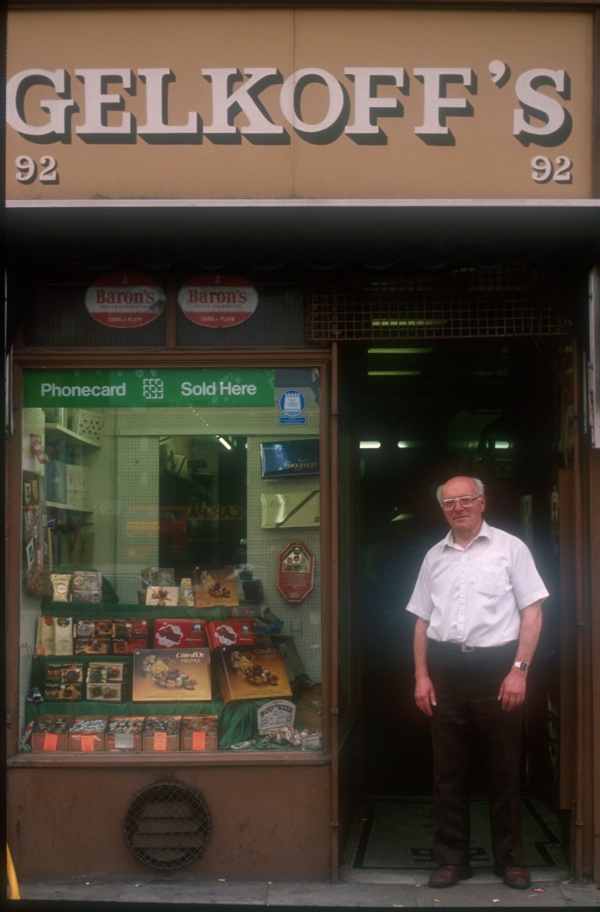
Whitechapel High St

Alderney Rd, Stepney
Photographs copyright © Alan Dein
You may also like to take a look at


