
Chris Kelly & Dan Jones in the Playground

Hopscotch at Columbia School, Bethnal Green, 1997
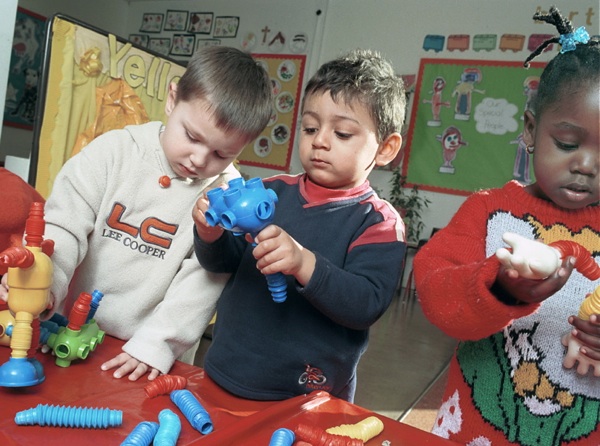
When photographer Chris Kelly sent me these exuberant pictures taken in East End primary schools, I realised it was the ideal opportunity to invite Dan Jones to select children’s rhymes to complement her playful images, drawing from the thousands he has collected in playgrounds here and elsewhere since 1948.
Asked to produce photographs for an education brochure, Chris Kelly turned up at six schools between 2000 and 2002 with camera, lights and optimism. There was never any shortage of ideas or young art directors, and the pictures you see here are the result of a collaboration between photographer, teachers and pupils, with the children aways having the biggest say.
Meanwhile, the heartening news from the playground that Dan Jones has to report is that the culture of rhymes is alive and kicking, in spite of the multimedia distractions of the modern age. The endless process of repetition and reinvention goes on with ceaseless vigour.
(Click here to go to an interactive painting by Dan Jones commissioned by The Museum of Childhood entitled “The Singing Playground” where you can to listen to recordings he made of all the different rhymes in the picture.)

Susan Lawrence Junior School
School dinners, school dinners,
Squashed baked beans, squashed baked beans,
Squiggly semolina, squiggly semolina.
I feel sick! Get a bowl quick!
It’s too late, I done it on the plate!
(Manya Eversley, Bow)

Susan Lawrence Junior School
Everywhere we go
Everywhere we go
People always ask us
People always ask us
Who we are
Who we are
And where we come from
Where we come from
So we tell them
So we tell them
We’re from Stepney
WE’RE FROM STEPNEY
Mighty, mighty Stepney!
MIGHTY, MIGHTY STEPNEY!
And if they can’t hear us,
IF THEY CAN’T HEAR US
We sing a little louder
WE SING A LITTLE LOUDER!
(Call and response chat from Rushmore Junior School)

Bonner Primary School
Inky Pinky Ponky,
Daddy had a donkey.
Donkey died,
Daddy cried,
Inky pinky ponky!
(Dip from St Paul’s Church of England School, Wellclose Sq)

Susan Lawrence Junior School
Zum gali gali gali,
Clap clap clap
Zum gali gali
Clap clap clap
Zum gali gali
Clap clap clap
Zum
clap clap clap
We can work with joy as we sing
Clap clap clap
We can sing with joy as we work
Clap clap clap
(Israeli round from the children of Kobi Nazrul School)

Olga Primary School
Pepsi Pepsi came to town,
Coca Cola shot him down,
Dr Pepper picked him up,
Now they order Seven Up!
(Clapping game from Honor, Sadia, April and Jahira of Bangabundu Junior School)

Bangabandhu Primary School
Im Pim Safety pin
Im pim
Out!
Change your nappies inside out
Not because they’re dirty
Not because they’re clean
Not because your mother says
You’re the Fairy Queen!
(Counting out rhyme from the children of Bangabandhu Primary School)

Holy Family Roman Catholic Primary School
London Bridge is falling down, falling down, falling down.
London Bridge is falling down, My Fair Lady.
Build it up with sticks and stones, sticks and stones, sticks and stones.
Build it up with sticks and stones, My Fair Lady.
Sticks and stones will wear away…
Build it up with iron and steel…Iron and Steel will rust away…
Build it up with bricks and clay…Bricks and Clay will wash away…
(Arch game from children of Bluegate Fields School, Stepney)

Susan Lawrence Junior School
Down in the valley where nobody goes,
There’s an ooky spooky woman who washes her clothes.
With a rub-a-dub here and a rub-a-dub there,
That’s the way she washes her clothes.
(Clapping game from children of St Paul’s Church of England School, Wellclose Sq)

Susan Lawrence Junior School
Please Mr Porter, may we cross your water
To see your lovely daughter, swimming in the water?
(Chasing game for running across the playground at St Paul’s Church of England School, Wellclose Sq)

Marion Richardson School
Once I had a snail
And I 1 it
I 2 it
I 3 it
I 4 it
I 5 it
I 6 it
I 7 it
I ATE (8) it
(Riddle from Colin and his mother at Museum of Childhood, Bethnal Green)
Holy Family Roman Catholic Primary School
Racing car number 9
Losing petrol all the time
How many gallons did you lose?
(6!)
1, 2, 3, 4, 5, 6
You’re OUT!
(Counting out rhyme from Shamima, Natalie Abida and Shazna of Hermitage School, Wapping)

Susan Lawrence Junior School
Twinkle, twinkle, chocolate bar, Daddy (or Mummy) drives a rusty car
Push the button, pull the choke,
Off we go in a puff of smoke,
Twinkle, twinkle, chocolate bar, Daddy drives a rusty car.
(Miming game from infants at Christchurch School, Brick Lane)

Olga Primary School
I like coffee
I like tea
I like climbing up the tree
1, 2, 3, 4, 5
(Dip from the children of Year 4 Christchurch Primary School, Brick Lane)

Holy Family Roman Catholic Primary School
Ta-ra-ra Boom-de-ay!
My knickers flew away
They came back yesterday
From a little holiday
I said “Where have you been?”
They said ‘To see the Queen
At Windsor Castle!”
You little rascal
(Comic song from Katie, Lizzy Alison (Ashford) at Museum of Childhood, Bethnal Green)

Susan Lawrence Junior School
Olicker Bolicker
Suzie Solicker
Ollicker boliker
Knob!
(Dip from Sonny and Marina of Wapping)

Holy Family Roman Catholic Primary School
Ecker decker,
Johnny Cracker,
Ecker decker do,
Ease, cheese,
Butter, bread,
Out goes you
(Counting out rhyme from Columbia School, Bethnal Green)

Bonner Primary School
Jee Jai Jao (Brother-in-law)
Kabhi upor Kabhi nicheh (You’re going up, you’re going down)
Kabhi ageh Kabhi pitcheh (You’re going in front, you’re going behind)
Kabhi eke Kabhi ekh dui teen (Going 1. Going 2. Going 1, 2, 3)
Pushu! (Punch!)
(Hindi dip from Christchurch Primary School, Brick Lane)

Susan Lawrence Junior School
Boom Boom
Shakalaka
Out goes you
Out goes another one
And that is YOU
(Dip from children of Bangabundhu School)

Holy Family Roman Catholic Primary School
In a golden treasure, with an East and a West,
I took my boyfriend to the Chinese shop.
He bought me ice-cream, he bought me a cake,
He sent me home with a bellyache.
I said: “Mama, Mama, I feel sick.
Call me a doctor quick, quick, quick!
Doctor, Doctor, am I gonna die?”
“Count to five if you’re alive
With a 1, 2, 3, 4, 5, 6, 7, 8, 9, 10
You’re dead again!”
(Skipping song from children of year 5 at Arnhem Wharf School)

Holy Family Roman Catholic Primary School
Miss Polly had a dolly that was sick sick sick
(Rock baby in arms)
She called for the Doctor to come quick quick quick
(Hold telephone to ear)
The doctor came with his bag and his hat
(Touch imaginary bag and hat)
And he knocked on the door with a Rat Tat Tat Tat!
(Knock on door)
He looked at the dolly and he shook his head
(Shake head)
He said “Miss Polly, put her straight to bed”
(Wag finger to indicate telling her off)
He wrote out a paper for a pill pill pill
(Write on imaginary paper)
“I’ll be back in the morning with my bill bill bill”
(Clapping and miming game from Rukhaya and Siobhan at Christchurch Primary School, Brick Lane)

Holy Family Roman Catholic Primary School
Sally go round the sun,
Sally go round the moon,
Sally go round the chimney pots
on a Sunday afternoon.
WHOOPS !
(Dancing game from Redriff Primary School, Rotherhithe)
Photographs copyright © Chris Kelly
A playground painting by Dan Jones is being hung in Bethnal Green Children’s Library on 8th March.
You may also like to take a look at
Chris Kelly’s Columbia School Portraits 1996
Chris Kelly’s Cable St Gardeners
and read about
Here are some earlier collections of photography of children in the East End
William Marshall Craig’s Itinerant Traders (Part Two)
After publishing a first selection last week, it is my pleasure to reveal the rest of William Marshall Craig’s Itinerant Traders of London in their Ordinary Costume with Notices of Remarkable Places given in the Background from 1804. As fresh as the day they were coloured, these were recently discovered at the Bishopsgate Institute, bound into the back of a larger volume of “Modern London” published in 1805. In contrast to their attractive aesthetic, these fascinating prints are often unexpectedly revealing of the reality of the lives of the dispossessed and outcast poor who sought a living upon the streets as hawkers at the beginning of the nineteenth century.
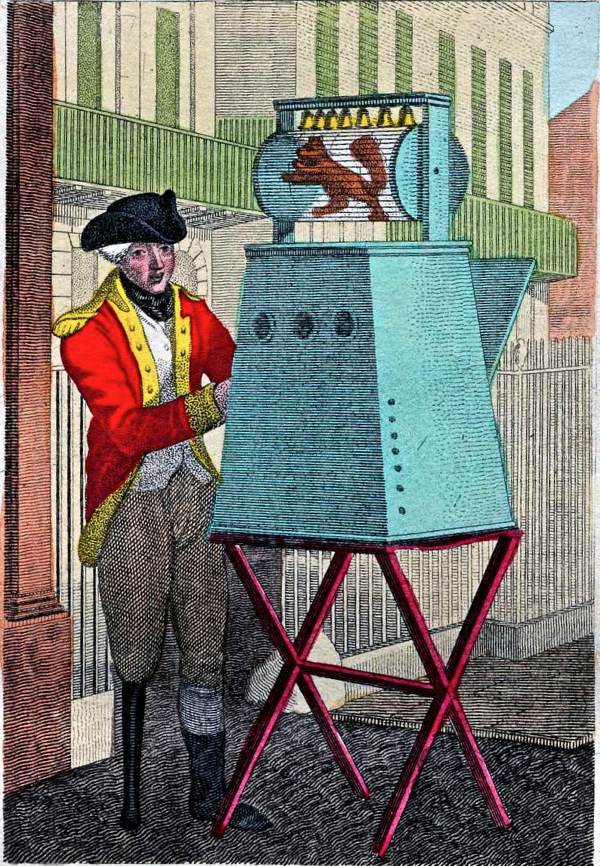
A Showman – This amusing personage generally draws a crowd about him in whatever street he fixes his moveable pantomime, as the children who cannot afford the penny or halfpenny insight into the show box are yet greatly entertained with his descriptive harangues and the perpetual climbing of the squirrels in the round wire cage above the box, by whose incessant motion the row of bells on the top are constantly rung. The show consists of a series of coloured pictures which the spectator views through a magnifying glass while the exhibitor rehearses the history and shifts the scenes by the aid of strings. (Hyde Park Corner, this entrance to London is worthy of the grandeur and extent of the metropolis. On one side of the spacious street of Piccadilly are lofty and elegant houses and on the other is a fine view of Green Park and Westminster Abbey.)
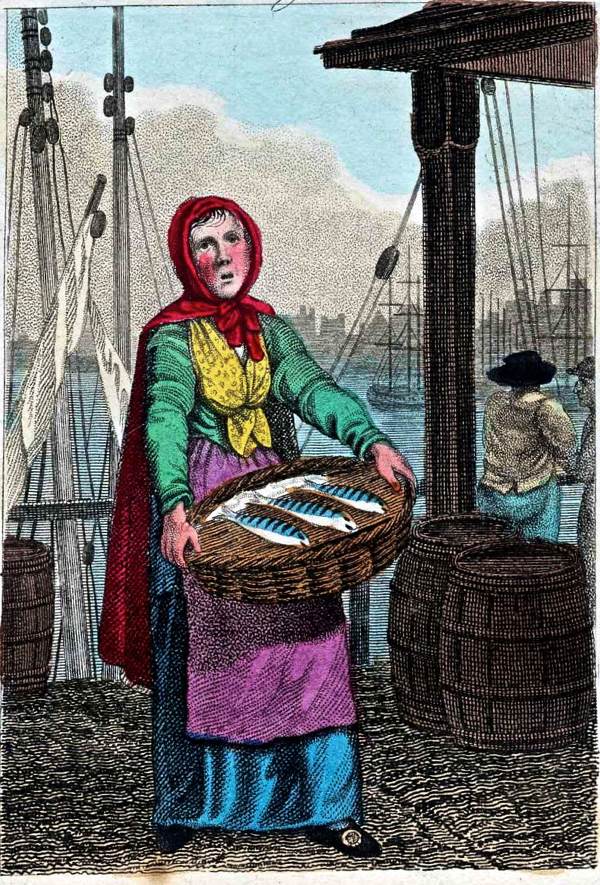
Mackerel – More plentiful than any other fish in London, they are brought from the western coast and afford a livelihood to numbers of men and women who cry them through the streets every day in the week, not excepting Sunday. Mackerel boats being allowed by act of Parliament to dispose of their perishable cargo on Sunday morning, prior to the commencement of divine service. No other fish partake that privilege. (Billingsgate Market commences at three o’clock in the morning in summer and four in winter. Salesmen receive the cargo from the boats and announce by a crier of what kinds they consist. These salesmen have a great commission and generally make fortunes.)
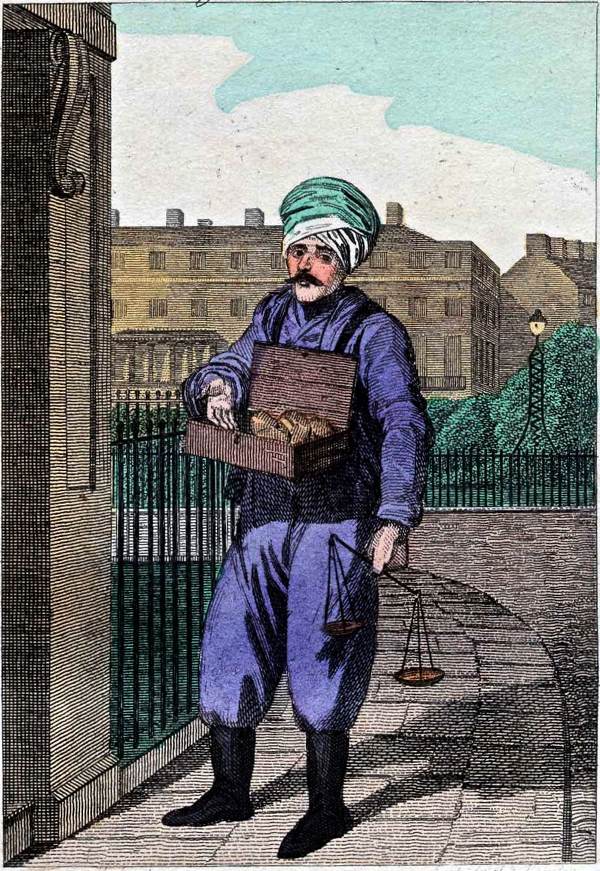
Rhubarb! – The Turk, whose portrait is accurately given in this plate, has sold Rhubarb in the streets of the metropolis during many years. He constantly appears in his turban, trousers and mustachios and deals in no other article. As his drug has been found to be of the most genuine quality, the sale affords him a comfortable livelihood. (Russell Sq is one of the largest in London, broad streets intersect at its corners and in the middle, which add to its beauty and remove the general objection to squares by ventilating the air.)
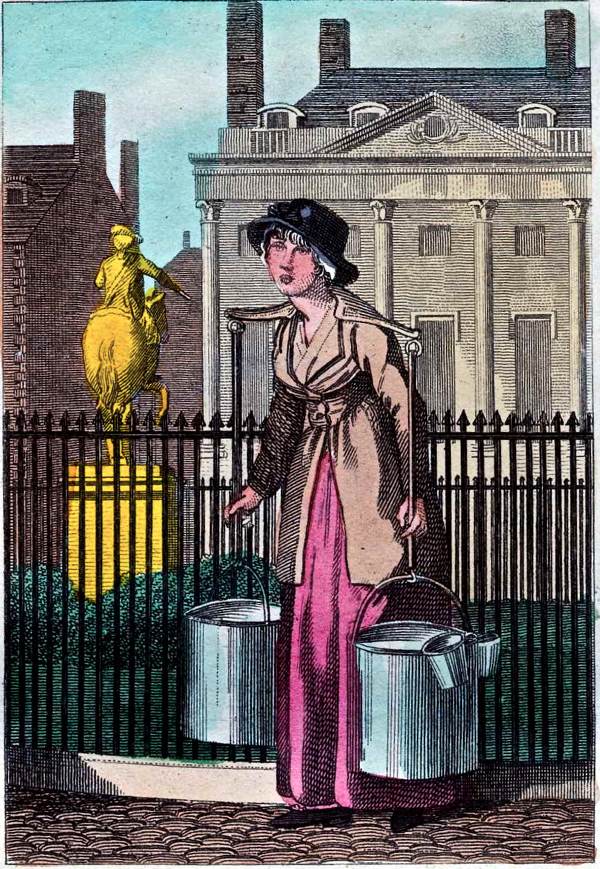
Milk below! – Every day of the year, both morning and afternoon, milk is carried through each square, each street and alley of the metropolis in tin pails, suspended from a yoke placed on the shoulders of the crier. Milk is sold at fourpence per quart or fivepence for the better sort, yet the advance of price does not ensure its purity for it is generally mixed in a great proportion with water by the retailers before they leave the milk houses. The adulteration of the milk added to the wholesale cost leaves an average profit of cent per cent to the vendors of this useful article. Few retail traders are exercised with equal gain. (Cavendish Sq is in Marylebone. In the centre of the enclosure, erected on a lofty pedestal is a bronze statue of William Duke of Cumberland, all very richly gilded and burnished. In the background are two very elegant houses built by Mr Tufnell.)
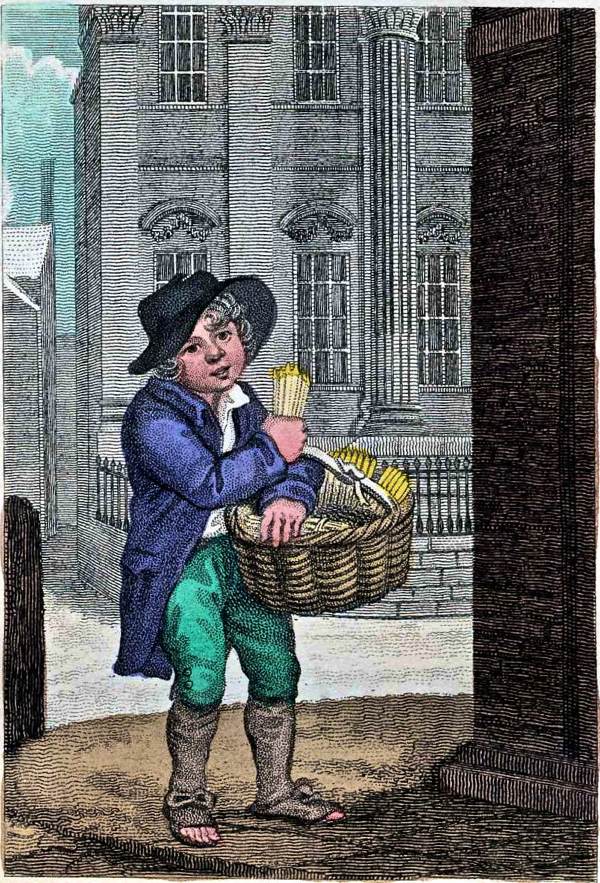
Matches – The criers are very numerous and among the poorest inhabitants, subsisting more on the waste meats they receive from the kitchens where they sell their matches at six bunches per penny, than on the profits arising from their sale. Old women, crippled men, or a mother followed by three or four ragged children, and offering their matches for sale are often relieved when the importunity of the mere beggar is rejected. The elder child of a poor family, like the boy seen in the plate, are frequent traders in matches and generally sing a kind of song, and sell and beg alternately. (The Mansion House is a stone building of considerable magnitude standing at the west end of Cornhill, the residence of the Lord Mayor of London. Lord Burlington sent down an original design worthy of Palladio, but this was rejected and the plan of a freeman of the City adopted in its place. The man was originally a shipwright and the front of his Mansion House has all the resemblance possible to a deep-laden Indiaman.)
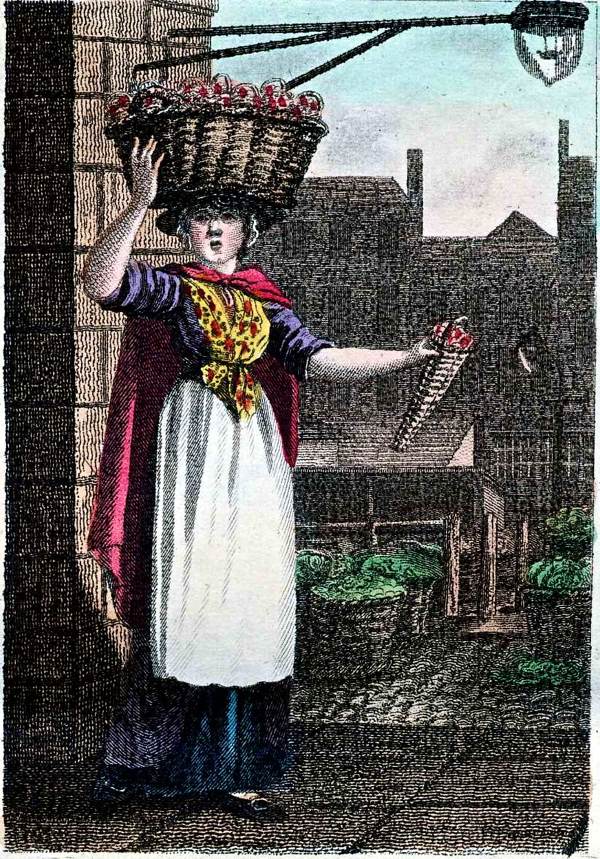
Strawberries – Brought fresh gathered to the markets in the height of their season, both morning and afternoon, they are sold in pottles containing something less than a quart each. The crier adds one penny to the price of the strawberries for the pottle which if returned by her customer, she abates. Great numbers of men and women are employed in crying strawberries during their season through the streets of London at sixpence per pottle. ( Covent Garden Market is entirely appropriated to fruit & vegetables. In the south side is a range of shops which contain the choicest produce and the most expensive productions of the hot house. The centre of the market, as shown in the plate, although less pleasing to the eye is more inviting to the general class of buyers.)
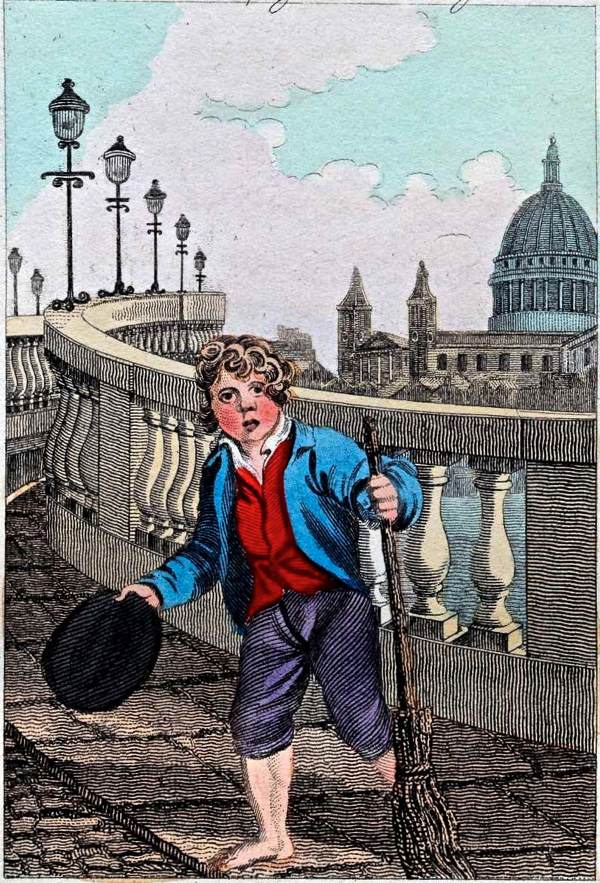
A Poor Sweep Sir! – In all the thoroughfares of the metropolis, boys and women employ themselves in dirty weather in sweeping crossings. The foot passenger is constantly importuned and frequently rewards the poor sweep with a halfpenny, which indeed he sometimes deserves for in the winter after fall of snow if a thaw should come before the scavengers have had time to remove it, many streets cannot be crossed without being up to the middle of the leg in dirt. Many of these sweepers who choose their station with judgement reap a plentiful harvest from their labours. (Blackfriars Bridge crosses the river from Bridge St to Surrey St where this view is taken. The width and loftiness of the arches and the whole light construction of this bridge is uncommonly pleasing to the eye and St Paul’s cathedral displays much of the grandeur of its extensive outline when viewed from Blackfriars Bridge.)

Knives to grind! – The apparatus of a knife grinder is accurately delineated in this plate. The same wheel turns his grinding and his whetting stone. On a smaller wheel, projecting beyond the other he trundles his commodious shop from street to street. He charges for grinding and setting scissors one penny or twopence per pair, for penknives one penny each and table knives one shilling and sixpence per dozen, according to the polish that is required. (Whitehall – this beautiful structure stands in Parliament St, begun in 1619 from a design by Inigo Jones in his purest manner and cost £17,000. The northern end of the palace, to the left of the plate, is that through which King Charles stepped onto the scaffold.)
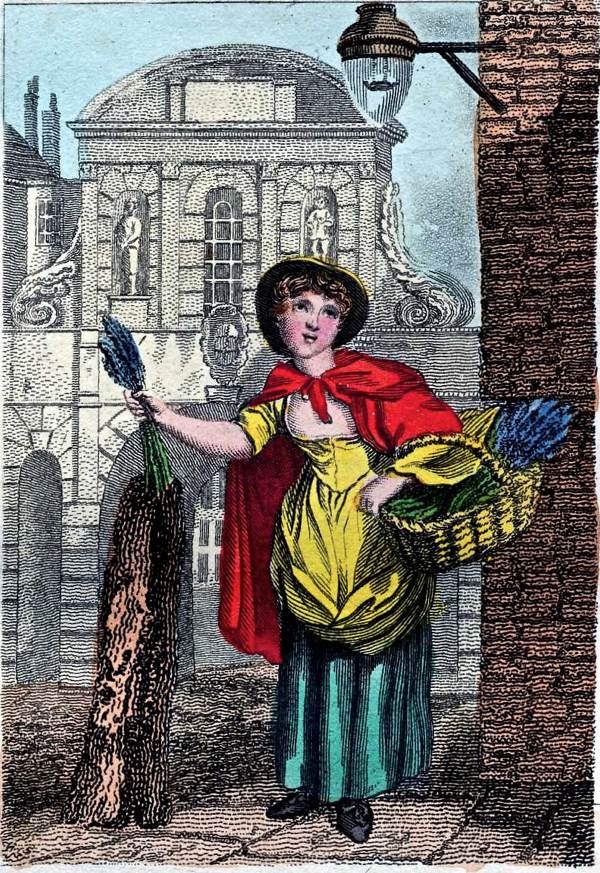
Lavender – “Six bunches a penny, sweet lavender!” is the cry that invites in the street the purchasers of this cheap and pleasant perfume. A considerable quantity of the shrub is sold to the middling-classes of the inhabitants, who are fond of placing lavender among their linen – the scent of which conquers that of the soap used in washing. (Temple Bar was erected to divide the strand from Fleet St in 1670 after the Great Fire. On the top of this gate were exhibited the heads of the unfortunate victims to the justice of their country for the crime of high treason. The last sad mementos of this kind were the rebels of 1746.)

Sweep Soot O! – The occupation of chimney sweep begins with break of day. A master sweep patrols the street for custom attended by two or three boys, the taller ones carrying the bag of soot, and directing the diminutive creature who, stripped perfectly naked, ascends and cleans the chimney. The greatest profit arises from the sake of soot which is used for manure. The hard condition of the sweep devolves upon the smallest and feeblest of the children apprenticed from the parish workhouse. (Foundling Hospital, a handsome and commodious building in Guildford St, stands at the upper end of a large piece of ground in which the children of the foundation are allowed to play in fine weather.)
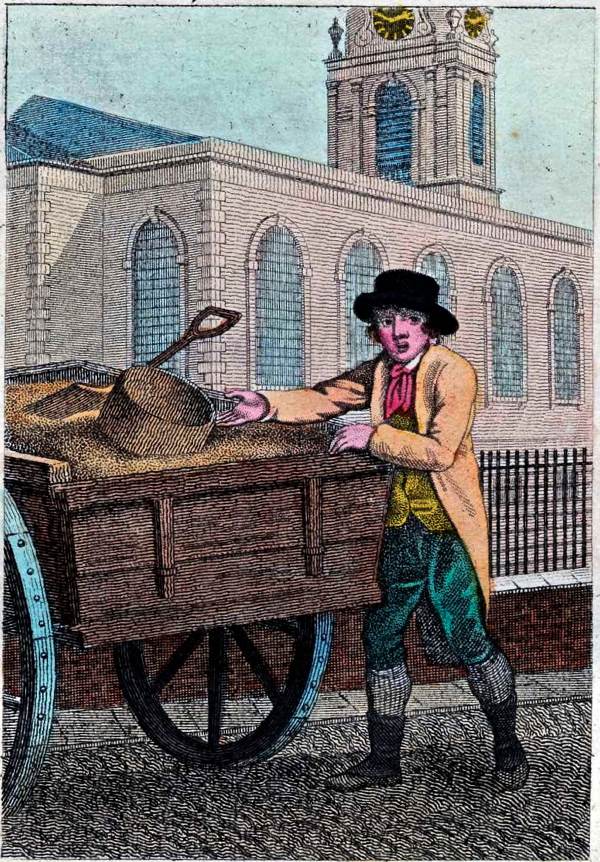
Sand O! – Sand is an article of general use in London, principally for cleaning kitchen utensils. Its greatest consumption is in the outskirts of the metropolis where the cleanly housewife strews sand plentifully over the floor to guard her newly scoured boards from dirty footsteps, a carpet of small expense and easy to be renewed. Sand is sold by measure, red sand twopence halfpenny and white five farthings per peck. (St Giles’ Church at the west end of Broad St Giles is a very handsome structure. Over the gate, entering the church yard is fixed a curious bass-relief representing the Last Judgement and containing a very great number of figures, set up in the 1686)
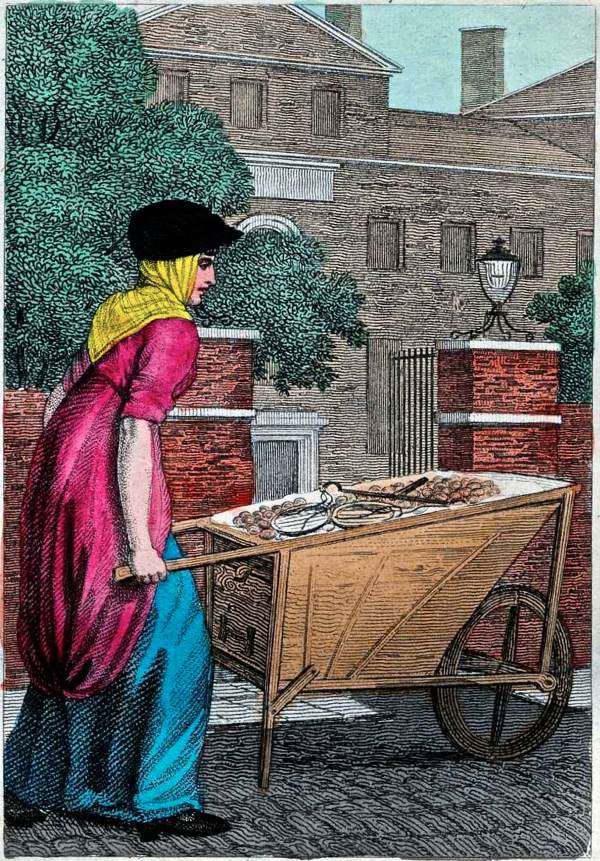
New potatoes – About the latter end of June and July, they become sufficiently plentiful to be cried at a tolerable rate in the streets. They are sold wholesale in markets by the bushel and retail by the pound. Three halfpence or a penny per pound is the average price from a barrow. (Middlesex Hospital at the northern end of Berners St is the county hospital for diseased persons. It stands in a large court with trees, covered by a wall in front with two gates, one of which is represented in the plate.)
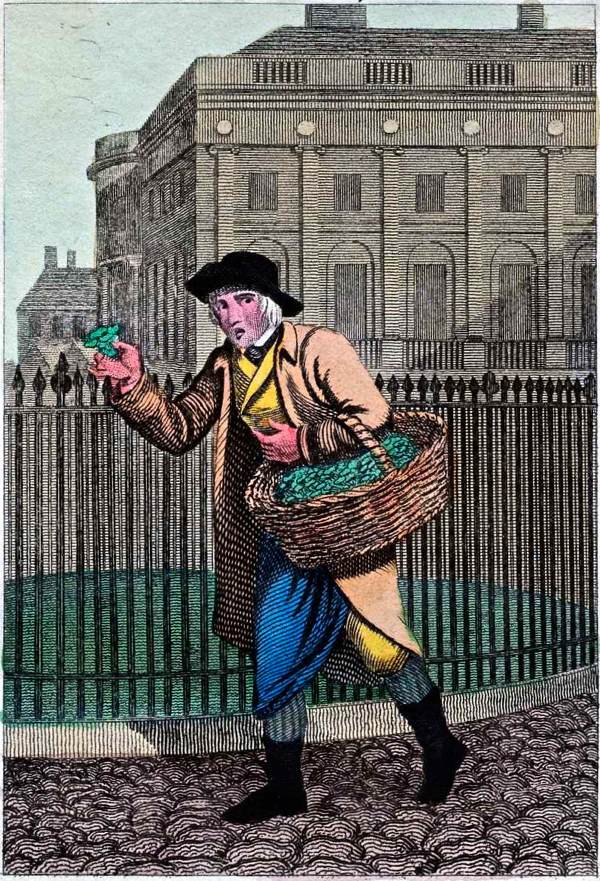
Water Cresses – The crier of water cresses frequently travels seven or eight miles before the hour of breakfast to gather them fresh. There is a good supply in the Covent Garden Market brought along with other vegetables where they are cultivated like other garden stuff, but they are inferior to those grown in the natural state in a running brook, wanting that pungency of taste which makes them very wholesome. (Hanover Sq is on the south side of Oxford St, there is a circular enclosure in the middle with a plain grass plot. In George St, leading into the square, is the curious and extensive anatomical museum of Mr Heaviside the surgeon, to the inspection of which respectable persons are admitted, on application to Mr Heaviside, once a week.)
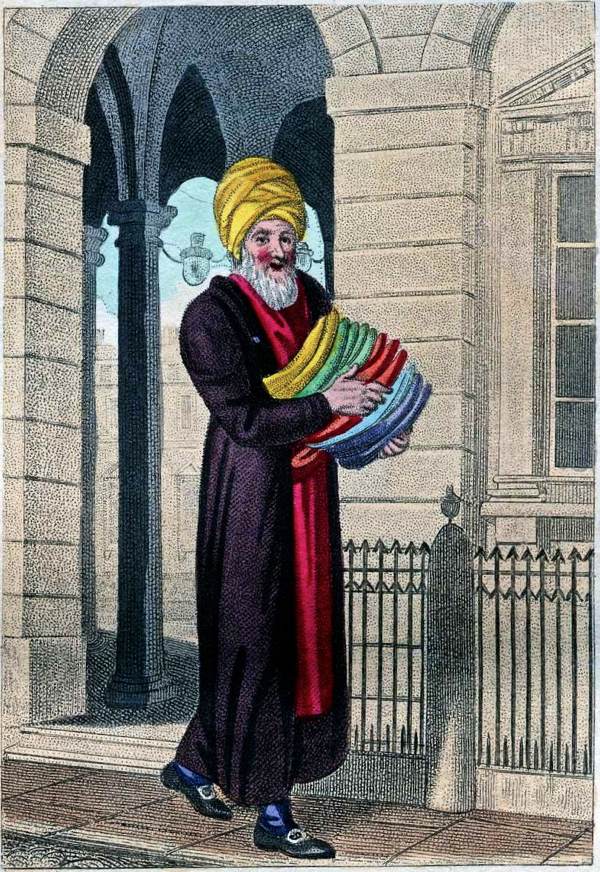
Slippers – The Turk is a portrait, habited in the costume of his nation, he has sold Morocco Slippers in the Strand, Cheapside and Cornhill, a great number of years. To these principal streets, he generally confines his walks. There are other sellers of slippers, particularly about the Royal Exchange who are very importunate for custom while the venerable Turk uses no solicitation beyond showing his slippers. They are sold at one shilling and sixpence per pair and are of all colours. (Somerset House is a noble structure built by the government for the offices of public business. The plate shows the west side of the entrance which contains a gate for carriages and two foot ways. A visit will amply repay the trouble of a stranger.)
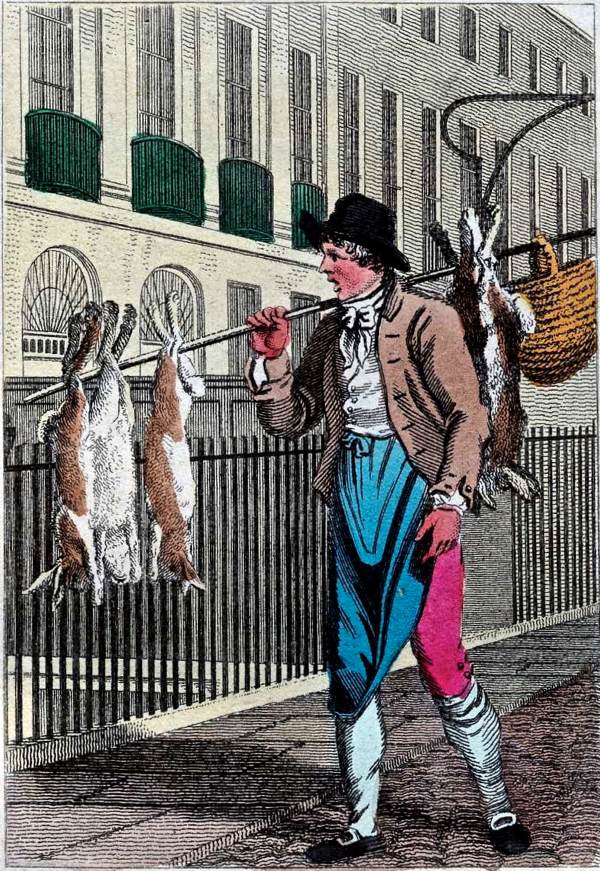
Rabbits – The crier of rabbits in the plate is a portrait well known by persons who frequent the streets at the west end of town. Wild and tame rabbits are sold from ninepence to eighteen pence each, which is cheaper than they can be bought in the poulterers’ shops. (Portland Place is an elegant street to the north of Marylebone. From the opening at the upper end is a fine view of Harrow and the Hampstead and Highgate Hills, making it one of the airiest situations in town. The houses being of perfect uniformity and no shops or meaner buildings interrupting the regularity of the design, it is one of the finest street in London.)
Images courtesy of Bishopsgate Institute
You may like to take a look at the rest of
William Craig Marshall’s Itinerant Traders
and these other sets of the Cries of London
H.W.Petherick’s London Characters
John Thomson’s Street Life in London
Aunt Busy Bee’s New London Cries
Marcellus Laroon’s Cries of London
More John Player’s Cries of London
William Nicholson’s London Types
Francis Wheatley’s Cries of London
John Thomas Smith’s Vagabondiana of 1817
John Thomas Smith’s Vagabondiana II
John Thomas Smith’s Vagabondiana III
Thomas Rowlandson’s Lower Orders
The East End from the Top Deck

6th May 2009 12:07pm
In spite of what a certain notorious former Prime Minister is reputed to have said about anyone over thirty who still travels by bus being a failure in life, I suggest that there is no better way to see London than from the top of a double-decker. James Pearson-Howes spent years walking up and down the Kingsland Rd taking photographs at street level in Dalston, but once he got on a bus a whole new perspective opened to him and he felt liberated to take to take a different kind of picture.“From the bus, I could see people going about their daily life without me interfering,” – as he put it with eloquent simplicity.
James’ photographs that you see here were produced as part of a collaborative project with Will Robson-Scott entitled “Top Deck,” in which both the photographers took pictures from the tops of buses as they travelled around the East End and then compared notes. “We carried our cameras whenever we went on a bus. Only on a few occasions, such as the dawn shots, did we get up early specially to go on a bus in order to take pictures,” James explained.
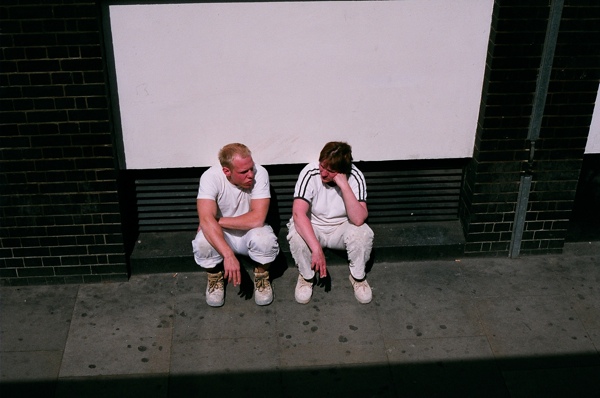
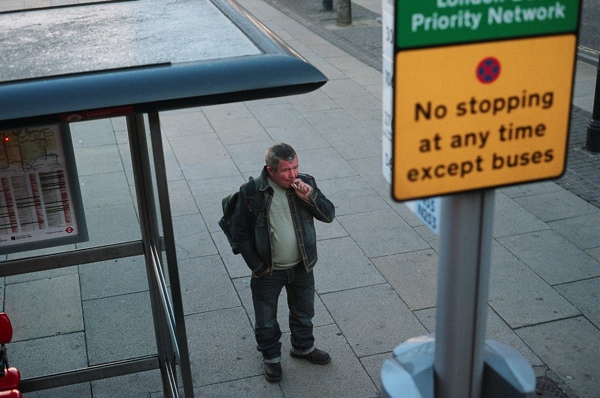
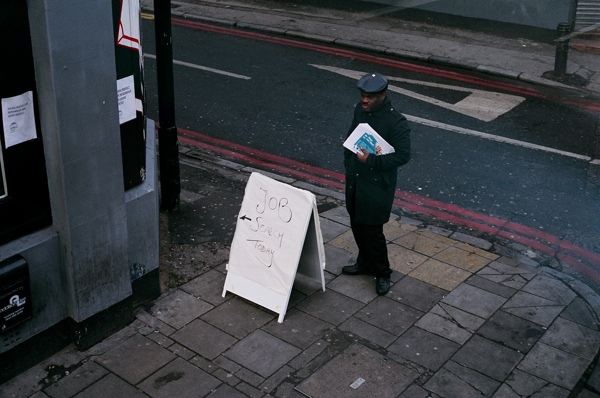
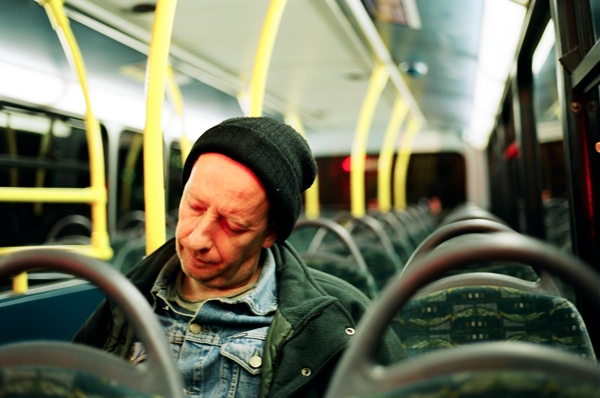
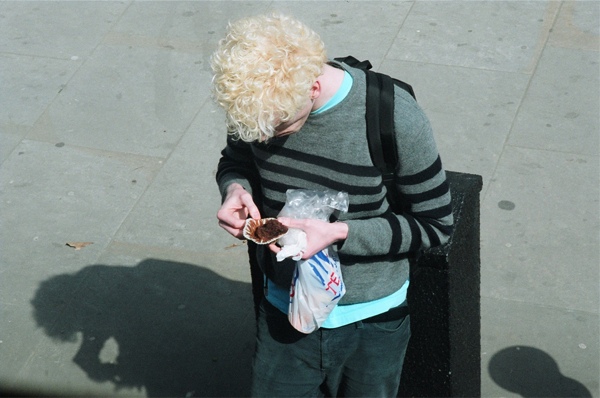
Many self -respecting readers, even over thirty, who travel on buses in the East End will recognise familiar scenes from the 67, 55, 242, 243, 149, 8 and 106 routes. Far below God’s eye view, yet raised significantly above those upon the pavement, the top of a bus provides an ideal platform for photography, both revealing the life of the street at close hand while offering a framed aspect too. This subtle shift of perspective serves to reveal our fellow humans more acutely than when we share their eye level, and the sense of personal exposure in these pictures is touching, as people on the street are revealed inhabiting private feelings within a public space.
Babes in arms and coffins in hearses, spring blossom and winter snowfall, daybreak and sunset, religion, commerce and politics – all of human life can be witnessed from the top of a bus. A sense of levity is encouraged by the momentum of the vehicle itself, always passing onto the next location, and offering up life as a continous fleeting series of tableaux vivants for the photographer to capture. A wedding couple in the snow, a job-seeker on midwinter’s day and a man poised to consume a cake, each of these diverse spectacles of existence presented themselves to James’ roving lens as he came by on the bus. Although the ingenious “Top Deck” project is now concluded, “I still carry a camera every time I go on a bus,” James admitted to me, “- just in case!”

16th April 2009 4:40pm

16th April 2009 4:55pm
6th May 2009 5:39pm


1oth April 2010 2:45pm

21st April 2010 6:17pm

10th April 201o 9:57am

17th April 2010 7:12pm

17th April 2010 3:41pm
21st April 2010 10:47pm

21st April 2010 10:50am

21st April 2010 10:51pm

28th June 2010 6.07am

3rd August 2010 11:37am

8th May 2010 9:30am

8th May 2010 11:20am

13th November 201o 6:43pm

21st December 2010 12:48pm

21st December 2010 4:23pm

23rd October 2011 3.45pm
21st December 201o 1:14pm
10th December 2009 6:05pm
15th June 2011 10.12am

10th September 2010 6:52am

28th May 2010 2:03pm
James Pearson-Howes & Will Robson-Scott have produced a limited edition of five hundred copies of a handsome large format thirty-six page coloured broadsheet of their pictures, entitled TOP DECK. Copies are available here.
You may also like to take a look at James Pearson-Howes’ photographs
John Twomey, Champion Fencer
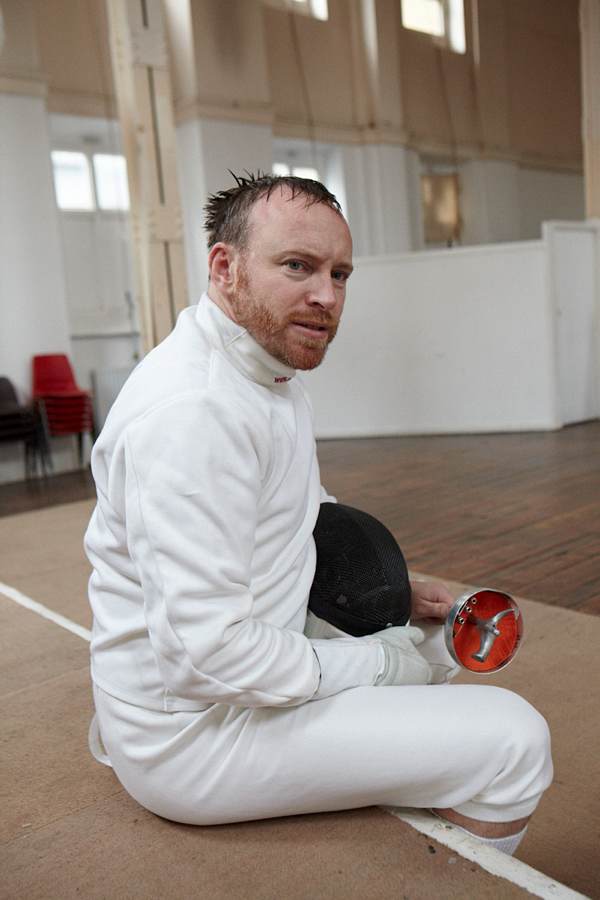
“Ten years, ten medals, ten bells!”
Ten years ago, when John Twomey became landlord of the Ten Bells in Commercial St, he had achieved the distinction of winning the Irish National Fencing Championship ten times – an unsurpassed record in the history of the competition – yet the challenge of taking over the pub led him to forsake his fencing career. But now, in an audacious move, he has decided to return to his beloved sport and attempt to reclaim his title once more at the 2012 Championship in Maynooth, County Kildare, on March 25th – where a contingent from Spitalfields will be present to offer encouragement.
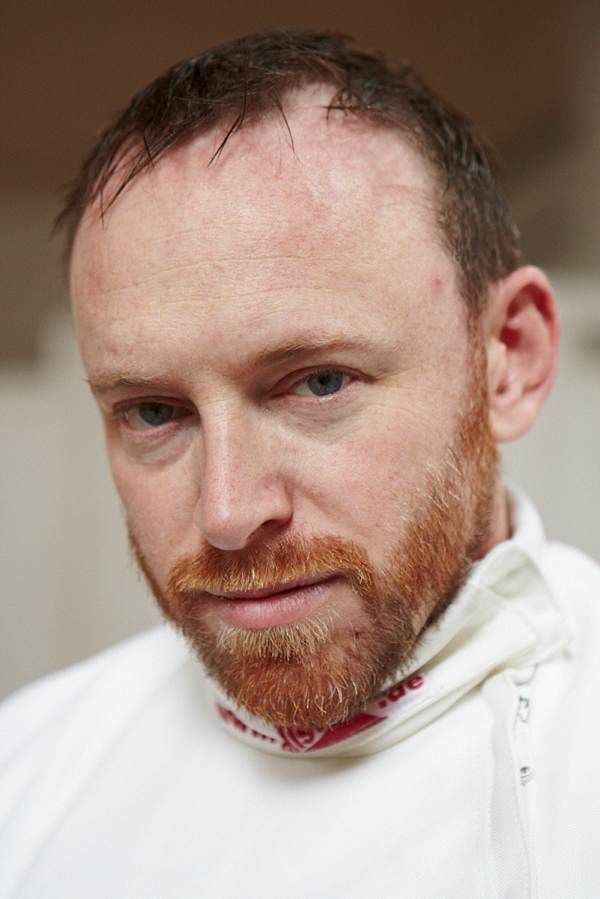
Over this past winter, John has been training conscientiously with Russian Fencing Master, Alex Agrenich, at the magnificent eighteenth century Hanbury Hall in Hanbury St. And so, last week, Spitalfields Life Contributing Photographer Patricia Niven and I decided to go along to show John our support and see how his preparations are shaping up.
“A year ago, when I first started training again, I realised how far back my fencing was,” John admitted to me with a grimace, soberly confronting the task he has embraced, “My reflexes are as fast as ever but my technique has suffered from ten years’ neglect.” Central to these training sessions has been the process of honing John’s style with the epée, his chosen weapon. “I tend to overreact quickly,” John confessed, “So we have been minimising the technique, because you don’t want to waste movement.” This approach is in line with the Russian school of fencing, of which Alex Agrenich is an exponent, characterised by a lack of flamboyance and a pared-down movement. A tall man of phlegmatic temperament, possessing inscrutable humour and undisclosed insight, Alex had John working very hard in response to seemingly effortless gestures on his part.
Even after we opened the windows, the heating, which is permanently on in the Hanbury Hall at this time of year, still served to intensify the hot-house atmosphere the training has acquired in these critical weeks approaching the contest. Tension and temperature rose in tandem, as Alex took John through a series of exercises designed to clarify his method, testing him hard, yet requiring him to do less in reaction.
I took refuge at a distance as the hall resounded to the accelerating rhythmic shuffle of their feet and the repeated click-click of the epées clashing, while John and his fencing master took on a strangely inhuman presence in their insect-like black mesh masks. Yet as the momentum of the physical engagement escalated to breaking point several times, I was surprised when they both took off their masks to reveal relaxed smiles in apparent contradiction to their accumulating perspiration. Though, as John’s wet hair stuck to his brow, his eyes acquired a sparkle that indicated his ferocious intent.
The training consists of repeated individual segments of movement, attempting an attack or a hit, moving on to practising the thrust and exploiting the angle between the blades – all serving to perfect John’s economy of movement, thereby increasing his accuracy and speed. John has been working furiously here for months now with his fencing master three days a week and working out with an army physical trainer on the other two weekdays. “In your forties you have a choice,” he revealed to me boldly with a grin, wiping the sweat from his brow, “whether to live as younger or older.”
As much as those actual contestants John will face in Ireland next month, I could not help but feel that John’s psychological opponent was his own younger self – that he aspires to match once more – which makes this a courageous endeavour indeed, yet one which John has shown he has both the guts and the commitment to accomplish. In the meantime, the toast in John’s majestic nineteenth century tiled barroom is, “Ten years, ten medals, ten bells!”

John Twomey competing in Tallinn in 1990.
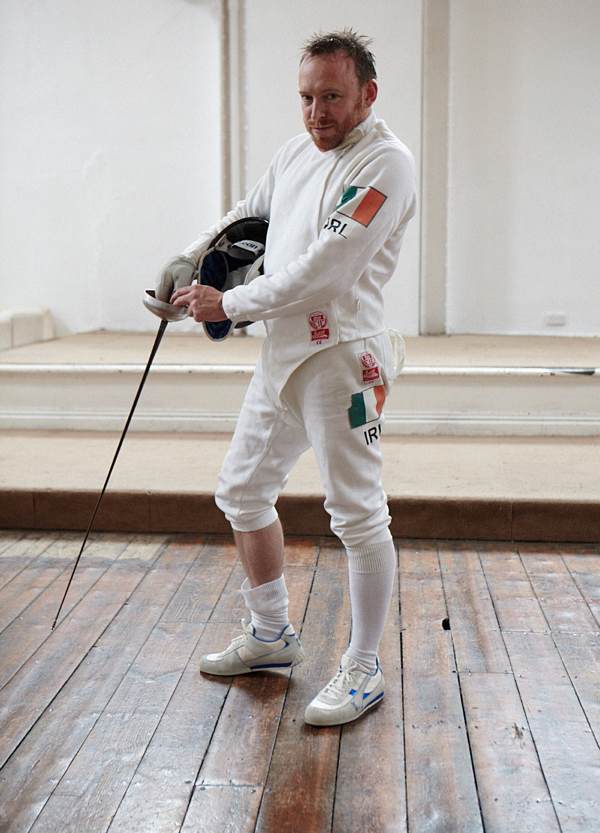
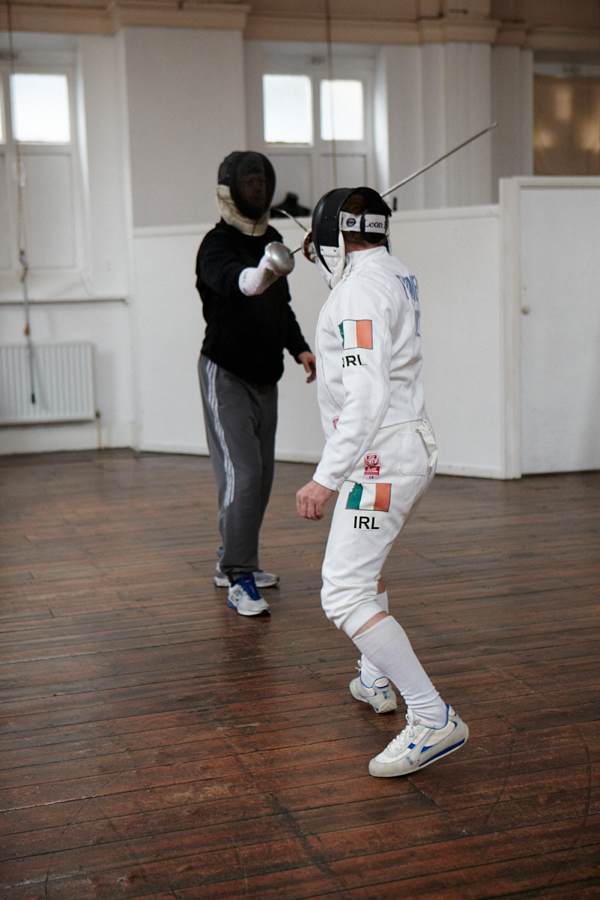
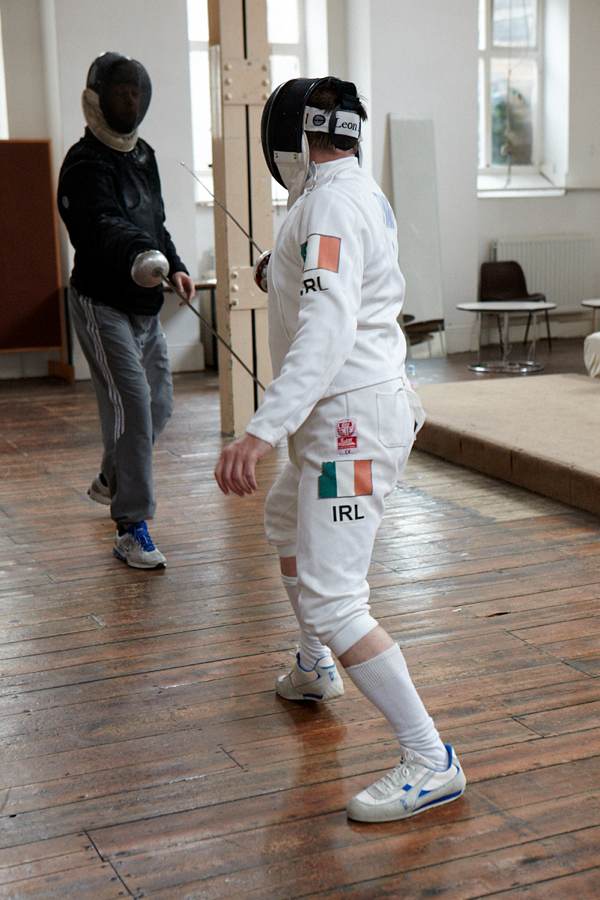

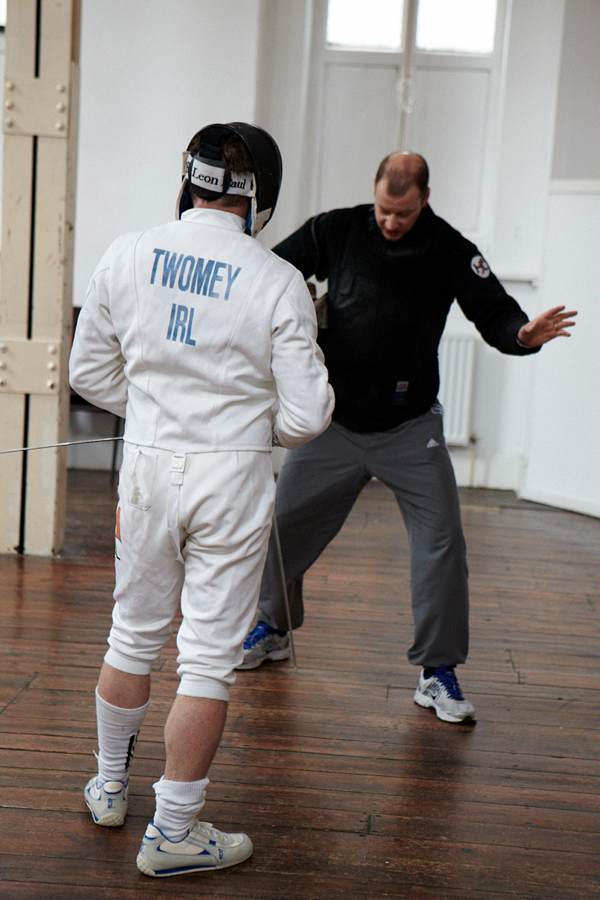
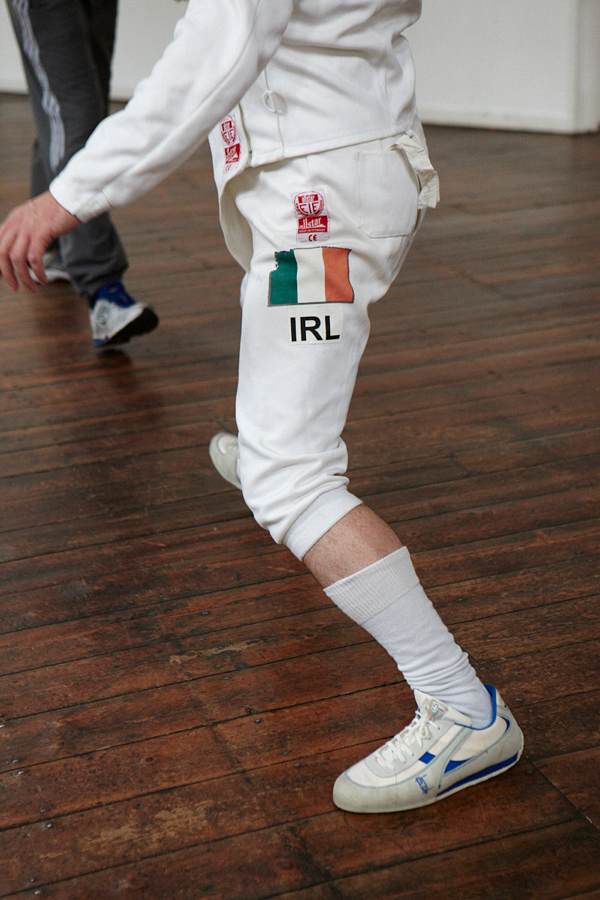
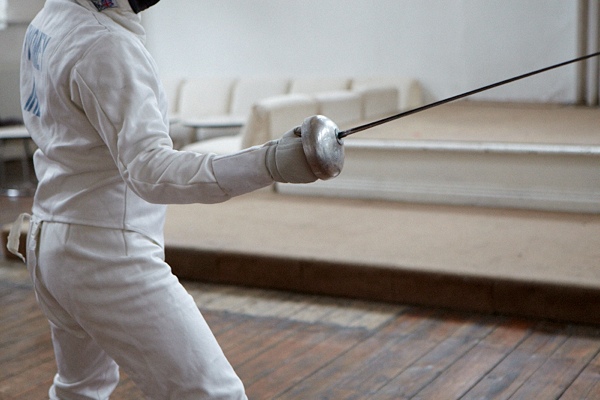
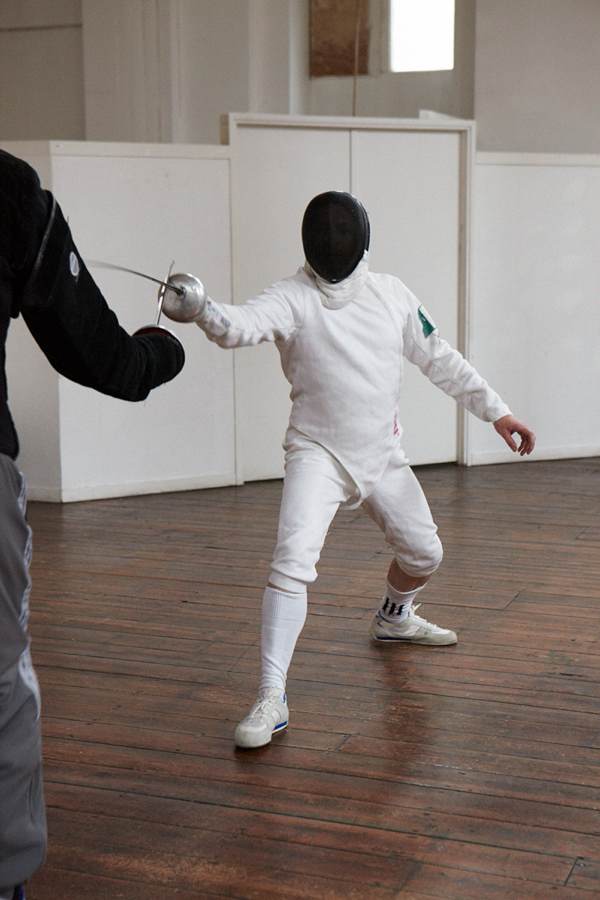

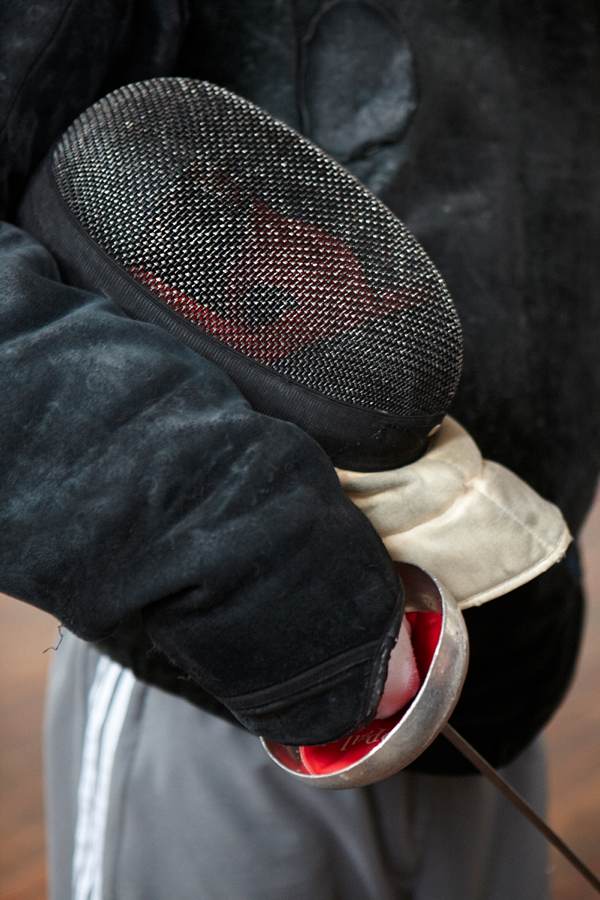
Wires attached to this button register when a hit is made.
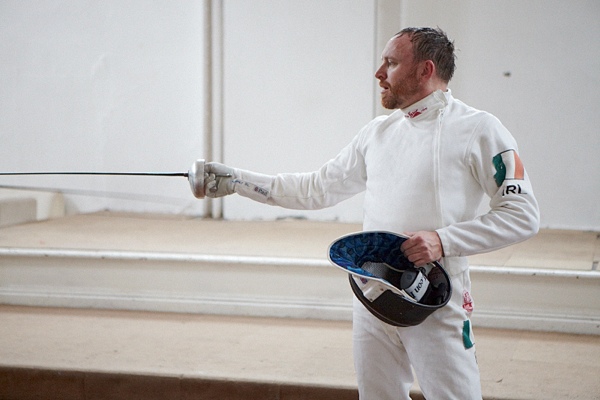
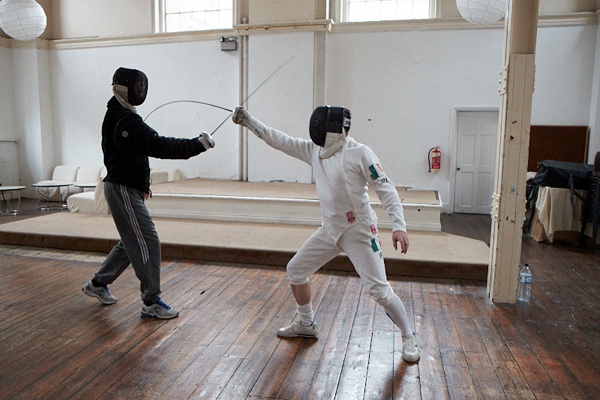
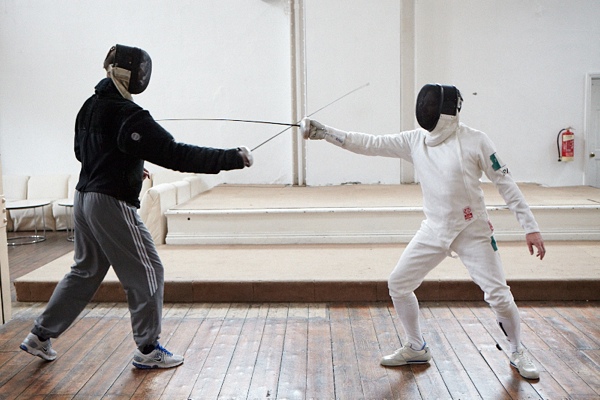
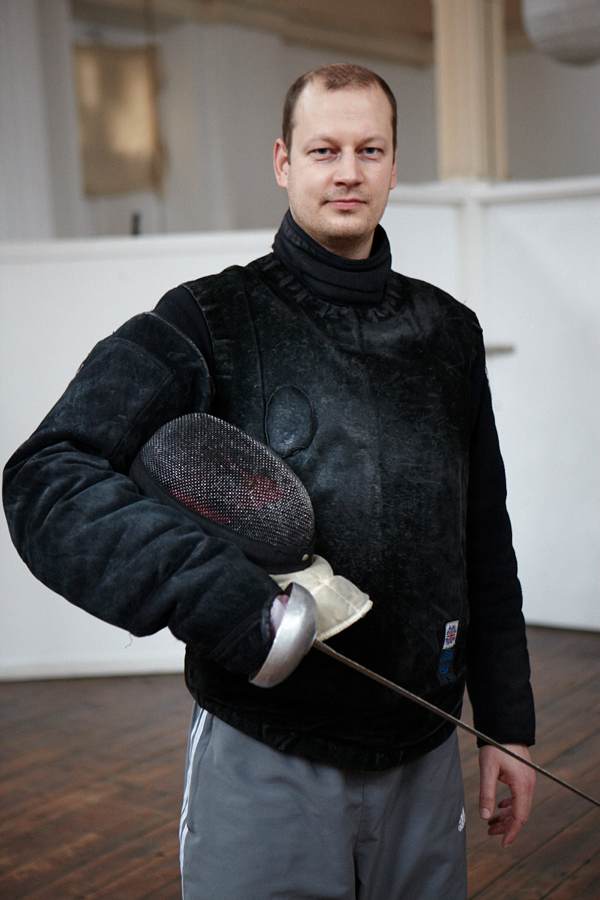
Russian Fencing Master, Alex Agrenich.



On the roof of the Ten Bells.
John Twomey’s Irish Fencing Championship 2012 attempt is sponsored by The Ten Bells.
Photographs copyright © Patricia Niven
You may also like to read
John Claridge’s East End

The window on the top right of this photograph was John Claridge’s former bedroom when he took this astonishing portrait of his neighbours in Plaistow – Mr & Mrs Jones – in 1968, on a visit home in his early twenties. Once, at the age of eight, John saw a plastic camera at an East End fun fair and knew he had to have it. And thus, in that intuitive moment of recognition, his lifelong passion for photography was born. Saving up money from his paper round in the London Docks, John bought a serious camera and recorded the world that he knew, capturing the plangent images you see here with a breathtaking clarity of vision. “Photography was a natural language,” he assured me, when I asked him about taking these pictures, “This was my life.”
“My father was a docker – everyone worked in the docks, did a bit of boxing or they were villains. My dad went to sea when he was thirteen, he did bare-knuckle boxing, he knew how to rig a ship from top to bottom, and he sold booze in the states during prohibition. I used to get up at five in the morning to talk to him before he went to work and he told me stories, that was my education. People say life was hard in the East End, but I found the living was easy and I loved it.”
With admirable self-assurance, John left school at fifteen and informed West Ham Labour Exchange of his chosen career. They sent him up to the McCann-Erickson advertising agency in the West End where he immediately acquired employment in the photographic department. Then, at seventeen years old, John bravely travelled from Plaistow to Hampstead to knock on the door of Bill Brandt to present one of his prints, and the legendary photographer invited him in, recognising his precocious talent and offering encouragement to the young man.
“I used to meet my mum after work in the Roman Rd where she was a machinist, and you couldn’t see the next street in the fog,” John recalled, when I enquired about the distinctive quality of light in these atmospheric images. At the age of nineteen, John left the East End for good and at the same time opened his first studio near St Paul’s Cathedral. It was the precursor an heroic career in photography which has seen John working at the top of his profession for decades, yet he still carries a deep affection for these eloquent haunting pictures that set him on his way. “My East End’s gone, it doesn’t exist anymore,” he admitted to me frankly with unsentimental discernment, “These are pictures I could never do again, I don’t have that naivety and innocence anymore, but seeing them now is like looking at an old friend.”

Collecting firewood, 1960

1961
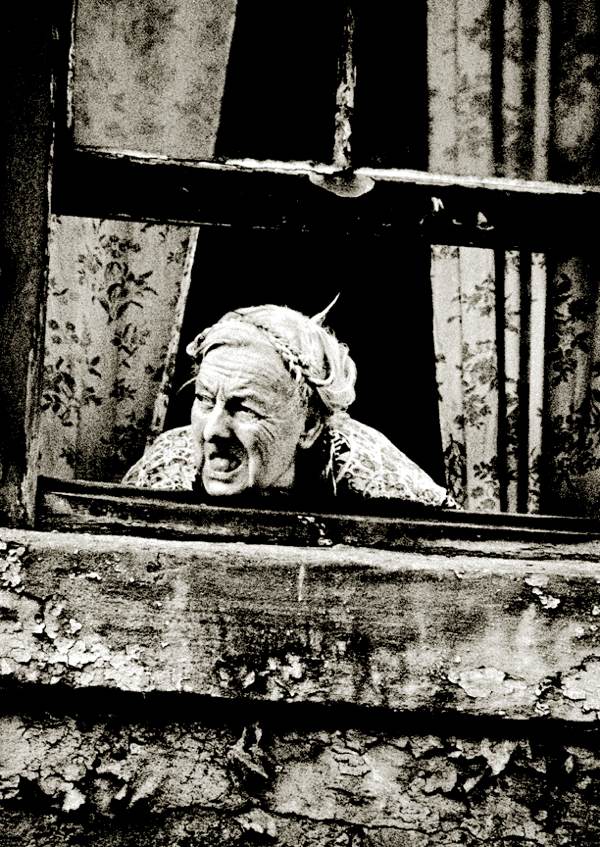
1963

1966

1972

1960

Ex-boxer, 1962

1974

1962

1961
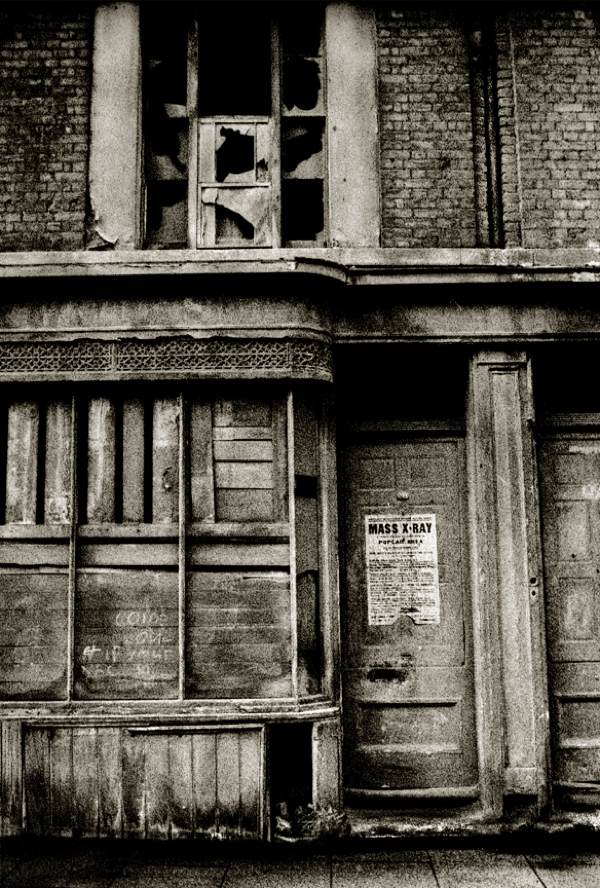
Mass X-Ray, 1966

1962

1960

Flower Seller, 1959

1962

Shoe Rebuilders, 1965

London fog, 1959

Going to work, 1959

London Docks, 1964
Photographs copyright © John Claridge
A View of Christ Church Spitalfields

This church is so big that I can hardly see it. Omnipresent and looming over my existence – as I go about my daily business in the surrounding streets – Nicholas Hawksmoor’s towering masterpiece of English baroque, Christ Church, Spitalfields, has become so deeply integrated into my perception that I do not see it anymore. Yet I can never forget it either, because it continually interposes upon my conscious by surprise, appearing on the skyline in places where I am not expecting it.
Equally, I can never get accustomed to the size of it, and it never ceases to startle me when I turn the corner from Bishopsgate into Brushfield St and spy it there across Commercial St – always bigger than I expect, bigger than I remember it. The church’s gargantuan scale makes it appear it closer than it is and – even though my mind’s eye diminishes it – the reality of it always surpasses my expectation.
In this sense, Nicholas Hawksmoor’s masterpiece still fulfils its original function superlatively, which was to be an monumental marker pointing heavenwards and inducing awe among all those who dwell in its shadow. Constructed between 1714 and 1729 – by Act of Parliament – as one of an intended fifty new churches to serve London’s new communities, at a time when the population of Spitalfields was dominated by Huguenot immigrants, Christ Church’s superhuman scale embodied a majestic flourish of power.
Three centuries later this effect is undiminished, though now the nature of its presence is less bombastic and more elusive. Sometimes, especially at night, I look up at the great cliff face of it stretching up into the dark sky and I feel like an ant, but when I walk out from the portico and the vista of Brushfield St opens to me ahead, I experience a mood of elevation as if the world were a spectacle for my sole disposal. Mostly though, it is through the punctuations in my consciousness that I know it, like the finger of God poking into a painting in an illuminated manuscript. According to my own mood and the meteorological conditions, it conjures different meanings – whether berating me, instructing me, reminding me, teasing me or beckoning me – although the precise nature of the signal remains ever ambiguous, beyond the imperative to lift up my eyes to the sky.
Taking a stroll around the territory, I set out to photograph Christ Church from different places and record its ubiquitous nature in Spitalfields. Upon my circular walk, which I undertook clockwise, travelling south then west then north then east and south again, my path traced each of the contrasted social environments that exist within the bounds of this small parish. In turn, these locations proposed different relationships with my subject which I photographed rising over dumpsters, through the window of a sushi bar and even from an orange grove.
Once upon a time the spire of Christ Church had no competition – existing as the sole pinnacle – yet although it rises now to face its much taller neighbours in the City, it holds its own as undaunted and heroic as David facing Goliath. So this is how I choose to interpret this extraordinary building which is so big that I cannot see it anymore, as the manifestation of an indomitable spirit. A sentinel to inspire me in my own equivocal day-to-day existence.

From Bangla Town Cash & Carry.
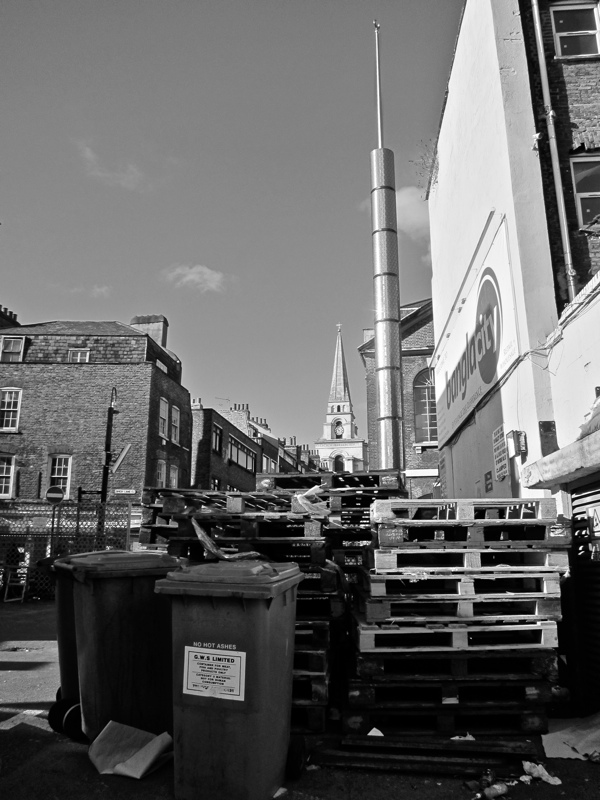
From Bangla City Continental Supermarket, Brick Lane.

From the Seven Stars.

From an orange grove in Flower & Dean St.

From Petticoat Lane in the City of London.

From Thrawl St.

From Bell Lane.

From Whites Row.

From Bishops Sq.

From Itsu Sushi, Broadgate.

From Shoreditch High St.

From Quaker St.

From the Truman Brewery.

From Corbet Place.

From Hanbury St.

From Fournier St.
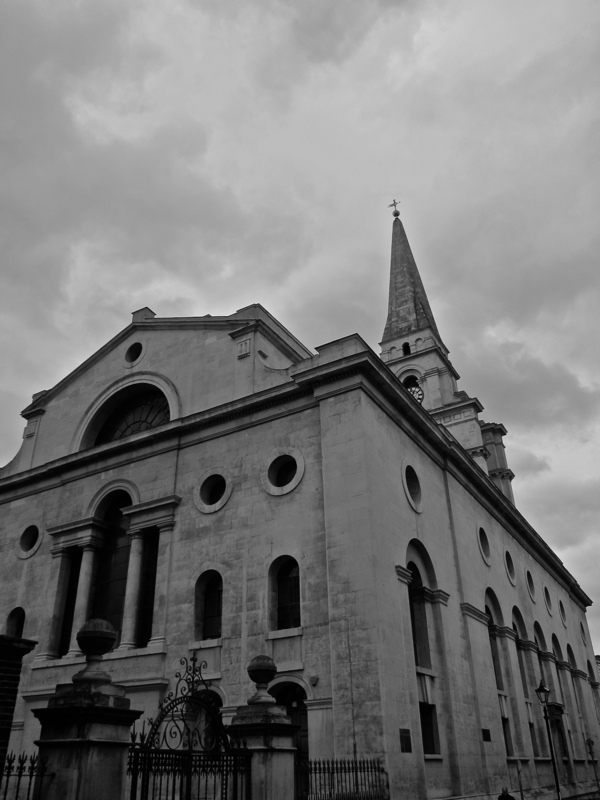
Please get in touch if you have a remarkable view of Christ Church from your window or roof, whether near or far, so that I may take a second set of pictures.
You might also like to read about
The Secrets of Christ Church Spitalfields
or take a look at these views of Christ Church
or visit Nicolas Hawksmoor, Architect of the Imagination at the Royal Academy.
Meet the Curry Chefs of Brick Lane


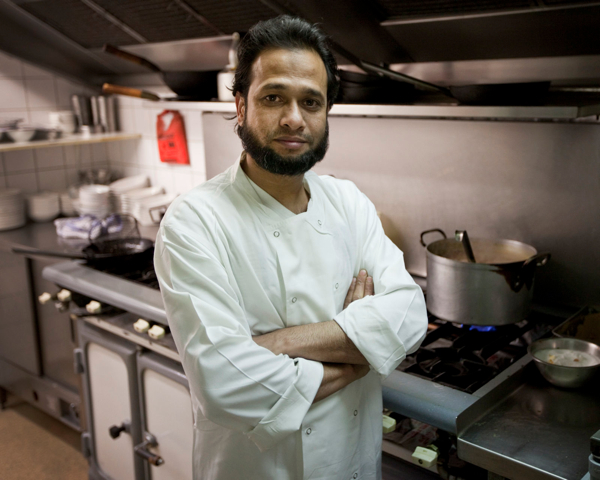
Photographs copyright © Jeremy Freedman
Originally published by Spitalfields Life, Jeremy Freedman’s portraits of The Curry Chefs of Brick Lane are to be shown at Rich Mix, Bethnal Green Rd, from 23rd February until 31st March. Learn more about events accompanying the exhibition including a competition and curry cook-off here
You may like to read about












