
Columbia Road Market 76

Carl Grover & his Uncle Bob
When Carl Grover was seventeen, he already had his own pitch at the market and, one Sunday in the late seventies, a photographer came along to take pictures, returning later with an envelope of black and white prints as a gift. This was long before photographers became commonplace in Columbia Rd, before the swarms of tourist with cameras that flock to the market today. Carl kept the pictures carefully in a cardboard file and although the photographer told him they had been exhibited, Carl never saw the exhibition.
Carl still has a pitch in Columbia Rd Market and last Sunday he showed me the cardboard file of ten by eight prints by the unknown photographer that it is my pleasure to publish here today. If you look closely at these fascinating pictures of Carl, his Uncle Bob, and pals Laurie and Lee at work, you can see they are selling plants without pots. In those days, Columbia Rd was still lined with furniture trades and the atmosphere on Sunday was relaxed enough for stallholders to enjoy a drink from the pub while they were at work, as Carl explained to me.
“I used to grow shrubs, and I went to auctions on Saturday and loaded up with plants, each with a root ball. By ten o’clock at night, I’d be driving up to the market to set up in my lorry, an ex-brewer’s articulated truck that had been used for transporting barrels. I started working at Columbia Rd on Sundays while I was still at school and and when I left it became my first job. We always sold cut flowers as well as plants but, when I sold off the nursery in the eighties, I switched over completely to cut flowers, which I sell today.
Laurie, the old man, he used to live in an ancient caravan close to the nursery where we grew shrubs and came along to Columbia Rd to lend a hand. He was an ex-navy man and sometimes on Sundays he liked to ride his bicycle on the wrong side of the road. He’d tell people, “On weekends, I cycle on the continental side, so I am ready for when we change over!” You can see him and my Uncle Bob with glasses in one of the pictures, they liked to have a drink from the Royal Oak.
At seventeen, I had a pitch between my dad Mick and my Uncle Bob, a little further down from where I am now. In those days, there were no lines to mark the pitches, we had to go by cracks in the pavement. Years later, the market authorities painted lines and we all got jiggled around.
At that time, we were selling delphiniums, lupins and hollyhocks – all the English cottage garden varieties – as bare root plants. We wrapped them in newspaper, there were no carriers or plastic bags in Columbia Rd then. We saved papers ourselves, and people used to collect them for us too and bring them along, the posh people used to bring the Times and the Daily Telegraph. When I think about it now, it was highly sustainable what we did.
The market wasn’t as busy then. It was a local market, not widely known as it is now and it was seasonal. We never saw a tourist, it was all real gardeners.”
It sounds a far cry from Columbia Rd today, lined with fashionable shops and cafes – a major attraction, drawing customers from across London and tourists from across the world. Yet Carl obviously still loves trading in the market and delights in the life it attracts. “Markets bring communities together.” he assured me, “Everyone’s equally welcome in a market, it doesn’t matter if you haven’t got any money.” Anyone that knows Carl will recognise him from these photographs of more than thirty years ago – he is still lean and eager and smiling, one of the most popular traders in the market.

The young man in the centre is Lee Irvine who worked with Carl for many years.

Bob Grover

At seventeen, Carl Grover had his own pitch selling shrubs at Columbia Rd.


Uncle Bob & Laurie enjoy a glass from the Royal Oak while trading.

Laurie lived in a caravan, was partial to rum and liked to cycle on the wrong side of the road at weekends.
You may also like to take a look at
Mick & Sylvia Grover, Herbsellers
George Gladwell’s photographs of Columbia Rd Market in the 1960s
Coffee Morning

For all those who were not able to make it to the book launch at the beginning of the month, I am hosting a Spitalfields Life Coffee Morning at Rough Trade East, Dray Walk in the Truman Brewery, Brick Lane, next Saturday 31st March from 10am until midday.
It will be an opportunity to see the originals of the six drawings by Lucinda Rogers of the streets of Spitalfields commissioned for the book, and you can watch Lucinda making a huge new drawing live during the morning.
King Sour, Rapper of Bethnal Green, who made such a hit at the launch, will perform his poems and other people whose stories are in the book will be dropping by.
Please come along to join us for a cup of coffee and say “hello!”
You may also like to read about

Philip Lindsey Clark’s Sculptures in Widegate St

Next time you pass through Widegate St, walking from Bishopsgate towards Artillery Passage on your way to Spitalfields, lift up your eyes to see the four splendid sculptures of bakers by Philip Lindsey Clark (1889 – 1977) upon the former premises of Nordheim Model Bakery at numbers twelve and thirteen. Pause to take in the subtle proportions of this appealing yet modest building of 1926 by George Val Myers in which the sculpture is integrated so successfully, just as at Broadcasting House which Val Myers designed five years later, placing Eric’s Gill’s figures upon the front.
In fact, Philip Lindsey Clark was a friend of Eric Gill – his work shares the same concern with illuminating the transcendental in existence, and from 1930 onwards his sculpture was exclusively of religious subjects. Born in Brixton, son of Scots architectural sculptor Robert Lindsey Clark, he trained in his father’s studio in Cheltenham and then returned to London to study at the City & Guilds School in Kennington. Enlisted in 1914, he was severely wounded in action and received a Distinguished Service Order for conspicuous gallantry. Then, after completing his training at the Royal Academy Schools, he designed a number of war memorials including those in Southwark and in Kelvingrove Park, Glasgow.
The form of these ceramic reliefs of bakers – with their white glaze and sparing use of blue as a background – recalls religious sculpture, especially stations of the cross, and there is something deeply engaging about such handsome austerely modelled figures with their self-absorbed presence, preoccupied by their work. The dignity of labour and the poetic narrative of transformation in the baking of bread is made tangible by these finely judged sculptures. My own favourite is the figure of the baker with his tray of loaves upon his shoulder in triumph, a satisfaction which anyone who makes anything will recognise, borne of the work, skill and application that is entailed in creation.
These reliefs were fired by Carters of Poole, the company that became Poole Pottery, notable for their luminous white glazes, elegant sculptural forms and spare decoration using clear natural colours. They created many of the tiles for the London Underground and their relief tiles from the 1930s can still be seen on Bethnal Green Station.
Philip Lindsey Clark’s sculptures are those of a man who grew up in the artists’ studio, yet witnessed the carnage of First World War at first hand, carrying on fighting for two days even with a piece of shrapnel buried in his head, and then turned his talents to memorialise those of his generation that were gone. After that, it is no wonder that he saw the sublime in the commonplace activity of bakers. Eventually Lindsey Clark entered a Carmelite order, leaving London and retiring to the West Country where he lived until the age of eighty-eight.
So take a moment next time you pass through Widegate St – named after the wide gate leading to the ‘spital fields that once was there – and contemplate the sculptures by Philip Lindsey Clark, embodying his vision of the holiness of bakers.


George Val Myer’s former Nordheim Model Bakery with sculptures by Philip Lindsey Clark.
You may also like to read about
A Night in the Bakery at St John
Dorothy Annan’s Murals in Farringdon St
Mick Taylor’s Walk

Almost every day, I exchange greetings with Mick Taylor who has been sitting outside the Beigel Bakery – off and on – for nearly fifty years. Over all this time, Mick has become famous for his personal style, emerging as a star player in the street life that he loves so much, celebrated as the Sartorialist of Brick Lane.
With the recent spell of fine weather – that Mick terms “a cockney summer” – we have been discussing taking a stroll together, and this week, over two days, Mick and I enjoyed a ramble round those streets which hold most meaning for him. Coming directly to the top of Brick Lane by bus each day, it was something of an adventure for Mick to walk south down the Lane to the familiar places of long ago. As he confessed to me, “When you have known an area so long, you begin to forget where you are.”
Leaving the environs of the Beigel Bakery which is Mick’s customary habitat, one afternoon, we turned left just before the railway bridge into Grimsby St where the newly constructed East London Line bridge of steel girders has replaced the shabby nineteenth century railway arches that stood here until recently. “You could find old things in the street and bring them down here and sell them, and people would always buy them and that way you were never without anything.” Mick assured me, casting his eyes affectionately over this former source of livelihood and screwing up his eyes in bewilderment as if somehow he could conjure it back into existence my focussing his attention. “They used to call me Mick the Finder.” he said, as we walked on.
Round the corner in Cheshire St, we paused outside the squat brick building that is Blackman’s, where the redoubtable Lee Knight sold shoes for years at rock bottom prices in a business continued now by his son Phil. This is a location of pleasure for Mick. He told me his beloved Gran bought him the pair of Italian pointed black shoes with cuban heels here, that he wanted for his seventh birthday, at a cost of two pounds, two shillings and sixpence. “My mother had twelve sons and two daughters, she didn’t have time to take care of us, she was too busy trying to find a husband,” he revealed, raising his eyebrows humorously, in partial explanation of why he came to be brought up by his grandparents.
Next day, we set out in the morning to venture further, walking down to the Truman Brewery where Mick worked as Drayman in 1963. “At half past seven in the morning it was busy here,” he recalled, rolling his eyes to evoke the chaotic drama as we passed the old iron gates. We turned the corner into Dray Walk where Mick arrived for work each day at quarter to seven. “You saw all the lorries backed up here,” he said gesturing to the invisible line of vehicles that once occupied the space where the shops are now,“We loaded them with barrels, hogsheads, firkins and crates.”
Yet before he started work Mick had to clock in and enjoy the two or three pints of maturing brown ale with his workmates, as was the custom in the brewery. “All the time I worked here I never saw any of the workers drunk,” Mick insisted,“You couldn’t afford to be drunk. You had to take it easy, because it was dangerous manhandling the kegs.” The foremen sent out the lorries making deliveries around London and by eleven o’ clock in the morning the draymen were finished. “We all met in the car park of the Ace Cafe on the North Circular. I’d be sat on the back of the lorry drinking pints from the keg.” Mick admitted to me with a delighted grin, “You lay the keg on its side and eased in the pointed handle of a file, and the beer poured out.”
“You had poor people here then, in those days most people wanted to get out of here,” he whispered to me as we moved on, pushing our way through the fashionable crowd,“Funny old world we live in isn’t it?” Glancing around conspiratorially as we passed the Spitalfields Market, “The villains used to come down here, and it wasn’t to buy fruit & vegetables,” he confided,“They used to do their business over a cup of tea and a sandwich, sit in a cafe and have a bit of a firm. They wore traditional gear, coat and scarf and a cheese cutter, and no-one paid any attention.”
Passing Burger King in Whitechapel High St, site of the legendary Blooms Restaurant, we arrived at the climax of our journey, Albert’s men’s clothing shop, still with its fascia of marble and red neon gothic lettering. A cut-price joint today, yet still charismatic for Mick as the place where he first cultivated his sartorial elegance. “I used to come down here when I had a bit of money, on Thursdays at three or four after I got paid. It was like going to the West End, I felt like I was famous.” he eulogised, “They sold cashmere suits and silk shirts. In those days, you had a lot of villains and benders came here, smart people. They all showed respect for each other.”
Walking back up the Lane towards the Beigel Bakery, Mick ruminated over the journey, thinking out loud, “It’s good that the young people are coming in and bringing money,” he suggested to me, “but I don’t think they care very much about the people who are here, they’re a bit selfish in that way.” And then he qualified the thought quickly, lest I think him ungenerous “People always treat me with respect and say nice things, they’re polite to me.” he confirmed with a weary smile. Both our energies were flagging now after this emotional odyssey through space and time, and we made for the nearest cafe to seek a perspective. “I haven’t had a walk like that in a long while, I think it’s done me good.” Mick concluded thoughtfully as we sat down together.

In his usual spot outside Brick Lane Beigel Bakery.

In Grimsby St – “You could find old things in the street and bring them down here and sell them, and people would always buy them and that way you were never without anything.”

At Blackman’s, Cheshire St – where Mick’s Gran bought him the pair of Italian pointed black shoes with Cuban heels that he wanted for his seventh birthday, at a cost of two pounds, two shillings and sixpence.

At Dray Walk, Truman Brewery – the doorway where Mick clocked in each morning and enjoyed two or three pints of maturing brown ale with his workmates at eight in the morning before commencing work.

At Albert’s, 88 Whitechapel High St – “I used to come down here when I had a bit of money, on Thursdays at three or four after I got paid. It was like going to the West End, I felt like I was famous.”

Mick Taylor – “You had poor people here then, in those days most people wanted to get out of here.”
You may also like to read about
Colin Ross, Docker

Colin Ross has always been drawn to the river, though now it is the River Crouch at Hullbridge in Essex where he lives in retirement, rather than the Thames where once he and three generations of men in his family before him worked as dockers at the Royal London Dock. With his sharp bird-like features, deeply lined face, strong jaw and shock of white hair, Colin is an imposing figure with natural dignity and an open sociable manner. Above all, you sense a generosity of spirit. It is an heroic attribute in one who fought the long battles that Colin did – battles which proved to be unwinnable – to keep the docks alive and keep his fellow dockers in employment there.
Yet zeal was a quality that was never lacking in the Ross family, as demonstrated by his father Tom who was one of those who set up The Distress Fund. “There was no sickness benefit or compensation for injuries in the docks, and we had so many dockers who were dying and getting pauper’s funerals,” Colin explained, “Ten thousand people joined the fund at a shilling a week and if a docker died his widow got seventy-five pounds. The work they put in to collect that one shilling a week, but that was the kind of people East Enders were, we looked after each other.”
Similarly, Colin came up against a management that had no concern for the dockers’ welfare when manhandling sacks of asbestos. “They said it was perfectly safe,” he recalled with a frown, “and they told me I was troublemaker for objecting. But in 1967, we were the first workplace to ban it, when the union refused to touch it. I feared for the African dockers who loaded it in hessian sacks.”
Living modestly with his wife in an immaculately-kept mobile home surrounded by a small garden close to the River Crouch in Essex, Colin has found a peaceful haven and no longer comes up to London very often, but he was eager to speak to me of the conflicts surrounding the closure of the docks in which he fought with such courage and presence of mind.
“The Royal London Group of Docks was the largest enclosed docks in the world and I was the fourth generation of my family to work there – before me there was Tom, Jack and Archie, who came down from Scotland. My grandfather Jack was involved in the first great dock strike of 1889 that led to the foundation on the TGWU. The East End was absolute poverty then and the strike went on and on. Money was sent from all over the world to support the dockers. Randolph Hearst sent money, and in the end it was the intervention of the Catholic church and Cardinal Manning personally that got the ship owners to the negotiating table. My nan’s brother – his family were so destitute that his wife sold her body to make money and, when he found out after the strike, he killed her.
I joined the docks in 1965 at the age of twenty. At sixteen, I went to sea but if your dad was a docker it was expected you would work in the docks, and my dad’s reputation went before me. When you went to work, you earned good money – but most of the time you didn’t get to go to work. Jack Dash – the legendary union man – took me on one side to recruit me as union leader and said, “Son, there’s three people you want to avoid in life, ship owners, insurance agents and bankers.” I don’t think he was far off there.
People don’t realise the battles we had in our struggle to keep the docks open. We saw that containerisation was coming and we realised it was going to mash the East End to bits. There were 27,000 regulated dock workers and for every one of them another two workers dependent on the docks. 100,000 people relied on the docks for a living. We negotiated with the Port of London Authority and they said, “It’s no good standing in the way of progress.” But what’s the good of progress if it doesn’t benefit everyone? Our argument was – You have the docks in place and the rail links and the workforce, why can’t containerisation be done in the docks? Gradually, they weakened our cause with increased offers of severance pay and then, before we knew it, the asset strippers moved into the Royal London Docks – only they called them Venture Capitalists, they bought up the docks, closed them down and sold them as flats at half a million pounds each.
When I went into the docks, Charles Dickens would have recognised it. It was that antiquated because the ship owners never spent a penny on it. I thought, “Something’s wrong here,” because the shipping companies belong to the richest people in the country, and the wages were so low they could afford to keep 2,000 paid dockers in reserve to cover for the holiday period. It was the industry with the highest level of accidents in the country and you got no sick pay. The mortality rate was high and dockers did not expect to live beyond fifty-eight to sixty on average – this was in the nineteen sixties.
We never realised they were going to close down the docks until we met some American longshore men and they had experienced the same thing. But in America the union was so strong because it was run by the mafia, they got a deal we would die for. I went to Jack Jones at the TGWU and said “Can’t you see what’s happening?” We formed our own unofficial committee, the National Port Shop Stewards’ Committee. The problem was the same in Liverpool, Hull and Southampton and we decided to hold dock gate meetings. We picketed dock gates in London, saying to lorry drivers they would be blacklisted in every dock in the country if they crossed our picket line, and it was a roaring success. Ted Heath was Prime Minister at the time and they threatened to put us in prison, but they realised if they arrested us there would be carnage.
All the time we had viable propositions to keep the docks open, using the river and opening up rail links but the Port of London Authority didn’t want them. All of a sudden, five of our members were arrested and put in Pentonville Prison, so we created a picket line at the prison gate. And in my four or five days there I saw more of life than I’d seen in my life. The TUC called a General Strike in our support. All the unions, the carworkers, the steelworkers, they were with us. Our five members were released but they had smashed us. The dispute shifted from being our dispute to being a dispute about the Industrial Relations Act. The union backed me but my Dad said, “They backed you to take control, and they used it to get more severance money and send us back to work.” I knew then that the chips were down.”
In 1978, Colin Ross left the docks. He went to work at a container plant in Purfleet and his wages increased from £30 to £350 a week, but he found there was no camaraderie as he had known at the docks in the East End. Within two years, Colin left to run a fruit and vegetable at Globe Town Market Sq in the Roman Rd for the rest of his working life. “It was the saddest day of my life,” was how he described leaving dock work, after his personal history of struggle and the struggle of three generations behind him.
“We had it within our grasp to keep the docks open, they could have been working today.” he said to me, raising his hands and reaching out with visible emotion, “I’m not angry, what has happened has happened. I am not bitter but I am annoyed at how it happened. Canary Wharf may be beautiful, yet I can’t ever bring myself to go back to the docks anymore.”
The London Docks were closed by shipowners who wanted to move to new container ports as a means to break the unions and introduce casual labour, and make short-term profits by selling off their warehouse spaces. Yet the final irony lies with Colin, because anyone who has travelled upon the Thames – the silent highway, as they once called it – recognises the absurdity of the empty river when it is the obvious conduit for transport of goods as the roads grow ever more overcrowded. River transport linked to rail would be a much greener and more efficient option in the long term than the container ports and haulage trucks we are now forced to rely upon. With remarkable foresight, Colin saw all this forty years ago and he fought his best fight to stop it happening. So although he may be disappointed his spirit is intact – and his story is an important one to remember today.

Colin made the front page of the Daily Mail in 1970.

Colin’s pass book issued by the National Dock Labour Board.

Colin’s union membership cards.


Note number six, the rate for unloading bags of Asbestos.

Colin as a Shop Steward in 1976.

Colin Ross in his garden in Hullbridge.
Colin’s memoir Death of the Docks can be purchased here
You may also like to read about Colin’s daughter
Mr Pussy in Spring

In spite of the visible signs, I am almost superstitious to write of spring, lest by doing so I invite an onslaught of snowstorms, tempests and whirlwinds. Yet I do believe that the change of season is irrevocably upon us, as confirmed by a particularly unpleasant experience I had recently.
At dawn, it is commonly Mr Pussy’s habit to stand at the bedside by my pillow and claw at the sheet to wake me. A recurring trait which causes me constant frustration now that first light comes earlier each day, especially if I have worked late the night before and wish to sleep longer. As an attempt to pacify him without opening my eyes, I reach out a hand with a crooked finger to stroke him on the head, in the vain hope that he will be satisfied and leave me in peace.
At a recent daybreak, Mr Pussy woke me in the usual manner, clawing and crying in delighted excitement, and I stretched out my finger blindly. To my surprise, he did not lift up his head to meet my finger. Instead, my touch fell upon another furry surface, soft and silky, yet curiously inanimate. In my surprise, I rolled over and opened my eyes to see what it was. It was a huge dead rat. And Mr Pussy stood over it with a look of foolish pride like those game hunters in old photographs. He had brought his fresh catch as a gift to share with me.
The forlorn carcass of the brown rat lay in a foetal pose, looking strangely innocent with its fluffy pale belly – like an abandoned soft toy – and immaculately clean despite its reputation for for filth. But with its long teeth splayed at a gross angle, it was a sight that I did not choose to contemplate upon my bedroom floor at dawn, especially placed by Mr Pussy upon a pile of yesterday’s clothes and giving the credible impression of sleeping there. Much to Mr Pussy’s dismay, a dustpan and brush served to dispatch the rat into the bin and I threw the contaminated laundry into the basket. Then, to his surprise, I shut the bedroom door in his face and went back to sleep, ignoring his melodramatic plaintive cries of exclusion.
For the first time this year, the nights are sufficiently mild for a creature as conservative and protective of his own comfort as Mr Pussy to go out and prowl around in the dark. This is my incontrovertible evidence of spring and the rat was a harbinger of it. For the first time this year, I open the sash window wide and Mr Pussy sits upon the sill taking the airs. For the first time this year, I dig in my garden and Mr Pussy keeps me company. For the first time this year, I return to find him sunning himself on the wall. And, each morning since his banishment, I open my bedroom door to discover Mr Pussy sitting placidly outside, perched upon the couch. Ever gracious, he waits there as a sentinel, my guardian at the gate.
It is spring and now, after peaceful uninterrupted sleep I wake to enjoy the sunshine while, as the nights grow milder, Mr Pussy goes roving to satisfy his duties in vermin control.

You may also like to read
Labour and Wait Field Trip 1 – R. Russell, Brush Makers
Today it is my pleasure to begin a new series in collaboration with Labour and Wait, visiting the manufacturers who make the traditional hardware sold in their shop in Redchurch St. For more than ten years, Labour and Wait have championed small British makers and for this first field trip, it was my delight to visit R.Russell, brush makers.
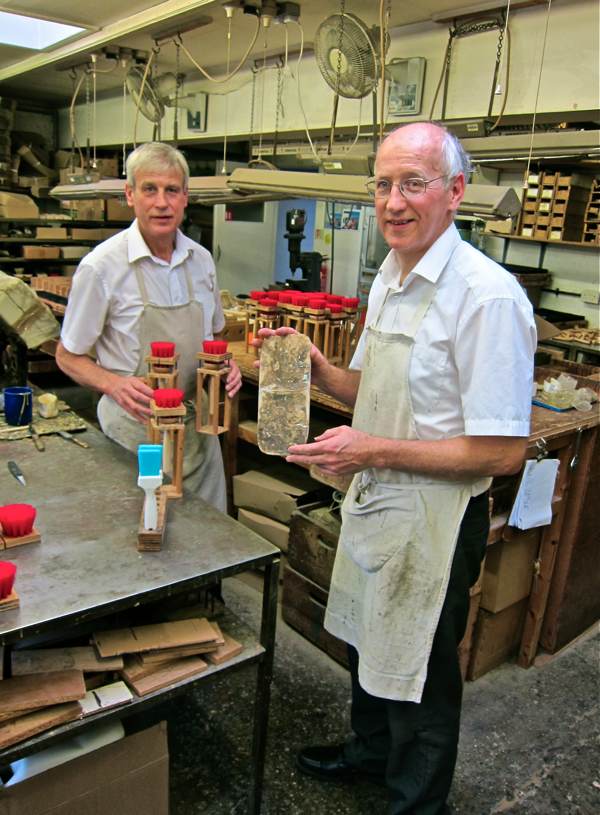
Robert & Alan Russell, sixth generation brush makers
Take the Metropolitan Line from Liverpool St St Station all the the way to Buckinghamshire and after a ten minute walk through the small market town of Chesham you will arrive at the tiny factory of R.Russell – Brush Makers since 1840 – secreted in a hidden yard. Here you will find brothers Robert & Alan Russell, sixth generation brush makers, working alongside their eight employees making beautiful brushes by hand, the last of their kind in a town once devoted to the trade. Surrounded by beech woods, Chesham had a woodenware industry since the sixteenth century and brush manufacture began two hundred years ago as a means to utilise the offcuts from the making of wooden shovels for use in brewing.
The workshop at R.Russell is on the first floor looking down onto a garden with a tall pollarded tree and an old camellia in flower. Two large battered worktables fill the centre of the room where batches of brushes are lined up in different stages of manufacture. There are stacks of brushes with garish plastic bristles and racks of sweeping brushes with natural brown bristles. Over by the window is Alan’s work bench, overlooking the garden. And it was here that I joined him as he placed the bristles into the former to make a broom, speaking as he worked with breathtaking dexterity, occasionally pausing for thought and gazing out onto the garden below, yet without ceasing from his task.
“My father was Robert, his father was Stanley, before him was Robert, his father was George and then there was Charles. The origins are lost in the mists of time, but we know that in 1840 Charles Russell had a pub by the name of The Plough in Chesham, and he used to make a few brushes at the back of the pub and sold them to the customers. His son George was the first member of the family down in the records as a brush maker.
I’ve been making brushes since I was sixteen and I’ve been here forty years, After you’ve been doing it as long as I’ve been doing it, it’s quite relaxing. I’d much rather be making brushes than sat behind a desk doing office work, your mind goes off wherever you please.
My grandparents lived in the house at the front and the factory was a shed in their back garden. I came down here with my father at the age of six and he showed me how to make brushes. I used to make brushes with the waste off the floor, because the bristles were too valuable to spoil, but if you can make a proper brush with the waste then you really know how to make a brush! By the time I left school, I had a good training in brush making because I worked here every holiday and after school. My father never pushed me or my brother into it, but it was a natural progression because we got on well with Dad. I was made a partner at eighteen and my brother who’s older than me was already a partner.
When I started, we produced mainly paper-hanging brushes and dusting brushes for painters. We sold them to the kings of the market – the paintbrush makers – and they sold them to decorators. But they are all finished now the paintbrushes are made in China, so we lost our trade. We have gone back to how we were before, we make specialist brushes to order. It’s a niche market because there’s so few of us left. We are a handmade specialist brush maker. We are flexible and we have a lot of experience and we can turn our hands to anything. We made a brush for the National Trust recently, based on an original in a sixteenth century painting. It’s much more interesting although we are not making the money we used to make. We peaked just before the turn of the century, when the Chinese started selling their paint brushes here, and we’ve managed our decline since then. But I feel more confident now than for a long time. People are looking for something different and business is looking up. Meanwhile prices are rising in China and the quality is not always there, and people are prepared to pay for a better brush and they’re the people we’re supplying.
I don’t want to do anything else, as long as I can make enough to live on by doing this. I can’t imagine working for someone else, even though we work long hours here. My wife will tell you, I’d rather be here than spend a day at home decorating. I’m a brush maker. On my father’s grave we put “brush maker” not “brush manufacturer” because that’s what he was, a skilled man.”
Next door, in the office where the brothers prefer to spend the minimum amount of time, Robert, the elder brother, showed me the photographs of his forebears who worked here in the same trade before him. He confided that he and his brother never take a holiday at the same time and while one is away they speak on the phone every day.
Both brothers wore identical white short sleeve shirts with black trousers and white aprons, which were – I realised – the uniform of the brush maker, not so different from their predecessors photographed in the 1930s. After six generations, this pair have become as absorbed as anyone could be in this most unusual of occupations, a life devoted to brushes. And I could not resist asking Alan which brush he would be, if he were a brush, because I knew he would have a ready answer.
At once he came back with this reply -“If I was a brush, I’d be a Badger Softener because it’s something that’s looked after. It does something very special. It’s for marbling, to create the soft texture beneath the veins. It just softens the edges. It doesn’t do much ,but you can’t do anything without it. It’s the sort of brush you’d buy once in a lifetime.”

Alan Russell tucks the bristles into the former – “I’d much rather be making brushes than sat behind a desk doing office work, your mind goes off wherever you please.”

Chess Vale Bowling Club, Chesham c.1910 – Old Bob Russell sits second from right in middle row with the watch chain while his son Stanley reclines in front.

Alan Russell uses his “flapper” to level off the bristles.

Robert & Alan’s grandfather Stanley Russell in the 1920s.

Ann Brett brushes out loose bristles. –“It’s nice to see something with the “Made in England” label on it.”

Robert & Alan’s great-grandfather Old Bob Russell in the 1930s.

Alan Russell checks the bristles are in alignment.

Bob & Stan Russell & a fellow brush maker in the 1930s.

Robert & Alan Russell – “people are prepared to pay for a better brush and they’re the people we’re supplying…”

The factory in the 1960s.

My souvenir, a beautiful handmade brush from R.Russell.
You may also like to read about


