
Next Meeting of the East End Trades Guild

Logo for EETG designed by James Brown.

The Broom & Whisk Makers Union design that inspired the EETG logo.
Around thirty independent shopkeepers and small traders met at the Bishopsgate Institute at the end of April to consider the potential for the East End Trades Guild as an advocate for their collective interests. When the issues facing their businesses were prioritised, it became apparent that rents, rates and planning were the subjects of greatest concern to those at the meeting.
Next Monday 11th June at 6:30pm, the traders will meeting again at Bishopsgate Institute to discuss these three issues further and explore what specific action can be taken to address them. All independent shopkeepers and small businesses in East London are invited to attend and participate in these discussions as the East End Trades Guild moves towards its formal launch on September 19th at Christ Church, Spitalfields.
Meanwhile, James Brown has produced a dignified and authoritative logo for the Guild which you can see above and, entirely fortuitously, a photograph of the Shoreditch Trades Council of one hundred years ago has surfaced. Until this picture appeared, no-one knew that there was a precedent for the East End Trades Guild, and its recent discovery presages well for this new endeavour.


A recently discovered picture of the Shoreditch Trades Guild of a century ago.
Archive photograph courtesy Bishopsgate Institute
For more information on the background to this new initiative you may like to read
Aaron Biber, London’s Oldest Barber

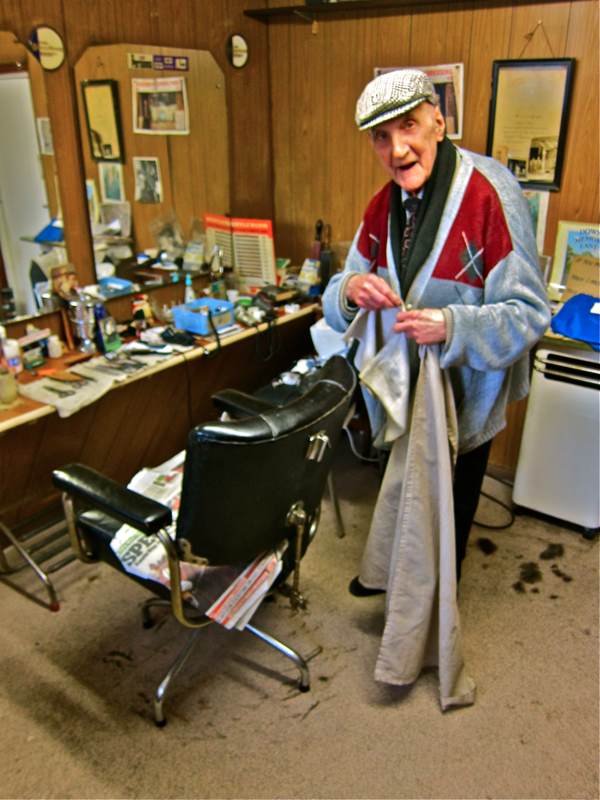
Aaron Biber has been cutting hair for seventy-eight years and he still uses the same blue steel scissors that his father gave him when he began at twelve years old, which he sharpens himself. At ninety years old, Aaron works six days a week at his tiny salon in Tottenham, waking each morning at four, driving the five minute journey from his home in Chingford and opening up the salon from six until midday.
After all this time, Aaron cannot retire because he knows nothing else. “Three doctors have told me, I would be dead within two months if I stopped,” he admitted with a helpless smile,“I can’t stop at home because my wife passed away after seventy years of marriage.”
For more than forty years, Aaron’s business was a going concern in Tottenham until one morning last summer, shortly after his wife died, when he arrived for work to discover a crowd of two hundred, including eighty interviewers outside his barber’s shop. The rioters had destroyed Aaron’s salon and he found himself at the centre of an international media storm. “I was on TV all over the world, Canada, Vietnam, Australia, Germany, Japan …” he recalled in bemusement, “And the Archbishop of Canterbury, Boris Johnson and Prince Charles, they all came to see me.”
But today, although his salon has been restored thanks to donations from an internet campaign, Aaron’s customers – many of whom had been coming for decades from all over London – have disappeared. On Monday this week, Aaron had one customer and on Tuesday also only one customer. No wonder he was delighted when I walked through the door at the end of the morning yesterday, on a day that had been a total blank, to interrupt his melancholic discourse with his pal Richard. “I’ve been cutting his hair since he was a baby,” declared Aaron to me, by way of introduction, with an affectionately dismissive flick of the wrist in the direction of his friend. A gesture reciprocated by Richard with a nod of confirmation and a loyal smile.
“They took everything, even my kettle and my chairs!” explained Aaron casting his eyes around at his memories of the destruction, “Luckily, I always carry my scissors with me, so they were safe at home.” Lesser men would be defeated what happened, but Aaron’s experience of life has granted him a sense of proportion which permits a degree of equanimity.
Aaron’s mother and father both came as refugees to the East End from Poland in the eighteen nineties. “My mother grew up on the farm, and the Russians used to ride through the village on horseback and knock people to the ground as they passed,” Aaron informed me, “My father killed a copper who assaulted him and he ran to England to escape.”
“When I was around ten years old, my mother moved out from Myrdle St where we lived because my dad wouldn’t give her a penny. She took all the children – nine sons and four daughters – to Coke St off Commercial Rd near the Bell Foundry. We went to the Jewish Board of Guardians to get an iron token for the soup kitchen, and we got bread and pilchards and kosher margarine. We used to go round the streets searching for money and once we found half a crown, we bought two salt beef sandwiches and had one shilling and eightpence left.
We had to work because we were starving. When I was ten, I went across the road to work for Mr Cohen making beigels for sixpence and then I weighed out sugar for his wife in the shop next door for tuppence, so I had eightpence. I used to wash down the horses, Ginger & Tubby, for Barney Dan, he had a cart and went round delivering stuff. He took me down to Covent Garden. I can tell you all about Covent Garden because I met my wife there, her father Alex Simmons, he designed all the sets for the theatres. I took a room in Tavistock St on the first floor, full of lads cutting hair. Later, I had a place in Hanbury St opposite the market in Spitalfields and I cut all the porters’ hair.
I cut hair for the police for fifty years, they wanted to make me a policeman at seventeen but my father said, ‘No, you don’t!’ I cut the hair for the flying squad for twenty-five years. Everyone wanted me because I cut hair properly. We used to have the police lined up outside the shop, there was a shortage of barbers.
We had all nationalities down in Cable St, Italians, Spanish, Maltese, Ghanese. I picked up all the languages. I can still speak Ghanese. We had the High Commissioner of Ghana come for a hair cut. Everyone got on and we all used to help each other out. I remember the Battle of Cable St, I was by the Royal Mint and the dockers came out of the dock to stop Mosley. I went to one of his rallies in Victoria Park to have a look but my mother warned me, she said, ‘They’ll kill you.’
During the war I was guarding Tower Bridge when Winston Churchill came along and said to me, ‘Shoot any parachutists you see coming down.’ I said, ‘What if they are ours?’ They showed me where they expected me to sleep and I said, ‘Forget it, I’m going home to my mother.’
I could have gone on the Queen Mary to America, cutting hair. There was this bloke in the docks, he said, ‘I’ll fix you up get you a job there, all you have got to do is give me a hundred pounds later.’ Most of the barbers from the East End went to America. My brother Ben opened a salon in Times Sq, but I couldn’t go because I was my mother’s blue-eyed boy, her favourite. She said, ‘No, not with them German submarines you’re not going.’ I never had any children. My mother told me, ‘It’s too much trouble.'”
If you want to have an unforgettable haircut by London’s oldest barber, and hear more stories, and experience Aaron’s barber shop wisdom, and get your locks trimmed with the seventy-eight year old blue steel scissors given to Aaron when he was twelve, head up to Tottenham. No appointment is necessary. Aaron Biber is sitting in the tiny salon waiting for you to walk through the door.
I appeal to my readers to show the spirit that has always characterised the East End, we’ve all got to pull together to keep Aaron cutting.

“Everyone wanted me because I cut hair properly.”

Aaron cuts hair in Cable St in 194o.

“The Archbishop of Canterbury, Boris Johnson and Prince Charles, they all came to see me.”

Aaron outside his salon in St Anne’s Rd in the nineteen fifties.
“I cut the hair for the flying squad for twenty-five years.”

The blue steel scissors given to Aaron by his father seventy-eight years ago when Aaron was twelve years old, wrapped in a nineteen forties linen towel.

“I can still speak Ghanese.”

Aaron’s pal Richard – “I’ve been cutting his hair since he was a baby.”

Aaron’s brother Ben (left) outside his salon in Times Sq, New York.

Aaron’s salon in Tottenham.

“Three doctors have told me, I would be dead within two months if I stopped.”
Visit Aaron Biber’s Gentlemen’s Hairdressing, 22 Scotland Green, Tottenham, N17 9TT
Watch a film by Mareka Carter of Aaron Biber talking by clicking here
You may also like to read about
Geoffrey Fletcher’s Pavement Pounders
The work of Geoffrey Fletcher (1923–2004) is an inspiration to me, and today I am publishing his drawings of London’s street people in the nineteen sixties from Geoffrey Fletcher’s Pavement Pounders of 1967. For an introduction to Geoffrey Fletcher’s writing, I recommend The London Nobody Knows which has been reprinted with a new introduction by Dan Cruickshank.

Charlie Sylvester -“I’m Charlie Sylvester, Charlie of Whitechapel. I’ve been on the markets over forty years. I can’t keep still too long, as I have to serve the customers. Then I must take me pram and go fer some more stock. Stock’s been getting low. I go all over with me pram, getting stock, I sell anythin’ – like them gardening tools, them baking tins and plastic mugs. All kinds of junk. Them gramophone records is classic, Ma, real classic stuff. Course they ain’t long playing? Wot do you expect? Pick where you like out of them baking tins. Well, I’ll be seeing you next you’re in Whitechapel. Don’t forget. Sylvester’s the name.”

Peanuts, Tower Hill – “We’ve only been doin’ this for a few months, me peanut pram and I. I only comes twice a week, Saturdays and Sundays. Sundays is best. It’s a hot day. Hope it will stay. I’m counting on it. How many bags do I sell in a day? I’ve never counted ’em. All I want is for to sell ’em out.”

Doing the Spoons, Leicester Sq -“I’ve been in London since 1932, doin’ the spoons, mostly. I does it when I’m not with the group – if they’re away or don’t show up. I’m about the only spoon man left. No, the police don’t bother us much – they know we’re old timers. We’re playing the Square tonight, later when the crowds will come.”

The Man with the X-Ray Eyes – “It’s the facial characteristics. I can usually guess within a year. It’s the emanations – that’s why they call me the man with the X-ray eyes. I’ve been doing it thirty-two years. Thirty -two years is a long time. I’m off-form today. Sometimes I am off-form and then I won’t take their money. I’m in show business. You see me on TV before the cameras. My show took London, Paris and New York by storm.”

Selections from ‘The Merry Widow,’ Oxford St – “You need a good breath for one o’ these. It’s called a euphonium. Write it down, same as when a man makes a euphemism at dinner. If I smoked or got dissipated, I couldn’t play. I can’t play the cornet, as it is, but that’s because I only have one tooth, as I’ll show you – central eating, as you say, Guv. I come from Oldham. When I was a boy of ten, I worked in Yates’ Wine Lodge, but I broke the glasses. I’m seventy-three now, too old for a job. But I don’t want a job, I have this – the euphonium. Life is an adventure, but things is bad today. People will do you down and not be ashamed of it. They’ll glory in it. Well, that’s it. My mother-in-law is staying with us so we have plenty to eat. She gives me the cold shoulder. I’m going for a cuppa tea. Have a nice summer and lots of luck.”

Lucky White Heather – “I’ve been selling on the London streets all my life, dearie. Selling various things – gypsy things – clothes pegs – it used to be clothes pegs. The men used to make them, but they won’t now – they’re onto other things. There wasn’t much profit in them, either. You sold them at three ha’pence a dozen. That was in the old days, dearie. Now I could be earning a pound while you’re drawing me. We comes every day from Kent. People like the lucky heather. But I’ll give you the white elephant – they’re very lucky. If they weren’t, we wouldn’t be selling them on the streets of London now, would we, dearie?”

Pavement Artist at Work, Trafalgar Sq – “I’ve been away two years, I haven’t been well, but I’m back again now. I’ve worked in other parts, but nearly always in London. Used to be outside the National Gallery, where I did Constable. I used to do copies of Constable. I do horses, dogs and other animals. The children like animals best, and give me money. I’m only playing about today, you might say. I haven’t prepared the stone. It gives it a smooth surface, makes the chalks sparkle. Makes them bright and clear, y’know. These pastels are too hard. I like soft ones, but everything’s gone up and I can’t afford them. Oh yes, I always clean off the stones. I won the prize for the best pavement artist in London.”

L.S.D. the Only Criterion, Tavistock Sq – “I’ve been here thirty years. I became a combined tipster and pavement artist because I had the talent, and because I believe in independence. Some people buy my drawings. I don’t go to the races now. I used to – Epsom, Ascot and all that. I have my regulars who come to see me and leave me money in my cap. That’s what it’s for. The rank and file are no good. It’s quiet Saturdays except when there’s a football match – Scoltand, say – and they stay round here. Weather’s been terrible – no-one about. Trafalgar Sq is where the money is, but they fights. I’ve sen the po-leece intervene when they’ve been fighting among themselves, and they say, ‘ere, move on, you?’ It’s money what’s at the bottom of it. Money an’ greed. Like I’ve got written here.”

The Best Friend You Have is Jesus – “Forty years I’ve been selling plants in London, and for over thirty years the Lord’s work has been done. In 1935, I was backing a dog – funnily enough it was called ‘Real Work’ – at New Cross. All at once, a small voice, the voice of the Lord, spoke to me and said ‘Abel (My name is Abel), I’ve got some real work for you to do.’ I gave up drink and dogs and got the posters on the barrow – the messages. I’ve been thousands of miles all over London doing the work of the Lord. London is wicked, and it’s getting worse. But God is merciful, and always gives a warning. It’s like Sodom and Gomorrah. The Lord says ‘Repent’ before His wrath comes. He could destroy London with an earthquake. Remember Noah? – how God wanted them to go in the Ark? But they wouldn’t. They said, ‘We’re going to have a good time…’ The Lord could destroy London with His elements. It dosen’t worry me as I’m doing the Lord’s work. Let these iris stand in water when you get ’em home.”

One Minute Photos, Westminster Bridge – “‘Happy Len,’ they call me, but my real name’s Anthony. Fifty years on the bridge. 1920 I came, and my camera was made in 1903. It’s the only one left. I have to keep patching it up. The man who made it was called ‘Moore,’ and he came from Dr Barnardo’s. They sent him to Canada, and he and a Canadian got together, a bit sharp like, and they brought out this camera. Died a millionaire. I’m seventy-three, and I’ve seen some rum ‘uns on the bridge. There was a woman who came up and took all her clothes off, and the bobby arrested her for indecent behaviour. Disgraceful. The nude, I mean. She was spoiling my pitch.”

Music in the Strand – “I had to make some money to live, and so I came to play in the streets. I’ve never played professionally, I play the piano as well but I never had much training. I’m usually here in the Strand but sometimes I play in Knightsbridge, sometimes in Victoria St. There’s not so many lady musicians about now. I only play classical pieces.”

Horrible Spiders – “Christmas time is the best for us, Guv, if the weather ain’t wet or cold. Then the crowds are good humoured. I like my picture and I’m going to pick out an extra horrible spider for you in return. I’ll tell you a secret – some of the spiders ain’t made of real fur. They’re nylon. But yours is real fur, and it’s very squeaky.”

Salty Bob – “Come round behind the stall and have a bottle of ale. It’s a sort of club, a private club. It’s a grand life sitting here drinking, watching the world go by. I’ve been selling salt and vinegar for fifty years and I’m seventy now. I’ve seen some changes. Take Camden Passage, it’s all antiques, like Chelsea, none of the originals left hardly. Let me pour you another drink. Here we are snug and happy in the sun. I’ve just picked up nine pounds on a horse, and I’ve got another good one for the four-thirty. Next time you’re passing, join me for another drop of ale. No, you can’t pay for it. You’ll be my guest, same as now, at our private club behind the bottles of non-brewed, an’ the bleach.”

Don’t Squeeze Me Till I’m Yours – “That’s a German accordion – they’re the best. Bought it cheap up in the Charing Cross Rd. I do the mouth organ too, this is an English one – fourteen shillings from Harrods. I began with a tin whistle and worked me way up. I’ve a room in Mornington Crescent. My wife died, luvly woman, thrombosis. I could see here everywhere, lying in bed and what not, so I cleared out. I got to livin’ in hostels. But I couldn’t stand the class of men. I work here Mondays, Fridays sometimes. I also work Knightsbridge and ‘ere. I work Aldgate Sundays. I do well there. I gets a fair livin.’ So long as I’ve got me rent, two pounds ten, and baccy money, I don’t want nothing else.”

A Barrel Organ Carolling Across a Golden Street – They received their maximum appreciation in the East End, in the days when the area was a world apart from the rest of London, and the appearance of a barrel organ in Casey Court, among patrons almost as hard pressed as the organist, meant an interval for music and dancing, while the poor little monkey, often a prey to influenza, performed his sad little capers on the organ lid.

Sandwich Man – Consult Madame Sandra – “It’s a poor life, you only get twelve shillings and sixpence a day and you can’t do much on that now, can you, sir? It was drink that got me, the drink. When I come off the farms, I became a porter at Clapham Junction, sir. I worked on the railways, but I couldn’t hold my job. So I dropped down, and this is what I do now. All you can say is you’re in the open air. Sometimes I sleep in a hostel, sometimes I stay out. Just now I’m sleeping out. It was the drink that done it, sir.”

Matchseller – “I was a labourer – a builder’s labourer – an’ I come frae Glasgow. I’ve not been down here in London verra long – eight years. Do i like it here? Weel, the peepull, the peepull are sociable, but they not gie you much, so you only exist. Just exist. I don’t sleep in no hostel, I sleep rough. I haven’t slept in a bed in four weeks. I sleep anywhere. I like a bench in the park or on the embankment. I like the freedom. Anywhere I hang my hat, it’s home sweet home to me.”

A Romany – Apart from the Romany women who sell heather and lucky charms in such places as Villiers St and Oxford St, the gypsies are rapidly disaapearing from Central London. Only occasionally do you see them at their traditional trade of selling. lace paper flowers of cowslips. Modern living vans are invariably smart turn-outs that have little in common with the carved and painted caravans of fifty years ago. They are with-it-gypises-O! Small colonies can still be found on East End bombsites, which the Romanies favour for winter quarters.

‘A Tiny Seed of Love,’ Piccadilly – “Oh yes, Guvnor, they’re good to me if the weather’s fine. Depends on the weather. I can’t play well enough, as you might say. I used to travel all over, four or five of us, saxo, drums, like that. Sometimes there was as many as eight of us. Then it got dodgy. I’m an old hand now. I’ve settled down. I got two rooms at thirty-two bob a week, Islington way. Where could you get two rooms for sixteen shillings each in London? I can easily get along at the price I pay. What’s more, I’ve married the woman who owns the house, too. She’s eight years older than I am, but we get along amicable.”
You may also like to read
Down Among the Meths Men with Geoffrey Fletcher
and take a look at
John Claridge’s Spent Moments

Self-Portrait with Keith (standing behind with cigarette), E7 (1961).
“We still meet up for a drink and put the world to rights.”
Here is the young photographer John Claridge at seventeen years of age in 1961, resplendent in a blue suede jacket from Carnaby St worn with a polo neck sweater and pair of Levis, and bearing more than a passing resemblance to the character played by David Hemmings in ‘Blow-Up’ five years later.
On the evidence of this set of photographs alone – published here for the first time – it is apparent that John loves people, because each picture is the outcome of spending time with someone and records the tender moment of connection that resulted. Every portrait repays attention, since on closer examination each one deepens into a complex range of emotions. In particularly intimate examples – such as Mr Scanlan 1966 and the cheeky lady of 1982 – the human soul before John’s lens appears to shimmer like a candle flame in a haze of emotionalism. The affection that he shows for these people, as one who grew up among them in the East End, colours John’s pictures with genuine sentiment.
Even in those instances – such as the knife grinder in 1963 and the lady on the box in Spitalfields 1966 – in which the picture records a momentary encounter and the subjects retain a distance from the lens, presenting themselves with a self-effacing dignity, there is an additional tinge of emotionalism. In other pictures – such as the dance poster of 1964 and the windows in E1 of 1966 – John set out to focus on the urban landscape and the human subjects created the photographic moment that he cherished by walking into the frame unexpectedly. From another perspective, seeing the picture of the mannequin in the window, we share John’s emotional double-take on discovering that the female nude which drew his eager gaze is, in fact, a shop dummy.
For John, these photographs are not images of loss but moments of delight, savouring times well spent. If it were not for photography, John might only have flickering memories of the East End in his youth, yet these pictures capture the people that drew his eye and those that he loved half a century ago, fixing their images eternally.

Across the Street, E1 (1982) – “I did a double-take when I first saw this. In fact, it was a mannequin in the window. Still looked good.”

School Cap, Spitalfields (1963) – “I just found this surreal. It was as if the man behind was berating a nine-year-old who couldn’t care less.”

Two Friends, Spitalfields (1968) – “They were walking along sharing one piece of bread.”

The Box, Spitalfields(1960) – “I came across this lady sitting on an orange box, there was nothing else around. Then she got up and walked off with her box.”

Labour Exchange, E13 (1963) – “Never an uncommon sight.”

Ex-Middleweight Boxer, Cable St (1960) – “We were talking about boxing when he just gave me the thumps-up.”

Knife Grinder, E13 (1966) – “Every few weeks he would appear at the end of the street. Quite a cross-section of people had their knives sharpened!”

Mr Scanlon, E13 (1966) – “My next door neighbour. Always with a wicked sense of humour and an equally wicked smile.”

The Doorway, E2 (1962) – “To this day I would still like to know where her thoughts were.”

Crane Driver, E16 (1975) – “He could balance a crushed car on half a crown and still give you change.”

59 Club, E9 (1973) – “The noise of the pinball machines with the sound of the jukebox playing Jerry Lee.”

A 7/6 Jacket, E13 (1969) – “He had a small shed where he sold anything he could find, which he collected in a small handcart.”

A Portrait, E1 (1982) – “This special lady asked me ‘Why do you want to photo me?’ I replied ‘Because you look cheeky.’ This is the picture.”

Scrap Dealer, E16 (1975) – “This was shot in Canning Town, near the Terry Lawless boxing gym.”

The Step, Spitalfields (1963) – “A kid at play.”

Dance Poster, E2 (1964) – “I was taking a picture of the distressed posters when he glided past.”

The Windows, Spitalfields (1960) – “Behind every window.”

My Mum & Dad, Plaistow (1964) – “Taken in the backyard.”

Fallen Angel, E7 (1960) – “There were a lot of fallen angels in the East End.”
Photographs copyright © John Claridge
You may also like to take a look at
Along the Thames with John Claridge
At the Salvation Army with John Claridge

(Click to enlarge and explore this drawing)
In recent years, Redchurch St has become the conduit through which the culture of the New East End has been channelled into the Old East End, as the street that was once part of the infamous Old Nicol slum has been transformed into London’s most fashionable destination. At one end is Shoreditch, lined with new media enterprises and expensive bars, while at the other end is Brick Lane, with its street markets, leather shops and beigel bakeries. And in the middle is Adam Dant, the last artist left on Redchurch St, living and working in the midst of the hullabaloo.
Celebrated as a cartographer extraordinaire, Adam took his satirical pen in hand to create this epic social panorama of The Meeting of the Old & the New East End in Redchurch St populated with hundreds of characters, both real and mythological, that compose the identity of this notorious thoroughfare. At the far end, drunken Foxtons estate agents characterised by their pointy shoes and spiky haircuts collapse in a drunken heap while leaving The White Horse strip pub. Ken Livingston is about the run them over by driving a bendy bus round the corner as Boris Johnston falls off the open platform of a passing Routemaster. All this drama, yet you are merely on the threshold of Redchurch St.
Meanwhile, amongst those representing the Old East End, you may recognise Richard Lee, the bicycle parts seller whose family have been trading on Sclater St since 1880, and the young Charlie Burns, the legendary waste paper merchant who died recently at ninety-six, portrayed here at seven-years-old, put in a halter by his father to pull the waste paper cart round the City. Elsewhere in this extravagant fantasy (eerily not too far from the reality) the iconography of Old and the New East End appear to have become mixed up as members of Shoreditch House have relocated from their rooftop swimming pool to a flooded hole in the road and a pop-up brothel opens for business nearby. Amongst the mayhem unleashed in this tiny street by the surreal culture clash between flashy new money and long-term poverty, spot Terence Conran, Keira Knightley, Bud Flanagan, Pearlies behaving badly, a pack of dogs from Hoxton and urban foxes on the prowl.
“We are presented with a plastic version of the authentic, here at the City fringe,” Adam confided to me in a discreet whisper as we walked together down the street in question, “In Redchurch St, behind this scruffy fascia of poverty, people on laptops are designing apps.”
For local cognoscenti, Adam’s drawing is a chance to test your people-spotting skills while, for the rest of us, it is a welcome opportunity to chuckle at human folly.


Drawing copyright © Adam Dant
You may like to take a look at some of Adam Dant’s other work
The Redchurch St Rake’s Progress
Map of the History of Shoreditch
Map of Shoreditch in the Year 3000
Map of Shoreditch as the Globe
Map of the History of Clerkenwell
Map of the Journey to the Heart of the East End

Click here to buy a copy of The Map of Spitalfields Life drawn by Adam Dant with descriptions by The Gentle Author
Phil Maxwell’s Old Ladies

Photographing daily on the streets of Spitalfields and Whitechapel for the last thirty years, Phil Maxwell has taken hundreds of pictures of old ladies – of which I publish a small selection of favourites here today. Some of these photos of old ladies were taken over twenty years ago and a couple were taken this spring, revealing both the continuity of their presence and the extraordinary tenacity for life demonstrated by these proud specimens of the female sex in the East End. Endlessly these old ladies trudge the streets with trolleys and bags, going about their business in all weathers, demonstrating an indomitable spirit as the world changes around them, and becoming beloved sentinels of the territory.
“As a street photographer, you cannot help but take photos of these ladies.” Phil admitted, speaking with heartfelt tenderness for his subjects, “In a strange kind of way, they embody the spirit of the street because they’ve been treading the same paths for decades and seen all the changes. They have an integrity that a youth or a skateboarder can’t have, which comes from their wealth of experience and, living longer than men, they become the guardians of the life of the street.”
“Some are so old that you have an immediate respect for them. These are women who have worked very hard all their lives and you can see it etched on their faces, but what some would dismiss as the marks of old age I would describe as the beauty of old age. The more lines they have, the more beautiful they are to me. You can just see that so many stories and secrets are contained by those well-worn features.”
“I remember my darkroom days with great affection, because there was nothing like the face of an old lady emerging from the negative in the darkroom developer – it was as if they were talking to me as their faces began to appear. There is a magnificence to them.”


Photographs copyright © Phil Maxwell
See more of Phil Maxwell’s work here
Celebrating Joseph Grimaldi

Zaz the clown spins a disc for Joseph Grimaldi
Last week saw the one hundred and seventy-fifth anniversary of the death of the world’s most famous clown, Joseph Grimaldi, and a small group of devotees with painted faces gathered – as they do each year on the anniversary – at the former graveyard of St James’ Pentonville Rd to celebrate his memory, in the place where the bones of the great man lie interred.
The church was deconsecrated long ago and the churchyard cleared, reconstituted now as Joseph Grimaldi Park with his tombstone given pride of place in a location twenty feet from where he is actually buried. Nearby, the traffic roars up and down the Pentonville Rd with a ferocity unknown in Grimaldi’s day, yet the remains of thirteen hundred souls still lie here peacefully and, even though Grimaldi was decapitated before burial at his own request out of a morbid fear of being buried alive, his spirit becomes manifest each year when the clowns arrive to pay tribute.
On an occluded summer’s day, the sun broke through as the ‘Joeys’ came stumbling in one by one, wearing their big boots, enacting their crazy poetry of gurning, and bringing delight with old gags and dumb tricks. Resplendent in a garish suit of Buchanan tartan, Mattie, the curator of the clown museum and local resident who has lived thirty-five years years in Clerkenwell, gave a plain speech of remembrance before laying flowers for Grimaldi. At a distance, Puzzle the silent clown, wiped tears from his eyes as he stood under an umbrella in the sunlight while water pumped up through the handle cascaded down over the shade, making a suitable gesture to honour the man who developed the notion of the modern clown that is universally recognised today.
“It’s been low-key for donkeys’ years and we thought it would be nice to pay a bit more attention to it,” explained Bluebottle, rubbing his hands in delighted satisfaction at the turnout. A clown of twenty years experience, he was speaking to me as official secretary of Clowns International, the world’s largest clown organisation. By contrast, Fiasco the clown has only been doing it for six months, eagerly confiding that her sole ambition is “to bring people happiness and to entertain handicapped children.” Meanwhile, Zaz the clown who has been clowning since he was eleven and is now thirty-three, revealed that he had performed for Madonna’s children and been flown to India just to entertain at a party. And Jolly Jack confessed that he began clowning at the Queen’s Silver Jubilee in 1977 and never looked back. They were a quorum of fools, and we delighted at their high jinks and idiocy.
At the entrance to Joseph Grimaldi Park, two metal coffin lids set into the ground invite you to dance upon them, triggering the sound of bells. They propose the triumph of clowning over death and offer a metaphor for the human condition – that we are all but dancing upon our graves. Clowning and mortality are inextricable in this way. We need clowns to humble us by reminding us of our essential foolishness, to encourage us to seek joy where it flies, and to confront us with our flawed humanity, lest we should make the mistake of taking ourselves too seriously.

Fans young and old gather to celebrate Joey the clown.

Mattie the clown.

Fiasco the clown with ‘Daddy.’

Bluebottle the clown.

Jolly Jack the clown.

Puzzle the clown.

Professor Geoffrey Felix’s Punch & Judy Show – Mr Punch is 350 years old this year.

Musical coffins commemorating Joseph Grimaldi and Charles Dibdin invite you to dance upon them.
[youtube uP-gMPl0XG0 nolink]

A sombre moment of remembrance at Grimaldi’s grave.

Joseph Grimaldi (18th December 1778 – 31st May 1837)
You may also like to read about


