
A London Herbal
Click here to book for THE GENTLE AUTHOR’S TOUR this Saturday
Today I publish these excerpts from Margaret Willes‘ book The Domestic Herbal, Plants for the Home in the Seventeenth Century published by the Bodleian Library 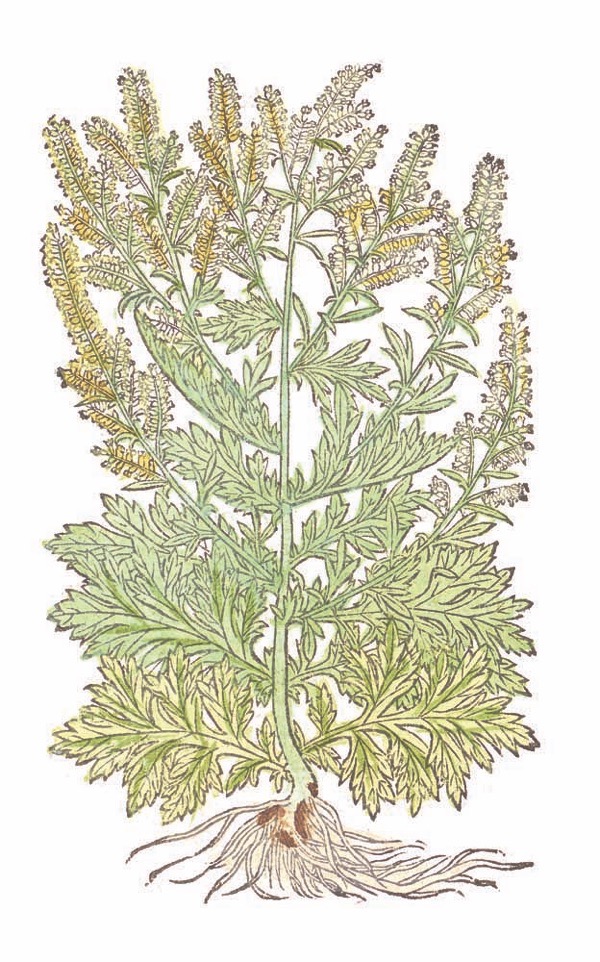
Mugwort
Artemisia vulgaris
London grew rapidly from the late fifteen-hundreds, becoming the largest city in western Europe by the end of the next century. The possession of a garden was a luxury for the few, so markets were a vital source of fruit and vegetables for the table, along with herbs for seasoning and remedies.
The number of doctors in London in relation to the population was tiny, no more than a hundred were licensed by the Royal College of Physicians in the seventeenth century. Their treatments were not only expensive but sometimes drastic, based on purgative drugs and bloodletting. One woman summed up this situation in trenchant terms, ‘Kitchen physic I believe is more proper than the Doctor’s filthy physic.’ Housewives usually had charge of the health of their families and needed to know what herbs they required for a range of ailments.
Two herbals in particular offered a comprehensive survey. John Gerard, a barber surgeon, compiled his Herball, or Generall Historie of Plantes that was publishedin 1597. This provided not only information about the medicinal properties of herbs, fruit, vegetables and flowers, but also descriptions of their cultivation, often based on his own experience in his garden in Holborn. His book is huge, with over eighteen hundred woodcuts and so expensive that copies were passed down through generations just like the family bible.
Five years later came The English Physitian, a herbal by the radical apothecary, Nicholas Culpeper, who had his garden in Spitalfields. The subtitle, An Astrologo-Physical Discourse of the Vulgar Herbs of this Nation indicates his interest in the influence of the planets on medicine. His book had no illustrations because he wanted it priced at a few pence so that it could be widely available.
The seventeenth century saw women beginning to write their own household manuals. One was Mary Doggett’s, compiled at the very end of the century and now held in the British Library. She was the first wife of Thomas, theatre manager of Drury Lane Theatre and fondly remembered today for the annual Doggett Coat & Badge race for Thames watermen. Mary’s book includes a wide range of recipes for cooking, distilling and brewing, for medicines, and care of the house.
Unlike many women of her time, Mary Doggett could read and write. Margaret Pepys, mother of the diarist Samuel, was a laundry maid who may well not have had her letters. But her son refers to Margaret sending out her maid to buy herbs from the market in Cheapside to cure his mouth ulcer. No doubt she learnt this remedy from her mother. Pepys does not specify the herbs but an early eighteenth-century recipe for mouth ulcers recommends rue, red sage, brambles and the leaves of ivy and honeysuckle added to vinegar and honey.
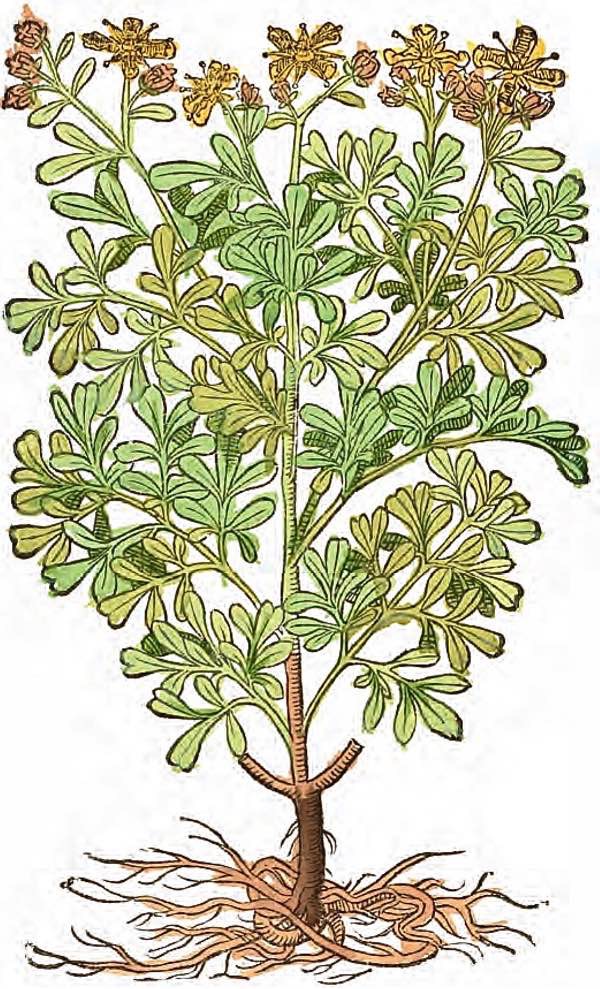
Garden Rue
Ruta Hortensis
Perhaps the greatest challenge facing seventeenth-century London households was the threat of bubonic plague. Brought by black rats on ships, it affected ports and spread to country villages as fleas were transferred to their brown cousins. There had been many visitations but the most devastating reached London in December 1664, known as the Great Plague.
The herb believed to be most efficacious against the plague was rue, known as the herb of grace because a bunch was added to holy water for exorcisms. John Gerard recommended mashing the leaves with the kernel of walnuts and figs as an antidote. A recipe ‘most esteemed of in the last Great Visitation’ was included in a printed cookery book seven years after the Great Plague. It took rue and sage and mixed them in wine with spices and a pennyworth of Mithridate. This last ingredient is named after Mithridates, ruler of Pontus in the first century BC, who was obsessed with the fear of being poisoned and had a remedy made up from no less than fifty-five herbs and spices. Apothecaries sold Mithridate, sometimes under the name Venetian Treacle.
The other most-feared disease was smallpox. While the plague proved most deadly for poorer people, living in close quarters, smallpox was no respecter of status, swooping upon the highest in the land. Several members of the royal family died from the disease, including Queen Mary in 1694 aged only thirty-two. Recipes for treating smallpox are rare, but one seventeenth century remedy, Lady Allen’s Water, used a range of herbs and flowers from the garden. Among these were powerful medicinal plants, such as henbane with painkilling properties, which was added to liquorice and white wine, and distilled.
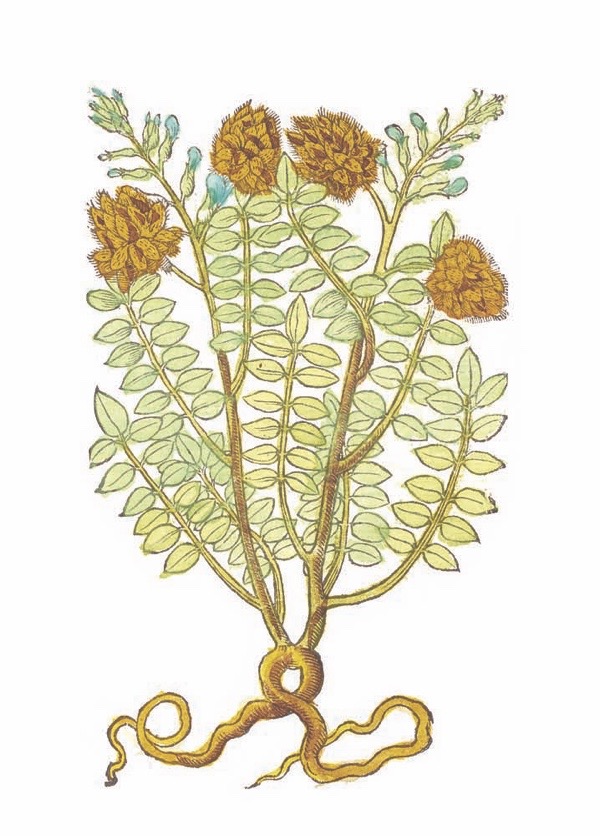
Liquorice
Glycyrrhiza glabra
Smallpox left physical scars, particularly cruel when one of the most important signs of beauty was to have a fair, smooth face. One recipe advised that as the scabs of smallpox began to dry out, they should be treated with salves. John Gerard considered oil of figs to be particularly good, while rosewater was often added to bacon fat and applied. Many recipes called for rosewater. Damask roses were recommended because their stronger scent made them ‘fitter for meate and medicine’ according to Gerard. To make rosewater required such a very large amount of petals that country gardens often had beds set aside especially for the cultivation of roses. When Elizabeth I ‘persuaded’ the Bishop of Ely to give up his palace and garden in Holborn to her dancing partner favourite, Sir Christopher Hatton, he demanded that he should receive twenty bushels of rose petals each year. These surely would have been destined for the episcopal stillroom to make up into a water. One recommendation to Londoners was that they should purchase rose petals when there was a glut. Mary Doggett may have done this, although her recipe book includes a note that she purchased rose water for the goodly sum of £2 from her apothecary.
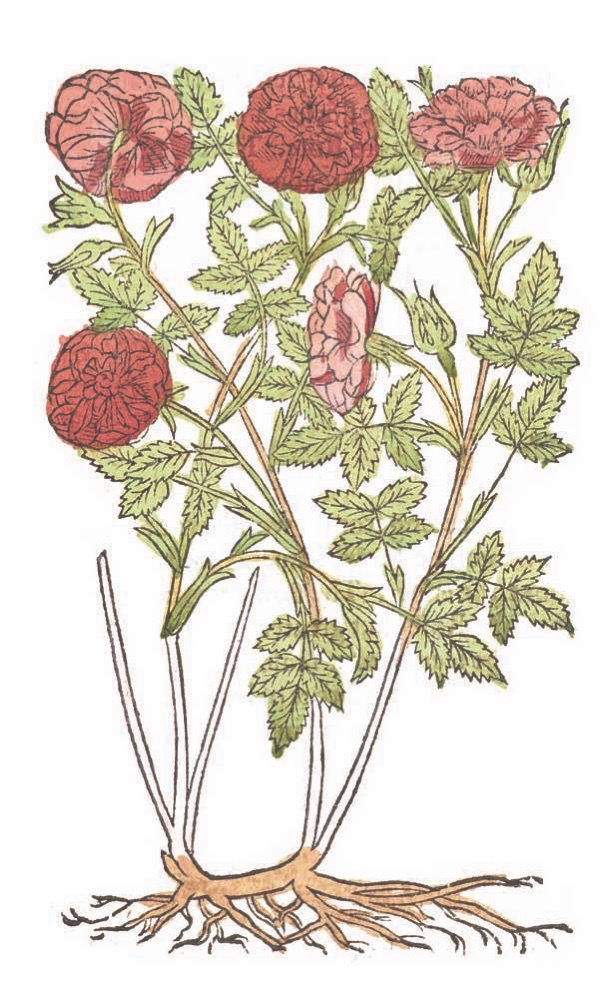
Damask rose
Rosa damascena
Mary used the rosewater in several of her recipes for keeping the house fragrant. One unusual idea was for aromatic beads, taking scented gums and rose water, and mixing them with the buds of Damask roses. These were coloured with lamp black, the soot collected from oil lamps, rolled in the hand with jasmine oil, and given a gloss before they were made into bracelets.
Housewives made up ‘sweet bags’ with flowers and herbs dried, powdered and distilled. Added to this mixture were aromatic gums expensively acquired from apothecaries or grocers, so it had to be long lasting. Unlike our potpourris, which are displayed in open bowls, the mixture would be kept in bags tightly sealed to retain the scent. One herb often used was sweet marjoram, which also featured in nosegays, carried to mask the smells of unwashed crowds, and against the plague.
Keeping houses sweet and clean presented a challenge. Floors were strewn with rushes acquired from barges that brought them to Thameside wharves. Added to these were sweet smelling herbs, such as bay and rosemary, which could be purchased from street vendors, as illustrated in Cries of London. The custom of strewing gradually declined with the century and instead straw matting was laid on floors. Marcus Laroon’s Cries of London of 1687 includes a pedlar offering door mats and strips of matting for the bedroom.
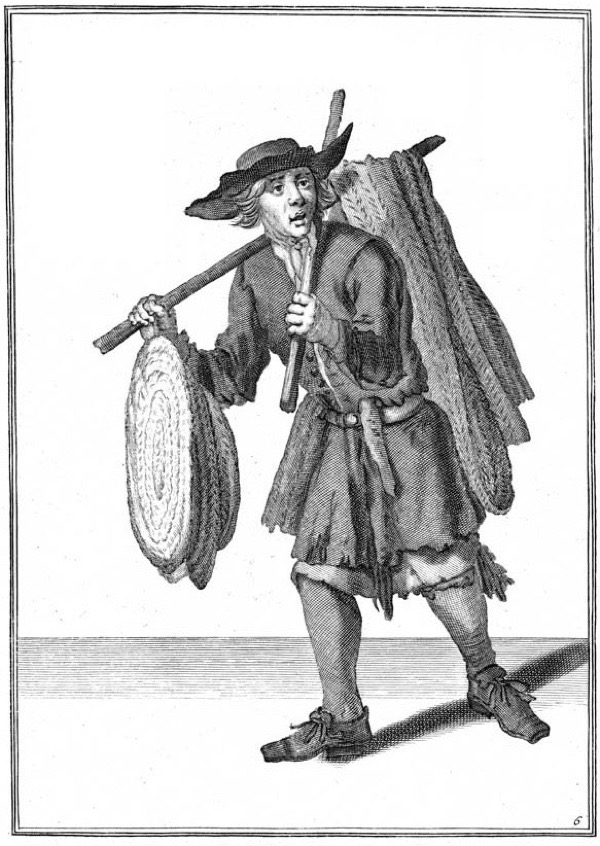
Seller of straw mats by Marcellus Laroon
A century earlier, a Dutch visitor remarked on how much the English appreciate flowers for their homes. Lemnius Levinus in his diary noted ‘altho’ we do trimme up our parlours with green boughes, fresh herbes or vine leaves scented … yet no nation does it more decently, more trimmely, nor more sightly than they do in England’. At Christmas evergreen shrubs and branches were brought in to decorate the house, a tradition that endures.
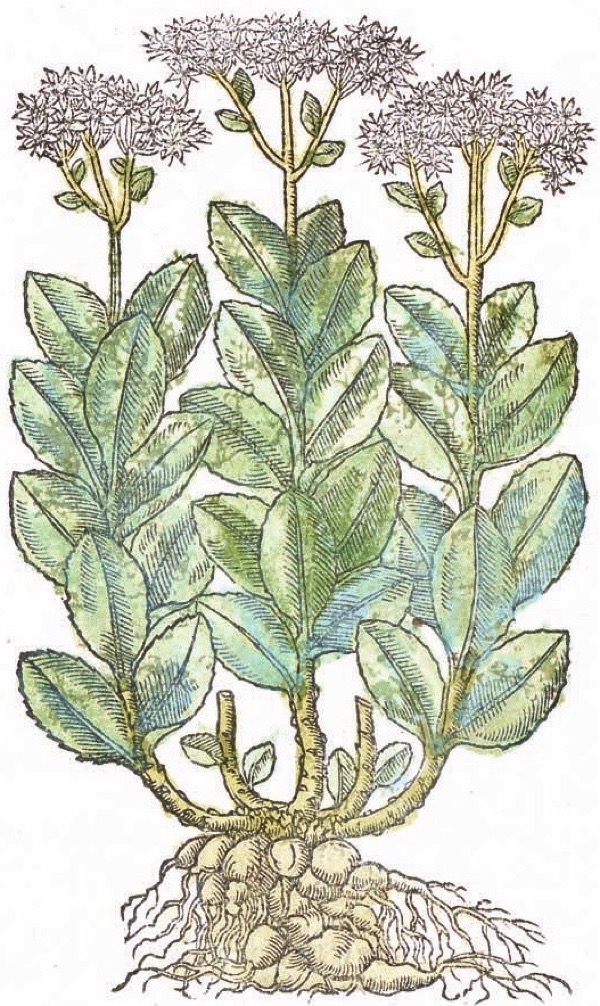
Orpine
Hylotelephium telephium
There was also a floral tradition at the opposite part of the year, to celebrate the festival of St John the Baptist on 24th June. John Stow in his chronicles of London described how every door was garlanded with birch, fennel, orpine and lilies. Orpine, a sedum, has the alternative names of ‘livelong’ because of its lasting qualities, and ‘midsummer men’ because of its connections with the summer festival. Another herb connected with midsummer was mugwort, which Culpeper attributed to Venus, hastening delivery in childbirth. Along with St John’s Wort, the herb was burnt on St John’s Eve to purify communities, probably one of a series of examples of how a pagan practice was adopted by the Church.
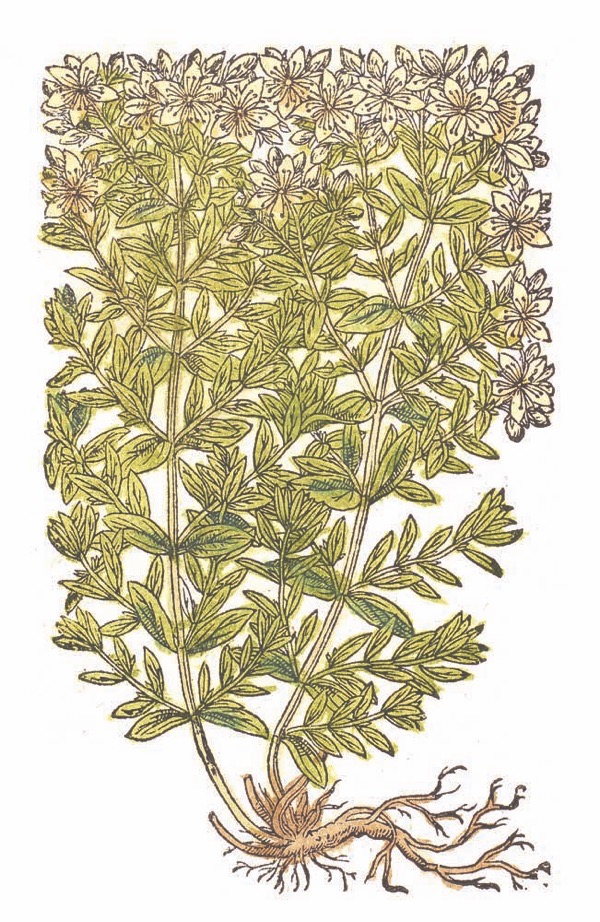
St John’s Wort
Hypericum perforatum
Woodcuts from Gerard’s Herbal © Bodleian Library
You may like to read these other stories by Margaret Willes
The Pumps Of Old London
Click here to book for THE GENTLE AUTHOR’S TOURS

“We never know the worth of water till the well is dry” -Thomas Fuller, 1732
Hardly anyone notices this venerable pump of 1832 in Shoreditch churchyard, yet this disregarded artifact may conceal the reason why everything that surrounds it is there. Reverend Turp of St Leonard’s explained to me that the very name of Shoreditch derives from the buried spring beneath this pump, “suer” being the Anglo-Saxon word for stream.
The Romans made their camp at this spot because of the secure water source and laid out four roads which allowed them to control the entire territory from there – one road led West to Bath, one North to York, one East to Colchester and one South to Chichester. In fact, this water source undermined the foundations of the medieval church and caused it to collapse, leading to the construction of the current building by George Dance but, even then, there were still problems with flooding and the land was built up to counteract this, burying the first seven steps out of ten at the front of the church. Later, human remains from the churchyard seeped into this supply (as in some other gruesome examples) and it was switched over to mains water. Today, the sad old pump in Shoreditch has lost its handle, had its nozzle broken and even its basin is filled with concrete, yet a lone primrose flowers – emblematic of the mystic quality that some associate with these wellsprings, as sources of life itself.
Before the introduction of the mains supply in London, the pumps were a defining element of the city, public water sources that permitted settlement and provided a social focus in each parish. Now, where they remain, they are redundant relics unused for generations, either tolerated for their picturesque qualities or ignored by those heedless of their existence. When I began to research this subject, I found that no attention had been paid to these valiant survivors of another age. So I set out West to seek those other pumps that had caught my attention in my walks around the city and make a gallery for you of the last ones standing.
Holborn is an especially good place to look for old pumps, there I found several fine examples contemporary with the stately Georgian squares, and the Inns of Court proved rewarding hunting ground too. At Lincoln’s Inn, the porter told me they still get their water supply untreated from the Fleet river, encouraging me to explore South of Fleet St at the Temple, although to my disappointment Pump Court no longer has a pump to justify its name.
Up in Soho, at Broadwick St, you will find London’s most notorious pump, the conduit that brought a cholera epidemic killing more than five hundred people in 1854. Now it has been resurrected as a monument to the physician who detected the origin of the infection and had the pump handle removed. Today, the nearest pub bears his name, John Snow. The East End’s most famous specimen, the Aldgate Pump – that I have written of elsewhere in these pages – was similarly responsible for a lethal epidemic, underlining the imperative to deliver a safe water supply, an imperative that ultimately rendered these pumps redundant.
Perhaps the most gracious examples I found were by St Paul’s Cathedral, “Erected by St Faith’s Parish, 1819,” and in Gray’s Inn Square. Both possess subtle expressive detail as sculptures that occupy their locations with presence, and in common with all their pitiful fellows they stand upright like tireless flunkies – ever hopeful and eager to serve – quite oblivious to our indifference.
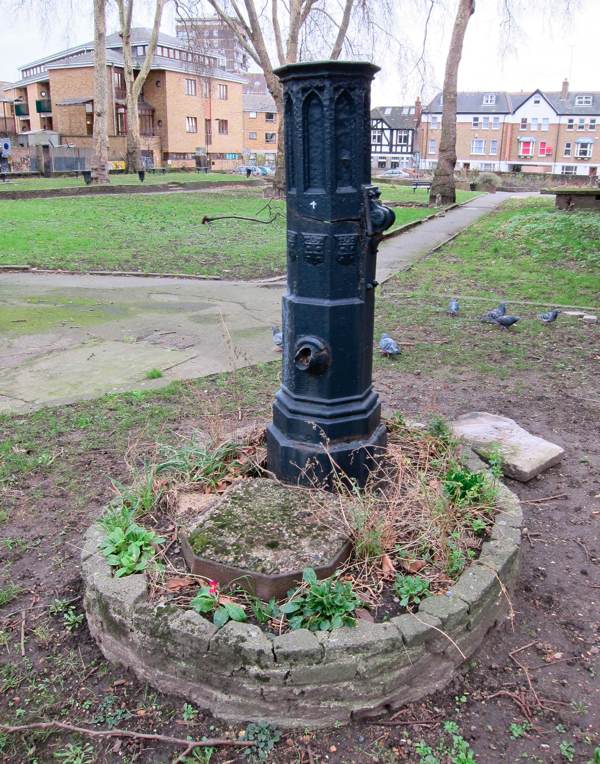
In Shoreditch churchyard, this sad old pump of 1832 has lost its handle, had its nozzle broken and basin filled with concrete, and is attended by a lone primrose.
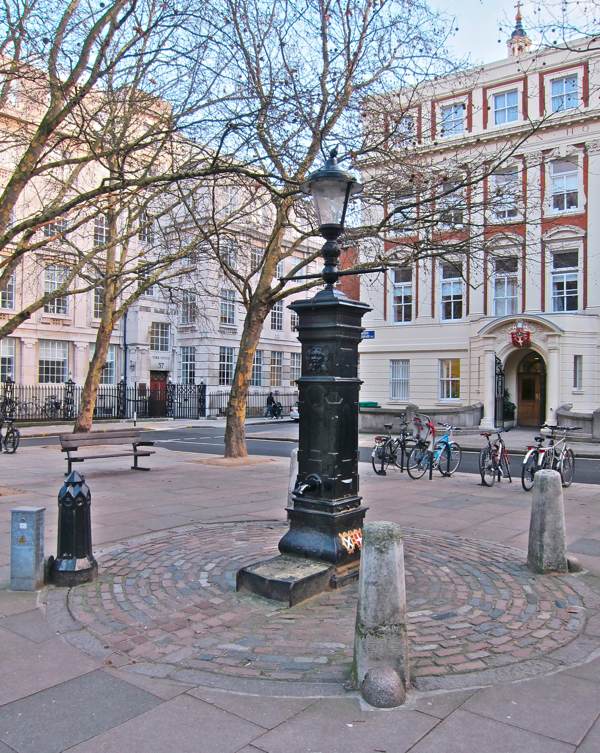
In Queen’s Sq, Holborn this pump of 1840 has the coats of arms of St Andrew and St George.
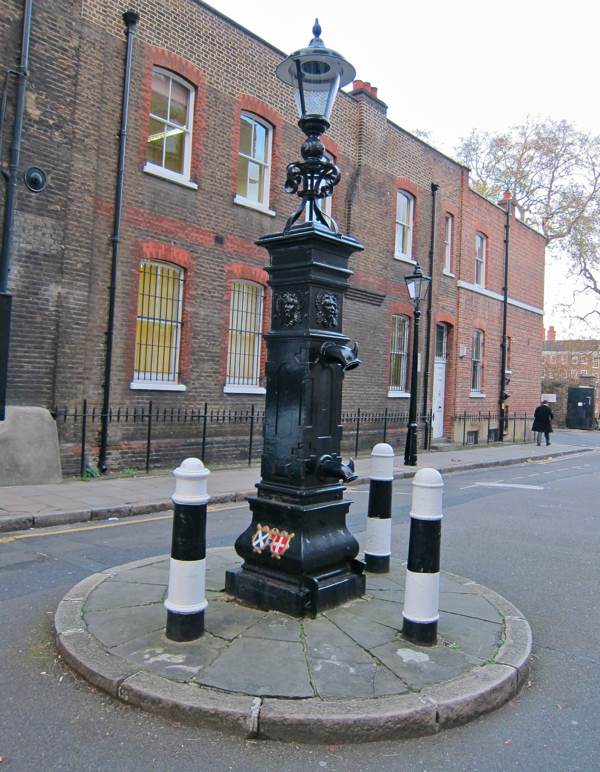
In Bedford Row, Holborn, this is contemporary with its colleague in Queens Sq.
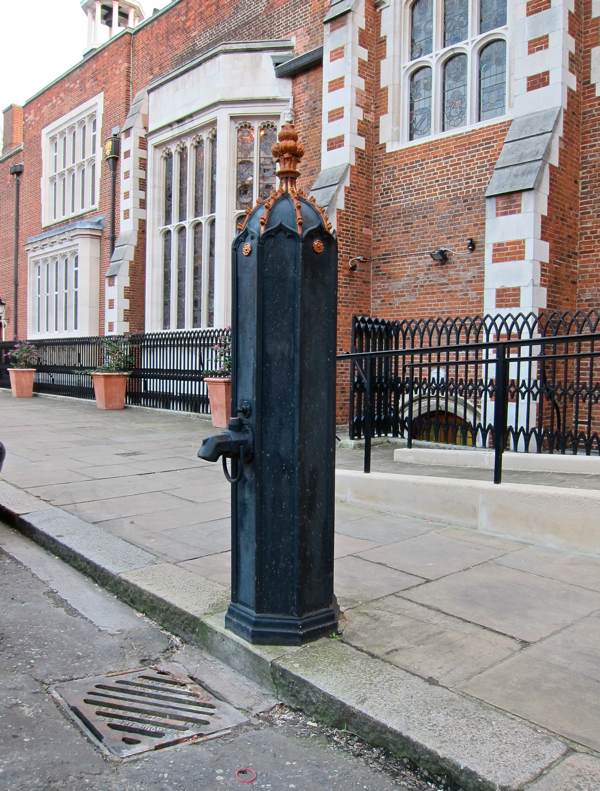
In Gray’s Inn Sq – where, in haste, a passing lawyer mislaid a red elastic band.

This appealing old pump in Staple Inn is a pastiche dated 1937.

This is the previous pump in the location above, more utilitarian and less picturesque.
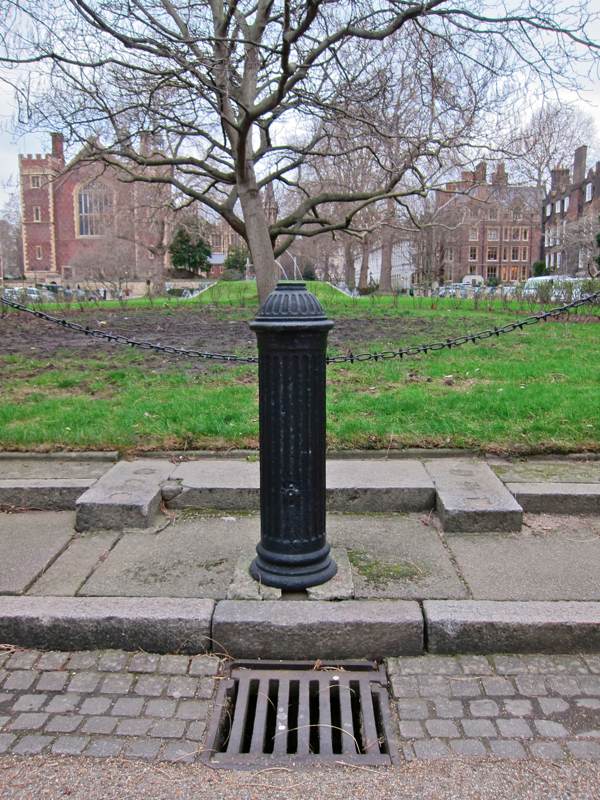
In New Square, Lincoln’s Inn.
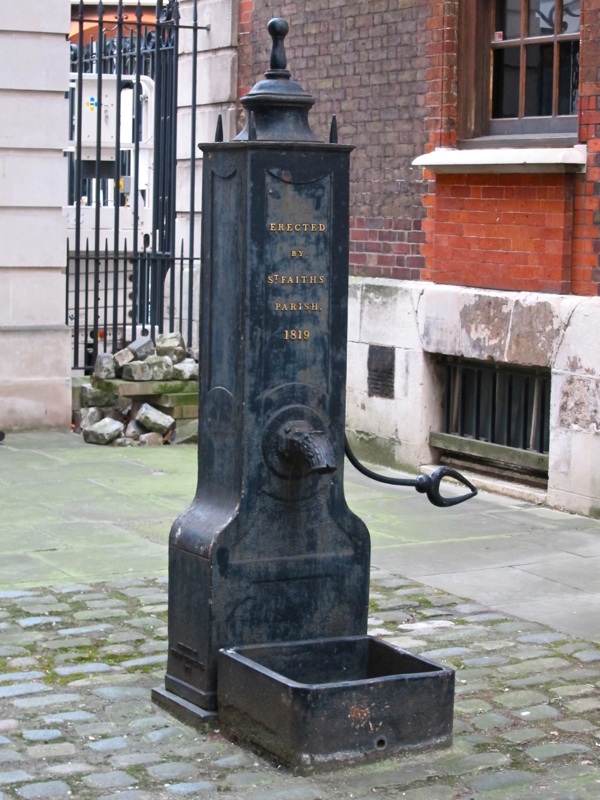
Between Paternoster Sq and St Paul’s Churchyard.
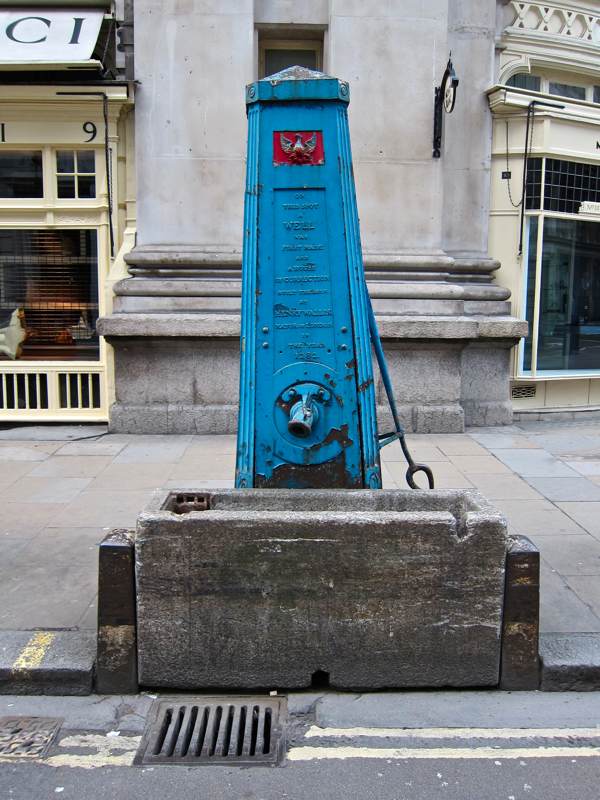
Outside the Royal Exchange in Cornhill. The text on the pump reads, “On this spot a well was first made and a house of correction built thereon by Henry Wallis Mayor of London in the year 1282.” Designed by architect Nathaniel Wright and erected in 1799.
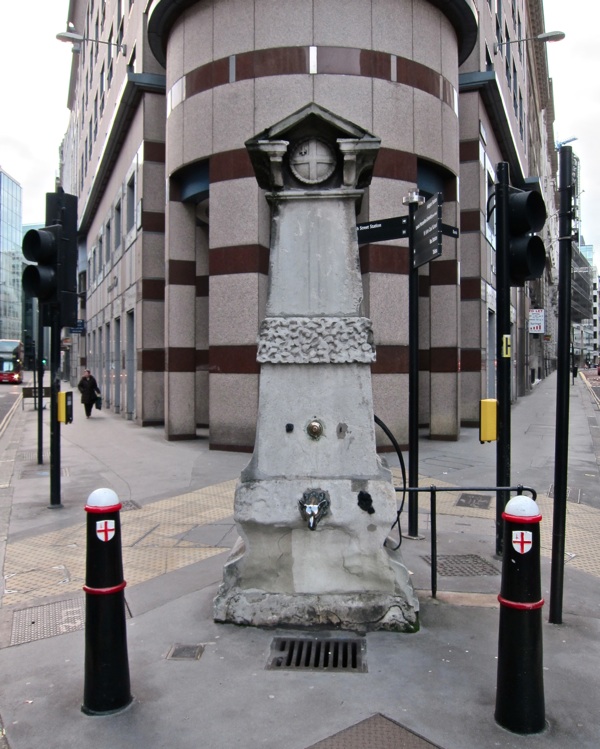
Aldgate Pump marks the boundary between the East End and the City of London. The faucet in the shape of a wolf commemorates the last of these beasts to be shot outside the walls of the City.

London’s most notorious pump in Broadwick St, Soho. Five hundred people died in the cholera epidemic occasioned by this pump in 1854. Reinstated in 1992 to commemorate medical research in the service of public health, the nearby pub is today named “John Snow” after the physician who traced the outbreak to this pump. A red granite kerbstone across the road marks the site of the original pump.
Archive image courtesy Bishopsgate Institute
You may also like the to read about
George Gladwell’s Columbia Rd Market
Click here to book for THE GENTLE AUTHOR’S TOURS

This is George Gladwell (1929-2020) selling his Busy Lizzies from the back of a van at Columbia Rd in the early seventies, drawing the attention of bystanders to the quality of his plants and captivating his audience with a bold dramatic gesture of presentation worthy of Hamlet holding up a skull. George began trading at the market in 1949 and it is my delight to publish this selection of his old photographs.
There is an air of informality about the flower market as it is portrayed in George’s pictures. The metal trolleys that all the traders use today are barely in evidence, instead plants are sold from trestle tables or directly off the ground – pitched as auctions – while seedlings come straight from the greenhouse in wooden trays, and customers carry away their bare-rooted plants wrapped in newspaper. Consequently, the atmosphere is of a smaller local market than we know today, with less stalls and just a crowd of people from the neighbourhood.
You can see the boarded-up furniture factories, that once defined Bethnal Green, and Ravenscroft Buildings, subsequently demolished to create Ravenscroft Park, both still in evidence in the background – and I hope sharp-eyed readers may also recognise a few traders who continue working in Columbia Rd Market today.
Over the years, many thousands of images have been taken of Columbia Rd Flower Market, but George Gladwell’s relaxed photographs are special because they capture the drama of the market seen through the eyes of an insider.
“I arrived in this lonely little street in the East End with only boarded-up shops in it at seven o’clock one Sunday morning in February 1949. And I went into Sadie’s Cafe where you could get a whopping great mug of cocoa, coffee or tea, and a thick slice of bread and dripping – real comfort food. Then I went out onto the street again at nine o’ clock, and a guy turned up with a horse and cart loaded with flowers, followed by a flatback lorry also loaded with plants.
At the time, I had a 1933 ambulance and I drove that around to join them, and we were the only three traders until someone else turned up with a costermonger’s barrow of cut flowers. There were a couple more horse and carts that joined us and, around eleven thirty, a few guys came along with baskets on their arms with a couple of dozen bunches of carnations to sell, which was their day’s work.
More traders began turning over up over the next few months until the market was full. There were no trolleys then, everything was on the floor. Years ago, it wasn’t what you call “instant gardening,” it was all old gardeners coming to buy plants to grow on to maturity. It was easy selling flowers then, though if you went out of season it was disappointing, but I never got discouraged – you just have to wait.
Mother’s Day was the beginning of the season and Derby Day was the finish, and it still applies today. The serious trading is between those two dates and the rest of the year is just ticking over. In June, it went dead until it picked up in September, then it got quite busy until Bonfire Night. And from the first week of December, you had Christmas Trees, holly and mistletoe, and the pot plant trade.
I had a nursery and I lived in Billericay, and I was already working in Romford, Chelmsford, Epping, Rochester, Maidstone and Watford Markets. A friend of mine – John – he didn’t have driving licence, so he asked me to drive him up on a Sunday, and each week I came up to Columbia Rd with him and I brought some of my own plants along too, because there was a space next to his pitch.
My first licenced pitch was across from the Royal Oak. I moved there in 1958, because John died and I inherited his pitches, but I let the other four go. In 1959, the shops began to unboard and people took them on here and there. That was around the time public interest picked up because formerly it was a secret little market. It became known through visitors to Petticoat Lane, they’d walk around and hear about it. It was never known as “Columbia Rd Flower Market” until I advertised it by that name.
It picked up even more in the nineteen sixties when the council introduced the rule that we had to come every four weeks or lose our licences, because then we had to trade continuously. In those days, we were all professional growers who relied upon the seasons at Columbia Rd. Although we used to buy from the Dutch, you had to have a licence and you were only allowed a certain amount, so that was marginal. It used to come by train – pot plants, shrubs and herbaceous plants. During the war, agriculture became food production, and fruit trees planted before the war had matured nicely. They sold masses of these at the Maidstone plant auctions and I could pick them up for next to nothing and sell them at Columbia Rd for two thousand per cent profit. Those were happy times!
In the depression at the end of the nineteen fifties, a lot of nurserymen sold their plots for building land because they couldn’t make it pay and it made the supply of plants quite scarce. So those of us who could grow our own did quite well but, although I did a mail order trade from my nursery, it wasn’t sufficient to make ends meet. Hobby traders joined the market then and they interfered with our trade because we were growers and kept our stock from week to week, but they would sell off all their stock cheap each week to get their money back. I took a job driving heavy haulage and got back for Saturday and Sunday. I had to do it because I had quite a big family, four children.
In the seventies, I was the first to use the metal trolleys that everyone uses now. My associates said I would never make it pay because I hocked myself up to do it. At the same time, plants were getting plastic containers, whereas before we used to sell bare roots which made for dirty pitches, so that was progress. All the time we were getting developments in different kinds of plants coming from abroad. You could trade in these and forget growing your own plants, but I never did.
Then in the nineties we had problems with rowdy traders and customers coming at four in the morning, which upset the residents and we were threatened with closure by the council. We had a committee and I was voted Chairman of the Association. We negotiated with the neighbours and agreed trading hours and parking for the market, so all were happy in the end.
It’s been quite happy and fulfilling, what I’ve finished up with is quite a nice property – something I always wanted. I like hard work, whether physical or mental. I used to sell plants at the side of the road when I was seven, and I used to work on farms helping with the milking at five in the morning before I went to school. I studied architecture and yet, as a job, I was never satisfied with it, I preferred the outdoor life and the physical part of it. Having a pitch is always interesting – it’s freedom as well.”

Albert Harnett

Colin Roberts


Albert Playle


Bert Shilling
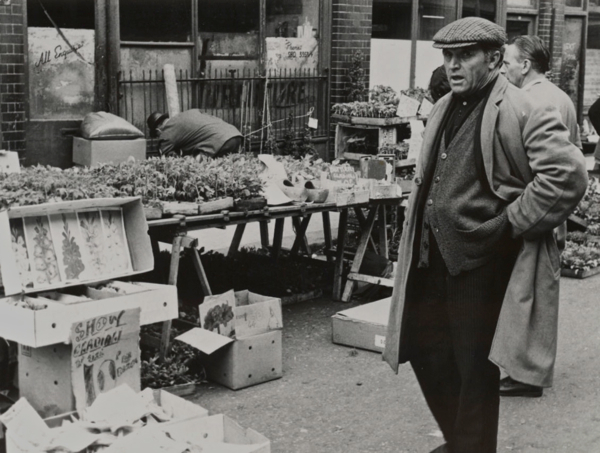
Ernie Mokes
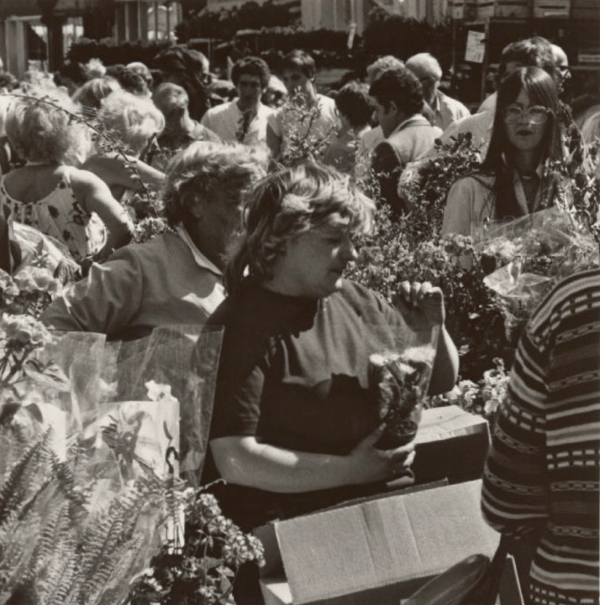
The magnificently named Carol Eden.


Fred Harnett, Senior

Herbie Burridge

George Burridge, Junior


Jim Burridge, Senior

Kenny Cramer

Lou Burridge

Robert Roper


Ray Frost

Robert Roper

George Burridge
At David Kira Ltd, Banana Merchants
Click here to book for THE GENTLE AUTHOR’S TOURS

To anyone that knows Spitalfields, David Kira Ltd is a familiar landmark at 1 Fournier St next to The Ten Bells. Here, at the premises of the market’s foremost banana merchant – even though the business left more than a quarter of a century ago – the name of David Kira is still in place upon the fascia to commemorate the family endeavour which operated on this site for over half a century.
By a fluke of history, the business that trades here now has retained the interior with minimum intervention, which meant that when David’s son Stuart Kira returned for the first time since he left in 1991, his former office, where he worked for almost thirty years – and even his old chair – was still there, existing today as part of a hairdressing salon.
This is a story of bananas and it began with Sam Kira in Southend, a Jewish immigrant from Poland who became naturalized in 1929 and started a company called “El Dorado Bananas.” Ten years later, his son opened up in Fournier St as a wholesaler, taking a lease from Lady Fox but having to leave the business almost at once when the war came, bringing conscription and wiping out the banana trade. Yet after the war, he built up the name of David Kira, creating a reputation that is still remembered fondly in Spitalfields and, since the shop remains, it feels as if the banana merchants only just left.
“When I first came to the market as a child of seven, we lived in Stoke Newington and took the 647 trolley bus to Bishopsgate and walked down Brushfield St. Every opportunity, I came down to enjoy the action and the atmosphere, and the biggest thrill was getting up early in the morning – I always remember being sent round to the Market Cafe to get mugs of tea for all the staff. When I joined my father David in 1962, aged sixteen, my grandfather Sam had died many years earlier. There was me and my father, John Neil (who had been with my father his entire working life), Ted Witt our cashier, two porters, Alf Lee and Billy Alloway (known as Billy the thief) and we had an empty boy. Our customers were High St greengrocers and market fruit traders, and we prided ourselves on only selling the best quality produce. Perhaps this was why we had a lot of customers. It was hard work and long working hours, getting up at half past four every morning to be at the market by five thirty. I used to sleep for a couple of hours in the afternoon when I got home, until about six, then I’d get up and return to bed at eleven until four thirty – I did that six days a week.
We received our shipments direct from Jamaica through the London Docks – bananas in their green state on long stalks – they arrived packed in straw on a lorry and it was very important that they be unloaded as soon as they arrived, whatever time of day or night the ship docked, because the enemy of the banana is the cold. They were passed by hand through a hatch in the floor to the ripening rooms downstairs – it took five days from arrival until they were saleable. Since the bananas came from the tropics, it was not so much the heat you had to recreate as the humidity. We had a single gas flame in the corner of each ripening room, the green bananas hung close together on hooks from the ceiling and, when the flame was turned down, a little ethylene gas was released before the door was sealed. Once they were ripened, they had to be boxed. You stood with a stalk of bananas held between your legs and struck off each bunch with a knife, placing it in a special box, three foot by one foot – a twenty-eight pound banana box.
During the sixties, dates were only sold at Christmas but in the seventies when the Bangladeshi people arrived, we started getting requests for dates during Ramadan. I contacted one of the dates suppliers and I asked him to send me thirty cases, and they were sold to Bengali greengrocers in Brick Lane before they even touched the floor. Subsequently, we sold as many dates as we could get hold of, more even than at Christmas. During this period, we also saw the decline of the High St greengrocers due to the supermarkets, however we found we were able to compensate for the loss of trade by fulfilling the requirements of the Asian community.
Eventually, they started importing pre-boxed bananas in the eighties, so our working practices changed and the banana ripening rooms became obsolete. My late father would be turning in his grave if he knew that bananas are now placed in cold storage, which means they will quickly turn black once they get home.
In 1991, when the market moved, we were offered a place in the new market hall but trading hours became a free-for-all and, although we started opening at three am, we were among the last to open. By then I was married and had children, and without the help of my father and John Neil who had both retired, I found it very difficult to cope. It was detrimental to my health – so, after a year, I sold the company as a going concern. I didn’t know what I wanted to do, but by chance I bumped into a colleague who worked in insurance and he introduced me to his manager. I realised in that type of business I could continue to be self-employed, so I trained and qualified and I have done that for the past twenty years. When I think back to the market, I only got two weeks a year holiday and I felt guilty even to put that pressure on my father and John Neil when I was away.”
Proud of his father’s achievement as a banana merchant, Stuart delighted to tell me of Ethel, the rat-catching cat – named after the ethylene gas – who loved to sleep in the warmth of the banana ripening rooms and of Billy Alloway’s tip of sixpence that he nailed to the wall in derision, which stayed there as his memorial even after he died. Stuart cherishes his memory of his time in the market, recognising it as a world with a culture of its own as much as it was a place of commerce. Today, the banana trade has gone from Spitalfields where once it was a way of life, now only the name of David Kira – heroic banana merchant – survives to remind us.

Sam Kira (far right) dealing in bananas in London and Southend.

Sam Kira’s naturalization papers.

David Kira at the Spitalfields Fruit Exchange – he is centre right in the fifth row, wearing glasses and speaking with his colleague.
 The banana trade ceased during World War II.

David Kira as a young banana merchant.

David Kira (left) with his son Stuart and business partner John Neil.

David Kira and staff.


Stuart Kira stands in the doorway of his former office of twenty years, where his father and grandfather traded for over fifty years.

David Kira Ltd, 1991
First and last pictures copyright © Mark Jackson & Huw Davies
You may also like to read about
Jimmy Huddart, Spitalfields Market Porter
Peter Thomas, Fruit & Vegetable Supplier
Ivor Robins, Fruit & Vegetable Purveyor
John Olney, Donovan Brothers Ltd
Jim Heppel, New Spitalfields Market
East End Desire Paths
Click here to book for THE GENTLE AUTHOR’S TOURS
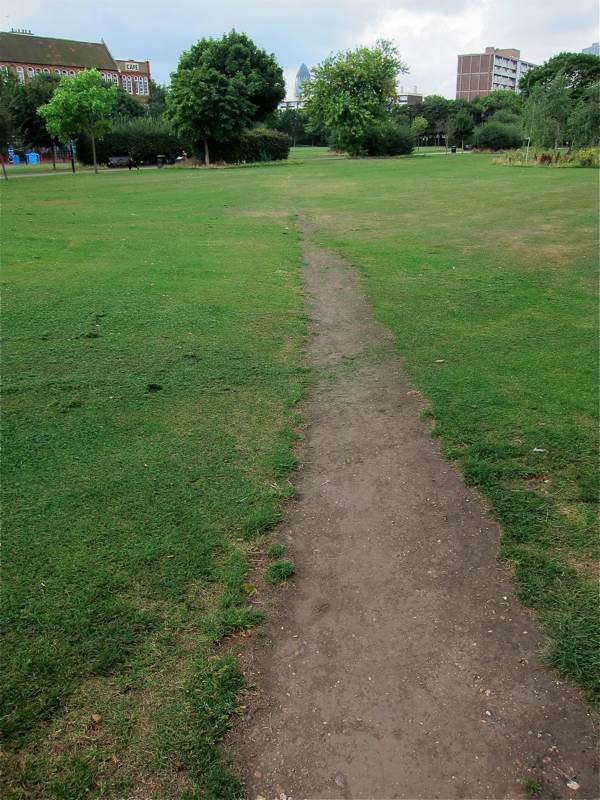
In Weavers’ Fields
Who can resist the appeal of the path worn solely by footsteps? I was never convinced by John Bunyan’s pilgrim who believed salvation lay in sticking exclusively to the straight path – detours and byways always held greater attraction for me. My experience of life has been that there is more to be discovered by stepping from the tarmac and meandering off down the dusty track, and so I delight in the possibility of liberation offered by these paths which appear year after year, in complete disregard to those official routes laid out by the parks department.
It is commonly believed that the French philosopher Gaston Bachelard invented the notion of “desire paths” (lignes de désir) to describe these pathways eroded by footfall in his book “The Poetics of Space,” in 1958, although, just like the mysterious provenance of these paths themselves, this origin is questioned by others. What is certain is that the green spaces of the East End are scored with them at this time of year. Sometimes, it is because people would rather cut a corner than walk around a right angle, at other times it is because walkers lack patience with elegantly contrived curved paths when they would prefer to walk in a straight line and occasionally it is because there is simply no other path leading where they want to go.
Resisting any suggestion that these paths are by their nature subversive to authority or indicative of moral decline, I prefer to appreciate them as evidence of human accommodation, coming into existence where the given paths fail and the multitude of walkers reveal the footpath which best takes them where they need to go. Yet landscape architects and the parks department refuse to be cowed by the collective authority of those who vote with their feet and, from time to time, little fences appear in a vain attempt to redirect pedestrians back on the straight and narrow.
I find a beauty in these desire paths which are expressions of collective will and serve as indicators of the memory of repeated human actions inscribed upon the landscape. They recur like an annual ritual, reiterated over and over like a popular rhyme, and asserting ownership of the space by those who walk across it every day. It would be an indication of the loss of independent thought if desire paths were no longer created and everyone chose to conform to the allotted pathways instead.
You only have to look at a map of the East End to see that former desire paths have been incorporated into the modern road network. The curved line of Broadway Market joins up with Columbia Rd cutting a swathe through the grid of streets, along an ancient drover’s track herding the cattle from London Fields down towards Smithfield Market, and the aptly named Fieldgate St indicates the beginning of what was once a footpath over the fields down to St Dunstan’s when it was the parish church for the whole of Tower Hamlets.
Each desire path tells a story, whether of those who cut a corner hurrying for the tube through Museum Gardens or of joggers who run alongside the tarmac path in London Fields or of the strange compromise enacted in Whitechapel Waste where an attempt has been made to incorporate desire paths into the landscape design. I am told that in Denmark landscape architects and planners go out after newly-fallen snow to trace the routes of pedestrians as an indicator of where the paths should be. Yet I do not believe that desire paths are a problem which can be solved because desire paths are not a problem, they are a heartening reminder of the irreducible nature of the human spirit that can never be contained and will always be wandering.
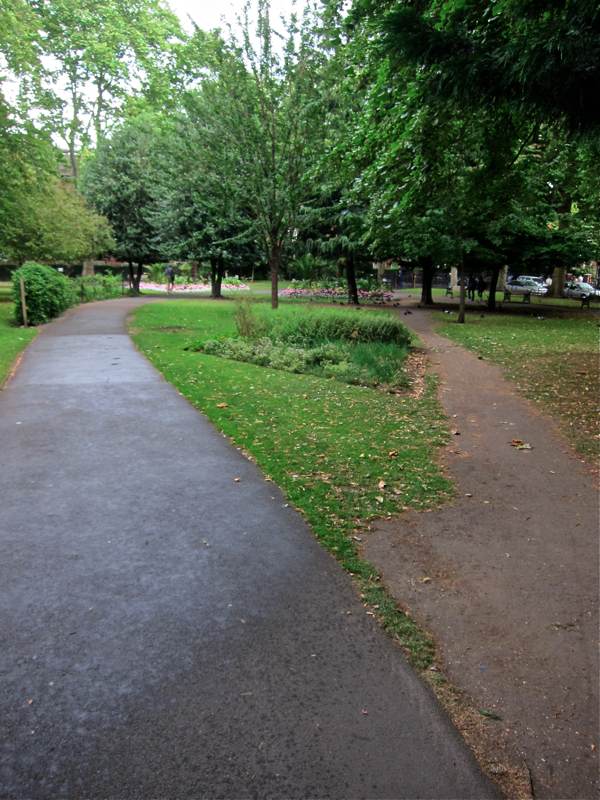
The parting of the ways in Museum Gardens.
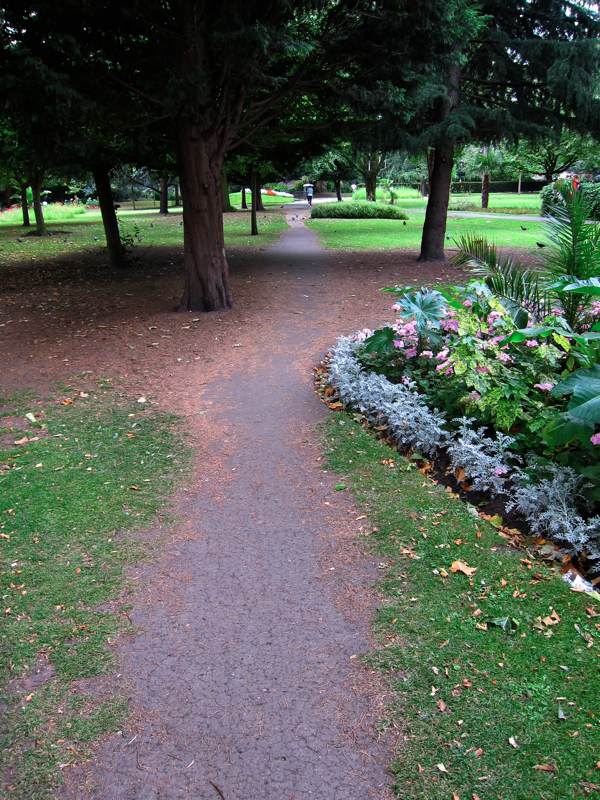
The allure of the path through the trees.
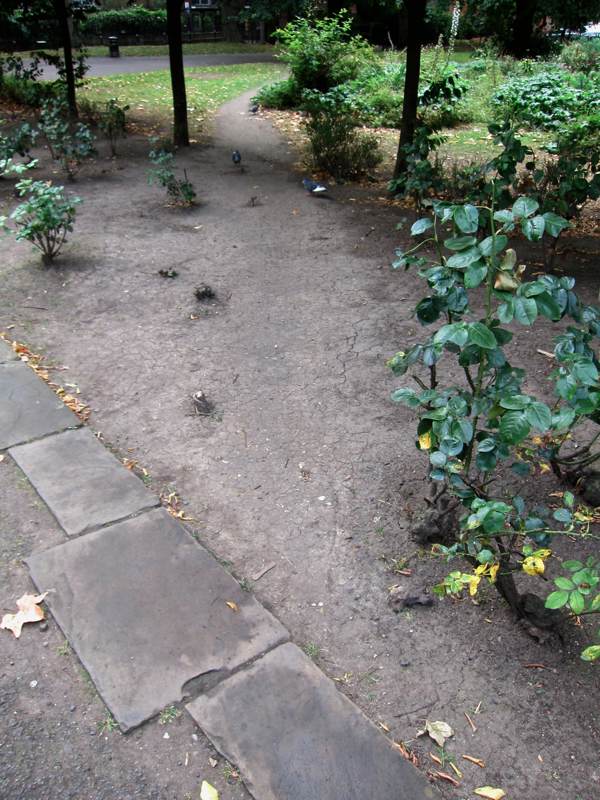
In Bethnal Green, hungry for literature, residents cut across the rose bed to get to the library.
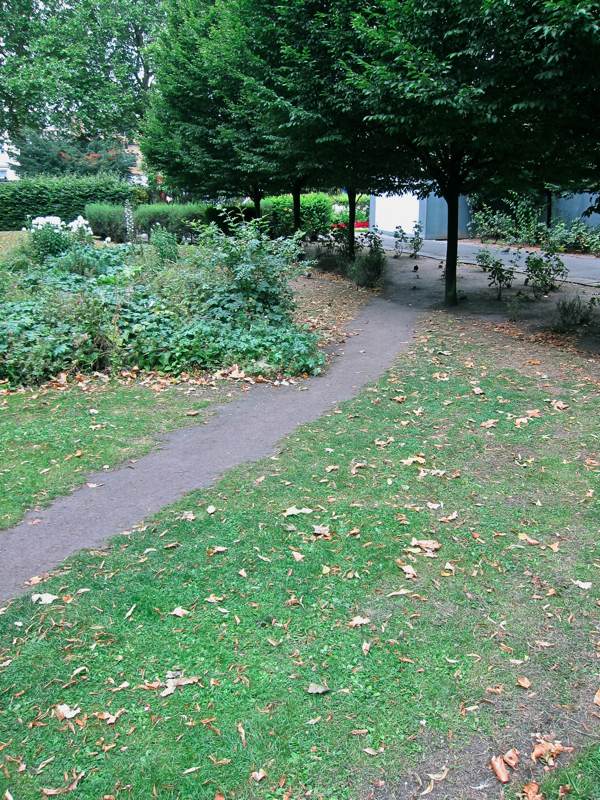
A cheeky little short cut.
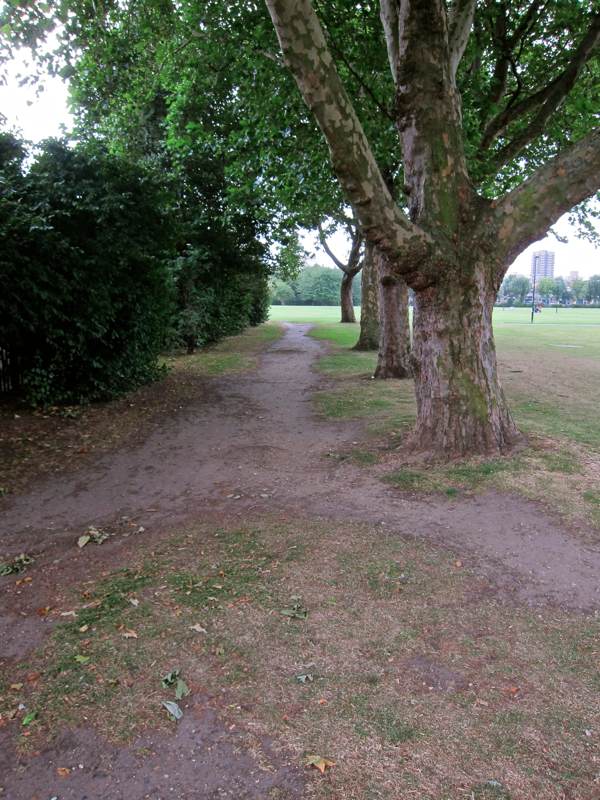
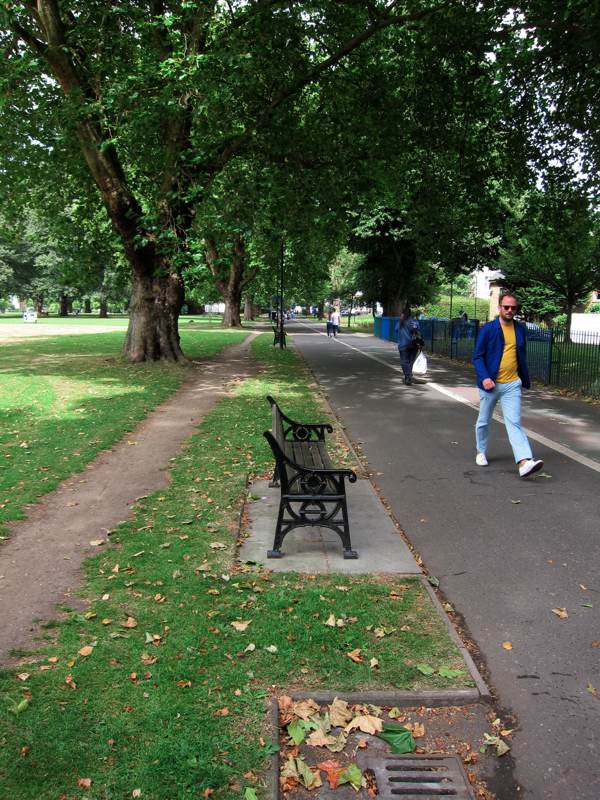
An inviting avenue of plane trees in Weavers’ Fields.
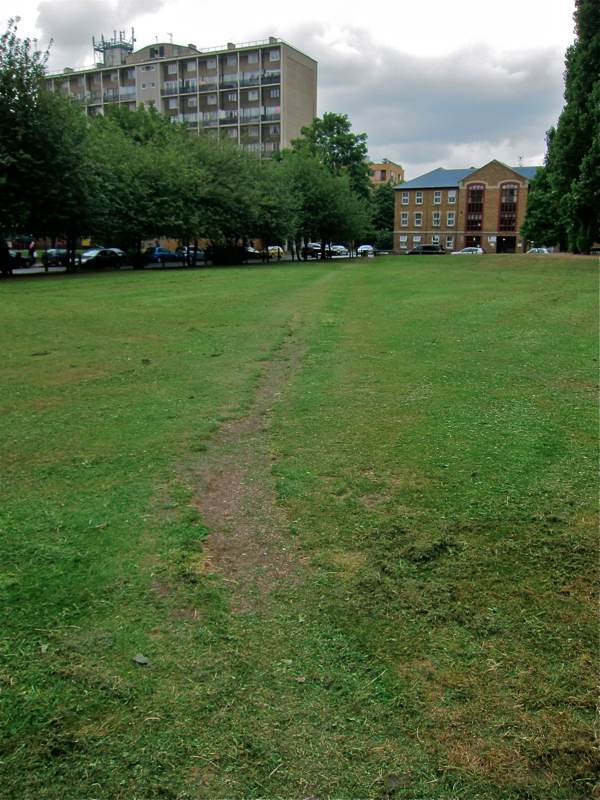
A detour in Florida St.
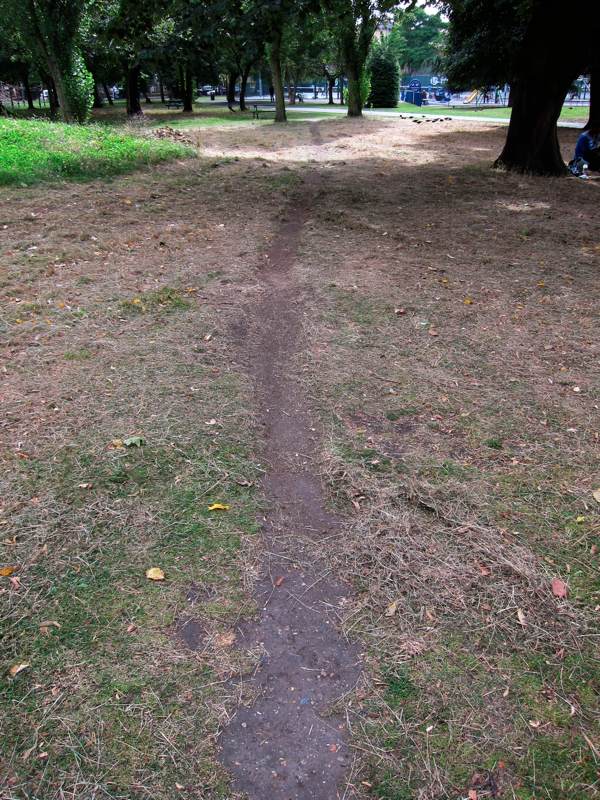
A byway in Bethnal Green.
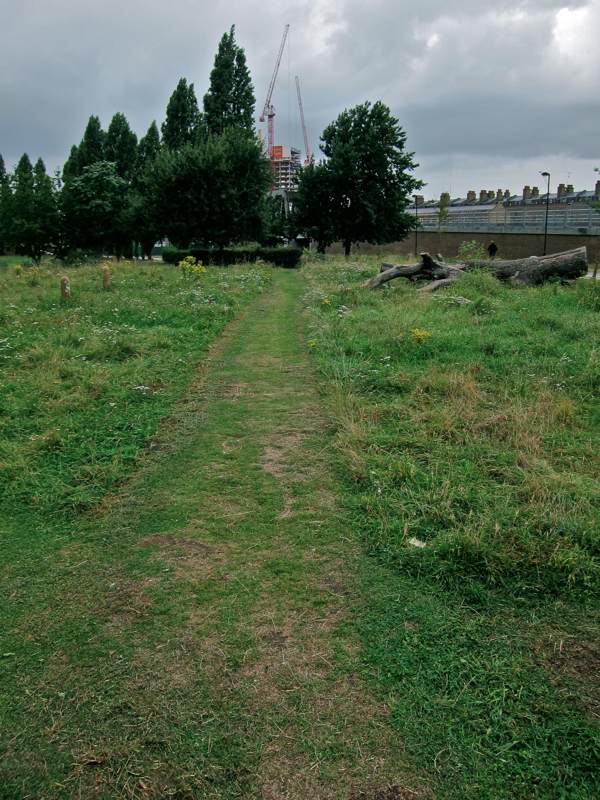
Legitimised by mowing in Allen Gardens, Spitalfields.
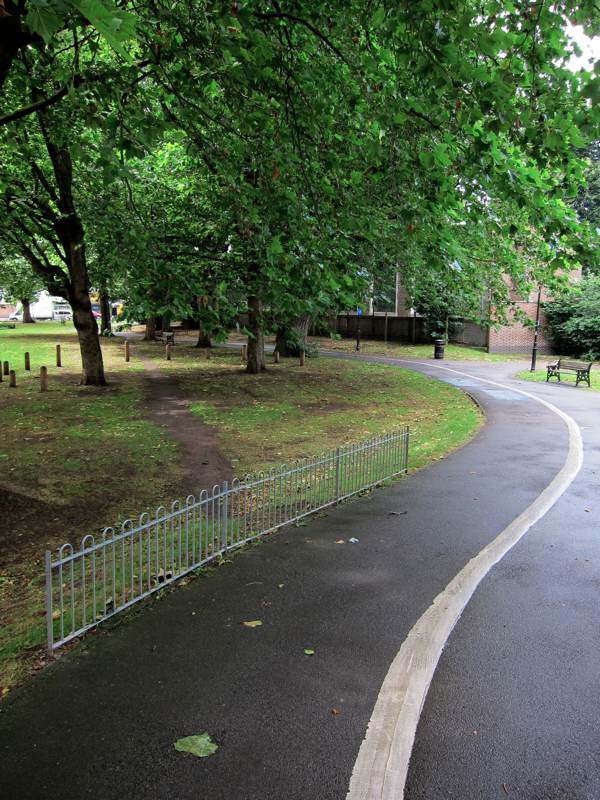
A pointless intervention in Shadwell.
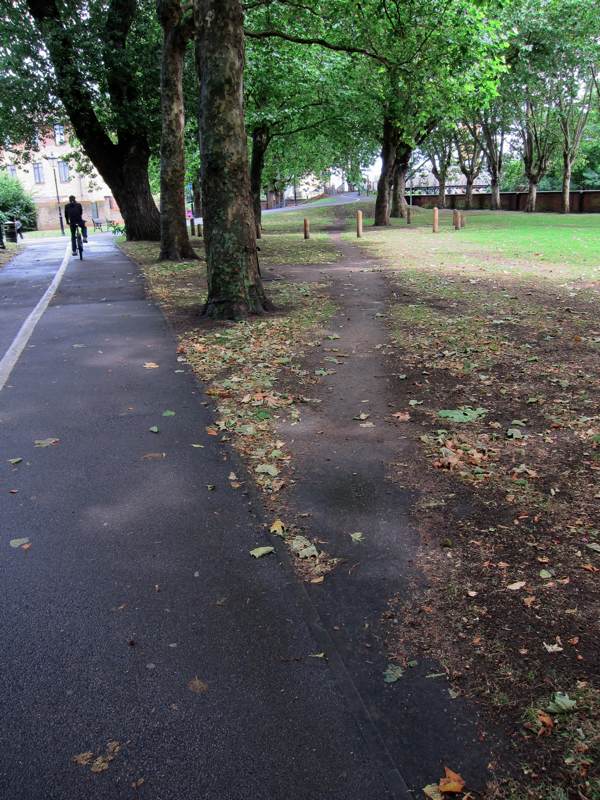
Which path would you choose?
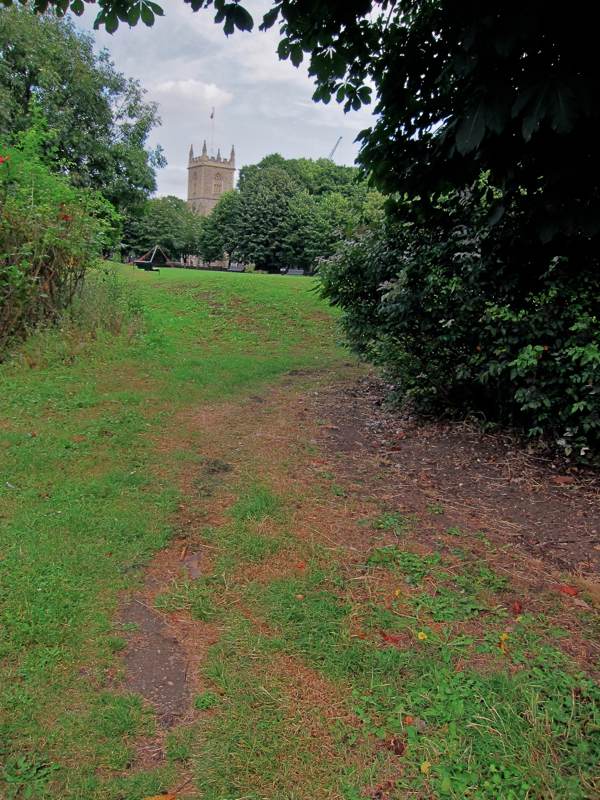
Over the hills and faraway in Stepney.
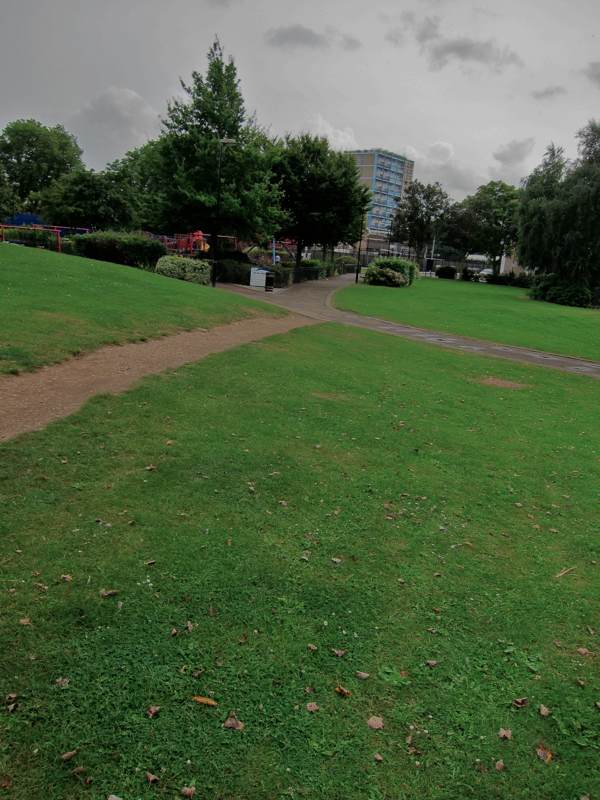
The triumph of common sense in Stepney Green.

Half-hearted appropriation by landscape architects on Whitechapel Waste.
A mystery in London Fields.
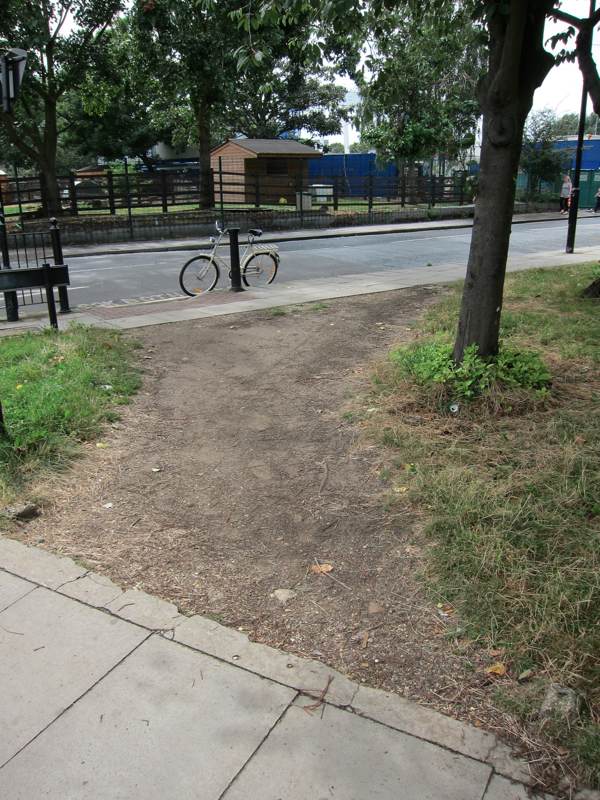
A dog-eared corner in Stepney.
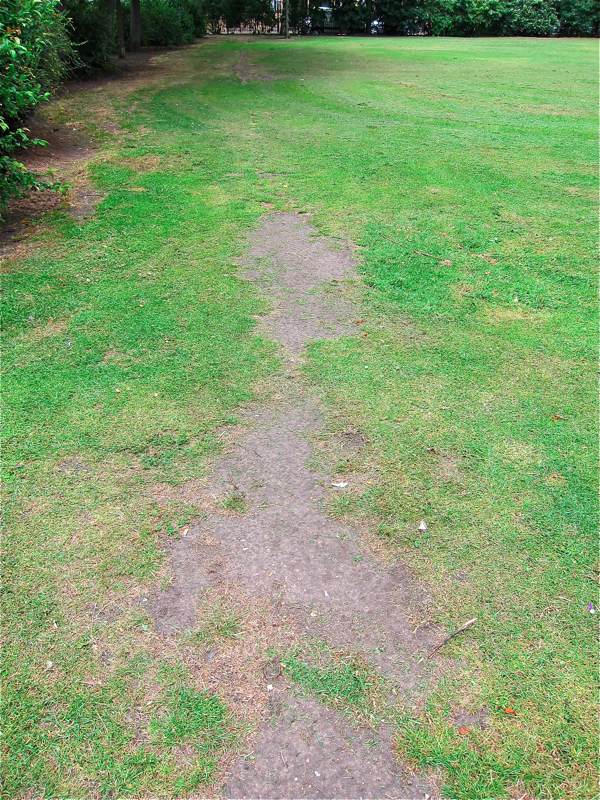
The beginning of something in Bethnal Green.
Philip Mernick’s East End Shopfronts
Click here to book for THE GENTLE AUTHOR’S TOURS
These splendid shopfronts from the beginning of the last century are published courtesy of Philip Mernick who has been collecting postcards of the East End for more than thirty years. In spite of their age, the photographs are of such high quality that they capture every detail and I could not resist enlarging parts of them so you can peer closer at the displays.
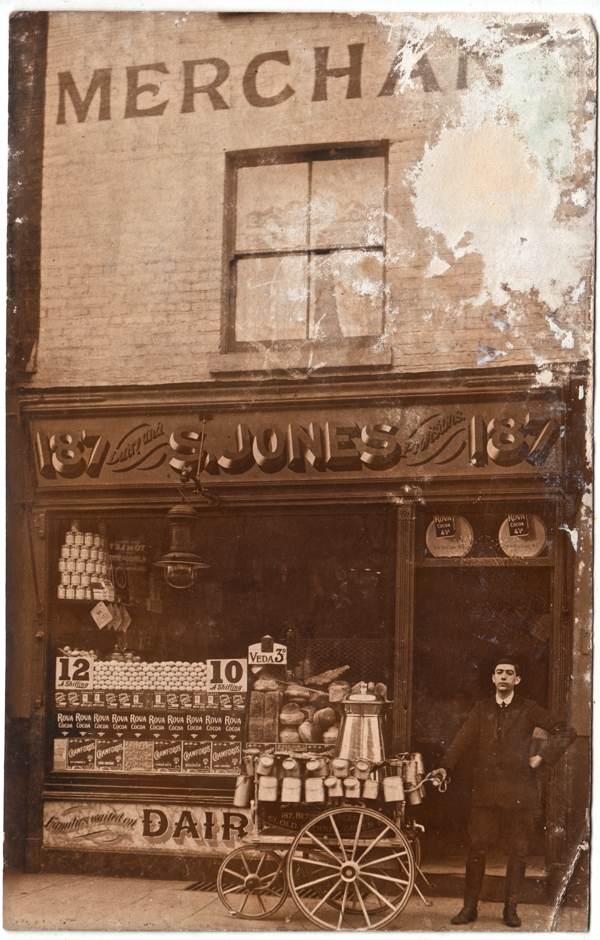
S.Jones, Dairy, 187 Bethnal Green Rd
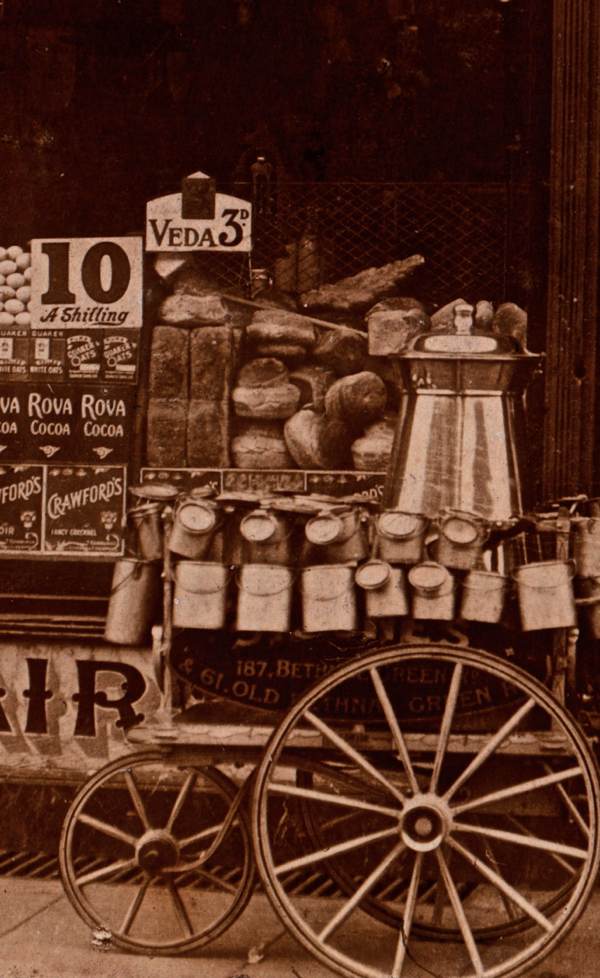

J.F. List, Baker, 418 Bethnal Green Rd


A.L.Barry, Chandlers & Seed Merchants, 246 Roman Rd


Direct Supply Stores Ltd, Butcher, Seven Sisters Rd


Vanhear’s Coffee Rooms, 564 Commercial Rd


Williams Bros, Ironmonger, 418 Caledonian Rd
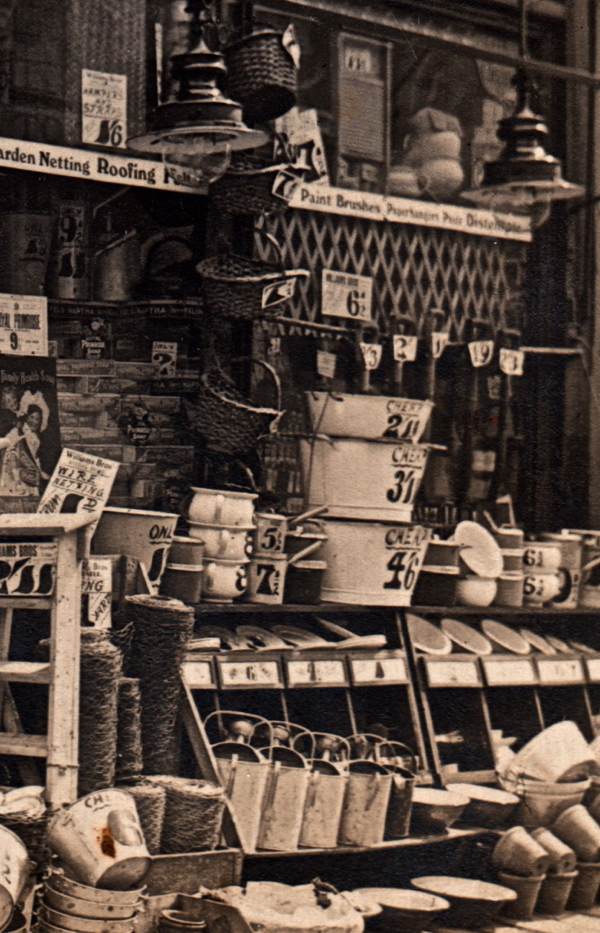

Francis J. Walters, Undertakers, 811 Commercial Rd


Pearks Stores, Grocer, High St, East Ham


A. Rickards, Umbrella Manufacturer, 30 Barking Rd, East Ham

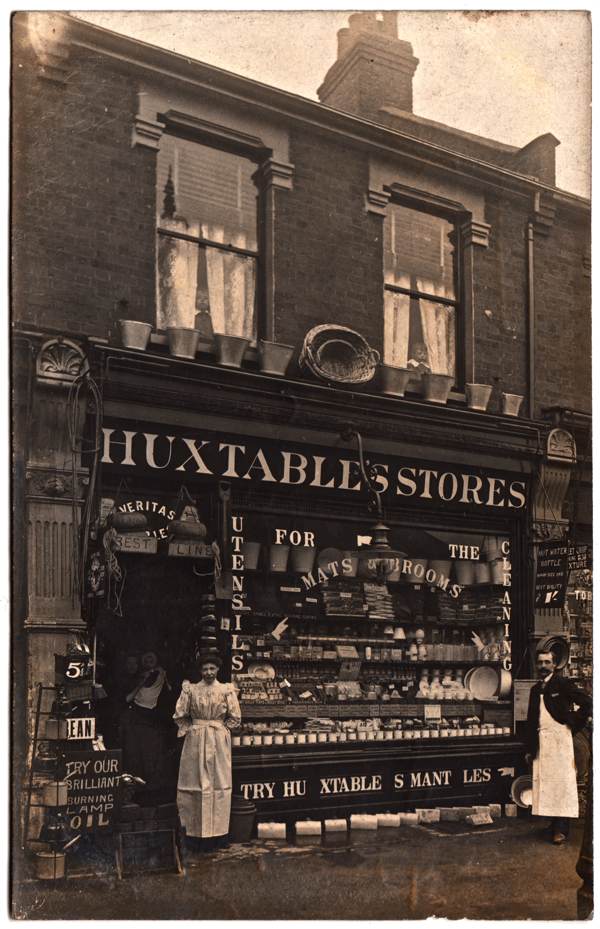
Huxtables Stores, Ironmonger, Broadway, Plaistow


E.J Palfreyman, Printer, Bookbinder & Stationer, High Rd, Leytonstone


J.Garwood, Greengrocer, Bow Rd

“The banana is the safest and most wholesome fruit there is”
You may also like to take a look at
Alan Dein’s East End Shopfronts
Emily Webber’s East End Shopfronts
Eleanor Crow’s East End Shopfronts
Jim Howett’s Spitalfields Shopfronts
At Dr Johnson’s House
Click here to book THE GENTLE AUTHOR’S TOURS
I walked over to Fleet St to pay a visit upon Dr Samuel Johnson who could not resist demonstrating his superlative erudition by recounting examples of lexicography that came to mind as he showed me around the rambling old house in Gough Sq where he wrote his famous Dictionary
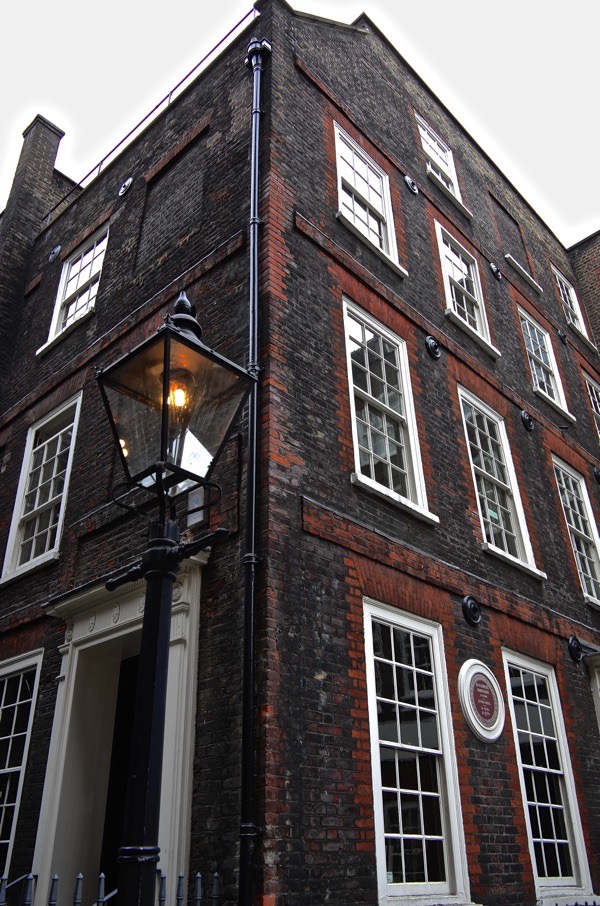
House. n.s. [hus, Saxon, huys, Dutch, huse, Scottish.] 1. A place wherein a man lives, a place of human abode. 2. Any place of abode. 3. Place in which religious or studious persons live in common, monastery, college. 4. The manner of living, the table. 5. Family of ancestors, descendants, and kindred, race. 6. A body of parliament, the lords or commons collectively considered.
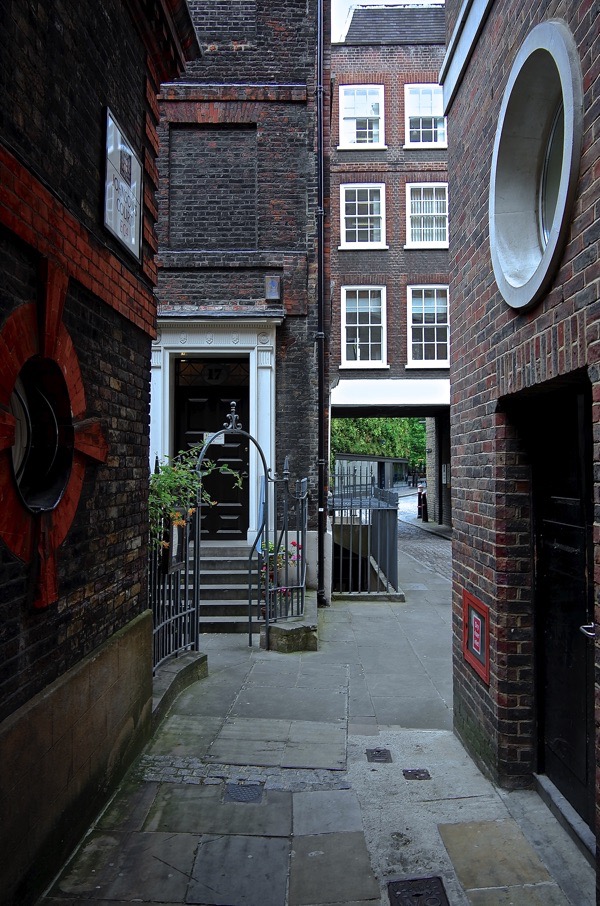
Acce’ss. n.s. [In some of its senses, it seems derived from accessus, in others, from accessio, Lat. acces, Fr.] 1. The way by which any thing may be approached. 2. The means, or liberty, of approaching either to things or men. 3. Encrease, enlargement, addition. 4. It is sometimes used, after the French, to signify the returns of fits of a distemper, but this sense seems yet scarcely received into our language.
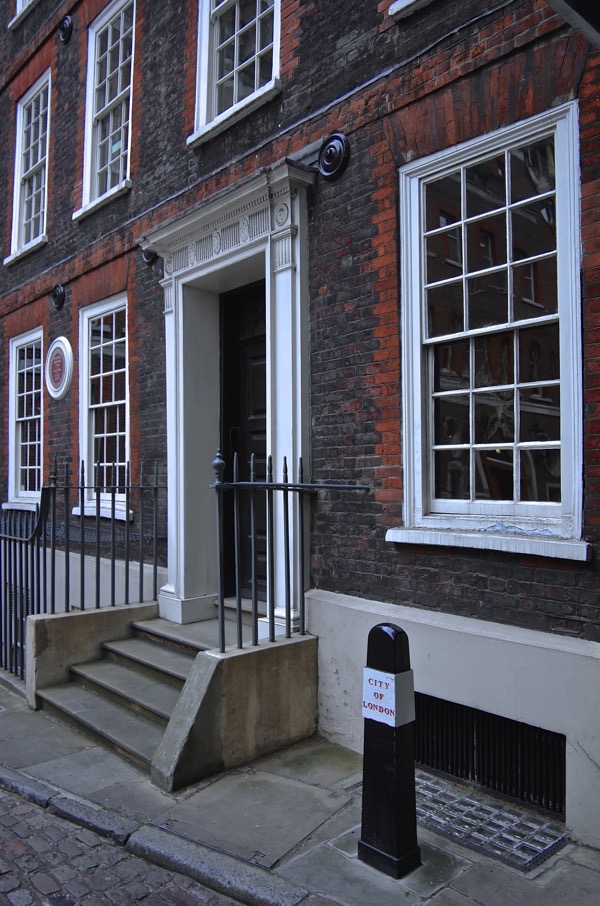
To Rent. v.a. [renter, Fr.] 1. To hold by paying rent. 2. To set to a tenant.
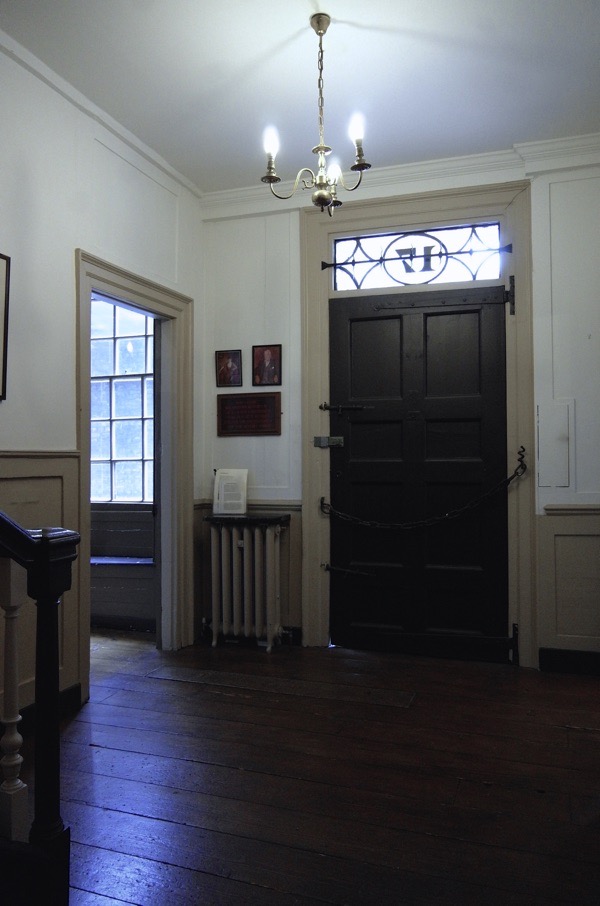
Ba’ckdoor. n.s. [from back and door.] The door behind the house, privy passage.
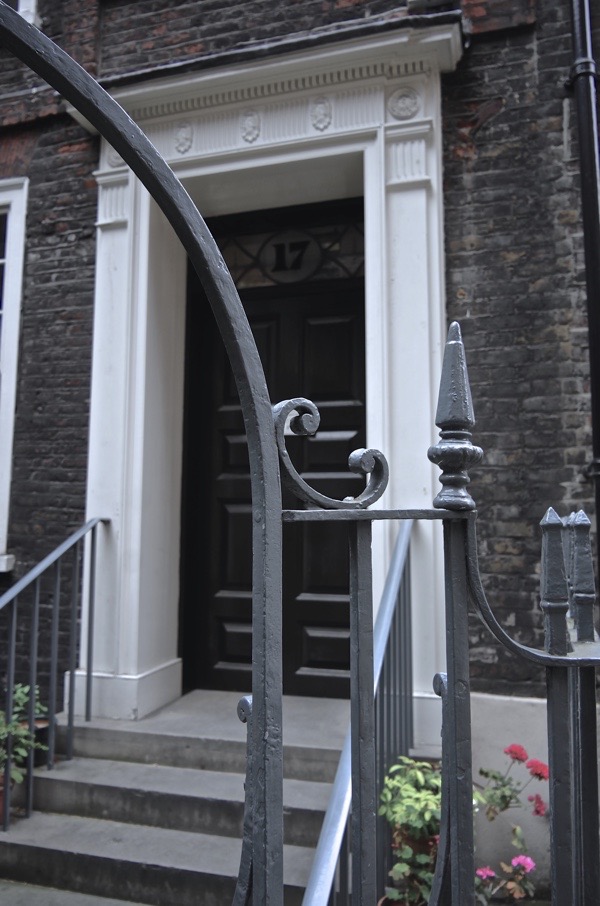
Door. n.s. [dor, dure, Saxon, dorris, Erse.] The gate of a house, that which opens to yield entrance. Door is used of houses and gates of cities, or publick buildings, except in the licence of poetry.
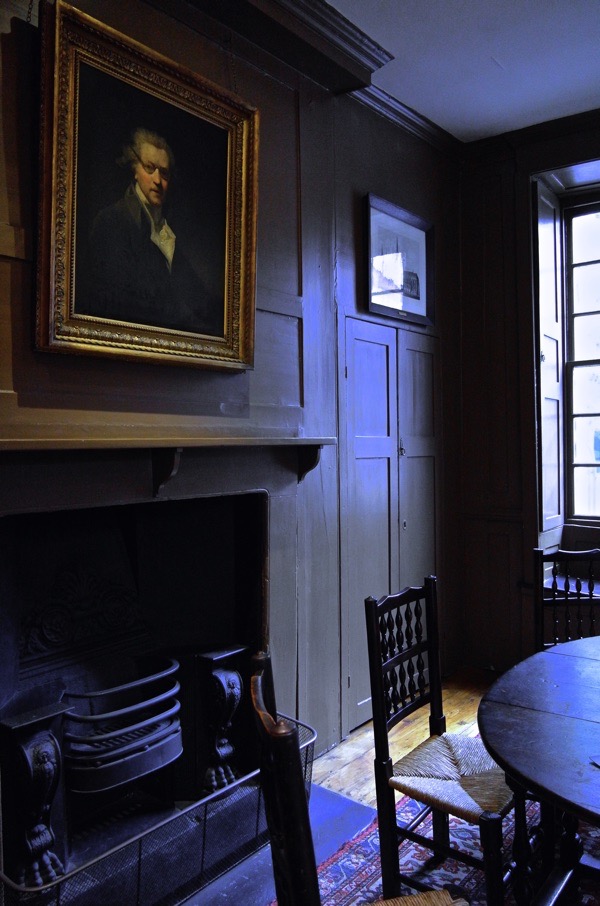
Hábitable. adj. [habitable, Fr. habitabilis, Lat.] Capable of being dwelt in, capable of sustaining human creatures.
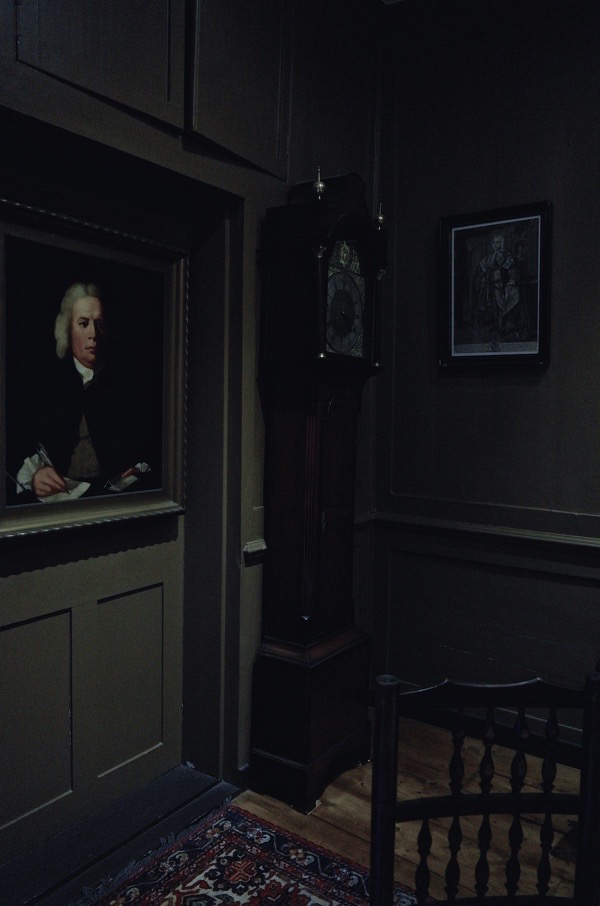
Time. n.s. [ꞇıma, Saxon, tym, Erse.] 1. The measure of duration. 2. Space of time. 3. Interval. 4. Season, proper time.
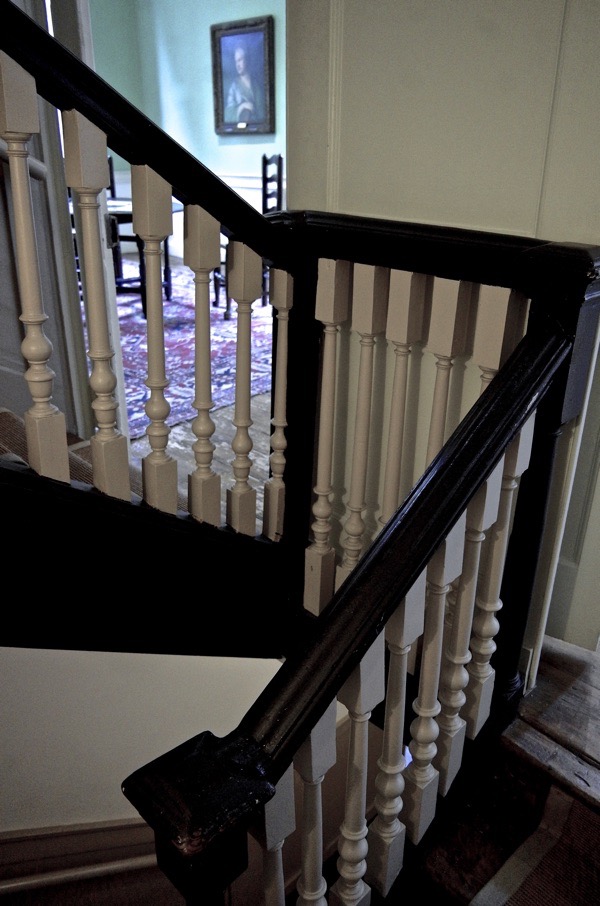
Stair. n.s. [ꞅꞇæᵹꞃ, Saxon, steghe, Dutch.] Steps by which we rise an ascent from the lower part of a building to the upper. Stair was anciently used for the whole order of steps, but stair now, if it be used at all, signifies, as in Milton, only one flight of steps.
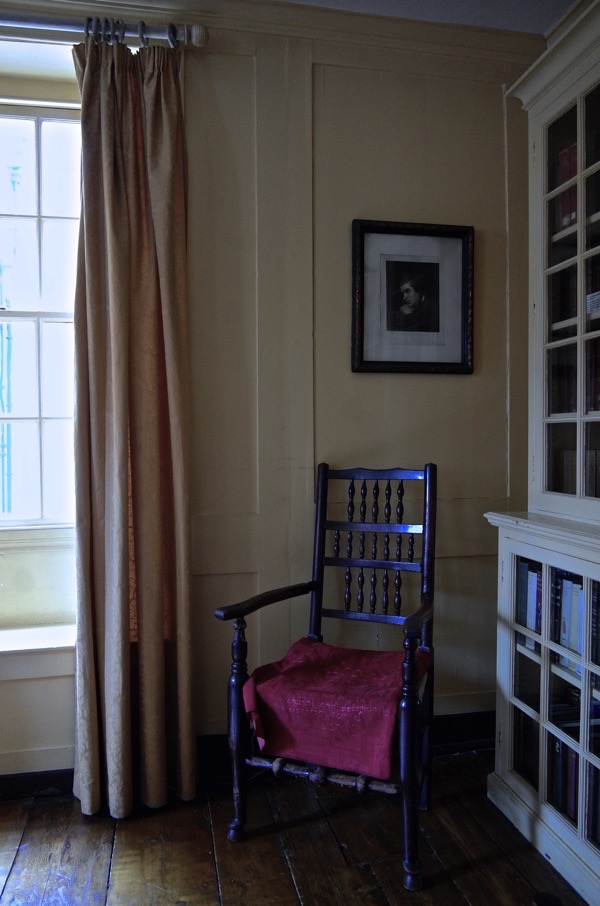
Chair. n.s. [chair, Fr.] 1. A moveable seat. 2. A seat of Justice or authority. 3. A vehicle borne by men, a sedan.
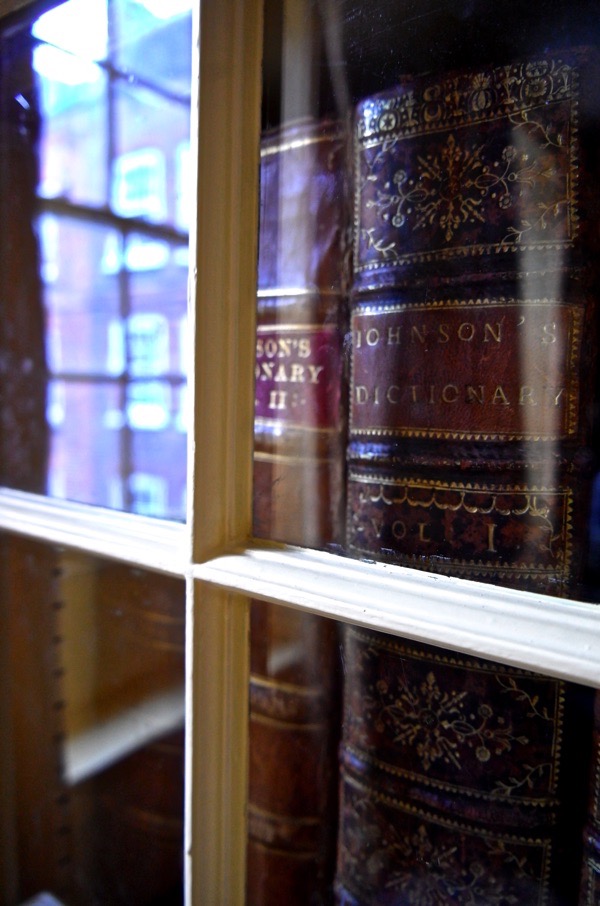
Díctionary. n.s. [dictionarium, Latin.] A book containing the words of any language in alphabetical order, with explanations of their meaning, a lexicon, a vocabulary, a word-book.
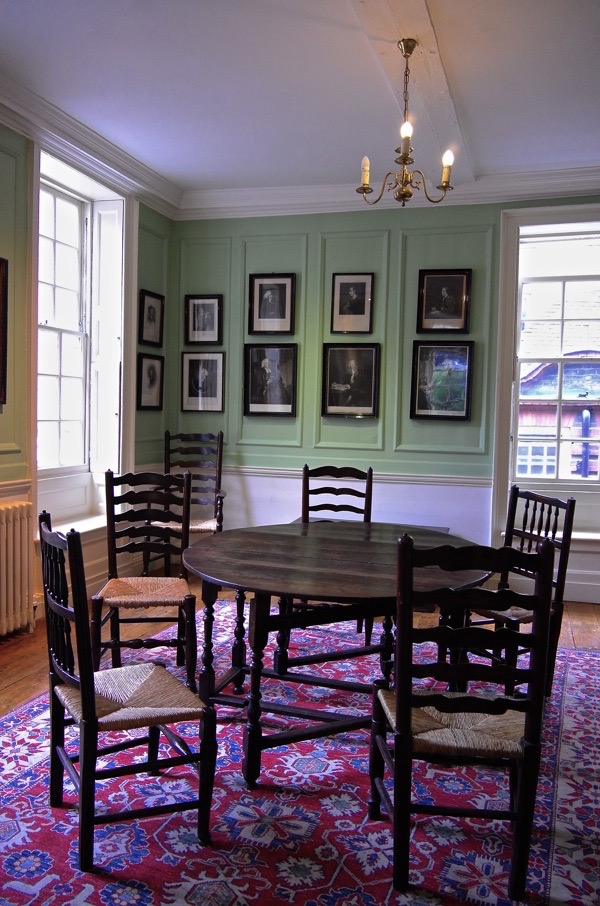
A’ftergame. n.s. [from after and game.] The scheme which may be laid, or the expedients which are practised after the original design has miscarried, methods taken after the first turn of affairs.
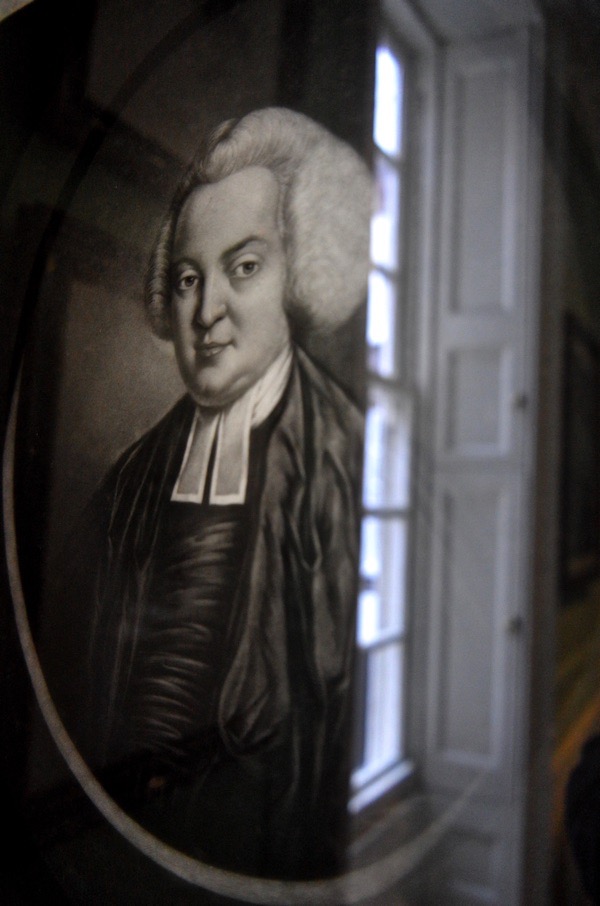
Mystago’gue. n.s. [μυσταγωγὸς, mystagogus, Latin.] One who interprets divine mysteries, also one who keeps church relicks, and shews them to strangers.
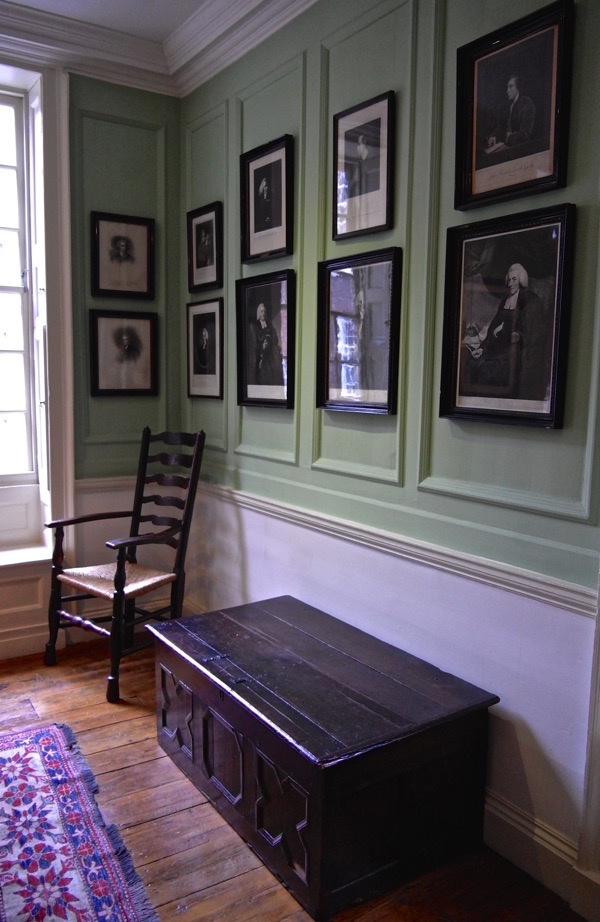
Box. n.s. [box, Sax. buste, Germ.] 1. A case made of wood, or other matter, to hold any thing. It is distinguished from chest, as the less from the greater. It is supposed to have its name from the box wood. 2. The case of the mariners compass. 3. The chest into which money given is put. 4. The seats in the playhouse, where the ladies are placed. (David Garrick’s box illustrated)
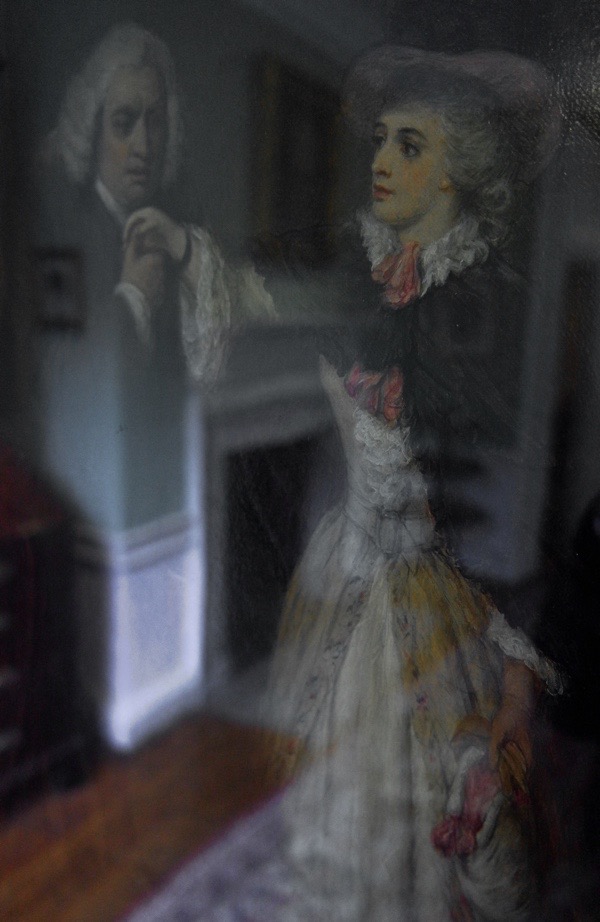
Fascina’tion. n.s. [from fascinate.] The power or act of bewitching, enchantment, unseen inexplicable influence.
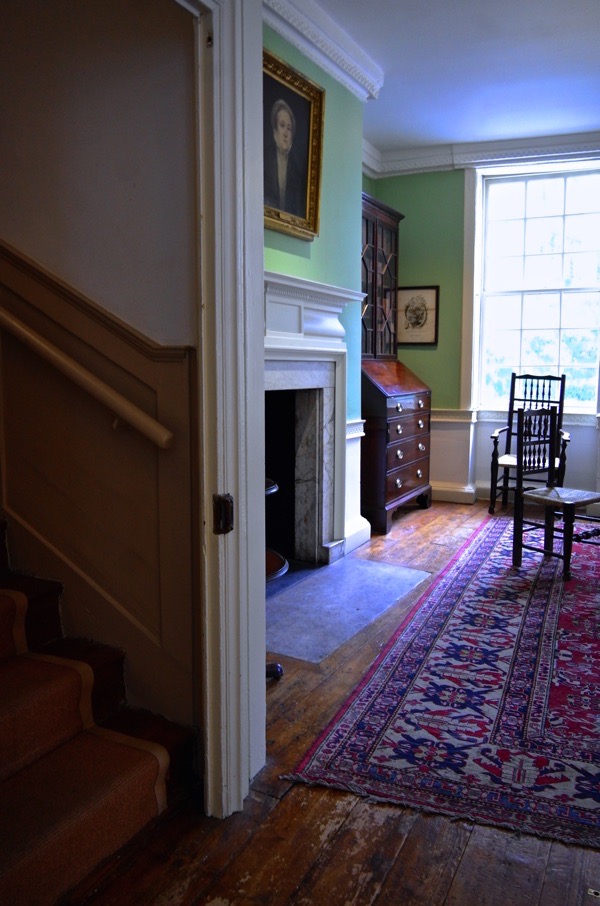
A’fternoon. n.s. [from after and noon.] The time from the meridian to the evening.
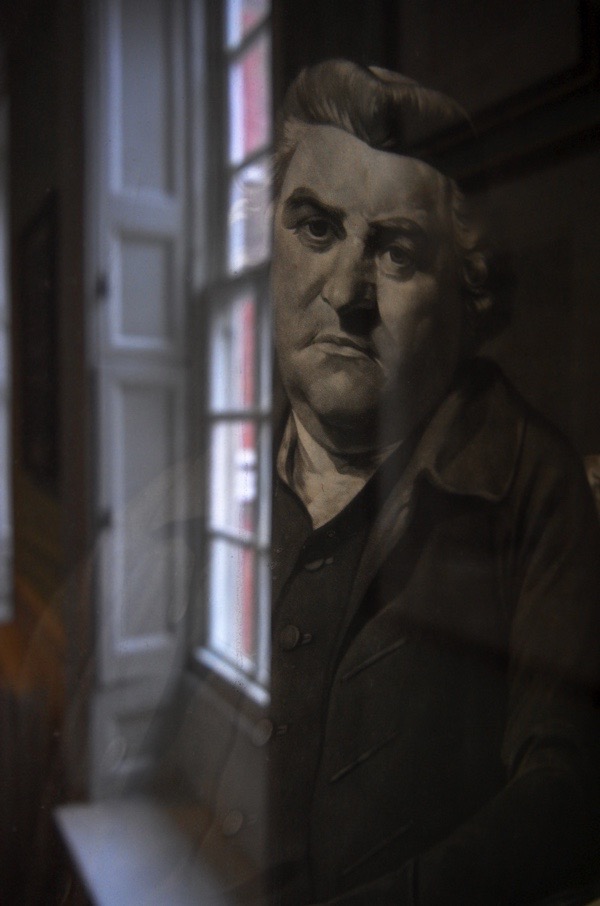
Intelléctual. n.s. Intellect, understanding, mental powers or faculties. This is little in use.
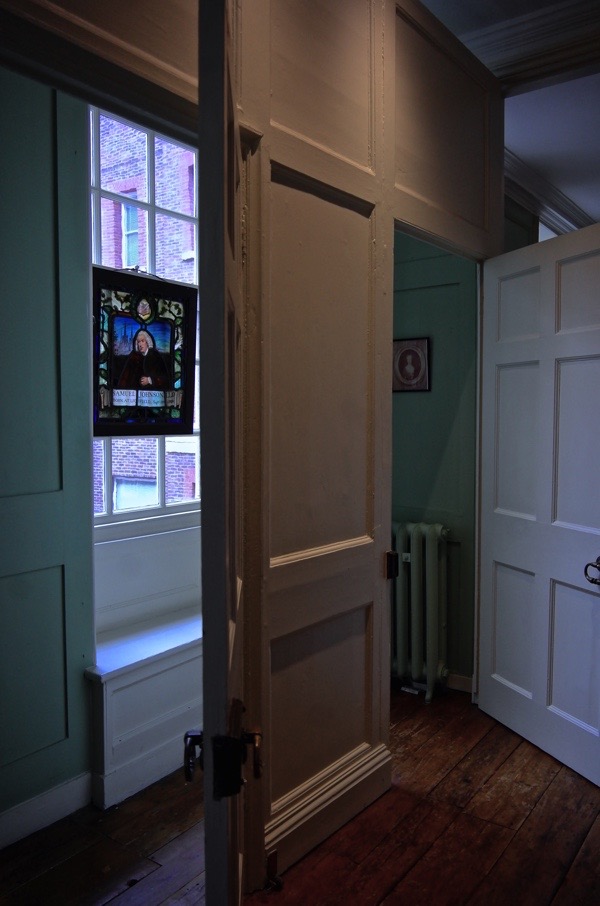
Prívacy. n.s. [from private.] 1. State of being secret, secrecy. 2. Retirement, retreat. 3. [Privauté, Fr.] Privity; joint knowledge; great familiarity. Privacy in this sense is improper. 4. Taciturnity.
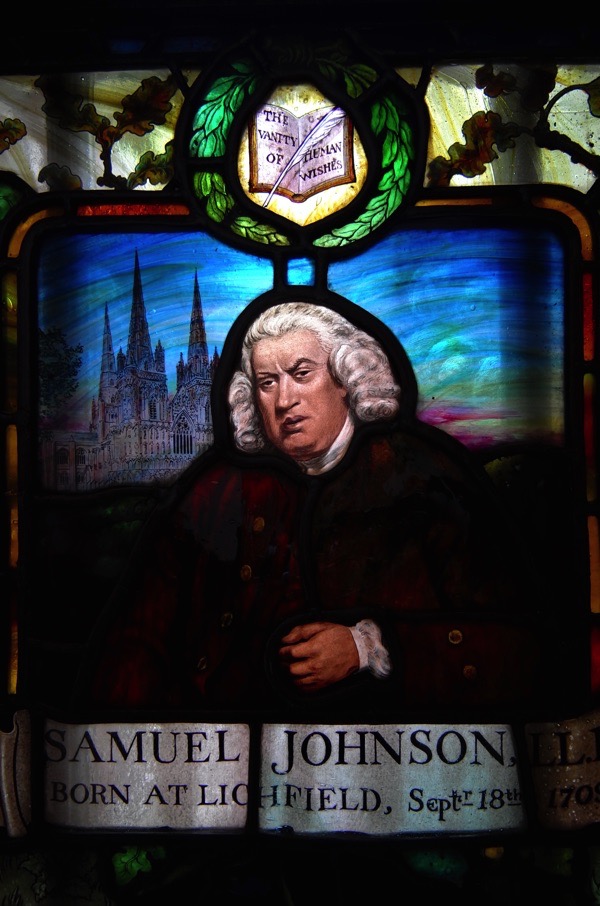
Lexicógrapher. n.s. [λεξικὸν and γράφω, lexicographe, French.] A writer of dictionaries, a harmless drudge, that busies himself in tracing the original, and detailing the signification of words.
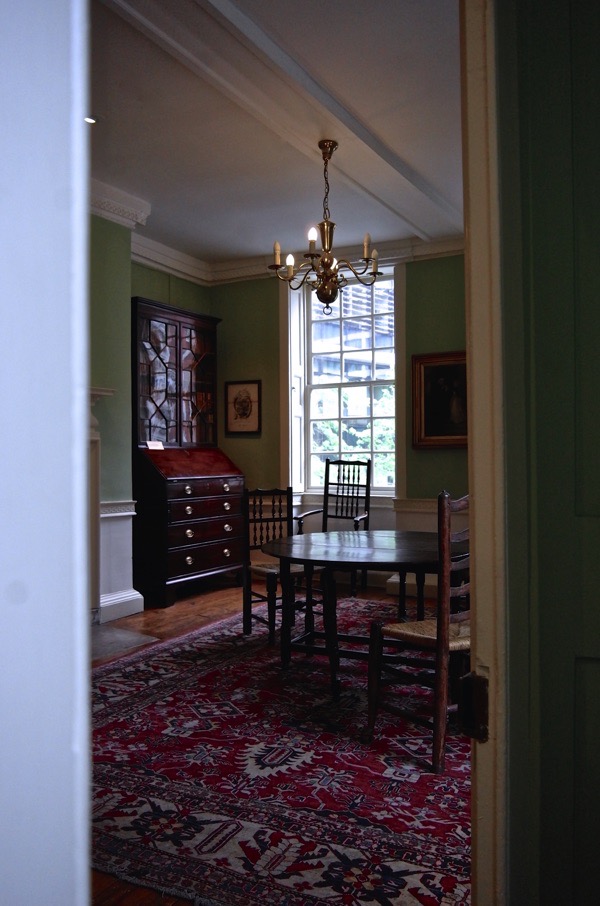
Ca’binet. n.s. [cabinet, Fr.] 1. A set of boxes or drawers for curiosities, a private box. 2. Any place in which things of value are hidden. 3. A private room in which consultations are held.
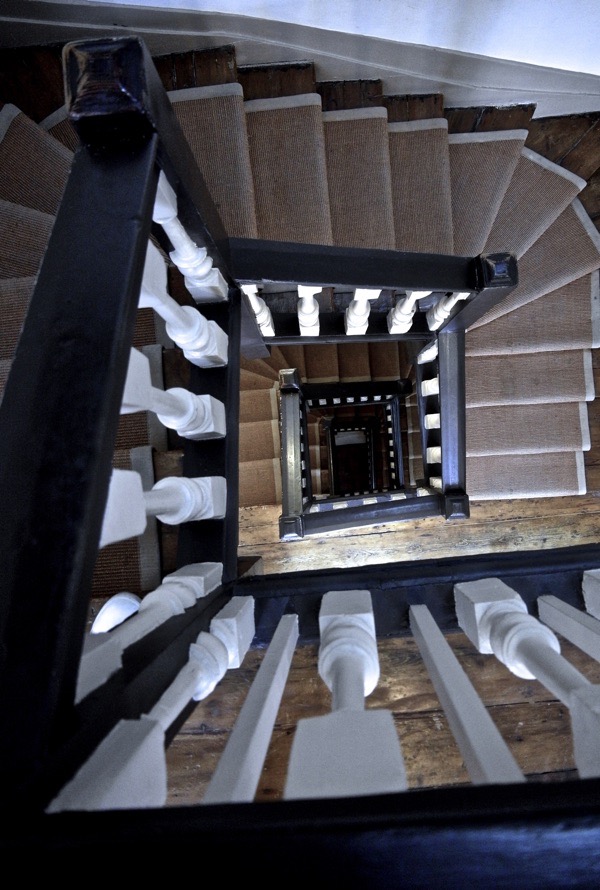
A’bsence. n.s. [See Absent.] 1. The state of being absent, opposed to presence. 2. Want of appearance, in the legal sense. 3. Inattention, heedlessness, neglect of the present object.
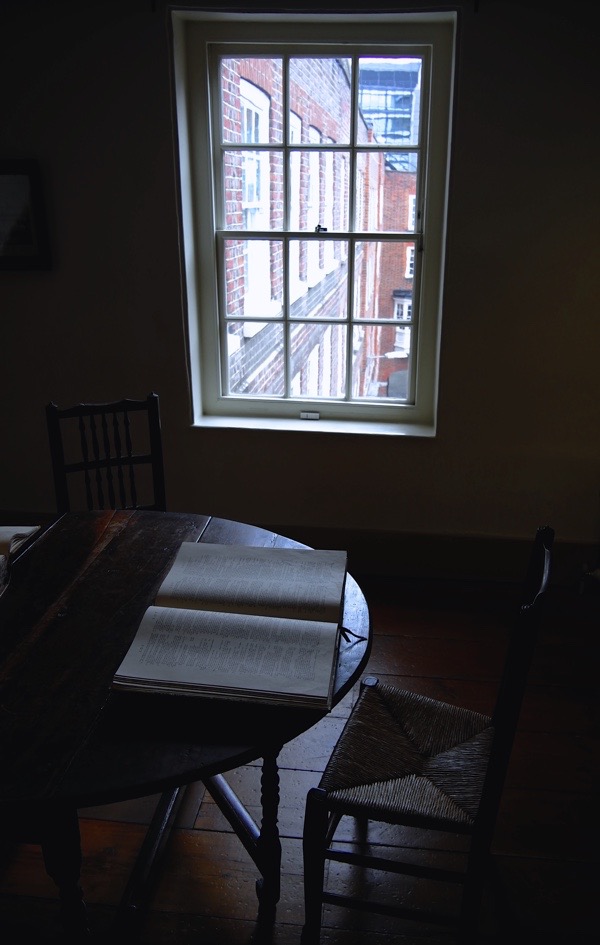
Work. n.s. [weorc, Saxon, werk, Dutch.] 1. Toil, labour, employment. 2. A state of labour. 3. Bungling attempt. 4. Flowers or embroidery of the needle. 5. Any fabrick or compages of art. 6. Action, feat, deed. 7. Any thing made. 8. Management, treatment. 9. To set on Work To employ, to engage.

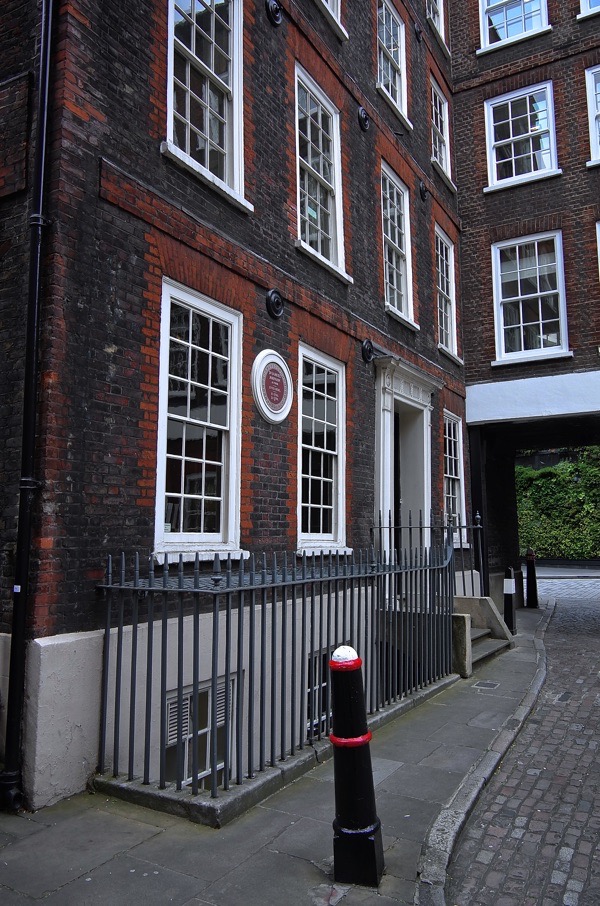
Way. n.s. [wœʒ, Saxon, weigh, Dutch.] The road in which one travels.
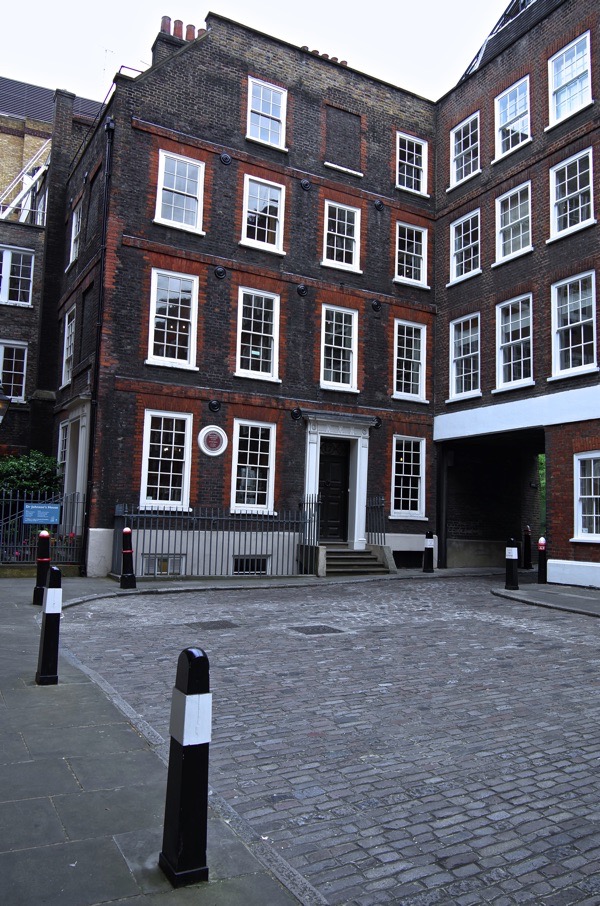
Court. n.s. [cour, Fr. koert, Dut. curtis, low Latin.] 1. The place where the prince resides, the palace. 2. The hall or chamber where justice is administered. 3. Open space before a house. 4. A small opening inclosed with houses and paved with broad stones.
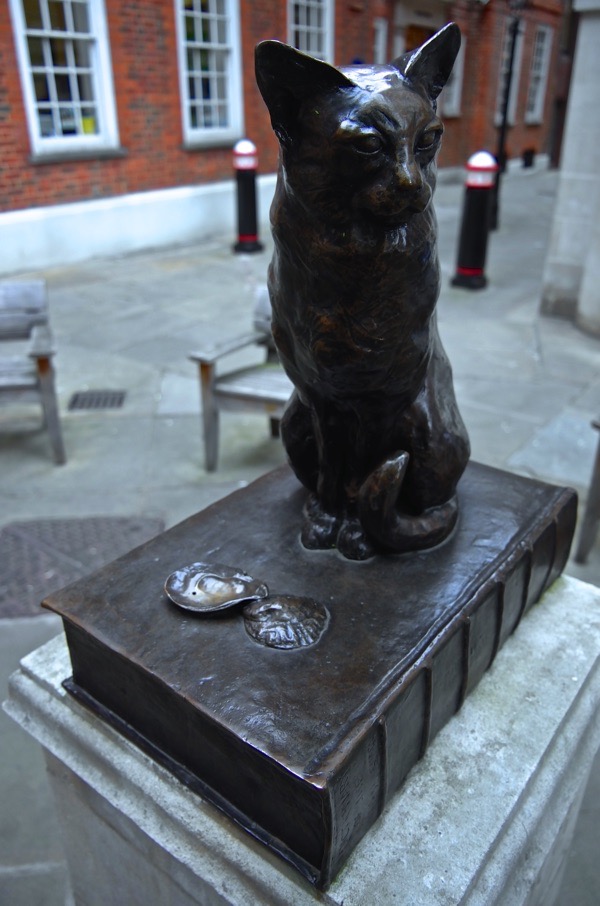
Cat. n.s. [katz, Teuton. chat, Fr.] A domestick animal that catches mice, commonly reckoned by naturalists the lowest order of the leonine species.
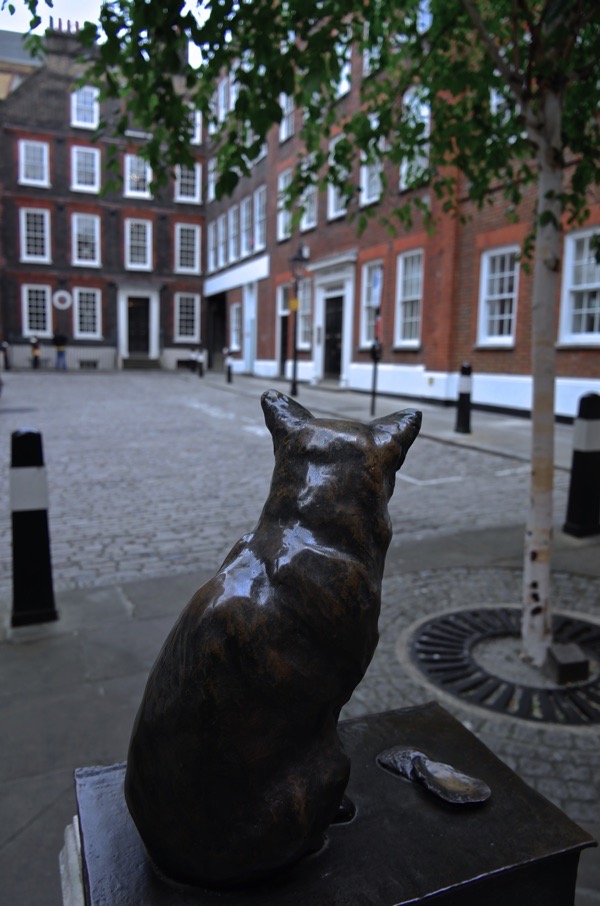
To Mew. v.a. [From the noun miauler Fr.] To cry as a cat.
Visit Dr Johnson’s House, 17 Gough Square, EC4A 3DE












