
In Search Of The Alleys Of Old London

Cover price is £35 but you can buy it from Spitalfields Life for £30
CLICK HERE TO ORDER A SIGNED COPY OF ENDURANCE & JOY
The Gentle Author will be giving an illustrated lecture, showing David Hoffman’s photos and telling the stories behind them on Thursday 7th November 7:30pm at Wanstead Tap, 352 Winchelsea Rd, E7 0AQ
I set out in the footsteps of Alan Stapleton seeking ‘London’s Alleys, Byways & Courts’ that he drew and published in a book in 1923, which I first encountered in the archive at Bishopsgate Institute.
It is a title that is an invitation to one as susceptible as myself to meander through the capital’s forgotten thoroughfares and my surprising discovery was how many of these have survived in recognisable form today.
Clearly a kindred spirit, Stapleton prefaces his work with the following quote from Dr Johnson (who lived in a square at the end of an alley) – ‘If you wish to have a notion of the magnitude of this great city, you must not be satisfied with seeing its great streets and squares, but survey its innumerable little lanes and courts.’

Jerusalem Passage, Clerkenwell

Jerusalem Passage, Clerkenwell

St John’s Passage, Clerkenwell

St John’s Passage, Clerkenwell

Passing Alley, Clerkenwell

Passing Alley, Clerkenwell

In Pear Tree Court, Clerkenwell

In Pear Tree Court, Clerkenwell

Faulkner’s Alley, Clerkenwell

Faulkner’s Alley, Clerkenwell

Red Lion Passage, Holborn

Red Lion Passage is now Lamb’s Conduit Passage, Holborn

Devereux Court, Strand

Devereux Court, Strand

Corner of Kingly St & Foubert’s Place, Soho

Corner of Kingly St & Foubert’s Place, Soho

Market St, Mayfair

Market St is now Shepherd Market, Mayfair

Crown Court, St James

Crown Court is now Crown Place, St James

Rupert Court, Soho

Rupert Court, Soho

Meard St, Soho

Meard St, Soho
Alan Stapleton’s images courtesy Bishopsgate Institute
You may also like to read about
Piotr Frac, Stained Glass Artist

Happy in the crypt beneath John Soane’s St John on Bethnal Green of 1828, Piotr Frac works peacefully making beautiful stained glass while the world passes by at this busiest of East End crossroads. Contributing Photographer Sarah Ainslie & I visited Piotr in his subterranean workshop and were delighted to observe his dexterity in action and admire some of his recent creations.
Piotr’s appealingly modest demeanour and soft spoken manner belie the moral courage and determination it has cost him to succeed in this rare occupation. This is to say nothing of his extraordinary skill in the cutting of glass and the melding of lead to fashion such accomplished work, or his creative talent in contriving designs that draw upon the age-old traditions of stained glass but are unmistakably of our own time.
Gripped by a passion for the magic of stained glass at an early age, Piotr always knew this what what he had to do. Yet even to begin to make his way in his chosen profession, Piotr had to leave his home country and find a whole new life, speaking another language in another country.
It is our gain that Piotr brought his talent and capacity for work to London. That he found his spiritual home in the East End is no accident, since he follows in the footsteps of centuries of skilled migrants, starting with the Huguenots in the sixteenth century, who have immeasurably enriched our culture with their creative energies.
“I am from a working class family in Byton, Silesia, in the south of Poland. My interest in stained glass began when I was ten or eleven years old and I went with my school to see Krakow Cathedral. The stained glass was something beautiful and that was the first time in my life I saw it. I was inspired by the colours and the light, it still excites me.
I always had an interest in drawing and painting – so, after high school, I went to a school of sculpture where they taught stained glass restoration. This was more than twenty years ago, but it was the start of my journey with stained glass. After I got my diploma in the restoration of stained glass, I worked on a project at a church for a few weeks before university. I studied art education in Silesia and I learnt painting, sculpture and calligraphy. I believe every artist needs a background in drawing and painting.
My ambition was to do stained glass, but there were hardly any jobs of any kind – I sold fish in the market in winter and I worked in a hospital, I took whatever I could get. Around 2005, I decided to leave the country. I had some Polish friends who had come to London and they helped me find a place to stay in Brixton. In the beginning, it was very difficult for me because of the language barrier. Without English, it was hard for me to communicate and find a job here. I worked on building sites. Every morning I got up at five and I walked around with this piece of paper which told me how to ask for a job. Someone wrote down a phonetic version of the words for me and I asked at building sites. After two weeks, I got a labouring job.
I lived in many places south of the river but seven years ago I moved to East London and I have stayed here ever since. At first I lived in the Hackney Rd near Victoria Park and I am still in that area, close the Roman Rd. I visited stained glass workshops but I could not get a job because I could not communicate. I did not want to work as a labourer forever so I decided to go to language school to learn English and this helped me a lot. At the English school here in the crypt of St John’s Bethnal Green, my teacher asked us to prepare a talk about myself and my interests. So I talked about my profession as a stained glass artist and my teacher introduced me to a stone carver in the crypt workshop. He told me, ‘If you are willing to teach stained glass classes, you are welcome to use the workshop.’ I started eight years ago with one student.
My first commission was to repair a Victorian glass door. Most of my work has been Victorian and Edwardian windows and doors, which has allowed me to survive because there are plenty that need repair or replacement. There are not a lot of creative commissions on offer but sometimes people want something different.
Two years ago, I won a competition to design a window for St John’s Hackney. It took a year for them to approve the design and I am in the middle of working on it now. I need to finish and install it. Also the Museum of London bought a piece of mine. It is gorilla from a triptych of gorillas and it will be displayed there next year.
Once I moved to East London, I felt I belonged to here – not only because I started my workshop but because I met my wife, Akiko, here. In 2016, I become a British citizen so now I am a permanent member of the community.
Stained glass is a wonderful medium to work with and always looks fantastic because it changes all the time with the light, in different times of the day and seasons of the year. I believe there is a great potential for stained glass in modern architecture.
These days I am able to make a living and I would like to become more recognised as a stained glass artist. I am seeking more ambitious commissions.”

Constructing a nineteenth century door panel


A panel from Piotr’s triptych of gorillas


Piotr’s first panel designed and made in London

Piotr with one of his stained glass classes in the crypt of St John’s Bethnal Green


Repairing a Victorian glass door

Restoring nineteenth century church glass

Before repair

After repair

Piotr Frac, Stained Glass Artist
Studio portraits © Sarah Ainslie
Contact Piotr Frac direct to commission stained glass
You may also like to read about
The Little Visitors
Sian Rees introduces an unexpected discovery in the work of Maria Hack (1777 – 1844), published by Darton, Harvey & Darton of Gracechurch St in the City of London

In Maria Hack’s The Little Visitors, published in London in 1815, one of the characters is a young slave. Although you might not expect children’s books of the Georgian era to explore the experience of slavery, some authors did embrace the challenge of discussing it with a young readership.
Even after the slave trade was outlawed by the 1807 Slave Trade Act, it was not until the Slavery Abolition Act of 1833 that it became illegal to own or purchase slaves. Maria Hack’s father, John Barton, had been involved in the Society of Friends to Influence the Abolition of Slavery.
In her book, Tom is a twelve-year-old boy who has been bought by sailors in the West Indies and brought to England, before being rescued from poor treatment and delivered to safety. Unsurprisingly perhaps, the wider industry of slavery is not portrayed in detail but Tom’s presence in the story as a credible and charismatic character reveals the violence of his origins through personal experience.
Maria Hack wrote educational books to provide children with assistance in reading, offering information about the world and moral guidance. This ‘conduct of life’ genre was popular among women writers and pioneered by Mary Wollstonecraft in the late eighteenth century. The protagonists are children of the same age as the readers in familiar situations they could recognise and relate to.
The Little Visitors is the story of two sisters, Ellen & Rachel, who visit their learned aunt’s house in the countryside. Through a series of dialogues with their erudite aunt, the girls learn about horticulture, the origin of household goods such as tea and coffee and how the poor sustain themselves through working in farming and domestic service. By the standard of modern children’s books, the story is lacking in excitement. But Maria Hack enlivens her tale by introducing an element of mystery in the form of the aunt’s unusual angora cat, Rosa.
Although the girls are curious to know who gave the cat to their aunt, there is never enough time at the end of each day of educational improvement for her to tell them. So the intrigue builds until one morning their aunt is ready to explain that she once rescued Tom, a child slave, who gave her the cat as a thank you present.
The aunt and Tom met by chance in a seaside town, when she heard a child crying out in distress and saw a black boy trying to escape from a sailor. The aunt confronted the sailor and persuaded him to accept money for the boy, then she placed Tom with someone she trusted to treat him with kindness. The protagonists, Ellen & Rachel, never actually meet Tom but his sympathetic representation as a character of the same age as the girls ensures that they and the readers identify with him and his situation.
Growing up in the sixties and sixties, I do not recall much diversity in the children’s books of that era. So while Maria Hack’s story reveals the limitations of her time, we should recognise her initiative in making a black character visible and refusing to erase slavery from her portrayal of everyday life.


Images courtesy University of California
Sian Rees is the author of PLANTING DIARIES, Gardens, Planting Styles & Their Origins
You may also like to take a look at
The Cabbies’ Shelters Of Old London
Created between 1875 and 1914, sixty of these structures were built by the Cabmen’s Shelter Fund established by the Earl of Shaftesbury to enable cabbies to get a meal without leaving their cabs unattended and were no larger than a horse and cart so they might stand upon the public highway.
Today, only thirteen remain but all are grade II listed and, on my pilgrimage around London in the sunshine, I found them welcoming homely refuges where a cup of tea can be had for just 50p.

Thurloe Place, SW7

Embankment Place, Wc2
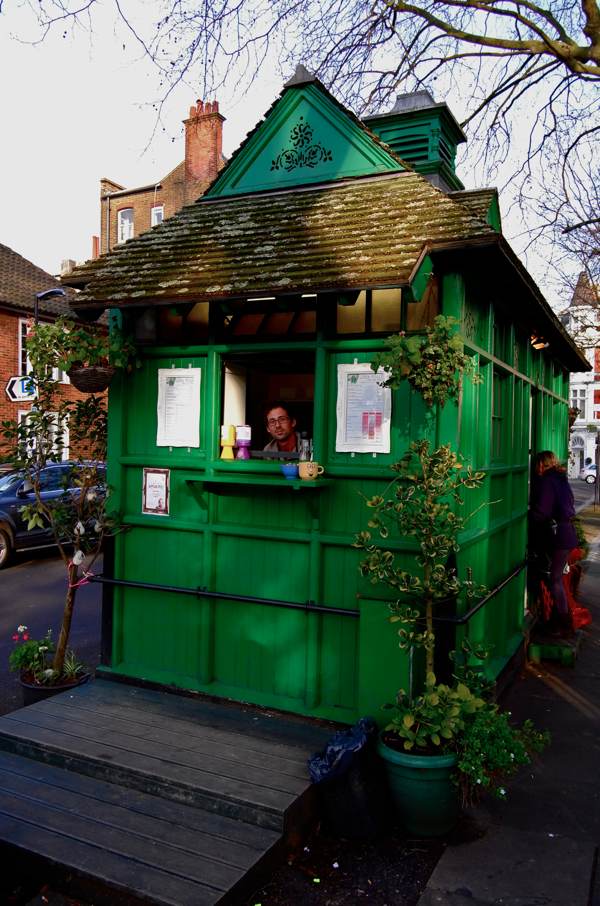
Wellington Place, NW8

Chelsea Embankment, SW3

Grosvenor Gardens, SW1

St Georges Sq, SW1

Kensington Park Rd, W11

Temple Place, WC2

Warwick Ave, W9

Russell Sq, WC1

Kensington Rd, W8

Pont St, SW1

Hanover Sq, W1

The shelter attendant at Wellington Place has special spoon-bending powers
You may also like to read about
From Ken Sequin’s Badge Collection
From hundreds in his magnificent collection, Ken Sequin kindly selected badges for me with a local connection – and they comprise an unexpected history of the East End.
Button badges were invented in 1896, when Benjamin Whitehead of Whitehead & Hoag in New York filed a patent for a celluloid-covered metal badge, swiftly opening offices in London, Toronto & Sydney as the craze went global.
Adopted first as a means of advertising by tobacco companies, button badges were quickly exploited for political, religious and fund-raising purposes by all kinds of clubs and organisations.

Kingsland Rd Costermongers Association manufactured by E. Simons, late nineteenth century – one of the rarest badges, possibly a unique survivor

Souvenir of Dirty Dick’s in Bishopsgate, twenties or thirties

St John at Hackney Parochial School founded in 1275 is one of the oldest in the country, early twentieth century

Woolwich Arsenal Football Club, 1907

Hackney Band Club, hat badge c1873, one of the most radical Working Men’s Clubs

Boer War, 1900 – one of the very earliest button badges in this country

Reverse of previous badge, note local manufacturer

Royal Eye Hospital, Moorfields – early twentieth century

Lea Bridge Speedway Supporters’ Club – 1928-32

Dartford Pageant, 1932

Possibly the Regal Edmonton, 1934

Bethnal Green Men’s Institute, Gymnastics, Turin St, early twentieth century

Temperance and Salvation Army buttons, early twentieth century

Dockers Trade Union Badge, established 1889

A cache of badges found in an allotment shed in Walthamstow

World War II propaganda badges

Salvage. Dulwich Council

St George’s Sunday School, Weslyan Mission House, in the eighteen-nineties it took over Wilton’s Music Hall

Reverse of previous badge

WWII National Air Raid Precautions Animals Committee, dog’s identity badge

World War II badges for fundraising clubs to build airplanes

WWII Fundraising club to buy a destroyer

First Labour Mayor of Poplar, Will Crooks was elected MP for Woolwich in 1902

Reverse of buttons above

Dulwich & District Defence League, a Home Front battalion established in 1915

The Mildmay Hospital in Shoreditch was named after Francis Bingham Mildmay in 1890

Early twentieth century silver badge rewarding service in hospital ‘meals on wheels’ service

Barnado’s Young Helpers’ Badge with a portrait of the founder, early twentieth century

Tilbury Seamen’s Hospital, ‘For services rendered’ – possibly thirties

John Groom’s Crippleage & Flower Girls Mission, fund-raising rosettes, c 1900
Photographs copyright © Ken Sequin
You might also like to take a look at
John Gillman’s Bus Ticket Collection
Viscountess Boudica’s Domestic Appliances
Libby Hall’s Dog Photography Collection
Clive Murphy’s Matchbox Label Collection
In Search Of Grinling Gibbons

Click here for more information

At St Mary Abchurch, Hugh climbs up to take a closer look
Master wood carver Hugh Wedderburn took me on a quest in search of Grinling Gibbons in the City of London. Gibbons was born in Rotterdam in 1648, where he trained as wood carver and was exposed to the art of Dutch still life painting before he came to Britain in 1667.
John Evelyn wrote in his diary in 1671, ‘I this day first acquainted with a young man Gibson [sic] whom I had lately found in an obscure place & that by mere accident, as I was walking neere a poor solitary thatched house in a field in our parish neere Says Court. I found him shut in but looking through the window I perceiv’d him carving that large cartoone or Crucifix of Tintoretto.’
John Evelyn arranged introductions for Grinling Gibbons to King Charles II and Christopher Wren, enabling him to set up his workshop on Ludgate Hill – an auspicious and opportune location for a wood carver, beside the ruins of Old St Paul’s.
It is significant that Evelyn described Gibbons carving from a two-dimensional image, transforming it into physical form. Today Gibbons is recognised for his extraordinarily lifelike carvings of flowers, fruit and foliage, which bear a relationship to still life painting yet upon close examination are less naturalistic than they may at first appear.
From Hugh Wedderburn’s workshop in Southwark, we undertook our quest westward across the City, commencing at the Tower of London to visit the Parade of Kings – a sequence of monarchs in armour on horseback – where a wooden horse is attributed to Gibbons and a portrait head of Charles I is by the same hand. While the other horses are lifeless merry-go-round figures, more mounts for armour than sculptures in their own right, it is easy to appreciate why this one particular horse might earn its attribution, with its lifelike flared nostrils and bulging veins visible through the skin. The accompanying head of Charles I possesses a soulful melancholy and presence, in stark contrast to the workmanlike nature of the others.
Just up the hill at All Hallows By The Tower, we admired the elaborate font lid of foliage with two putti gesturing to the large bird atop the construction. When the lid is suspended up above the font for ceremonies and seen from below, it has proportion and balance with everything in place. Yet when it is lowered, the sculpture appears distorted and the putti’s anatomy bulges curiously. This is an example of carving in perspective and evidence of Gibbons’ sense of theatre, creating a visual effect that works from a single view point and is deliberately non-naturalistic.
Just five minutes walk away at St Mary Abchurch, Hugh and I climbed up ladders to admire the swags on the reredos closely. When these swags were first installed the pale lime wood stood in contrast to the dark oak background, throwing them into even more dramatic relief. This is what we imagine when we think of Grinling Gibbons – lush garlands of fruit, flowers and foliage that he carved in a manner which appeared more lifelike than had been seen before.Yet on close examination, it became evident that the definition of the leaves and fruit was only carved where it was visible, with the forms merging into abstraction away from view.
At St Paul’s, we admired Grinling Gibbons majestic quire stalls and epic organ case before climbing up into the roof where trays of bits and pieces that have fallen off over the centuries are preserved. Like the most fascinating jigsaw in the world, here are thousands of fragments that all belong somewhere. Examining them closely revealed the breathtaking detail of the carving by Gibbons and his studio who were responsible for all the architectural decoration in the cathedral. Even the wings on the angels can be identified as derived from different species of birds, revealing the minute observation of the natural world that informs these bravura carvings.
As we left the cathedral, Hugh and I paused to look back at the west front and admire Gibbons’ lavish foliate adornments that provide such a successful counterpoint to the austerity of Wren’s geometry. Somehow the palm leaves on the Corinthian columns are more luxuriant that you might expect. Garlands of leaves and fruit have been hung directly across structural elements of the design, disrupting its formality.
The legend that Gibbons and Wren had a tense working relationship comes as no surprise because the conflict is evident in the dynamic between the two visual languages at play. Yet it is this dynamic between the classical geometry and the presence of organic forms that makes this architecture so compelling and alive. This is Gibbons’ contribution and one of many reasons why we should celebrate his genius.

Head of Charles I attributed to Grinling Gibbons

Horse in the Parade of Kings in the White Tower

Font cover at Allhallows by the Tower

Reredos at St Mary Abchurch

St Mary Abchurch

St Mary Abchurch

St Mary Abchurch

St Mary Abchurch

St Mary Abchurch

St Mary Abchurch

St Mary Abchurch

St Mary Abchurch

Missing pieces from Grinling Gibbons’ quire at St Paul’s

Missing wings from putti at St Paul’s

Different designs of cornicing at St Paul’s

Grinling Gibbons quire stalls at St Paul’s

Canopy over the Bishop’s Throne at St Paul’s

Note the repairs to the quire in new lime wood that is still pale in tone

Bishop’s Throne by Grinling Gibbons at St Paul’s

Repairs at St Paul’s

Grinling Gibbons epic organ case at St Paul’s

In Hugh Wedderburn’s Southwark workshop, a frame for designer Marianna Kennedy

Hugh’s collection of chestnuts and acorns to plant trees for generations of wood carvers to come

Hugh plants his acorns and chestnuts


Hugh’s saplings that will be his legacy to future wood carvers
Visit THE GRINLING GIBBONS SOCIETY to learn more
You may also like to read about
Charles Keeping’s Cockney Ding Dong

Click here to book for this afternoon’s tour
We publish these pictures as part of the celebrations of the centenary of the birth of illustrator Charles Keeping (1924–1988)

The illustrations of Charles Keeping burned themselves into my consciousness as a child and I have loved his work ever since. A major figure in British publishing in the last century, Keeping illustrated over one hundred books (including the entire novels of Dickens) and won the Kate Greenaway and Carnegie Medals for his superlative talent.
In 1975, Keeping published ‘Cockney Ding Dong,’ in which he collected songs he remembered sung at home as a child. Illustrated with tender portraits of his extended family, the book is an unusual form of autobiography, recreating an entire cultural world through drawing and popular song.
I visited the Keeping Gallery at Shortlands in Kent to meet Vicky and Sean Keeping who talked to me about their father’s work, as we sat in the family home where they grew up and where much of his work is now preserved and displayed for visitors. You can read my interview at the end of this selection of illustrations from ‘Cockney Ding Dong.’


Illustrations copyright © Estate of Charles Keeping
The Gentle Author – So why did your father create ‘Cockney Ding Dong’ ?
Vicky Keeping – We come from a family – he came from a family – where they all got together. They’d have their beer, they enjoyed their beer, and their Guinness – some of the women drank Guinness – and they would all sing and his Uncle Jack would play the piano. And everybody had their own song, so people would give their song and Dad loved that. We still know them all still, because we loved it, and people didn’t say, ‘Oh no, I’m not going to do it!’ They just got up and sang, and it was lovely and the songs were all from the music hall.
The Gentle Author – But he wasn’t a Cockney – where was he was from?
Vicky Keeping – He was from Vauxhall and he was born in Vauxhall Walk, Lambeth. He was very much brought up by the female side of his family. His father passed away when he was ten, he had a burst ulcer. He was a driver on the Daily Star.
Sean Keeping – Before that, his father had been a professional boxer between about 1912 and 1922. He had many professional fights. I know he definitely fought the British champion at the time and won! A chap called Ernie Rice.
His father came from a very poor family and he was orphaned. They had a watercress stall in Lambeth Walk but they died in the workhouse. His mother’s family were also Londoners from Lambeth who came from a nautical background – his grandfather had been a sailor in the Merchant Navy. In the eighteenth century, they had come up to London from the West Country. Like many families, they had not originated in London.
Vicky Keeping – His grandfather was very important to Dad, because he was a great storyteller and would tell stories from his voyages and the different people he met and he was – I suppose – a bit ahead of his time because he was welcoming to all and would speak very positively about the people he met around the world. Dad loved hearing his stories, so he learnt from his grandfather that storytelling was important. That came through to us as well – when we sat round the family tea table we were encouraged to tell stories.
Very sadly, Dad’s dad and Dad’s grandfather passed away in the same year – in 1934 – when Dad was ten. It left Dad and his sister Grace and their mum Eliza very poorly off, but they lived in this extended family with Dad’s granny who was a very strong influence. Dad idolised her and his aunties, and they thought he was the blonde blue-eyed boy and they loved him dearly.
Sean Keeping – They lived in a small terraced house in 74 Vauxhall Walk, which was right alongside the market, and Dad’s early influences were not just his family but also the characters in Vauxhall Market – those often crop up in his books.
Vicky Keeping – One of the things that Dad loved to do in the garden was to look through a little knot hole to see the Schweppes bottling plant and the workhorses and that was something that never left him, that memory of horses.
There was no obvious creativeness in his background, but Dad said his father used to come home – because he worked in print – and bring home paper, and Dad’s sister Grace used to write a story and Dad would illustrate it.
Sean Keeping – He was not a child who would have gone running around the streets, they were children who would sit at home writing a story and drawing. From a very young age, Dad showed a fantastic aptitude for drawing and we’ve got some drawings of his from when he was twelve and thirteen, and they are really fantastic – showing a London of working horses and working people, that’s what he was trying to depict in his drawings.
Vicky Keeping – He was called up in the Second World War but he worked for Clowes the printers when he left school at thirteen. He was not a particularly great scholar at school. One of the things was that he found difficult was that he was left-handed and the teachers would try to get him to write with his right hand.
Sean Keeping – Working for Clowes the printers, he would go around on a horse & cart delivering paper, and that was where he met one of the characters who had a great influence on him – Tom Cherry. Many of the burly-looking men driving a horse through London in Dad’s pictures – they’re Tom Cherry, and usually he drew a little boy sitting next to him which was Dad. Tom had a great influence, telling him stories about London and the people of London.
Vicky Keeping – Dad became a Telegrapher on a frigate and he was on the boat at D-Day. After the war, he tried to get into Art College but that was very difficult, so he worked collecting pennies from gas meters. He worked for the Gas Light & Coke Company and he would go around on a bicycle, with a big sack on his shoulder with all the pennies in it, going from door to door in North Kensington. He used to tell us funny stories. At that time, North Kensington was a poor area and I think he got a lot out of the characters he met there, but he hated working for a company, for a boss, and he decided he wanted to do something better.
He went to night classes at the Regent St Polytechnic but, because he left school at thirteen with no formal qualifications and had been through the war, it was very difficult for him to get in at first. He tried and tried, and eventually he spent time in a psychiatric hospital due to his experiences in the War. I think it was also to do with his father. When his father and his grandfather died in the same year, they were laid out in the front room and – as a ten year old – Dad had to go and kiss them. That had a profound effect on him. He spent six months in a psychiatric hospital and two weeks of those were in a deep sleep. Yet he talked about the great characters he met there and there was a Psychiatrist, Dr Sargent, who knew Dad should go to Art College and he supported him in writing letters – and eventually that’s what happened.
Sean Keeping – When Dad went to Art College, he had to fight hard to get a grant because, at that stage, his mother had been widowed for a number of years and she had a job cleaning, so there was not a lot of money around. But eventually, he got a grant to go to Regent St Polytechnic. Right after the war, there were two types of students – those that had just come out of the forces who were much more mature and those who had come directly from school. So it was an interesting mix of people and mix of cultures.
The Gentle Author – How did he set out to make an income as an illustrator?
Sean Keeping – Dad was not motivated by making a career or making money or even motivated – I think – by success. Dad was motivated by one thing and that was doing what he wanted to do – drawing pictures of things that he wanted to draw pictures of – so he never really thought about a career. But then he got a job on the Daily Herald, drawing the strip cartoon and that started to pay very well, and from that he was able to move out of the council flat that he lived in with his mother in Kennington and buy a small terraced house in Crystal Palace.
When they were looking for houses, once he was making money from the strip cartoon, they looked in two areas – one was Crystal Palace and the other was Chelsea. Now the idea that you might choose Crystal Palace or Chelsea to look for a house nowadays is an strange idea, but they decided on Crystal Palace!
(Transcription by Rachel Blaylock)

Visit The Keeping Gallery at Shortlands in Kent where you can see the work of both Charles & Renate Keeping preserved in their family home. Visits are by appointment arranged through the website and Shortlands is a short train ride from Victoria.


