
Peter Bellerby, Globemaker

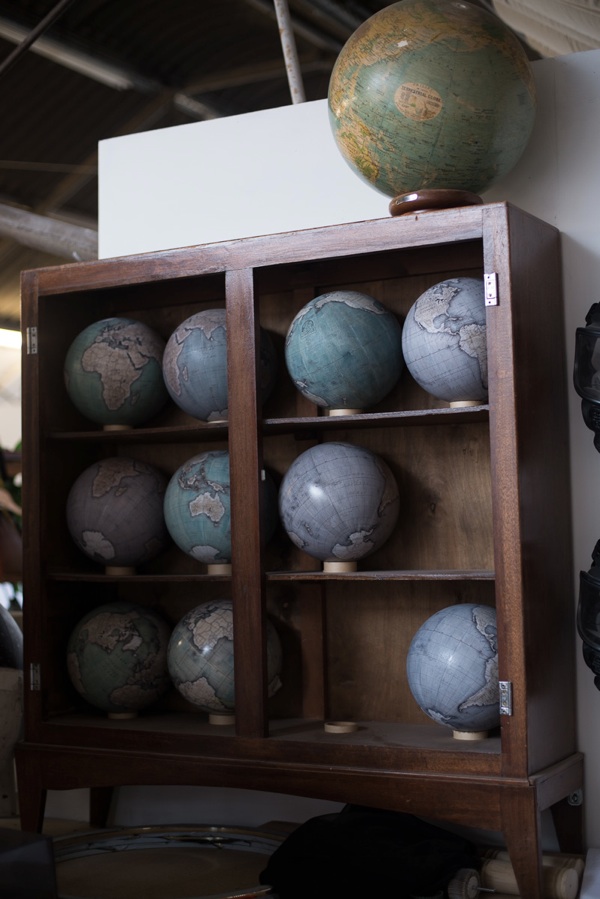
Just a couple of years ago, Peter Bellerby of Bellerby & Co was unable find a proper globe to buy his father for an eightieth birthday present. Now Peter is to be found in his very own globe factory in Stoke Newington and hatching plans to set up another in New York – to meet the growing international demand for globes which he expects to exceed ten times his current output within five years. A man with global ambitions, you might say.
Yet Peter is quietly spoken with deferential good manners and obviously commands great respect from his handful of employees, who also share his enthusiasm and delight in these strange metaphysical baubles which serve as pertinent reminders of our true insignificance in the grand scheme of things.
A concentrated hush prevailed as Contributing Photographer Sarah Ainslie & I ascended the old staircase in the former warehouse where we discovered the globemakers at work on the top floor, painstakingly glueing the long strips of paper in the shape of slices of orange peel (or gores as they are properly known) onto the the spheres and tinting them with fine paintbrushes to achieve an immaculate result.
“I get bored easily,” Peter confessed to me, revealing the true source of his compulsion, “But making globes is really the best job you can have, because you have to get into the zone and slow your mind down.”
“Back in the old days, they were incredibly good at making globes but that had been lost,” he continued, “I had nothing to go by.” Disappointed by the degradation of his chosen art over the last century, Peter revealed that, as globes became decorative features rather than functional objects, accuracy was lost – citing an example in which overlapping gores wiped out half of Iceland. “What’s the point of that?,” he queried rhetorically, rolling his eyes in weary disdain.
“People want something that will be with them for life,” he assured me, reaching out his arms around a huge globe as if he were going to embrace it but setting it spinning instead with a beautiful motion, that turned and turned seemingly of its own volition, thanks to the advanced technology of modern bearings.
Even more remarkable are his table-top globes which sit upon a ring with bearings set into it, these spin with a satisfying whirr that evokes the music of the spheres. Through successfully pursuing his unlikely inspiration, Peter Bellerby has established himself as the world leader in the manufacture of globes and brought a new industry to the East End serving a growing export market.
To demonstrate the strength of his plaster of paris casting – yet to my great alarm – Peter placed one on the floor and leapt upon it. Once I had peeled my fingers from my eyes and observed him, balancing there playfully, I thought, “This is a man that bestrides the globe.”



Isis Linguanotto, Globepainter


John Wright, Globemaker


Chloe Dalrymple, Globemaker


Peter Bellerby, on top of the globe
Photographs copyright © Sarah Ainslie
More Birds Of Spitalfields
When I published my Birds of Spitalfields, selected from Thomas Bewick’s History of British Birds 1797, I invited readers to send in their additions to my survey and today I publish this list accompanied by the relevant extra plates.

Pied Wagtail – spotted by Ash on the Holland Estate, Petticoat Lane
 Rose-ringed Parrakeet – an occasional visitor
 Heron – spotted flying overhead in Spitalfields
 Buzzard – spotted over Holland Estate, Petticoat Lane

Blackcap – spotted by Libby Hall in Clapton
 Swift – spotted by Ian Harper around Christ Church

Raven – spotted by Ian Harper & Jim Howett around Christ Church

Kite – spotted by Ian Harper & Jim Howett around Christ Church

Sparrowhawk – spotted by Vivienne in Islington

Long-tailed Tit – spotted in Wapping

Willow Warbler – spotted by Tony Valsamidis in Whitechapel

Greater Spotted Woodpecker – spotted by Annie Martin in Finsbury Park
You may also like to take a look at
Clive Murphy, Autograph Hunter

“May I have your autograph?”
My friend Clive Murphy, Oral Historian, Novelist, Writer of Ribald Rhymes, Philumenist, Snapper and Exhibitionist, was once also an Autograph Hunter. “I was already collecting at eight, writing around to radio personalities for their autographs,” he recalled fondly, “When I went to Castle Park Prep School it became my craze. Although it was a lot of work writing the letters, it was very exciting waiting for the replies.”
Recently, when Clive gave many of his personal papers to the Bishopsgate Institute, his childhood Autograph Album from the late forties came to light and we spent an hour going through it together. With its pages of inspirational verse written by teachers and autographed studio portraits of radio personalities from long ago, this modest volume is a poignant evocation of the post-war affluent middle class world in Dublin that Clive left behind. “It was a phase I went through,” he assured me with finality, once we had studied the Album.
Growing up in a sheltered suburb, Clive’s well-connected mother hoped he might eventually become Solicitor to Trinity College but instead, once he qualified, Clive ran away to London in search of the bright lights and became Lift Attendant at Lyons Corner House in the Strand.
Subsequently, Clive won success for his novels and a ground-breaking series of oral history books, entitled ‘Ordinary Lives.’ Thus he rejected the privileged world of his upbringing – and the fascination with celebrity incarnated in his Album – for a modest existence comprising menial jobs and rented rooms, while exploring his personal interest as a writer in the lives of working people.
In 1974, Clive moved into a tiny flat above the Aladin Curry House on Brick Lane where he lives happily to this day. “There I was living in a goldfish bowl, but here I am a non-entity,” he admitted to me without regret.
(Clive is currently working on the oral autobiography of Joan the Cat Lady of Spitalfields, entitled ‘Angel Of The Shadows.’ He kept in regular touch with her from 1991 until her death in 2011.)


“My Latin teacher”

Jimmy O’Dea – “The most famous Dublin comedian that ever was – I think I stood at the Stage Door of the Gaiety Theatre to get that. I went there every year to the Pantomime. The great shame at school was if you went to a matinee, everyone wanted to go in the evening when the jokes were much naughtier. I don’t know why they call it ‘adult’ humour – it doesn’t say much for adults does it?”

Leslie Malcolmson – “A most gifted teacher of English who would go to infinite pains upon behalf of favoured pupils such as myself. He thought I might have some talent. He directed me in the role of ‘Dopey’ in ‘Snow White & the Seven Dwarfs.'”

Donald Wormell – “He became Provost of Trinity College, Dublin, but he didn’t like it and had to be relieved of it. All public speeches were done by him in Latin.”

Sandy McPherson “A popular organist, the kind of music that would be played in the cinema before the film begins. I heard him play many times on the radio.”

“He and his wife were close friends of my mother. We often went to the theatre together and I called him ‘uncle.’ He was a Director of the Bank of Ireland.”

“This was a real coup”

Kenneth Horne – “He was with Richard Murdoch in ‘Much Binding in the Marsh.'”

“This was written by my English teacher”

Gracie Fields – “I was a terrific fan of Gracie Fields, she had a gift of being terribly funny. ‘The biggest aspidistra in the world,’ she made it sound terribly rude. But she could sing ‘Wish me luck as you wave me goodbye’ and be terribly serious. She had this marvellous untrained voice.”

Tommy Handley – “We listened in to ‘I.T.M.A’ at Prep School.”

“This was my first teacher at eight years old. We called here ‘Braddy Depth Charge’ because she was a large lady. She wrote this when I left at thirteen.”

Stephen Goodin – “He designed some of Britain’s coinage. When he died I got his cast-offs – his tailcoat and his dinner jacket.”

“I especially like this picture of Richard Murdoch star of ‘Much Binding in the Marsh.’ As with the others, he was kind enough to send it to me even though I couldn’t enclose a stamped addressed envelope as Irish stamps were no use in the United Kingdom.”

Richard Dimbleby, Broadcaster –“I asked him to get me the signatures of everyone else on a show and – as you can see – he wrote ‘You must get the others!'”

“This is a drawing by Marcus Clements, my best friend at Castle Park Prep School. When he went to Eton, he never spoke to me again, not even when he returned to the school on a visit. It’s a pretty little drawing.”

“My mother’s housekeeper, Maureen McDonnell, was my favourite person in the world, apart from my mother. Although she worked in Woolworths, she devoted her life to taking care of me and my mother. I’m very happy to read what she wrote because she really did mean it.”

“I haven’t the slightest idea who this genial fellow is. Oh yes, he was conjurer – the Great Bamboozlem and he appeared at the Olympia, Dublin.”

“When I was thirteen and moving on to Public School, my mother wrote out the last verse of Rudyard Kipling’s ‘If” for me. If you live by that poem, you’ve got principles to last your whole life. There’s nothing in it that isn’t useful.”

Clive Murphy as a schoolboy in the back garden in Dublin
Images courtesy of Bishopsgate Institute
You may also like to read about
At Bob Mazzer’s Launch


We had a grand celebration on Thursday when we launched Bob Mazzer’s UNDERGROUND and opened his debut exhibition at Howard Griffin Gallery in Shoreditch on the same night with a party fuelled by Truman’s Beer. For Bob, it was the culmination of forty years taking pictures on the tube and a moment of triumph that he exalted by skylarking in the gallery and tossing his hat in the air, as captured by Colin O’Brien – Bob’s pal and fellow Spitalfields Life Contributing Photographer.


Singer Henrietta Keeper & Photographer Patricia Niven

Photographer Phil Maxwell & Filmmaker Hazuan Hashim

Robson Cezar, King of the Bottletops


Richard Howard Griffin, Gallery Owner


Rose Pomeroy & Vicky Stewart, Booksellers


The Gentle Author In The Tower
Next Monday 16th June, I shall be giving a MAGIC LANTERN SHOW in St Augustine’s Tower in Hackney, showing one hundred of my favourite photographs of London old and new, and telling the stories of the people and the places.
The event starts at 7:30pm and doors open at 7pm, affording the opportunity to view the medieval tower. Admission is free but numbers are strictly limited, so you must book in advance by emailing info@hhbt.org.uk or calling 020 8986 0029 .
Below you can read my account of my visit to St Augustine’s Tower last autumn.

St Augustine’s Tower
I wonder how many people even notice this old tower, secreted behind the betting office in the centre of Hackney? Without a second glance, it might easily get dismissed as a left-over from a Victorian church that got demolished. Yet few realise St Augustine’s Tower has been here longer than anything else, since 1292 to be precise.
“It is an uncompromising medieval building, the only one we have in Hackney,” Laurie Elks, the custodian of the tower, admitted to me as we ascended its one hundred and thirty-five steps, “and, above all, it is a physical experience.” Climbing the narrowing staircase between rough stone walls, we reached the top of the tower and scattered the indignant crows who, after more than seven centuries, understandably consider it their right to perch uninterrupted upon the weather vane. They have seen all the changes from their vantage point, how the drover’s road became a red route, how London advanced and swallowed up the village as the railway steamed through.
Yet inside the tower, change has been less dramatic and Laurie is proud of the lovingly-preserved cobwebs that festoon the nooks and crevices of his cherished pile, offering a haven for shadows and dust, and garnished with some impressive ancient graffiti. The skulls and hourglasses graven upon stone panels beside the entrance set the tone for this curious melancholic relic, sequestered among old trees just turning colour now as autumn crocuses sprout among the graves. You enter through a makeshift wooden screen, cobbled together at the end of the eighteenth century out of bits and pieces of seventeenth century timber. On the right stands an outsize table tomb with magnificent lettering incised into dark granite recording the death of Capt Robert Deane, on the fourth day of February 1699, and his daughters Mary & Katherine and his son Robert, who all went before him.
“There was no-one to wind the clock,” revealed Laurie with a plaintive grimace, as we stood on the second floor confronting the rare late-sixteenth-century timepiece that was once the only measure of time in Hackney, “so I persuaded my sixteen-year-old daughter, Sam, that she would like to do it and she did – until she grew unreliable – when I realised that I had wanted to wind the clock myself all along. I would come at two in the morning every Saturday and go to the all-night Tesco and buy a can of beans or something. Then I would let myself in and, sometimes, I didn’t put on the light because I know the building so well – and that was when I fell in love with it.” Reluctantly, Laurie has relinquished his nocturnal visits since auto-winding was introduced to preserve the clock’s historic mechanism.
It was the Knights Templar who gave the tower its name when they owned land here, until the order was suppressed in 1308 and their estates passed to the Knights of St John in Clerkenwell who renamed the church that was attached to the tower as St John-at-Hackney. Later, Christopher Urstwick, a confidant of Henry VII before he became king, retired to Hackney as rector of the church and used his wealth to rebuild it. Yet, to the right of the entrance to the tower, rough early medieval stonework is still visible beneath the evenly-laid layers of sixteenth century Kentish ragstone – bounty of the courtier’s wealth – that surmount it.
When the village of Hackney became subsumed into the metropolis, with rows of new houses thrown up by speculators, a new church was built down the road in 1797, but it was done on the cheap and the tower was not strong enough to carry the weight of the bells. Meanwhile, the demolition contractor employed to take down the old church was defeated by the sturdy old tower and it was retained to hold the bells until enough money was raised to strengthen the new one. Years later, once this had been effected, the fashion for Neo-Classical had been supplanted by Gothic and it suited the taste of the day to preserve the old tower as an appealing landmark to remind everyone of centuries gone by.
Thus, no-one can say they live in Hackney until they have made the pilgrimage to St Augustine’s Tower – where Laurie is waiting to greet you – and climbed the narrow stairs to the roof, because this is the epicentre and the receptacle of time, the still place in the midst of the mayhem at the top of Mare St.


The view from the top of the tower towards the City of London.


A bumper crop of conkers in Hackney this year, as seen from the parapet.

Laurie Elks, Custodian of the Tower


St Augustine’s Tower is open on the last Sunday of every month (except December) from 2pm-4:30pm
Thankyou Butler & Tanner!
A month ago, photographer Bob Mazzer, book designer Friederike Huber & I visited the historic printing works of Butler & Tanner (Britain’s oldest established printer, in Frome since 1845) to see the printing of Bob’s book UNDERGROUND which I published yesterday.
No-one knew that a couple of days later the company would go into administration and, on the day of our visit, we were told that it had been the longest factory tour ever – on account of Bob’s insistence upon photographing every aspect of the production of his book. Yet now these photographs exist as a poignant tribute to those people who made Butler & Tanner one of the great names in British printing.
I have no doubt that there will be future editions of UNDERGROUND and other books of Bob Mazzer’s photography, but the one to have will always be the legendary first edition which was also the last book ever printed by Butler & Tanner.

The Master Printer who printed UNDERGROUND

Bob Mazzer & Friederike Huber

Fred checks the cover

Checking the colour quality of the photographs


The covers roll off the press

Plates ready to print UNDERGROUND

Bob’s son Arthur gets into a discussion with a printer


Reject prints of the cover


Completed pages ready for collating

The binding department

Collated pages


The women of the binding department


Bob’s son Arthur sleeps all the way back to London
 Back on the tube again!
CLICK HERE TO ORDER A COPY OF BOB MAZZER’S UNDERGROUND FOR £20
Photographs copyright © Bob Mazzer
You may also like to read about
On Bob Mazzer’s Publication Day
Less than a year ago, I published Bob Mazzer’s tube photographs on Spitalfields Life and they spread out across the internet from here, reaching a huge audience and winning acclaim for their humour and humanity. Today, it is my great delight to publish a beautiful two hundred page hardback book of these irresistibly joyous images.
[youtube k3qLEFFR4iI nolink]
This book is published with the generous investment of the following readers of Spitalfields Life:
Rose Ades, Fiona Atkins, Millie Baker, Beata Bishop. Andrew Burgess, Rosemary Burton, Robson Cezar, Adrian Clarke, Ellida Dawes, Stephane Derone, Charlie de Wet, David Ethier, Diana Fawcett, Lynda Finn, Jan Fuscoe, Susie Ford & Jonathon Green, Alex Graham, Ed Griffiths, Libby Hall, Carolyn Hirst (on behalf of Rowland Hirst), Elissa James & Duncan Watson, Michael Keating, Julia Meadows, Sinead McQuillan, Jack Murphy, Colin O’Brien, Jan O’Brien, William Palin & Heloise Palin, Sian Phillips & Rodney Archer, Jonathan Pryce & Kate Fahy, Honor Rhodes, Tim Sayer, Elizabeth Scott, David Sweetland, Penelope Thompson, The Watts Family, Tracey Williams (in memory of Keith Yeomans), Julian Woodford and Erminia Yardley.

CLICK HERE TO ORDER A COPY OF BOB MAZZER’S UNDERGROUND FOR £20


 .
.
Next Wednesday 18th June at 7pm at Waterstones Piccadilly, Bob Mazzer will be showing his favourite tube photographs and telling the stories of taking pictures on the underground through four decades. Admission is free but you must reserve a place by emailing piccadilly @waterstones.com
You may also like to read about


