
The Cabbies’ Shelters Of Old London
Inspired by the life-size replica of a cabbies’ shelter that Contributing Artist Adam Dant has installed as the centrepiece of his new exhibition at the Bloomberg Space in Finsbury Sq, I set out to photograph those still to be found on the streets of London.
Created between 1875 and 1914, sixty of these structures were built by the Cabmen’s Shelter Fund established by the Earl of Shaftesbury to enable cabbies to get a meal without leaving their cabs unattended and were no larger than a horse and cart so they might stand upon the public highway.
Today, only thirteen remain but all are grade II listed and, on my chilly pilgrimage around London in the winter sunshine this week, I found them welcoming homely refuges where a cup of tea can be had for just 50p.

Thurloe Place, SW7

Embankment Place, Wc2
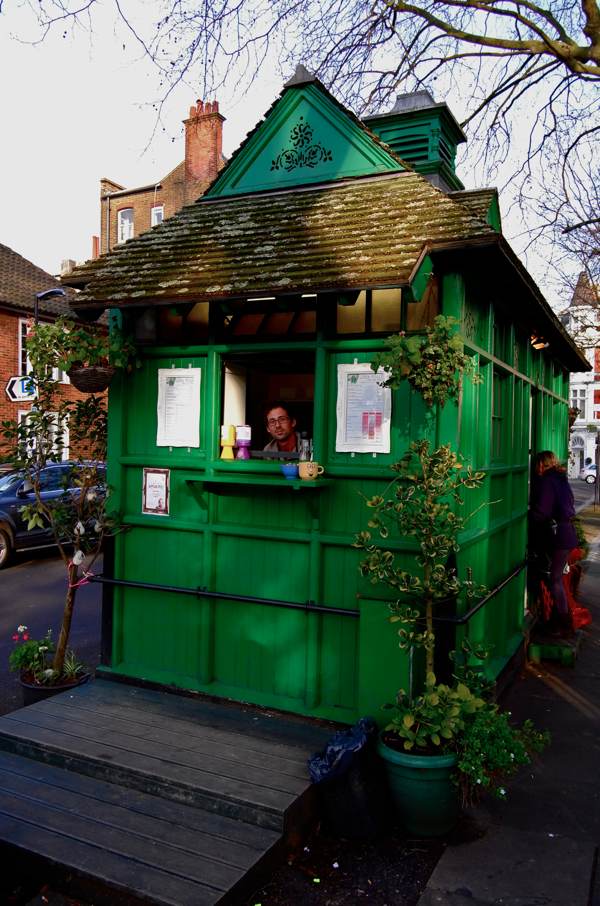
Wellington Place, NW8

Chelsea Embankment, SW3

Grosvenor Gardens, SW1

St Georges Sq, SW1

Kensington Park Rd, W11

Temple Place, WC2

Warwick Ave, W9

Russell Sq, WC1

Kensington Rd, W8

Pont St, SW1

Hanover Sq, W1

The shelter attendant at Wellington Place has special spoon-bending powers
You may also like to read about
East End Entertainers Of 1922
Given that this is officially the most depressing week of the year, I thought it was high time we brought on some entertainers to banish those January blues and cheer us all up, so I consulted the Concert Artistes Directory of 1922 in the Bishopsgate Institute to see what local talent was on offer.


Images courtesy Bishopsgate Institute
You may also like to take a look at
John Hall, Accordionist & Ambulance Man

John Hall
Contributing Artist Lucinda Rogers took me to visit her friend John Hall, the Piano Accordionist, in Haggerston and she drew this portrait while John and I enjoyed a chat. We sat in John’s new flat, replacing his former home in Samuel House that was demolished last year when the Estate was cleared, to be replaced by a much larger development including a significant number of private flats.
From John’s flat in the completed building, housing the former tenants of Samuel House, we looked across to the construction site where another building will rise, eating up almost all the green space of the old Haggerston Estate and we wondered what the future will bring. All around, John was surrounded by musical paraphernalia attesting to his remarkable talent that has brought him new friends and enlivened his social life over the last forty years.
“I was born in a prefab in the Old Ford Rd in 1947. They were built as temporary accommodation after the bomb damage in the war, and they had everything you needed – even gardens. My dad was given one when he came out of the Navy, though I don’t remember it too well because we moved when I was small to Reginald Rd E7. Originally he had been a furniture van driver but he took over a little corner shop. A lot of people had the idea that we had it easy because my dad ran the shop, but it was hard work, we always came home from school and had to work behind the counter. The shop was open from seven until nine every day. I was the third of four children – Lesley the oldest, Linda my elder sister, then me and Peter, my little brother.
When I was at school, I was good at metalwork and I had no trouble getting a job because in those days you had all this manufacturing in the East End. For a spell, I was in the services and I went to Berlin but they found I had bronchitis and I got discharged in 1968.
My grandmother was a classical pianist but I didn’t discover music until my teens when I saw Allodi’s Accordions in Finsbury Park. I just remember looking in the shop window and seeing these piano accordions and deciding I wanted to learn to play one. I went to have lessons above the shop given by Mr Allodi’s son, and I took to it naturally. This was in 1971 when I was working as an ambulance man, after joining the service in 1968. I played the accordion at The Talbot in Englefield Rd and I used to play at the Ambulance Service Social Club in Highams Park in variety shows. In the early seventies, I had a significant social life. I wanted to try busking, so I went down to Ezra St next to Columbia Rd and I was there for ten years. That’s where I met David Bailey. He told me to look in the lens and he snapped me. Then he came back the next week with an autographed print. I like his pictures because they are very clear.
After eleven years in the ambulance service, I went into anaesthetics and I worked at the East London Chest Hospital, it was a very homely place in those days. In 1980, I moved into Samuel House in Haggerston. They had some flats that were described as ‘hard to let’ and it was quite run down in those days with lots of broken windows, although it wasn’t too bad. Four flights of stairs is no problem when you are thirty but I couldn’t make it now. I was having trouble getting up there.
These days, I am in a wheelchair and I live in a flat on the ground floor of the new building. The old flats were very draughty and the double glazing here helps enormously. But it’s sad in a way, I miss some of those people, those that died. They went through a lot but they never got a new flat.
I still play the accordion occasionally.”

Customers at John’s family corner shop in Reginald Rd

John and his younger brother Peter

John in a sharp suit in the sixties

John experimented with sideburns in the seventies
 An early photo of John with his piano accordion

John as an ambulance man with John Rose (standing) and David Komble (right)

John plays piano accordion at Pellicci’s in Bethnal Green

John in the Samuel House days

John shows David Bailey’s photograph of him playing the accordion in Ezra St
Drawing copyright © Lucinda Rogers
You may also like to read about
More Of Paul Sandby’s Cries Of London

“Turn your copper into silver before your eyes”
Last week, I published Paul Sandby’s twelve plates of Cries of London, 1760 and today I present a gallery of his sketches held by the Yale Centre for British Art, selected from around a hundred drawings Sandby made of the hawkers and vendors he encountered in the streets around his house in Carnaby Market. The dirty realism of Sandby’s portraits of street traders proved unpopular among the print buyers of his day and he never published any more engravings from his watercolour sketches. He had already designed the title page for another series with the intention of turning all his sketches into prints, yet – ironically – the unsentimental quality of Sandby’s human observation that rendered these Cries a disappointment in his day is precisely what makes them appealing to us.

Hawker with donkey and panniers

Flower Seller

Seller of pots and pans

Fishmonger

“Lights for the cats, liver for the dogs”

Shoe cleaner

Seller of laces

“Do you want any spoons?”

“All fire and no smoke”

Black-hearted cherries

Man with a bottle

“Throws for a ha’penny. Have you a ha’penny?”

“Any kitchen stuff”

Muffin Man

Tinker and his wife

“Small coal or brushes”

“Last dying speech and confession”

Mountebank

Orange Seller

Old Clothes Seller

Milk Maid

“Fun upon fun!”

“My Pretty Little Ginny Tarters for a Ha’penny a Stick or a Penny a Stick, or a Stick to Beat your Wives or Dust your Clothes”
Images courtesy Yale Centre for British Art
You may also like to look at
Lindsey Garratt, Chairman Of New Era Estate Tenants Association

Lindsey and her daughter Dolly
Contributing Photographer Sarah Ainslie & I went up to Hoxton to visit Lindsey Garratt who is still reeling from her revelatory triumph before Christmas when she and the other tenants, with moral support from Russell Brand, forced Westbrook Partners to relinquish control of the New Era Estate where ninety-two families were under threat of eviction. This success has been a transformative experience for Lindsey, awakening her to a recognition of the wider crisis beyond the immediate problem she and her neighbours confronted. Theirs is an inspirational example that reaffirms the power of collective action in the struggle for justice against the malign forces of corporate property development.
“I’m a Healthcare Co-ordinator and I love it, but I also like campaigning now too. I’d never done anything like that before. I was never interested in Politics, it didn’t affect me before because I’ve always lived in my working class bubble here in Hoxton. I lived on the New Era Estate since I was fifteen. This is my home. My great nan lived in Hoxton and my grandfather, and all my dad’s family have been here for ever. I would never want to live anywhere else. My parents live opposite, my sister and aunty live on the Estate. I know everyone here. It wasn’t just about our homes, it was about what we have here, our community. I’ve got such lovely memories of my time on the Estate, I couldn’t bear to leave.
In July 2012, we were told the flats had gone up for sale and I arranged a meeting to set up a Tenants Association, although we were told that there was nothing to worry about. Then in July 2014, we were told the Estate was sold and our rents would go up. I just felt compelled to do something, so I called up the Daily Mail and they put the story on the front page because the owner, Richard Benyon, was one of the Tory elite. We held regular meetings to keep people informed and hold everyone together, but we didn’t think we had much chance. We set up a pitch in Hoxton Market and it all died down, until one day Russell Brand walked past and asked us what was going on.
Three hundred of us dressed up in a Dickens theme and we marched to Benyon’s office to serve an eviction notice upon them – that was my idea. It worked, because they pulled out and sold their stake in the Estate. After that we had Westbrook Partners to contend with. So we marched with six to eight hundred people from their offices in Berkeley Sq to Downing St to deliver our petition of nearly three hundred thousand signatures. We weren’t going to give up but they did. We were surprised. We thought, ‘Bloody Hell, that was easy! What next?’
It’s changed me personally, it’s opened up my eyes to how politics works and how difficult it is for the working class – how much pressure is put on you. I was ‘restructured’ at work and I lost three hundred pounds a month and my rent went up two hundred pounds a month, and I was being told, ‘You just can’t live in London anymore.‘ I felt I was being forced into poverty, but I’m a single parent and I’ve never claimed benefits. I’ve got work and I’m just asking to pay an affordable rent.
All around us is going, for us to remain when all around us is going is scary. It’s easy for landlords to divide and rule when it’s a more diverse community, but because the families in the New Era Estate have been here together since the nineteen-thirties it’s harder to get rid of us. We said, ‘Enough is enough.’ We proved people can make a difference because it happened here. At Christmas, we all celebrated and cried a lot. It was a real success story, everyone got to stay and all the shops too.
There are other communities that are being cast aside. I feel passionate about it and I will continue to campaign for it.”
Portrait copyright © Sarah Ainslie
You may also like to read about
Sam Middleton & Jasmine Stone, Campaigning Stratford Mothers
At The Model Engineering Exhibition

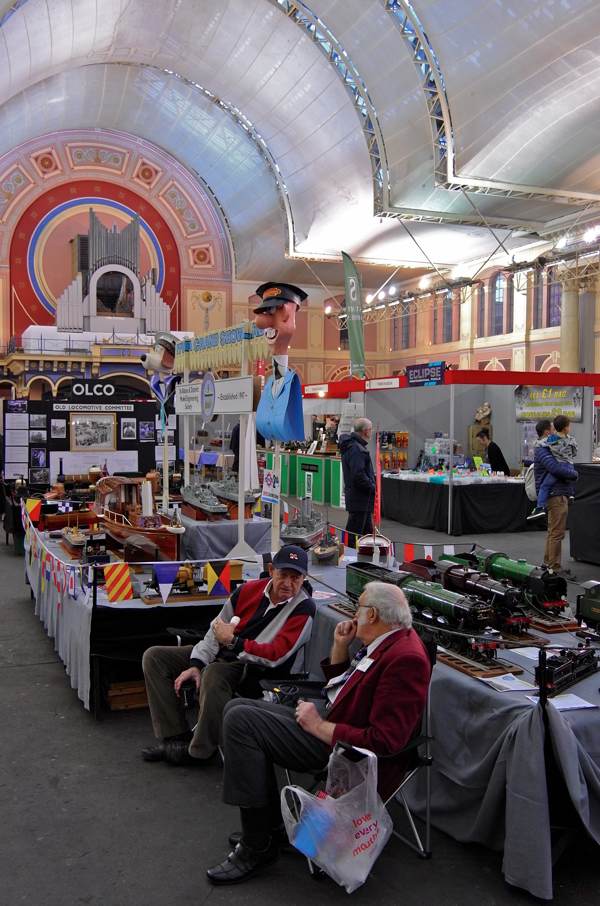
Over the weekend, I braved the frozen wastes of North London to visit Alexandra Palace for the London Model Engineering Exhibition at which myriad wonders of handmade technology were to be admired. It was a heartwarming experience to view the thousands of little trains, planes, boats and cars of expert manufacture, painstakingly crafted in loving detail, and all working – powered by steam, motor, electricity, clockwork or candle power.
The model engineers watched over their cherished creations with a mixture of pride and protectiveness, enjoying the adulation of casual enthusiasts, while taking the opportunity to exchange specialist banter among their peers and cast a critical eye over the competition too. It was the culmination of countless hours in sheds and attics, when the pale-faced creators emerged blinking from the gloom of their self-imposed captivity into the glare of the limelight to accept applause for their tiny miracles.


You may also like to read about
George Cruikshank’s Sunday In London
George Cruikshank published these engravings in 1833 as a protest against a Sabbatarian bill “in order to promote the better observance of the Lord’s day” which called for restrictions upon secular public activity. Yet the persistence of bars, clubs and markets opening on Sunday bears witness to the enduring and unassailable commitment of Londoners to make the most of their precious weekends.

“Miserable Sinners!”

Marching to Divine Service

Cordial Workings of the Spirit

The Sunday Market

“Thou Shalt Do No Manner of Work – Thou, nor Thy Cattle”
 “People of Condition” on a Sunday

“The Servants Within Our Gates”

Gin-Temple Turn-Out At Church Time

Sunday Ruralizing
 The Pay-Table

Sunday “Soiree Musicale”
You may also enjoy
George Cruikshank’s Comic Alphabet


