
Skilton’s London Life

Tickets available this Saturday 21st June
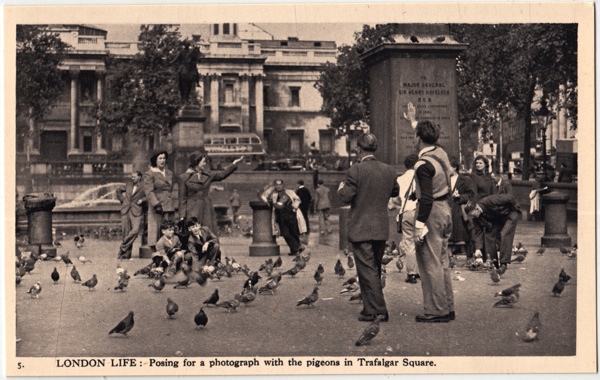
Now that the summer visitors are here and thronging in the capital’s streets and transport systems, I thought I would send you this fine set of postcards published by Charles Skilton, including my special favourites the escapologist and the pavement artist.
Looking at these monochrome images of the threadbare postwar years, you might easily imagine the photographs were earlier – but Margaret Rutherford in ‘Ring Round the Moon’ at The Globe in Shaftesbury Ave in number nine dates them to 1950. Celebrated in his day as publisher of the Billy Bunter stories, Charles Skilton won posthumous notoriety for his underground pornographic publishing empire, Luxor Press.




You may also like to take a look at
Visit Robson Cezar’s Studio In Bow

You are invited to visit Spitalfields artist Robson Cezar’s studio in Bow as part of Bow Arts Open Studios this Friday and Saturday, 20th & 21st June, at 181-183 Bow Road, E3 2SP. Contributing Photographer Sarah Ainslie went along this week as Robson was making final preparations, so that readers may have this sneak preview.
Robson has created a new artwork of 88 spinning tops made from bottletops which guests can enjoy spinning for themselves and take home for free afterwards as souvenirs. Each spinning top has words concealed underneath, like a fortune cookie or a cracker motto.
For this occasion, Robson has also produced an edition of five of his celebrated solar-powered recycled houses made out of boxes from Whitechapel Market, that can be seen below.
Every house is fitted with a solar panel. If you leave it on a window sill, it will charge in daylight, light up automatically at dusk and the light will go off at dawn. And they will do this more or less indefinitely. Robson has enjoyed employing the colours, printed lettering and images of fruit and vegetables on the boxes, and made windows from coloured mushroom crates.
As usual, these houses will be sold on a first-come, first-served basis. So if you like to buy one of these house please drop a line to spitalfieldslife@gmail.com specifying which one you would like and we will supply payment details. They are £200 each.
These houses are sculptures not toys and we do not recommend them for children under the age of twelve.


Devising the words for the spinning tops

Robson sorting crates to make houses

House A (front)

House A (reverse)

House B (front)

House B (reverse)

House C (front)

House C (reverse)

House D (front)

House D (reverse)

House E (front)

House E (front)
Photographs copyright © Sarah Ainslie
Tony Hall’s East End In The Afternoon
Tickets available this Saturday 21st June

There is little traffic on the road, children are at play, housewives linger in doorways, old men doze outside the library and, in the distance, a rag and bone man’s cart clatters down the street. This is the East End in the afternoon, as photographed by newspaper artist Tony Hall in the nineteen sixties while wandering with his camera in the quiet hours between shifts on The Evening News in Fleet St.
“Tony cared very much about the sense of community here.” Libby Hall, Tony’s wife, recalled, “He loved the warmth of the East End. And when he photographed buildings it was always for the human element, not just the aesthetic.”
Contemplating Tony’s clear-eyed photos – more than half a century after they were taken – raises questions about the changes enacted upon the East End in the intervening years. Most obviously, the loss of the pubs and corner shops which Tony portrayed with such affection in pictures that remind us of the importance of these meeting places, drawing people into a close relationship with their immediate environment.
“He photographed the pubs and little shops that he knew were on the edge of disappearing,” Libby Hall confirmed for me, ‘He loved the history of the East End, the Victorian overlap, and the sense that it was the last of Dickens’ London.”
In 1972, Tony Hall left The Evening News and with his new job came a new shift pattern which did not grant him afternoons off – thus drawing his East End photographic odyssey to a close. Yet for one who did not consider himself a photographer, Tony Hall’s opus comprises a tender vision of breathtaking clarity, constructed with purpose and insight as a social record. Speaking of her late husband, Libby Hall emphasised the prescience that lay behind Tony’s wanderings with his camera in the afternoon. “He knew what he was photographing and he recognised the significance of it,” she admitted.


Three Colts Lane

Gunthorpe St


Ridley Rd Market


Stepney Green


Photographs copyright © Estate of Libby Hall
Images Courtesy of the Tony Hall Archive at the Bishopsgate Institute
You may also like to read
Tony Hall’s East End Panoramas
Eleanor Crow’s Falling Light

Here are a selection of paintings from Eleanor Crow‘s new exhibition FALLING LIGHT which opens at Townhouse, 5 Fournier St, E1 6QE this Saturday 21st June and runs until 6th July.

Harry Thomas, Baker
‘Many of these paintings were made in kitchens, the heart of any house, café or restaurant. Places that are often a repository of things we have collected, things that have been handed down to us and which constitute an ongoing story. Once these spaces were hidden but nowadays we want to see what is happening.
Kitchens are like a theatre with the utensils as props, where skill, labour and love are employed in the alchemy of ingredients transmuted into food. Ongoing activity means that elements are constantly moved and the light changes while I am painting, so nothing is ever quite the same. I sought to paint these transient moments of light falling in a particular way, over particular things, in a particular place.’
– Eleanor Crow

Scottish kitchen

E Pellicci, Bethnal Green

An egg and an onion

Chelvey taps

Clerkenwell kitchen

Hungarian jug and yellow tomatoes

North London kitchen

Basket of limes

Dutch kitchen

Leeks and broad beans

Farmhouse kitchen

Market produce

Shelves in the paupers’ attic at Dennis Severs’ House

At the Eagle, Farringdon Rd

At William Hogarth’s House

Laundry in the stairwell at Dennis Severs’ House

Suffolk kitchen
Paintings copyright © Eleanor Crow
You may also like to take a look at
From Viscountess Boudica’s Album

A tender scene from the childhood of Viscountess Boudica
For years, Viscountess Boudica wrote an autobiography – absurd, bawdy and magical by turns – in daily installments. Entitled There’s More to Life than Heaven & Earth (sadly now discontinued), it was like nothing else on the internet. One day, the Viscountess and I met for a chat to take stock of her brave endeavour and select a few key excerpts.
“The blog is like justice in a way,” she confided to me. Ascribing her storytelling instincts to her Celtic roots, Viscountess Boudica is a latter-day Mother Goose, intertwining poignant tales of lost love with unexplained visionary encounters and broad comic stories to weave a mythological universe that is entirely her creation.
With an unerring instinct for the ironies of existence, Boudica reconciles herself to the painful contradictions of life by taking fearless narrative delight in personal humiliations others might choose to forget. Viscountess Boudica understands she can advance herself in actuality through becoming the author of her own story.


My clothes designing started down on the farm at five years old, when I was taking care of the pigs, Paul & Keith. When the cats were expecting, I used to hide them in the barn so my uncle wouldn’t drown them. They were all feral and interbred. I used to make clothes for the kittens and they lay in a pram which I used to wheel around the village. I tried to dress the pigs too, but it didn’t quite work out because they ripped them off and rolled in the mud.


Paul O’R, when I first met him, I asked if he was an Aries. So the second time I met him I took him a chocolate biscuit and – you know what – he said, “You look lovely,” and he bowed his head and I stroked his hair.

The Monks of Moreton. The engine of my car stopped and I saw all these monks crossing the road to the abbey. Apparently, it’s a well-known local sight.

Whatever happened to the old English sayings? They just don’t say, “What ho!” anymore, except in period films.

Paul B. said, do I fancy going to a barbecue and off we went to the wilds of Colchester. He was barbecuing sausages and there were four on the grill at one pound each. The one in the middle looked under-done and I am sure it winked at me. So I grabbed it to put some mustard on it and as I pulled it Paul’s eyes were watering.

Paul S., a white South-African, I met him in 1995 at Tesco in Tollerton. He’d had a row with his boyfriend and said, “Could you put me up for a couple of days?” As a present, he got me some flours as a joke when I expected flowers. Eventually, his boyfriend came to pick him up but they didn’t think it was so funny when I poured the flours over them.

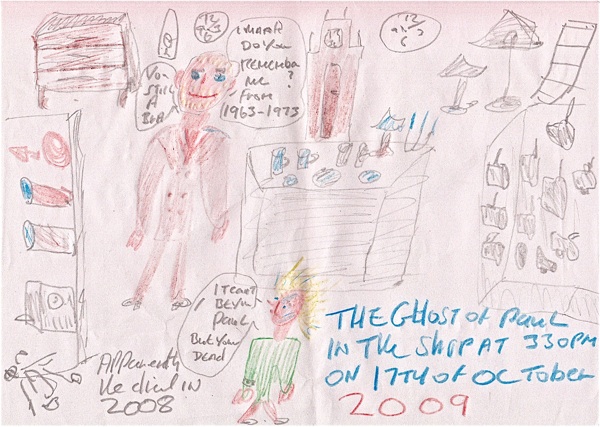
I went into Des & Lorraine’s Shop in Bacon St and it was full of people. Then as I looked where Des was standing, I thought I’d seen this bloke somewhere before. It was quarter past three and my watch stopped and everything stopped and the man said to me, “Do you remember who I am? Do you remember that day in 1965 when you got banned from the farm?” It was Farmer Paul and recalled I used to sit on his lap as a child and I could feel something hard, and he used to put his hand on my chest and say, “It’s getting bigger.” He said to me, “Something’s going to happen, you’ll find out.” I ran out through the shop and my watch dropped on the pavement. He followed me and said, “I will come for you when you die.” So then I went home and rang Chris from Southend, and when he said his mother died at 3:15pm, I realised I had experienced some kind of vision.

One time, I went to Braintree Freeport to sell some photos and this sexy bearded train driver walked past the carriage.

There was this brickie called Eric in Braintree and he told me about this cottage on the A12, and I imagined a cottage with a thatched roof and roses round the door. But when I asked if I could come, he said, “It’s strictly for boys and we have prayer meetings.” So when I passed my driving test, I went to find this mystery building, but it wasn’t until years later that I discovered it was a public toilet.
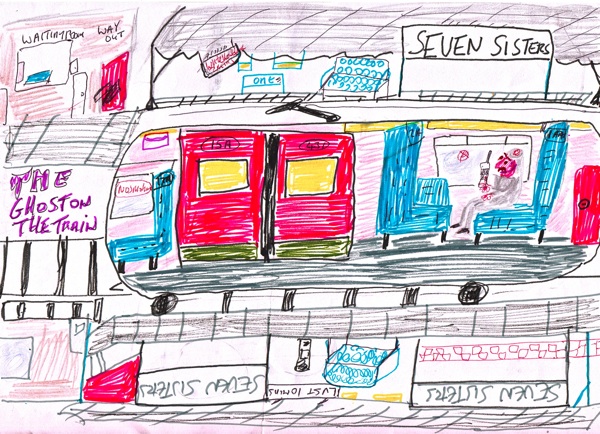
My friend Ted in Braintree worked for the BBC and had a love of Islington, so he moved back to Finsbury Park and then Bounders Green. Four years later, after I moved to London on Halloween 1994, he was dead. Then, five years ago, I got on a train at Cambridge Heath and this guy got on at Seven Sisters and sat opposite me and smiled. He pulled out an old square mobile phone with an aerial and he kept looking at me. At Bruce Grove, he was gone, so I ran down the stairs and he was there. He said, “You remember who I was? There’s more to LIfe than Heaven & Earth.”

For thirteen years, I visited Keith at Lordship Cookers and held his hand outside the shop. That went on for years and I bought all these dodgy makes that never worked.

Now I’ve let go of the past, I’ve destroyed my diaries and got rid of my cookers but I’ll always have my memories. Since I changed my kitchen I got one of those ranges, because I’ve accepted that the Tricity 643 will never come.


The last time I saw Paul O’R from Sclater St was in 2009 on 21st December, and I went home and put his present under the tree but he never came to get it. Maybe this year?


Viscountess Boudica with the Christmas present she has kept awaiting its recipient for the past three years. Like the spirit of Christmas Present, Boudica always travels with a fully decorated tree in the festive season.
You my also like to read my other stories about Viscountess Boudica
Viscountess Boudica’s Domestic Appliances
From Henrietta Keeper’s Album

Henrietta Keeper, Singer
Henrietta Keeper (widely known as “Joan”), the vivacious octogenarian ballad singer who used to perform at E.Pellicci in the Bethnal Green Rd on Fridays, once invited me to round to her tiny flat to show me her remarkable collection of photographs and meet her daughter Lesley, custodian of the family album.
These pictures show Henrietta’s life as it existed within a small corner of the East End on the boundary of Spitalfields and Bethnal Green in the nineteen fifties. On one side of Vallance Rd was Cranberry St where Henrietta’s mother-in-law Selina lived and took care of her daughters while the family waited for a house of their own. On the other side of Vallance Rd was Selby St where Henrietta’s husband Joe and his brother Jim ran Keeper & Co, making coal deliveries. And at the end of Vallance Rd was New Rd where Henrietta worked as a machinist at Bartman & Co making coats and jackets.
Having grown up in Bethnal Green during the war and brought her own family up though the austerity that followed, Henrietta was a woman of indefatigable spirit. Most remarkable of all, she sang throughout her life, winning innumerable singing competitions and giving free concerts.

Henrietta with fellow machinist Izzie. “When I was nineteen I started here and I became the top machinist,” she explained, “I think my hair looks a bit like Barbara Windsor’s in this picture.”

Henrietta with Mr Bartman at Bartman & Co.

“This is Selina Keeper, my mother-in-law at her house in Cranberry St. She was real Victorian lady. She used to whip the cup of tea off the table before you had finished it!” said Henrietta. And Lesley added, “She had a best front room that she kept under lock and key, and only once – when she unlocked it – did I go in, but she said ‘Get out!’ You couldn’t touch anything. It had to be kept perfect.”

“My husband Joe took this picture of his two best friends George Bastick and Leslie Herbert in Nelson Gardens next to St Peter’s Church, Bethnal Green. What a pity he isn’t in it?”

Coronation Day, 1953, celebrated at Hemming St, Bethnal Green. Lesley is in the blazer on the right hand side of the front row and Henrietta can be distinguished by her blonde hair beneath the Union Jack, peering round the lady in front of her.

“This is Jim Keeper, my brother-in-law, with his horse Trigger. My husband, Joe, worked with him and he had the biggest coal round in the East End – Keeper & Co. Joe was so strong he could carry a two hundredweight sack of coal on his back up the stairs of the buildings with ease. The brothers used to go home to lunch with their mum in Cranberry St and take Trigger with them. She always collected the horse manure for her roses while they were there and when the Queen Mother visited the East End, she leaned over the fence and said ‘This one should win best garden.'”

“Taken in 1947 at Southend, when I was twenty, this is Cathy Tyler, my sister Marie and me – I was known as Minxie at the time and we all sang together like the Andrews sisters. I was a bit shocked when I saw it because you can see I am pregnant. I thought, ‘Is that me?'”

Henrietta (far right) photographed with her workmates by a street photographer around Brick Lane during a lunch break in the fifties.

This is Henrietta’s daughter Lesley visiting Petticoat Lane with her grandfather James Keeper in 1953. “He was a delivery man with a horse and cart, they called it a ‘carman,'” Henrietta remembered, “he was also a cabinet-maker and he brought me beautiful polished wooden boxes that he made.”

Henrietta and her husband Joe with their daughter Lesley on a trip to Columbia Rd.

The two children on the right are Lesley and Linda Keeper playing at Cowboys and Indians with their friends in the nineteen fifties in Cranberry St while they lived with their grandmother. Lesley remembers Mrs Dexter across the road who called out “Play nicely on the debris!” to the children and you can see the bomb site where they played in the back of the photograph. Today Cranberry St no longer exists, just the stub of road beside Rinkoff’s bakery in Vallance Rd indicates where it once was.

Henrietta singing at a Holiday Camp at Selsey Bill in the nineteen sixties.

Henrietta singing at Pelliccis
You may like to read my original portrait
From Clive Murphy’s Album
I am celebrating my friend, the late Clive Murphy, by publishing his snaps

Pauline, Animal Lover, 77 Brick Lane, 16 July 1988
When it cames to photography, Clive Murphy – the novelist, oral historian and writer of ribald rhymes – modestly described himself as a snapper. Yet although he used the term to indicate that his taking pictures was merely a casual preoccupation, I prefer to interpret Clive’s appellation as meaning “a snapper up of unconsidered trifles” – one who cherishes what others disregard.
“I carried it around in my shoulder bag and if something interested me, I would pull out my camera and snap it,” Clive informed me plainly, “I am a snapper because I work instinctively and I rely entirely upon my eye for the picture.”
In thousands of snapshots, every one labelled on the reverse in his spidery handwriting and organised into many shelves of numbered volumes, Clive chronicled the changing life of Spitalfields, of those around him and of those he knew, since he came to live above the Aladin Restaurant on Brick Lane in 1973. These pictures are not those of a documentary photographer on assignment but the intimate snaps of a member of the community, and it is this personal quality which makes them so compelling and immediate, drawing the viewer into Clive’s particular vivid universe in Spitalfields.
One day, we pulled out a few albums and leafed through the pages together, selecting a few snaps to show you, and Clive told me some of the stories that go with them.

Brick Lane, May 1988

Komor Uddin, Taj Stores, 7 December 1990

Columbia Rd Market, 13 November 1988

Jasinghe Ranamukadewasa Fernando (known as Vijay Singh), Holy Man with acolyte, Brick Lane, March 1988 – “Many people in Brick Lane thought he was the new Messiah and the press came down in droves. He was regarded as a very holy man, he held court in the Nazrul Restaurant and people took his potions and remedies. When he died, I joined the crowd to see his body at the Co-op Funeral Parlour in Chrisp St.”

Clive Murphy’s cat Pushkin, 132 Brick Lane, July 1988 – “Pushkin followed me down Brick Lane from Fournier St one night and, when I opened my hall door, he came in with me. So he adopted me, when he was only a kitten and could hardly jump up a step. And I had him for twenty years.”

Neighbour’s doves hoping to be fed, 16 March 1991 – “The Nazrul Restaurant used to keep doves and, when they disappeared, Pushkin was blamed but I assure you he had nothing to do with it.”

Kyriacos Kleovoulou, Barber, Puma Court, 23 February 1990 – “I’ve had a few haircuts there in the past.”

Waiter, Nazrul Restaurant, Brick Lane, 29 May 1988

Harry Fishman, 97 Brick Lane, 19 September 1987 – “He was a godsend to everybody because he cashed any cheque on the spot. I think he was used to being robbed, so he wanted to get rid of the cash. Harry Fishman was the most-loved man on Brick Lane in the seventies, his shop was always full of people wanting to be around him, and I often delivered papers to The Golden Heart for him.”

Harry Fishman’s shop, corner of Quaker St, 19 September 1987

Window Cleaning, Woodseer St, March 1988 – “This man used to run an orchestra and, at all dances and Bengali events, they would play.”

Sunday use of Weinbergs (sold), November 1987 – “It was a printers and when it closed it became a fruit stall. Mr Weinberg was a very jolly fat man, slightly balding, who ordered his staff about. He would say things like, ‘Left, right, left, right, do it properly!’ I dined at his house and I didn’t like the cover of my first novel, so I asked him to redesign it for me. He had a nephew who had never been with a woman and he asked me to find him an escort agency. We all dined in a restaurant behind the Astoria Theatre in the Charing Cross Rd, and then I let them use my front room. But after an hour she came out and said, ‘It’s no use, I give up!’ but we still had to pay, and his nephew never became a man.”

Christ Church Night Tea Stall, October 1987 – “I always went out as the last thing I did before I went to bed, to have a snack.”

Clive’s landlord, Toimus Ali, at The Aladin Restaurant, 6 March 1991 – “He was very taciturn.”

Fournier St, 7 February 1991 – “I used to come here and have lunch with all the taxi-drivers who loved it so much.”

Retired street cleaner, Brick Lane, March 1988

Tramp, Brick Lane, 29 May 1988

Pushkin unwell, Jan 4 1991 – “I was told it would be quite alright to feed my cat on frozen whitebait, but I didn’t thaw it properly and it killed my Pushkin.”

Harry Fishman’s shop after closure, 97 Brick Lane, 27 September 1987

Clive at his desk, 132 Brick Lane, 31 December 1989
Photographs courtesy of the Clive Murphy Archive at the Bishopsgate Institute
You may like to read my other stories about Clive Murphy


