Richard Jefferies In The City

Often when I set out for a walk from Spitalfields, my footsteps lead me to the crossroads outside the Bank of England , at the place where Richard Jefferies – a writer whose work has been an enduring inspiration – once stood. Like me, Jefferies also came to the city from the countryside and his response to London was one of awe and fascination.
Whenever I feel lost in the metropolis, Richard Jefferies’ writing is always a consolation, granting a liberating perspective upon the all-compassing turmoil of urban life and, in spite of the changes in the city, his observations resonate as powerfully today as they did when he wrote them. This excerpt from The Story of My Heart (1883), the autobiography of his inner life, describes the sight that met Richard Jefferies’ eyes when he stood upon that spot at the crossroads in the City of London.
“There is a place in front of the Royal Exchange where the wide pavement reaches out like a promontory. It is in the shape of a triangle with a rounded apex. A stream of traffic runs on either side, and other streets send their currents down into the open space before it. Like the spokes of a wheel converging streams of human life flow into this agitated pool. Horses and carriages, carts, vans, omnibuses, cabs, every kind of conveyance cross each other’s course in every possible direction.
Twisting in and out by the wheels and under the horses’ heads, working a devious way, men and women of all conditions wind a path over. They fill the interstices between the carriages and blacken the surface, till the vans almost float on human beings. Now the streams slacken, and now they rush again, but never cease, dark waves are always rolling down the incline opposite, waves swell out from the side rivers, all London converges into this focus. There is an indistinguishable noise, it is not clatter, hum, or roar, it is not resolvable, made up of a thousand thousand footsteps, from a thousand hoofs, a thousand wheels, of haste, and shuffle, and quick movements, and ponderous loads, no attention can resolve it into a fixed sound.
Blue carts and yellow omnibuses, varnished carriages and brown vans, green omnibuses and red cabs, pale loads of yellow straw, rusty-red iron clunking on pointless carts, high white wool-packs, grey horses, bay horses, black teams, sunlight sparkling on brass harness, gleaming from carriage panels, jingle, jingle, jingle! An intermixed and intertangled, ceaselessly changing jingle, too, of colour, flecks of colour champed, as it were, like bits in the horses’ teeth, frothed and strewn about, and a surface always of dark-dressed people winding like the curves on fast-flowing water. This is the vortex and whirlpool, the centre of human life today on the earth. Now the tide rises and now it sinks, but the flow of these rivers always continues. Here it seethes and whirls, not for an hour only, but for all present time, hour by hour, day by day, year by year.
All these men and women that pass through are driven on by the push of accumulated circumstances, they cannot stay, they must go, their necks are in the slave’s ring, they are beaten like seaweed against the solid walls of fact. In ancient times, Xerxes, the king of kings, looking down upon his myriads, wept to think that in a hundred years not one of them would be left. Where will be these millions of today in a hundred years? But, further than that, let us ask – Where then will be the sum and outcome of their labour? If they wither away like summer grass, will not at least a result be left which those of a hundred years hence may be the better for? No, not one jot! There will not be any sum or outcome or result of this ceaseless labour and movement, it vanishes in the moment that it is done, and in a hundred years nothing will be there, for nothing is there now. There will be no more sum or result than accumulates from the motion of a revolving cowl on a housetop.
I used to come and stand near the apex of the promontory of pavement which juts out towards the pool of life, I still go there to ponder. London convinced me of my own thought. That thought has always been with me, and always grows wider.”


Richard Jefferies (1848-1887)
Archive photographs courtesy Bishopsgate Institute
You may also like to read about
The Alphabet Of Lost Pubs M-P
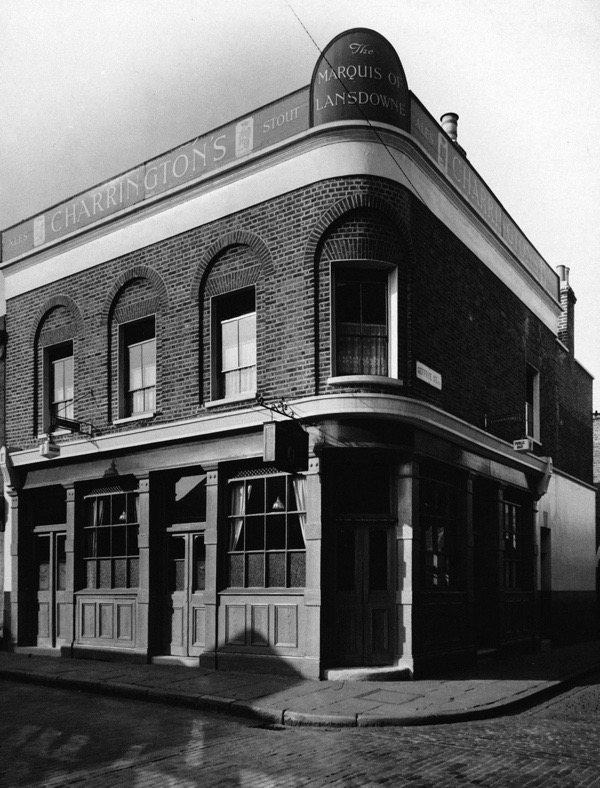
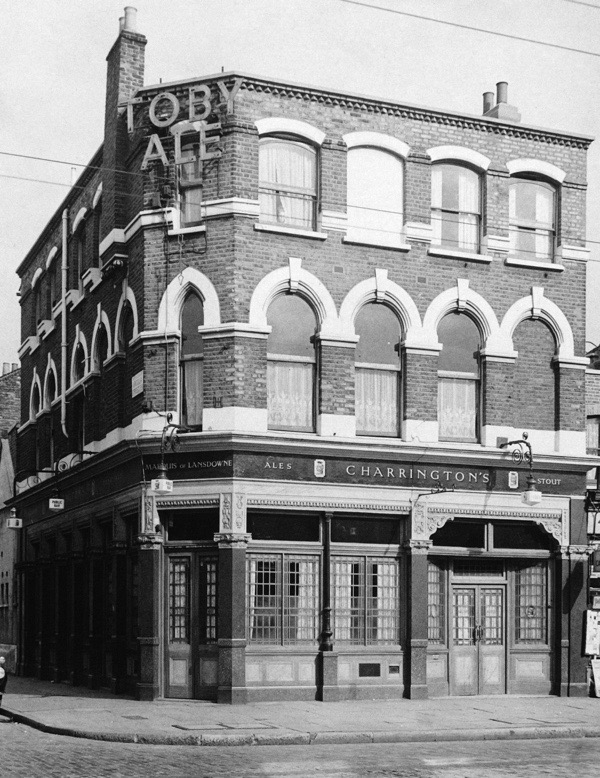
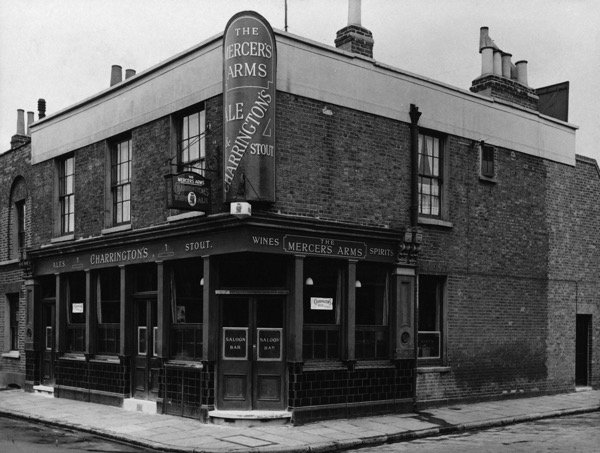
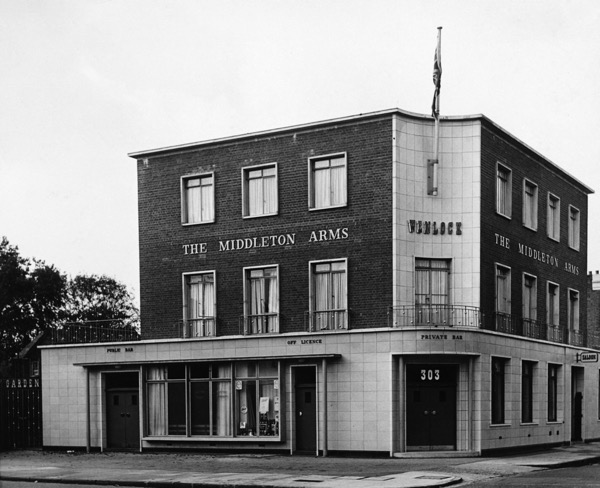
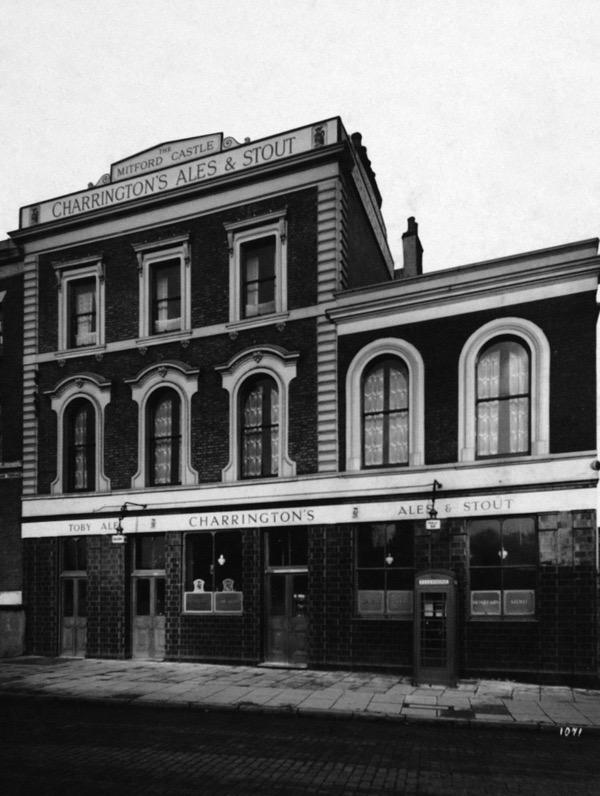
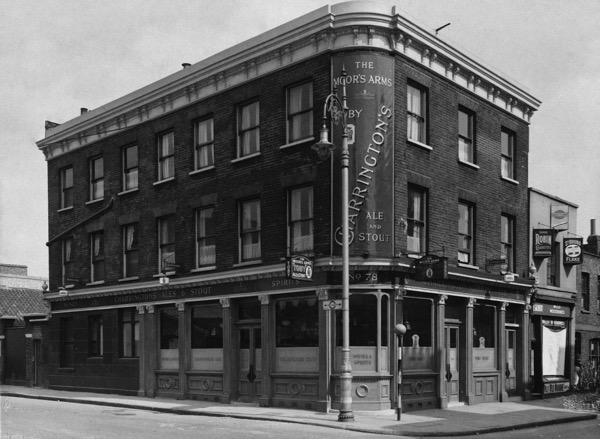
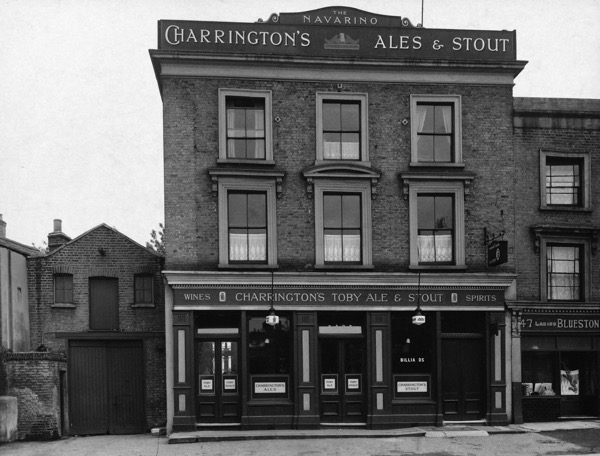
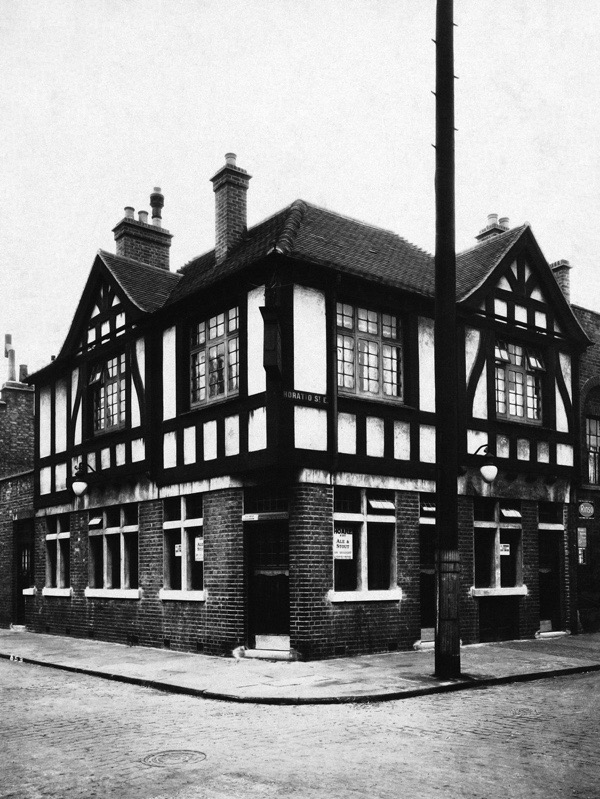
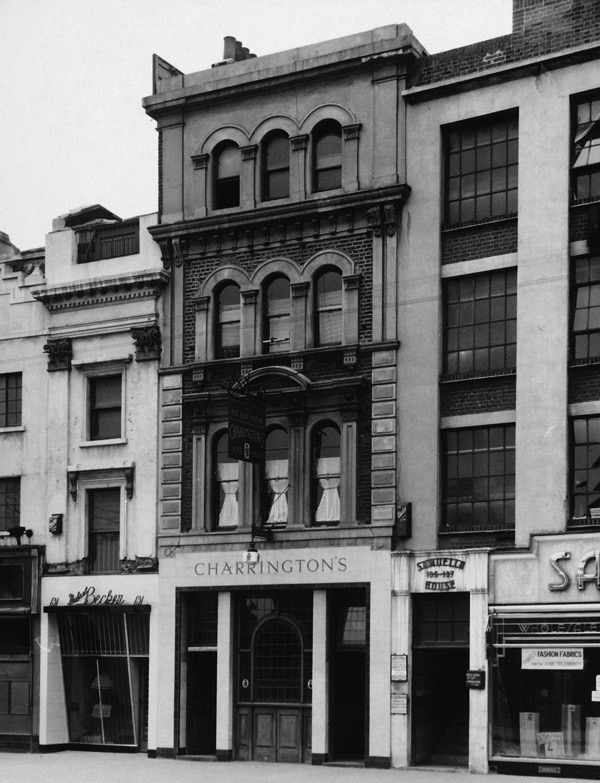
Among the fine specimens of watering holes in the fourth part of my series of The Alphabet of Lost Pubs, I am delighted to present The Marquis of Lansdowne which was saved from demolition in 2013 by a campaign led by Spitalfields Life and will be restored next year as part of a Heritage Lottery Fund scheme at the Geffrye Museum. Additionally, I should like to highlight a favourite of mine, The Marksman – as a shining example of a pub that has recently discovered new life, cherished as Michelin Pub of the Year for the excellence of its food. My time-travelling pub crawl is presented in collaboration with Heritage Assets who work in partnership with The National Brewery Heritage Trust, publishing these historic photographs of the myriad pubs of the East End from Charrington’s archive for the first time.

The Magpie & Stump, 18 Old Bailey, St Sepulchre, EC4 (Originally The King of Denmark, dating from the fifteenth century, renamed in 1944 and open today)

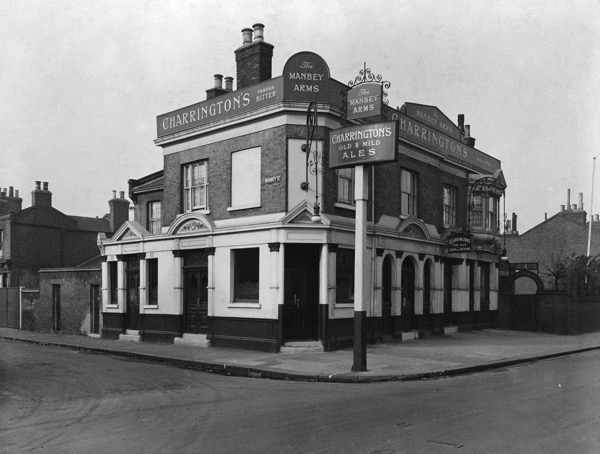
The Manby Arms, 19 Water Lane, Stratford, E15 (Opened before 1874, closed 27th September 1940, reopened 10th May 1943, closed and sold in 2013)

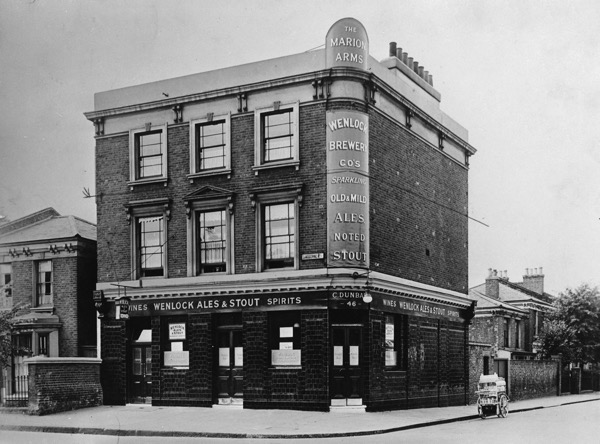
The Marion Arms, 46 Lansdowne Rd, Dalston, E8 (Opened before 1859, closed in 1994 and now converted to residential)

The Marksman, 254 Hackney Rd, E2 (Opened before 1869 and open today)

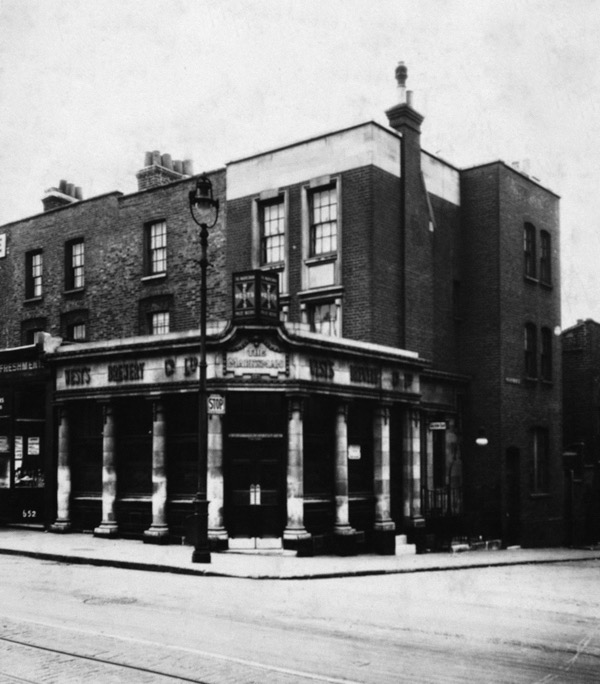
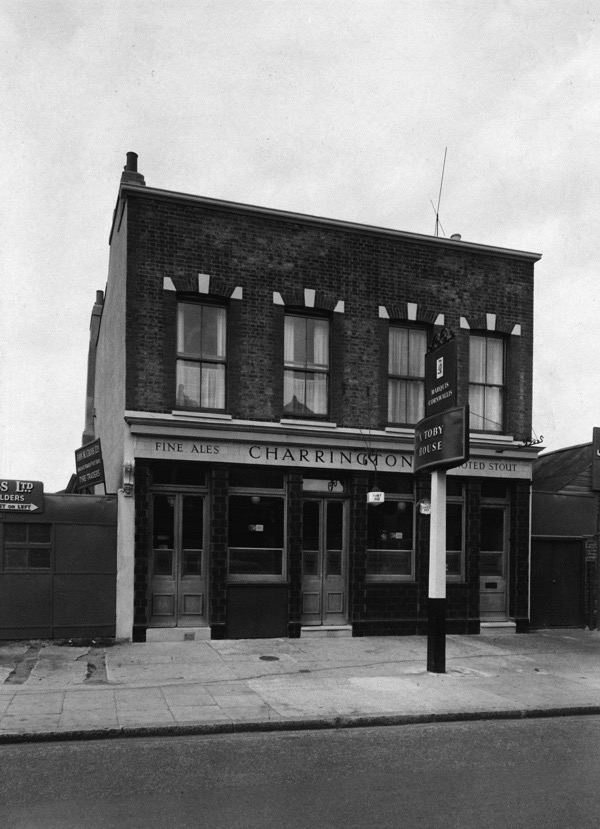
The Marquis of Cornwallis, 337 Old Ford Rd, Bow, E3 (Opened before 1855 but now demolished)

The Marquis of Cornwallis, 115 Curtain Rd, Shoreditch, Ec2 (Opened before 1856 but now demolished)

The Marquis of Lansdowne, 32 Cremer St, Haggerston, E2 (Opened 1838, closed 2000, threatened with demolition but saved and to be restored next year by Geffrye Museum)

The Marquis of Lansdowne, 48 Stoke Newington Rd, N16 (Opened before 1851 and open today)

The Mercers Arms, 34 Belgrave St, Stepney, E1 (Opened before 1839, closed 2006 and now converted to residential use)

The Middleton Arms, 123 Queens Rd, Dalston, E8 (Opened before 1837, rebuilt in the twentieth century, but closed and demolished in 2002)

The Milton Arms, 28 Wrights Rd, Old Ford, Bow, E3 (Opened before 1869, closed in 2007 and demolished in 2008)

The Mitford Castle, 129 Cadogan Terrace, Victoria Park, Bow, E9 (Opened before 1864, renamed ‘Top O’The Morning’ in 1983, closed in 2013 and demolished in 2015)

The Moor’s Arms, 78 Bow Common Lane, Bromley by Bow, E3 (Opened before 1848 and destroyed by enemy action on 7th September 1940)

The Navarino, 45 Navarino Rd, Dalston, E8 (Opened before 1856, closed by 1983 and converted to residential use in 2007)

The Nelson’s Head, 32 Horatio St, Shoreditch, E2 (Opened before 1839, changed name to ‘Fanny Nelson’s’ this year and open today)

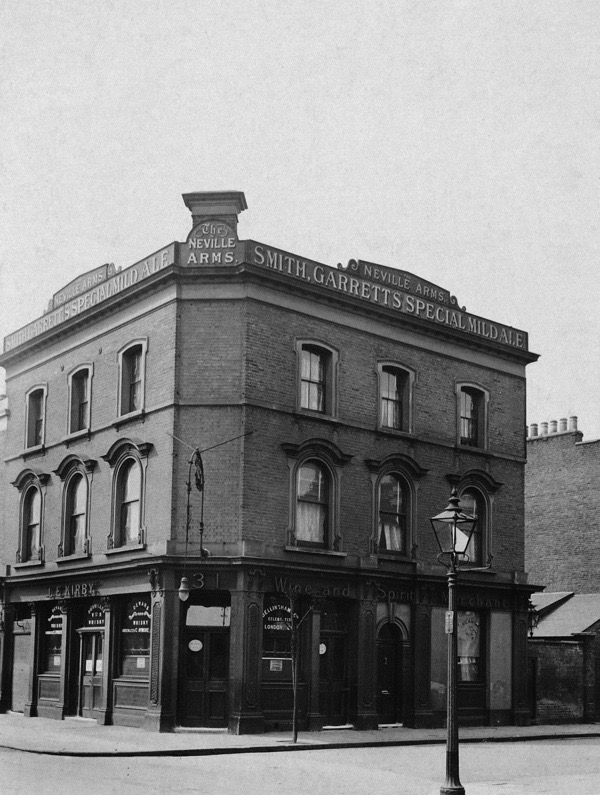
The Nevill Arms, 31 Nevill Rd, Stoke Newington, N16 (Opened before 1874, closed 1984 and now converted to residential)

The Newmarket, 26 Smithfield St, EC1 (Opened before 1856, destroyed by enemy action in September 1940 then rebuilt, closed in 2006 and now a restaurant)

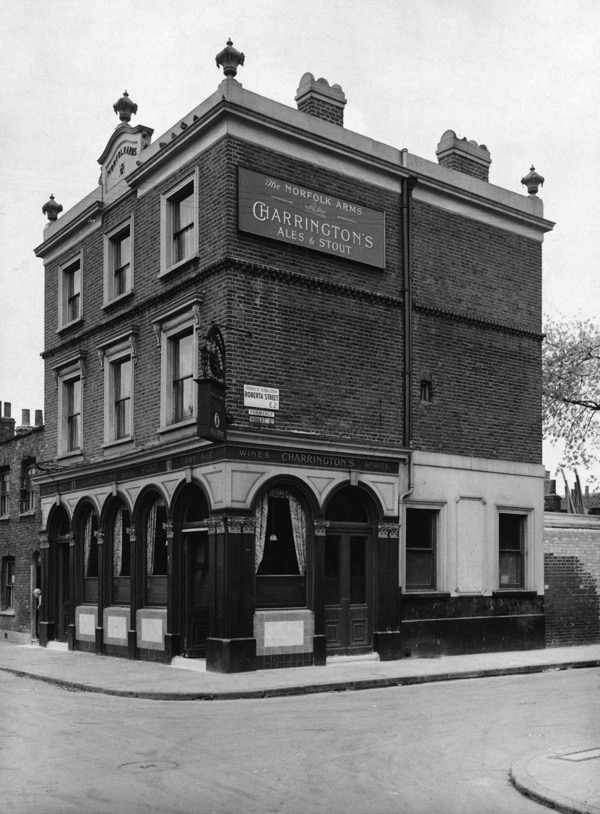
The Norfolk Arms, 15 Ivimey St, Bethnal Green, E2 (Opened before 1822 and now demolished, the site is a park)

The Norfolk, 199 Shoreditch High St, E1 (Opened 1856, closed 1996 and demolished in 2004)

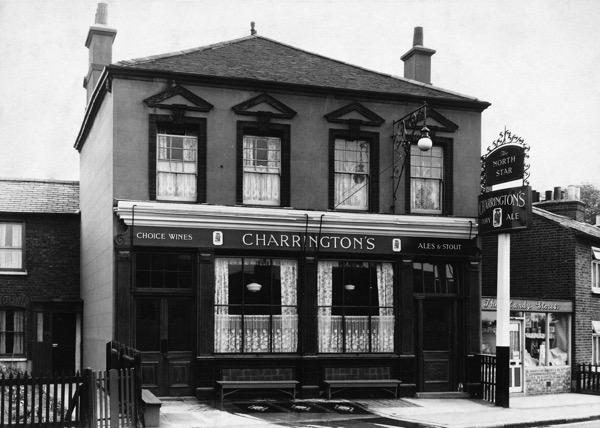
The North Star, 24 Browning Rd, Leytonstone, E11 (Opened in 1858 and open today)

The Northampton Arms, 205 Goswell Rd, Clerkenwell, EC1 (Opened before 1802, rebuilt 1891, closed 1961 and now demolished)

The Old Blue Anchor, 133 Whitechapel Rd, E1 (Opened before 1754, rebuilt in 1860, renamed ‘Indo’ in 2000 and open today)

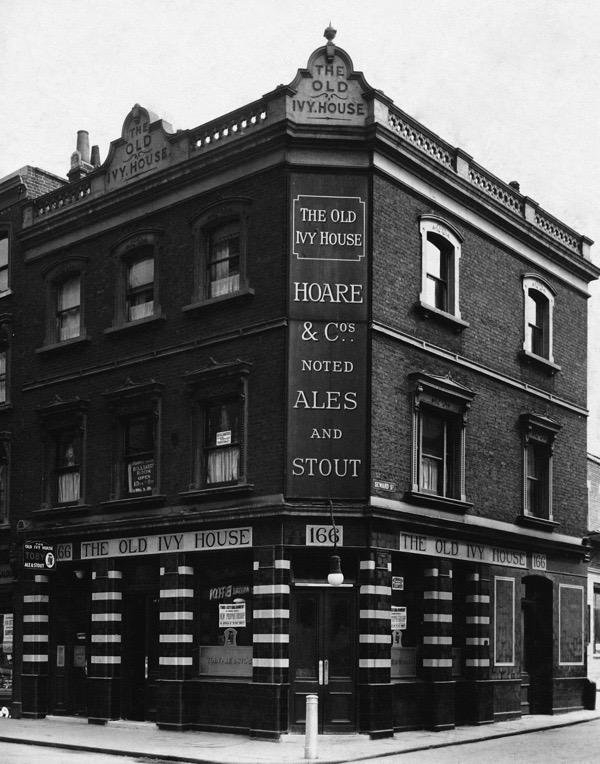
The Old Ivy House, 166 Goswell Rd, EC1 (Opened before 1837 and open today)

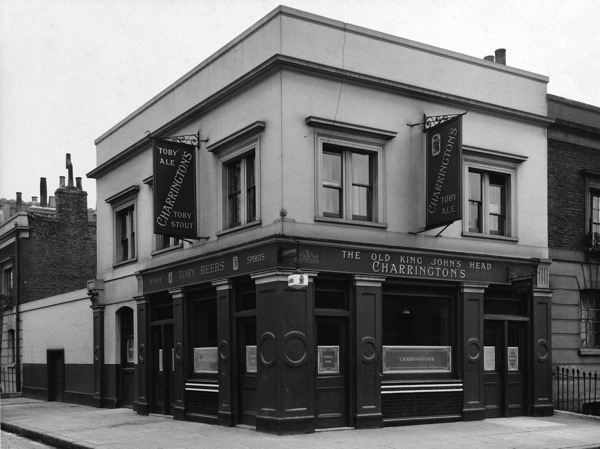
The Old King John’s Head, 90 Mansfield St, Shoreditch, E2 (Opened before 1848, rebuilt in 1965, closed and demolished 2013)

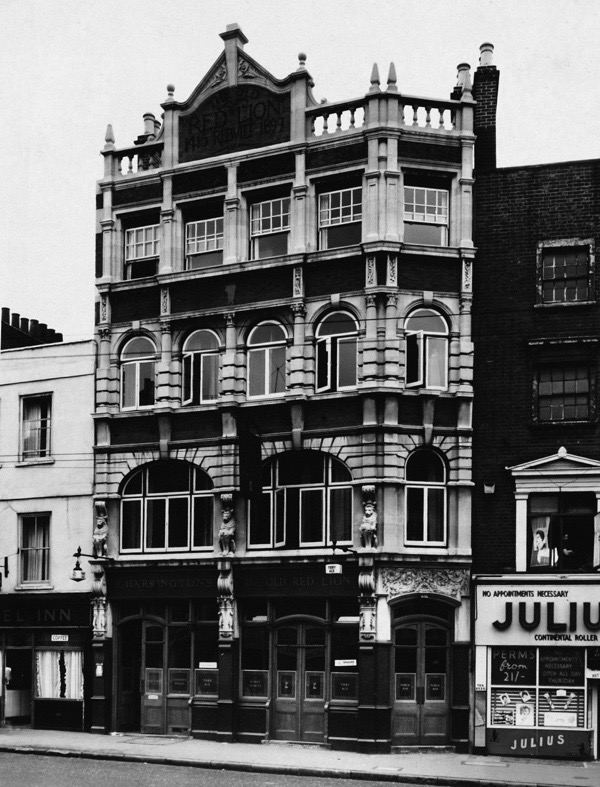
The Old Red Lion, 418 John St, Clerkenwell, EC1 (Opened in 1415, rebuilt 1899 and open today)

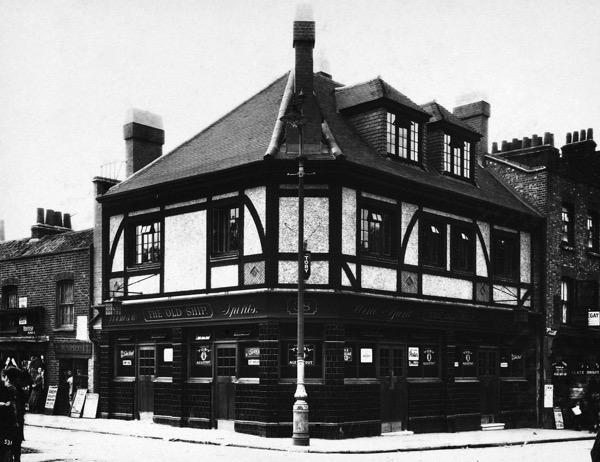
The Old Ship, 38 Stepney High St, Mile End, E1 (Opened before 1839, closed 1944 and now demolished)

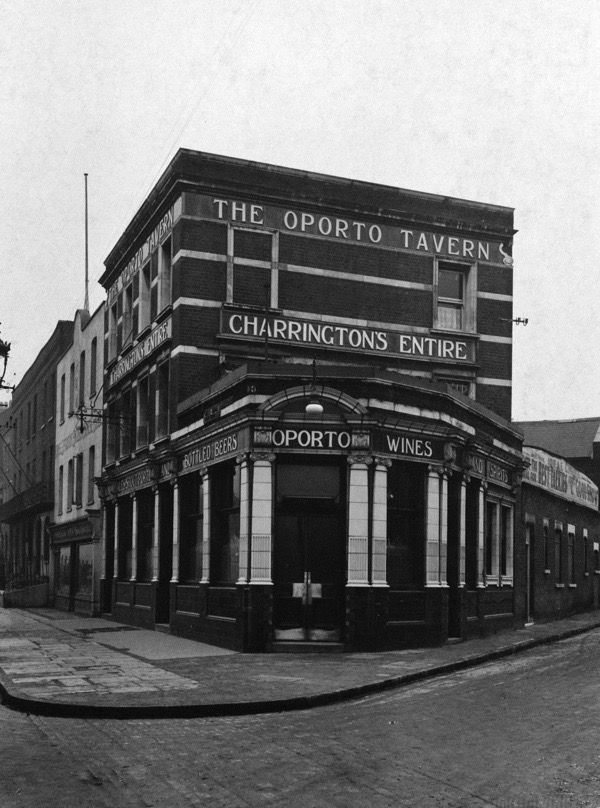
The Oporto Tavern, 43 West India Dock Rd, Poplar, (Opened 1851, changed name to ‘Westferry Arms’ in 2012 and closed in 2016)

The Palmerston Arms, 184 Well St, Hackney, E9 (Opened before 1872, closed 1950 and now a pizzeria)

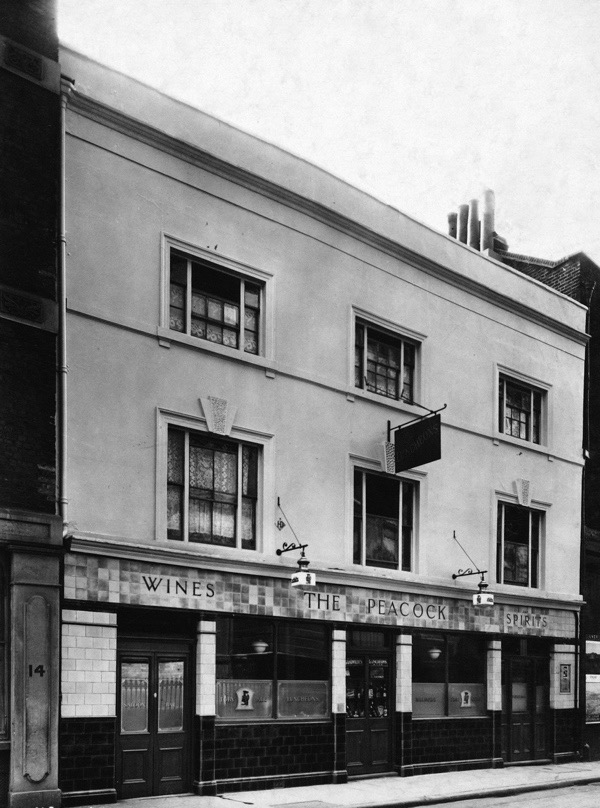
The Peacock, 12 Whitecross St, Cripplegate, EC1 (Opened 1725 but destroyed by enemy action inDecember 1940)

The Percy Arms, 26 Great Percy St, Clerkenwell, EC1 (Opened before 1853 but now closed and converted to residential use)

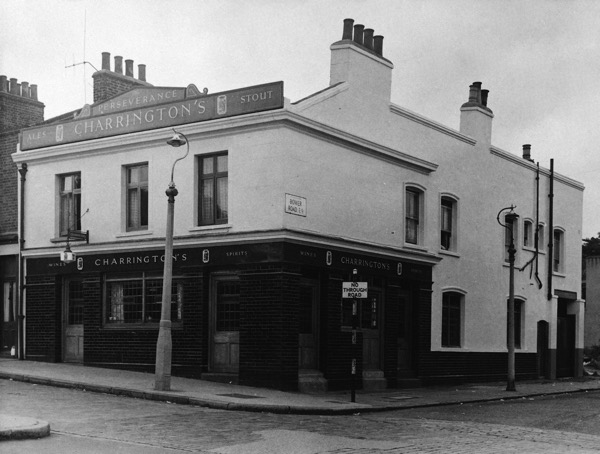
The Perseverance, 35 Vicarage Lane, East Ham, E6 (Opened befire 1881, closed 2004 and now converted to residential use)

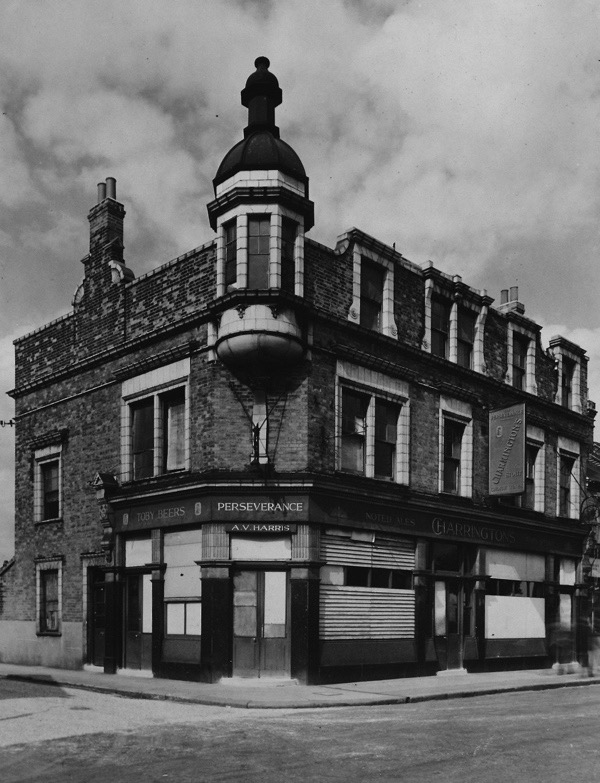
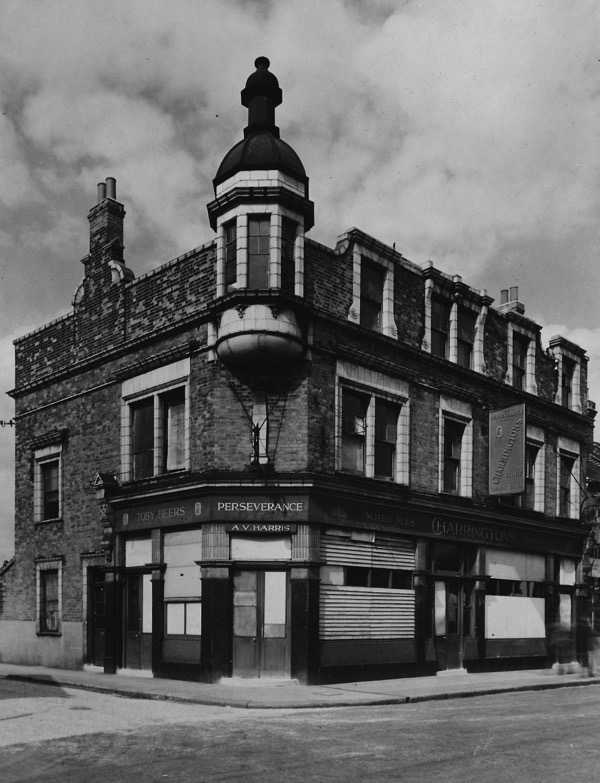
The Perseverance, 7 Wallis, Hackney Wick, E9 (Opened 1911, closed 1967 and now demolished)

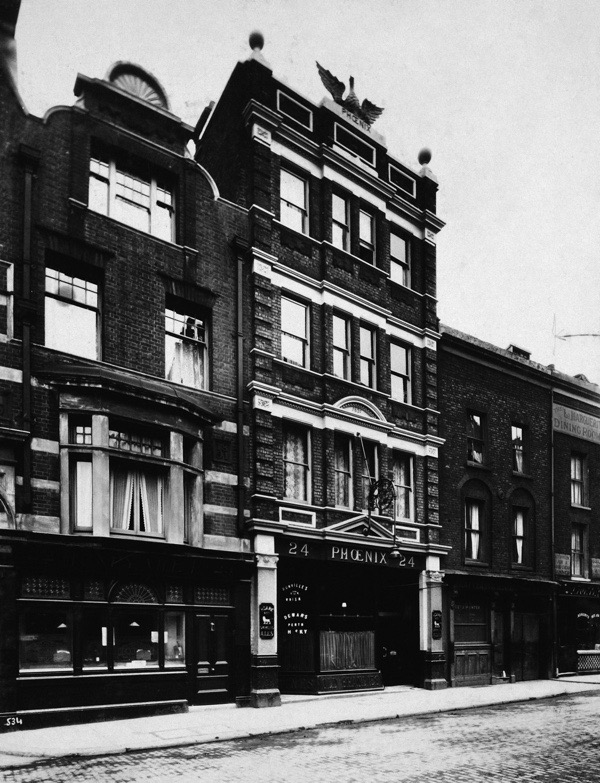
The Phoenix, 24 Upper East Smithfield, Aldgate, E1 (Opened before 1826 but destroyed by enemy action on 15th September 1940)

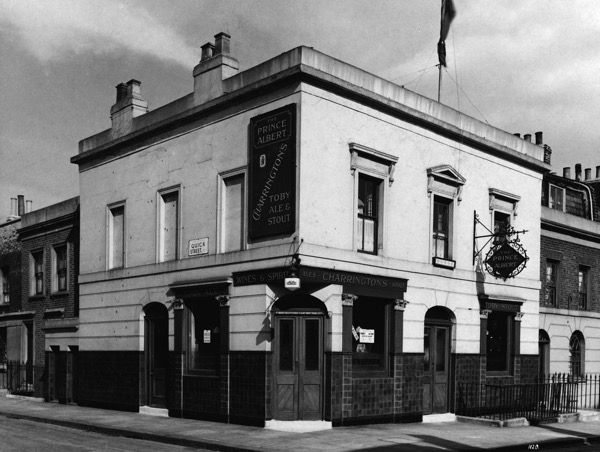
The Prince Albert, 16 Alfred St, City Rd, N1 (Opened before 1850, renamed ‘The Charles Lamb’ in 2006 and open today)

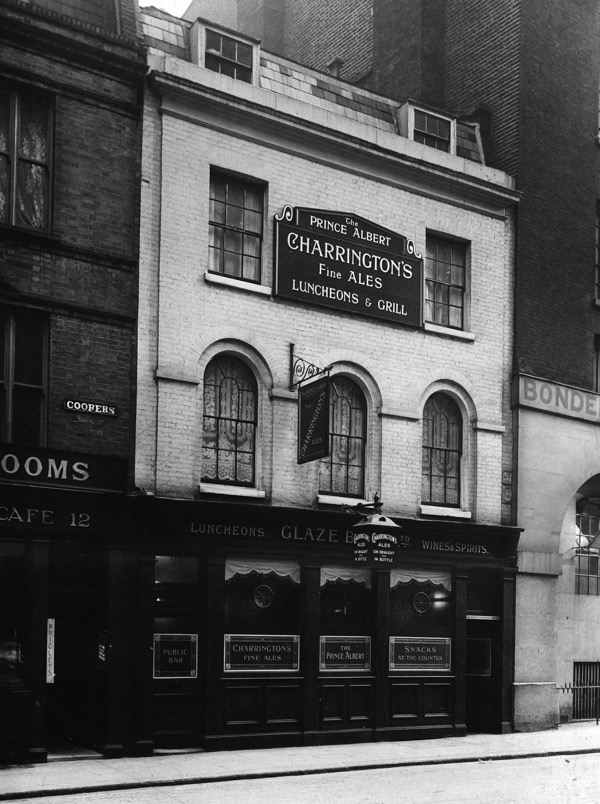
The Prince Albert, 11 Coopers Row, Crutched Friars, City of London, EC (Opened before 1842 and destroyed by enemy action on 10th May 1941)

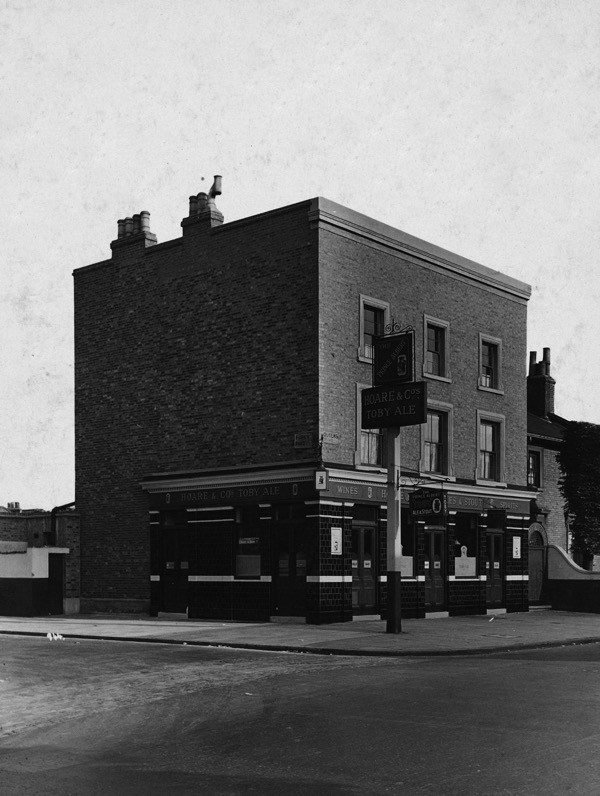
The Prince Albert, 221 Queesbridge Rd, Dalston, E8 (Opened before 1848, closed 1971 and now demolished)

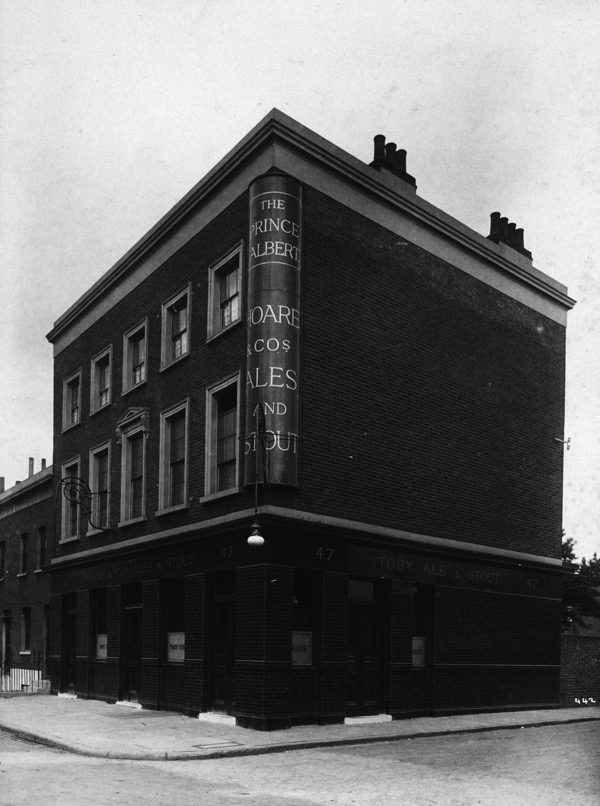
The Prince Albert, 47 Hows St, Shoreditch, E2 (Opened before 1848 and now demolished)

The Prince Alfred, 46 Eleanor Rd, London Fields, N11 (Opened before 1863 abut destroyed by enemy action in September 1940)

The Prince Alfred, 7 Poplar High St, E14 (Opened 1861, closed 1972 and now demolished)

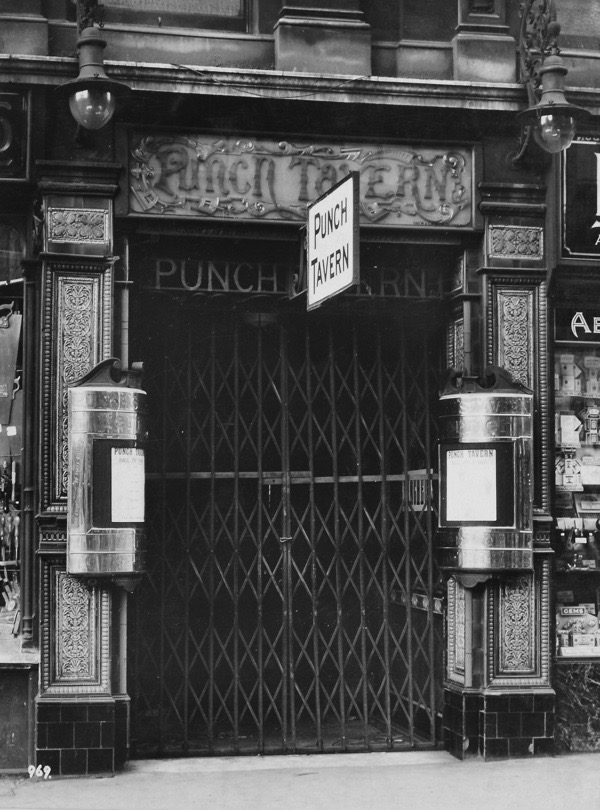
The Punch Tavern, 99 Fleet St, EC4 (Opened before 1839 and open today as a restaurant)
Photographs courtesy Heritage Assets/The National Brewery Heritage Trust

You may also like to take a look at
The Programme For Tomorrow
Baddeley Brothers have produced beautiful cards designed by Friederike Huber which we will distribute tomorrow at our Celebration of the Life & Work of Colin O’Brien, but I am publishing the programme today alongside Marcus Liversedge‘s film as a taster of what to expect


You may also like to read about
Dan Cruickshank At Trinity Green
Despite public opposition, widespread coverage and the outcry of all the significant heritage bodies, Sainsbury’s are pushing ahead with their plans for a twenty-eight storey tower of luxury flats overshadowing the historic Grade I listed Trinity Green Almshouses in Whitechapel
[youtube ySeMkm3wWjU nolink]
The Friends of Trinity Green are staging a fundraising dinner on Friday 2nd December cooked by Oliver Rowe, acclaimed chef & star of BBC2’s The Urban Chef, in the beautiful panelled chapel at Trinity Green which has never before hosted such an event. This candlelit evening will include a three course seasonal meal inspired by Oliver’s new book, Food for All Seasons. The Friends of Trinity Green are inviting a donation of £300 per guest towards their legal fighting fund to stop Sainsbury’s. If you wish to attend, please email friendsoftrinitygreen@gmail.com to reserve your place.

The proposed Sainsbury’s tower of luxury flats (as tall as Centrepoint) overshadowing Trinity Green

The Chapel at Trinity Green

Celebrated chef Oliver Rowe will be cooking a candlelit seasonal dinner in the chapel on Friday 2nd December to raise money for the fighting fund to stop Sainsbury’s and Save Trinity Green.
Click here to learn more about the FRIENDS OF TRINITY GREEN
You may also like to read about
Tim Hunkin’s Housing Ladder
If you are heading to Clerkenwell this Thursday 17th November for our Celebration of the Life & Work of Colin O’Brien, starting at 6pm at St James, Clerkenwell Green, you might like to walk over to Holborn afterwards to visit Novelty Automation which is open until 10pm that night for the inauguration of a new machine by Tim Hunkin

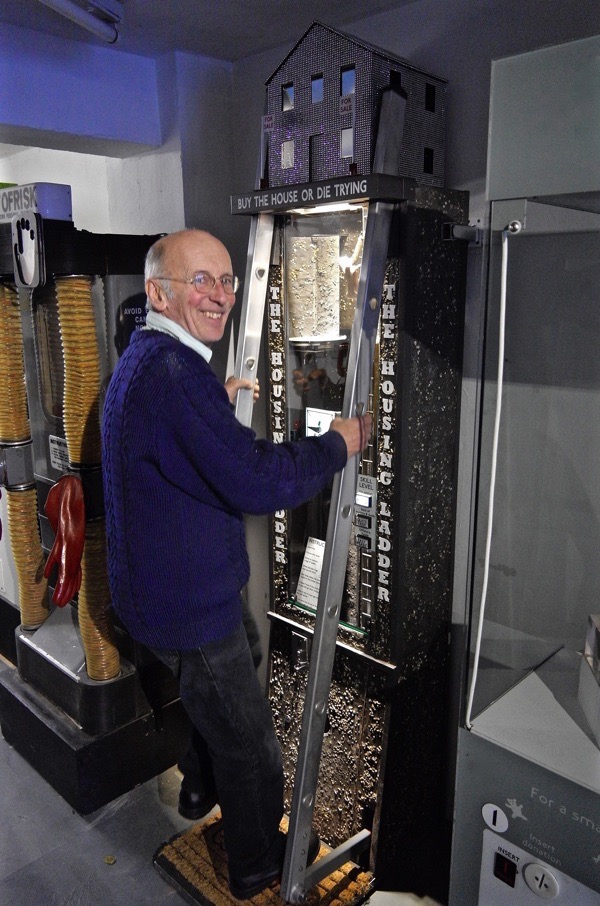
Tim Hunkin climbs The Housing Ladder
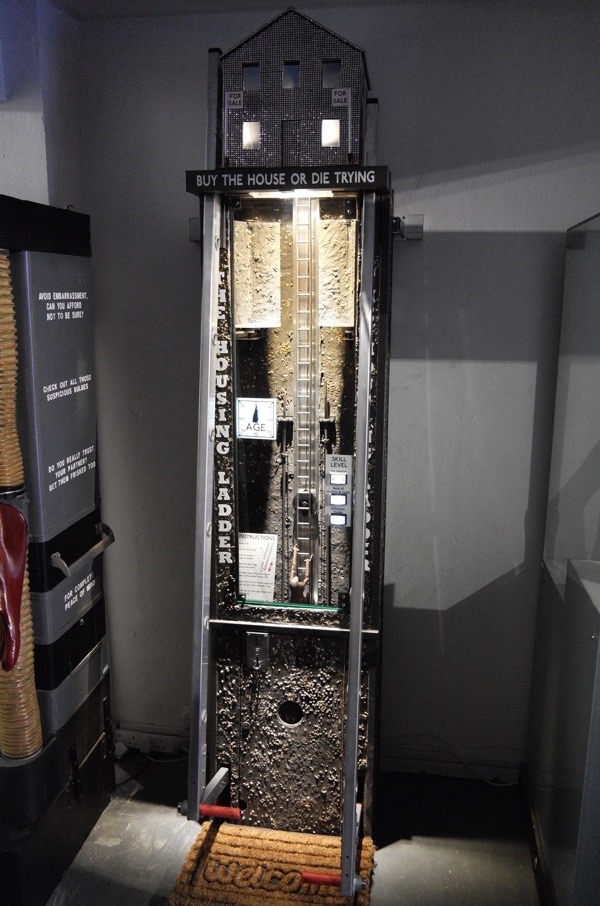
Yesterday I paid a visit to Novelty Automation, Tim Hunkin’s home-made slot machine arcade in Holborn, where I found the maestro at work installing his latest satirical contraption, The Housing Ladder, Buy the House or Die Trying – an elegant construction which expresses our current crisis with astute irony.
The purpose is to climb the ladder to reach the shining house at the top without being knocked back by buy-to-let entrepreneurs, property developers or second home owners. Once you start climbing, a clock that gives you eighty years starts ticking and you need to be alert because, if the one of the villains pops out, you will find yourself sliding backwards down the ladder and may run out of time before you can reach the top. Unlike life, there are options which you can choose, offering degrees of difficulty – from EASY PEASY (Offshore funds), QUITE EASY (Bank of mummy & daddy) and HARD (No savings).
At first, I was encouraged when I succeeded by setting the machine to EASY PEASY (Offshore funds) but then I was dismayed to discover the HARD (No savings) option takes greater skill than I possess – Why should I have been surprised? Readers are invited to step up and test their ability on The Housing Ladder at Novelty Automation.

Tim Hunkin’s Housing Ladder, Buy the House or Die Trying


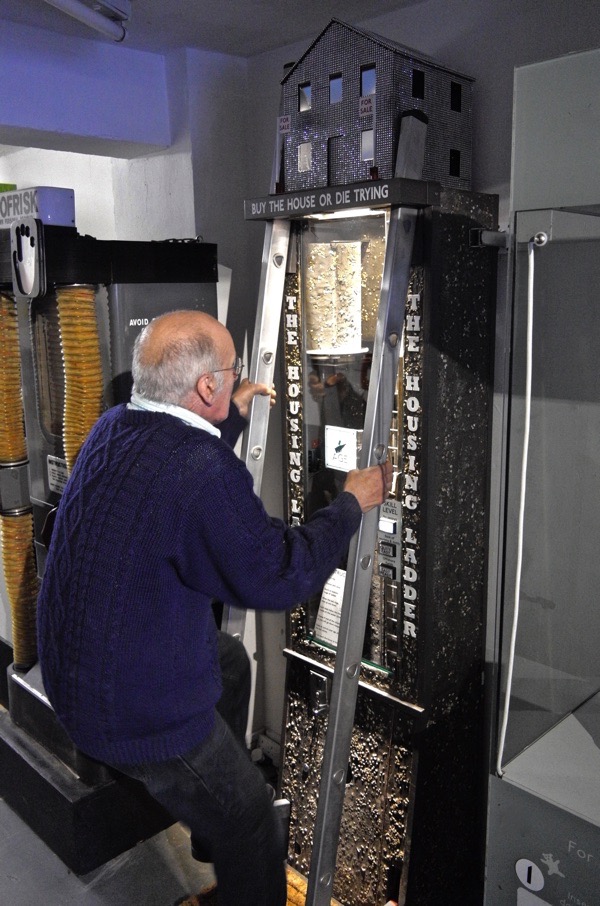
Tim climbs…


Tim climbs…


Tim’s progress up the property ladder is halted when a property developer pops out …

[youtube dSUXKKu9TYQ nolink]
[youtube vsO-vum1f1Y nolink]
[youtube jYBZxozcOfM nolink]
Click here to read Tim Hunkin’s account of making The Housing Ladder
You may also like to take a look at
Spitalfields Remembers The Great War
On Armistice Sunday, we remember the eighty-three men whose names are commemorated upon the war memorial in the churchyard at Christ Church. For months, Vicky Stewart has been researching the lives of these people, uncovering biographical material where possible, while designer Adam Tuck has created maps which show where they lived in Spitalfields and the vicinity.

War memorial at Christ Church photographed by John Claridge, 1961

Click to enlarge this map which shows the homes we have traced in Spitalfields of those of who died

The memorial today – ‘Greater love hath no man than this that a man lay down his life for his friends’

(Click to enlarge this map)
1. DAVID FREEMAN, Air Mechanic 3rd class. Service No 55241, Royal Flying Corps.
Died 29 May 1917, aged 37. Panel P.1.17 Plashet Jewish Cemetery.
David was born in 1880 in Poland, the Son of Jacob & Rachel Freeman, the eldest of five children. He married Louise and they lived at 22 Clifton Buildings, Camlet St, on the Boundary Estate.

This is the doorway that David Freeman walked out of at Clifton Buildings
2. JOSEPH HARRIS, Corporal. Service No 13507, Royal Berkshire Regiment, 2nd Battalion.
Died 2nd April 1918, aged 23. Grave II. E. 4. Pargny British Cemetery.
Joseph’s father, Benjamin, a slipper maker from Warsaw who worked from home was unable to write his name, signing the census form with a cross. Joseph was born in Spitalfields and had four brothers and four sisters. His mother, Sarah, was a charwoman. By seventeen, Joseph was a general labourer and, when he died, the family were living at 33 Culham Buildings on the Boundary Estate.

This is the doorway that Joseph Harris walked out of at Culham Buildings
3. JAMES DANIEL POPPY, Private.
James was Roman Catholic, born in 1885, and attended St Ann’s School in 1893 while living at 24 Gt Pearl Street. By 1901 he was a ‘Boy Under Detention’ at St David’s Reformatory School for Catholic Boys’ in Wales, run by Jesuits, where he received land-based nautical training. By 1906, aged twenty-one while living at 24 Thrawl St and working as a shoemaster, he entered Whitechapel Infirmary with a ‘swelled face.’ In 1909, now at 4 Flower and Dean St, he was treated in Stepney Workhouse Hospital for ulcerated legs. By 1915, he was a hawker and back in the Whitechapel Infirmary. His military career is unknown.
4. JOSEPH FREDERICK GOODSON, Rifleman. Service No 56007, King’s Royal Rifle Corps, 6th Battalion. City of London Rifles.
Died 20th June 1918, aged 19. Grave VIII. I. 12. Dernancourt Communal Cemetery Extension. Epitaph: ‘Oh for a glimpse of the grave where you’re laid only to lay a flower at your head, Mother.’
Born 10th May 1899 at 19a Corbetts Court and baptised at Christ Church, Spitalfields, Joseph went to St Mary’s School, Spital Sq, when the family lived at 2 Chapel Place. The following year, they moved just around the corner to 2 Nantes Place, Norton Folgate. He was one of six children born to Joseph & Norah Goodson until the year before he enlisted when a brother and sister both died.
5. HENRY GEORGE VINCENT, Private. Service No 16017, Norfolk Regiment, 7th Battalion.
Died 12th August 1916, aged 41. Grave IV. H. 19. Pozieres British Cemetery, Ovillers-la-Boiselles
Henry Vincent may have brought his young family to Spitalfields to work for the Great Eastern Railway, a short walk from his home at in Commercial St. His father, George, had worked on the railway as a goods clerk, rising to become Railway Station Master in Ramsey, Huntingdonshire, where Henry was born. He followed his father into the railway starting as a railway clerk while living in Tottenham and eventually became a correspondence clerk working from home at 117 Commercial St. The son of George and Mary Ann Vincent, he married the daughter of a farmer, Caroline Chapman, who lived in Hornsey Rise, Islington and they married there before moving to Tottenham. They had four children, three surviving infancy.

The door that Henry George Vincent walked out of at 117 Commercial St
6. & 7. MALCOLM & LESLIE ANDREW
MALCOLM ANDREW, Lieutenant. Service No 4722, Lancashire Fusiliers, attd. 104th Trench Mortar Bty.
Died 4 November 1918, aged 28. Grave VI. D. 1. Romeries Communal Cemetery Extension. Epitaph ‘In God’s Keeping’ (Gladys)
LESLIE WALTER ANDREW, Carpenter’s Crew. Service Number M13789, Royal Navy, H.M.S. Duncan
Died 17 November 1915, aged 19. Grave IV. E. 3. Taranto Town Cemetery Extension.
Malcolm & Leslie, born 1890 & 1896 respectively, were both baptised at Christ Church, Spitalfields, and lived at 96 Commercial St. Their father Thomas, a potato salesman and then a dairyman, was from the remote village of Granton in the Highlands of Scotland while their mother, Martha, was born in Jersey. By 1911, Malcolm, then twenty-one years old and single, a fruit salesman’s clerk, was living in a boarding house along with eight others in Hackney while Leslie, a greengrocery clerk, boarded with his sister at 25 Osborn St, Spitalfields. Malcolm was married to Gladys who later returned to her parents’ home on a farm near Tunbridge Wells. Malcolm signed up in 1917 and died seven days before the Armistice, the same day as his neighbour Thomas Anderson.
Leslie died from “a fracture of the skull consequent upon falling from aloft” whilst serving on HMS Duncan six months after enlisting. He was a motor body builder, who was recorded as 5 foot 5 3/4 inches tall with a 36 3/4 inch chest with black hair, hazel eyes, a fresh complexion and a scar to his right knee. Previously, he had served on HMS Pembroke II where his character was described as ‘Very Good.’

The door that Malcolm & Leslie Andrew walked out of at 96 Commercial St
8. WILLIAM HENRY PERCIVAL, Rifleman. Service No 534290, London Regiment (Prince of Wales’ Own Civil Service Rifles), 15th Battalion.
Died 8th June 1917, Age 19. Grave I. D. 16. Mendinghem Military Cemetery. Epitaph ‘He giveth his beloved rest’ (Father)
William Gray was adopted by Percy & Grace Percival, parents of Fred, born in Aldgate with a crippled left hand, and Stanley and Grace who both died young. Born on 15th Mar 1898 in Kentish Town, William entered Raywood St Infants School at age three, while living in Battersea, where his father an omnibus conductor. On 9th August 1909, his parents with their three surviving children were admitted to Poplar Workhouse. The children were ten and nine years old with the littlest just eleven months, when when their father was classed as ‘infirm’ and requiring an ‘infirm diet,’ while their mother was classed ‘firm.’ By the end of that year, baby Grace had died. On 20th Feb 1911, Percy was a ‘fruit hawker,’ by then aged forty-three and living at 82 Brushfield St, when he admitted himself to South Grove Workhouse, Whitechapel, as ‘destitute.’ By the time of William’s enlistment, the family were living at 7 Puma Court.

The door that William Henry Percival walked out of at 7 Puma Court
9. HARRY TIPPETT, Rifleman. Service No S/25195, Rifle Brigade, 11th Battalion.
Died 1st April 1918, aged 21. Grave P. VII. G. 4A. St Sever Cemetery Extension, Rouen.
The Tippett family home was 10 Puma Court, Commercial St. Harry was born on the 14th September 1897 and baptised at Christ Church, Spitalfields. By the time of his death in 1918 his mother, Sarah, widowed since 1911, had moved across the court into the Norton Folgate Almshouses, to “No 3 Alms Rooms, Puma Court.” Harry was one of eleven children, six of whom had died by 1911. By the time of the census his father William, a printer’s assistant, had been dead only a week, leaving Harry, age thirteen and still at school, the eldest son with three remaining sisters.
10. LESLIE LLEWELLYN LITTLEJOHN, QMS. Service No 10673, Royal Scots Lothian Regiment, 2nd Battalion.
Died 11th April 1917, aged 24. Grave I.M.2 Duisane British Cemetery.
Leslie was an orphan, born in Kensington on 5th Jan 1892. Given a home by Matthew, a blindmaker, and Ellen (Nellie) Littlejohn, he was the third of their six children. On July 15th, 1901 Nellie and all the children entered Britten St Workhouse in Chelsea. In 1909 Leslie, age fourteen, he spent a month in Whitechapel Infirmary with pneumonia and his address given as 14 Fournier St with his brother Cyril, listed as his relative, living in West Brompton.

The door that Leslie Llewellyn Littlejohn walked out of at 14 Fournier St
11. HENRY SHATKOVSKY, Private Service No 132092, Machine Gun Corps (Infantry), 8th Battalion.
Died 28th May 1918, aged 20. Soissons Memorial
Henry was the son of Jacob & Fanny Shatkofsky who lived at 19 Booth St (now Princelet St). Jacob died in 1919, followed in December 1927 by Henry’s brother Samuel, followed twelve days later by their mother. When the family buried Fanny alongside Jacob they erected a third stone between them with the inscription ‘In memory of their dear son Henry, Killed in Action 28th May 1918, aged 20.’ The graves are at the Edmonton Federation Cemetery laid our in 1889 on land donated by Lord Montague, MP for Whitechapel, for Jewish people in the East End who could not afford fees asked by other synagogues.

The door that Henry Shatkovsky walked out of at 19 Princelet St

(Click to enlarge this map)
12. JAMES MINNS, Corporal. Service No 4/7904, West Yorkshire Regiment (Prince of Wales’s Own), 18th Battalion.
Died 3rd May 1917, aged 20. Panel Bay 4: Arras Memorial
James’s father George, of 56 Flower & Dean St, a brewer’s labourer, married Elizabeth Homewood in 1891 at Christ Church, Spitalfields. Her father was a weaver. On 14th May 1896, James was born and, at fourteen months, he was admitted to the Whitechapel Infirmary with measles, his mother staying with him as he was still suckling. The notes say that his father, then a dock labourer, had been ‘absent for two weeks.’ They lived in Hanbury St then but when he started at George Yard Charity School, the family lived in Aldgate. At six years old, he was re-admitted to Whitechapel Infirmary with an abscess on his face, his address now South Grove Workhouse where his mother lived while his father was at 9d Dorset St. A year on found him still at George Yard School but living in ‘shelters.’ In 1911, James’ parents were at 15 Little Pearl St but James then fourteen years old was an ‘inmate’ at the East London Industrial School in Lewisham for ‘Boys under Detention’, described as ‘a plumber.’ All boys had a trade title but received some schooling. At enlistment, he was living at 45 Crispin St.

The doorway that James Minns walked out of at 45 Crispin St
13. CHARLES THOMAS KENNY, Rifleman. Service No R/32916, King’s Royal Rifle Corps, 10th Battalion.
Died 19th February 1917, aged 36. Panel Pier and Face 13 A and 13 B. Thiepval Memorial
Charles Keeny died leaving a wife and five surviving children. In 1901, Charles was a plumber living at 9 Paternoster Row, Spitalfields (now Brushfield St) with his parents John, a warehouseman, and Elizabeth – who ran their home as a lodging house – and six siblings. The family lived in two of the rooms, while the other four rooms were occupied by nineteen others. In January 1904, he married Jane Hayes, a hawker, who lived next door. By 1911, they had six children, one of whom died in infancy and they lived two doors from his parents. At the time of his death, the family were at 51 Gun St.
14. DAVID FLYNN, Driver. Service No 40123, Royal Field Artillery, “A” Bty. 83rd Brigade.
Died 29th October 1917, aged 21. Grave VI. B. 3. Bard Cottage Cemetery
In 1890, David Flynn was born in Spitalfields, one of seven children, two of whom died before 1911. His parents were David & Theresa Flynn, born in Holborn and the City, both men’s tailors. In 1911 David was sixteen and a contractor’s van boy, he was living with his parents and older brother James, eighteen years old, and younger sister Theresa, twelve years old. They lived in one room at 6 Tenter St, Spitalfields. At the time of his enlistment, the family lived at 35 Artillery Lane.
15. AUGUSTUS MAHONEY, Sergeant. Service No 8807, York & Lancaster Regiment, 2nd Battalion.
Died 21st March 1918. Bay 8, Arras Memorial
Augustus was born on 8th June 1888 to John & Mary Ann Mahoney, as the eldest of six children. His father, John, was a general labourer from Cork. In 1894, when Augustus enrolled at St Matthias School, the family were living at 41 Bacon St but by 1901 they had moved to 39 Dorset St – in the house at the entrance to Millers Court where thirty-seven people lived, seven families in seven rooms. When he was nineteen years in 1907, Augustus decided to leave his job as a news vendor and enter the army and by 1911 was serving in India. On Christmas Day 1917, he married Florence Squibb at the Church of St Mathew, Bethnal Green, but was killed just three months later.
16. JOSEPH DANIEL DISS, Gunner. Service No 125215, Royal Field Artillery, 306th Brigade.
Died 30th August 1917, aged 22. Grave VI. A. 5A. Wimereux Communal Cemetery
On 11th February 1901, Joseph Diss spent eight days with his siblings Mary & Edward in the City Rd Workhouse, where they were followed a few days later by brothers George & Walter. The family lived in an overcrowded house in Clerkenwell, which was home to eight families, totalling thirty-two people. Born in 1895 in Robin Court in the City of London, he was one of eleven children born to Thomas Diss, a hawker of wooden cases and his wife Minnie. Six children had died by 1911, when the remaining five with their parents plus Joseph, aged fifteen, a brewer’s van boy, lived in one room at 5 Duval St (Dorset St). Three months before the war, Joseph, then a carman, married Ellen, twenty years old, a packing case dealer who was pregnant with their first child. They lived at 7 Duval St. The year Daniel married, his younger sister Mary married Philip Schratsky, who was also killed.
17. BERTIE INGREY, Rifleman. Service No 14/45152, Royal Irish Rifles, 14th Battalion.
Died 7th December 1917, aged 25. Grave V. E. 21. Rocquigny-Equancourt British Cemetery
Born in 1892, Bertie was the son of Mrs. Agnes Garroway, of 2 Duval St, Spitalfields.
18. JAMES EAGLE, Rifleman. Service No 11475, King’s Royal Rifle Corps, 16th Battalion.
Died 20th May 1917, aged 23. Panel Bay 7. Arras Memorial.
In 1911, James Eagle’s mother, Anna, an out-of-work charwoman, was recorded as an ‘inmate,’ along with two hundred and fifty-nine others, at Providence Row Night Refuge in Crispin St, Spitalfields. James was born in Bow in 1894 and by 1917, the year James was killed, Anna was living at 33 Whites Row, with his brothers William and Thomas.
19. HARRY JOHNSON, Private. Service No 524482, Private Labour Corps, 111th Company
Died 23rd November 1918, aged 45. One of three graves ‘near the SE corner’ of Wevelgem Communal Cemetery.
Harry was the husband of Annie and they lived at 23 St Margarets Buildings, Whites Row. He was forty-one years old in 1914, three years over the age limit of thirty-eight for regular army enlistment.
‘The Labour Corps, formed in 1917, was manned by officers and other ranks who had been medically rated below the “A1” condition needed for front line service. Many were wounded. Units were often deployed for work within range of enemy guns, sometimes for lengthy periods. In the crises of March and April 1918 on the Western Front, Labour Corps units were used as emergency infantry. The Corps always suffered from its treatment as something of a second class organisation.’
20. ISAAC FRANKS, Private. Service No 282370, London Regiment (Royal Fusiliers), 4th Battalion.
Died 4th June 1917. Grave II. B. 11. Crooisilles Railway Cemetery.
Emanuel & Raynor Franks were born in Amsterdam, but their children all born in Spitalfields. Isaac was born on 25th January 1893. In 1900, when he was aged seven, the family were living at 3 Butler St (now Brune St) and he attended St Mary’s School. They lived with two other families making eighteen in one house, six adults and twelve children. Isaac’s father, Emanuel, was a hawker and the two other fathers in the house were ‘hawkers of lemons.’ By 1911, they had moved to 130 Rothschild’s Buildings, E Block, Spitalfields.
21. LOUIS BARZOLOI, Private. Service No. 611863, London Regiment, 1st/19th Battalion.
Died 7th December 1917, aged 23. Grave III. F. 7. Abbeville Communal Cemetery Extension.
Louis’s father, Philip, was a labourer in the London Docks and came from Leeds, while his mother, Hannah, was from Amsterdam. In 1901, Louis, age six years old, he was living with his Dutch Grandparents, Emanuel, a retired upholsterer, and his wife Betsy, along with his parents Philip & Hannah, and his four siblings at 8 Freeman St, Spitalfields. His brother Isaac was a cigar maker and fourteen-year-old David was a bookstall assistant. They shared their tiny terraced house with another couple. By 1911, the family were at 6 Butler St. His father, who was no longer a dockworker, and his brother David, were both hawkers of sweets, while his brother Jacob was a labourer in the market and Louis, then sixteen years old, was a boat riveter. All eight children were born in Spitalfields.

(Click to enlarge this map)
22. MOSES MICHAELS, Private. Service No 54958. Royal Welsh Fusiliers, 10th Battalion.
Died 3rd January 1917, aged 31. Grave VII. F. 4. Puchvilliers British Cemetery. Epitaph ‘Deeply mourned by his sorrowing mother, brother, aunts’
Moses’ father, Simeon, died when Moses and his brother Solomon were aged just three and one years old and thereafter their mother Rosetta (known as Rose) brought up her two sons while working from home as a dealer in old silk hats. Rose had grown up a few streets away in Gravel Lane, just off Petticoat Lane. Moses was born in 1887 at 9 Palmer St and by the age of fourteen he was working in the boot trade. Also living with them were Rose’s niece Bloomah, a cigar maker, and her brother Alexander, a repairing tailor, in which trade Moses joined him while his brother Sol became a tailor’s stock cutter.
23. ALEXANDER ISAACS, Rifleman. Service No 6044, Rifle Brigade, 9th Battalion.
Died 6th January 1916. Panel 46-48 & 50 Ypres (Menin Gate) Memorial.
Alexander was married to Sarah Isaacs who lived at 18 Palmer St.
24. MICHAEL HOLBROOK, Private. Service No 77180, London Regiment (Royal Fusiliers), 2nd/4th Battalion.
Died 25th April 1918, aged 18. Grave I. A. 1. Crouy British Cemetery, Crouy-Sur-Somme.
Michael’s family were Roman Catholic. Born in 1900, he was the son of John & Ellen Holbrook of 7a Shepherd Buildings, (now Toynbee St). At age thirteen, Michael was admitted to hospital with ulcerative tonsillitis. The family were then living at 11 Margaret’s Buildings, Whites Row. His hospital discharge states that his mother had moved to 194 Hanbury St and his father, a dock labourer, was living in Duval St (Dorset St).
25. GEORGE FIELDSEND, Private. Service No 211800, Rifle Brigade.
George was not killed in battle but died in Whitechapel in 1921 aged thirty-five, presumably from injuries sustained in the war. He was the son of Frederick Fieldsend & Norah Hennessey. His father was a market porter, and later a fruit and vegetable hawker. George and brothers Frederick & William followed their father into the trade. They had two sisters, Ellen & Nora. In 1896, they lived at 8 Corbett’s Court, Hanbury St. By 1901, the family lived at 5 Crispin St in a pub on the corner of Dorset St, the Horn of Plenty, where forty-two others lived, mainly families with children. By 1911, they were at 20a Shepherds Buildings. While working as a travelling salesman in June 1911, George married ‘the girl next door’ Ellen Bailey from No 19.

In 1901, the Fieldsend family lived above the Horn of Plenty at 5 Crispin St, as photographed by C A Mathew in 1911
26. GEORGE RANDALL, Private. Service No 205180, Queen’s Own (Royal West Kent Regiment), 11th Battalion.
Died 21st September 1917. Grave XXIV. H. 5A. Lijssenthoek Military Cemetery
George’s mother, Emma, lived by taking in washing and his father, Thomas, was a labourer. In 1891, Thomas & Emma and their children lived at 4 Brick Lane and, by 1901, they were at 27 Shepherd’s Buildings (Toynbee St) with the older son, Ernest, working as a horse groom and their father as a navvy. By 1911, George was no longer at home but his family were at 4 Wheler St, Spitalfields. At the time of his marriage at Christ Church in 1915 to Rose Everson, a glassblower of 132 Vallance Rd, George was a City Corporation servant and back living in Spitalfields again. George died just nine months after their first son, Edward William, was born on 23rd December 1916.
27. THOMAS DERBY ANDERSON, Private. Minns. Service No 49655, Northamptonshire Regiment, 1st Battalion.
Died 4th November 1918, aged 19. Grave D4. Le Rejet-de-Beaulieu Communal Cemetery. Family’s Epitaph ‘Gone But Not Forgotten.’
Thomas’ father, William, a cigar maker, was thirty-seven years older than his mother, with May, the youngest, born when he was seventy-one. Thomas was born on 31st May 1899 and baptised at Christ Church, Spitalfields, one of nine children in the family, living at 132 Lolesworth Buildings, Thrawl St. He attended George Yard Charity School, Whitechapel, (also known as the George Yard Ragged School). His older brother was a telegraph messenger and an older sister was a card box maker. He worked as a carman and was living in Lolesworth Buildings when he enlisted. He died seven days before the Armistice.
28. JOHN ALFRED BARNSLEY, Lance Corporal. Service No G/10818, The Queen’s (Royal West Surrey Regiment), “B” Coy. 11th Battalion.
Died 1st August 1917, aged 27. Panel 11 – 13 and 14. Ypres (Menin Gate) Memorial
After his father died when John was fourteen and his mother when he was twenty, John was left head of the family with four sisters, the youngest just eight, living in two rooms in Old Ford. John, a chairmaker, was born in 1890, the son of John Barnsley, a book laster, and his wife Emma.. In 1915, he was married at Christ Church, Spitalfields, by the Rector Charles H Chard, to Rose, a glass engraver, daughter of George Clements, a dock labourer and they lived at 167 Lolesworth Buildings, Thrawl St.
29. WILLIAM HENRY CLEMENTS, Private. Service No 295381, London Regiment (Royal Fusiliers), 2nd/4th Battalion.
Died 9th August 1918, aged 21. Panel 10. Vis-en-Artois Memorial.
When William was fourteen, his brother was employed as an upholsterer’s spring binder with his three sisters working as a cigarette labeller, a worker in a druggists and a charwoman. Born on 1st May 1897, Henry’s father George was a dock labourer and his mother Caroline was a charwoman. Their cousin lived with them in three rooms at 167 Lolesworth Buildings, Thrawl St. All were born in Stepney, except their mother who was from Hoxton. He started at George Yard Charity School on 12th January 1903 where many of the children starting at that time were listed as from Russia. Rose Clements, William’s sister, married John Barnsley – also on the memorial – and moved into the family home.
30. RENE GAUTIER, Corporal. Service No 10462, Gloucestershire Regiment, 7th Battalion.
Died 8th August 1915. Panel 102 to 105. Helles Memorial.
Rene’s parents, Fernand & Victorine (later called Adele) were born in France. Rene, one of eight children, was born in Paris but, by 1891, the family were living in a shared house in Shoreditch. By the time of his marriage in 1910 to Emily Wragg, aged twenty-one but already a spinster, he was a ‘moulding maker,’ as his father had been, and living at 202 Lolesworth Buildings. They were married at Christ Church. In 1911, Rene & Emily had a daughter, Gladys, who was just four when her father died.
31. WILLIAM ROBERT LIPMAN, Rifleman. Service No 5978, London Regiment, 17th Battalion.
Died 8th November 1916, aged 22. Panel X.C.5, Lijssenthoek Military Cemetery.
William was born on 3rd Nov 1893 in Spitalfields, as the youngest of five children of Joseph & Mary Ann Lipman. The family lived at 63 Lolesworth Buildings, Thrawl St. When William was born they lived in No 44 but, by the time he started at George Yard Charity School, they had moved across the Buildings into two rooms at No 63. William, like his father and older brother, was a carman while his elder brothers were a tea packer and a railway van guard.
32. PHILLIP SCHRATSKY, Rifleman. Service No R/22366, King’s Royal Rifle Corps, 7th Battalion.
Died 21sr March 1918, aged 24. Panel 61 to 64, Pozieres Memorial.
School records show Phillip was born in Romania on 30th May 1894, the eldest of eleven children born to Jack, a tailor, and Mary (Minnie) Schratsky. He started at Berner StSchool in 1900 while living at 51 Cable St but a few months later the growing family moved into two rooms at No 25 Block A, Rothschild’s Buildings in Flower and Dean St. Then they moved to three rooms in 20 Alexandra Buildings, Commercial St. Phillip and his father were tailor’s pressers and his fifteen-year-old brother Zucman was a cigarette maker. In 1914, he married Mary Diss who lived next door when he was at 6 Duval St, the younger sister of Daniel Diss, who was also killed in the war.
33. MOSES FRESCO,Rifleman. Service No 474352, London Regiment (The Rangers), 12th Battalion.
Died 9th April 1917, aged 20. Panel 1.A.27. London Cemetery, Neuville-Vitasse.
Moses’ father was a short man of 5 feet 6 inches who enlisted in the Army on 7th June 1915 stating his age asthirty-eight years. Howevee, he was actually forty-five years old with seven dependant children .The second of twelve children born to Alexander, a fish hawker, and his wife Betsy, Moses was born in 1897 in Spitalfields. In 1901, the family of six lived in two rooms at 171 Wentworth Buildings, but by the next year the family had mysteriously grown to eleven and lived in three rooms at 19 Grey Eagle St, which they shared with another couple.
34. CHARLES WASHINGTON, Private. Service No 6427, The King’s (Liverpool Regiment), 1st Battalion.
Died 10th March 1915, aged 36. ‘Missing at Givenchy.’ Panels 6 to 8, Le Touret Memorial.
Charles Washington, son of Henry Charles Stamm, was born in 1878 in Montreal, Canada, as one of four boys. Then his parents moved to Brooklyn, New York. By April 1899, aged twenty, he was a labourer living in Warrington where he enlisted in the Army for twelve years, but completed fifteen. He fought in the Boer War. Recorded as just 5 feet 5 inches tall and weighing nine and half stone stone, he had grey eyes, light brown hair, sallow complexion with numerous scars to his back and loins. By 1908, he had a scar on his jaw, two scars on his left hand and three tattoos to his arms – anchor, stars & stripes and a ‘female figure and bust.’ His character was described as ‘Indifferent.’ He was in hospital in Rangoon, later in Dublin, for various conditions including syphilis which caused ‘loss of feeling in both arms.’ He was on the Syphilis Register. In March 1900, he spent 56 days in the Military Prison, the first of various confinements for offences which included ‘using insubordinate language towards an officer’ (84 days), ‘drunk in town,’ ‘deficiency of kit and public clothi,g,’ ‘loss of equipment,’ ‘absence from Tattoo,‘ going AWOL and desertion. He forfeited pay ‘thru physical inefficiency.’ Yet on his death, the box for ‘Good Conduct Pay’ was ticked. In 1910, while living at 22 Whitechapel High St, he made a statement to the Thames Police Court about losing his Identity & Life Certificate, and by September 1911 he had moved to 198 Wentworth Buildings, Wentworth St. He changed his name to Isidor Stamm – occasionally calling himself Israel – and converted from Roman Catholic to Judaism prior to marrying Fanny Bearman in Mile End Old Town in July 1912. They had to no children. However, the Army received a letter from ‘Margaret’ in Warrington asking for his whereabouts as he was the father of her child. Fanny was awarded his Widow’s Pension of ten shillings a week.

Letter to Fanny Washington informing her of the death of Charles Washington
35. JAMES HAYES, Private. Service No 8946, South Staffordshire Regiment, 2nd/8th Battalion.
Died 25th September 1915, aged 20. Panel XXX1.A.8, Cabaret-Rouge Cemetery, Souchez.
John, James’ father, was born in Bishopsgate and his mother, Elizabeth, in Spitalfields. James was born on 16th February 1894 and the family of six lived in Spitalfields, firstly at 116 Wentworth St, then they moved to 6 Flower & Dean St where they were when he started at George Yard Charity School. On finishing school, James followed his father to the docks where they both worked as labourers.

(Click to enlarge this map)
36. ALBERT E. SUTER, Company Quartermaster Sergeant. Service No 27496, Royal Engineers, Postal Section.
Died 22nd November 1918. Grave I. D. 2. Solesmes British Cemetery.
Albert’s wife was Louie, the daughter of the schoolmaster and mistress, Edward & Louisa Skinner, of Christ Church School, Brick Lane. They lived in the Schoolmaster’s House. Albert, when twenty-five years old and living in Notting Hill while working as a Post Office sorter, married Louie on the 10th January 1913. He had been baptised at Christ Church, Spitalfields, on 28th Sept 1887. His father, Alfred, was a carpenter, later a warehouseman, and the family lived at 4 Heneage St. Albert died just after war ended and Louie returned to the School House to live with her parents.

This is the doorway where Albert E. Suter walked out at 4 Heneage St
37. HYMAN MOSES, Private. Service No 37806, Northamptonshire Regiment, 9th Labour Company – transferred to (87874) 147th Company. Labour Corps.
Died 21st April 1918, aged 32. Grave XI. C. 11. Warlincourt Halte British Cemetery, Saulty. Epitaph ‘My dear husband Hymie mourned by his wife.’
Hyman’s parents were Barnett & Sarah Moses from Russia. Barnett was an umbrella stickmaker who worked from home. They had seven children but one died. Born in Spitalfields, Hyman was still living there at the time of his enlistment. In 1891 ,the family were living at 50 Grey Eagle St and by 1901 they were at 134 Brick Lane. By 1911, they were all at 27 Heneage St when Hyman, twenty-five years old and single, was a packer in the tobacco works, while his older siblings worked in the fur and millinery trades. Hyman married Hannah and they had a daughter, Rose and lived at 8 Palmer St, opposite Moses Michaels, who was the same age as him and was killed the previous year.
38. MORRIS GOODMAN, Rifleman. Service No S/19802, Rifle Brigade, 12th Battalion.
Died 24th August 1917, aged 27. Grave VIII. I. 13. Boulogne Eastern Cemetery.
Morris was born in 1890 and married Leah, with whom he had two children and lived at 35 Heneage St.
39. JOHN WRIGHT, Rifleman. Service No 6/608, Rifle Brigade, 9th Battalion.
Died 25th September 1915. Panel 46 – 48 and 50. Ypres (Menin Gate) Memorial.
John Alfred Wright was born in Spitalfields and baptised in Christ Church on 24th March 1889. The family lived at 27 George St in the heart of the Flower & Dean rookery. John had an older sister Sarah Ellen. By 1901, their mother had died and the family of three were living at 63 Brick Lane. At recruitment on 24th Aug 1914, John had become a general labourer like his father.

This is the doorway where John Wright walked out at 63 Brick Lane
40. FREDERICK GOLDSTEIN, Private. Service No 281362, London Regiment (Royal Fusiliers), 2nd/4th Battalion.
Died 19th May 1917. Panel Bay 9, Arras Memorial.
Frederick’s father Harris was from Plotska in Poland and his mother Annie from South Russia, both were tailor machinists. He was born on 22nd October 1895, as one of eight children all born in Spitalfields. Frederick joined his parents as a tailor machinist on leaving school. They lived at 2 New Church St, Brick Lane.
41. & 42. JAMES & THOMAS HUGHES
JAMES HUGHES, Rifleman. Service No 6/9878, Rifle Brigade, 11th Battalion.
Died 14th July 1918, aged 27. Grave 1.E.24, Ligny-St. Flochel British Cemetery, Averdoingt.
THOMAS HUGHES, Rifleman. Service No S/2458, Rifle Brigade, 12th Battalion.
Died 25th September 1915, aged 23. Panel 10, Ploegsteert Memorial.
James was admitted into the Whitechapel Infirmary with bubonic plague in February 1914, at the age of twenty-two, while living in lodgings in Flower & Dean St, still single and working as a chairmaker. Born May 1891 at 59 Wentworth St, he was the eldest child of seven born to Thomas Hughes, a haddock smoker, and his wife Rachel, all in Spitalfields. Thomas was born eighteen months after James. James & Thomas started at George Yard Charity School on the same day. In 1911, the family were at 38 Hanbury St. By then James had become a chairmaker and his mother worked as a ‘bedmaker in lodging houses.’ In 1912, Thomas, who had become a french polisher, was married to Sarah Strange and they had two daughters, Emma & Sarah.

This is the doorway where James & Thomas Hughes walked out at 38 Hanbury St
43. HENRY LEE, Rifleman. Service No 21016, King’s Royal Rifle Corps, 21st Battalion.
Died 4th August 1917. Grave C19, Oak Dump Cemetery.
Henry, the son of Thomas Lee, was baptised in July 1886 at Christ Church, Spitalfields, when the family were living at 6 Gt Eastern Buildings and he was still living in Spitalfields at the time of his enlistment.
44. & 45. MARK & DAVID SHUSTER
MARK SHUSTER, Lance Corporal. Service No 33285, Lancashire Fusiliers, 18th Battalion.
Died 30th July 1916, aged 21. Addenda Panel, Thiepval Memorial.
DAVID SHUSTER, Private. Service No 33292, Lancashire Fusiliers, 18th Battalion.
Died 30th July 1916, aged 19. Panel Pier and Face 3 C and 3 D, Thiepval Memorial.
On 30th July 1916, the Shusters lost their two eldest sons, David & Mark, aged nineteen and twenty-one respectively. David had been a gents’ tailor. They were the eldest sons of nine children born to Russian immigrants, Vigdor (Victor) Shuster, who worked from home as a ‘finisher of boots,’ and his wife Golda, who bore him nine children. They lived at 4 Harriot Place, Fashion St, in 1901, moving to Bethnal Green, then Dalston, but by 1916 a newspaper report shows them back in Spitalfields, at 46 Weaver St. David & Mark joined the Lancashire Fusiliers together. On the day they died, their regiment was part of the Somme offensive attacking near the village of Guillemont. They are remembered at Thiepval along with 72,193 fellow soldiers from the Somme with no known grave.

War memorial at Christ Church
NAMES FOR WHOM WE CAN TRACE NO ADDRESS IN SPITALFIELDS
ERNEST EDWARD DENCH, Lance Corporal. Service No 9351, East Lancashire Regiment, 2nd Battalion.
Died 4th March 1917, aged 28. Grave VII. A. 23. Fins New British Cemetery, Sorel-le-Grand
Enlisted in London
WALTER H HERSEY, Gunner. Service No 47144, Royal Field Artillery, 46th Bty.
Died 3rd November 1914. Grave I.A.17. Longuenesse (St Omer) Souvenir Cemetery
ERNEST PETERS, Rifleman. Service No R/21426, King’s Royal Rifle Corps, 9th Battalion.
Died 15th September 1916. Panel Pier & Face 13 A & 13 B Thiepval Memorial.
Edward Ernest Raymond Peters was born 24th January 1897, the son of John & Phoebe Peters, his father a recorded as a fly driver. He had nine brothers and sisters and they lived at 39 Nutley Lane, Reigate. By 1901, his father was a groom and, by 1911, a cab driver with Ernest, then fourteen years old, an errand boy. By the time Ernest enlisted he was living in Stepney.

Ernest Peters, the only one of the names on the memorial for whom we can find a photograph
ERNEST WILLIAM RANDELL, Rifleman. Service No 323355, London Regiment (City of London Rifles),1st/6th Battalion.
Died 8th October 1916. Panel Pier & Face 9 D. Thiepval Memorial
GEORGE RANDALL, Private. Service No 205180, Queen’s Own Regiment (Royal West Kent), 11th Battalion.
Died 21st September 1917. Lijssenhoek Militart Cemetery. Grave XX.1V.H.5A
George lived in Spitalfields but enlisted at St Paul’s Churchyard
ALBERT EDWARD RUSSELL, Rifleman. Service No S/14866, Rifle Brigade, 2nd Battalion.
Died between 22nd & 24th October 1916. Grave XXIX. A. 4. Caterpillar Valley Cemetery, Longueval
Albert was born in Bermondsey, lived in Spitalfields and enlisted in Shoreditch. By the time the graves were detailed his mother, Mrs S A Russell, was living in Croydon.
FREDERICK WRIGHT, Private. Service No 22042, Royal Fusiliers, 32nd Battalion.
Died 7th October 1916. Grave VIII. J. 5. A.I.F Burial Ground, Flers.
Frederick was born and lived in Spitalfields, and signed up in Shoreditch where many locals enlisted. On 7th October 1916, as part of the Somme offensive, Frederick’s unit attacked Bayonet Trench where he lost his life. Between 15th September and 7th Oct the Royal Fusiliers, 32nd Battalion, made three attacks with 185 men losing their lives of which 117 bodies were never found.
Additionally, there are these twenty-nine men for whom no records have yet been found and who are not listed by the Commonwealth War Graves Commission. It is possible that they died of injuries after the war and after the date range covered by the Commission.
Rifleman R Arnett
Private W Barlow
Private J J Benson
Private A W Buckley
Rifleman J Burgess
Private J H Carrol
Private T Carrol
Grenadier A Collins
Private G Cook
Private W Crawley
Private R N Davis
Private W H Evans
Private J Gannon
2nd Mechanic G Haines
Private H Hare
Rifleman R Hewson
Rifleman T Hughes
Private T J Kenyon
Private R Long
Private R Marshall
Private W H Mason
S.M.H. Mortimer
Rifleman G Page
Able Seaman T G Patten
Private S S Phillips
Sergeant W E Rackham
Private J Sullivan
Private F Smith
Private G N Vincent
Sergeant J Watts

Homeless men sleeping outside Christ Church photographed by Moyra Peralta in the eighties
Maps & C A Mathew photograph courtesy Bishopsgate Institute
You may also like to take a look at
The Publican & The Historian
In this extract from his newly-published book SPITALFIELDS, The History of a Nation in a Handful of Streets, Dan Cruickshank reflects on his friendship with Sandra Esqulant, landlady of the Golden Heart, and the changes they have seen in the neighbourhood over the last forty years

Portrait of Sandra Esqulant & Dan Cruickshank by Sarah Ainslie
I moved into my house in Spitalfields in 1977, the same year that Sandra and Dennis Esqulant took over the Golden Heart, and we soon became friends. Sadly Dennis died in 2009, but Sandra continues to run the Golden Heart with tremendous energy and enthusiasm. She is naturally generous, with a genuine belief in the beneficial power of friendship, and we sometimes sit in the heart of the Golden Heart, talking of Spitalfields past and present, of the living and the dead, of things that have been, that are and that might be.
We talk, for example, of the strange array of characters who occupied the area before the great watershed of 1991 when the ancient fruit, vegetable and flower retail market closed. While it was going strong the market transformed night into day, with pubs – granted special licences – and cafés thriving in the small hours, serving drinks and vast dinners to lorry drivers and market workers while wholesalers and shop owners arrived to buy their daily stocks. The Golden Heart was then a market pub and, like most market-related establishments, attracted not just local workers and visitors to the area but also society’s outsiders, who were drawn to the nocturnal life of Spitalfields and the sense of liberty that pervades all great markets. I remember the prostitutes who eased the lives of the hard-driving hauliers transporting fruit from Spain, flowers from the Netherlands or vegetables from the north. They gathered on the corners of streets leading to the market – at Fournier St next to Christ Church, along Commercial St – chatting to the lorry drivers with good humour, occasionally asking me, as I made my way home in the early hours of the morning, if I ‘wanted business, darlin.’ And I remember the piles of debris created by the market on a daily basis: the heaps of timber pallets, the abandoned crates of fruit and vegetables that seemed, to my inexpert eye, without blemish. I collected and burnt the pallets, which kept me warm as I repaired my house in Elder Street, and I ate the fruit and vegetables and took pleasure from bunches of discarded flowers. And I was not the only one.
The market helped to support a truly remarkable community of men and women. Once they would have been called ‘tramps’ (but most of them tramped nowhere) or ‘down and outs’ – certainly more accurate – or derelicts. I have no idea what they should be called – but I know their like no longer exists. Many were ragged, grimy, aged, eccentric, fiercely individual and independent – people who must have seen and suffered things beyond the comprehension or imagination of most. They gathered on corners at night, warming themselves in the early-morning light with huge fires, kindled from pallets, papers and any other available combustible debris. I remember they particularly favoured the corner of Brushfield St and what had been Steward St, in the heart of the market area, where they lingered against a backdrop of long-decayed or derelict late-eighteenth-century houses, like animations from the drawings of Hogarth. Such vivid images of outcast London were spellbinding and brought the mean streets of the past to life with an intensity and authenticity that it is now hard to imagine and impossible to see in the new, brittle, commercial and consumer-orientated Spitalfields, with its array of chain stores and ersatz ‘Victorian-style’ lamps and bollards. Much of the fabric and paraphernalia of life in the area is now fake, many of its historic houses ruthlessly ‘made-over’ and modernised. But – forty or so years ago – things were very different.
As far as I can remember Spitalfields’ destitute street characters never begged for money. Possibly they were too proud, or perhaps they just took the basics they needed – food and wood from the street, companionship from each other. Sandra too remembers many of these transient characters. Some would occasionally sneak into the pub for refuge, to watch television – she recalls the BBC’s current affairs programme Panorama was a favourite – and she of course would end up buying drinks for these penniless people. Sandra confirms that they never begged for money, but she recalls they would occasionally borrow £5 and then scrupulously pay it back, usually from the proceeds of erecting stalls in Petticoat Lane market. Some would offer to help out at the pub in lieu of repayment, collecting glasses and ashtrays, but unused to the niceties of civilised life they would as often as not cast the ash upon the floor and create more chaos than order.
There was ‘Big Jean’ who was – Sandra insists – given to drinking Esso Blue (something that seems hardly possible given that more than a few mouthfuls of this deadly paraffin would kill most people, or, at least, turn them blind). ‘Big Jean’ must have been made of heroic stuff. She was regularly purged by the Catholic nuns in the mid-nineteenth-century shelter in Crispin St, a place that has seen many desperate cases through the years, and would just as regularly return to her inebriated and unpredictable ways. Then there was ‘Cat Woman’, a mesmerising prostitute, and Elaine, who ran the all-night food van outside Christ Church and who was famed for her massive bacon and egg rolls known as – no one can now say why – ‘cowboys’.
And Sandra remembers – as do I – the lost peoples of East End life. We recall, for example, the families of Irish tinkers who arrived in due season to sell Christmas trees in the market. They would gather in large and extended family groups in the Golden Heart – women in one bar and men in the other – and drink through the long hours of the night and early morning, enjoying the pub’s liberal market licence. We also cast our minds back to the last days of Spitalfields’ Jewish community that as recently as the thirties had occupied nearly all the streets and courts around Wentworth St and Old Montague St. By the late seventies almost all of them had gone, leaving the odd bakery or hardware shop in Brick Lane, a delicatessen in Petticoat Lane and Bloom’s Restaurant in Aldgate. Just two of Spitalfields’ once numerous synagogues – those in Fournier St and in Sandys Row – remained open. Now only the Sandys Row synagogue continues in operation as a living reminder of a once vibrant community.
Sandra and I also consider the future, and try to imagine a neighbourhood that may soon be as remote from the Spitalfields of today as contemporary Spitalfields is from the East London of the Huguenot weavers. Spitalfields has always been a place of change, but in recent years the changes have been so great and rapid that it seems little of the old locality will be left: just a handful of early-Georgian buildings clustered around Christ Church and the junction of Folgate St and Elder St, and memories that are fast fading. Even as I write a block of eighteenth-, nineteenth- and twentieth-century buildings between Blossom St and the section of Ermine St named Norton Folgate is threatened with demolition. If this happens yet one more portion of Spitalfields will have gone, and a rich mix of buildings – small-scale and on a site on which Londoners have lived and worked for at least two thousand years – will have given way to corporate-style schemes, incorporating open-plan commercial space and rising as high as thirteen storeys behind some pathetic fragments of retained brick façades.
My book – among other things – celebrates lost and disappearing worlds.

You may also like to take a look at
Dan Cruickshank’s Photographs of Spitalfields