
At Chu’s Garage, London Fields
Celebrating the eighth birthday of Spitalfields Life with a week of favourite posts from the past year

Quang Chu of Chu’s Garage
Chu’s Garage under the railway arches in London Fields has become a reliable institution among motorists in Hackney over the last thirty years for good service and honest dealing. Contributing Photographer Sarah Ainslie & I met the Chu family while making a survey of the small independent businesses under the arches which are currently being threatened with excessive rent increases up to 300% by Network Rail, and we decided to return to hear the Chu’s story.
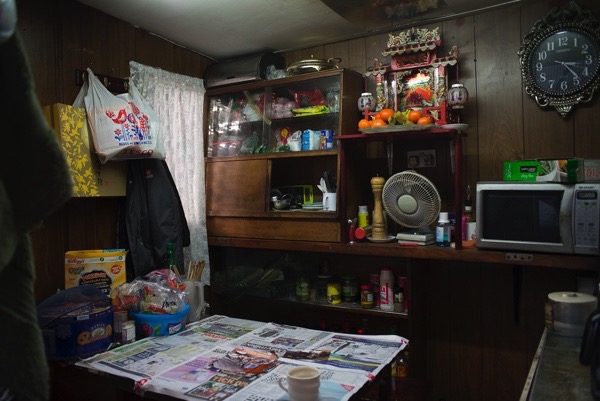
In the middle of the day at Chu’s Garage, work ceases and a ring is attached to a gas bottle for Jimmy Chu to cook a fresh lunch, which the family eat around the table in the cosy hut, complete with an altar, which serves as their dining room.
Sarah & I were honoured to be lunch guests and afterwards, over cups of green tea, we learnt of the astonishing story that lies behind Chu’s Garage. This was an unexpected epic, the dramatic tale of the Chu family’s perilous journey from Viet Nam to Britain, revealing their remarkable hard work, courage and tenacity in pursuit of a new life, which culminated in opening their beloved garage.

Chuong Kim Chu in Hai Phong, Viet Nam, 1974
Nhi Chu – My father, Chuong Kim Chu, was Chinese but he was born in 1935 in Viet Nam. My grandfather had come from Quanzhou in the south of China and migrated with his brothers to Viet Nam. So my father married my mother, Lien, who was Vietnamese and, although we grew up knowing that my dad was Chinese, we did not speak Chinese until we came to the refugee camp in Hong Kong.
Quang Chu – I remember when I was small my grandfather tried to speak Chinese with us. At that time, Viet Nam and America were at war and, many times by day and by night, they were bombing the city where we lived. It was very scary but interesting for a child. At night I saw the rockets and they were colourful, like fireworks. I remember the sound of the aeroplanes and fire everywhere. The table and chairs shook! Many times we were evacuated from the city to escape the bombs.
Chau Chu – One day my mum said there was a siren and, as we didn’t have a shelter, she went to the neighbours and asked ‘ Can we please come in to your shelter?’ But they said, ‘We’re so sorry, there’s no space.’ So my mum took us somewhere else and later that day, when we came back, we found our neighbours’ house had been bombed and everyone killed.
Nhi Chu – When my father grew up in Viet Nam, the family were poor so he didn’t go to school but he taught himself to read and write, Vietnamese and Chinese. He said, he learnt by eavesdropping on classrooms. When my father was seven, my grandfather, who was a herbalist, saved someone’s life and in return they said, ‘Your son can come with me and I will give him an education.’ But, one night, my father wet the bed and was so scared that he would be beaten up that he ran away, and that was the end of his education. When he was thirteen, he became an apprentice in the engine room on a big passenger ship. He had such a curious mind that, when the captain went away, he took an engine apart and memorised how it fitted together. But when he put it back he forgot one piece, so when the captain returned he got a whack over the head.
Chau Chu – We never saw our father much because he was always away from home as a long distance lorry driver. Whenever it broke down, he could fix it himself. That was how he started as a mechanic. The company gave him the lorry and he had to look after it. He saved up a long time to buy his truck, yet when the Communists took over they just took it from him.
Nhi Chu – During the war with America, Viet Nam and China were on good terms but, after the war ended the two countries fell out over a border dispute. At that time, there was a campaign by the Vietnamese government to get all Chinese migrants and their descendants to leave the country, and they were as hostile to them as they possibly could be. People started to lose their businesses. My mother said that my father was being subjected to a lot of abuse at work, from his colleagues who had once been his friends. He was quite a popular person and every year when they had the competition to see whose lorry was in the best condition, my dad always won the first prize. But then the tables turned and he had his truck taken away, so he no longer had his business or customers. My father knew that he had to leave because he was no longer able to make a living.
Meanwhile, my mother was being bombarded by people saying, ‘Leave your husband! He’s Chinese, you are Vietnamese. If he goes to China, you should stay here because you will be abused there.’ So there was a conflict, but my mother decided she wanted to stay with her husband and children. As children, we felt we were Vietnamese, we didn’t know we were Chinese, we didn’t make the distinction.
Chau Chu – All of a sudden, people were pointing at us and saying, ‘You are Chinese, you don’t belong here!’
Quang Chu – When we got to Hong Kong, they spoke Cantonese and we had to start everything from the beginning. Everything was very hard for us.
Chau Chu – We were forced to leave Viet Nam, we had no choice. We didn’t go to Hong Kong right away, we just wanted to leave the hostile environment of Viet Nam.
Nhi Chu – Because my father was Chinese, the Chinese government gave him visas and papers to go to China legally and we travelled from Viet Nam to China by train. We lived there for a year but the problem was that, although my dad was accepted as Chinese and got a job as a lorry driver, my mother and us kids were not accepted. We were city folk but we were sent to the mountains and every day we were given a portion of a field and had to turn it into fertile soil. Unfortunately, my mother looks Vietnamese and she was subjected to a lot of abuse from the locals. She had no choice but to hide inside the house. My dad realised this was no way to live and no future for us children. We couldn’t stay and he knew he had to find a new territory where all of us could live together peacefully.
We left China illegally because in those days no-one was permitted to leave. We couldn’t all leave in one go, so we divided the family. The plan was for our elder brothers Quang and Jimmy to leave to Hong Kong and make some money and send it back, and then the rest of us would join them there.
Quang Chu – The sea was very rough and lot of people died. The old boat was rotten and leaked inside, and it was overloaded. There were more than two hundred people, old and young and even babies just born. All kinds of people but all seasick. It was their first time ever on a boat. This was a short distance but a long journey, very long. Suddenly the sky might turn dark with thunder and lightning, heavy rain and strong wind – oh, it was scary. It was only a few days but the captains were inexperienced and they went round and round. We were lucky we survived the sharks but a lot of people didn’t.
Nhi Chu – We waited but we didn’t hear anything from them for six months and then a year.
Quang Chu – We sent them letters but they didn’t get them.
Nhi Chu – My dad decided that we couldn’t wait and we needed to go. We left at night but we had to make the house look as if we were still living there, because if the police found out they would come and stop us. For about a week, we were stranded at sea and then we got to Hong Kong.
Chau Chu – They hated us as well because we wanted to come onto their small island. They wouldn’t let our boat land, it was only when it was sinking that they picked us up. They had to check we were not from China, because if they knew we were from China they would send us back, so we had to say we had come from Viet Nam.
Nhi Chu – For two nights, we were on the boat and there was a storm which hit our boat and it began to sink, which is why they took us on board. For two weeks, we were held in a Forbidden Camp, where you can’t get out of, and then we were released to a Freedom Camp. We were waiting to be allocated a sleeping area when we saw my brother Jimmy. He came with Quang and we asked, ‘Still alive! How come you didn’t write to us?’ They explained that they had to get rid of all their paperwork at the border, so they lost the address and every day for a year they took turns to come to the camp to see if we were there. Finally, we were reunited but we found out that if we had been a month later we should have missed Quang and Jimmy, because they had already decided to go to America.
My dad didn’t want to go America, he wanted to come to England because he had been told that they treat old people very nicely here. He said, ‘I’m going to be old one day.’
Quang Chu – He said, ‘Why don’t they say ‘Speak American’? – they say ‘ Speak English.’ So he thought England must be a very good country, better than America.
Nhi Chu – That was 1979 and Mrs Thatcher announced she would accept ten thousand Vietnamese refugees, so we among the first batch. We came to England in 1980 and we first settled at the refugee centre in Dorchester for ten months where we started learning English.
Quang Chu – We went to the sea at Bridport, it was very nice.
Chau Chu – There were about fifteen families and we were happy there. Each of the families took turns cooking. Then we were resettled in Barrow-in-Furness and all the racism started again, like in Viet Nam.
Nhi Chu – We had been sheltered in Dorset but then suddenly we were the only Vietnamese family in Cumbria. It was back to square one, and we couldn’t find work so Quang had to move to Wigan and Jimmy to Bournemouth.
Quang Chu – Barrow-in-Furness is a very small town where everyone works at the shipyard and that only offers enough jobs for the local people, so we had to go elsewhere. But I think it’s good to see other places and other ways of life. You learn a lot when you have to stand on your own two feet, facing life.
Nhi Chu – After five years, we moved south.
Quang Chu – I think my father had decided that Barrow was good enough for him, but then he met so many people in London.
Nhi Chu – Even though my father was in his late forties by then, he managed to pick up the English language. He continued to attend evening classes after the rest of the family stopped and, after about a year, he managed to get a job at the local garage in Barrow. When he went for an interview, the manager just said, ‘Here’s a car, tell me how many faults you can find with it.’ When he came back, the manager said, ‘There should be eleven,’ and my father said, ‘I found thirteen’ – and that’s how he got the job. Dad worked there for three years to get his qualification and then he was promoted to foreman, but he had such a hard time because the other younger mechanics resented him because of his age and race.
Chau Chu – He always knew that he would come to London one day to set up a garage.
Nhi Chu – One of his mottos in life was ‘Whatever anyone can do, the Chu family can do it just as good, if not better.’ We could never go to him and say, ‘Dad I can’t do that.’ He’d say, ‘What do you mean? You can’t yet!’
Chau Chu – He was fifty when he came to London.
Quang Chu – In 1985, he started across the road from here in a shed that he shared with a Turkish guy. There were holes in the ceiling, which made it very slippery when it rained. At that time, the railway arches were vacant and this was a very rough area.
Nhi Chu – After a year, quite a few people applied to rent this arch, but my father was lucky and he was successful. The rent was between five and six thousand annually then.
Quang Chu – We moved in here in 1988 and we fitted it ourselves but there was no business.
Nhi Chu – Bricks and cement fell from the arch whenever trains ran across. We contacted Network Rail but they ignored us for years and years.
Quang Chu – Business was very difficult, so my father decided to do MOT Class 7, vans and light commercial vehicles. There were so many garages doing MOT Class 4 but MOT Class 7 was very rare. In Hackney, we have not heard of anyone else doing it. So my father decided that doing Class 7 MOTs was the way to survive. There was so much regulation and red tape to get to be an MOT Station – but then we realised we had no MOT testing equipment! Everything for us for us was new. It was very scary.
Nhi Chu – Dad had to study the MOT textbook, the rules and regulations, and then he had to go and do a test. He really struggled, so he had to have the help of his old English teacher to translate all the terminology – and my dad passed.
Quang Chu – When we first became the MOT-nominated tester, we held a party and invited our old friends. It was very expensive to set up and we had to borrow money from so many people. The bank wouldn’t lend to us, so we had to do it Vietnamese style – we go to a lot of people, relatives, neighbours and friends, and borrow small amounts of money and keep a list. They said, ‘This is good for everybody, good for you and for the Vietnamese community.’ So we have tried to look after them and pay back everyone gradually.
Chau Chu – The MOTs have kept our business going, otherwise we would have shut down.
Quang Chu – We feel good about it – even Hackney Council bring their vans here for MOT.
Nhi Chu – When my dad died, we wanted to have a grave to represent his life, so we got a designer to come here and take a look at the garage. He said, ‘Howabout if we design it with an arch?’ My father used to say, ‘I spent all my time here, my blood and sweat to make this garage as it is, so when I die bury me in the maintenance pit.’ We achieved that in a way by creating a tombstone in the shape of an arch which he is now resting beneath.
When we start talking about our father, we realise what an amazing character he was. When he passed away, we had to tell the customers and some of them burst out crying. A lot of people miss him. Without his motivation, we would not have been able to bring the whole family from one country to another country. This garage is his legacy.

The Chus’ lunch cabin

Jimmy Chu cooks lunch


Nhi Chu


Chau Chu washes up

The Chu’s office

Nhi Chu


Chau Chu


Jimmy Chu


Quang Chu with his father’s toolbox


Quang Chu


Jimmy Chu

Chuong Kim Chu

Lien Chu
 Chuong Chu standing in front of his trunk with Quang in Viet Nam, 1974

The Chu family reunited in Hong Kong 1979

Chu family in Barrow-in Furness

Chuong Chu at Chu’s garage

Mr & Mrs Chu outside Chu’s garage

Mrs & Mrs Chu upon their return to Viet Nam for their fiftieth wedding anniversary
New photographs copyright © Sarah Ainslie
You may also like to read about
A Conversation With Milly Rich
Celebrating the eighth birthday of Spitalfields Life with a week of favourite posts from the past year

“You know, being nearly a hundred is a lot of years to account for…”
Portrait of Milly Rich by Patricia Niven
The Gentle Author – Are you from the East End?
Milly Rich – I am from the last place I have lived! But I was born at 19 Commercial Rd on October 23rd 1917, which of course was during the First World War and my mother, Leah, told me that the air raid warnings were sounding at the time. People were terrified of air raids but my she had a basement under her shop in Commercial Rd where she took shelter.
My mother made corsets and she taught me to make them too. Corsets were a vital part of a lady’s outfit in those days because – of course – smart clothes needed a good foundation and a good foundation was a nice heavily-boned corset with a strong steel bust in the front. Everybody had remarkably good posture, not slumped – like you see today – over a hand-held computer.
The Gentle Author – Your mother was proprietor of the shop?
Milly Rich – I have a picture of her standing outside the shop with her two assistants when she was not yet twenty. She was very creative, very artistic – and she got her first job in an embroidery factory in Hanbury St. Then she opened a shop at 87 Brick Lane and – many years later – it transpired that the young man I married was the son of the owner of the embroidery factory where my mother had once been a designer. So the world is full of concentric circles!
The Gentle Author – Tell me about your father.
Milly Rich – My father, Morris Levrant, was an ‘émigré of the Empire of Russia’ and I know that because he went to America first and patented an airtight valve for bicycle tyres when he was thirty. He was very clever. My mother said he spoke nine languages and he was an inventor. He was born in Siedlce in Poland where my daughter has traced our family back to 1733.
He left a wife and three children in New York when he came to London and my mother’s father was not very happy about that. Apparently, my grandfather put him through hoops to prove that he was properly divorced. I do not know how he got the divorce but he obviously did because otherwise they would not have allowed the marriage. My parents were married in Princelet St Synagogue and I was born in 1917, so I suppose they were married in 1916.
The Gentle Author – Do you have brothers and sisters?
Milly Rich – I had one brother, Mossy. He is dead now, he died at seventy-five years old. I suppose it speaks volumes for the kind of life we led that he had rickets, which is caused by malnutrition. He was very good with his hands and became a jeweller and worked in Black Lion Yard and Hatton Garden.
When the Jews were promised a homeland in the Balfour Declaration, my father decided he would settle in what was then Palestine. Of course, he was an inventor, and he was agog to go and be an inventor there – he was a clever chap. So in 1921 we set sail.
The Gentle Author – You shut the shop in Commercial Rd?
Milly Rich – Yes, we got rid of it and went off to Palestine but a war broke out there and, in the first month, my father was killed and he was buried there. He was only forty when he died and left three children in New York. We found them not very long ago. The two sisters were still alive, they were ten and eleven years older than me. We went and stayed with them, and they were lovely. They turned out to be artists and designers too
When my father died, my mother was expecting my brother, so she could not come back from Palestine at once but she did not speak the language and, of course, my father had all the money – she was stuck in Jaffa. Fortunately my uncle – my mother’s sister’s husband – came to the rescue and got us back to England. By that time, I was three, I remember. And we were stuck in Boulogne because I had a watery eye – they thought it was catching – an eye disease, maybe trachoma but it was just a trapped eyelash.
On our return, we stayed with my uncle in Whitechapel. He had a jewellery shop opposite the Whitechapel Gallery, it was museum as well in those days. I remember they had a septic mouse in a case on the stairs and an illuminated panorama of Medieval London on the landing. It was lovely, I used to stand and stare at it for hours.
We stayed there until my uncle found the shop at 192 Bethnal Green Rd. It was flanked on one side by the Liberal Party headquarters, Sir Percy Harris was the MP, and on the other side by a newsagent. They were not Jewish, but everybody was on excellent terms and there was no anti-Semitism where we were.
We lived above the shop and we had tenants as well, who had to come through the shop. Originally, it been a house and garden but it had been transformed into one great long space. My mother had a curtain put up to screen people walking through because they had to cross our parlour, which my mother also used as a fitting room for the corsets.
Women used to come in and treat her as an agony aunt. Like a hairdresser or a dressmaker, she was a recipient of confidences. All the locals would tell my mother their troubles which invariably were to do with their husbands. They used to speak Yiddish so that I should not hear but, knowing they were speaking so I could not understand, I soon picked up Yiddish. I never let on that I could and, of course, I would tell the stories to my friends at school which was a source of much merriment.
There was a window in the parlour so my mother could see if anyone came into the shop. My brother used to climb up to look through it at the women trying on the corsets and, of course, a good time was had by all!
The Gentle Author – What took you out of Bethnal Green?
Milly Rich – I won a scholarship to Central Foundation School in Spital Sq. It was a fee-paying school at the time and there used to be quite a division between the scholarship girls and the fee-paying pupils. I was a great reader and I have always loved words and I had a good vocabulary. The other children did not like it. “Oh you’ve swallowed a dictionary,” that was a great insult. I did not care, did I? From there, I won another scholarship but I could not make up my mind whether to go to the London School of Economics, because I wanted to be a journalist, or St Martin’s School of Art.
In the event, I decided I would not train to be a journalist because I was not going to learn shorthand – I was not going to take down anybody else’s words. So I took the place at St Martin’s instead and hated it. We used to sign in and go off to the local Lyons teashop and sit there for hours, making patterns on the tablecloth with the salt cellar. Eventually, my mother could not afford for me to stay there any longer because I only got ten shillings a week and I did not like it anyway – I do not like any form of regimentation.
I got a job inscribing certificates because I was quite good at lettering and I did that for a couple of months. It was trees in Israel. They kept planting forests and I used to write ‘five trees planted in the name of so-and-so on the occasion of his this-and-that.’
I did not do it for long, I got a job in a drawing office instead. I told them I could do it, even though I had never held a drawing pen in my life. They said, “Well, here’s one – take it home and bring it back tomorrow, completed.” I went into an art shop and asked, “How do you do this?” They showed me a drawing pen and how you filled it and how you used it, so I went home and I did the drawing and I took it back the next day and I got the job. The drawing office was quite fun actually, I enjoyed it there. It was right at the top of Crown House, which is still there on the corner of Drury Lane and Aldwych. We used to feed the pigeons and there was a Sainsbury’s around the corner which delivered lunch in a box. You got a sandwich and some orange juice and a piece of cake for sixpence.
You know – being nearly a hundred is a lot of years to account for.
The Gentle Author – Tell me about Moss, your husband.
Milly Rich – We met at a play-reading group. He was a writer, and I always liked plays and acting and so on. We met there and he would walk me home.
The Gentle Author – Where did he come from?
Milly Rich – His father had the embroidery factory in Hanbury St, where my mother had once worked doing the patterns although we did not realise that at the time. It was only when our parents were introduced that they realised that they all knew each other already. Small world. People were so ready to help each other, I do not know if people are still like that in the East End, but they were once. I remember the blackshirts marching down Bethnal Green Rd and shouting “The Jews, the Jews, we’ve got to get rid of the Jews!” Whenever they passed our shop, my brother used to be outside yelling.
The Gentle Author – Did you feel threatened?
Milly Rich – I do not think I was aware of it, but I became aware because Moss used to take me to the political meetings and the Unity Theatre. When there was the Battle of Cable St, we went there. I remember leaning on the lamppost outside Gardiner’s Corner and we were all yelling, “They shall not pass, they shall not pass.”
The Gentle Author – That was eighty years ago.
Milly Rich – Then war was declared and we all thought the first air raid would obliterate London. Everybody was terrified and I had known Moss four years, so he said “We’d better get married right away, while we can,” and he got a special licence. I did not want any fuss and I told my mother, “I’m not having any ‘do’” because getting married, especially in Jewish families, was a great occasion you know. I said, “I’m not having any family there.” It was the custom then – I do not know what people do now– for the woman to take the man’s name but I did not like that, so I said, “If I have got to take your name, you have got to take my name.” His name was Rich and my name was Levrant so we became Levrant Rich, which sounds quite good.
The Gentle Author– Was that unusual in those days?
Milly Rich – Goodness knows! Moss was very easy about it, he said he did not care. My mother said she would kill herself if we did not get married in the synagogue, but I said “I’m not having anyone there , I don’t want a fuss,” so she agreed she would not tell anyone. But when Moss and I arrived at the synagogue, standing outside wreathed in smiles was my fat Aunty Milly and her husband. I said, “I’m not going to do it!” and we turned tail and ran away, so we did not get married that day.
We came back the next day and got married when nobody was there. We got no photographs, nothing. It was just the two of us, and Moss had to go back to work because he was in the timber importing business, doing the advertising, and everybody thought the work was absolutely vital. So he went back to work and I went shopping in Petticoat Lane for a couple of cups and saucers and a saucepan.
Moss had found us an attic room at 4 Mecklenburgh Sq and we went back there. It was one pound a week which was a lot of money for rent. There was an oven on the landing which four other tenants used and we each took a turn to put a shilling in the meter. Sometimes, I would come back early and find the landlady on her knees fiddling the meter!
When the air raid siren went, we dashed down to the shelter which was just opposite. One night we got a direct hit. The thing shuddered but it did not go off and we were marshalled out by wardens. I remember walking up Gray’s Inn Rd with fires blazing on either side right up to Euston Station. There were aeroplanes droning overhead and the church opposite the station was on fire. We were ushered into the station and we spent the rest of the night there, before returning to Mecklenburgh Sq.
Although our rent was one pound a week, Moss earned four pounds and I earned two pounds and a bit, so we only had just over six pounds as our total income. After our pound rent was paid and Moss had ten cigarettes delivered each day, I used to be able to send stuff to the laundry. They would come and collect and deliver it, all freshly ironed, and a sheet was tuppence to launder. Can you imagine? Shirts and everything. I never did any washing myself. As well as Mrs Pointy the landlady, there was a caretaker who kept our two rooms clean for two shillings a week, which was very nice. Mrs Pointy used to feed her cat cods’ heads and the smell – I can still smell it – was absolutely indescribable.
The Gentle Author – Nowadays in London, many people spend half their wages on rent.
Milly Rich – I was just thinking about the nature of progress. When I was young, it was usual for a woman to stay at home and the man would bring home the money – his wage could support the wife and the family. Now two wages are not enough, do you call that progress?
Transcript by Rachel Blaylock

Milly, aged one and a half in 1919

Milly, aged five in 1922
 Milly, aged eighteen in 1935

Milly, aged twenty in 1939

Moss in 1939

Milly & Moss’ Marriage Certificate, 1939

Milly’s London Transport card, 1939

Milly & Moss in the forties

Milly & Moss in the eighties – Milly & Moss were married for seventy-two years
You may also like to read about
Maurice Sills, St Paul’s Cathedral Treasure
Jack Corbett, London Oldest Fireman
Aaron Biber, London’s Oldest Barber
Charlie Burns, Waste Paper Dealer
The Alphabet Of Lost Pubs
Celebrating the eighth birthday of Spitalfields Life with a week of favourite posts from the past year

The Duke of Gloucester,
26 Seabright St, Bethnal Green, E2
(Opened prior to 1839 and now demolished)
Sometimes I find myself walking the streets looking for a pub. I am seeking an enclave of civility as a refuge from the barbarity of the city, a friendly bar where the publican lives upstairs and the residents of the street congregate. I am looking for a local.
Oftentimes, in accumulating disappointment, I stand and gaze at the fine buildings which once were pubs, now closed down and converted into flats or shops, or restaurants. So you can imagine my emotion when I discovered this cherished inventory of pubs from the early twentieth century, mostly pictured in their shining moment of glory, when the signwriting was crisp, the mirrors were polished and the lamps gleamed – the beloved drinking palaces of yesteryear. You can almost hear the clink of glasses, the hubbub of voices and distant tinkle of barroom ivories.
In collaboration with Heritage Assets, who work in partnership with The National Brewery Heritage Trust, I am able to publish these historic photographs of the myriad pubs of the East End from Charrington’s archive. It is no exaggeration to say that every street corner was once a pub, thus the catalogue of our loss runs into hundreds and this first instalment of The Alphabet of Lost Pubs only covers A-C.
I wish we could have enjoyed a pint together in every one. Instead we must be thankful we can go there in spirit thanks to the alluring visions conjured by these entrancing photographs, which might have vanished forever if they had not been rescued from a skip twenty-five years ago by some far-sighted soul.

The Adam & Eve, 126 Abbey Rd, West Ham, E15 (Damaged by enemy action 1st July 1944, reopened 2nd April 1948, closed 1994)

The Albert Arms, 66 Bancroft Rd, Mile End, E1 (Destroyed by enemy action 1944)

The Albion, 423 Bethnal Green Rd, E2 (Opened prior to 1870, now known as Coupette)

The Albion, 33 Albion Rd, Dalston, E8 (Opened prior to 1850, closed in 2002 and now residential)

The Albion, 211-212 High St (now The Highway), Shadwell, E1 (Opened prior to 1841, closed 1922 and now demolished)
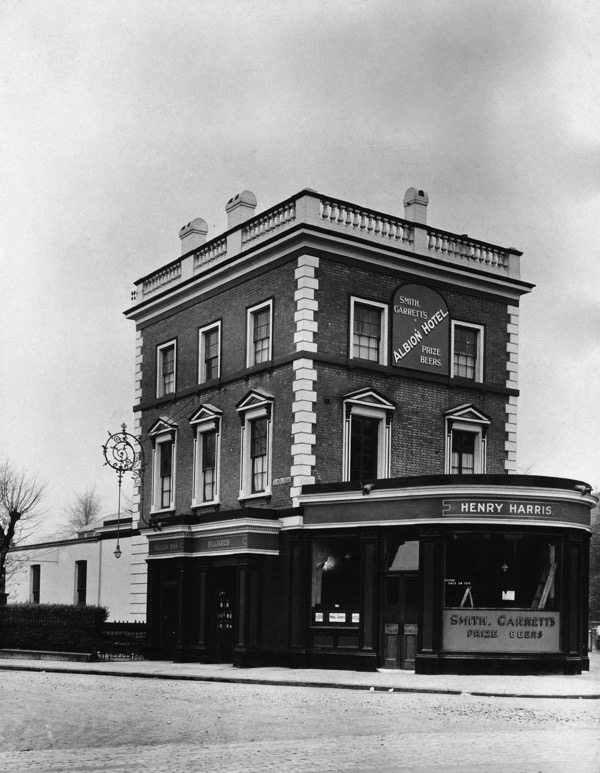
The Albion, 2 Clissold Rd, Stoke Newington, N16 (Opened prior to 1855, converted to residential use in nineteen nineties)

The Alfred’s Head, 49 Shandy St, Stepney, E1 (Opened prior to 1849, damaged due to enemy action on 12th September 1940 and closed)

The Alma, 41 Spelman St, Spitalfields, E1 (Opened prior to 1870, closed 2001 and now offices)

The Angel & Crown, 170 Roman Rd, Bethnal Green, E2 (Opened prior to 1809, rebuilt in 1951 and still open)

The Astric Lodge, 60 Stepney Green, E1 (Opened prior to 1818 and closed in 1997)

The Barley Mow, 7 New Gravel Lane, Shadwell, E1 (Opened prior to 1778, now demolished)

The Bedford Hotel, 220 Victoria Park Rd, Hackney, E9 (Built 1870, converted to residential use 1999)

The Beehive, 36 Holly St, Dalston, E8 (Opened prior to 1848, closed 1964 now demolished)

The Bell, 116 George St (now The Highway), Shadwell, E1 (Named in 1839, closed 1922)

The Benyon Arms, 155 De Beavoir Rd, Hackney, N1 (Opened prior to 1852, closed 1984 and now residential)

The Black Bull, 192 Stoke Newington High St, N16 (Opened 1826, closed 1981 and now Kentucky Fried Chicken)

The Black Horse, 168 Mile End Rd, E1 (Opened prior to 1856, closed 2010 and currently vacant)

The Blade Bone, 185 Bethnal Green Rd, E2 (Opened in 1823, destroyed by enemy action in World War II and rebuilt, then closed in 1999 and became The Noodle King now a development site for flats)

The Brewery Tap, 17 Stean St, Shoreditch, E8 (Opened prior to 1881, closed 1921 and now demolished)

The British Queen, 31 White Horse Lane, E1 (Opened prior to 1843 and closed 1934, now demolished)

The Bull’s Head, 58 St Katharine’s Way, E1 (Opened 1838, closed 1952)

The Burford Arms, 11 Burford Way, Stratford, E15 (Opened prior to 1872, closed in 1990 and demolished in 1994)

The Camden’s Head, 456 Bethnal Green Rd, E2 (Opened prior to 1816 and still open)

The Carlton, 238 Bancroft Rd, Mile End, E1 (Opened 1836 and still open today)

The Carpenters’ Arms, 151 Cambridge Heath Rd, E1 (Opened prior to 1839, rebuilt in the nineteen-sixties and still open)

The Cat & Mutton, 76 Broadway Market, Hackney, E8 (Opened prior to 1732 and still open)

The City Arms, 2 Dock Rd, Canning Town, E16 (Opened prior to 1867 and closed in 1934)

The Clapton Park Tavern, 9 Chatsworth Rd, Hackney, E5 (Opened prior to 1872, closed and converted to a restaurant in 2001)

The Colet Arms, 94 White Horse Rd, Stepney, E1 (Opened prior to 1851, closed in 2003 and now residential)

The Commercial Tavern, 142 Commercial St, Spitalfields, E1 (Built in 1865 and still open today)

The Commercial Tap, 66 Ben Jonson Rd, Stepney, E1 (Opened 1881 and closed 1934, now demolished)

The Conqueror, Boundary St, Shoreditch, E2 (Opened prior to 1872 and closed in 2007, now residential)

The Crooked Billet, 93 Hoxton St, Hoxton, N1 (Opened prior to 1841, closed 1938 and now demolished)

The Crown & Anchor, 35 Temple St, Bethnal Green, E2 (Opened prior to 1831, closure unknown)

The Crown & Dolphin, 56 Cannon St Rd, Shadwell, E1 (Opened 1851, closed 2002 and now residential)

The Crown, St John St, Clerkenwell, EC1 (Opened in 1910, closed in 1953 and now a shop)

The Crown, 19 Mayfield Rd, Dalston, E8 (Opened 1866 and closed in 1954)

The Crown, 34 Redchurch St, Shoreditch, E2 (Established late seventeenth century and renamed The Owl & The Pussycat in 1990)

The Crown, 14 Goodman St, Whitechapel, E1 (Opened in 1823, closed in 1952 and now demolished)

The Cutlers’ Arms, 2 Cutler St, Houndsditch, E1 (Opened prior to 1839, closed in the nineteen-fifities and is now demolished)
Photographs courtesy Heritage Assets/The National Brewery Heritage Trust

You may also like to take a look at
Misericords In Limehouse
Celebrating the eighth birthday of Spitalfields Life with a week of favourite posts from the past year

Tutivillus the demon eavesdropping upon two women
I spent yesterday morning on my knees in St Katharine’s Chapel in Limehouse, photographing these rare survivors of fourteenth century sculpture, believed to have been created around 1360 for the medieval St Katharine’s Chapel next to the Tower of London, which was displaced and then demolished for the building of the docks in 1825.
These marvellous carvings evoke a different world and another sensibility, combining the sacred and profane in grotesque and fantastical images that speak across time as emotive and intimate expressions of the human imagination. I am particularly fascinated by the sense of mutability between the human and animal kingdom in these sculptures, manifesting a vision of a mythic universe of infinite strange possibility which was once familiar to our forebears.
Intriguingly, these misericords appear to have been created by the same makers who carved those at Lincoln and Chester cathedrals, and a friary in Coventry.
After a sojourn of over a hundred years in Regent’s Park, the Royal Foundation of St Katharine, originally founded by Queen Matilda in 1147, moved back to the East End to Limehouse in 1948 where it flourishes today, offering an enclave of peace and reflection, sequestered from the traffic roaring along the Highway on one side and Commercial Rd on the other.


Centaur with club and shield

Tutivillus holds the parchment on the Day of Judgement


Owl

Bust of a bearded man in a striped cap with a cape and trailing drapery

Winged beast with a long tail and human head

Dragon

Edward III

Queen Philippa

Bishop’s head

Green man

Bearded man wearing a cap

A former Master of St Katharine’s was Chancellor of the Exchequer

Angel playing the bagpipes

Pelican in her piety with three chicks, supported by a pair of swans


Lion leaping upon the amphisbaena, supported by reptilian monsters

Coiled serpentine monster

Woman riding a beast with a man’s head


Elephant and castle surmounted by a crowned head

Beast with a hooded human head


Miser


Choir stalls with misericords

St Katharine’s Chapel was built in 1951 on the site of St James, Ratcliffe, destroyed in the blitz

Late fifteenth or early sixteen century carving of angel musicians playing a psaltery, a harp and tabor
The Royal Foundation of St Katharine, 2 Butcher Row, Limehouse, E14 8DS
With thanks to the Master of the Royal Foundation of St Katharine for permission to photograph the misericords
If you are interested to visit St Katharine’s Chapel please write to info@rfsk.org.uk
Eighth Annual Report

Eight years and three thousand stories ago, I published my first post in these pages. What a journey it has been and what sights we have witnessed. Already, I am approaching a third of the way towards my ambition of ‘at least ten thousand stories.’
Today – as it has become my custom upon this anniversary – I present my annual report looking back over the past twelve months.
One of the wonders of writing and making an account of life is that, even as it makes you aware of loss and time passing, it accumulates to create an ever-growing stack of pages. I take consolation that, thanks to my writing, I am able look back and revisit the people and experiences which I have cherished through the last eight years. Even if they are gone from the world, they will always reside here in this record.
When I began to write stories in the pages of Spitalfields Life, it was never my expectation or intention to become a publisher of books or get involved in politics. Yet both these activities have become an integral part of my work, offering challenges and rewards in equal measure.
This year, I am especially proud to have launched the writing career of Julian Woodford by publishing his debut book The Boss of Bethnal Green. Julian’s brilliant account of the breathtakingly appalling life of Joseph Merceron, the eighteenth century gangster and corrupt East End politician, proved to be a major work of biography, which was recognised as a significant contribution to the history of London by glowing reviews in the Evening Standard, the Times, the Times Literary Supplement.
This spring, I published a handsome new illustrated edition of AS Jasper’s compelling memoir of growing up in the East End at the beginning of the twentieth century, A Hoxton Childhood, accompanied by the first publication of the sequel The Years After, detailing the author’s struggle and eventual triumph in the Shoreditch cabinet-making trade. If anyone ever wonders why it is we need a National Health Service, proper Council Housing or legislation to ensure decent working conditions, they should read this candid and heart-breaking account of life in the world before these things came into existence.
More than two years have passed since five hundred of you joined hands around Norton Folgate to save it from demolition. Readers frequently ask what has become of British Land’s threatened development in these streets. The answer is that the campaign and the Spitalfields Trust’s Judicial Review, challenging Boris Johnson’s ‘calling-in’ of the development over the heads of Tower Hamlets Council, postponed matters long enough for the European Referendum to happen. Overnight, this office development became no longer financially viable and, subsequently, British Land saw an 85% fall in profits. In Spitalfields, people say that the consequence of the Referendum was, ‘We lost Europe but we saved Norton Folgate.’ Yet, as long as the planning permission stands, the door remains open for the revival of this hideous scheme when the economy improves.
We can celebrate two notable successes in conservation in the past year. Largely due to letters of objection written by readers of Spitalfields Life, the murals in the Royal Exchange were saved when the developer withdrew their application to bisect these magnificent paintings. Similarly, the historic Still & Star in Aldgate ( the last ‘slum pub’ in the City of London) was given a reprieve from demolition when it was granted Asset of Community Value status.
Thus another year passes in the pages of Spitalfields Life.
As the season changes and the summer fades away, there is much to look forward to this autumn and I hope I will have the pleasure of meeting you at one these forthcoming events.
14th SEPTEMBER: A HOXTON CHILDHOOD AT V&A BETHNAL GREEN MUSEUM: Celebrating our new edition of AS Jasper’s classic East End childhood memoir, we present an evening of readings from A Hoxton Childhood & The Years After and an interview with the author’s son, Terry Jasper. Additionally, Derrick Porter, Poet of Hoxton, will read a selection of his poems and Henrietta Keeper, Belle of Bethnal Green, will sing. Click here for tickets.
10th OCTOBER: LAUNCH OF EAST END VERNACULAR AT NUNNERY GALLERY: There will be a special viewing for Spitalfields Life readers from 6-8pm of Bow Arts’ exhibition The Working Artist: The East London Group at which I will introduce my new book East End Vernacular, Artists who painted London’s East End streets in the 20th century. Make a note in your diary and watch this space for further details.
4th & 5th NOVEMBER: BLOG WRITING COURSE IN SPITALFIELDS: I have been running these courses for five years now and it is an enduring delight to spend a weekend with readers in an eighteenth century weaver’s house in Fournier St, and hear the wonderful ideas and stories that people bring. With delicious lunch served by Leila’s Cafe and cakes baked by the Townhouse to eighteenth century recipes, we always have a lot of fun. Click here for more information and email spitalfieldslife@gmail.com to book.
Over the next week, I shall be at the printers overseeing the production of EAST END VERNACULAR and, in the meantime, I will be publishing favourite posts from the past year until I resume with new stories on Monday 4th September.

Click here to order a copy of THE BOSS OF BETHNAL GREEN
 Click here to order a copy of A HOXTON CHILDHOOD & THE YEARS AFTER

Click here to pre-order a copy of EAST END END VERNACULAR
You may like to read my earlier Annual Reports
Lunch At Mama Thai

Raj Chawla (centre) and his team at Mama Thai
Mama Thai on the corner of Toynbee St and Brune St, just fifty yards from Christ Church, has long been one of my favourite lunch spots. Thus it was with great sadness in 2015 I reported the death of chef Pam Chawla who had run this beloved establishment with her husband Raj since 1991.
Two years later, I am delighted to announce that, under the continuing supervision of Raj, there are new chefs at Mama Thai and the standard of fresh food prepared daily is as high as it has ever been. I know of nowhere else in Spitalfields where you can find such a reliably wholesome lunch for just five pounds. In face of a disappointing proliferation of chain outlets around the Spitalfields Market offering fast pre-prepared food, it is heartening to return to an old haunt and find it reinvigorated with new life.
At least once a week you will find me here tucking in to a tasty plate of vegetables and rice. In my opinion, it is the ideal healthy lunch. I always have the same thing and I am never disappointed by its reliable high quality. Sometimes, Abdus Samad Ajad, the chef who does the serving, asks me which vegetables I should like from the seasonal selection they have cooked that day and my reply is always the same, ‘You decide!’
Spinach is one of my favourites and the texture is very important, it should not be overcooked and turn to slush. At Mama Thai, head chef Mohammed Shofique Miah understands this and his spinach is always chewy and freshly cooked. I cannot to pretend to enjoy lentils on the whole, but here they are cooked to such a gentle consistency and so subtly spiced that they are delicious. Similarly, the pumpkin accompanied by ground coconut is another favourite of mine.
Cooking vegetables well is the test of any chef and it is an unexpected delight to discover real cooking in this cosy corner cafe where no dish costs more than five pounds. Among all the junk food and over-hyped pretentious places, Mama Thai is Spitalfields’ best kept culinary secret and I do recommend you seek it out. Raj Chawla is waiting to welcome you in person.

Chef Mohammed Shofique Miah


Hajera Begum prepares all the vegetables freshly for the chefs during service

Mohammed with his Deputy Chef Abdus Samad Ajad

The kitchen team

Raj Chawla has run Mama Thai in Spitalfields since 1991

Photographs copyright © Sarah Ainslie
You may also like to read my earlier story about Mama Thai from 2010
Sheila Bell of Great Eastern Buildings

(Click on this photograph to enlarge it)
Can you spot Sheila Bell in this photograph of the residents of Great Eastern Buildings celebrating Victory in Europe Day at the Grey Eagle in Quaker St on 2nd May 1945? Look more closely, there she is sitting in the front row, to the left of the girl in a floppy hat. Sheila has a bow in her hair for this special occasion.
Unfortunately, this picture was not too much use when I met Sheila at Victoria Station recently to hear about her life at Great Eastern Buildings on the corner of Brick Lane and Quaker St. Yet, as Sheila began to tell her story, I quickly recognised the little girl in this photograph of a lifetime ago.
“My grandparents, George & Sarah Keppel, lived in Great Eastern Buildings and my great-grandparents, Emma & Frederic Lewis lived in the same flat before them – before that I do not know. My nan never went out to work, she stayed at home, cooked the dinner and kept the house, and my granddad worked down Spitalfields Market. He started off as a porter but he was a carpenter by trade, so he made the ladders for the guys in the market. He hired two rooms in the next block at the Buildings and did all his carpentry work there. I used walk in there and smell the fresh wood shavings. He had a black iron glue pot and he made me stir it. It looked like toffee but it did not smell like toffee, I can assure you.
My parents lived in the Buildings as well and, as soon as I was born, I was taken to the Buildings, as the fourth generation of my family there. My mother worked in Truman’s Brewery as a bottling girl, she wore a green overall, a white apron and clogs, and my father was a smoked salmon curer in Frying Pan Alley, opposite Liverpool St Station. We lived in flat number sixty-eight Great Eastern Buildings, on the second floor. I was brought up in those Buildings with Jewish, Irish and Maltese, and we all rubbed along very nicely.
There always used to be a lot of workmen in and out of the Buildings, fixing things, and my first memory was of playing with a load of sand and water. Me and my cousins used to make sandcastles in the builders’ sand. That was our life! We lived in two rooms. We shared a wash house with a mangle and three sinks, two normal-sized and one butler’s sink with two taps. There was no hot water and each of the four flats on the landing shared the wash house. If you wanted a bath you had to boil a kettle. We had a tin bath like everybody else and an outside toilet that we shared with the three other families. We took it in turns to clean the toilet on a weekly rota system.
I do not remember a gas stove but I do remember a black range. You could lift the lid with a poker and put coal in. The kettle was always on the hob and there was an oven to the side. On Sunday, my nan would black-lead the range and it used to gleam. It had a white hearth and she used to whiten it, that was her pride and joy. It was always done, and our two rooms were kept clean. One room doubled as a front-room-come-kitchen, -come-everything really. We had old armchairs in there and a settee made of Rexine, that looked like leather but it was plastic and, in the summer, it used to stick to your legs, so we had to put a blanket on it. We had an old piano, I think everybody in those days had a piano. There was a little sink in the corner for the bowl and jug which we kept in the bedroom. That was all you had plus a table and a cupboard.
In the bedroom, we had a double bed and a single bed, if you had more than one child or if anybody came to stay. Unfortunately, that was how it was. We put up with because we did not know any different. I was the eldest and I had a younger brother. Now my nan had two rooms and my mum had two rooms, so my brother slept in the front room which meant mum and dad had the bedroom, my nan and grandad had the other bedroom and I slept in the other front room on a made-up bed. I used to lie on the floor and listen to the trains shunting in the goodsyard. Both flats were opposite each other across the same landing.
When I was fourteen, the flats were modernised by combining two, so then we had two bedrooms, a kitchen and a lounge. They put in electricity. It was amazing because I had only known gaslight since childhood. We did not know we were born! It was like a palace. I had my own room and my brother had his own room. It was our home and they did not move us out while they modernised, they just worked around us.
As children, we used to love to run through Wheler St Arch because it was always dark and gloomy with gas lamps – it was a dare really. We liked to go down Spitalfields Market and pick up the specks – the damaged fruit – and we used to bring them home. We did not have any other fruit. At Christmas time, my granddad came home with a sack full of specks. All the family would get together round the piano. My Auntie used to play the piano fantastically, sitting on a crate of brown ale. My nan never went out all week but on a Saturday night she went with out her friend and they would go either to the Two Brewers on the corner or the Grey Eagle. On a Saturday night, when she did not go out, my nan and I, we would get our pillow and put it on the window sill, and sit with our cups of tea and wait for the pubs to turn out. There would be fights and it was entertainment for us.
My granddad used to have a stall at the top of Brick Lane on Sundays and sell nuts and bolts, and I took tea to him in a white enamel flask. The market was packed in those days and, by the time I got there, the tea would be splashed everywhere, so he only got one cup out of it.
My first job was for Durrants the printers opposite Mount Pleasant Post Office in Clerkenwell and I absolutely hated it. I was sixteen or seventeen and I used to come home black with ink. Then I went into the rag trade, machining at Universal Underwear – it was very highbrow, we made it for Marks & Spencers – just off Shoreditch High St. I loved it and stayed there for ten years. I did an apprenticeship and my first week’s pay was four pounds, nineteen shillings and eleven pence. I thought I was rich!
After three months, they put you on piecework and I used to earn a fortune. Twenty or thirty pounds a week was a lot of money in those days. I was a saver and there would be times when I only had a shilling and sixpence in my purse but that was fine. I have always put a bit by because you never know what might happen. My parents did the same and they taught me not to spend money on non-essentials. Then, if you really need that money you do not have to go to anybody, you have got it there. My mother was very independent and my parents never owed anybody any money. I only ever wanted to pay the rent and put food on the table.
When I was twenty-five, I left Great Eastern Buildings to get married. I met my husband Riaz at Queen’s Ice Skating Rink in Bayswater. It was a ritual, I used to go there every Friday. Every Saturday, we went to the cinema and, every Sunday, we went to the Mecca Ballroom in Leicester Sq. We had a fantastic social life. We moved to a rented two bedroom flat in Hackney Downs when we got married and my daughter was born in Lower Clapton Rd at the Salvation Army Hospital. My husband was an aircraft engineer at Gatwick and the travelling was too much for him, so they offered us a flat down there and we stayed thirty years.
I still miss the community spirit of Great Eastern Buildings. Nobody went without, the people in those Buildings would give you their last ha’penny even if they had nothing.”

The Grey Eagle photographed by Philip Marriage in 1967

Corner of Grey Eagle St today

Steven Harris, who also grew up in Great Eastern Buildings, managed to identify these people:
Little girl at front, right of centre, with floppy white hat is Joyce Gibbons (my Aunty Joyce).
Next to floppy white hat, toddler with bow in hair is Sheila Bell herself.
The lady to the left, with her arm up, may well be Franny Vigas.
Behind Franny, with the dark hair is Sarah Keppel (Sheila’s grandmother)
The shorter of the two men, just to Sarah’s right, is Sheila’s granddad, George Keppel.
To George’s right, with her back against the pub wall is Lily Bell (Sheila’s mother)
Further to the right, holding two children (you can just see her head against the pub window) is Bessie Lee, sister to Lily Bell. The two children were Lorraine and Ronnie Lee.
Staying at the back and just along from Bessie Lee and her children, are two dark haired women – they were sisters, Celia and Sarah Bawes.
One forward and three along to the right from Lily Bell is a blond girl with roundish face – that was Betty Wright (who was long standing friends with my Aunty Pat)
Third row back, a little to the left of the roll of honour, with her beret pulled down at a sharp angle and standing slightly alone, is Phyllis Greenslade.
To the extreme right of the photo, sitting next to the honours roll, is Pat Green.
Third row back, to the left of the central line of children, is George Hall (with finger in mouth).
To the left of George is, I believe, my very own nine-year-old dad – Eddie Harris!
George’s sister, Rosie, is the blond girl with big smile, one row forward and three along to the right of George.

Sheila Butt (nee Bell)
You may also like to read about


