
In Old Clerkenwell

In St John’s Path
At weekends, when the crowds throng in Spitalfields, I sometimes walk over to Clerkenwell. Apart from those carousing in Exmouth Market, the place is like a ghost town on Saturday & Sunday, leaving the visitor free to explore the streets in peace.
There is a particular ramshackle quality to this quarter of London that especially appeals to me, where every street is either winding around a corner or sloping away down the hill, or both. Many of my formative experiences as a writer occurred in Clerkenwell, since from 1990 I rented a tiny office in Clerkenwell Close for ten years or so, and went there every day to write. When I could not write, I wandered the streets which became familiar to me as the urban landscape of my contemplation and, over time, I learnt something of their history too.
I wander around Clerkenwell and I think about the Mystery plays performed by clerks on the Green in the medieval era, about how the Close still follows the former cloister of the Priory of St John, about Wat Tyler addressing his rebel force upon the Green, about Oliver Cromwell’s house in Clerkenwell Close that had orchards down to the Fleet River, about the monstrous Middlesex House of Detention where thousands met their deaths, about Joseph Grimaldi playing at Sadler’s Wells, about Charles Dickens sitting with his reporter’s notebook in the Court House, about Vladimir Ilyich Lenin having a drink in the Crown, about Arnold Bennett’s Riceyman Steps and George Gissing’s The Nether World – two magnificent Clerkenwell novels – and, more recently, I think of Colin O’Brien photographing car crashes in the Clerkenwell Rd.

In Britton St

St John’s Gate, where Hogarth’s father ran a Latin-speaking Coffee House

Old Court House, Clerkenwell Green, where Dickens served as a cub reporter

Door at the rear of the Court House

On Clerkenwell Green

St James, Clerkenwell, by James Carr 1792

At the rear of the church

The church gates

In Pear Tree Court

In Amwell St

In Wilmington Sq

In Clerkenwell Close, where Oliver met the Artful Dodger in ‘Oliver Twist’

The old wall of the former Middlesex House of Detention

St James Clerkenwell

Farmiloe Building, St John St

In Passing Alley

Finsbury Savings Bank, Sekforde St since 1840 – customers included Charles Dickens

Sekforde Arms, since 1838

Sekforde St

Sekforde Arms

In Hayward’s Place

Woodbridge Chapel

Gleave & Co, Watch Repair Supplies, Albemarle Way

In Herbal Hill

In Back Hill

The Castle in Cowcross St since 1830

Coach & Horses in Ray St since 1808

Clerkenwell Fire Station, formerly Britain’s oldest 1872- 2014

Our Most Holy Redeemer, Exmouth Market

In Exmouth Market

Exmouth Arms since 1825

In Cafe Kick

Farringdon Tool Supplies, Exmouth Market
You may also like to take a look at
Eleanor Crow’s East End Fish Shops

Victoria Fish Bar, Roman Rd
I try to eat fresh fish at least once a week and so, as I travel around the East End, I tend to navigate in relation to the fish shops. Illustrator Eleanor Crow shares a similar passion, witnessed by these loving portraits of top destinations for fish, whether jellied eels, fish & chips or fresh on the slab. “These places are a reminder of our river-dependent history,” Eleanor informed me, “I love the look of London’s famous eel shops with their ornate lettering and wooden partitions. Nothing beats having a proper fishmongers’ shop or market stall in the neighbourhood – not only do the shops look good, but these guys really know about fish.”

F.Cooke, Broadway Market

The Fishery, Stoke Newington High St

George’s Place, Roman Rd

G. Kelly, Bethnal Green Rd

Mike’s Quality Fish Bar, Essex Rd

Davies & Sons, Hoe St

The Fish Plaice, Cambridge Heath Rd

Mersin Fish, Morning Lane

Dennis Chippy, Lea Bridge Rd

Kingfisher, Homerton High St

Mersin 2, Lower Clapton Rd

Golden Fish Bar, Farringdon Rd

Tubby Isaacs, formerly in Aldgate

L. Manze, Walthamstow High St

Sea Food & Fresh Fish, Chatsworth Rd

G. Kelly, Roman Rd

Steve Hatt, Essex Rd

Jonathan Norris, Victoria Park Rd

Downey Brothers, Globe Town Market Sq

Barneys Seafood, Chambers St

Billingsgate Market
Illustrations copyright © Eleanor Crow
You may also like to see Eleanor Crow’s other East End illustrations
Eleanor Crow’s East End Bakers
and read these other fish stories
The Markets of Old London

Clare Market c.1900
I never knew there was a picture of the legendary and long-vanished Clare Market – where Joseph Grimaldi was born – until I came upon this old glass slide among many thousands in the collection of the London & Middlesex Archaeological Society, housed at the Bishopsgate Institute. Scrutinising this picture, the market does not feel remote at all, as if I could take a stroll over there to Holborn in person as easily as I can browse the details of the photograph. Yet the Clare Market slum, as it became known, was swept away in 1905 to create the grand civic gestures of Kingsway and Aldwych.
Searching through this curious collection of glass slides, left-overs from the days of educational magic lantern shows – comprising many multiple shots of famous landmarks and grim old church interiors – I was able to piece together this set of evocative photographs portraying the markets of old London. Of those included here only Smithfield, London’s oldest wholesale market, continues trading from the same building, though Leather Lane, Hoxton Market and East St Market still operate as street markets, but Clare Market, Whitechapel Hay Market and the Caledonian Rd Market have gone forever. Meanwhile, Billingsgate, Covent Garden and Spitalfields Fruit & Vegetable Market have moved to new premises, and Leadenhall’s last butcher – once the stock-in-trade of all the shops in this former cathedral of poultry – closed last year.
Markets fascinate me as theatres of commercial and cultural endeavour in which a myriad strands of human activity meet. If you are seeking life, there is no better place to look than in a market. Wherever I travelled, I always visited the markets, the black-markets of Moscow in 1991, the junk markets of Beijing in 1999, the Chelsea Market in Manhattan, the central market in Havana, the street markets of Rio, the farmers’ markets of Transylvania and the flea market in Tblisi – where, memorably, I bought a sixteenth century silver Dutch sixpence and then absent-mindedly gave it away to a beggar by mistake ten minutes later. I often wonder if he cast the rare coin away in disgust.
Similarly in London, I cannot resist markets as places where society becomes public performance, each one with its own social code, language, and collective personality – depending upon the nature of the merchandise, the location, the time of day and the amount of money changing hands. Living in Spitalfields, the presence of the markets defines the quickening atmosphere through the week, from the Thursday antiques market to the Brick Lane traders, fly-pitchers and flower market in Bethnal Green every Sunday. I am always seduced by the sense of infinite possibility when I enter a market, which makes it a great delight to live surrounded by markets.
These old glass slides, many of a hundred years ago, capture the mass spectacle of purposeful activity that markets offer and the sense of self-respect of those – especially porters – for whom the market was their life, winning status within an elaborate hierarchy that had evolved over centuries. Nowadays, the term “marketplace” is sometimes reduced to mean mere economic transaction, but these photographs reveal that in London it has always meant so much more.

Billingsgate Market, c.1910
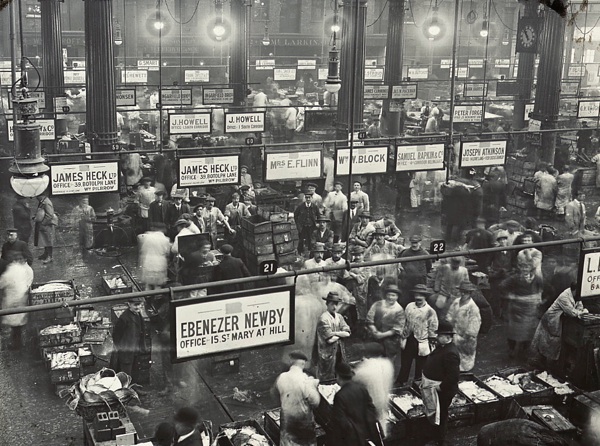
Billingsgate Market, c.1910

Whitechapel Hay Market c.1920 (looking towards Aldgate)

Whitechapel Hay Market, c.1920 (looking east towards Whitechapel)

Porters at Smithfield Market, c.1910

Caledonian Rd Market, c.1910

Book sale at Caledonian Rd Market, c.1910

Caledonian Rd Market, c.1910

Caledonian Rd Market, c.1910

Covent Garden Market, c.1920

Covent Garden Market, c.1910

Covent Garden, c.1910

Covent Garden Market, 1925

Covent Garden Market, Floral Hall, c.1910

Leadenhall Market, Christmas 1935

Leadenhall Market, c.1910

East St Market, c.1910

Leather Lane Market, 1936
 Hoxton Market, Shoreditch, 1910

Spitalfields Market, c.1930
Images courtesy Bishopsgate Institute
You may like to look at these old photographs of the Spitalfields Market by Mark Jackson & Huw Davies
Night at the Spitalfields Market
Other stories of Old London
Tony Armstrong Jones In The East End
Tony Armstrong Jones (1930-2017) is remembered today as Lord Snowdon, husband to Princess Margaret, yet – before all that royal hullabaloo took over his life – he was a jobbing photographer in his twenties and took these photographs of the East End, as published in his book LONDON in 1958.

Cheshire St

Sclater St Market, Sunday Morning

Bomb site, St Mathias School, Bethnal Green

Rathbone St Market, Canning Town

Rathbone St Market, Canning Town

Garage hand, Stepney

The Magpie & Stump, Cable St

The Railway Tavern, West India Dock Rd – open 6am to 8am

Cafe in East India Dock Rd

Wens Cafe, Bethnal Green

Tattoo parlour

Tower of London

Smithfield Market

Christmas in Cable St

Pub in Cable St

Juke Box Dance

Deuragon Arms, Hackney

Bethnal Green Rd
Photographs copyright © Estate of Tony Armstrong Jones
You may also like to read about
The Coal Holes of Old London
These hundred and fifty drawings of cast iron plate covers for coal chutes were sketched by a young medical student, Dr Shepherd Taylor, while studying at King’s College Hospital in the Strand in 1863. “I determined to try to reproduce them on paper, and, although I had no particular artistic skill or genius, I found no great difficulty in making a fair sketch of the more simple devices,” he admitted proudly. Whether Dr Taylor was a purist who omitted those with their maker’s names because he preferred abstract design or whether he simply could not do lettering, we shall never know.
Dr Taylor was ninety years old before his cherished designs were published in 1929 and he christened them Opercula, which means a cover or a lid. I will give a prize to anyone that can send me a photograph of any of these opercula drawn by Dr Taylor still in its location today.


You may also like to take a look at
James Leman, Silk Designer

The oldest surviving set of silk designs in the world, James Leman’s album contains ninety ravishingly beautiful patterns created in Steward St, Spitalfields between 1705 and 1710 when he was a young man. It was my delight to visit the Victoria & Albert Museum recently and study the pages of this unique artefact, which is currently the subject of an interdisciplinary research project under the auspices of the V&A Research Institute, funded by the Andrew W. Mellon Foundation. The Leman Album offers a rare glimpse into an affluent and fashionable sphere of eighteenth century high society, as well as demonstrated the astonishing skill of the journeyman weavers in East London three hundred years ago.
James Leman (pronounced ‘lemon’ like Leman St in Aldgate) was born in London around 1688 as the second generation of a Huguenot family and apprenticed at fourteen to his father, Peter, a silk weaver. His earliest designs in the album, executed at eighteen years old, are signed ‘made by me, James Leman, for my father.’ In those days, when silk merchants customarily commissioned journeyman weavers, James was unusual in that he was both a maker and designer. In later life, he became celebrated for his bravura talent, rising to second in command of the Weavers’ Company in the City of London. A portrait of the seventeen-twenties in the V&A collection, which is believed to be of James Leman, displays a handsome man of assurance and bearing, arrayed in restrained yet sophisticated garments of subtly-toned chocolate brown silk and brocade.
His designs are annotated with the date and technical details of each pattern, while many of their colours are coded to indicate the use of metallic cloth and different types of weave. Yet beyond these aspects, it is the aesthetic brilliance of the designs which is most striking, mixing floral and architectural forms with breathtaking flair in a way that appears startling modern. The Essex Pink and Rosa Mundi are recognisable alongside whimsical architectural forms which playfully combine classical and oriental motifs within a single design. The breadth of James Leman’s knowledge of botany and architecture as revealed by his designs reflects a wide cultural interest that, in turn, reflected flatteringly upon the tastes of his wealthy customers.
Until last year, the only securely identified woven example of a James Leman pattern was a small piece of silk in the collection of the Art Gallery of South Australia. Miraculously, just as the V&A’s research project on the Leman Album was launched, a length of eighteenth-century silk woven to one of his designs was offered to the museum by a dealer in historical textiles, who recognised it from her knowledge of the album. The Museum purchased the silk and is now investigating the questions that arise now design and textile may be placed side by side for the first time. With colours as vibrant as the day they were woven three hundred years ago, the sensuous allure of this glorious piece of deep pink silk adorned with elements of lustrous green, blue, red and gold shimmers across the expanse of time and is irresistibly attractive to the eye. Such was the extravagant genius of James Leman, Silk Designer.


On the left is James Leman’s design and on the right is a piece of silk woven from it, revealing that colours of the design are not always indicative of the woven textile

The reverse of each design gives the date and details of the fabric and weave

Portrait of a Master Silk Weaver by Michael Dahl, 1720-5 – believed to be James Leman
All images copyright © Victoria and Albert Museum, London
Click here to read about recent research into James Leman’s Album
With grateful thanks to: Dr Olivia Horsfall Turner, Senior Curator of Designs – Dr Victoria Button, Senior Paper Conservator – Clare Browne, Senior Curator of Textiles – Dr Lucia Burgio, Senior Scientist and Eileen Budd, V&A Research Institute Project Manager
You may also like to read about
The Principal Operations of Weaving
At Anna Maria Garthwaite’s House
Anna Maria Garthwaite, Silk Designer
William Nicholson’s London Types

William Nicholson created his London Types in 1898. They were a set of images that, alongside his Almanac of Twelve Sports and An Illustrated Alphabet, were to make his reputation as a printmaker. At that time, his son Ben who was to eclipse him entirely in the history of British Art was only five years old.
Working within the culture of the British popular print, Nicholson deliberately chose to use the coarse-grained side of the block in his wood cuts. This was a style that owed more to Toulouse Lautrec and Japanese precedents than to native visual traditions, which gave his work an innovative quality, even as he appeared to be celebrating traditional roles in British society.
Although not strictly Cries of London, some of these street characters are familiar from prints stretching back through the previous century and Nicholson portrays them as curiosities from another age. The doggerel by W.E. Henley that accompanied them poked fun at the anachronistic nature of these stereotypes, outlining their equivocal existence – whether a street hawker displaced in Kensington far from his East End home, or an aristocratic lady at Rotten Row challenged by her suburban counterparts, or a drunken Sandwich-man displaying moral texts, or a fifteenth generation Bluecoat boy at Charterhouse School in Smithfield, now moved out to Horsham.
These chunky monochromatic images fascinate me because they characterise their protagonists with subtlety, placing them in a dynamic relationship with the viewer and the social landscape of London as it was in the final years of the nineteenth century. Irrespective of the disparity in their circumstances, The Lady and The Coster confront us with equal assurance. Nicholson’s subjects retain self-possession because, although the prints illustrate their diverse social situations, their demeanour is consistently impassive.
Working in partnership with his brother-in-law James Pryde under the pseudonym the Beggarstaff Brothers, Nicholson enjoyed a successful career creating lively graphics which served the boom in advertising that happened in the eighteen-nineties. After 1900, he shifted his attention to painting, embarking on a series of portraits including J.M.Barrie, Rudyard Kipling and Max Beerbohm, that filled the rest of his career. Nicholson had always wanted to paint, regarding his graphic work as a lesser achievement, a reservation confirmed by his modest self-portrait as a pavement artist.
William Nicholson’s London Types provide a distinctive contribution to the innumerable series of images that have portrayed street life throughout the centuries, remarkable both for their superlative graphic elegance and as a complex and witty social portrait of London at the dawn of the twentieth century.

News-Boy, the City – “the London ear loathes his speeshul yell…”

Sandwich-Man, Trafalgar Square – “the drunkard’s mouth awash for something drinkable…”

Beef-eater, Tower of London – “his beat lies knee-high through a dust of story.”

Coster, Hammersmith – “deems herself a perfect lady.”

Policeman, Constitution Hill – “whenever pageants pass, he moves conspicuous…”

Lady, Rotten Row – “one of that gay adulterous world.”

Bluecoat Boy, Newgate St. – “the old school nearing exile…”

Flower Girl, – “of populous corners right advantage taking…”

Guardsman, Horseguards Parade. – “of British blood, and bone, and beef and beer.”

Barmaid, any bar – “posing as a dove among the pots.”

Drum-Major, Wimbledon Common – “his bulk itself’s pure genius…”

William Nicholson portrayed himself as pavement artist
Images copyright © Desmond Banks
You may like to take a look at
Francis Wheatley’s Cries of London


