
Crudgie, Motorcyclist

Behold the noble Crudgie!
I have been hoping for the opportunity to catch up with Crudgie ever since we were first introduced at the Fish Harvest Festival, so I was delighted to accept his invitation to meet at that legendary bikers’ rendezvous, the Ace Cafe on the North Circular.
Over six foot six in height, clad head to toe in black leather, with extravagant facial hair trained into straggling locks and carrying the unmistakable whiff of engine oil wherever he goes, Crudgie makes an unforgettable impression. Crudgie’s monumental stature, beady roving eyes and bold craggy features adorned with personal topiary, give him the presence of one from medieval mythology, like Merlin on a motorbike. Yet in spite of his awesome appearance and gruff voice, I found Crudgie a warm and friendly personality, even if he does not suffer fools gladly, issuing fearsome warnings to pedestrians not to get in his way.
“I’m only called by my surname, Crudgington. “Ington” means family living in an enclosed dwelling, and “crud” is a variation of curd, so they were probably cheesemakers. There’s a place in Shropshire named Crudgington, but there’s nobody buried in the church with that name, nobody living there with that name either and nobody that lives there has ever heard of anybody called Crudgington. The shortened version of my name came about when I went to play rugby and cricket where everyone gets a nickname ending in “ie.” I’ve swum for the county, and competed as an athlete in the four hundred metres and javelin, as well.
I grew up in Billericay, famous for being the first place to count the votes in the General Election. My father was builder called Henry but everyone knew him as Nobby. I went into banking for ten years in Essex but I couldn’t get on with it, even though I was the youngest person ever to pass the banking exam. So then I went to work in insurance in the City, I worked for Barclays for ten years and played for their rugby team until they couldn’t afford to fund it anymore. In the nineteen nineties, I felt I was getting nowhere in insurance so I started motorbicycle couriering. I got a motorbike from my parents for fifteenth birthday, so I’ve always been a biker and I do thousands of miles on it every year, going to sporting events, meet-ups and scrambles.
It’s the camaraderie of it that appeals to me, meeting up with your mates, but unfortunately you are perceived as an outlaw. I have been stopped eighty-nine times in twenty-one years by the police. Apparently, couriers are the second most-disliked Londoners after Estate Agents. It’s because people get scared out of their wits when they are not thinking where they are going and a courier brushes by and gives them the shock of their life. People should look where they are going. If you are going to hit a pedestrian, it’s best to hit them them straight on, that way they get thrown over the handlebars. A few cuts and bruises, but nobody gets killed by a motorbicycle. Whereas if you veer to either side to avoid them, the danger is you clip them with your handlebars and it sends you into a tailspin, and you fall off.
I’m a member of the most important biker club – The 59 Club, set up by Father Bill Shergold in 1959. He was a vicar who was a biker, and he wanted to bring the mods and rockers together, so he opened up in a church hall in West London in 1961 and on the first day he had Cliff Richard & The Shadows performing there. Then in 1985, it moved to Yorkton St, Bethnal Green. It was open three days a week, and you could go in and have a cup of tea after work. They had a bike repair workshop for maintenance, two snooker tables and a stage where lots of bands performed. And once a year, you could go to a church service. They moved to Plaistow now, but everybody that was in it is still in it – it’s the largest bike club in the world.
There’s only a few British couriers left, most are Brazilians now. It used to be Polish until they earned enough money and all went back home. Once upon a time, there was a lot of money in it though it’s gone down thanks to technology, but the beauty is you can work when you like and you get to go interesting places that you’d never go otherwise. I’ve picked up the Queen’s hair products from SW3 and driven into Buckingham Palace to deliver them. I do a lot of deliveries for film companies and quite often I stay around on set to watch, especially if it’s in some interesting stately home that you wouldn’t normally get to visit. If I have to go somewhere on a journey out of London, I always take time to visit the museum or castle or whatever there is to see.
I’ve worked from nine until seven for years, but I’ve decided I’m only going to do nine thirty to six because I’m getting old. If I had independent funds, I wouldn’t be riding anymore. I haven’t missed a day in quite a few years and I’ve only ever had one week off in twenty years…”
When I arrived at the Ace Cafe, I saw Crudgie’s bike outside and I spotted him through the window, head and shoulders above his fellows. Inside, a long counter ran along one wall, facing a line of windows looking out on the North Circular, and the space in between was filled by tables, scattered with helmets to indicate those which were reserved by customers. Once Crudgie had greeted me with a firm bikers’ handshake, we settled by the window where he squeezed every drop from his teabag to achieve a beverage that was so strong it was almost black. A characteristic Crudgie brew.
Like the questing knight or the solitary cowboy, Crudgie has no choice but to follow his ordained path through the world, yet he is a law unto himself and the grime he acquires speeding through the traffic is his proud badge of independence. A loner riding the city streets with his magnificent nose faced into the wind, Crudgie is his own master.


Crudgie at the Ace Cafe on the North Circular. “- Like Merlin on a motorbike.”
You may also like to read
Adam Dant’s Rudimentary London
Contributing Artist Adam Dant is celebrated for his intricately complex maps as published in MAPS OF LONDON & BEYOND, yet I fear the excessive heat may have got to him because this week he produced Rudimentary London which took him no more than sixty seconds. On first glace, you would be forgiven for thinking these are the deluded scribbles of a deranged imagination but the wonder of it is that anyone who knows the capital will be able to decipher Adam’s marks and identify its major landmarks immediately. To start you off, can you spot the Albert Hall and Tower Bridge?

(Click this image to enlarge)
“These bold squiggles are my attempt to encapsulate all the nuanced geographic complexity of the capital city executed in a single minute.
Inevitably, the resulting graphic ends up looking like a piece of Chinese calligraphy or the artistic output of a Zen monastery. When rendered as a woodblock print, the flicks and flourishes of the brushwork resemble ‘ink rubbings,’ such as those produced from thirteenth century Suzhou astronomical charts.
My Rudimentary London is an exercise in reductive poetics, comparable to seeing the globe as a bubble or our lives in a grain of sand. In this realm, the futility of trying to record all of our diverse travails and triumphs in a single flick of the wrist invites comparison with the gesture of a vengeful and almighty creator who could sweep all matter aside with equal ease.
Yet as a depiction of the specific terrain of London, it is all there. The topography of the capital can immediately be recognised by that confusing crook in the River Thames, bisected by the Fleet River, with the Euston Rd skirting its upper edge and splodged by familiar sites and landmarks. Nelson’s Column marks at the heart of London, Hyde Park and the Serpentine lie to the west, Regents Park sits at the top, while St Paul’s Cathedral and Tower Bridge stand in the east. Between the bold black main thoroughfares, the knitted network of London’s alleys is suggested by the inky infill of chiselled gouges in the woodblock.”
Adam Dant currently has an exhibition at The Map House in Knightsbridge which runs until 14th July and at The Townhouse in Spitalfields which runs until 22nd July.

CLICK TO ORDER A SIGNED COPY OF MAPS OF LONDON & BEYOND BY ADAM DANT
Adam Dant’s MAPS OF LONDON & BEYOND is a mighty monograph collecting together all your favourite works by Spitalfields Life‘s cartographer extraordinaire in a beautiful big hardback book.
Including a map of London riots, the locations of early coffee houses and a colourful depiction of slang through the centuries, Adam Dant’s vision of city life and our prevailing obsessions with money, power and the pursuit of pleasure may genuinely be described as ‘Hogarthian.’
Unparalleled in his draughtsmanship and inventiveness, Adam Dant explores the byways of English cultural history in his ingenious drawings, annotated with erudite commentary and offering hours of fascination for the curious.
The book includes an extensive interview with Adam Dant by The Gentle Author.
Adam Dant’s limited edition prints are available to purchase through TAG Fine Arts
You may like to take a look at some of Adam Dant’s other maps
Map of the History of Shoreditch
Map of Shoreditch in the Year 3000
Map of Shoreditch as the Globe
Map of the History of Clerkenwell
Map of the Journey to the Heart of the East End
The Ploys Of Mr Pussy
With your help, I am compiling a collection of stories of my old cat THE LIFE & TIMES OF MR PUSSY, A Memoir Of A Favourite Cat to be published by Spitalfields Life Books on 20th September. Below you can read an excerpt.
There has been a mignificent response from you, the readers – both in preorders and offers of financial support – and I just need a couple more who are willing to invest £1000 in THE LIFE & TIMES OF MR PUSSY so I can send it to the printers. In return, I will publish your name in the book and invite you to a celebratory dinner hosted by yours truly. If you would like to know more, please drop me an email spitalfieldslife@gmail.com
Alternatively, you can preorder a copy of THE LIFE & TIMES OF MR PUSSY and you will receive a signed and inscribed copy in September when the book is published.
Click here to preorder your copy

Mr Pussy may appear self-possessed, yet he is circumspect. He keeps a keen eye upon the life of the household and no detail escapes his attention. In spite of his sufficiency, domestic harmony is essential to his peace of mind. Like those lonely watchmen who once patrolled the city at night, Mr Pussy monitors the premises and the residents. He loves routine. He seeks regular confirmation that the rhythm of life is stable and ensures that his place in the household remains constant. He desires equilibrium and he wants the world to be unchanging. He is the self-appointed guardian of the peace. He is assiduous and he sets an example. He is the model of poise and master of the subtle persuasion necessary to maintain the harmony he craves. He has his ways and means. He has ploys.
He wants me to be at home and stay at home. In his ideal world, I would not stray beyond the house and the garden. He does not. Everything he needs is here. This is the world. He cannot imagine what could be of interest beyond his personal utopia. Possessing a medieval mind-set, he thinks only the void lies beyond his known universe. Yet he is patient with my frequent absence. His ploy is to wait.
Assuming the role of a sentinel, he settles down in a vantage point to pass the hours until my return. Innumerable times, I have turned the corner and seen him there – a dark shape – waiting expectantly at the end of alley. He will lift his head at the moment of recognition and, as I walk towards him, he will leap up and run to meet me, rubbing against my legs in greeting. Then he will step aside to clear the path and let me go past, following along behind like an escort or a shepherd. He will not accompany me into the house at once. He likes to see me go inside and shut the front door, so that he may savour the long-awaited homecoming and be satisfied that all is well outside, before entering through his flap and following me upstairs.
A favoured vantage point of his is the first floor sill, where he presides from above, and, if he is not immediately visible upon my approach up the alley, then I know that, if I raise my gaze, it will be met by two golden eyes peering down at me inquisitively from the window. Upon entering the house, he will appear at the top of the stairs, stretching his stiff limbs from crouching upon the ledge and peering at me curiously to assess my mood.
If I should change into my slippers and settle in a chair at once to open letters or read, without paying him attention, he will coax me from my preoccupation. His ploy is to remove my slippers by curling up around them, gripping them in his claws, and pulling them off. He can achieve such an act with expert precision and, if I still do not acknowledge him, he can use his sharp claws to inflict jabbing pain as an eloquent indication of his frustration at my absence and my callous disregard of his existence. Yet events only rarely reach such a dramatic conclusion, since I have learnt to take the hint and lay aside the object of my attention, as soon as he curls up round my slippers.
Delighting in frequent catnaps at regular intervals, Mr Pussy will not tolerate me sleeping beyond dawn. He wants me to conform to his timetable. When his old ploy of scratching at my bed sheets grows too tiresome, I shut him out of the bedroom and ignore his cries. Then he will claw at the upholstered chair outside the door, knowing this will raise my ire. Yet I have found that if I lay a few sheets of paper upon the chair, he will accept this novelty as a concession, settling down upon the paper and granting me my wish to sleep uninterrupted for a few more hours.
Mr Pussy never sought for scraps at dinner until recently. He is not hungry – it is a ploy. If I indulge him, he rarely eats what I offer, he is satisfied merely to taste. He hopes that I can be taught to grant him this privilege as an automatic recognition of his status within the household, as one who has the right to participate in meals. Afterwards, he always licks his lips in delight at the curious flavours of human food and leaves the house directly to patrol the vicinity, reassured once more that his position is secure.
Thus Mr Pussy has his ploys and, thanks to his expert stewardship, peace is maintained and the world runs smoothly in our corner of Spitalfields.

Slumbering

Dreaming

Dozing

Awakening
CLICK HERE TO PREORDER A COPY OF THE LIFE & TIMES OF MR PUSSY
Anyone that has a cat will recognise the truth of this memoir of a favourite cat by The Gentle Author.
“I was always disparaging of those who dote over their pets, as if this apparent sentimentality were an indicator of some character flaw. That changed when I bought a cat, just a couple of weeks after the death of my father. “
THE LIFE & TIMES OF MR PUSSY is a literary hymn to the intimate relationship between humans and animals, filled with sentiment without becoming sentimental.
David Carpenter, Maker Of Glass Eyes

David Carpenter
In the nineteenth century, artificial eyes were sometimes made of lead-based glass, so if the owner were to walk in extreme cold temperatures and then enter a warm room with a blazing fire, there was always a danger their eye might explode – a risk that, thankfully, has been overcome these days through the prudent use of crystallite rather than glass.
This was just one of many memorable pieces of information upon the esoteric subject of glass eyes that I garnered when Contributing Photographer Patricia Niven & I visited David Carpenter, Chief Ocularist, at the Moorfields Eye Hospital in the City Rd. David and his team of four produce more than thirteen hundred eyes annually – each one hand-crafted and individually-painted – to replace those that get lost in the capital.
It may sound like an awful lot of eyes but David and his colleagues are so skilful that, if you were not looking for it, you would not notice the results of their handiwork. Such is their success in creating life-like eyes – David assured me – that you probably know people with artificial eyes but you do not even realise.
Yet there is far more to the work of an ocularist is than just technical expertise. “If people have to have an eye removed because they’ve had a tumour or a cancer, it’s akin to losing a limb,” David admitted to me quietly, “They put their life on hold – then, after surgery and the healing process, they come to me and I make the prosthetics. You give them an eye, but really you are giving them their life back. It can be a great moment when you give them their glass eye – often, they cry with joy and, sometimes, they give you a hug.”
As one who has wrought such transformations for the better in so many people’s lives – simultaneously a technician, an artist and a counsellor – David certainly carries his role lightly. “I make little model tanks, I made them as a kid and I’ve never stopped,” he confessed with a blush, revealing the early manifestation of his distinctive talent, “and when I applied for this job, I was able to show them to prove I could do modelling.”
“Let me get out my box of bits to show you,” David suggested enthusiastically, pulling a container from a cabinet that looked it might contain a sponge cake, only it actually contained a selection of glass eyes and pieces of rubber prosthetics attached to spectacles.
Glass eyes are not round like marbles – as I had naively assumed – but curved like sea shells, so they fit neatly under the lid and can move in tandem with their living partner. David makes a cast to ensure that the eye fits its owner perfectly and then paints the pupil with the patient in front of him, using his expert judgement to match it exactly. “An eye is more than just one colour, you’ll need to use two or three colours to get the effect you want,” he informed me, “You start with a little black disc and you paint lines outwards from the centre and these striations of different tones blend to create the colour of the pupil. In the States, they have tried to do this digitally but the effect is flat whereas building up the layers of paint creates a more three dimensional effect.” Then David pointed out how unravelled strands of red embroidery thread are used to create the impression of veins upon the white of the eye and grinned with pleasure as he studied the convincingly life-like result.
It was surreal to stand in the workroom surrounded by lone eyes of every hue peering at us, yet this was David’s normal environment and the place where he is at home. “I just fell into it really,” he informed me with shrug and a gauche smile, picking up an eye and polishing it tenderly with his finger, “I was training as a dental technician, making teeth at a college in Hastings – because I planned to emigrate to Australia and work in dentistry – when I saw an advert for an apprenticeship on ocularistry. Once you have trained as a dental technician, the next step is to become maxillofacial technician – I can make noses, ears, fingers – in fact, any part of the body that might get accidentally severed.”
“I can’t make arms and legs though, there are other people who do that,” he qualified modestly, acknowledging his own limitations, “but I can reconstruct any part of the face that is missing including the eye.” And then he picked up the pairs of spectacles with realistic parts of facial anatomy, noses and eyebrows, attached and proudly explained they were particularly useful for older people who might otherwise mislay their replacement facial features.
“I’ve worked here for sixteen and a half years,” he said, turning contemplative suddenly and speaking as if to himself, “I’ve got patients that I first saw when they were little babies who are now grown up and still come back to see me – there’s some that are almost friends.”

Painting artificial eyes

David scrutinises his handiwork critically


A selection of prosthetic eyes

The white of the eye before the pupil is attached

A pupil before painting

The pupil in place

The finished eye emerging from the mould

Prosthetic attached to a spectacle frame


Polishing the eye

David Carpenter, Chief Ocularist at the London Eye Hospital
Photographs copyright © Patricia Niven
You might also like to read about
Peter Bellerby, Globemaker

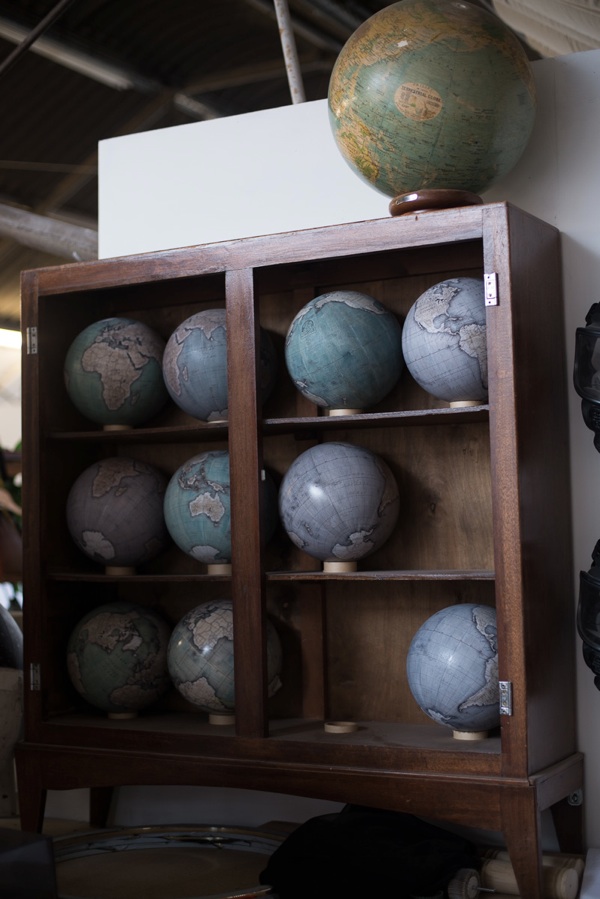
Once upon a time, Peter Bellerby of Bellerby & Co was unable find a proper globe to buy his father for an eightieth birthday present. Now Peter is to be found in his very own globe factory in Stoke Newington and hatching plans to set up another in New York – to meet the growing international demand for globes which he expects to exceed ten times his current outputs. A man with global ambitions, you might say.
Yet Peter is quietly spoken with deferential good manners and obviously commands great respect from his handful of employees, who also share his enthusiasm and delight in these strange metaphysical baubles which serve as pertinent reminders of our true insignificance in the grand scheme of things.
A concentrated hush prevailed as Contributing Photographer Sarah Ainslie & I ascended the old staircase in the former warehouse where we discovered the globemakers at work on the top floor, painstakingly glueing the long strips of paper in the shape of slices of orange peel (or gores as they are properly known) onto the the spheres and tinting them with fine paintbrushes to achieve an immaculate result.
“I get bored easily,” Peter confessed to me, revealing the true source of his compulsion, “But making globes is really the best job you can have, because you have to get into the zone and slow your mind down.”
“Back in the old days, they were incredibly good at making globes but that had been lost,” he continued, “I had nothing to go by.” Disappointed by the degradation of his chosen art over the last century, Peter revealed that, as globes became decorative features rather than functional objects, accuracy was lost – citing an example in which overlapping gores wiped out half of Iceland. “What’s the point of that?,” he queried rhetorically, rolling his eyes in weary disdain.
“People want something that will be with them for life,” he assured me, reaching out his arms around a huge globe as if he were going to embrace it but setting it spinning instead with a beautiful motion, that turned and turned seemingly of its own volition, thanks to the advanced technology of modern bearings.
Even more remarkable are his table-top globes which sit upon a ring with bearings set into it, these spin with a satisfying whirr that evokes the music of the spheres. Through successfully pursuing his unlikely inspiration, Peter Bellerby has established himself as the world leader in the manufacture of globes and brought a new industry to the East End serving a growing export market.
To demonstrate the strength of his plaster of paris casting – yet to my great alarm – Peter placed one on the floor and leapt upon it. Once I had peeled my fingers from my eyes and observed him, balancing there playfully, I thought, “This is a man that bestrides the globe.”



Isis Linguanotto, Globepainter


John Wright, Globemaker


Chloe Dalrymple, Globemaker


Peter Bellerby, on top of the globe
Photographs copyright © Sarah Ainslie
Paul Bommer’s Salmagundy
Contributing Artist Paul Bommer, celebrated in Spitalfields for his plaque of Huguenot tiles on the Hanbury Hall, has produced this splendid limited edition of large letterpress cards on eclectic subjects in his characteristic graphic style. Click here to buy a set direct from Paul. In Spitalfields, sets are on sale at Townhouse and in Ledbury at Tinsmiths.

Signboards for taverns that existed in Bishopsgate in Shakespeare’s time

An automated oracle, both the Roman poet Virgil and the Medieval monk Friar Bacon had one

Cod Latin Tombs on the Appian Way

Trade card for Johannes van Oosterom’s Coffee-House

Croque Monsieur, a grilled ham and cheese sandwich, and Croque Madame, the same with an egg on top

Par le bois du Djinn où s’entasse de l’effroi/ Parle et bois du gin ou cent tasses de lait froid (By the woods of the Djinn, where fear abounds/ Talk and drink gin, or a hundred cups of cold milk). Alphonse Allais’ famous holorime in which both lines read the same.

In Bleak House, Miss Flite is a spinster caught up in the unending Jarndyce & Jarndyce lawsuit who keeps songbirds with names reflecting her initial hope and optimism and subsequent disillusionment and madness as the case drags on.

The Green Dragon, a traditional and once common British pub sign, indicating a connection to Wales

Mandragora, the medicinal root resembling a man which let out a fatal scream when dug up

Orion the Hunter with his belt is one of the most discernible constellations of the Winter sky

The Round Table with the Holy Grail, the sword Excalibur, and arms of King Arthur and his knights

Diepzee Schepselen (Deep Sea Creatures), marine beasts, after Adriaen Coenen’s Whale Book, 1585
Images copyright © Paul Bommer
You may also like to take a look at Paul’s other work
The Map Of Shoreditch As New York
Join me from six this Thursday 5th July for the East End launch party celebrating publication of Adam Dant’s MAPS OF LONDON & BEYOND at The Townhouse, 5 Fournier St, E1. Adam’s exhibition in Spitalfields runs until 22nd July and his exhibition at The Map House in Knightsbridge continues until 14th July.
Click here to order a signed copy

(Click to enlarge)
When Adam Dant drew this map of Shoreditch as New York in the last century, he could not have been aware how prescient his vision might become. With a line of towers sprouting along Shoreditch High St and a host more in the pipeline, it may not be more than few years before the resemblance between this corner of the East End and Manhattan is more than a mere fancy.
“People sometimes say they like the New-Yorky feel, here in Shoreditch,” admitted Adam with a discernible twinkle in his eye, when I asked him how he came to draw this map of Shoreditch as New York. In his arresting conceit, Old St roundabout is transformed into Old St Circle, Arnold Circus Park becomes Madison Square Gardens and Liverpool St Station becomes Grand Central Station. The buildings and terminology are Americanised too, Brick Lane becomes Brick Lane Avenue, Bethnal Green Rd becomes Bethnal Green Boulevard and Quaker St becomes simply Quaker.
The comparison becomes less far fetched than you might assume, because Broadway in New York is along the line of an ancient pathway followed by the Algonquin tribe, whereas in Shoreditch, Old St follows the route of a primeval trackway of the ancient Britons, and Canal St in New York follows the route of the former canal whereas Shoreditch takes its name from the ‘suer’ that was once ditched and is now piped off. Both places are renowned for their mix of artists and immigrant culture, and down in Brushfield St, on the site of the Spitalfields Market, Adam has drawn New York’s Ellis Island building in acknowledgement of the immigrants who have come to New York and Spitalfields, defining the nature of these locations today.
Looking around the neighbourhood, you quickly come upon further clues. We have Rivington St just as they do, and Broadway Market and Columbia Rd too, chiming with New York. And the extension of the Great Eastern Railway up to Old St created a narrow triangular plot, occupied by a tall tapered building at the bottom of Great Eastern St which is reminiscent of the Flat Iron Building. Many people live in lofts in this vicinity today just as you might find in Soho or Tribeca. Here we have Shoreditch House whereas in New York they have Soho House.
One day, Adam & I were stopped in our tracks by an image on a passing truck in Redchurch St, showing New York viewed through Tower Bridge grafted onto the Brooklyn Bridge. But was it Tower Bridge joining the Brooklyn Bridge across the East River with Manhattan in the background? Or was it London with the New York Financial District transferred to Shad Thames? Was it London-as-New York or New York-as-London? We stood and looked at each other in amazement …

CLICK TO ORDER A SIGNED COPY OF MAPS OF LONDON & BEYOND BY ADAM DANT
Adam Dant’s MAPS OF LONDON & BEYOND is a mighty monograph collecting together all your favourite works by Spitalfields Life‘s cartographer extraordinaire in a beautiful big hardback book.
Including a map of London riots, the locations of early coffee houses and a colourful depiction of slang through the centuries, Adam Dant’s vision of city life and our prevailing obsessions with money, power and the pursuit of pleasure may genuinely be described as ‘Hogarthian.’
Unparalleled in his draughtsmanship and inventiveness, Adam Dant explores the byways of English cultural history in his ingenious drawings, annotated with erudite commentary and offering hours of fascination for the curious.
The book includes an extensive interview with Adam Dant by The Gentle Author.
Adam Dant’s limited edition prints are available to purchase through TAG Fine Arts


