
Samuel Wilson’s Ledger
October is Huguenot Month in Spitalfields and this year’s theme is Women & Power including walks exploring Spitalfields Sisters, The Work & Lives of Remarkable Women.
Kate Wigley, Director of the School of Textiles, introduces the rare survival of an early nineteenth century weaver’s working diary. She will be speaking about Samuel Wilson’s ledger at 2pm on Saturday 20th October at Christ Church, Spitalfields. Click here for tickets

When my eyes fell upon the weaving ledger of Samuel Wilson (1792-1881) for the first time, I was struck not only by the captivating fabrics but also the beauty of the detailed records of production and manufacturing processes. Each line, carefully written in exquisite copper plate, sits alongside its own delicate textile production sample.
Written between 1811 and 1825, the ledger is a record of Samuel Wilson’s apprenticeship to his brother’s company, Lea & Wilson of 26 Old Jewry, Cripplegate, alongside an account of his personal exploration of weaving processes. When he embarked on his apprenticeship in 1806, Samuel began a comprehensive study of the process of silk manufacture – from throwing to weaving.
Samuel’s brother, Stephen Wilson was known for introducing an early version of the Jacquard loom into England in 1820 through his own patent. He was already well established within the London silk industry and had expanded his business with additional premises in Streatham. In the pages of the ledger, it is evident how mechanical improvements were contributing to the development of the Joseph Marie Jacquard’s new manufacturing technology.
Samuel Wilson became a leading force in the London silk industry and worked his way up to the position of Upper Bailiff in the Worshipful Company of Weavers. By 1838, the power of Samuel’s Wilson wider influence was recognised when he was elected Lord Mayor of the City of London.
Although his ledger is in private hands, I have been granted the opportunity of studying it in detail after I first encountered while researching early nineteenth century looms with textile historian, Mary Schoeser. Turning the pages carefully, we were both surprised how the ledger touched us and, without quite realising it, we found we had made a silent pact to uncover the secrets held within.
The opening pages are devoted to a discourse on how to create a perfect woven circle and the many minor adjustments to the ‘tyes’ and ‘sett’ that Samuel had to make on a loom to achieve this. It reveals the remarkable technological changes weavers experienced in the first three decades of the nineteenth century. Part-way, the ledger includes patterns for silk scarf designs. A tantalisingly small cutting of a hand-woven red and yellow silk for ‘chair bottoms for one of her majesty’s rooms in the Castle Windsor’ in 1816 is pinned carefully to the left-hand corner of a page.
Samuel Wilson’s apprenticeship record is a rare discovery that offers a unique view of the workings of the London silk industry in his era. More importantly, Samuel shares his own experiments and personal findings alongside accounts of disputes over weavers’ pay, dye recipes and client orders. The fabric samples and text are of great interest in their own right, but together they comprise an exceptional window into the development of a period in London’s textile history that is largely neglected. Through his personal ledger, we can read Samuel Wilson’s personal thoughts and hear his voice too.


Photographs copyright © Kate Wigley
Click here to see the full programme of events in this year’s Huguenot Month
You may also like to read about
Joginder Singh’s Boy
Spitalfields Life Books will be publishing A MODEST LIVING, Memoirs of Cockney Sikh by Suresh Singh in October. Here is the fourth instalment and further excerpts will follow over coming weeks.
In this first London Sikh biography, Suresh tells the story of his family who have lived in their house in Princelet St for nearly seventy years, longer I believe than any other family in Spitalfields. In the book, chapters of biography are alternated with a series of Sikh recipes by Jagir Kaur, Suresh’s wife.
You can support publication by pre-ordering a copy now, which will be signed by Suresh Singh and sent to you on publication.
Click here to order a signed copy of A MODEST LIVING for £20

Suresh Singh & Jagir Kaur at 38 Princelet St this summer (Photograph by Patricia Niven)

Me & Dad
As a child, I lived in awe of Dad, to me he was god. He was a very strong man and occasionally I would accompany him to the building sites where he worked. The Irish builders loved seeing us, father and son together, calling me ‘Jo’s boy.’ They would give me ten pence at the end of the day for helping and say, ‘He’s your boy, he’s our boy.’ I was so proud of Dad.
When he did repairs around the house, I passed him the hammer and carried the nails and I loved being around him. I believed nothing could hurt me if he was there. I felt safe anywhere he was. He had such a strong presence, making me feel as if I was in the company of someone holy.
Mum was affectionate and warm. She was a large woman who was very cuddly and I would always be hugging her. As the youngest boy, I spent all my time with her. She washed my hair every morning in the kitchen and every evening in front of the fire. It was a ritual – undoing the plait, combing the hair forward and washing it. Sometimes she would wash it with yoghurt, then massage mustard oil all the way down through the hair. Afterwards, she combed it, first in front and then flicking it back to comb it from behind. Finally, she would plait it into one long plait, wrap it all the way round into a big bob, cover it with a hanky and tie with a ribbon at the end to hold it all together. If she found an elastic band, she might encapsulate the bob to hold it in shape. Mum loved to see my hair tied up in a big knot and I think it broke her heart when it was cut off later. She missed it so.
From the age of two, I had asthma. It became more severe as I grew. I used to sleep with Mum when I was little and she would rub my chest with Vick’s eucalyptus cream and heat Wright’s Coal Tar in a vaporiser to clear my lungs. She was always making me jumpers and dressing me up. She liked putting me in dresses that she made. Visitors asked, ‘Is Suresh a girl or a boy?’ Mum loved sewing things, making clothes and other stuff for the home from bits and bobs of fabric that workers in the local rag trade gave her. ‘There’s a bit of lining left over,’ they would say, ‘you can have it.’ Dad bought old printed cotton curtains in the Sunday market and she adjusted them, hemming and sewing rings onto them.
Dad lit fires in the winter and he swept the chimney himself. Even though we covered everything, the soot got everywhere. When we all ate together on the floor in front of the fire, using newspaper as a tablecloth, Dad recited hymns from Guru Granth Sahib, the holy book. He always told us stories of the gurus, especially Guru Ravidas Ji the shoemaker and Guru Nanak, the first guru and founder of Sikhism.
Every day, I watched him leave and return from shoe shining on Liverpool Street station or labouring on building sites, then doing odd jobs for family and friends to make sure we were well fed. He could work all day on a building site and then go to shine shoes on Liverpool Street to make a bit extra.
Although our clothes might have been secondhand from the flea market or altered and patched up, they were always clean. Mum used to heat them in a pan with washing powder. Occasionally they boiled over, and the soap suds spilt all over the cooker and onto the floor.
My earliest memory was of playing in the yard on my bike which Dad got me in the Brick Lane market. Everyone always showed me great affection and, because I was the youngest boy, I was very well treated. It meant a lot to Mum and Dad that I was the one who had the Sikh hair, the kesh. I had to stay at home because I was ill and, even after I got married and everybody else moved out, I lived with them in Princelet Street right up to the end.
Some family and friends suggested that maybe my long hair was the reason my health was not good. It was down to my knees by then. I was taken to the doctor in Brune Street. Dr Gottlieb asked Mum, ‘Mrs Kaur, can you wait outside a minute?’ Then he spoke with me, ‘What’s the matter, Suresh?’ he asked. I started to cry and said, ‘I want to cut my hair off!’ My fear was that I would get bullied at secondary school and it was really hard to manage. Mum’s health was not good and she found it difficult to comb and wash it every morning and evening. Dr Gottlieb brought Mum in again and told her, ‘You’ve got to cut his hair off.’ Mum said, ‘Oh, that’s sad,’ but I was grateful to Dr Gottlieb for supporting me.
Dad took me into the yard and cut all my hair off with a pair of scissors. While he was doing it, he chanted ‘Wah Hey Guru.’ I wonder if it reminded him of when his hair was cut off in Glasgow. Mum collected my hair and treasured it in a hidden place in the house for more than a year, bundled in a cloth. Then one evening she took me for a walk to Tower Bridge and, producing the bundle from her handbag, released it with both hands over the parapet in silence into the Thames. Then she said to me, ‘Hun Chuyla,’ meaning ‘Let’s move on.’
Once my hair was cut off, I felt a proper jack the lad, you know? I played in the street with the Bengali children who had recently arrived from Bangladesh. They loved marbles and we played a lot of football in Princelet Street. We used to climb onto the garden walls of the houses in Fournier Street, walking from Brick Lane to Commercial Street.

Me in the yard with my topknot

Me in Weavers Fields after I lost my topknot

Mum & Dad in Princelet St

Click here to order a signed copy of A MODEST LIVING for £20

John Thomas Smith’s Rural Cottages

Near Battlebridge, Middlesex
As September draws to a close and autumn closes in, I get the urge to go to ground, hiding myself away in some remote cabin and not straying from the fireside until spring shows again. With this in mind, John Thomas Smith’s twenty etchings of extravagantly rustic cottages published as Remarks On Rural Scenery Of Various Features & Specific Beauties In Cottage Scenery in 1797 suit my hibernatory fantasy ideally.
Born in the back of a Hackney carriage in 1766, Smith grew into an artist consumed by London, as his inspiration, his subject matter and his life. At first, he drew the old streets and buildings that were due for demolition at the turn of the eighteenth and nineteenth centuries in Ancient Topography of London and Antiquities of London, savouring every detail of their shambolic architecture with loving attention. Later, he turned his attention to London streetlife, the hawkers and the outcast poor, portrayed in Vagabondiana and Remarkable Beggars, creating lively and sympathetic portraits of those who scraped a living out of nothing but resourcefulness. By contrast, these rural cottages were a rare excursion into the bucolic world for Smith, although you only have to look at the locations to see that he did not travel too far from the capital to find them.
“Of all the pictoresque subjects, the English cottage seems to have obtained the least share of particular notice,” wrote Smith in his introduction to these plates, which included John Constable and William Blake among the subscribers, “Palaces, castles, churches, monastic ruins and ecclesiastical structures have been elaborately and very interestingly described with all their characteristic distinctions while the objects comprehended by the term ‘cottage scenery’ have by no means been honoured with equal attention.”
While emphasising that beauty was equally to be found in humble as well as in stately homes, Smith also understood the irony that a well-kept dwelling offered less picturesque subject matter than a derelict hovel. “I am, however, by no means cottage-mad,” he admitted, acknowledging the poverty of the living conditions, “But the unrepaired accidents of wind and rain offer far greater allurements to the painter’s eye, than more neat, regular or formal arrangements could possibly have done.”
Some of these pastoral dwellings were in places now absorbed into Central London and others in outlying villages that lie beneath suburbs today. Yet the paradox is that these etchings are the origin of the romantic image of the English country cottage which has occupied such a cherished position in the collective imagination ever since, and thus many of the suburban homes that have now obliterated these rural locations were designed to evoke this potent rural fantasy.

On Scotland Green, Ponder’s End

Near Deptford, Kent

At Clandon, Surrey – formerly the residence of Mr John Woolderidge, the Clandon Poet

In Bury St, Edmonton

Near Jack Straw’s Castle, Hampstead Heath

In Green St, Enfield Highway

Near Palmer’s Green, Edmonton
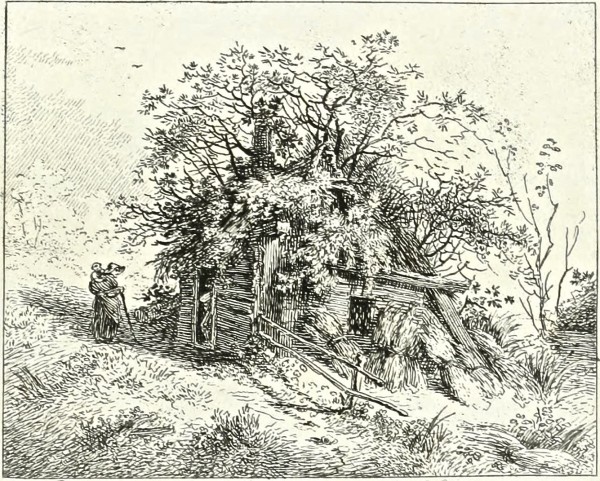
Near Ranelagh, Chelsea

In Green St, Enfield Highway

At Ponder’s End, Near Enfield

On Merrow Common, Surrey

At Cobham, Surrey – in the hop gardens

Near Bull’s Cross, Enfield

In Bury St, Edmonton

On Millbank, Westminster

Near Edmonton Church

Near Chelsea Bridge

In Green St, Enfield Highway

Lady Plomer’s Place on the summit of Hawke’s Bill Wood, Epping Forest

You may also like to take a look at these other works by John Thomas Smith
John Thomas Smith’s Ancient Topography of London
John Thomas Smith’s Antiquities of London
John Thomas Smith’s Vagabondiana
John Thomas Smith’s Vagabondiana II
Dr Legg, General Practitioner
Contributing Writer Gillian Tindall celebrates the career of Leonard Fenton, an East End boy better known as ‘Dr Legg,’ who has recently returned to Eastenders at the fine age of ninety-two years old. Gillian’s books include The House by the Thames and A Tunnel Through Time.

Leonard Fenton as Dr Legg with June Brown as Dot Cotton (reproduced courtesy BBC)
When Dr Legg, the General Practitioner in Eastenders, retired in 1997, there was universal regret among viewers – even though they could see he was already older than any real-life General Practitioner would be. Afterwards, he continued to be referred to as an off-stage presence, like a benign Scarlet Pimpernel, and he made occasional informal reappearances – most notably for the stage-funeral of Mark Fowler in 2004, with whom he had once had ferocious doctorly words about heroin addiction and, in 2010, to counsel Dot Branning about a supposed Romanian foundling.
In real life, Dr Legg is the actor Leonard Fenton. Although his Eastenders‘ role has been the one for which he has been widely celebrated (and even accosted in the street and the Underground by people so convinced of the reality of soaps that they ask for friendly medical advice) he has a life-time of other roles to his credit. One of those actors who was always in work and much esteemed by other professionals, Len has done seasons with the National Theatre and the Royal Shakespeare Company, worked with Orson Welles, with Jonathan Miller and Samuel Beckett – who personally chose him in 1979 to play opposite Billie Whitelaw in Happy Days at the Royal Court.
His last stage roles were the Duke in The Merchant of Venice at Stratford-on-Avon in 2008 and the demanding part of Vincentio in The Taming of the Shrew at the Aldwych Theatre in London in 2009. By then Len was eighty-three years old, but you would never have guessed it. He went on for several more years specialising in ‘old rabbis’ and has only now taken to retirement in the actors’ home at Denville Hall, because his diabetes needs more careful management than he can give it alone.
The kindly Dr Legg in East Enders is obviously Jewish and the early lives of the doctor and the actor paralleled each other. Dr Legg was born in the East End, a bright boy who got a scholarship to a Grammar School and then to medical school, but had preferred to remain close to his roots in the fictional East London district of `Walford’ rather than moving out to a polite suburb.
Similarly, Len Fenton was born during the General Strike of 1926 in a little house in Duckett St, Stepney Green, that his parents and elder sister shared with relatives. When he was eleven, he won a Junior County scholarship to Raines School for Boys in Arbour Sq. A surviving school report, under the name Leonard Feinstein, describes him as “A quiet intelligent pupil. Gives no trouble and works well.” The same report shows that he was particularly good at drawing, singing and languages, but as he showed an aptitude for maths too, plus ‘satisfactory’ work at Chemistry and Physics, the headmaster urged him towards engineering – a destiny that took Len some years and quite a bit of enterprise to escape.
The heart of the Jewish East End in the twenties and thirties was in Whitechapel and Spitalfields. Half a mile away, in Duckett St there was only one other Jewish household besides Len’s family, although Len recalls a big block of flats on Stepney Green itself that was “full of our lot. I would rather liked to have lived there.” Possibly it was the presence of this block that drew Mosleys’ Blackshirts down to Stepney Green for a series of threatening marches that were to culminate in the Battle of Cable Street. As a small boy, Len remembers his mother standing in the upstairs window of their house with a baby – one of Len’s younger sisters – in her arms, watching Mosley giving a speech at the corner about how all Jews had substantial bank balances. At this point, she yelled down at him “Sir Oswald, would you like to see my fucking bank balance?” Her husband worked in the garment trade and, like most people in their position, they lived hand to mouth. Various neighbours, who were inclined to side with Mosley in those uncertain times, hastily cried “No, no, Fanny, we don’t mean you!”
Len’s mother had arrived in London as a baby, circuitously, via New York, at the beginning of the twentieth century. She was working in a box factory when she met her husband. Both sets of grandparents were immigrants from Eastern Europe, mother’s from Riga and father’s from Lithuania, and all that generation spoke Yiddish as their household tongue. The family name was originally, Len thinks, something like Resnik, a Russian-Yiddish term to do with tailoring, but it just happened that the neighbour who helped Len’s grandfather to register in London when he arrived in the 1890s suggested ‘Feinstein’ as a suitable name and it was accepted. The change to Fenton happened during the Second World War, when Len’s elder sister Sylvie convinced their father that it would be a good idea. However, the cousins living on the ground floor of the same house, including little Arnold who was six months younger than Len and his constant playmate, did not change their name. Arnold Feinstein, another scholarship boy, grew up to be a distinguished academic scientist and the husband of Elaine Feinstein, the poet. There are many routes out of the ghetto, but the Fenton-Feinstein families have always remained close.
Grandparents and uncles were important too. Len’s mother’s mother, who had been widowed in New York with the baby, come to London and remarried, lived at Bow. Neighbours of theirs organised a synagogue in their front room where the family foregathered on Saturdays. It was from here that an uncle took Len, then aged ten or eleven, on a trip to Watford to hear Thomas Beecham conducting Bizet’s First Symphony in C – for Len, a revelatory experience about what music could be. But, sadly, this thoughtful relative later became known to Len and his sisters as ‘bad uncle’ because he tried to convince Len that he could neither draw and paint, nor sing well enough to envisage it as a career – both of which no-doubt-well-intentioned judgements were untrue.
Len was thirteen in 1939, at the point when the whole Jewish East End began to be swept away, first by war and then by the social changes that war brought. Raines School was evacuated to various places near the south coast: hardly the ideal location in view of the threat of invasion, but such a hasty relocation was common in those times. By the time Len returned to battered and blitzed Stepney towards the end of the war, he was a tall and handsome seventeen-year-old – and his feisty mother, with whom he had not lived since he was a child, was suffering with tuberculosis and possibly diabetes as well. There was no NHS yet but, even if there had been, not a great deal could have been done for her. She died in 1945 and it was the eldest sister Sylvie who took on the maternal role for their father, for Len, his younger brother Cyril (who also died young) and the two pretty and ambitious younger sisters, Corinne and Annie.
National Service loomed at eighteen for all young men of Len’s generation yet, instead of joining the Army as a squaddie, Len was sent, on his head-master’s recommendation and Government approval, to do a two-year degree in Engineering at Kings’ College. He did not relish it at all, but it meant that, when the Army finally claimed him at age twenty, he was given a commission in the Royal Engineers – a new world for him. “I really enjoyed myself,” he recalled, “As an officer I could just oversee things and sign off the paper, while the NCOs did all the work!”
Len’s Army experience led him to five years in a civil engineering job in Westminster. This was still unsatisfying for Len, even though the firm in question seems to have been extraordinarily tolerant of their amiable but undevoted employee. Len found that he could take long, dreamy lunch hours walking round the London parks. By then he was living in Clapton and discovered, while changing from tube to bus at Aldgate on his evening commute, that Toynbee Hall ran courses in art and music. He started spending his evenings there, as many other aspirant East Enders had done before him – and a new life began. A starring role singing in a Christmas performance led to the offer of a place at the Webber-Douglas theatrel school, and the boy from Stepney was re-born as an actor and never looked back.
“I was older than most people at drama school,” he explained, “That was useful and I soon learnt to age myself up – I loved making-up.” A Spotlight award in his final year set Len off on a career playing character roles – fulfilling even if he never achieved a minor ambition to take the part of Baron Hard-Up in pantomime. “Trouble is, people don’t associate Dr Legg with slapstick,” he confessed.
Did becoming a celebrity in such a long-running soap affect his chances of other roles? Len feels that it may have kept him out of the theatre, but one would hardly think so given the stage successes of his last years in the profession. Oddly, Dr Legg is almost the only role in Len’s career which was not a character part. “The character wasn’t written to any great depth,”says Len, “so inevitably what came over on TV was a lot of me. I sometimes used to slip in words of my own that weren’t in the script! I think they should have given me a proper wife, though, not just a dead one.” Mrs Legg was supposed to have been a nurse, killed long ago by a land-mine.
In real life Len married, aged almost forty, to a professional cellist, Madeline Thorner, considerably younger than him. Three sons and a daughter arrived in quick time, in their house in Hampstead Garden Suburb that was a far cry from Duckett St. Although the marriage eventually foundered, Len and Madeline remain friends and it was she who managed to get him into Denville Hall.
Any regrets? “Well, if I’d know how well my voice would last,” he admitted, “I’d have been a singer.” Len does still sing beautifully, even in his ninth decade, and possesses an extraordinary ability to imitate dogs and cats well enough to fool the animals themselves. His ability to paint and aptitude for drawing that his headmaster and uncle dismissed long ago came to the fore during Len’s years as Dr Legg, and he continues to paint. The aura of cheerful interest in life, that stood him in such good stead as a small boy in Stepney, still surrounds Len today.

Leonard Fenton

Leonard’s mother and father with his elder sister Sylvie as a baby

Leonard and his sister Sylvie with their Uncle

Leonard Fenton’s publicity shot as a young actor

Leonard playing older than his years in the seventies

Leonard’s publicity shot in the eighties

Leonard in the West End

Leonard’s sketch of Samuel Beckett, done while rehearsing Happy Days at the Royal Court in 1979
You may also like to read about
Morris Goldstein, the Lost Whitechapel Boy
Charlie Chaplin in the East End
David Garrick at Goodman’s Fields Theatre
At the Pavilion Theatre, Whitechapel
Mr Pussy At Hatchards

Please join me at 6:30pm this Monday 1st October to launch THE LIFE & TIMES OF MR PUSSY, A Memoir of a Favourite Cat at Britain’s oldest bookshop, Hatchards in Piccadilly, where I will be reading stories from the book and signing copies. Admission is free and all are welcome.

Click here to order a signed copy for £15
City Animals
I am delighted to publish these CITY ANIMALS from Symbols & Secrets, written by The City Gent, a graduate of my blog writing course. The Gent has worked in the City of London for thirty years and every week he publishes stories of things that he likes. Follow SYMBOLS & SECRETS, Walking the City of London
We are now taking bookings for this autumn’s course, HOW TO WRITE A BLOG THAT PEOPLE WILL WANT TO READ on November 10th & 11th. Come to Spitalfields and spend a weekend with me in an eighteenth century weaver’s house in Fournier St, enjoy delicious lunches from Leila’s Cafe, eat cakes baked to historic recipes by Townhouse and learn how to write your own blog. Click here for details
If you are a graduate of my course and you would like me to feature your blog, please drop me a line.

The Boar’s Head Tavern in Eastcheap was where Sir John Falstaff and Prince Hal caroused in Shakespeare’s Henry IV Part One & Two. The present building at number 33-35 dates from 1868 and references this history with a boar peeping out of bushes and portrait heads of Henry IV and Henry V. Architectural critic, Ian Nairn, described the building as ‘the scream you wake on at the end of a nightmare.’


This magnificent leaping fox appears on the Grade II listed Art Deco shopfront of the Fox company, who manufacture and repair umbrellas. Mr Fox opened his first shop in the City in 1868 but this shop dates from 1935. You can still purchase a classy Fox umbrella if you go to their website, but the shop is now a wine bar.

Mice nibbling a piece of cheese add charm to a building in Philpot Lane off Eastcheap and have been described as London’s smallest sculpture. Even though they have been repainted, they are still hard to find. I am not saying precisely where they are but hopefully you will enjoy looking for them.
One theory of their mysterious origin is that the builders were pestered by mice who ransacked their lunch packs in 1862 left this informal tribute. Another story is that they commemorate a worker who died during the construction of the Monument. Apparently, mice ate his lunch but he accused a fellow by mistake and fell to his death in the ensuing fight.

Hanging signs were once a major feature of City streets. Charles I encouraged them to help those find their way around who could not read. They became immensely popular and proliferated to such an extent that they posed a threat to life in storms and windy weather. In 1718, when one caused the collapse of an entire frontage and killed four people, it was obvious something had to be done. But it was not until 1762 that businesses were forced to remove them and fix them to shopfronts instead. The Cat & Fiddle sign in Lombard St harks back to a tavern of that name which once stood on the site although this sign was actually only erected in 1902, along with several other replica signs, to celebrate the coronation of Edward VII.

This little Scottish terrier called Chippy rests now in All Hallows by the Tower at the feet of his master the Reverend ‘Tubby’ Clayton who was vicar between 1922 and 1963. He is best known for his work as an army chaplain during the First World War, in particular establishing Talbot House as a place of rest and sanctuary for the troops. After the war, Talbot House grew into the Toc H movement.

As you approach the Bank junction from Cheapside, look up and you will see two boys at either end of the building that was once headquarters of Midland Bank. Each one is struggling with an angry goose. Why a goose? A clue is the name of the street and the goose was a suggestion by the architect Edwin Lutyens to commemorate the former poultry market.

The Church of St Katherine Cree in Leadenhall St, which is one of the few to survive the Great Fire and the Blitz, has a rooster on its weathervane. The Bible tells how Peter denying Christ three times ‘before the cock crowed’. In the late sixth century, Pope Gregory I declared the rooster as the emblem of St Peter and also of Christianity itself. In the ninth Century, Pope Nicholas decreed all churches should display it and, although the practice faded away, the tradition of rooster weathervanes has survived in may places.

The Agnus Dei, or Lamb of God, is the emblem of the Middle Temple and can be seen in many places around the Inn. There is a theory that the holy lamb was chosen because it had originally been used by the Knights Templar whose arms were two knights mounted on one horse with a trotting Agnus Dei.

The leopard’s head – which has always been the mark of the London Assay Office – recalls King Richard II, whose symbol this was and who granted the Worshipful Company of Goldsmiths its charter in 1393. It can be found over the entrance to the site of the former churchyard and church of St John Zachary which was partly destroyed in the Great Fire. In 1339, the Goldsmiths acquired this land and built the earliest recorded livery hall there.

This wise owl gazes at commuters as they trek over London Bridge from his perch on the House of Fraser department store north of the bridge.

This bee is the keystone over the entrance to Honey Lane which connects Cheapside with Trump St. The name of the lane comes from the bee-keepers who used to live there and it also once led to All Hallows Honey Lane, a medieval church destroyed in the Great Fire.

The Black Eagle sign in Brick Lane reminds passers-by of the Black Eagle Brewery. Founded in 1666, in the eighteenth century under the management of Sir Benjamin Truman, it began the expansion that led to the creation of Truman, Hanbury & Buxton, the largest brewer in the world.

This beaver above 64 Bishopsgate is a reminder of the Hudson’s Bay Company which was based nearby and once dominated the fur trade. Beaver fur was much sought after, particularly for hats.

This figure of a ram by an unknown sculptor in New St, dates from the eighteen-sixties and once presided over the entrance to Cooper’s wool warehouse.
Photographs copyright © The City Gent
You may also like to take a look at
Rachael South, Chair Caner & Upholsterer

Rachael South at her workshop in Dalston
It never fails to inspire me when I meet someone who finds joy in the work they do – and Rachael South, third-generation chair caner, is a prime example. The chain of events that led to making contact with Rachael was extraordinary and the resultant visit to her workshop proved a rewarding outcome.
One day I published a picture of an unknown man in a suit sitting on the kerb mending a cane chair, which came from David Sweetland’s A London Inheritance, where he writes a weekly commentary upon his father’s photographs of London in the fifties and sixties. The picture fascinated me because of its similarity to the age-old images of chair menders to be found in the Cries of London series of prints published in these pages. Imagine my surprise when his granddaughter, Rachael, got in touch, naming him as Michael South and explaining that she carries on the trade to this day which was taught to her by her father, who had in turn been taught by her grandfather.
My quest led me to an old workshop in Shacklewell Lane where Rachael spends her days caning and upholstering chairs by the light of a large window. “The family lived in Ladbroke Grove but was Irish in origin, I believe there were a lot of Irish immigrants there at one time, “she revealed to me, talking as she worked at her caning, “Michael, my grandfather, was a prizefighter and bare-knuckle boxer, but over time the chair caning took over as his boxing career waned. He had a pedlar’s licence and walked up the hill from Ladbroke Grove to work around Kensington and Knightsbridge. They may have been travelling people once, because I was told it was called ‘Gypsy Caning.’ You can do it in the street because you don’t need any tools, just a knife and a block of wood or hammer to knock out the pegs.”
Certainly, chair caning has been carried out upon the streets of London for centuries and Rachael delights in the notion of being the inheritor of this artisan tradition, which suits her independent nature very well and guarantees a constant income as long as she chooses to do it.
“Terry, my dad, wanted to stay on at school and train as a draughtsman but at fourteen my granddad said, ‘You’ve got to get a job,'” Rachael admitted to me.”He had been brought up doing chair caning and he managed to get an apprenticeship with Mrs Shield, who was a celebrity decorator of the time – before setting up his own upholstery workshop in Harrow where he trained six apprentices”
“My dad taught me caning when I was fourteen. I used to go along to his workshop and I liked it, because I’m quite a patient person and the upholsterers were a good laugh,” Rachael recalled fondly,” and when I went to art college, it was what I did to make money – I lived in Hammersmith and went round all the antiques dealers and they supplied me with enough caning to see me through.”
Employed as a textile designer, Rachael soon felt the need for freedom and set up her own workshop as upholsterer and chair caner. “I’ve never been without work and I have three people working with me. I’ve been caning chairs for over thirty years,” she confided to me proudly, “I can’t turn work away because I know I can do it and people are always so delighted when I give it back to them. I say, ‘That’s it done for another generation.'”

Rachael’s grandfather Michael South (1905-1964) at work in Kensington, sitting on his tool box

Michael worked with a pedlar’s licence in West London –“He had many brothers and sisters. One called Samson used to ride a motorbike on the wall of death and another called Danny had only one ear.”

Rachael’s father Terry South at work in his workshop in Harrow in the seventies

Rachael South at work today in Dalston

Terry South and Rachael at his workshop in 1978

Rachael sets to work with cane soaked in water for flexibility

Michael always went to work dressed in a suit and leather shoes

Rachael with a bundle of reeds

“Israel Potter, one of the oldest menders of chairs still living” – as portrayed by John Thomas Smith in Vagabondiana, 1819

Photo by John Thomson from Street Life in London, 1876: Caney the Clown – ”thousands remember how he delighted them with his string of sausages at the yearly pantomime, but Caney has cut his last caper since his exertions to please at Stepney Fair caused the bursting of a varicose vein in his leg and, although his careworn face fails to reflect his natural joviality, the mending of chairs brings him constant employment.”

“Old Chairs to mend!” by Thomas Wheatley, seventeen-nineties

“Any Old Chairs To Mend! & Green and Young Hastings!” by Sam Syntax

“Old Chairs to mend, Old Chairs to Mend!” by J. Kendrew

“Chairs to Mend!” from The New Cries Of London, 1803

“The kerbside mender of chairs, who ‘if he had more money to spend would not be crying – “Chairs to mend!’ is one of the neatest-fingered of street traders. Watch how deftly he weaves his strips of cane in and out – how neatly he finishes off each chair, returning it to the owner, ‘good as new.'” from London Characters, 1934

William Marshall Craig’s Itinerant Traders in their Ordinary Costune, 1804 : “Chairs to mend. The business of mending chairs is generally conducted by a family or a partnership. One carries the bundle of rush and collects old chairs, while the workman seating himself in some convenient corner on the pavement, exercises his trade. For small repairs they charge from fourpence to one shilling, and for newly covering a chair from eighteen pence to half a crown, according to the fineness of the rush required and the neatness of the workmanship. It is necessary to bargain for price prior to the delivery of the chairs, or the chair mender will not fail to demand an exorbitant compensation for his time and labour.”

Chairmender at corner of Prince Orange Lane, Greenwich from Charles Spurgeon’s Londoners


From Julius Mendes Price’s London Types, 1919

From The Cries of London, early nineteenth century
Archive photos of Michael South © A London Inheritance
Cries of London courtesy Bishopsgate Institute
Contact Rachael South for chair caning and upholstery


