At Mile End Place

Mrs Johnson walks past 19 Mile End Place
Whenever I walk down the Mile End Rd, I always take a moment to step in through the archway and visit Mile End Place. This tiny enclave of early nineteenth century cottages sandwiched between the Velho and the Alderney Cemeteries harbours a quiet atmosphere that recalls an earlier, more rural East End and I have become intrigued to discover its history. So I was fascinated when Philip Cunningham sent me his pictures of Mile End Place from the seventies together with this poignant account of an unspoken grief from the First World War, still lingering more than fifty years later, which he encountered unexpectedly when he moved into his great-grandparents’ house.
“In 1971, my girlfriend – Sally – & I moved from East Dulwich to Mile End Place. It was number 19, the house where my maternal grandfather – Jack – had been born into a family of nine, and we purchased it from my grandfather’s nephew Denny Witt. The house was very cheap because it was on the slum clearance list but it was a lot better than the rooms we had been living in, even with an outside toilet and no bath.
There were just two small bedrooms upstairs and two small rooms downstairs. In my grandfather’s time, the front room was kept immaculate in case there might be a visitor and the sleeping was segregated, until Uncle Harry came back from the Boer War when he was not allowed to sleep with the other boys. For reasons left unexplained, he was banished to the front room and told he had better get married sharpish – which he did.
I first met my neighbour Mrs Johnson when gardening in the front of the house. I said ‘Morning,’ but there came no reply.‘What a nasty woman’ I thought, yet worse was to come. Mrs Johnson lived at the end of the street and two doors away lived a vague relative of hers who was married to an alcoholic. ‘She picked ‘im up in Jersey,’ I was told. He drank half bottles of whisky and rum, and threw the empties into the graveyard at the back of our houses – sometimes when they were half full.
I would often go to our outside toilet in socks and, on one occasion, nearly stepped upon pieces of broken glass that had been thrown into our backyard. At first, I assumed it was Paul – the graveyard keeper – and went straight round to his house in Alderney St. I nearly knocked his door down and was ready to flatten him, until he became very apologetic and explained that Mrs Johnson had told him we were students and always having parties. True in the first count, lies in the second. Mrs Johnson knew quite well who the culprit was, as did the everyone else in street. I was still angry, so I threw the glass back where it came from – which must have been a real chore to clear up on the other side
Sometime after all these events, Jane Plumtree – a barrister – moved into the street. She said ‘We must have street parties!’ and so we did. At the first of these, the longest established families in the street all had to sit together and – unfortunately – I was sat next to Mrs Johnson. She hissed and fumed, and turned her back on me as much as she could, until suddenly she turned to face me and said, ‘I knew your grandfather J-a–c—k, he came b-a–c—k!’ She spat the words out. I did not know what she was talking about so I just said, ‘Yes, he was a drayman.’
Later, I reported it over the phone to my Auntie Ethel. ‘Oh yes,’ she explained, ‘Mrs Johnson had three brothers and, when the First World War broke out, they thought it was going to be a splendid jolly. They signed up at once, even though two were under-age, and they were all dead in three months.’ Unlike my grandfather Jack, who came back.
Jack was married and living in Ewing St with his five children, but he was called up immediately war was declared because had been in the Territorial Army. He was present at almost every major piece of action throughout the First World War and, at some point, while driving an ammunition lorry, he got into the back and rolled a cigarette when there was no one around. He got caught and was sentenced to be shot, but – fortunately – someone piped up and declared they did not have enough drivers, so his punishment was reduced to six weeks loss of pay, which made my grandmother – to whom the money was due – furious!
When Jack and the other troops with him came under fire in a French village, he and an Irish soldier broke into a music shop for cover. On the wall was a silver trumpet which Jack grabbed at once, but his Irish companion grabbed the mouthpiece and would not let Jack have it unless he went into the street, amid the falling shells, to play. Reluctantly, Jack did this – playing extremely fast – and he brought the trumpet home with him to the East End.”
 19 Mile End Place

Philip’s grandfather Jack was born at 19 Mile End Place

View from 19 Mile End Place

Philip purchased 19 Mile End Place from his cousin Danny Witt, photographed during World War II

Outside toilet at 19 Mile End Place

Backyard at 19 Mile End Place

View towards the Alderney Cemetery with the keeper’s house in the distance

Paul Campkin, the Cemetery Keeper

The Alderney Cemetery

Looking out towards Mile End Rd

Entrance to Mile End Place from Mile End Rd
Photographs copyright © Philip Cunningham
You may also like to read about
Schrodinger’s First Winter In Spitalfields
This Thursday 20th December at 7pm, I shall be reading from THE LIFE & TIMES OF MR PUSSY, A MEMOIR OF A FAVOURITE CAT at Burley Fisher Books in Dalston as part of their Christmas late opening until 10pm

Schrodinger
As the winter closed in, my cat Schrodinger has been discovering the manifold delights of his newly-acquired existence in Spitalfields. His previous life as Shoreditch Church cat and his unspecified origins on the streets of the East End render domestic comforts as novelties for a modest creature with low expectations.
When I first lit the iron stove, stoking it up with logs, I expected Schrodinger to go and sit in front of it at once just as my old cat Mr Pussy used to. Instead, he perched upon the sofa at a safe distance, enjoying the warmth and regarding the flames with curiosity. In less than a week, he grew in thrall to their mesmerising dance and stretched out on the rug, relaxing in the warmth.
Now he sits beside the cold stove in the morning, supported on his front legs with his tail wrapped round him, in expectation of when I will light it again. He peers disappointedly into the glass at the darkness within, hoping for signs of life, as if by wishful thinking he can encourage a conflagration. When I walk past, he raises a pitiful gaze of longing but I am consumed with my own thoughts and quite indifferent to his wishes.
Brought up in a house without heating by parents with puritanical leanings and no spare cash, it is still my custom to wear extra clothes indoors as the temperature drops through the autumn and only light a fire when the chill can no longer be resisted. I often sit at my desk writing with my coat on and shivering, reluctant to light the fire before dusk falls, so that I can make the log pile last as long as possible. My precious stash of firewood is my insurance against the arrival of the worst imaginable winter weather and I need to eke it out, lest I should come to regret my excess when the mythical big freeze happens. Such is the frugal ethos I inherited.
Schrodinger’s thinking is less nuanced. Once he slept in the cold among dusty tombs, but he has quickly grown accustomed to the pleasure to be derived from a warm hearth. If I do not light the fire, he jumps up to warm himself by pushing into the narrow space between me and the back of the chair when I am leaning forward at my desk. Then he climbs around to sit upon my lap, cosy in the tented space beneath my long coat. There is mutual advantage to this behaviour since he also keeps me warm, meaning I can postpone the lighting of the stove for longer.
Once I have completed my writing, it is dark outside and the house is cold. I leave my desk, fill my arms with logs and kneel down at the hearth to light the fire. Schrodinger follows me. He does not understand why he had to wait all day for this moment or how I could be so foolish to neglect such a fundamental task.
I believe he observes me intently in the hope that by close study he can master this task for himself and thus avoid waiting for me to do it. Yet these thoughts are rapidly dispelled, overtaken by a haze of warm stupefaction as he settles down for another long night in front of the fire while I doze, stretched out on the sofa in contemplation. Thus the pattern has been established and thus Schrodinger passes his first winter in Spitalfields.


CLICK HERE TO ORDER TO A SIGNED COPY BEFORE CHRISTMAS

Looking For Madge Gill
Prior to a major exhibition next summer, curator Sophie Dutton tells the story of East London-born artist Madge Gill, and appeals for anyone with a connection to this enigmatic woman to get in touch.

Madge Gill (photograph courtesy of Getty)
Four years ago, my father told me about the vast and incredible collection of nearly two thousand drawings he had seen stashed away in Newham Council’s archive, all created by a former East Londoner, the artist Madge Gill (1882-1961). The idea of anyone being inspired to make such a vast amount of work fascinated me and, a little while later, I contacted the council. They arranged for me to view a number of her postcards and drawings in Stratford Library. These minute cards were filled from edge to edge with what I now recognise as Madge Gill’s free-flowing drawing technique.
Mostly in black and white, these drawings often feature a girl’s face or figure surrounded by repetitive patterns of broken or swirling lines and checkerboards. They are mesmerising and quite blew me away. Madge Gill’s work is widely recognised among those interested in ‘Outsider Art’ but little known in the places she lived or was connected to. I was inspired to undertake a journey of my own to find out as much as I could about this mysterious artist.
Subsequently, I have visited many archive or collections, and spoken with many people and organisations, recording any information they could offer me about Madge Gill. With each conversation I learnt a little more. Madge Gill’s story is certainly not a fairy tale and, although hers was a difficult biography to uncover, it reveals that her artwork was a testament to inner strength. She possessed a natural creativity, constantly teaching herself new skills in drawing and embroidery, which led her to produce a seemingly endless wealth of artworks.
Madge Gill was an outstanding exponent of mediumistic art and remains one of the foremost British ‘Outsider’ artists. Christened Maud Ethel Eades in Walthamstow, Gill was born illegitimate and placed into the care of Dr Barnardo’s at the age of ten. From there she was enrolled in the British Home Children scheme for orphans and sent to Canada, where she spent a significant part of her teenage years. Enduring hard labour and poor living conditions, she saved everything she earned to return to Britain.
On her return to London in 1900, she called herself ‘Madge’ and began to work as a Nurse at Whipps Cross hospital in Leyton, marrying her cousin Tom Gill, with whom she had three sons. The second, Reggie, died in the Spanish Flu epidemic of 1918 and the following year Madge gave birth to a longed-for daughter who was stillborn. Complications proved almost fatal and a lengthy illness resulted in the loss of her left eye. Her grief manifested itself in deep depression and in 1922 she underwent treatment in Hove for an undiagnosed psychiatric condition.
It was at this time, on 3rd March 1920, that Gill was first ‘possessed’ by Myrninerest, her spirit-guide. From the age of thirty-eight, she maintained contact with this phantom for the rest of her life. In these trances, she produced an extraordinary number of artworks: in ink on paper and calico, and in multiples of fifty or a hundred postcards populated with the faces of young girls. She also produced rugs, hangings and dresses, knitted, crocheted and woven with a dexterity inherited from her mother, a skilled needlewoman, and encouraged by Barnardo’s who trained girls in such commercially viable work.
Today Madge Gill is one of the world’s most highly regarded ‘Outsider’ artists, represented in all the major international collections, including Jean Dubuffet’s Collection de l’Art Brut in Lausanne and the l’Aracine Collection at the Musee d’Art Moderne in Lille. Yet the largest collection of her work resides in the place where she is perhaps least known – in East London where she once lived and where nearly two thousand of her works are owned by Newham Council.
Is there anyone who knew or remembers Madge Gill? Did anyone visit her son Laurie Gill’s umbrella shop in Plashet Grove, Newham? Does anyone recall seeing her huge calico artworks hung in the East End Academy at the Whitechapel Gallery in 1938? Does anyone have letters from Madge or her son? Be aware that Madge rarely signed her art, and her drawings were often only marked with a cross or signed by ‘Myrninerest.’
I am seeking anyone with a connection to Madge Gill, anyone who knows anything about her work or anyone who owns any of her artwork. Many of her creations, especially her embroideries have gone astray and it would be wonderful to get a true sense of the quantity and variety of work that exists. Any information will help to expand her story and may be included in a book and the exhibition of her work that I am curating next year.
Please email me: info@worksby-madgegill.co

Madge Gill at work on one of her embroideries (photograph courtesy of Getty)

Six drawings (courtesy of Christies)


An example of Madge Gill’s ‘spirit writing’ (courtesy of Borough of Newham Heritage & Archives)

Madge Gill at work on a large tapestry (photograph courtesy of Getty)

Six abstract patterns (courtesy of Rosebery’s Auctions)

Madge Gill (1882-1961) (photograph courtesy of Getty)
Click here to learn more about Sophie Dutton’s Madge Gill project
You may also like to read about
The Roundels Of Spitalfields

Around the streets of Spitalfields there are circular metal plates set into the pavement. Many people are puzzled by them. Are they decorative coal hole covers as you find in other parts of London? Or is there a mysterious significance to them?
Sculptor Keith Bowler was walking down Brick Lane one day when he heard a tour guide explaining to a group of tourists that these plaques or roundels – to give them their correct name – were placed there in the nineteenth century for the benefit of people who could not read. Keith stuck his neck out and told the guide this was nonsense, that he made them on his kitchen table a few years ago. And although the tour guide gave Keith a strange look and was a little dubious of his claim, this is the truth of the matter.
“I was approached by Bethnal Green City Challenge in 1995, and I was asked to research, design and fabricate twenty five roundels. I was given a list of sites and I spent a few months doing it,” explained Keith summarily as we sat at the table where he cast the moulds for the roundels in the basement kitchen of his house in Wilkes St. Keith cut the round patterns out of board and then set real objects in place on them, such as the scissors you see above. From these patterns he made moulds that were sent over to Hoyle & Sons, the traditional family-run foundry by the canal in the Cambridge Heath Rd, where they were cast in iron before being installed by council workers.
The notion was that the pavements were already set with pieces of ironwork, made it a natural idea to introduce pieces of sculpture, and the emblems and locations were chosen to reflect the culture and history of Spitalfields. Sometimes there was a literal story illustrated by the presence of the roundel, like the match girls from the Bryant & May factory who met in the Hanbury Hall to create the first trade union. Elsewhere, like the scissors and buttons above in Brick Lane, the roundel simply records the clothing industry that once existed there. Once there were interpretative leaflets produced by the council which directed people on a trail around the neighbourhood, but these disappeared in a few months leaving passersby to create their own interpretations.
The roundels have acquired a history of their own. For example, the weaver’s shuttle and reels of thread marking the silk weavers in Folgate St were cast from a shuttle and reels that Dennis Severs found in his house and lent to Keith. And there was controversy from the start about the roundels, when two were mistakenly installed on the City of London side of the street in Petticoat Lane and at at the end of Artillery Passage in City territory, leading to angry phone calls from the Corporation demanding they be moved. Six are missing entirely now, stolen by thieves or covered by workmen, though occasionally roundels turn up and wind their way back to Keith. He has a line of errant roundels in his hallway, ready to be reinstalled and, as he keeps the moulds, plans are afoot to complete the set again.
Keith told me he liked the name “roundels” because it was once used to refer to the symbols on the wings of Spitfires, and is also a term in heraldry. There is a simplicity to these attractive designs that I walk past every day and which have seeped into my subconscious, witnessing the presence of what has gone. I photographed half a dozen of my favourites to show you, but there are at least eight more roundels to be found on the streets of Spitalfields.

On Brick Lane, among the Bengali shops, a henna stenciled hand

Commemorating the Bryant & May match girls, outside the Hanbury Hall on Hanbury St

In Folgate St, cast from a shuttle and reels from Dennis Severs’ House

In Brick Lane, outside the railings of Grey Eagle Brewery

In Princelet St, commemorating the first Jewish Theatre, where Jacob Adler once played

In Petticoat Lane, on the site of the ancient market

In Wentworth St, an over-vigilant council worker filled in this roundel as a potential trip hazard
You may also like the read about
Baking London’s Largest Gingerbread Man

Louise Lateur at E5 Bakehouse
Many years ago, I bought a gingerbread figure of St Nicholas in a bakery in Galway. A few years later, I bought another gingerbread figure – this time of Krampus – in Prague. While St Nicholas brings gifts to good children each December, Krampus punishes those who have misbehaved, so I realised that my gingerbread figures belonged together. And all this time, they have lived side by side in a glass case on my bookshelf.
Imagine my excitement when Fiona Atkins, antique dealer and proprietor of Townhouse in Fournier St, showed me a hefty old wooden mould for a gingerbread man she had bought in an auction. The design was of a man in Tudor clothing, not unlike the outfits worn by the yeoman warders at the Tower of London, and the figure was over two and a half feet high. He wore a wide-brimmed hat, a ruff and long quilted coat with slashed sleeves.
At once, I persuaded Fiona to let me find a baker to make us some giant gingerbread men. My good fortune was to meet Louise Lateur, a pastry chef from Flanders working at E5 Bakehouse, who agreed to take on the challenge. Thus it was that, early one frosty morning this week, Contributing Photographer Patricia Niven & I arrived at the Bakehouse under the arches in London Fields to record the baking of London’s largest gingerbread man.
As a Belgian baker, Louise knew that the correct name for these gingerbread figures was ‘speculaas’ and recognised the design of the mould as one of St Nicholas’ helpers. Her father had a similar mould hanging on the wall at home in Ghent and she knew the traditional recipe. “At pastry school in Belgium, it is one of the things you have to make to qualify,” Louise revealed proudly. Yet although Louise has made speculaas, she has never made one of this size before.
Already, Louise had done a week of experimentation to address the challenges posed by the giant gingerbread man. She perfected her recipe to create dough that was flexible enough to take an imprint of all the details of the mould yet stiff enough when baked so the gingerbread man was not too brittle to stand up. At first she experimented with decoration, adding icing to the figure, but decided it was better without. Most importantly, she created the ideal mixture of spices – ginger, cloves, nutmeg, cardamon, pepper and coriander to bake the classic speculaas. “In Belgium,” she revealed, “every bakery has their own spice mix for speculaas.”
Taking out a large lump of the golden dough, Louise rolled it on the table and then placed it on top of the mould, pressing and spreading it out to fill the figure. The density of the dough rendered this an arduous task, demanding twenty minutes of pushing and pummelling, requiring skill and muscle in equal degree. As she worked, Louise trimmed the excess from the back of the mould with a flat knife and added it to the bulk of the dough as it extended to fill the mould.
Once the mould was full and the edges of the dough neatly trimmed, Louise faced the challenge of turning the gingerbread man out in one piece. Tilting the mould sideways, she stood it up on its longest side and then quickly turned it face down onto a sheet of greaseproof paper. Lifting one end carefully, she used her flat knife to coax the edge of the dough from the mould. We held our breaths.
Suddenly the head fell out and, as Louise lifted the mould away, the entire figure rolled down onto the greaseproof paper in a single wave. He did not break and the impression of the mould was perfect in every detail. What had seconds before been mere dough suddenly acquired presence and personality. Behold, London’s largest gingerbread man was born. We stood amazed and delighted at this new wonder of creation.
Exhilarated and relieved, Louise painted the figure with egg white to give it a shine and a crust when baked. Meanwhile the gingerbread man lay inert, regarding us with a vacant grin. After another twenty minutes, he emerged from the oven as shiny-cheeked as a footballer from a tanning salon. Glowing with delight, we stood together and admired our festive bakery miracle. Could this be the birth of a new Christmas tradition in London Fields?
These giant gingerbread men are available now at Townhouse Spitalfields, Leila’s Shop and E5 Bakehouse

The Gentle Author’s St Nicholas purchased in Galway in 1989 and Krampus purchased in Prague in 1992

Pressing the dough down into the mould to imprint the design

Slicing off excess dough

The completed mould is filled with gingerbread dough

Preparing to remove the gingerbread man from the mould

The gingerbread man comes out head first

The birth of London’s largest gingerbread man

The gingerbread man and the mould

Detail of the mould

“the gingerbread man lay inert, regarding us with a vacant grin”

Coating the gingerbread man to give him a shine and a crust

Taking him to the oven

The gingerbread man emerges from the oven

London’s largest gingerbread man

Pastry chef Louise Lateur at E5 Bakehouse
Photographs copyright © Patricia Niven
You may also like to read about
A Sikh At Christ Church
This Saturday 15th December at noon, Suresh Singh & I will be signing copies of our books A MODEST LIVING and THE LIFE & TIMES OF MR PUSSY at The Broadway Bookshop, Broadway Market, E8 4QJ. Please come along and say hello.
Today, Suresh Singh, author of A MODEST LIVING, Memoirs of Cockney Sikh, recalls his days at Christ Church Spitalfields, when Rector Eddy Stride was chairman of Nationwide Festival of Light and Lord Longford, Mary Whitehouse, Malcolm Muggeridge, and Cliff Richard came regularly to Fournier St.

Suresh Singh & Jagir Kaur at 38 Princelet St this summer (photo by Patricia Niven)

The old sign preserved in the outside toilet in Princelet St (photo by Patricia Niven)
There were no Sikh temples in Spitalfields, so Dad sent us to the Christ Church Sunday School instead. He said to us, ‘You need moral purpose.’ I went every week for eleven years and I loved it. Sunday School was held in the Hanbury Hall because the church was derelict at that time. Mavis Bullwinkle, Fay Watson, Mrs Price and Mrs Hilda Foskett ran it. They were great teachers and, thanks to them, I know my Bible pretty well.
Dad used to bow down and touch the floor to pay his respects outside holy places, but he never went into any church or synagogue. He sent me inside because he believed that all religions were equal, although he did not realise that the congregation of Christ Church were strongly evangelical. He always gave me the penny for Sunday School and respected the teachings of Jesus. We used to come home and talk to him about what we had learnt. I remember Mavis and Hilda used to tell us captivating tales like ‘Noah’s Ark’ and ‘Jonah & the Whale.’ They were beautiful stories and I loved them. We enjoyed going there and singing hymns. They would have liked me to have become a born-again Christian but I never did because I already had a belief in what Dad told me. Yet I did find a sense of moral purpose there. It taught me to be kind.
Dad became friends with Eddy Stride, the rector of Christ Church. Dad told me Eddy was a ‘Sikh’ rector, and they enjoyed a long friendship drawn together by their shared belief in selflessness and service to others. Later, I got to know Eddy myself and visited the rectory at 2 Fournier St. He gave me the run of the house. I fed the rabbits and ducks in the back garden, and I jumped over the garden wall into the adventure playground.
As I was growing up, I found I spent more and more time on the other side of Brick Lane. There was a different atmosphere among the eighteenth-century houses with their canopied doors, old sash windows and little yards at the rear backing onto my school. I suppose there were always more people around on our side of Brick Lane and the far side was a strange place to me, both scary and friendly at the same time. I used to find the crypt of Christ Church especially alien. The dirty smelly steps led down to a shelter for alcoholics. It was like an underground prison, and the cabbagey smell of the stodgy food made me sick. When you went inside and spoke to the men, they were lovely, and had beautiful sad stories of their family breakups and how they came from Scotland or wherever.
There was Ken Noble, who used to carry a book of Robert Burns and sang the poems at the top of his voice when he got drunk. He was banned from the shelter because he would not give up drink and he used to stand at the back of the services at Hanbury Hall, drowning out the congregation singing hymns. Eddy had a bee in his bonnet about alcohol. Every Christmas, he used to receive a bottle of expensive whisky from Truman’s brewery and pour it down the drain, saying ‘These people can’t handle it.’ He refused to meet face-to-face with the brewery people, because he saw the misery it caused to people’s lives. He made it his mission to rid the disease of alcohol from Spitalfields.
Eddy Stride was chairman of the Nationwide Festival of Light who campaigned to raise morals by cleaning up television and stopping pornography. They held their meetings at the rectory. When Mrs Stride made the sandwiches in the kitchen, I used to help her. I was shocked to see Lord Longford, Mary Whitehouse, Malcolm Muggeridge, and Cliff Richard coming regularly to Fournier Street. Lord Longford stored stacks of his book, ‘The Pornography Report,’ in the church. Mary Whitehouse’s son Richard was a silversmith, he used to repair my flute.
One day, I met Eddy and the curate coming back from Liverpool St station in long raincoats and flat caps, which was unusual, as if they were in disguise. Eddy always wore his dog collar but on this occasion he did not have it. Later I found out they had been visiting newsagents to see how they were displaying their pornographic magazines and check they were not breaking laws of indecency. I heard they also went in disguise to cinemas in Soho.
Eddy kept giving me carpentry and joinery work at the church, the crypt, the school, the Hanbury Hall and the rectory. ‘You’ve got a good eye for architecture, Suresh,’ he said one day. It was very kind of Eddy. He was always looking out for me, like a guardian angel.
All these jobs were opening my eyes. ‘You’ve got to study architecture,’ Eddy kept saying. He helped me apply and was my referee for the Polytechnic of Central London School of Architecture which was the place to be at the time because it was in the spirit of an École Polytechnique – which meant it was more engineering-based than a university – and because it was close to the Royal Institute of British Architects.
At my interview, when they asked me what I did, I told them, ‘I am a self-employed carpenter and joiner. I do bits and bobs in Hawksmoor’s church in Spitalfields.’ They all stood up. ‘I’ve got to go back now because I’ve got to put casters on the communion table,’ I continued, ‘I’ve got work to do.’ They said, ‘You’re in now.’
Eddy was frustrated with how the church was being restored. The architect thought this was the opportunity to restore it as closely as possible to Hawksmoor’s original design. Eddy wanted handrails for the elderly, a lift for disabled access and wheelchair ramps but this did not coincide with how the architect believed Hawksmoor wanted the church. I made wooden ramps and put the communion table, lectern and pulpit on casters. Eddy stood his ground with the neo-Georgians who bought eighteenth-century houses. It helped that he lived in the best one in Spitalfields, designed by Hawksmoor.

Eddy Stride, Rector of Christ Church and Chairman of the Nationwide Festival of Light

Suresh Singh’s photograph of Christ Church

Suresh Singh’s photograph of a down-and-out on the steps of the rectory

“a timely reminder of all that modern Britishness encompasses” – The Observer
In this first London Sikh biography, Suresh Singh tells the candid and sometimes surprising story of his father Joginder Singh who came to Spitalfields in 1949.
Joginder sacrificed a life in the Punjab to work in Britain and send money home, yet he found himself in his element living among the mishmash of people who inhabited the streets around Brick Lane.
Born and bred in London, his son Suresh became the first Punjabi punk, playing drums for Spizzenergi and touring with Siouxsie & the Banshees.
Chapters of biography are alternated with Punjabi recipes by Jagir Kaur.
Click here to order a copy of A MODEST LIVING for £20
You may also like to read about
At Gaetano Meo’s Grave

Helen Craig with Tessa Hunkin
Mosaic Artist Tessa Hunkin invited me to meet her at the grave of Gaetano Giuseppe Faostino Meo (1849-1925) in Hampstead Cemetery one bright morning recently to learn the extraordinary story of its forgotten occupant – an artist who was a favourite model of the pre-Raphaelite painters. Even if you have never heard his name, anyone who knows these paintings will be familiar with his handsome features.
The cemetery offered a suitably atmospheric environment. Graves interspersed with growths of briar and gothic architecture conjured the requisite tone of dignified melancholy beloved of the pre-Raphaelites. It was an ambience not unlike that of Edward Burne-Jones’ painting of Love Among the Ruins for which Gaetano Meo served as one of the models, stretched out in languorous abandon, his pallid flesh swathed in a silken robe.
In 1864, at fourteen years old, Gaetano Meo walked to England from his home in the south of Italy to seek his fortune, carrying only his harp as a means to earn board and lodgings. Surviving attacks by brigands, at Calais he smuggled aboard a ship bound for Dover. Yet his intended destination was California where he hoped to strike it rich in the Gold Rush. In fact, he only made it as far as Clerkenwell which was known as ‘Little Italy’ in those days. The story goes that a tip from a barber led to an introduction to Dante Gabriel Rossetti who was seeking a model, while artist Simeon Solomon claimed to have discovered Gaetano Meo playing the harp on a London street.
What is clear is that Gaetano Meo’s swarthy mediterranean features and sensuous demeanour suited the imaginative fantasies of these artists in the creation of the literary and allegoric scenes which were the fashion of the nineteenth century. He became one among an elite of Italian artists’ models, working for Dante Gabriel Rossetti, Edward Burne-Jones, Lord Leighton, Ford Madox Brown, William Blake Richmond, Henry Holiday and Simeon Solomon among other luminaries.
In time, Gaetano Meo became assistant to William Blake Richmond, learning to paint and work in mosaic. He exhibited paintings at the Royal Academy and worked alongside Blake Richmond in the creation of the mosaics in St Paul’s Cathedral. Settling in Hampstead, he married Agnes Morton and they had a boy – Little Bertie – who died young, and three daughters – Elena Fortuna, Margarita Maria Agnes and Taormina Bertha. Elena was a violinist and married her next door neighbour Edward Gordon Craig, the theatre designer and son of actress Ellen Terry and architect Edward Godwin.
At the graveside, Tessa Hunkin introduced me to Gaetano Meo’s great granddaughter Helen Craig who is an illustrator celebrated for the creation of Angelina Ballerina, the tutu-wearing mouse. Helen learnt the stories of her Italian great-grandfather from her father who had been told them by Gaetano Meo himself in his final years.
Tessa and Helen have collaborated to do restoration work on the gravestone as it approaches its centenary. While Tessa restored the mosaic, re-gilding and replacing fallen tesserae, Helen repainted lost detail on the glass panels known as ‘opus sectile.’ The Madonna & Child was originally designed by Gaetano Meo as a tribute to his wife Agnes Morton when she was died in 1921, but it now serves as a memorial to their family since he and Little Bertie were also interred here.
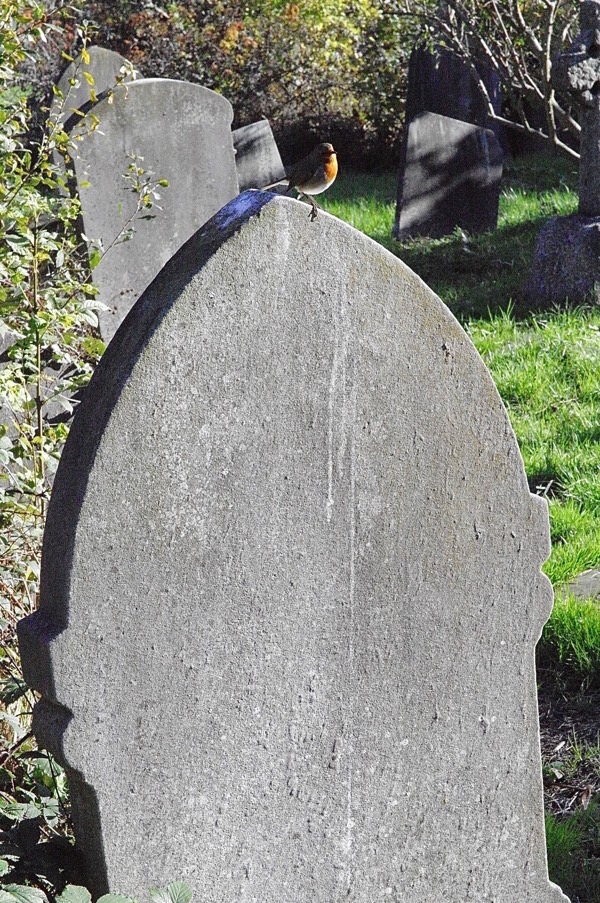
Although Hampstead Cemetery is less renowned than Highgate, I recommend a visit to this attractively unexpected enclave of peace in North London. While you are admiring Gaeatano Meo’s gravestone mosaic and contemplating the strangeness of the pre-Raphaelites you are likely to encounter a robin that presides in this vicinity – just as I did when I made my pilgrimage.

Gaetano Meo featured as a model in Edward Burne-Jones’ Love Among the Ruins, 1870-3 (reproduced courtesy of Tate Gallery)

Gaetano Meo featured as the model for Dante in Dante Gabriel Rossetti’s painting Dante’s Dream, 1869-71 (reproduced courtesy of Walker Art Gallery)

Gaetano featured as the model for Dante in Henry Holiday’s Dante & Beatrice, 1882-4 (reproduced courtesy of Walker Art Gallery)

Gaetano Meo featured as the model for Anchises in Venus & Anchises by Sir William Blake Richmond, 1890 (reproduced courtesy of Walker Art Gallery)

Gaetano Meo is believed to the model on the right in Simeon Solomon’s The Sleepers and the One who Watcheth, 1870 (reproduced courtesy of Birmingham Museums & Art Gallery)

Gaetano Meo’s The Madonna & Child mosaic created as tribute to his wife Agnes on her death in 1921

Gaetano Meo in Venice in his later years

Gaetano Meo’s robin at Hampstead Cemetery
You may also like to take a look at