
The Pellicci Museum

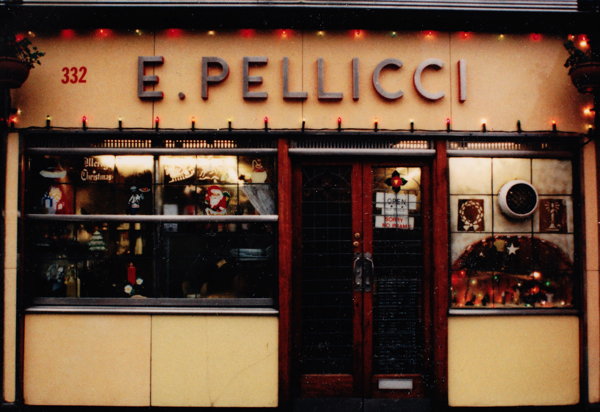
This is Lucinda Rogers‘ drawing of E.Pellicci in the Bethnal Green Rd, London’s most celebrated family-run cafe, into the third generation now and in business for over a century – and continuing to welcome East Enders who have been coming for generations to sit in the cosy marquetry-lined interior and enjoy the honest, keenly-priced meals prepared every day from fresh ingredients.
E.Pellicci is a marvel. It is so beautiful it is listed, the food is always exemplary and I every time I come here I leave heartened to have met someone new.
I found Lucinda Rogers’ drawing on the wall in one of the small upper rooms that now serves as an informal museum of the history of the cafe, curated by Maria Pellicci’s nephew – Toni, a bright-eyed Neapolitan, who has been working here since he left school in Lucca in Tuscany and came to London in 1970. He led me up the narrow staircase, opened the door of the low-ceilinged room and with a single shy gesture of his arm indicated the family museum. Toni has lined the walls with press cuttings, photographs and all kinds of memorabilia, which tell the story of the ascendancy of Pellicci’s, attended by a few statues of saints to give the pleasing aura of a shrine to this cherished collection.
Primo Pellici began working in the cafe in 1900 and it was here in these two rooms that his wife Elide brought up his seven children single-handedly, whilst running the cafe below to keep the family after her husband’s death in 1931. Elide is the E.Pellicci whose initial is still emblazoned in chrome upon the primrose-hued vitroglass fascia and her portrait remains, she and her husband counterbalance each other eternally on either side of the serving hatch in the cafe. In 1921, Nevio senior was born in the front room here. He ran the cafe until his death in 2008, superceded as head of the family business today by his wife Maria who possesses a natural authority and charisma that makes her a worthy successor to Elide.
As I sat alone in the quiet of the room, leafing through the albums, surrounded by the walls of press coverage, Maria came upstairs from the kitchen to join me. She pointed out the flat roof at the rear where her former husband Nevio played as a child. “He was very happy here,” she assured me with a tender smile, standing silently and casting her eyes between the two empty rooms – sensing the emotional presence of the crowded family life that once filled in this space that is now a modest store room and an office. Maria and Nevio brought up their children in a terraced house around the corner in Derbyshire St, and these days Toni goes round each morning early to pick her up from there, before they start work around six at the cafe she runs with her son Nevio and daughter Anna.
Pellicci’s collection tells a very particular history of the twentieth century and beyond – of immigration, of wars, of coronations and gangsters too. But, more than this, it is a history of wonderful meals, a history of very hard work, a history of great family pride, and a history of happiness and love.

Primo Pellicci still presides upon the cafe where he started work in 1900

Primo’s children, Nevio and Mary Pellicci, 1930

Pellicci’s wartime licence issued to Elide Pellicci in 1939 by the Ministry of Food

Pellicci’s paper bag issued to celebrate the Coronation of Elizabeth II in 1953 – note the phone number, Bishopsgate 1542

Mary and Maria Pellicci, Trafalgar Sq, 1963


Nevio junior, aged seven, skylarking outside the house in Derbyshire St with pals Claudio and Alfie

Nevio senior and Toni, 1980

Pellicci’s customers in 1980

Nevio senior, 1980

Nevio and Toni


Christmas card from Charlie Kray, 1980

Nevio junior and Nevio senior

George Flay’s montage of the world of Pellicci’s

Nevio Senior, 2005


Salvatore Zaccaria, known as Toni, curator of the Pellicci Museum
You may also enjoy reading
Thomas Barnes, Photographer
The most prolific nineteenth century East End photographer was Thomas Barnes, responsible for producing over one hundred thousand portraits taken between 1858 and 1885 at his studio at 422 Mile End Rd in Bow.
Although these cartes de visite are nameless, Barnes numbered most of his pictures – enabling us to create a sequence and establish an indication of their dates, as demonstrated by these fine examples selected from Philip Mernick‘s collection gathered over the past twenty years.
Remembered today primarily for his widely-discredited before-and-after photos commissioned by Dr Barnardo, nevertheless Thomas Barnes’ studio portraits reveal a photographer of abundant talent and accomplishment. It is a poignant gallery of withheld emotion, bringing us face to face with anonymous long-dead East Enders who are now inhabitants of Tower Hamlets Cemetery Park.

Number 4178 – taken between 1858 & 1864

Unnumbered

Number 21236 – 1867

Number 33999 – taken around 1870

Number 34101 – taken around 1870

Number 37432 – taken after 1873

Unnumbered

Number 38774 – taken after 1873

Number 41536 – taken mid-1870s

Unnumbered

Number 43979 – taken mid-1870s

Number 44425 – taken prior to 1877

Number 47385 – taken prior to 1877

Number 53458 – 1877
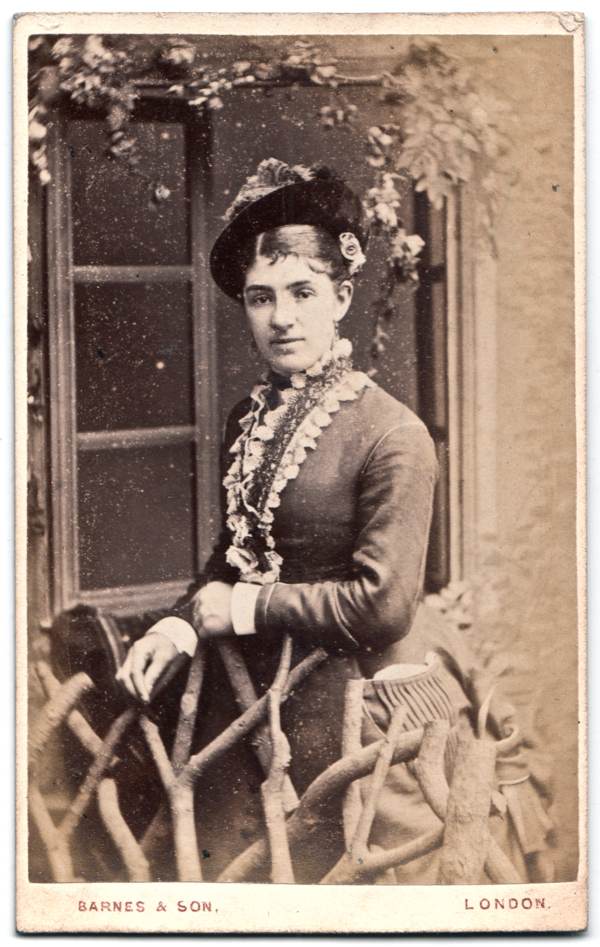
Number 56157 – 1877

Unnumbered

Number 57248 – 1877

Number 65460 – taken between 1877 and 1880

Number 75384 – taken after 1880

Photographs reproduced courtesy of Philip Mernick
Biographical details of Thomas Barnes supplied by David Webb
You may also like to take a look at
Benjamin Kipling, Bell Tuner
Today I introduce Benjamin Kipling, former Bell Tuner at the Whitechapel Bell Foundry

Benjamin Kipling
One Sunday morning, I joined Benjamin Kipling and his bellringing pals for a congenial breakfast in Waterloo Station after they had rung the bells before the service at St John’s church across the road. Once we had finished our chat, I accompanied Benjamin who could not resist returning to Francis Octavius Bedford’s handsome bell tower of 1822 to ring again after the service. Working now in Somerset from Monday to Friday, Benjamin commutes back and forth by car each weekend to fulfil his bellringing commitments in the capital. Even when we shook hands to say goodbye and he climbed into his sports car, Benjamin was setting off to judge a ringing contest in Cranford as a detour on his journey to the West Country – such is the passion of the man for bells.
The Gentle Author – How should a bell sound?
Benjamin Kipling – A nice bell should have a crisp, clear strike note, followed by the hum coming through underneath, and the hum should be stable and long-lasting.
The Gentle Author – What does the job of a bell tuner consist of?
Benjamin Kipling – Well, the basics involve mounting the bell, mouth upwards, on a very big vertical lathe and taking metal out of different areas inside to alter the partial tones within the mouth. A bell does not just produce a single frequency, a bell has lots and lots of different modes of vibration, and each mode of vibration produces a different frequency and therefore a different note. The standard for bell tuning for the last century has been to aim towards what we refer to as Simpson tuning, so the five lowest notes in the bell strike a minor chord.
The Gentle Author – Why cannot a bell be cast to make the right sound?
Benjamin Kipling – The thickness of the wall of a bell has to be precise to get exactly the right note and – to be perfectly honest – casting techniques just are not that good, they never have been. So to get a bell absolutely precise, the only way is to cast it deliberately too thick and scratch a bit off.
The Gentle Author – Once a bell has been cast, are you the next person to work on it?
Benjamin Kipling – The people in the loam shop dig the newly cast bell out from the mould, removing the core of bricks and loam, and doing a little bit of tidying up on the inscription. Then the bell is passed to me and I do a bit more work to the inscription just to make it looks as nice as possible. I start by putting the bell mouth down on the lathe and skimming across it to give a flat surface on the top before I turn the bell over, bolt it to the machine, and tune it.
The Gentle Author – How do you assess a bell in order to tune it?
Benjamin Kipling – This has been one of the limiting factors in the development of bell tuning. It was only in late Victorian times with the advent of the calibrated tuning fork that it became possible to accurately record the frequencies within a bell. Calibrated tuning forks were the normal way of doing things up until the nineteen seventies and Whitechapel’s tuning forks were still in use until the end – we used them sometimes to double check.
Today, we have other ways of doing it. An electronic stroboscope tuner employs a microphone attached to a light which shines through a spinning wheel, and you can adjust the speed so that if there is a frequency in the sound that corresponds to the spinning wheel, it will appear to stand still. This is the method I use for finishing tuning bells because it is reliably accurate, but there is also a quicker – if slightly less accurate way – of pitching bells using a laptop computer and Fourier Transform software which instantly reads the main partial tones.
The Gentle Author – So it is a question of striking the bell and then bridging the difference between what it is and what you want it to sound like, do you expect to get there immediately or is it a long process?
Benjamin Kipling – Bell tuning is a job of many stages. Calculating what I am aiming for in a particular bell gives me the size of the gap. Usually, I try and make a series of cuts that will get me halfway between where I was and where I need to be, so I can check the bell is responding as I expect it to. Then I will go half as far again, and half as far again, and gradually close in, which theoretically means I never get there. Yet, in practice, this is engineering not mathematics and if I overshoot by a fraction of a semitone then nobody is going to notice. I try and tune a bell to within a cent, which is 1/100 of a semitone, but nobody is going to hear if it is two or three cents out.
The Gentle Author – Are there different kinds of cuts you make to a bell?
Benjamin Kipling – Only in terms of shallow cuts or deep cuts, but they are in different areas of the bell. For instance, if you cut metal out of the shoulder of the bell, the second partial tone flattens more quickly. In the middle of the bell, it is the hum note, the lowest one, that flattens the most quickly. Towards the lip, it is the nominal tone which flattens most quickly. Generally, wherever you take metal off a bell all of the partial tones will move – so it is a juggling act.
The Gentle Author – What is the minimum number of cuts?
Benjamin Kipling – One! But if you are tuning a bell and you are getting very close, you might make one little scratch and test it again, and make another scratch and test it again – it could take dozens.
The Gentle Author – Do you rely upon your ears or instruments?
Benjamin Kipling – The ear is always the final arbiter as to whether a bell sounds good or not. The instruments are there to tell me what is wrong and by how much. I can hear if something is wrong with a bell but I may not necessarily be able to tell exactly what is wrong or by how much, and that is where the instrumentation comes in.
The Gentle Author – Tell me some bells that you are proud to have tuned.
Benjamin Kipling – Absolutely. The five largest at St James Garlickhythe and also all ten of the new bells at St Dunstan-in-the-West on Fleet Street. The tenor bell there is the only bell where I have ever managed to get it to exactly where I want within a fraction of a 100th of a semitone. On paper, that is the best bell I have ever cut. In practice, bigger bells always sound better than little bells. They have more presence and more power, and so the best of all would probably be the largest bell I have tuned, which was for a carillon in the United States. It was cast at 43 hundredweight – a little over two tonnes – and finished at 37 hundredweight, after I tuned six hundredweight out of it. You could hit the bell, walk away, come back a couple of minutes later and still hear it humming.
The Gentle Author – Is there an element of subjectivity in this work?
Benjamin Kipling – There is more than one way to skin a cat. You get differences in character of bells and that can be down to how the tuner approaches the bell. Also, the shape of a bell varies according to who cast it. There are subtle differences between the profile of a Whitechapel Bell, the profile of a Taylor bell or a Gillett & Johnson bell.
The Gentle Author – How did you become a bell tuner?
Benjamin Kipling – At school, I did not like music very much which was maybe because I did not want to learn to play an instrument. I had an interest in music theory, but the teachers did not think it was worthwhile teaching me music theory if I was not going to be learning an instrument. So I dropped music at the earliest opportunity.
Then, in sixth form, a friend of mine who was a bell ringer said, ‘Why don’t you come along on Wednesday night and learn to ring bells?’ So I did and I found it very addictive, and bell ringing became my hobby and I did a lot of bell ringing at university. I studied Physics, then I dropped out and started Computer Science, until I dropped out of that as well. I spent quite a long time at Nottingham University without getting a degree. Possibly, that was because I was spending too much of my time ringing bells rather than getting any work done.
The Gentle Author – Yet you have managed to fit all those things together in your career, how did you enter the industry of bell making?
Benjamin Kipling – There was a bell hanging company in Nottingham at the time, Hayward Mills. I got a holiday job with them and stayed for a couple of years. However, I discovered I was not keen on site work but I did like the theory behind the tuning of bells and, although Hayward Mills did not have a bell tuning machine, they were considering getting one. So when I dropped out from university, they took me on full time, doing admin and occasional bell hanging, with a view to me being the one who would do the tuning when they got a bell tuning machine which – a couple of years later – they did.
The Gentle Author – Are you a self-taught bell tuner?
Benjamin Kipling – Partly. I found some tuning graphs on the internet showing how the different partial tones respond according to where you take metal off a bell. But I had to teach myself how to drive the machine and how much metal to take off, which obviously is nerve-wracking and involves taking off tiny amounts to begin with and checking. Then you find the sound of the bell has hardly changed and so you take off a bit more, until you realise you actually have to take quite a bit of metal off to make any significant difference.
The Gentle Author – Did you ever take too much off?
Benjamin Kipling – The simple answer is ‘No.’ If you are gradually homing in on what you want, that should not be a problem. In practice, with four of the five partial tones, it is possible to go back up again if necessary. Generally, you are thinning the wall of the bell and making it more flexible so it vibrates at a lower frequency. Each time you take a little off, the notes go down. However, by taking more metal off the lip of the bell, it is possible to get four of those five to come back up. So there are usually ways of sorting these things out.
The Gentle Author – Do you find this rewarding work?
Benjamin Kipling – Oh absolutely, it is a lasting legacy. Hopefully my handiwork will be there for centuries because bells do not go out of tune. A lot of old bells were never in tune to begin with, they would just try and cast a bell as close as they could to the right note and, if it was a long way out, they would take out a hammer and chisel and try and chip bits off until it was bearable. That is the reason why old bells are retuned.
The Gentle Author – Is retuning a major part of your work?
Benjamin Kipling – Oh yes. At Whitechapel, probably half of the bells I tuned were old ones that came in for retuning.
The Gentle Author – How is that different?
Benjamin Kipling – The difference is that, whereas a new bell has been cast with enough metal in the right places to be able to do what you want, in an old bell the chances are there may not be enough metal in the places you need. You just have to try and push it in the right direction as much as you can. In the last few years, we tended to do more tuning of old bells on the outsides as well as on the insides and I found you can get much better results by doing that.
The Gentle Author – What are the oldest bells you have retuned?
Benjamin Kipling – Bells over a certain age tend to be listed for preservation.
The Gentle Author – They cannot be retuned?
Benjamin Kipling – It means there is a presumption against tuning, but different dioceses have a different interpretation of what that means. In some dioceses, you will never get permission to tune a listed bell, while in other dioceses – as long as you put a sensible case forward – they have no problem with you retuning anything of any age. The diocese that I have found which is most likely to give permission for tuning old bells is Bath & Wells. There were some bells in Bath & Wells diocese from the fourteenth, if not the thirteenth century, that I have tuned. The profile of bells and the composition of the bell metal has changed remarkably little in all those years.
The Gentle Author – Does bell tuning make you happy?
Benjamin Kipling – Absolutely, when people ask me what my job is, I like to see the expressions on their faces, ranging from disbelief that there could be such a job to complete fascination.
The Gentle Author – Tell me about the Royal Jubilee bells.
Benjamin Kipling – These were cast for St James Garlickhythe but first they were installed in a barge to go down the Thames as part of the Royal Jubilee pageant in 2012.
The Gentle Author – Where were you on that day?
Benjamin Kipling – I was close to St James Garlickhythe, struggling to get to the water’s edge to catch a view of them going past from the bank of the Thames, along with umpteen thousand other people, but the crowds were so deep that I missed them. The framework was fabricated at an engineering company in Edenbridge, so I did hear them and got to ring them on the frame in the works even if I never got to hear them on the river or see them in the barge. The sound of bells tends to bounce off water in a pleasing way. Certainly, I know the bells at St Magnus the Martyr at the northern end of London Bridge sound at their best if you stand just the other side of the river and I think the same is probably true of the Southwark Cathedral bells if you stand on the north bank. People told me my bells did sound very nice on the river.
Transcript by Rachel Blaylock


You can help save the Whitechapel Bell Foundry as a living foundry by submitting an objection to the boutique hotel proposal to Tower Hamlets council. Please take a moment this weekend to write your letter of objection. The more objections we can lodge the better, so please spread the word to your family and friends.
HOW TO OBJECT EFFECTIVELY
Use your own words and add your own personal reasons for opposing the development. Any letters which simply duplicate the same wording will count only as one objection.
1. Quote the application reference: PA/19/00008/A1
2. Give your full name and postal address. You do not need to be a resident of Tower Hamlets or of the United Kingdom to register a comment but unless you give your postal address your objection will be discounted.
3. Be sure to state clearly that you are OBJECTING to Raycliff Capital’s application.
4. Point out the ‘OPTIMUM VIABLE USE’ for the Whitechapel Bell Foundry is as a foundry not a boutique hotel.
5. Emphasise that you want it to continue as a foundry and there is a viable proposal to deliver this.
6. Request the council refuse Raycliff Capital’s application for change of use from foundry to hotel.
WHERE TO SEND YOUR OBJECTION
You can write an email to
planningandbuilding@towerhamlets.gov.uk
or
you can post your objection direct on the website by following this link to Planning and entering the application reference PA/19/00008/A1
or
you can send a letter to
Town Planning, Town Hall, Mulberry Place, 5 Clove Crescent, London, E14 2BG

You may also like to read about
Nigel Taylor, Tower Bell Manager
Hope for The Whitechapel Bell Foundry
A Petition to Save the Bell Foundry
Save the Whitechapel Bell Foundry
So Long, Whitechapel Bell Foundry
In Search Of Doreen Fletcher’s East End
Photographer Alex Pink accompanied Doreen Fletcher on a pilgrimage to visit the locations of many of her paintings and he photographed what they discovered …
Fiona Atkins, gallerist at Townhouse Spitalfields is giving a lecture about Doreen Fletcher’s painting at the Nunnery Gallery in Bow this Wednesday 20th February as part of Doreen Fletcher’s Retrospective exhibition which runs until 24th March. Click here to book

Benjy’s Mile End, 1992


Mile End church seen from the park, 1986


The Albion Pub, 1992


Snow in Mile End Park, 1986


Park with train, 1990


Limehouse library, 1986


Terrace in Commercial Rd under snow, 2003


Brickfields Gardens, 1986


Grand Union Canal, 1983


Hairdresser, Ben Jonson Rd 2001


Rene’s Cafe, 1986


Bus Stop, Mile End, 1983


The Condemned House, 1983


Caird & Rayner Building, Commercial Rd, 2001


CLICK HERE TO ORDER A SIGNED COPY OF DOREEN FLETCHER’S BOOK FOR £20

Spring Flowers At Bow Cemetery

When yesterday’s unseasonably warm sunshine brought temperatures of fourteen degrees to the East End and the promise of an early Spring, I decided to return to Bow Cemetery to see if the bulbs were showing yet. Already I have some Snowdrops, Hellebores and a few Primroses in flower in my Spitalfields garden, but at Bow I was welcomed by thousands of Crocuses of every colour and variety spangling the graveyard with their gleaming flowers. Beaten and bowed, grey-faced and sneezing, coughing and shivering, the harsh Winter has taken it out of me, but feeling the warmth of the sun today and seeing these sprouting bulbs in such profusion restored my hope that benign weather will come before too long.
Some of my earliest crayon drawings are of snowdrops, and the annual miracle of Spring bulbs erupting out of the barren earth never ceases to touch my heart – an emotionalism amplified in a cemetery to see life spring abundant and graceful in the landscape of death. The numberless dead of East London – the poor buried for the most part in unmarked communal graves – are coming back to us as perfect tiny flowers of white, purple and yellow, and the sober background of grey tombs and stones serves to emphasis the curious delicate life of these vibrant blooms, glowing in the sunshine.
Here within the shelter of the old walls, the Spring bulbs are further ahead than elsewhere the East End and I arrived at Bow Cemetery just as the Snowdrops were coming to an end, the Crocuses were in full flower and the Daffodils were beginning. Thus a sequence of flowers is set in motion, with bulbs continuing through until April when the Bluebells will come leading us through to the acceleration of Summer growth, blanketing the cemetery in lush foliage again.
As before, I found myself alone in the vast cemetery save a few Magpies, Crows and some errant Squirrels, chasing each other around. Walking further into the woodland, I found yellow Winter Aconites gleaming bright against the grey tombstones and, crouching down, I discovered wild Violets in flower too. Beneath an intense blue sky, to the chorus of birdsong echoing among the trees, Spring was making a persuasive showing.
Stepping into a clearing, I came upon a Red Admiral butterfly basking upon a broken tombstone, as if to draw my attention to the text upon it, “Sadly Missed,” commenting upon this precious day of sunshine. Butterflies are rare in the city in any season, but to see a Red Admiral, which is a sight of high Summer, in February is extraordinary. My first assumption was that I was witnessing the single day in the tenuous life of this vulnerable creature, but in fact the hardy Red Admiral is one of the last to be seen before the onset of frost and can emerge from months of hibernation to enjoy single days of sunlight. Such is the solemn poetry of a lone butterfly in Winter.
It may be over a month yet before it is officially Spring, but we are at the beginning now, and I offer you my pictures as evidence, should you require inducement to believe it.

The Spring bulbs are awakening from their Winter sleep.

Snowdrops.


Crocuses


Dwarf Iris


Winter Aconites


Daffodils will be in flower next week.


A single Red Admiral butterfly, out of season in mid-February – “sadly missed”
You may also like to read about
Viscountess Boudica’s Valentines Day
On Valentine’s Day, I cannot help thinking back to the days when we had Viscountess Boudica of Bethnal Green to make the East End a more colourful place, before she was ‘socially cleansed’ to Uttoxeter

Viscountess Boudica of Bethnal Green confessed to me that she never received a Valentine in her entire life and yet, in spite of this unfortunate example of the random injustice of existence, her faith in the future remained undiminished.
Taking a break from her busy filming schedule, the Viscountess granted me a brief audience to reveal her intimate thoughts upon the most romantic day of the year and permit me to take these rare photographs that reveal a candid glimpse into the private life of one of the East End’s most fascinating characters.
For the first time since 1986, Viscountess Boudica dug out her Valentine paraphernalia of paper hearts, banners, fairylights, candles and other pink stuff to put on this show as an encouragement to the readers of Spitalfields Life. “If there’s someone that you like,” she says, “I want you to send them a card to show them that you care.”
Yet behind the brave public face, lay a personal tale of sadness for the Viscountess. “I think Valentine’s Day is a good idea, but it’s a kind of death when you walk around the town and see the guys with their bunches of flowers, choosing their chocolates and cards, and you think, ‘It should have been me!'” she admitted with a frown, “I used to get this funny feeling inside, that feeling when you want to get hold of someone and give them a cuddle.”
Like those love-lorn troubadours of yore, Viscountess Boudica mined her unrequited loves as a source of inspiration for her creativity, writing stories, drawing pictures and – most importantly – designing her remarkable outfits that record the progress of her amours. “There is a tinge of sadness after all these years,” she revealed to me, surveying her Valentine’s Day decorations,” but I am inspired to believe there is still hope of domestic happiness.”


Take a look at
The Departure of Viscountess Boudica
Viscountess Boudica’s Domestic Appliances
The Door In Cornhill

The Bronte sisters visit their publisher in Cornhill, 1848
An ancient thoroughfare with a mythic past, Cornhill takes its name from one of the three former hills of the City of London – an incline barely perceptible today after centuries of human activity upon this site, building and razing, rearranging the land. This is a place does not declare its multilayered history – even though the Roman forum was here and the earliest site of Christian worship in England was here too, dating from 179 AD, and also the first coffee house was opened here by Pasqua Rosee in 1652, the Turk who introduced coffee to London. Yet a pair of carved mahogany doors, designed by the sculptor Walter Gilbert in 1939 at 32 Cornhill – opposite the old pump – bring episodes from this rich past alive in eight graceful tableaux.
Walter Gilbert (1871-1946) was a designer and craftsman who developed his visual style in the Arts & Crafts movement at the end of the nineteenth century and then applied it to a wide range of architectural commissions in the twentieth century, including the gates of Buckingham Palace, sculpture for the facade of Selfridges and some distinctive war memorials. In this instance, he modelled the reliefs in clay which were then translated into wood carvings by B.P Arnold at H. H. Martyn & Co Ltd of Cheltenham.
Gilbert’s elegant reliefs appeal to me for the laconic humour that observes the cool autocracy of King Lucius and the sullen obedience of his architects, and for the sense of human detail that emphasises W. M. Thackeray’s curls at his collar in the meeting with Anne and Charlotte Bronte at the offices of their publisher Smith, Elder & Co. In each instance, history is given depth by an awareness of social politics and the selection of telling detail. These eight panels take us on a journey from the early medieval world of omnipotent monarchy and religious penance through the days of exploitative clergy exerting controls on the people, to the rise of the tradesman and merchants who created the City we know today.

“St Peter’s Cornhill founded by King Lucius 179 AD to be an Archbishop’s see and chief church of his kingdom and so it endured for the space of four hundred years until the coming of Augustine the monk of Canterbury.”

“Eleanor, Duchess of Gloucester, did penance walking barefoot to St Michael’s Church from Queen Hithe, 1441.”

“Cornhill was an ancient soke of the Bishop of London who had the Seigneurial oven in which all tenants were obliged to bake their bread and pay furnage or baking dues.”

“Cornhill is the only market allowed to be held afternoon in the fourteenth century.”

“Birchin Lane, Cornhill, place of considerable trade for men’s apparel, 1604.”

“Garraway’s Coffee House, a place of great commercial transaction and frequented by people of quality.”

“Pope’s Head Tavern in existence in 1750 belonging to Merchant Taylor’s Company, the Vinters were prominent in the life of Cornhill Ward.”

You might also like to read about


