David O’Mara’s Spitalfields
I have published many pictures of renovations of old houses in Spitalfields but David O’Mara‘s candid photography reveals the other side of these stories, recording the back-breaking labour and human toil that is expended upon these endeavours

“For the past ten years I have worked as a painter & decorator in London, both as a means of surviving and also funding my artistic practice – but the roles of artist & decorator are not always easily reconciled, time demands and budgets often lead to a conflict of interests.
My work is described as ‘restoration,’ though I began to question the truth of this description. From the beginning, you strip back the layers of previous occupants. Cupboards, doors and walls that were later additions are all removed. At every turn and removal you notice the evidence of previous lives, all to be erased and replaced with freshly painted blank surfaces – everything is pared back to the tabula rasa.
This has a resonance with my own experience: the daily repetition of tasks erodes memory, time is distilled into but a few recollections. I started photographing my working life as a way of recording the disappearing history of the houses and also to combat the erosion of memory through the repetition of work.” – David O’Mara


Photographs copyright © David O’Mara
You may also like to read about
Inside The Model Of St Paul’s

Simon Carter, Keeper of Collections at St Paul’s
In a hidden chamber within the roof of St Paul’s sits Christopher Wren’s 1:25 model of the cathedral, looking for all the world like the largest jelly mould you ever saw. When Charles II examined it in the Chapter House of old St Paul’s, he was so captivated by Wren’s imagination as manifest in this visionary prototype that he awarded him the job of constructing the new cathedral.
More than three hundred years later, Wren’s model still works its magic upon the spectator, as I discovered last week when I was granted the rare privilege of climbing inside to glimpse the view that held the King spellbound. While there is an austere splendour to the exterior of the model, I discovered the interior contains a heart-stopping visual device which was surely the coup that persuaded Charles II of Wren’s genius.
Yet when I entered the chamber in the triforium at St Paul’s to view the vast wooden model, I had no idea of the surprise that awaited me inside. Almost all the paint has gone from the exterior now, giving the dark wooden model the look of an absurdly-outsized piece of furniture but, originally, it was stone-coloured with a grey roof to represent the lead.
At once, you are aware of significant differences between this prototype and the cathedral that Wren built. To put it bluntly, the model looks like a dog’s dinner of pieces of Roman architecture, with a vast portico stuck on the front of the dome of St Peter’s in the manner of those neo-Georgian porches on Barratt Houses. Imagine a fervent hobbyist chopping up models of relics of classical antiquity and rearranging them, and this is the result. It is unlikely that this design would even have stood up if it had been built, so fanciful is the conception. Yet the long process of designing a viable structure, once he had been given instruction by Charles II, permitted Wren to reconcile all the architectural elements into the satisfying whole that we know today.
I had been tempted to visit the cathedral by an invitation to go inside the model but – studying it – I could not imagine how that could be possible. I could not see a way in. ‘Perhaps one end has hinges and Charles II crawled in on his hands and knees like a child entering a Wendy House?,’ I was thinking, when Simon Carter, Keeper of Collections opened a door in the plinth and disappeared inside, gesturing me to follow. In blind faith, I dipped my head and walked inside.
When I stood up, I was beneath the dome with the floor of the cathedral at my chest height. There was just room for two people to stand together and I imagined the unexpected moment of intimacy between the Monarch and his architect, yet I believe Wren was quietly confident because he had a trick up his sleeve. From the inside, the drama of the architecture is palpable, with intersecting spaces leading off in different directions, and – as your eyes accustom to the gloom – you grow aware of the myriad refractions of light within this intricately-imagined interior.
Just as Wren directed Charles II, Simon Carter told me to walk to the far end of the model and sit on the bench placed there to bring my eye level down to the point of view of someone entering through the great west door. Then Simon left me there inside, just as I believe Wren left Charles II within the model, to appreciate the full effect.
I have no doubt the King was thrilled by this immersive experience, which quickly takes on a convincing reality of its own once you are alone. Charles II discovered himself confronted by a glorious vision of the future in which he was responsible for the first and greatest classically-designed church in this country, with the largest dome ever built. Such is the nature of the consciousness-filling reverie induced by sitting inside the model that the outside world recedes entirely.
How astonishing, once you have accustomed to the scale of the model, when a giant face appears filling the east window. I could not resist a gasp of wonder when I saw it and neither – I suggest – could Charles II when Christopher Wren’s smiling face appeared, grinning at him from the opposite end of the nave, apparently enlarged to twenty-five times its human scale.
In these unforgettable circumstances, the King could not avoid the realisation that Wren was a colossus among architects and – unquestionably – the man for the job of building the new St Paul’s Cathedral. The model had worked its spell.

Behold, the largest jelly mould in the world!


The belfry that was never built


The single portico that was replaced by a two storey version


Just a few fragments of paintwork remain upon the exterior

Original paintwork can be seen inside the model

Charles II’s point of view from inside the model

‘How astonishing, once you have accustomed to the scale of the model, when a giant face appears filling the east window.’
Click here to book for a tour of the Triforium at St Paul’s Cathedral
Click here for events commemorating the 350th Anniversary of the Great Fire
You may like to read my other stories of St Paul’s
Kirby’s Eccentric Museum
I am very grateful to have met collector Mike Henbrey because among the wonders he introduced me to was Kirby’s Eccentric Museum

John Biggs was born in 1629 and lived in Denton in the county of Bucks in a cave

This wonderful boy, who in early age outstripped all former calculators, was born in Morton Hampstead on 14th June 1806

In Mme Lefort the sexes are so equally blended that it is impossible to say which has predominance

This gentleman was a bookseller in Upper Marylebone St, remembered today as Shelley’s bookseller

The parachute here represented was used by Monsieur Garnerin at his ascension in London


Thomas Cooke was born in 1726 at Clewer near Windsor as the son of an itinerant fiddler

Robert Coates Esq, commonly called ‘The Amateur of Fashion’


The giant Basilio Huaylas came in May 1792 from the town of Joa to Lima and publicly exhibited himself

Mr James Toller and Mr Simon Paap are presumed to be the tallest shortest men in the kingdom


Miss McAvoy, who distinguished colours by the touch, was born in Liverpool on 28th June 1800

Mr Hermans Bras, designated the gigantic Prussian Youth, was born at Tecklenbourg in 1801


Thomas Laugher, aged 111 years, and known by the name of Old Tommy

Petratsch Zortan in the 185th year of his age, he died on 5th January 1724

John Rovin in the 172nd & Sarah his wife in the 164th year of their respective ages

The turnip represented in the plate grew in 1628

The parsnip here represented grew in 1742

The radish here represented was found in 1557 in Haarlem

You may also like to take a look at
Mike Henbrey, Collector of Books, Epherema & Tools
Vinegar Valentines for Bad Tradesmen
So Long, Maurice Franklin
Only this week have I learnt the sad news of the death of Maurice Franklin, the wood turner, on 5th November last year aged ninety-eight. Over the years, Maurice’s story has proved to be one of the most popular that I have ever published on Spitalfields Life and I am proud to have to met him, a legend in wood turning. Last year, Maurice made newel posts for the staircase in my house and now I think of him every time I walk up and down stairs.

If you were to rise before dawn on Christmas Eve, and walk down the empty Hackney Rd past the dark shopfronts in the early morning, you would very likely see a mysterious glow emanating from the workshop at the rear of number forty-five where spindles for staircases are made. If you were to stop and press your face against the glass, peering further into the depths of the gloom, you would see a shower of wood chips flying magically into the air, illuminated by a single light, and falling like snow into the shadowy interior of the workshop where wood turner Maurice Franklin, who was born upstairs above the shop in 1920, has been working at his lathe since 1933 when he began his apprenticeship.
In the days when Maurice started out, Shoreditch was the centre of the furniture industry and every premises there was devoted to the trade. But it has all gone long ago – except for Maurice who has carried on regardless, working at his lathe. Now at ninety-one years old, being in semi-retirement, Maurice comes in a few days each week, driving down from North Finchley in the early hours to work from four or five, until eight or nine in the morning, whenever he fancies exercising his remarkable talent at wood turning.
Make no mistake, Maurice is a virtuoso. When rooms at Windsor Castle burnt out a few years ago, the Queen asked Maurice to make a new set of spindles for her staircase and invited him to tea to thank him for it too. “Did you grow up in the East End?” she enquired politely, and when Maurice nodded in modest confirmation of this, she extended her sympathy to him. “That must have been hard?” she responded with a empathetic smile, although with characteristic frankness Maurice disagreed. “I had a loving family,” he told her plainly, “That’s all you need for a happy childhood, you don’t need palaces for that.”
Ofer Moses who runs The Spindle Shop – in the former premises of Franklin & Sons – usually leaves a list for Maurice detailing the work that is required and when he returns next morning, he finds the completed wood turning awaiting him, every piece perfectly achieved. But by then Maurice will already be gone, vanished like a shade of the night. So, in order to snatch a conversation with such an elusive character, a certain strategy was necessary which required Ofer’s collaboration. Early one frosty morning recently, he waited outside the shop in his car until I arrived, and then, once we had checked that there was a light glimmering inside the shop, he unlocked the door and we went in together to discover the source of the illumination. Sure enough, the wood chips were flying, accompanied by the purr of the motor that powered the lathe, and hunched over it was a figure in a blue jacket and black cap, liberally scattered with chips and sawdust. This was Maurice.
Unaware of our presence, he continued with his all-engaging task, and we stood mesmerised by the sight of the master at work, recognising that we were just in time to catch him as he finished off the last spindles to complete a pristine set. And then, as he placed the final spindle on the stack, Maurice looked up in surprise to see us standing there and a transformation came upon him, as with a twirl he removed his overall and cap, sending a shower of wood chips fluttering. The wood turner that we saw hunched over the lathe a moment before was no more and Maurice stood at his full height with his arms outstretched, assuming a relaxed posture with easy grace, as he greeted us with a placid smile.
“This firm was the wood turning champion of Britain in 1928,” announced Maurice with a swagger. “Samuel, my father, had been apprenticed in Romania and was in the Romanian army for two years before he came here at the beginning of the twentieth century, and then he served in the British Army in the 14/18 war before he opened this place in 1920. He had been taught by the village wood worker in Romania, they made everything from cradles to coffins. All the boys used to sleep on a shelf under the bench then.”
Maurice told me he was one of a family of twelve – six boys and six girls – and he indicated the mark in the floor where the staircase once ascended to the quarters where they all lived. “I started when I was thirteen, I’ve still got my indenture papers” he informed me conscientiously, just in case I wanted to check the veracity of his claim, “I took to it from the start. It’s creative and at the end of the day you see what you’ve made. I’m proud of everything I do or I wouldn’t do it.”
In spite of his remarkable age, Maurice’s childhood world remains vivid to him. “Here in Shoreditch, ninety per cent were Jewish and the ones that weren’t were Jewish in their own way. Over in Hoxton, they’d take your tie off you when you arrived and sell it back to you when you left – but now you couldn’t afford to go there. In 1925, you could buy a house in Boundary St for £200, or you could put down a pound deposit and pay the rest off at three shillings a week. I was born here in 1920 and I went to Rochelle School – They won’t remember me.”
The only time Maurice left his lathe was to go and fight in World War II, when although he was offered war work making stretcher poles, he chose instead to enlist for Special Operations. Afterwards, Franklin & Sons expanded through acquiring the first automatic lathe from America, and opening a factory in Hackney Wick to mass-produce table legs. “Eventually we closed it up because everyone was getting older, except me.” quipped Maurice with a tinge of melancholy, as the last of his generation now, carrying the stories of a world known directly only to a dwindling few.
Yet Maurice still enjoys a busy social calendar, giving frequent lectures about classical music – the other passion in his life. “I especially like Verdi, Puccini and Rossini,” he declared, twinkling with bright-eyed enthusiasm, because having made chairs for the Royal Opera House he is a frequent visitor there. “I like all music except Wagner. You’ll never hear me listening to Wagner, because he was Hitler’s favourite composer.” he added, changing tone and catching my eye to make a point. A comment which led me to enquire if Maurice had ever gone back to Romania in search of his roots. “I’ve got no family there, they were all wiped out in the war. My father brought his close relatives over, but those that stayed ended up in Auschwitz.” he confided to me, with a sombre grimace, “Now you know why I wanted to go to war.”
And then, after we had shared a contemplative silence, Maurice’s energy lifted again, pursuing a different thought, “I remember the great yo-yo craze of the nineteen thirties,” he said, his eyes meeting mine in excitement, “We worked twenty-four hours a day.”
“What’s the secret?” I asked Maurice, curious of his astonishing vitality, and causing him to break into a smile of wonderment at my question. “All you’ve got to do is keep on living, and then you can do it. It isn’t very difficult.” he said, spreading his arms demonstratively and shaking his head in disbelief at my obtuseness. “Are you happy?” I queried, provocative in my eagerness to seize this opportunity of learning something about being a nonagenarian. “I’ll tell you why I am happy,” said Maurice, with a grin of unqualified delight and raising one hand to count off his blessings, “I’ve got a wonderful family and wonderful children. I’ve been successful and I’ve got an appetite for life, and I’ve eaten every day and slept every night.” Maurice was on a roll now. “I was going to write a book once,” he continued, “but there’s no time in this life. By the time you know how to live, it’s over. This life is like a dress rehearsal, you just make it up as you go along. One life is not enough, everyone should live twice.”
There was only one obvious question left to ask Maurice Franklin, so I asked it, and his response was automatic and immediate, with absolute certainty. “Yes, I’d be a wood turner again.” he said.


“I wake up every day and I stretch out my arms and if I don’t feel any wood on either side, then I know I can get up.”


Maurice’s handiwork.

Ofer Moses, proprietor of the The Spindle Shop

Maurice’s service book from World War II.

Maurice as a young soldier, 1941


Maurice as a child in the nineteen twenties, in the pose he adopts leaning against his lathe today.

The figure on the left is Maurice’s father Samuel in the Romanian army in the eighteen nineties.

Samuel Franklin as proprietor of Franklin & Sons, Shoreditch.

Maurice Franklin
Photographs copyright © Patricia Niven
You may also like to read about Hugh Wedderburn, Master Woodcarver
The Lost World Of The Alleys

You only walk in the alleys if you have a strong stomach and stout shoes, if you are willing to ignore the stink and the sinister puddles for the sake of striking out alone from the throng of humanity coursing along Bishopsgate.
This whole place was once characterised by the warren of alleys and yards which laced the streets. And, when the fancy takes me to enter those that remain, it is in thrall to the delusion that maybe I can find a way back through the labyrinth to old Spitalfields. There is part of my mind that wonders if I will ever find my way out again and another part of me that yearns for this outcome, longing to find an alley that is a portal to a parallel world.
Of the alleys that tempt the innocent pedestrian emerging from Liverpool St Station, only Catherine Wheel Alley actually leads anywhere, delivering you by means of a dog-leg to Middlesex St. Stepping beneath the arched entrance and passing under the low ceiling above, you emerge behind the buildings which line the street to discover yourself at the bottom of a well where sunlight descends, bouncing off the ceramic bricks lining the walls. You walk dead straight in the blind faith that a route lies ahead and enter a tiny yard, where you may surprise a guilty smoker enjoying an illicit cigarette.
“Can I get through?” asked a lone woman I encountered, approaching from the opposite direction with a disarming lack of wariness. I stood against the wall in the yard here to consider the confluence of buildings that intersect in elaborate ways overhead and, to my surprise, a door opened in the wall behind me and an Eastern European woman asked me to step aside as she hauled out two sack of rubbish before disappearing again. From this yard, a narrow street leads uneventfully to Middlesex St – the drama of the alley diminished once the destination is apparent.
Perhaps most people avoid these empty alleys for fear of what they might discover? Individuals engaged in lewd activity, or relieving bodily functions, or injecting pharmaceuticals, or threatening violence, or robbery, or worse? Yet every corner of every alley has a film camera gazing down, removing the possibility of any truly clandestine activity.
The lack of space in these passages demands that people acknowledge each other and the code of mutual disregard which prevails in the street cannot hold. This is the true magnetism of alleys, as escape routes from the hegemony of the crowd. The spatial disorientation, leaving street sounds behind you, as you enter an ambiguous architectural maze is a welcome respite. You can turn in the alley and look back to the people on the pavement, and you discover you have become invisible – they no longer see you.


You may also like to read about
At The Angel, Rotherhithe
I am delighted to publish this extract of a post from A London Inheritance, written by a graduate of my blog writing course. The author inherited a series of old photographs of London from his father and by tracing them, he discovers the changes in the city over a generation. Follow A LONDON INHERITANCE, A Private History of a Public City
I am now taking bookings for the next course, HOW TO WRITE A BLOG THAT PEOPLE WILL WANT TO READ on February 2nd & 3rd. Come to Spitalfields and spend a weekend with me in an eighteenth century weaver’s house in Fournier St, enjoy delicious lunches from Leila’s Cafe, eat cakes baked to historic recipes by Townhouse and learn how to write your own blog. Click here for details
If you are graduate of my course and you would like me to feature your blog, please drop me a line.

My father’s photograph from 1951

There are many good reasons for a walk along the River Thames from Tower Bridge to Rotherhithe – views over the river, ancient streets, historic architecture and a number of excellent pubs.
My father took the top photo of the pub from the foreshore of the river in 1951. I have been meaning to take the same view for a couple of years, but my previous visits have either been when the tide has not been low enough or the building was covered in scaffolding.
I was lucky on my recent visit. The tide was low, the building work over and after some early morning rain, the weather was improving. Despite sixty-seven years between the two photos, the pub looks much the same – just cosmetic changes and some woodwork replaced, I suspect.
There is access to the foreshore via stairs just to the right of the pub, these are the Rotherhithe Stairs. A short distance to the east are another set, these are the modern replacement for the King’s Stairs. The King’s Stairs and Rotherhithe Stairs are both shown on the 1746 Rocque Map of London, with Rotherhithe Stairs were recorded as Redriff Stairs (one of the earlier names for Rotherhithe).
The Angel dates from the eighteen-thirties although it may include material from a seventeenth century building. It has served many varied functions of a public house beyond selling alcohol – hosting inquests, providing a meeting place for clubs and societies, offering a venue for sales and being used as a contact address.
Today The Angel has open space on either side, permitting the visitor to admire the full sweep of the Thames, but the riverside was once crowded with warehouses. In August 1948, three years before my father took his photo of The Angel from the foreshore, he took a trip from Westminster to Greenwich and photographed it from the boat. In this picture, barges fill the river and a large warehouse occupies the space to the right of The Angel. This was a bonded tobacco warehouse built in the thirties in place of earlier warehouses.
Yet the remains of an ancient building survived underneath. Much of the space to the south of The Angel that was formerly occupied by the warehouse is now a large grassy lawn where the remains of old stone walls are visible, the relics of King Edward III’s Manor House. He reigned for fifty years, from 1327 to 1377, surprising long for the fourteenth century.
His Manor House was built on a low-lying island when much of this land was marsh. It consisted of a central courtyard surrounded by buildings and a moat around three sides. The fourth side was open to the Thames before the land on which Bermondsey Wall now runs was reclaimed, and the growth of industry eastwards from the City resulted in construction of embankments, cutting off the house from the river by the end of the sixteenth century.
The Angel, Rotherhithe, stands between two historic stairs down to the river, alongside the remains of a fourteenth century Manor House. It is one of my favourite places to stand with a pint and watch the Thames flowing past.

Detail of John Roque’s Map Of London, 1746

My father’s photograph of The Angel, Rotherhithe, August 1948

The Angel, Rotherhithe, with the remains of Edward III’s Manor House

Looking west from The Angel

Looking east from The Angel
Photographs copyright © A London Inheritance
The Last Of The London
As part of the Being Human Festival in November, Nadia Valman of Queen Mary University and projection artist Karen Crosby paid tribute to the former Royal London Hospital in Whitechapel by conjuring the ghosts of its past

Dorothy Stewart Russell, pioneer female medical student at the London and later the first female professor of Pathology in Western Europe
When it first rose in 1757 over farmland, market gardens and the hamlets east of the Tower, The London Hospital was an imposing presence. Its governors chose a design that would be sturdy and resilient, and the hospital turned its confident neoclassical frontage to the Whitechapel Rd with the promise of a bright and healthy future for the poor of East London. In the following decades, the docks, the sugar and brewing industries and the garment trade brought new employment to the area. By the late-nineteenth century, ‘The London’ served the most densely populated area of the metropolis and donations enabled it to become the largest general hospital in the country.
Yet today Whitechapel’s most monumental building looks vulnerable. On a chilly winter night, it slumps heavily in a pool of darkness, its façade covered with lesions, its brickwork blotchy. At the back of the hospital, pigeons roost on rusty balconies, and behind the boarded windows long corridors lie cold and inert. There is a grand melancholy that hangs over this derelict institution. We are witnessing not only the hubris of a structure built to last but also the husk of the labour, the hope, the striving, that once radiated within. Perhaps The London’s planners and makers knew that it must – in time – be superseded, but did the doctors and nurses who tended to those at the end of their lives ever imagine the dying of the building?
The Last of the London brought light back to the dark building in November. I worked with artist Karen Crosby to tell the stories of the hospital through photographs projected on its walls. Projected light is a magical and mysterious medium. Like hesitant ghosts, the images hover above the surfaces. You must look long and slow, and you cannot always be certain what you are seeing.
There are many well-known figures associated with The London, including Joseph Merrick, the so-called ‘Elephant Man,’ who was first discovered in 1884 being displayed in a disused shop in the Whitechapel Rd and later became a resident in the hospital. Also, Sir Frederick Treves, the surgeon who cared for him and Edith Cavell, who trained as a nurse at The London and was executed for helping British soldiers in German-occupied Belgium in 1915. Yet what interested us more were the untold stories of those who came from far and wide to work at The London, or whose lives began and ended there.
Karen Crosby is especially alert to what goes on in the background and edges of photographs, looking for the figures who were not the focus of the camera’s gaze. And so we found the ghosts of The London lurking in the corners of photographs or caught off guard in moments of uninhibited tenderness. There was something exceptionally moving about seeing these obscure individuals, whose lives are barely documented, transformed into giant luminous projections visible all the way along Whitechapel Rd. A maternity nurse gazes fondly at a newborn baby in the maternity ward, too preoccupied to pose for the camera. Two staff nurses in the back row of a group shot from 1895 look away from the lens because each is absorbed in her own world of reflection. In the photograph, they stand up straight as duty demanded but as we coax them from the shadows, the play of light and shade reveal their fatigue. They were working fourteen-hour days with two hours break and only one day off a month.
To reach their senior position, these women had to impress the Matron of The London, Eva Lückes. In the late nineteenth century, while still in her twenties, Lückes revolutionised training of nurses at the hospital and created a new perception of nursing as a respectable and rewarding profession. But she also believed it was a vocation that demanded constant exertion. ‘It is those who never willingly to give less than their best who will go on finding satisfaction in their chosen work,’ she wrote, ‘and who will discover that their powers have increased and that they are growing richer, not only in what they receive but in what they give. Of all things let us guard against slackness, against the performance of routine duties without that true “love of the work” which sanctifies the drudgery, that love which makes the labours of the day – or of the night – worthy of our best endeavours.’ These were high ideals for any woman but a nurse, said the Matron, was no ordinary woman.
It is because Eva Lückes examined each nurse’s sense of vocation with such rigour and kept such meticulous records of her observations that we can discover the complex individuals behind these enigmatic photographs. A young woman named Gertrude Harlow, for example, began as a probationer in 1885 with ‘average ability and a very abrupt manner’ but her training softened her manner and brought out her ‘earnest and unselfish character’, which gained the approval of Matron Lückes.
Rosamund Llewellyn, on the other hand, despite having a ‘hasty temper’ and being ‘naturally obstinate,’ excelled in charge of an isolation ward for septicaemia patients. Yet after a few years, she formed what the Matron described as an ‘exclusive’ and ‘morbid’ friendship with the sister on her ward – a euphemism for a same-sex relationship. Although the cornerstone of Lückes’ teaching was kindness and compassion for the patient, she regarded any personal emotional attachment on the part of a nurse as detrimental to her work. Finding Rosamund increasingly ‘indolent’ and ‘indifferent,’ she was evidently relieved when both nurses left the hospital in 1900, presumably for a life less determined by self-abnegation.
No such scrutiny was applied to the young men admitted as medical students at The London. We found some of them lounging hands in pockets in a leisurely manner in the background of a photograph of Cambridge Ward. They spent five years training: the first two attending lectures and demonstrations followed by three years on the job watching seniors on the hospital wards. It was a profession only open to the privileged and cost a fee of £100 (the equivalent of two years’ wages for an artisan or around £8000 in today’s currency). These young men would have felt comfortable in a large institution with a hierarchy reminiscent of school, but they were unaccustomed to the idea of providing services to people of a lower social class and sometimes got into trouble for treating patients without due courtesy.
Although the local neighbourhood was unfamiliar and thrilling territory, with music halls, gruesome waxwork shows, penny gaffs and all kinds of disreputable entertainment just outside the hospital gates, these distractions were discouraged for the more wholesome pleasures of playing in the hospital rugby team. In the photograph, they stand out in their smart dark jackets and waistcoats, but projected as translucent images onto the blackened brick wall it is harder for them to make their presence felt.
Perhaps the most uncanny aspect of hospital photographs is their stillness. A photograph of Crossman Ward gives a reassuring feeling of calm and order as we look straight down the middle of the room, with the beds arranged symmetrically on left and right and the nurses standing either side of the cabinet at the far end. The patients seem tiny on their heavy iron bedsteads bathed in light from windows that reach to the high ceiling. And yet such an image cannot tell us of the emotional experience of these individuals, their lives hanging in the balance, their bodies in pain. It cannot convey the intimacy of being vulnerable and being cared for. But when the photograph is projected on a decaying wall it absorbs the fragility of the building’s fabric. The peeling paint that cracks the surface of this otherwise clean, sharp image can help us see what the photograph tries to hide – the frail human bodies at the edges of the frame.
The London will not be fragile for long. It is now undergoing renovation and will be reborn as the civic centre for the Borough of Tower Hamlets. We hope that the preservation of many of the exterior and interior features that recall the building’s former life will serve as a memorial to those who played their part in the long history of public service in Whitechapel.


Two girls, 1906


Eva Lückes and staff nurses, 1895


Laying the foundation stone, 1864


Frederick Treves, Surgeon, 1892


Medical students, Cambridge Ward


Joseph Merrick


Nurse Annie Brewster, Head of the Ophthalmic Ward, was of Afro-Caribbean descent and spent her entire career at The London

Gertrude Harlow, Nurse at the London, 1885-89

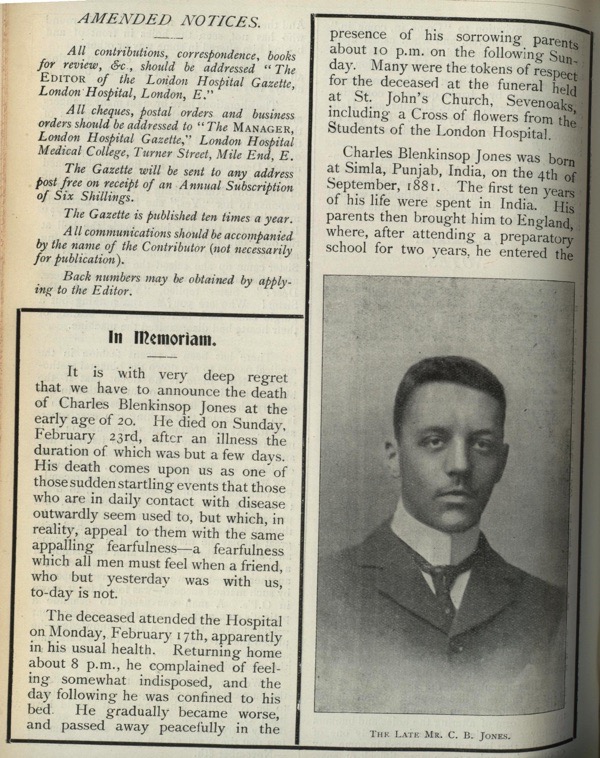
Charles Jones, born in the Punjab, who enrolled as a medical student at the London in 1900 before his tragic death at the age of twenty

Nurse Rosamund Llewellyn, who enrolled as a probationer in 1886 and worked as a nurse for fourteen years

Crossman Ward
Images courtesy Barts Health Archives & Museums
Photographs of projections © Gary Schwartz
You can hear more of the history of The Royal London Hospital in I AM HUMAN, a free downloadable walking tour of the hospital written by Nadia Valman and produced by Natalie Steed
You may also like to take a look at