Laurence Marks & Maurice Gran, Writers
On the afternoon of Sunday July 7th, Laurence Marks & Maurice Gran – celebrated television dramatists whose work has entertained the nation for the past four decades – will be speaking at Sandys Row Synagogue in Spitalfields, discussing their relationship with the East End.
This side of town has proved a source of inspiration for many of their most popular works, including Birds of a Feather, Frieda & Erich Gottlieb, Shine On Harvey Moon and their films Mosley and Wall of Silence.
It promises to be an enthralling evening of storytelling by two born raconteurs in one of London’s most beautiful synagogues. As a preview, I was granted the privilege of an audience with the genial duo who talked to me about their East End roots.

Laurence Marks & Maurice Gran
Maurice Gran – For me, the East End is a place of kinship. My family was a very large family but now it is quite a small family, because so many people have died and all those aunts and uncles in the thirties did not have many children. My father, Mark, always believed that family was all you needed, he did not trust friends – certainly not friends who were not Jewish.
My parents, like most Jewish people who came into this country in the early twentieth century, lived in the East End and I think they migrated to Finsbury Park in the thirties. Debbie, my mother’s family lived in Sydney St and I was told that journalists came to ask if they would let them up on the roof to watch the siege in 1911. When the journalists left, the family found a guinea on the table which was as much as a month’s rent.
My parents relationship to the East End was quite conflicted. They moved out in stages, first to Stamford Hill and then to Finsbury Park. In the late thirties, Auntie Sadie, my mother’s youngest sister, she lived with her husband in a couple of rooms in Mile End, very near to where they were building the new Odeon. One day there was a rap on the door and there was a burly foreman standing there in a leather jerkin and a collar and tie. He said, ‘What are you doing here? All these houses are coming down to make way for the Odeon.’ She said, ‘Well, no-one told me,’ and he replied, ‘If you are not out by teatime, there will be a wrecking ball coming through your front parlour.’ She said, ‘We can’t move at the drop of a hat.’
Someone came round and gave her some money to bugger off there and then. Ten pounds, let’s guess. So she got on the 106 bus and sat on the top deck looking out the window all the way from Hackney to Finsbury Park to see where she could move to. When the bus was nearly at the terminus, she thought, ‘Well, this looks alright.’ She got off the bus, went into the first estate agent and said, ‘I need to rent somewhere today.’ My parents subsequently took over and eventually bought the house she rented, which was where I grew up.
Sadie found the house by lunchtime and spent the afternoon buying a bed and some other bits of furniture with the fiver she had left over. At the end of the day, she waited outside the sweatshop where her husband worked and told him, ‘We don’t live in Mile End anymore, we live in Finsbury Park.’
My father came over from Russia in 1910 and went to the Jews Free School in Spitalfields. He was there for a couple of years, I have got a certificate somewhere. He had nice handwriting and could do his sums on the back of an envelope.
My parents were at the Battle of Cable St, yet my father was not a courageous man. My father and my sister were on a trolley bus once, and some blackshirts got on and my father and his sister jumped off and ran for their lives. I do not know if they needed to run for their lives but that was the shadow it cast.
By the time I was growing up, the East End was a place for occasional visits to Petticoat Lane – which was always a big deal – and very occasional salt beef sandwiches at Blooms, if we were feeling really flush which was not very frequently.
They managed to kill Yiddish as a spoken language in a generation, it was a secret language for me. We never learnt it, it was the language for ‘not in front of the kinder.’ I do not think this was unique to my family, that whole generation did not want us to speak Yiddish even if they used it to have conversations in front of us.
The war was such a massive discontinuity. Before the war was the Shteitel in the East End and after the war was looking forward. They never went to Israel when my father was alive, but my mother went after he died. That was very big thing, the existence of the state of Israel and every Jewish household had a Jewish National Fund collecting tin on the kitchen table which all the spare change went into. I would steal most things but I never thought about robbing that, because I would have died.
My father and my wealthy uncle had sponsored a charity bed in their dead brother’s name in a hospital in the East End. When I was about seventeen, I remember being dragged down to see this bed. I thought, ‘Why are we going on this long journey to see a bed?’
The real old East End I never knew that well. If you put me down there, I would be lost looking for Aldgate East station or Gardiner’s Corner.
Laurence Marks – My uncle said that of you were able to make it beyond Gardiner’s Corner, then you were able to make it to the West End.
Lily, my mother did not come from the East End, she came to the East End. Bernard, my father was born in a flat above a shop in the Mile End Rd and his family lived in that area their entire lives. In 1928, my mother came to London from Cardiff with a chaperone, on a trip organised by the Board of Jewish Deputies, to be show around the Jewish East End. She was taken to the Brady Club where my father was a member. He also played cricket and football for the Peoples Palace. He was a fine cricketer.
My mother and father met at the club and they corresponded through 1928 and 1929. My father’s family were very different to my mother’s, so she was slumming it in many ways but she clearly loved him and his family. They were a family with five children living in two rooms and my grandfather was a bootmaker who worked from home, cutting leather on the kitchen table.
When her father in Cardiff met my father and approved of him, he decided to visit London to see my father’s family in Mile End. He walked into abject poverty. He had never gone up three flights of stairs to two small rooms in which seven people lived. I do not know if he ever said to my mother, ‘Are you sure you know what you are doing?’ but he might well have done. The love must have been very strong. I think it disappeared in about 1940.
Nevertheless, my father courted my mother and they married in Cardiff in 1931. Before the wedding, she had decided to leave Cardiff and come and live in this overcrowded two bedroom flat in Mile End, when she had been brought up in a very nice house in Cardiff. I think she wanted to escape the Jewish circle in Cardiff where her father was the Rabbi and everyone knew everyone.
When they got married, they found a basement flat in King Edward Rd near Columbia Rd. She suddenly realised what poverty was like because he could not get work as furrier. It was a seasonal job. By 1935, they had two child but they could not afford to feed them or themselves, but fortunately grandparents were living nearby who used to fed them every Friday and Saturday. Her life was really horrible, but the man who owned the house was a Hungarian chef and he taught her how to cook. She became a very good cook, domestically.
Eventually, my father decided that work was almost impossible to get and was advised to join the police. It was regular job with regular wages and their life became stable. He was a policeman all through the war when the bombing was heavy and missed death narrowly on at least two occasions. He often spoke about the blitz.
I never lived in the East End and was not schooled there. In the fifties, my father still had lots of relatives there so we would visit them and I remember him taking me to the salt beef bars in Petticoat Lane. One had a large oak beer barrel outside full of pickled cucumbers. The smell of those cucumbers and the salt beef was a big treat for us. He would buy a salt beef sandwich and share it with me. So I knew the East End through relatives of his family and going there most Sundays. He had an aunt who lived near Wentworth St and I would accompany him. My mother never went.
Years later, I met Sue, a girl who lived in Duckett St, Stepney Green, and we got married in Nelson St Synagogue on a very wet Sunday afternoon in February 1972. She was very much an East End girl, so I got to know the East End during the time her parents and relatives were alive. Her family never moved further than two or three streets in their entire lives. They were not typical East End though because her brother went to Cambridge and it was on the front page of the East London Advertiser, ‘Stepney Boy Accepted at Cambridge.’
There was this cloud of the Holocaust hanging over the East End after the war.
In the sixties, my parents took a coach tour to see Europe but when they reached Germany and Austria, my mother would not get off the bus. She slept on the bus. My second wife was German and I do not know quite what my mother would have said about that. I do not know if it would have been possible while she was alive.
I was in Leeds filming once and I rang my mother’s brother to let him know I was there. He said, ‘You must come for Friday night supper,’ which was big deal in his house. I said, ‘The problem is I am with my new ladyfriend. Have you heard I have separate from Sue?’ ‘Then you must bring her to Friday night dinner,’ he insisted. ‘There is a problem, something you ought to know, ‘ I told him. He asked ‘What is it?’ I said, ‘She’s not Jewish.’ There was a pause and he said, ‘Bring her anyway.’ I said, ‘And there’s something else you ought to know, she’s German.’ He said, ‘You bring her.’ So I took her there and he said he had a lovely night because he could talk Yiddish with my German girlfriend. There was this bond. It really meant a great deal to him.’
My last remaining relative in the East End died a few weeks ago. He was ninety-nine, three months off a hundred. He lived off Commercial Rd with my wife’s mother, they used to take in a lot of people from abroad who arrived at the docks and walked down the road with nowhere to go. They took in young people to give them a Jewish home.

Maurice’s mother Debbie is in the middle with his Aunt Sadie on the left and Aunt Debbie in the right, taken at Maurice’s sister Celia’s wedding in 1962

Passport photo of Maurice’s maternal grandfather Morris Cohen from the late thirties

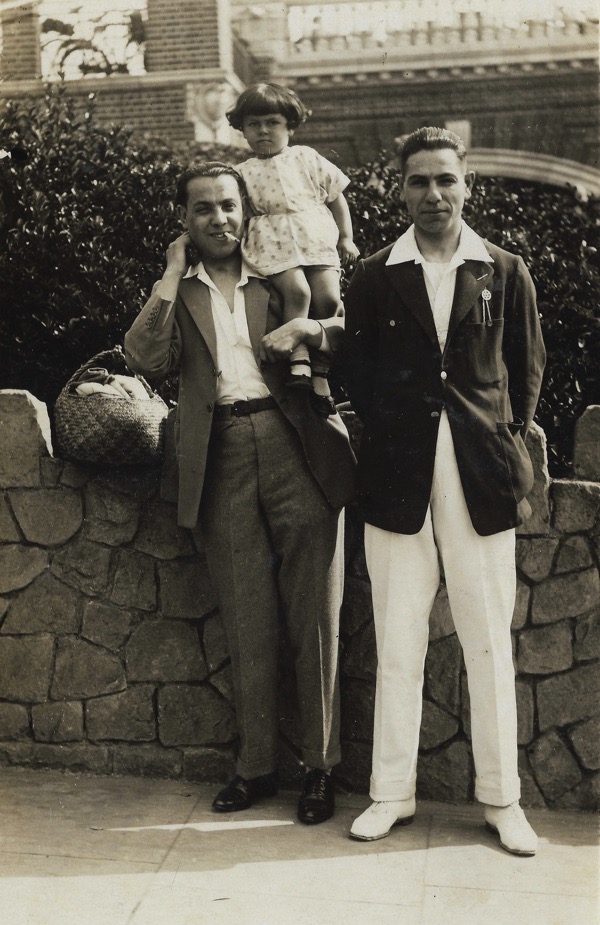
Maurice’s father Mark stands on the right with his brother Hymie on the left and Hymie’s daughter Naomi, c. 1936

Laurence’s parents, Bernard Marks and Lily Goldberg in the twenties

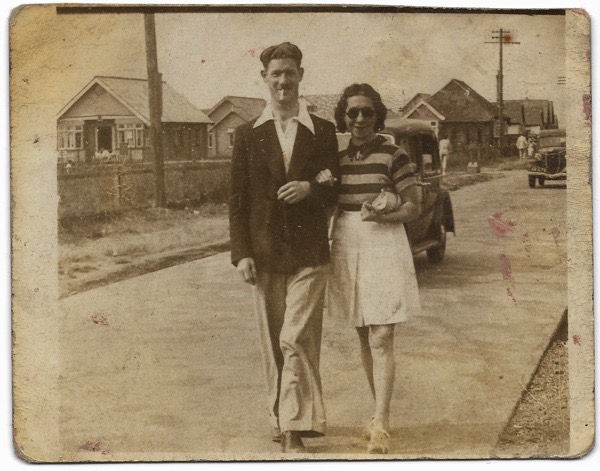
Bernard and Lily in the twenties

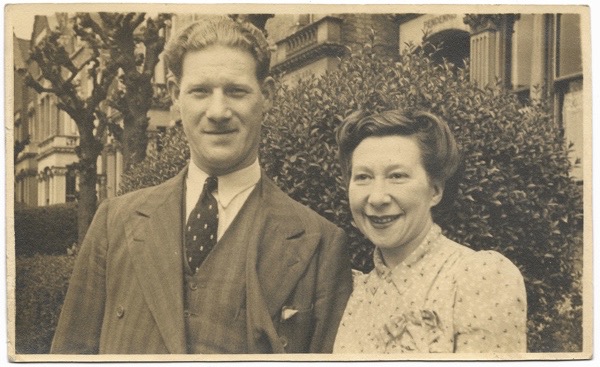
Bernard & Lily Marks in the thirties
Click here for tickets for Laurence Marks & Maurice Gran at Sandys Row Synagogue
You may also like to take a look at
Adam Dant’s Map Of Civil War London
You may recall that Adam Dant & I set out to walk the lines of the Civil War defences from Wapping to Westminster last month, as part of Adam’s research for his map of London in the Civil War which is now complete and published for the first time here.
Adam points out that today is the anniversary of two events which divided the nation. One was the surrender of Charles I’s capital in Oxford in 1646 – concluding the Civil War with his capture, trial and execution – and the other was the European Referendum in 2016. We hope that this account of London in the Civil War will grant our readers a certain perspective and restore a necessary sense of proportion in the current crisis.

Click on this map to enlarge
Adam Dant writes:
“The date of June 23rd will forever mark a key moment in the history of a fractious and divided kingdom – long and protracted vacillation on the part of the powers that be and their favoured agents, a reticent and recalcitrant parliament, and a threat to the status quo triggering any number of schisms, political, familial, religious and regional .
From outside, London was starting to look like a disputed central European town, as if the continent had claimed the island. The people of the capital, men, women and children, took to the streets voluntarily, marshalled and motivated by a fear of omnipotent and conclusive process. Wielding stakes and all manner of drums and ensigns, they set about digging in and advancing the cause at London. Calculated to divide and defend vested interests, London’s lines of communication were erected as swiftly as they were removed .
As to the great responsibility handed over to parliament in the hope that they would make good and wholesome laws which the people of the nation expected, hopes were abated. Instead of uniting a nation with righteousness and peace (which would have been a glorious thing to have done) what was found was anarchy, corruption, division and dissatisfaction in what was from the beginning a provisional government, not truly representative of the people.
Enemies of the nation flourished under parliament’s protection. An immovable parliament being as obnoxious as an immovable king, full of drunkards, tricksters, villains, whore-masters, godless self seeking tricksters, no more capable of conducting the affairs of the nation than of running a brothel. Scum! and a truly elected scum at that. This is no parliament.”
Bibliographical material used in the creation of the map includes, with gratitude and respect –
David Flintham, The English Civil War Defences of London & Civil War
Stephen Porter, London & the Civil War
John Stubbs, Reprobates- The Cavaliers of The English Civil War
The scholarship of Mike Osbourne, Peter Harrington, Donato Spedaliere, Sarah Sulemsohn, Robin Rowles and David Ryan.
Click here to read about our walk
In Search of the Civil War in London

Charles I by Anthony Van Dyck, 1635

Oliver Cromwell by Samuel Cooper, 1656

CLICK TO ORDER A SIGNED COPY OF MAPS OF LONDON & BEYOND BY ADAM DANT
Adam Dant’s MAPS OF LONDON & BEYOND is a mighty monograph collecting together all your favourite works by Spitalfields Life‘s Contributing Cartographer in a beautiful big hardback book.
Including a map of London riots, the locations of early coffee houses and a colourful depiction of slang through the centuries, Adam Dant’s vision of city life and our prevailing obsessions with money, power and the pursuit of pleasure may genuinely be described as ‘Hogarthian.’
Unparalleled in his draughtsmanship and inventiveness, Adam Dant explores the byways of London’s cultural history in his ingenious drawings, annotated with erudite commentary and offering hours of fascination for the curious.
The book includes an extensive interview with Adam Dant by The Gentle Author.
Adam Dant’s limited edition prints are available to purchase through TAG Fine Arts
Midsummer With The Druids
You can join the druids to celebrate midsummer on Primrose Hill this Sunday 23rd June at 1pm

In the grove of sacred hawthorn
One Midsummer, Photographer Colin O’Brien & I joined the celebrants of the Loose Association of Druids on Primrose Hill for the solstice festival hosted by Jay the Tailor, Druid of Wormwood Scrubs. As the most prominent geological feature in the Lower Thames Valley, it seems likely that this elevated site has been a location for rituals since before history began.
Yet this particular event owes its origin to Edward Williams, a monumental mason and poet better known by his bardic name Iolo Morganwg, who founded the Gorsedd community of Welsh bards here on Primrose Hill in June 1792. He claimed he was reviving an ancient rite, citing John Tollund who in 1716 summoned the surviving druids by trumpet to come together and form a Universal Bond.
Consequently, the Druids began their observance by gathering to honour their predecessor at Morganwg’s memorial plaque on the viewing platform at the top of the hill, where they corralled bewildered tourists and passing dog walkers into a circle to recite his Gorsedd prayer in an English translation. From here, the Druids processed to the deep shade of the nearby sacred grove of hawthorn where biscuits and soft drinks were laid upon a tablecloth with a bunch of wild flowers and some curious wooden utensils.
Following at Jay the Tailor’s shoulder as we strode across the long grass, I could not resist asking about the origin of his staff of hawthorn intertwined with ivy. “It was before I became a Druid, when I was losing my Christian faith,” he confessed to me, “I was attending a County Fair and a stick maker who had Second Sight offered to make it for me for fifteen pounds.” Before I could ask more, we arrived in the grove and it was time to get the ritual organised. Everyone was as polite and good humoured as at a Sunday school picnic.
A photocopied order of service was distributed, we formed a circle, and it was necessary to select a Modron to stand in the west, a Mabon to stand in the north, a Thurifer to stand in the east and a Celebrant to stand in the South. Once we all had practised chanting our Greek vowels while processing clockwise, Jay the Tailor rapped his staff firmly on the ground and we were off. A narrow wooden branch – known as the knife that cannot cut – was passed around and we each introduced ourselves.
In spite of the apparent exoticism of the event and the groups of passersby stopping in their tracks to gaze in disbelief, there was a certain innocent familiarity about the proceedings – which celebrated nature, the changing season and the spirit of the place. In the era of the French and the American Revolutions, Iolo Morganwr declared Freedom of Thought, Freedom of Speech and Freedom of Association. Notions that retain strong resonance to this day.
Once the ritual wound up, we had exchanged kisses of peace Druid-style and everyone ate a biscuit with a gulp of apple juice, I was able to ask Jay the Tailor more questions.“I lost my Christian faith because I studied Theology and I found it difficult to believe Jesus was anything other than a human being, even though I do feel he was a very important guide and I had a personal experience of Jesus when I met Him on the steps of Oxford Town Hall,” he admitted, leaving me searching for a response.
“When I was fourteen, I went up Cader Idris at Midsummer and spent all night and the next day there, and the next night I had a vision of Our Lady of Mists & Sheep,” he continued helpfully,“but that just added to my confusion.” I nodded sagely in response.“I came to Druids through geometry, through studying the heavens and recognising there is an order of things,” he explained to me, “mainly because I am a tailor and a pattern cutter, so I understand sacred geometry.” By now, the other Druids were packing up, disposing of the litter from the picnic in the park bins and heading eagerly towards the pub.
I have such a fond memory of that afternoon Colin O’Brien and I enjoyed among the druids on Primrose Hill.

“Do not tell the priest of our plight for he would call it a sin, but we have been out in the woods all night, a-conjuring the Summer in!” – Rudyard Kipling

Sun worshippers on Primrose Hill

Memorial to Iolo Morganwg who initiated the ritual on Primrose Hill in 1792


Peter Barker, Thurifer – “I felt I was a pagan for many years. I always liked gods and goddesses, and the annual festivals are part of my life and you meet a lot of good people.”


Maureen – “I’m a Druid, a member of O.B.O.D. (the Order of Bards, Ovates & Druids), and I’ve done all three grades”


Sarah Louise Smith – “I’m training to be a druid with O.B.O.D. at present”


Simeon Posner, Astrologer – “It helps my soul to mature, seeing the life cycle and participating in it”


John Leopold – “I have pagan inclinations”


Jay the Tailor, Druid of Wormwood Scrubs

Iolo Morgamwg (Edward Williams) Poet & Monumental Mason, 1747-1826
Photographs copyright © Estate of Colin O’Brien
You may also like to read about
Sammy McCarthy, Flyweight Champion

Let me tell you the story of “Smilin’ Sammy McCarthy,” one of legends of East End Boxing. Voted “Best British Boxer of 1951” by Boxing Times, Sammy was a golden boy who won eighty-three out of his ninety amateur contests and represented England four times in the nineteen fifties, before becoming British Featherweight Champion twice and then Lightweight Champion after that.
Yet to this day Sammy is resolute in his refusal to be called a hero. With his impeccable manners and old-fashioned proper way of talking, he is the paragon of self-effacement – an enigma who modestly ascribes his spectacular boxing career to no more than a fear of disappointing others. His contemporaries informed me that only once I knew about his background, could I fully appreciate the true impulse behind Smilin’ Sammy’s suave temperament, but what I discovered was something far more surprising than I ever expected.
Born in 1931 as one of ten children, Sammy grew up in a terrace off Commercial Rd next to Watney Market as the son of costermonger. “My father used to go round the streets selling fruit and veg and we all helped him, and I helped him more than anyone but I always hated it,” Sammy revealed to me, explaining how he visited Spitalfields Market each day with his father in the early morning and stood outside the church while his father bought the produce. Then Sammy had to wheel the loaded barrow back to Stepney but, although it gave him the physical strength which made him a boxer, it was also was a source of humiliation when Sammy’s schoolmates jeered. “Subconsciously, I suppose I was a bit of snob – I wanted to be posh even though I didn’t know the meaning of the word.” he confided with a blush, expressing emotions that remain current even after all these years.
Sammy’s elder brother Freddie was a boxer before him and Sammy has a vivid memory of hiding under the table as a child, while his father and brother listened to the celebrated Tommy Farr and Joe Louis fight on the radio. “All the talk was of boxing and I so much wanted to participate but I was naturally timid,” he admitted to me shyly, “I was frightened of being frightened, I suppose – but after my fights I was always so elated, it became like a drug.”
Sammy joined the St George’s Gym in Stepney where his brother trained. “I absolutely loved it but each time I went, I was extremely nervous.” he continued, breaking into his famous radiant smile, “At fifteen I had my first fight and lost on points, so I didn’t tell my father but he found out and cuffed me for not telling him, because he didn’t mind.”
“I had a great following thanks to my two uncles who sold tickets and everybody in the markets bought them because my brother was already well-known. So there used to be coach loads coming to watch me box and I was always top of the bill, not because I was good but because I always sold plenty of tickets.” It was a characteristic piece of self-deprecation from a champion unrivalled in his era.
At nineteen, Sammy turned professional under the stewardship of renowned managers Jarvis Astaire and Ben Schmidt. “Every time I go to West End, I still go to Windmill St and stand outside where the training gym used to be. All the big film stars, like Jean Simmons and John Mills, they used to go there to the weigh-in before a big fight.” he told me proudly.
In spite of his meteoric rise, Sammy was insistent to emphasise his vulnerability. “Everyone’s nervous, but I was petrified, not of fighting but of letting the side down,” he assured me. “I’d rather fight a boxer who thought he could fight but actually couldn’t,” Sammy announced, turning aphoristic and waving a finger,“than a boxer who thought he couldn’t fight but really could.” And I understood that Sammy was speaking of himself in the latter category. “It makes you sharp,” he explained, “your reflexes are very fast.”
‘”I retired at twenty-six, but I didn’t know I was going to retire,” admitted Sammy with a weary smile,“I had to meet these people who were putting a book together about me and it turned out to be the ‘This Is Your Life’ TV programme. It was 1957 and they expected me to announce I was going to retire. I must have been a little disappointed but maybe I hadn’t seen I was slowing down a little.”
Married with two children and amply rewarded by the success of his boxing career, Sammy bought a pub, The Prince of Wales, known as “Kate Odders” in Duckett St, Stepney. You might think that Sammy had achieved fulfilment at last, but it was not so. “I hated every moment because I like home life and as a publican you are always being called upon.” he confessed, “I had a little money and I spent it all unfortunately.”
“My boxing career, it gave me confidence in myself. Boxing made me happy.” Sammy concluded as our conversation reached its natural resolution,” I didn’t enjoy the fights, but I love the social life. You meet the old guys and you realise it’s not about winning, it’s about giving of your best.” Living alone, Sammy leads a modest bachelor existence in a neatly kept one bedroom flat in Wanstead and he meets regularly with other ex-boxers, among whom he is popular character, a luminary.
And that is where this story would have ended – and it would have been quite a different kind of story – if Sammy had not confronted me with an unexpected admission. “I want you to know why I am divorced from my wife and separated from my children,” he announced, colouring with a rush of emotion and looking me in the eye, “I’m telling you, not because I’m boasting about it but because I don’t want you to make me out to be a hero.”
There was a silence as Sammy summoned courage to speak more and I sat transfixed with expectation. “I robbed banks and I stole a lot of money, and I was caught and I was put in prison for years.” he said.
“I think I was too frightened not to do it,” he speculated, qualifying this by saying,“I’m not making excuses.”
“I’m reformed now.” he stated, just to be clear.
“I was alright in prison because I’m comfortable with my own company and I read books to pass the time,” he added, to reassure me.
“But why did you do it?” I asked.
“Because we never had anything,” he replied, almost automatically and with an abject sadness. His lips quivered and he spread his hands helplessly. He had been referring back – I realised – to his childhood in the family of ten. A phrase he said earlier came back into my mind,“I can’t say that I experienced hardship,” he told me,“not by comparison with what my parents went through.”
Subsequently, a little research revealed that Sammy had been convicted three times for armed robbery, and served sentences of three, six and fourteen years. When I think of Smilin’ Sammy now, I think of his sweet smile that matches the Mona Lisa in its equivocation. It is a smile that contains a whole life of fear and pain. It is a smile that knew joy yet concealed secrets. It is a brave smile that manifests the uneasy reconciliation which Sammy has made with the world in the course of his existence.

Smilin’ Sammy McCarthy


Sammy McCarthy, the Stepney Feather, has Peter Morrison against the ropes under a fierce attack at the Mile End Arena.

Sammy McCarthy makes Denny Dawson cover up under a straight left attack.

Jan Maas goes headlong to the canvas after taking a Sammy McCarthy “special” to the chin.

Still smiling! Not even a knockdown can remove the famous smile from Sammy McCarthy, as he goes down for a count of “eight” in the fifth round.


Smilin’ Sammy McCarthy
You may also like to read about
Ron Cooper, Lightweight Champion Boxer
A Film About The Whitechapel Bell Foundry
It is my great delight to present Gavin Kingcome‘s Save the Whitechapel Bell Foundry film
[youtube Rd6_iUF5Kbg&t=1s nolink]
As you will recall, developers bought the world-famous, historic Whitechapel Bell Foundry to convert it into a bell-themed boutique hotel, party venue and private members club with a rooftop swimming pool. Currently they are seeking planning permission for this change of use and we want to stop it.
There is a perfectly viable proposal put forward by the UK Historic Building Preservation Trust with its partner Factum Foundation to continue to operate a full-scale working foundry. This proposal has a credible business plan, experienced management and funding available. The UKHBPT has done this before to great success at Middleport Pottery in Stoke. This proposal will ensure that East London retains one of the finest craft facilities in the world, adding to the cultural and artistic value of Whitechapel for generations to come.
Recognising that there is a viable alternative to their boutique hotel proposal, the developers have appropriated the language of their rivals by claiming they are actually ‘reinstating a foundry,’ meaning that bell polishing will happen in the lobby of their hotel sometimes. The reality is they are reducing the foundry use to 12%. In spite of this attempt to muddy the waters, I think the difference between a boutique hotel and a bell foundry is quite obvious.
The East London Mosque is the Whitechapel Bell Foundry’s closest neighbour and, in the planning application, the developers claim “Several attempts were made to contact the Mosque.” Yet the Mosque confirms that no attempt to consult with them has been made by the developers. In fact, the East London Mosque is wholly in favour of restoring the Whitechapel Bell Foundry to its full capacity as you can read in their letter of objection to the hotel proposal.
 Click on this letter to enlarge

Click to enlarge this plan showing the top floor of the boutique hotel of 100 rooms with rooftop swimming pool and bar overlooking the East London Mosque

This picture of Shoreditch House rooftop swimming pool and cocktail bar gives an indication of how the plan for Whitechapel will be realised

The developers plan to put a bell on the top of their bell-themed boutique hotel

You can help save the Whitechapel Bell Foundry as a living foundry by submitting an objection to the boutique hotel proposal to Tower Hamlets council. Already we have lodged over six hundred letters of objection but we aim to deliver over a thousand. If you have not already done so, please take a moment to write your letter of objection. The more objections we can lodge the better, so please spread the word to your family and friends.
Readers who have already objected will have received notice of revisions to the developers’ planning application. No response to this is necessary since all the objections still stand and the revisions make no significant changes to the boutique hotel proposal.
HOW TO OBJECT EFFECTIVELY
Use your own words and add your own personal reasons for opposing the development. Any letters which simply duplicate the same wording will count only as one objection.
1. Quote the application reference: PA/19/00008/A1
2. Give your full name and postal address. You do not need to be a resident of Tower Hamlets or of the United Kingdom to register a comment but unless you give your postal address your objection will be discounted.
3. Be sure to state clearly that you are OBJECTING to Raycliff Capital’s application.
4. Point out the ‘OPTIMUM VIABLE USE’ for the Whitechapel Bell Foundry is as a foundry not a boutique hotel.
5. Emphasise that you want it to continue as a foundry and there is a viable proposal to deliver this.
6. Request the council refuse Raycliff Capital’s application for change of use from foundry to hotel.
WHERE TO SEND YOUR OBJECTION
You can write an email to
planningandbuilding@towerhamlets.gov.uk
or
you can send a letter to
Town Planning, Town Hall, Mulberry Place, 5 Clove Crescent, London, E14 2BG

You may also like to read about
Nigel Taylor, Tower Bell Manager
Four Hundred Years at the Whitechapel Bell Foundry
Pearl Binder at Whitechapel Bell Foundry
Dorothy Rendell at Whitechapel Bell Foundry
Hope for The Whitechapel Bell Foundry
A Petition to Save the Bell Foundry
Save the Whitechapel Bell Foundry
Ray Newton, Historian Of Shadwell

Ray Newton at the churchyard gate of St Paul’s Shadwell
You do not meet many people who can say they come from Shadwell these days, not in the way that Ray Newton can when he tells you his family have been there since at least 1820 – which is only as far he chooses to probe, yet more than sufficient to claim Shadwell as his place of origin.
Ray has dedicated himself to learning the history of Shadwell and, for the past thirty years, he ran the local history trust with Madge Darby who was his counterpart in Wapping. Between the pair of them they were able to enjoy specialist conversations that traced niceties of historical detail, especially concerning the boundary between their adjoining Thames-side parishes.
“Madge would tell you that the Prospect …” Ray began, referring to the ancient Prospect of Whitby riverside pub by its familiar name, “Madge would tell you that the Prospect is in Wapping because, since the early nineteenth century when the Docks were built, the Wapping people have said that you have to cross water to get to Wapping – yet prior to that the Prospect was in Shadwell.”
In confirmation of this assertion, Ray took me round the back of St Paul’s Church in Shadwell and gestured significantly towards a blank wall before turning one hundred and eighty degrees to indicate a route crossing the Basin towards the Thames. “This used to be Fox’s Path, from the Highway down to the Prospect,” he informed me, “it was raised on stilts across the marshes that were here before the Docks.”
Thus Ray’s thesis about the shifting boundary of Shadwell and Wapping was proven, though it left me with an unfulfillable yearning to cross Fox’s Path upon the long-gone stilts over the marshes and down to the Prospect of Whitby.
“My father, Thomas Newton, was born in 1904 in Cornwall St off Watney St Market but he lived his early life in Juniper St, which was swarming with hundreds of children then. Although it was a big family, my grandfather John Newton had a good job, he was a foreman in a cold store at Bankside, so my father got educated and he could read and write letters for people in Juniper St.
We were lucky because my dad had a secure job and even in the thirties, when there were no jobs, he worked. At twelve years old, my father left school and went to work with my grandfather at the cold store, and his brothers worked there with him too.
When he was fourteen, he went to Broad St Boys’ Club in the Highway that was run by the son of Bombardier Billy Wells (the man who wielded the hammer on the gong at the start of J. Arthur Rank films) and, at eighteen years old, my father became a professional boxer. He fought against Raymond Perrier, the Champion of France, and beat him and he topped the bill in the twenties. He fought all over the East End but, because he was boxer not a fighter, he had trouble with his eye and he had to have an operation. After that, he couldn’t box anymore so he became a manager and ran a gym in Davenport St above the Roebuck.
My mother, Maria Edgecombe, was born in Gravesend. Her mother was a farmer’s daughter who married my grandfather, who was a waterman who came from Shadwell and worked for the Tilbury Dock Company. When it was taken over by the Port of London Authority, he moved out and worked on the Pierhead and they lived in Cable St, where my mother met my father and they had three boys and a girl.
On my dad’s side, they were all dockers and on my mother’s side they all worked for the Port of London Authority. They were different people, because in the docks it was all casual labour whereas the Port of London Authority was regular employment. It was very hard work in the docks but I never met anyone that didn’t love working there. The docks could find a job for anyone.
When the War came, my dad was still working in the cold store and it was a reserved occupation. He joined the Home Guard and his job was to guard the London Dock and the King Edward VII Memorial Park which was the entrance to the Rotherhithe Tunnel – and he was given five rounds of ammunition. I remember him in his uniform because I was born just before the War.
My father was always into everything sporty and boxing was his life so, when his father died, he become a bookmaker and set himself up as a turf accountant and gave up the docks. Next, he decided to be a publican and bought a pub on the Highway opposite Free Trade Wharf called the Cock but, while I was doing National Service, he became ill. At fifty-one, he was told he had lung cancer and had five years to live, and he died at fifty-six.
He was a lad but he wasn’t a criminal. He was a hard man and he could fight anyone just like that, yet he was also very generous. He was into everything, he organised dances and sold tickets.
We had a boxing gym in the cellar of the pub and he gave away all the equipment to the St Georges Boxing Club in the church crypt – where they produced a world champion, Terry Marsh. I didn’t want him to give it away because I thought they’d damage it but he said to me, ‘You don’t know what it’s like to have no money.’
At twenty-three years old, I took over the pub and I was a publican right on the docks, serving seamen and dockers. So you had to be a little hard – but I’m not. During the days, it was dockers, lightermen and ships’ captains but at nights, and at weekends, local families came. We had a piano player and everyone knew the words, they had competitions – one song in the Saloon Bar then one in the Public Bar. In the Saloon, you could charge what you pleased but in the Public Bar the drinks’ prices were set. Ships’ officers, customs’ men and the management of Free Trade Wharf went into the Saloon and dockers and lightermen went in the Public Bar – they never met, that was the class system.
I ran the pub until it was pulled down to make way for the widening of the Highway and I was rehoused in Gordon House, where I still live today. After the pub came down, I worked for my elder brother – he was a bookmaker – in his betting shops, but it wasn’t me. When he decided to sell the shop in Walthamstow, I stayed on and worked for the new people – for the company which became City Tote.
Yet I realised I didn’t want to do this for the rest of my life so, at thirty-two, I decided to get an education and, after the shop closed at night, I used to go to evening classes. I enrolled for a basic English class and the teacher said, ‘Write something down so I can look at it,’ and when he saw it he said, ‘This ain’t your class but if you help me with teaching the other students, I’ll mark your essay each week.’ So I got a year of personal tuition.
Then I was doing my homework in the betting shop one day, when two young men who were different from the other punters asked what I was doing. I said, ‘I’m doing O levels.’ They were lecturers and they said, ‘We’ll help you with your O levels if you’ll teach us gambling.’ After I did my O levels and A levels, I realised that if I don’t go to university, I’d be disappointed for the rest of my life, so I went to Middlesex Polytechnic and did a four year degree in Social Sciences. While I was a student, I was working as an Adult Literacy volunteer and after I got my degree I became a lecturer in Social Sciences at West Ham College, but the most rewarding thing I did was teaching partially blind people.
After thirty-six years of teaching, I retired and for the past ten years I’ve had an allotment in Cable St Gardens, and I’m secretary of the History of Wapping Trust. I used to teach a Local History class and one day Madge Darby came along, there’s nothing about Wapping she didn’t know. We published over twenty books. We never set out to make money, it is a thing we did for love.
Once upon a time, we were all in the same boat, we all went to the same school, we all went to the same pub, we all had the same doctor and everybody knew everybody. Now nobody knows anybody. I think I was lucky because I worked in a pub at twenty-three and I met the full range of people, and it got me interested in local history.”

Ray upon the steps overlooking Shadwell Basin

Ray shows the stone plaque in the churchyard wall of St Paul’s Shadwell, placed after it was shored up when Shadwell Basin was being excavated between 1828-32 and the church began to slide downhill

Ray pointed out these early nineteenth century doors facing the Highway, in the side of the Vestry at St Paul’s Shadwell, which were once the entrance to Shadwell’s first Fire Station
You may also like to read about
An Abomination In Bethnal Green
This is an extract from my article in the current issue of Design Exchange magazine.
One of the most popular posts of recent years has been THE CREEPING PLAGUE OF GHASTLY FACADISM. Now I have written a book which is a gallery of the most notorious facades and a humorous analysis of facadism – the unfortunate practice of destroying everything apart from the front wall and constructing a new building behind it – revealing why this is happening and what it means.
There are two ways you can help me publish the book.
1. I am seeking readers who are willing to invest £1000 in THE CREEPING PLAGUE OF GHASTLY FACADISM. In return, we will publish your name in the book and invite you to a celebratory dinner hosted by yours truly. If you would like to know more, please write to me at spitalfieldslife@gmail.com
2. Preorder a copy of THE CREEPING PLAGUE OF GHASTLY FACADISM and you will receive a signed and inscribed copy in October when the book is published. Click here to preorder your copy
Please suggest other facades I should include.

The Duke of Cambridge was built in 1823
It is rare that you cannot believe your eyes, yet that such was my response when I first saw this chimera. When I examined the proposal for facading of The Duke of Cambridge in Felix St, Bethnal Green, in the planning application for a development by Heath Holdings, designed by Guy Hollaway Associates, I was astonished and appalled at how a new building appeared to have been forceably inserted into an old building to create such a hybrid monster.
At the time, I dismissed it as a dystopian fiction because I could not believe it would ever get built, but the reality is so much worse than the proposal. Such is the ugly conflict between the old and the new, you can almost feel the humiliation and pain of the original building. The experience is akin to your dear old grandpa with the Father Christmas physique having his trousers stolen and you find him wandering bereft in the street, tricked out in a pair of garish lycra shorts as the only option available.
It makes you wonder. How can anyone have thought that this treatment of a gracious nineteenth century pub was sympathetic? Or imagined that the finished result is acceptable as architecture? It stretches my imagination to grasp the aesthetic which permits an architect to arrive at such a disastrous compromise.
On his website, the architect describes it thus – ‘A dynamic glazed box of ‘reglit’ glass tubes juts out of the top of the brown and red brick façade of the original building, creating a relationship between old and new.’ This statement set me thinking about the nature of this relationship.
Guy Hollaway’s new structure crouches like an incubus on top of the old, expressing antipathy for the building it inhabits and denying the potential of any resolution of the diverse elements into a satisfactory architectural whole, which ought surely to be the object of the exercise.
Firstly, the scale, proportion, colour and idiosyncratic placement of the windows in the extension ignore the form of those in The Duke of Cambridge, which now have clunky new frames inserted that differ from the originals, dividing the windows in half laterally and compounding the inelegance.
Secondly, the ‘reglit’ glass tubes with their strong vertical emphasis give the extension the effect of being extruded from the building below. The industrial modernity of these glass tubes is alien in this context, disregarding the brickwork of the pub and mitigating against any integration of the elements into a whole.
Thirdly, the former mansard roof of The Duke of Cambridge was raked, tilting away from the walls beneath and held in place visually by the symmetrical flourishes of the Dutch gable on the front of the building, but the new extension does not resolve the form of the building below. Instead, by avoiding any acknowledgement of the Dutch gable, this crudely disproportionate rectangular box exists in conflict with the rest of the structure to discordant effect.
There is no reason why an architect could not use modern materials in such a project, if the proportion and form of the building unified them within the design. Similarly, I can see that by using traditional materials an architect might extend a building successfully in a form that contrasted with the pre-existing structure. The problem with The Duke of Cambridge is that the choice of form and the materials for the extension are both at odds with what is already there. It is these decisions by the architect not to engage with the old building that deliver a visual eyesore.
I feel disingenuous pointing this out because I would like to think that architects are blessed with a sensitivity for these essential concerns of their trade. I would like to imagine that the architect who chose to put the glass tubes on top of The Duke of Cambridge believed the luminosity of this material might impart a levity to the extension, as if it hovered above its predecessor like a cloud of light, or the beacon of a lighthouse. Yet, even if this were the case, they have failed miserably.
The explanation of why The Duke of Cambridge has been degraded in this way must lie with the two huge new buildings which are part of a larger development by the same architect and developer on the other side of Felix St. Out of a total of more than two hundred dwellings in these buildings, just around 25% are ‘affordable.’
These vast curved blocks possess no relationship in form or scale with the brick terraces of the Hackney Road or the dignified Guinness buildings constructed as social housing a century ago on the opposite side of Felix St. Such is their generic nature, they could equally be placed in Minneapolis or Milton Keynes because stylistically they do not belong anywhere, raising the suspicion that the form is dictated solely by an imperative to maximise volume and financial return rather than entertain any dialogue with the existing urban landscape. It is disappointing to witness how the current housing shortage has delivered a field day for exploitative development across the capital, rather than attempting to address the real needs of Londoners.
Which brings me back to The Duke of Cambridge – because the anachronistic materials and forms which blight this formerly elegant structure, the ‘reglit’ glass tubes and the idiosyncratic window placing, are prominent features of the development across the road. In other words, The Duke of Cambridge has been adulterated in an attempt to unify it with the new housing blocks resulting in a dysfunctional conversation between incompatible languages.
Although The Duke of Cambridge closed in 1998, I am informed there were those who wanted to reopen it and give it new life, which would not have been impossible in this burgeoning neighbourhood. It might have functioned as the place where the residents of the Guinness social housing and the inhabitants of the new development could meet. But the opportunity of providing a public space for fellowship, as the pub had done for the previous one hundred and seventy-five years, was denied by the developer for the sake of cramming in a few more flats, thereby consigning it to the past and retaining the lettering on the facade as a mere historic relic reminding us only of a life that has gone.
We confront the fundamental question of how the financial imperative driving such ill-conceived developments may be reconciled with our need for a city we want to live in, and which serves the needs of all Londoners. The treatment of The Duke of Cambridge incarnates a metaphor of this conflict vividly and the ugliness of the outcome is a pertinent slap in the face, reminding us how blatantly any concern for quality of life or good architecture is being sacrificed for the sake of greed. This disastrous hybrid is an unfortunate totem of where we are now, an object lesson for architectural students of what not to do, and we may be assured future generations will laugh in horror and derision at the folly of it.

The exterior cover of the book…

…which opens to reveal the title.
CLICK HERE TO ORDER A COPY OF THE CREEPING PLAGUE OF GHASTLY FACADISM