
List Of Local Shops Open For Business

Every Wednesday, I publish the up to date list of stalwarts that remain open in Spitalfields. Readers are especially encouraged to support small independent businesses who offer an invaluable service to the community. This list confirms that it is possible to source all essential supplies locally without recourse to supermarkets.
Be advised many shops are operating limited opening hours at present, so I recommend you call in advance to avoid risking a wasted journey. Please send any additions or amendments for next week’s list to spitalfieldslife@gmail.com
This weeks illustrations are photographs by Tony Hall from the sixties and seventies. See the full set here

GROCERS & FOOD SHOPS
The Albion, 2/4 Boundary St
Ali’s Mini Superstore, 50d Greatorex St
AM2PM, 210 Brick Lane
As Nature Intended, 132 Commercial St
Banglatown Cash & Carry, 67 Hanbury St
Breid Bakery, Arch 72, Dunbridge St
Brick Lane Minimarket, 100 Brick Lane
The Butchery Ltd, 6a Lamb St (Open Thursdays only)
City Supermarket, 10 Quaker St
Costprice Minimarket, 41 Brick Lane
Faizah Minimarket, 2 Old Montague St
JB Foodstore, 97 Brick Lane
Haajang’s Corner, 78 Wentworth St
Leila’s Shop, 17 Calvert Avenue (Call 0207 729 9789 between 10am-noon on Tuesday-Saturdays to place your order and collect on the same day from 2pm-4pm)
The Melusine Fish Shop, St Katharine Docks
Nisa Local, 92 Whitechapel High St
Pavilion Bakery, 130 Columbia Rd
Rinkoff’s Bakery, 224 Jubilee Street & 79 Vallance Road
Spitalfields City Farm, Buxton St (Order through website)
Sylhet Sweet Shop, 109 Hanbury St
Taj Stores, 112 Brick Lane
Zaman Brothers, Fish & Meat Bazaar, 19 Brick Lane

TAKE AWAY FOOD SHOPS
Before you order from a delivery app, why not call the take away or restaurant direct?
Absurd Bird Fried Chicken, 54 Commercial St
Al Badam Fried Chicken, 37 Brick Lane
Allpress Coffee, 58 Redchurch St
Band of Burgers, 22 Osborn St
Beef & Birds, Brick Lane
Beigel Bake, 159 Brick Lane
Beigel Shop, 155 Brick Lane
Bellboi Coffee, 104 Sclater St
Bengal Village, 75 Brick Lane
Big Moe’s Diner, 95 Whitechapel High St
Burro E Salvia Pastificio, 52 Redchurch St
The Carpenters Arms, 73 Cheshire St (Open for take away beers)
China Feng, 43 Commercial St
Circle & Slice Pizza, 11 Whitechapel Rd
Dark Sugars, 45a Hanbury St (Take away ice cream and deliveries of chocolate)
Donburi & Co, Korean & Japanese, 13 Artillery Passage
Duke of Wellington, 12 Toynbee St (Open for take away beers)
Eastern Eye Balti House, 63a Brick Lane
Enso Thai & Japanese, 94 Brick Lane
Exmouth Coffee Shop, 83 Whitechapel High St
Grounded Coffee Shop, 9 Whitechapel Rd
Holy Shot Coffee, 155 Bethnal Green Rd
Hotbox Smoked Meats, 46-48 Commercial St
Jack The Chipper, 74 Whitechapel High St
Jonestown Coffee, 215 Bethnal Green Rd
Laboratorio Pizza, 79 Brick Lane
La Cucina, 96 Brick Lane
Leon, 3 Crispin Place, Spitalfields Market
Madhubon Sweets, 42 Brick Lane
Mooshies Vegan Burgers, 104 Brick Lane
Nude Expresso, The Roastery, 25 Hanbury St
E. Pellicci, 332 Bethnal Green Rd
Pepe’s Peri Peri, 82 Brick Lane
Peter’s Cafe, 73 Aldgate High St
Picky Wops Vegan Pizza, 53 Brick Lane
Quaker St Cafe, 10 Quaker St
Rajmahal Sweets, 57 Brick Lane
Rosa’s Thai Cafe, 12 Hanbury St
Shawarma Lebanese, 84 Brick Lane
Shoreditch Fish & Chips, 117 Redchurch St
Sichuan Folk, 32 Hanbury St
String Ray Globe Cafe, 109 Columbia Road
Sushi Show, 136 Bethnal Green Rd
Vegan Yes, Italian & Thai Fusion, 64 Brick Lane
White Horse Kebab, 336 Bethnal Green Rd
Yuriko Sushi & Bento, 48 Brick Lane

OTHER SHOPS & SERVICES
Boots the Chemist, 200 Bishopsgate
Brick Lane Bookshop, 166 Brick Lane (Books ordered by phone or email are delivered free locally)
Brick Lane Bikes, 118 Bethnal Green Rd
Brick Lane Off Licence, 114/116 Brick Lane
Day Lewis Pharmacy, 14 Old Montague St
E1 Cycles, 4 Commercial St
Eden Floral Designs, 10 Wentworth St (Order fresh flowers online for free delivery)
Flashback Records, 131 Bethnal Green Rd (Order records online for delivery)
Harry Brand, 122 Columbia Road (Order gifts online for delivery)
Hussain Tailoring, 64 Hanbury St
iRepair, Phones & Computer, 94 Whitechapel High St
GH Cityprint, 58-60 Middlesex St
Leyland Hardware, 2-4 Great Eastern St
Mobile Clinic & Laptop Repairs, 7 Osborne St
Post Office, 160a Brick Lane
Quality Dry Clean, 151 Bethnal Green Rd
Rose Locksmith & DIY, 149 Bethnal Green Rd
Sid’s DIY, 2 Commercial St
Spitalfields Dry Cleaners, 12 Whites Row

ELSEWHERE
E5 Bakehouse, Arch 395, Mentmore Terrace (Customers are encouraged to order online and collect in person)
Gold Star Dry Cleaning & Laundry, 330 Burdett Rd
Hackney Essentials, 235 Victoria Park Rd
Quality Dry Cleaners, 16a White Church Lane
Newham Books, 747 Barking Rd (Books ordered by phone or email are posted out)
Region Choice Chemist, 68 Cambridge Heath Rd
Symposium Italian Restaurant, 363 Roman Road (Take away service available)
Thompsons DIY, 442-444 Roman Rd

Photographs copyright © Estate of Tony Hall
You may like to take a look at these other photos by Tony Hall
Remembering The 43 Group
Photographer Stuart Freedman introduces his fine portraits of the last surviving members of the 43 Group, brave men who fought back against the resurgence of fascism in post-war London. Next month sees the seventh anniversary of when the Group officially disbanded.

Jules Konopinsky
“When I was a boy, I used to walk down Brick Lane with my father on a Sunday. We would sometimes see men selling the National Front’s rag on the corner of Bethnal Green Rd beneath a tatty Union Jack flag. This was the seventies, a troubled time when the certainties of the post-war settlement were under threat. This was the time of Rock Against Racism and the murder of Blair Peach, where racism, nationalism and bigotry were presented in some quarters as appealing and even respectable. How times do not change.
But each generation remembers its own battles. In the nineties I became a photographer and, for a very short time, I started to make images of the ‘Lane and inevitably saw the same men selling the same newspapers under the same tatty flag.
In 1996, I made a set of portraits and interviews for the Independent Magazine of veterans of the International Brigades who had fought fascists in Spain sixty years before. Many had to go and fight the same battles again across the world in 1939. A few talked about the resurgence of fascism after the war and how, when interned Blackshirts were released from prison they started to organise, prompting a far-right revival.
It was then I read Maurice Beckman’s book about the 43 Group, a historically significant but largely forgotten organisation of mostly – but not exclusively – Jewish ex-servicemen, and some extraordinarily brave women, who returned from the horrors of war only to find fascism again on their own doorstep. I read how they resolved to fight back, to physically oppose the menace, to meet violence with violence to protect their communities. And how they had done so against the wishes of their elders and representatives.
My father lived in a poor, bomb-damaged street in Stoke Newington and, as a young man in 1947, had seen the savage violence of the long-forgotten battles of Dalston and Ridley Rd. Battles unremembered but perhaps no less significant than Cable St. I had resolved to find those men that had stood up to a new generation of Oswald Mosley’s thugs and record them for posterity. But I never did, I spent the next two decades working and living across the world as a photo-reporter. I forgot.
Last year, I read Daniel Sonabend’s wonderful, forensic and compelling new history of the 43 Group, We Fight Fascists: The 43 Group and Their Forgotten Battle for Post-War Britain and I knew that I needed to make these images to remember before it was too late.
By the turn of this year, there were only six of the original members left. I photographed them just before lockdown. Tragically, Maurice Podro passed away earlier this month and so these images are shown in his memory.
We forget at our cost.”
Stuart Freedman
 Gerry Kaffin
 Martin White
 Gerry Abrahams
 Maurice Podro
 Harry Kaufman
Portraits copyright © Stuart Freedman
You may also like to take a look at Stuart Freedman’s other work
At Kirby’s Eccentric Museum
Whenever I used to visit collector Mike Henbrey, he always showed me something extraordinary from his collection and he certainly did not disappoint when he pulled two volumes of Kirby’s Eccentric Museum from the shelf for me to take a look

John Biggs was born in 1629 and lived in Denton in the county of Bucks in a cave

This wonderful boy, who in early age outstripped all former calculators, was born in Morton Hampstead on 14th June 1806

In Mme Lefort the sexes are so equally blended that it is impossible to say which has predominance

This gentleman was a bookseller in Upper Marylebone St, remembered today as Shelley’s bookseller

The parachute here represented was used by Monsieur Garnerin at his ascension in London


Thomas Cooke was born in 1726 at Clewer near Windsor as the son of an itinerant fiddler

Robert Coates Esq, commonly called ‘The Amateur of Fashion’


The giant Basilio Huaylas came in May 1792 from the town of Joa to Lima and publicly exhibited himself

Mr James Toller and Mr Simon Paap are presumed to be the tallest shortest men in the kingdom


Miss McAvoy, who distinguished colours by the touch, was born in Liverpool on 28th June 1800

Mr Hermans Bras, designated the gigantic Prussian Youth, was born at Tecklenbourg in 1801


Thomas Laugher, aged 111 years, and known by the name of Old Tommy

Petratsch Zortan in the 185th year of his age, he died on 5th January 1724

John Rovin in the 172nd & Sarah his wife in the 164th year of their respective ages

The turnip represented in the plate grew in 1628

The parsnip here represented grew in 1742

The radish here represented was found in 1557 in Haarlem

You may also like to take a look at
Mike Henbrey, Collector of Books, Epherema & Tools
Vinegar Valentines for Bad Tradesmen
A History Of Gardening In The East End
Plantswoman Margaret Willes sent me this brief horticultural history of the East End

Early twentieth century garden at the rear of WF Arber & C0 Ltd, Printing Works
Today Spitalfields and Shoreditch are intensely urban areas but, four centuries ago, the scene was very different. Maps of this era show that behind the main roads flanked by houses and cottages, there were fields of cattle and, close by the city walls, laundrywomen laying out their washing to dry.
Many craftsmen who needed to be near to the City of London, yet who did not wish to be liable to its trading restrictions, found a home here. At the end of the sixteenth century, Huguenot silk weavers fleeing from religious persecution in the Spanish Netherlands and France, and landing at ports such as Yarmouth, Colchester and Sandwich, made their way to the capital. Records of this first wave of Huguenots and their arrival in Spitalfields are sparse, but there are references to them in the rural village of Hackney for instance.
Just as these ‘strangers’ took up residence east of London, so too did actors and their theatres. William Shakespeare lodged just within the City walls in Silver St, in the fifteen-nineties, in the home of an immigrant family from Picardie, the Mountjoys, who were involved in silk and wire-twisting.
Tradition tells us that these refugees brought with them their love of flowers. Bulbs and seeds may easily be transported, so they could have brought their floral treasures in their pockets. The term ‘florist’ first appears in English in 1623 when Sir Henry Wotton, scholar, diplomat and observer of gardens wrote about them to an acquaintance. He was not using ‘florist’ in its modern sense as a retailer of cut flowers, but rather as a description of an enthusiast who nurtured and exhibited pot-grown flowers such as tulips and carnations. One flower that has been traditionally associated with the Spitalfields silk weavers is the auricula, with its clear-cut colours. Auricalas do not like rain, so those who worked at home were in an ideal position to be able to bring them under cover when inclement weather threatened.
Another ‘outsider’ living in Spitalfields in the mid-seventeenth century was the radical apothecary, Nicholas Culpeper. He set up home in the precincts of the former Priory of St Mary Spital with his wife Alice Ford in 1640, probably choosing to be outside the City in order to able to practise without a licence. A Nonconformist in every sense, he disliked the elitism of the medical profession and in his writings threw down a challenge by offering help to all, however poor they were. He develop his knowledge by gathering wild flowers and herbs, but it is likely he also cultivated them in his own garden. His English Physitian, later known as the Complete Herbal, is one of the most successful books published in the English language and is still available today.
Culpeper’s books are a reminder that the garden has been for centuries the vital source of all medicines and poultices in this country. As London expanded, and private gardens within the City walls were built over, so the supply of medicinal herbs for apothecaries and housewives became of vital importance. Some of the market herbwomen are mentioned by name in the records of 1739-40 of the Fleet Market along with their places of residence. Hannah Smith, for example, came from Grub Sin in Finsbury, but others from further afield, such as Bethnal Green and Stepney Green. The remedies of the period required large quantities of certain herbs, such as wormwood and pennyroyal, and these women cultivated these as market gardeners.
With the Revocation of the Edict of Nantes in 1685 by Louis XIV, a fresh wave of Huguenot refugees arrived, this time from France rather than the Lowlands. We know much more about these people, including their love of flowers, along with singing birds and linnets, which until quite recently could still be bought from Club Row Market. The French king made a mistake in divesting his realm of some of the most talented craftsmen: gunsmiths and silversmiths as well as silk weavers. The skill of the weavers was matched by their love of flowers in the exquisite silks they produced for court mantuas, the ornate dresses made for aristocratic ladies attending the court of St James. In these designs, a genuine attempt was made to produce botanical naturalism rather than purely conventional floral motifs and although today the most famous designer was Anna-Maria Garthwaite, there were others working alongside her in these streets.
As Spitalfields grew more developed in the eighteenth century, so the pressure on land increased and many of the gardens were built over with new houses. Some residents appear to have taken to their rooftops, creating gardens and building aviaries for their birds up there. Thomas Fairchild, who cultivated a famous nursery in Hoxton, recommended the kind of plants that could survive at this height, including currant trees. Others created gardens upon grounds along the Hackney and Mile End roads. A commissioner reporting on the conditions of the handloom weavers in the early nineteenth century described one such area, Saunderson’s Gardens in Bethnal Green.
“They may cover about six acres of ground. There is one general enclosure round the whole, and each separate garden is divided from the rest by small palings. The number of gardens was stated to be about one hundred and seventy: some are much larger than the rest. In almost every garden is a neat summer-house, where the weaver and his family may enjoy themselves on Sundays and holidays …. There are walks through the ground by which access is easy to the gardens.
The commissioner found that vegetables such as cabbages, lettuces and peas were cultivated, but pride of place was given to flowers. “There had been a contest for a silver medal amongst the tulip proprietors. There were many other flowers of a high order, and it was expected that in due time the show of dahlias for that season would not fail to bring glory to Spitalfields. In this neighbourhood are several dealers in dahlias.”
The competitions held for the finest florists’ flowers were fiercely fought. The Old Bailey sessions records include cases where thieves had broken into gardens not only to steal from the summer houses, but to take prize bulbs too. The Lord Mayor’s Day, 9th November, was traditionally the time to plant the bulbs and, in the spring, judges visited the gardens to make their decisions.
But these gardens were doomed, for the eastern parts of London – Bethnal Green, Stepney Green and Hackney – were being overwhelmed by street after street of new terraced houses. The handloom weavers of the area were likewise doomed, as the silk industry was threatened by competition from overseas and by looms powered by machinery in this country. Their love of flowers, however, was not to be dimmed, and a picture of a Spitalfields weaver in 1860 working alongside his daughters in a garret shows plants on the windowsill, while a contemporary account describes a fuchsia in pride of place near a loom, with its crimson pendants swinging to the motion of the treadles.
Root plants could be bought from sellers, especially along the Mile End Rd, and cut flowers from Spitalfields Market. At the beginning of the twentieth century, a market specifically for flowers and plants was established in Columbia Rd in Shoreditch. This followed the failure of an elaborate food market built by the philanthropist, Angela Burdett-Coutts in the nineteenth century. Her project had been based on a prospective railway line to deliver fish, which never materialised, while the traders preferred to sell outdoors and their customers, many of whom were Jewish immigrants, wanted to buy on Sunday. Originally, Columbia Market traded on Saturday but a parliamentary act moved it to Sunday, enabling Covent Garden and Spitalfields traders to sell their leftover stock, and this market thrived, attesting to the persistent love of flowers in the East End of London.

London Herb Woman, late sixteenth century from Samuel Pepys collection of Cries of London

Nicholas Culpeper (1616-1654), the Spitalfields Herbalist

An auricula theatre

The tomb of Thomas Fairchild (1667-1729) the Hoxton gardener

Rue, Sage & Mint – a penny a bunch! Kendrew’s Cries of London

Buy my watercress, 1803

Buy my Ground Ivy, 1803

Chickweed seller of 1817 by John Thomas Smith

This is John Honeysuckle, the industrious gardener, with a myrtle in his hand, the produce of his garden. He is justly celebrated for his beautiful bowpots and nosegays, 1819

Here’s all a Blowing, Alive and Growing – Choice Shrubs and Plants, Alive and Growing, eighteen-twenties

Selling flowers on Columbia Rd in the nineteen seventies Photo by George Gladwell
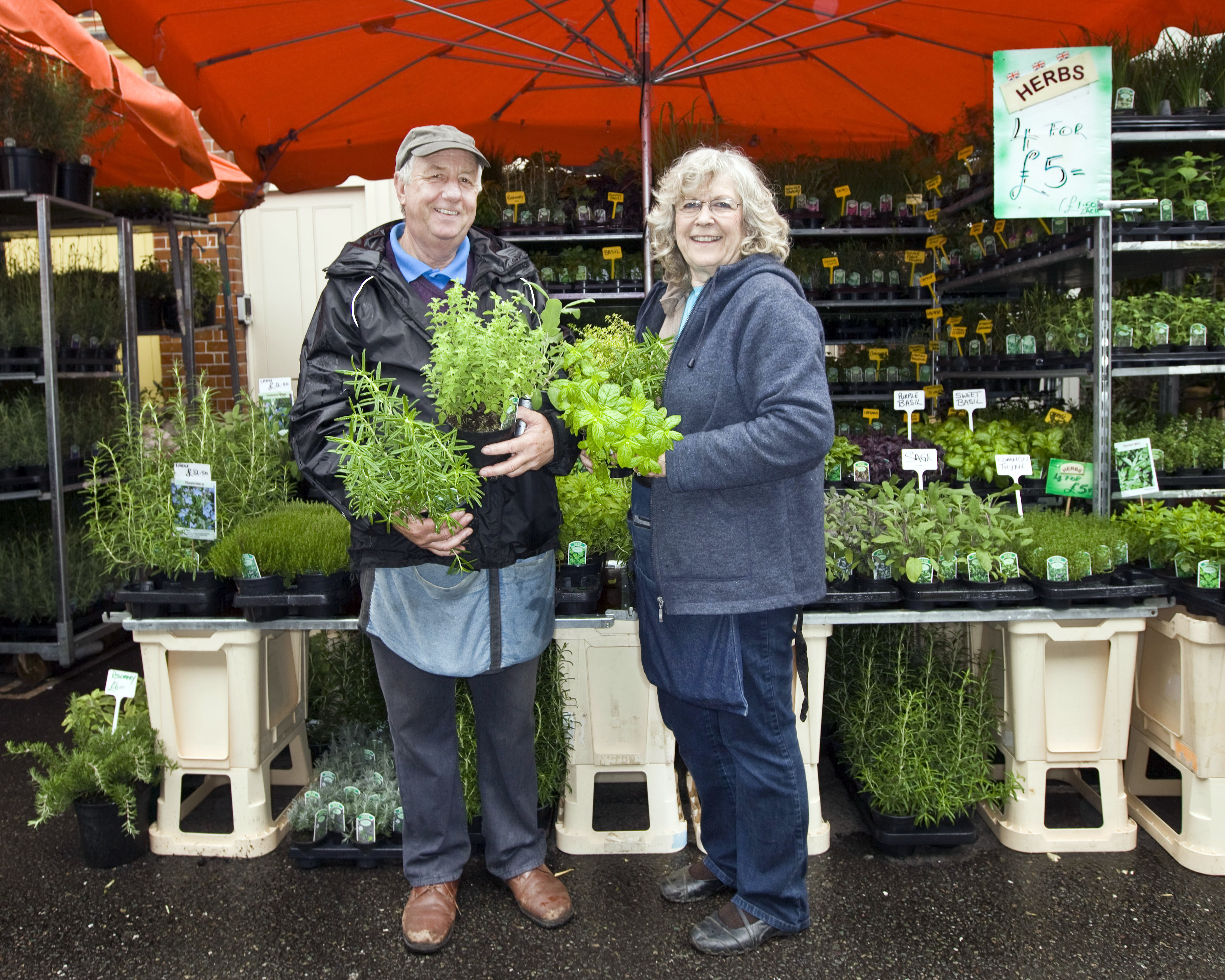
Mick & Sylvia Grover, Herb Sellers in Columbia Rd – Portrait by Jeremy Freedman

Margaret Willes in her garden – Portrait by Sarah Ainslie
The Gardens of the British Working Class by Margaret Willes is published by Yale University Press
You may also like to read about
Nicholas Culpeper, Herbalist of Spitalfields
Thomas Fairchild, Gardener of Hoxton
Thierry Girard’s East End, 1976
Today it is my pleasure to show these photographs by Thierry Girard from 1976

“More than simply pictures from my early years as a photographer, these are the starting point of my photographic work. At the beginning of 1976, when I was twenty-four, I had just graduated from Paris Institute of Political Studies and I had no specific idea about my future. I was very interested in photography, I bought my first photography books and I went to exhibitions, but I had very little experience.
At that time, my interest was in British photography and photographs taken in Britain by foreigners. I was an Anglophile. I was fond of Bill Brandt’s work, of course, and I was familiar with the photographs of Tony Ray-Jones, Homer Sykes and David Hurn – but the real catalyst was to be Robert Frank’s portfolio of London & Wales published in the 1975 edition of the Creative Camera International Yearbook. Knowing London rather well —I had stayed there several times in the previous years— I immediately related to the atmosphere of Frank’s pictures.
So I decided to go back to London for a challenge, a rite of initiation: to face the outside world and do photography. I stayed in the East End where I had lived as a student, although I did not intend to do a reportage about the East End or Eastenders. I just wanted to walk for hours and days in, snatching bits of life, passing through dilapidated districts, pushing doors of pubs, rambling through markets and playing with kids. I spent time with a wonderful couple, clever and cheerful people, but living in poverty in a damp basement flat while sewing ties for chic French companies. At lunchtime or in the evenings I went to strip pubs. The people attending the shows, both men and women, were locals.
I hope these photographs made in London in 1976 are worth revisiting. Very few of these pictures have ever been published or exhibited, but what I did there at the time has been decisive for my future as a photographer.” – Thierry Girard

At the Elephant, Dalston

In Brick Lane

At the Elephant, Dalston

In Bethnal Green

Alan B, homeworker in Graham Rd, Hackney

In Mare St

In Wapping

In Ridley Rd Market

In Dalston

Betty & Penny B, Graham Rd, Hackney

In Hackney

At Limehouse Social Club

In Wapping

At Limehouse Social Club

In Bethnal Green

In Tower Hamlets

In Hackney

In Hackney

Hackney Empire
Photographs copyright © Thierry Girard
You may also like to take a look at
Philip Marriage’s Spitalfields
George Cruikshank At The Tower Of London

The Execution of Lady Jane Grey at Tower Green
“It has been for years, the cherished wish of the writer of these pages to make the Tower of London the groundwork of a Romance,” wrote William Harrison Ainsworth in 1840, introducing his novel, “The Tower of London” – and it is an impulse that I recognise, because I know of no other place in London where the lingering sense of myth and the echoing drama of the past is more tangible that at the Tower.
Whenever I have entered those ancient walls, I am struck anew by the mystery of the place. I have to stop and reconcile my knowledge of history with the location where it happened, and each time I become more spellbound by the actuality of the place, which in spite of Victorian rebuilding still retains its integrity as an ancient fortress. I always make a point to pause and read the age-old graffiti, to stop in each doorway and take in the prospect at this most dramatic of monuments.
When I discovered “The Tower of London” by William Harrison Ainsworth in the Bishopsgate Institute I was captivated by George Cruikshank’s illustrations, realising that not only had this favourite of mine amongst nineteenth century illustrators once stood in exactly the same places I had stood, but he had the genius to draw the images inspired by these charged locations.
“Desirous of exhibiting the Tower in its triple light of a palace, a prison and a fortress, the author has shaped his story with reference to that end, and he has also endeavoured to combine such a series of incidents as should naturally introduce every relic of the old pile, its towers, halls, chambers, gateways and drawbridges – so that no part of it should remain uninvolved.” explained Ainsworth in his introduction to his sensationalist fictionalised account of the violent end of the short reign of Lady Jane Grey. Yet it is George Cruikshank’s engravings which bring the work alive, providing not just a tour of the architectural environment but also of the dramatic imaginative world that it contains – and done so vividly that I know already that when I return I shall be looking out for his characters in my mind’s eye while I am there.
There is a grim humour and surreal poetry in pictures which, to my eyes, presage the work of Edward Gorey, who like George Cruikshank also created a sinister diaphanous world out of dense hatching. Maurice Sendak is another master of the mystery that can be evoked by intricate webs of woven lines in which – as in these Tower of London engravings – three dimensional space dissolves into magical possibility. But to me the prime achievement of these pictures is that George Cruikshank has given concrete life to the Tower’s past, creating figures that convincingly take command of the stage offered by its charged spaces and, like the acting of Henry Irving, appear as if momentarily illuminated by flashes of lightning. Cruikshank’s pictures are like glimpses of a strange dream, drawing the viewer into a compelling emotional universe with its own logic, peopled by its own inhabitants and where it is too readily apparent what is going on.
The popularity of William Harrison Ainsworth’s novel was responsible for creating the bloodthirsty reputation of the Tower of London which still endures today – even though for centuries the Tower was used as a domestic royal residence and administrative centre, headquarters of the royal ordinances, records office, mint, observatory, and a menagerie amongst other diverse functions throughout its thousand year history. Yet although it may be just one of the infinite range of tales to be told about the Tower of London, William Harrison Ainsworth’s Romance does witness historical truth. There is a neglected plaque in the corner of Trinity Green, just outside Tower Hill station, which is a memorial to those executed there through the centuries – as testament to the reality of the violence enacted upon those with the misfortune to find themselves on the wrong side of authority in past days.

Jane Grey’s first night in the Tower – “Prompted by an undefinable feeling of curiosity, she hastened towards it and, holding forward the light, a shudder went through her frame, as she perceived at her feet – an axe!”

Cuthbert Cholmondeley surprised by a mysterious figure in the dungeon adjoining the Devilin Tower.

Jane Grey interposing between the Duke of Northumberland and Simon Renard.

Jane Grey and Lord Gilbert Dudley brought back to the Tower through Traitors’ Gate – “Never had Jane experienced such a feeling of horror as now assailed her – and if she had crossed the fabled Styx, she could not have greater dread. Her blood seemed congealed within her veins as she gazed around. The light of the torches fell upon the black arches – upon the slimy walls and upon the yet blacker tide.”

Jane imprisoned in the Brick Tower – “Alone! The thought struck her to the heart. She was now captured. She heard the doors of the prison bolted – she examined its stone walls, partly concealed by tapestry – she glance at its barred windows, and she gave up hope.”

Simon Renard and Winwinkle, the warder, on the roof of the White Tower – “There you behold the Tower of London,” said Winwinkle, pointing downwards. “And there I read the history of England,” replied Renard. “If it is written in these towers, it is a dark and bloody history, ” replied the warder.

Mauger sharpening his axe – ” A savage-looking individual seated on a bench at a grinding stone, he had an axe blade which he had just been sharpening, and he was trying its edge with his thumb. His fierce blood-shot eyes, recessed far beneath his bent and bushy brows were fixed upon the weapon.”

Execution of the Duke of Northumberland upon Tower Hill – “As soon as the Duke had disposed himself upon the block, the axe flashed like a gleam of lightning in the sunshine – descended – and the head was severed from the trunk. Mauger held it aloft, almost before the eyes were closed, crying out to the the assemblage in a loud voice, “Behold the head of a traitor!”

Cuthbert Cholmondeley discovering the body of Alexia in the Devilin Tower – “Pushing aside the door with his blade, he beheld a spectacle that filled him with horror. At one side of the cell upon a stone seat, rested the dead body of a woman, reduced almost to a skeleton. On the wall, close to where she lay, and evidently carved by her own hand, the name ALEXIA.”

Queen Mary surprises Courtenay and Princess Elizabeth

Lawrence Nightgall dragging Cicely down the secret stairs in the Salt Tower

Courtenay’s escape from the Tower

The burning of Edward Underhill at Tower Green – “As the flames rose, the sharpness of the torment overcame him. He lost control of himself, and his eyes started from their sockets – his contorted features and his writhing frame proclaimed the extremity of his agony. It was a horrible sight, and a shudder burst forth from the assemblage.”

The Death Warrant – “Mary tried to ascertain the cause of the animal’s disquietude as its barking changed to a dismal howl. Not without misgiving, she glanced towards the window and there between the bars she beheld a hideous black mask, through the holes of which glared a pair of flashing eyes.”

Elizabeth confronts Sir Thomas Wyatt in the torture chamber – “‘Sir Thomas Wyatt,’ Elizabeth declared in a loud and authoritative tone, and stepping towards him, ‘If you would not render your name forever infamous, you must declare my innocence!'”

The Fall of Nightgall – “Nightgall struggled desperately against the horrible fate that waited him, clutching convulsively against the wall. But it was unavailing. He uttered a fearful cry, and tried to grab at the roughened surface. From a height of nearly ninety feet, he fell with a terrific smash upon the pavement of the court below.”

The Night before the Execution – “In spite of himself, the executioner could not repress a feeling of dread and the contrary urge, which represented his curiousity. He pointed towards the church porch, from which a figure, robed in white, but insubstantial as the mist, suddenly appeared. It glided noiselessly along and without turning its face to the beholders.”

Jane Grey meeting the body of her husband at the scaffold – “She knew it was the body of her husband, and unprepared for so terrible an encounter, uttered a cry of horror.”

Plaque at Trinity Green on Tower Hill
You may also like to read
John Keohane, Chief Yeoman Warder at the Tower of London
The Journey Of Martin Nadaud
Contributing Historian Gillian Tindall sent me this account of the life of Martin Nadaud (1815-98), a refugee who came to London in the nineteenth century and worked as a stone mason to survive

The familiar beggars disappeared from the streets of London when the lockdown began, but here and there new homeless faces have taken their place. These men show no sign of alcohol or drug use and are overly grateful – in limited English – for the few coins that come their way. They are immigrants and refugees of uncertain status who did labouring or restaurant work in ordinary times but now have nothing.
Like plagues and wars, it has all happened before in London. One particular long-ago immigrant who struggled to survive on our streets is of special interest to me. He was a stone-mason by trade and his name was Martin Nadaud.
Born in the year of Waterloo in mountainous Central France, far from battles or political conflict, he walked to Paris with his father when he was fourteen. Away from home and learning a trade on the job, this clever boy studied in his own time to replace his regional dialect and taught himself to read and write. Through the turmoils and mini-revolutions of the eighteen-thirties and forties he grew interested in politics and human rights. By the time Emperor Louis-Napoleon (the nephew of the first Napoleon) took over in 1849, Nadaud was such a well-known figure that he was elected as the first working class member of Parliament in France.
Yet his triumph was short-lived. Within two years Louis-Napoleon revealed dictatorial tendencies and sought to rid himself of critics. Nadaud, along with many other left-wingers, was imprisoned and then banished. Where should he go but England, traditionally celebrated for not being a police state and welcoming refugees?
Nadaud took a paddle steamer to Wapping and stayed his first night in a house in Soho that had long been a shelter for French refugees. Next morning he and a compatriot walked to a huge, muddy site in the unbuilt wastes beyond Kings Cross, where the railway stations had yet to appear. There Nadaud got a job building the new Metropolitan Meat-Market.
It was a lonely life. He could not speak with any of his work mates, many of whom were wary of him. Most of the other French political refugees had private means. After that job came to an end Nadaud had to walk, cap-in-hand, to sites elsewhere. “Chance of a job, Master?” was the first English phrase he learnt. As with many highly qualified immigrants today – it was as if, on the way over the Channel, all his achievements and hard-won status of the last twenty years had vanished. In the depths of a bitter winter, when the Crimean War brought a slump in the building trade, he could not even afford coal for a fire to heat his rented room in Greenwich
I am happy to report that after enduring times so dire he passed over them in his memoir, Nadaud made good. An unnamed friend, who may have been Friedrich Engels, arranged a job for him near Manchester where mill-building was flourishing. There, for the first time, he encountered the source of Britain’s manufacturing prosperity.
Later, while lodging with the family of a carpenter in Wimbledon, he observed how well they lived by comparison with families in France of the same social level. “On Sunday, round the dinner table, it is more like being with a prosperous shop-keeper’s family than with a working class one.”
Development was booming in London in the mid-nineteenth century. The population of the capital increased sixfold during the century, making it the largest city in the world. While continental capitals were mostly still corseted within their ancient limits – and Paris was building a new defensive wall – London was already pursuing the suburban dream. The fields and market gardens of Kensington and Chelsea were disappearing under terraces of upmarket housing. Bayswater and Paddington were being colonised, and Camden Town was stretching greedy fingers out all the way towards Hampstead. The inauguration of the Metropolitan Railway in 1863 – the world’s first Underground – opened more distant possibilities. Consequently, the British have been in thrall to the questionable fantasy of ‘living in the country’ while working in the town ever since.
Meanwhile in the older neighbours, enormous redevelopment was underway. Over the previous two hundred years, the surviving Tudor mansions of Bishopsgate and Clerkenwell, Holborn and Westminster, had been destroyed piecemeal. Protests against this vandalism by conservationists including William Morris and C.R. Ashbee lay in the future.
Yet it was not only precious relics of old London that were reduced to dust and smoke. The coherent Georgian urban landscape with its elegant terraces was being superseded by taller and larger housing blocks, usually of red brick in a pseudo-ecclesiastical style. There were also new mansions for the super rich, public institutions, hospitals, schools, model dwellings for the working classes, railway stations with towering hotels, new churches to replace old ones, Holborn Viaduct to cover the dirty Fleet River and, indeed, Barry & Pugin’s new Houses of Parliament.
All this, Nadaud tentatively admired. Eventually, he found more congenial employment in one of the new Gothic school-buildings where he taught French to young gentlemen, concealing from them and his employer that he ever wielded a builder’s trowel. Nadaud remained grateful to England for giving him a new life, even if he had had to struggle for it.
On the Emperor’s downfall in 1870, Nadaud returned to his homeland. Acclaimed as a returning hero, he was given a job in the new administration. A respected but lonely figure, Nadaud lived for another twenty-eight years, writing his semi-fictional memoir and his account of the British working classes, which – perhaps unsurprisingly – proved not to be a big seller in France.
He spent his remaining years trying to persuade those in charge of Paris that they needed an Underground like London’s, although he did not live to see it built. Yet as the Métro began to be constructed in the year of his death, I like to think that he knew at the last that this particular dream would be fulfilled.

Leaving the village to walk in search of employment in the city

Masons at work

Hostel for for casual labourers

Wimbledon School where Nadaud taught

Martin Nadaud (1815-98)
Gillian Tindall’s book The Journey of Martin Nadaud: a life and turbulent times was first published in 1999 and copies can be found online. Her latest book The Pulse Glass & The Beat of Other Hearts is published by Chatto & Windus
You may like to read these other stories by Gillian Tindall
Wenceslaus Hollar at Old St Paul’s
Memories of Ship Tavern Passage
Gillian Tindall’s Wartime Memories
At Captain Cook’s House in Mile End


