
The Nine Herbs Charm To Cure Infection
We publish the text of the Anglo-Saxon Nine Herbs Charm to cure infection, of which many ingredients – we are reliably informed – are to found locally at the last bombsite in Aldgate. The charm is recorded in the tenth century Lacnunga (remedies) manuscript in British Museum and is published here accompanied by the translation by Þórbeorht Línléah and illustrated with plates from old herbals.
“may thou withstand the loathsome that yond the land fareth”

Artemisia Vulgaris (Mugwort)
Gemyne ðú, mucgwyrt, hwæt þú ámeldodest,
hwæt þú renadest æt Regenmelde.
Una þú hattest, yldost wyrta.
ðú miht wið III and wið XXX,
þú miht wiþ áttre and wið onflyge,
þú miht wiþ þám láþan ðe geond lond færð.
Remember thou, Mugwort, what thou declared
What thou advised at the proclamation of the gods (Regen, “council of the gods,” and meld, “proclamation”)
“Una” (First) thou were named, the eldest of worts (herbs)
Thou hast might against three and against thirty,
thou hast might against venom and against that which flies.
thou hast might against the loathsome that yond the land fareth.

Plantago Major (Plantain)
Ond þú, Wegbráde, wyrta módor,
éastan openo, innan mihtigu;
ofer ðé crætu curran, ofer ðe cwene reodan,
ofer ðé brýde bryodedon, ofer þé fearras fnærdon.
Eallum þú þon wiðstóde and wiðstunedest;
swa ðú wiðstonde áttre and onflyge
and þæm laðan þe geond lond fereð.
And thou, Waybread (Plantain), mother of worts
open to the east, mighty within;
over thee carts creaked, over thee queens (women) rode,
over thee brides cried out, over thee bulls snorted.
All of them thou withstood and dashed against;
so may thou withstand venom and that which flies
and the loathsome that yond the land fareth.

Cardamina Hirsuta (Hairy Bittercress)
Stune hætte þéos wyrt, héo on stane gewéox;
stond héo wið áttre, stunað héo wærce.
Stíðe héo hatte, wiðstunað héo attre,
wreceð héo wráðan, weorpeð út áttor.
Stune (Watercress) is named this wort, she on stone waxes;
stands she against venom, stuneth (dasheth) she against pain.
“Stiff” she is named, withstandeth she venom,
wreaked (driveth out) she the wrathful, warpeth (casteth) out venom.

Stachys Annua (Betony)
þis is séo wyrt séo wiþ wyrm gefeaht,
þéos mæg wið áttre, héo mæg wið onflyge,
héo mæg wið ðam laþan ðe geond lond fereþ.
Fléoh þú nú, Áttorláðe, séo læsse ðá máran,
séo máre þá læssan, oððæt him beigra bót sy.
This is the wort that with wyrm (serpent) fought,
she that prevails against venom, she that prevails against that which flies,
she prevails against the loathsome that yond the land fareth.
Put thou now to flight, Adder-loather (Betony, the lesser [and] the more
the more [and] the lesser, until he, of both, is cured.

Matricaria Discoidea (Chamomile)
Gemyne þú, mægðe, hwæt þú ameldodest,
hwæt ðú geændadest æt Alorforda;
þæt næfre for gefloge feorh ne gesealde
syþðan him mon mægðan tó mete gegyrede.
Remember thou, Mayweed (Chamomile), what thou declared,
What thou earned at Alder-fjord;
that never for that which flies life would be sold (given, lost)
since for him mayweed, as meat (food), was readied.

Urtica Dioica (Nettle)
þis is séo wyrt ðé Wergulu hatte;
ðás onsænde seolh ofer sæs hrygc
ondan áttres óþres tó bóte.
This is the wort that is named Weregulu (Nettle);
this sent a seal over the sea’s ridge
the undoing of venom, to others a cure.

Malus Domestica (Apple)
Þas VIIII magon wið nygon attrum.
Wyrm cóm snícan tóslát hé man
ðá genóm Wóden VIIII wuldortánas,
slóh ðá þá næddran, þæt héo on VIIII tófléah.
Þær geændade Æppel and áttor,
þæt héo næfre ne wolde on hús búgan.
These nine have main (power) against nine venoms.
Wyrm came sneaking. It slit a man
Then took up Wóden nine glory-tines (tines of Wuldor),
slew with them the adder that she into nine flew.
There earned Apple and venom
that she never would bend-way (slither) into house.

Anthriscus Sylvestris (Chervril)

Foeniculum Vulgare (Fennel)
Fille and Finule, felamihtigu twá,
þá wyrte gesceop witig drihten,
hálig on heofonum, þá hé hóngode;
sette and sænde on VII worulde
earmum and éadigum eallum tó bóte.
Stond héo wið wærce, stunað héo wið éáttre,
séo mæg wið III and wið XXX,
wið feondes hond and wið færbregde,
wið malscrunge mánra wihta.
Chervil and Fennel, most mighty two,
those worts were shaped by the witty Drighten,
holy in the heavens, where he hung;
set and sent [them] into seven worlds
for the wretched and the wealthy for all a cure.
Stands she against pain, stuneth (dasheth) she against venom,
that prevails against three and against thirty,
against the fiend’s hand and against far-braiding (shape-shifting?),
against maskering (bewitching) by evil wights.
Nú magon þás VIIII wyrta wið nygon wuldorgeflogenum,
wið VIIII áttrum and wið nygon onflygnum,
wið ðý réadan áttre, wið ðý runlan áttre,
wið ðý hwítan áttre, wið ðý hæwenan áttre,
wið ðý geolwan áttre, wið ðý grénan áttre,
wið ðý wonnan áttre, wið ðý wedenan áttre,
wið ðý brúnan áttre, wið ðý basewan áttre,
wið wyrmgeblæd, wið wætergeblæd,
wið þorngeblæd, wið þystelgeblæd,
wið ýsgeblæd, wið áttorgeblæd,
gif ænig áttor cume éastan fléogan
oððe ænig norðan [ænig súþan] cume
oððe ænig westan ofer werðéode.
Now prevail these nine worts (herbs) against the nine wonder-flying-ones,
against nine venoms, and against nine which fly,
against the red venom, against the foul smelling venom,
against the white venom, against the blue-gray venom,
against the yellow venom, against the green venom,
against the wan (dark) venom, against the woad (blue) venom,
against the brown venom, against the crimson venom,
against the wyrm-blister, against the water-blister,
against the thorn-blister, against the thistle-blister,
against the ice-blister (frostbite), against the venom blister,
if any venom comes flying from the east,
or any other from the north, any [from the south] come
or any other from the west over the tribes of men.
Ic ána wat éa rinnende
þær þá nygon nædran néan behealdað;
motan ealle wéoda nú wyrtum áspringan,
sæs tóslúpan, eal sealt wæter,
ðonne ic þis áttor of ðé geblawe.
I alone wot (know) of a river running
There the nine adders near it beholdeth; (keep watch)
May all weeds now from worts spring,
Seas to slip away, all salt water,
When I, this venom from thee blow.
Mugcwyrt, wegbráde þé éastan open sy, lombescyrse, áttorláðe, mageðan, netelan, wudusúræppel, fille and finul, ealde sápan: gewyrc ðá wyrta to duste, mængc wiþ þá sápan and wiþ þæs æpples gor. Wyrc slypan of wætere and of axsan, genim finol, wyl on þære slyppan and beþe mid æggemongc, þonne hé þá sealfe on dó, ge ær ge æfter. Sing þæt galdor on ælcre þára wyrta, III ær hé hý wyrce and on þone æppel ealswá; ond singe þon men in þone muð and in þá earan bútá and on ðá wunde þæt ilce gealdor, ær hé þá sealfe on dó.
Mugwort, Waybread (plantain) that is open to the east, lambcress (stune), adder-loather (betony), mayweed, nettle (weregulu), apple, chervil and fennel, and old soap: work the worts to dust, mix with the soap and with the apple’s gore. Work up a slop of water and of ashes, take the fennel, well it up (boil it) in the slop and bathe it with an egg-mixture, when he dons the salve, either ere or after. Sing that galdor (incantation) o’er each of those worts thrice ere you work them and on the apple also; and sing it into the man’s mouth and in both ears and on the wound likewise galdor, ere he dons the salve.
You may also like to read about
List Of Local Shops Open For Business

Samuel Stores by John Allin, 1975
Each Wednesday, I shall be publishing the list of stalwarts that remain open locally. Readers are especially encouraged to support small independent businesses who offer an invaluable service to the community. This list confirms that it is possible to source all essential supplies locally without recourse to supermarkets.
Be advised many shops are operating revised opening hours at present, so I recommend you call in advance to avoid risking a wasted journey. Please send any additions or amendments for next week’s list to spitalfieldslife@gmail.com

Wentworth St by John Allin
GROCERS & FOOD SHOPS
Ali’s Mini Superstore, 50d Greatorex St
AM2PM, 210 Brick Lane
As Nature Intended, 132 Commercial St
The Butchery Ltd, 6a Lamb St (Open Thursdays only)
Banglatown Cash & Carry, 67 Hanbury St
Brick Lane Minimarket, 100 Brick Lane
City Supermarket, 10 Quaker St
Costprice Minimarket, 41 Brick Lane
Faizah Minimarket, 2 Old Montague St
JB Foodstore, 97 Brick Lane
Leila’s Shop, 17 Calvert Avenue (Call 0207 729 9789 between 10am-noon on Tuesday-Saturdays to place your order and collect on the same day from 2pm-4pm)
Nisa Local, 92 Whitechapel High St
Nude Expresso, The Roastery, 25 Hanbury St (For sale of coffee beans only)
Pavilion Bakery, 130 Columbia Rd
Planet Organic, 10 Devonshire Sq
Sylhet Sweet Shop, 109 Hanbury St
Taj Stores, 112 Brick Lane
Zaman Brothers, Fish & Meat Bazaar, 19 Brick Lane

Whitechapel Rd by John Allin
TAKE AWAY FOOD SHOPS
Absurd Bird Fried Chicken, 54 Commercial St
Albadam Fried Chicken, 37 Brick Lane
Beigel Bake, 159 Brick Lane
Beigel Shop, 155 Brick Lane
Big Moe’s Diner, 95 Whitechapel High St
Burro E Salvia Pastificio, 52 Redchurch St
China Feng, 43 Commercial St
Enso Thai & Japanese, 94 Brick Lane
Holy Shot Coffee, 155 Bethnal Green Rd
Leon, 3 Crispin Place, Spitalfields Market
E. Pellicci, 332 Bethnal Green Rd
Peter’s Cafe, 73 Aldgate High St
Picky Wops Vegan Pizza, 53 Brick Lane
Shawarma Lebanese, 84 Brick Lane
Stingray Globe Cafe, 109 Columbia Road
Sushi Show, 136 Bethnal Green Rd

Fashion St by John Allin
OTHER SHOPS & SERVICES
Boots the Chemist, 200 Bishopsgate
Brick Lane Bikes, 118 Bethnal Green Rd
Brick Lane Off Licence, 114 Brick Lane
Day Lewis Pharmacy, 14 Old Montague St
Leyland Hardware, 2-4 Great Eastern St
Post Office, 160a Brick Lane
ELSEWHERE
City Clean Dry Cleaners, 4a Cherry Tree Walk, Whitecross St
Hackney Essentials, 235 Victoria Park Rd
Quality Dry Cleaners, 16a White Church Lane
Region Choice Chemist, 68 Cambridge Heath Rd
Thompsons DIY, 442-444 Roman Rd

Brick Lane by John Allin
One Hundred Penguin Books


I came across this set of the first hundred Penguin books in my attic when I was unpacking a box that has been sealed since I moved in. With their faded orange, indigo, green, violet and pink spines they make a fine display and I am fond of this collection that took me so many years to amass.
When I left college, I wrote to companies all over the country seeking work and asking if they would give me an interview if I came to see them. Then I travelled around on the cheap, through a combination of buses, trains and hitchhiking, to visit all these places – the industrial towns of the North and the Cathedral cities of the South – staying in bus stations, youth hostels and seedy B&Bs, and going along filled with hope to interviews that were almost all fruitless. It was the first time I encountered the distinctive regional qualities of Britain and in each city, to ameliorate the day of my interview, I took the opportunity to visit the museums, civic art galleries, cathedrals and castles that distinguish these places. Arriving at each destination, I would consult the directory and make a list of the second-hand booksellers, then mark them on a tourist map and, after the job interview, I would visit every one. There were hundreds of these scruffy dusty old shops with proprietors who were commonly more interested in the book they were reading behind the counter than in any customer. Many were simply junk shops with a few books piled in disorder on some shelves in the back or stacked in cardboard boxes on the pavement outside.
In these shabby old shops, I sometimes came upon Penguin books with a podgy penguin on the cover, quite in contrast to the streamlined bird familiar from modern editions. These early titles, dating from 1935 had a clean bold typography using Eric Gill’s classic sans typeface and could be bought for just twenty or thirty pence. So, in the manner of those cards you get in bubblegum packets, I began to collect any with numbers up to one hundred. In doing so, I discovered a whole library of novelists from the nineteen thirties and reading these copies passed the time pleasantly on my endless journeys. In particular, I liked the work of Eric Linklater whose playful novel “Poet’s Pub” was number two, Compton Mackenzie whose novel of the Edwardian vaudeville “Carnival” was ten, Vita Sackville-West whose novel “The Edwardians” was sixteen, T.F.Powys whose “Mr Weston’s Good Wine” was seventy-three and Sylvia Townsend Warner whose novel “Lolly Willowes” was eighty-four. After these, I read all the other works of these skillful and unjustly neglected novelists.
Eventually I found a job in Perthshire and then subsequently in Inverness, and from here I made frequent trips to Glasgow, which has the best second-hand bookshops in Scotland, to continue my collection. And whenever I made the long rail journey down South, I commonly stopped off to spend a day wandering round Liverpool or Durham or any of the places I had never been, all for the purpose of seeking old Penguins.
The collection was finally completed when I moved back to London and discovered that my next door neighbour Christine was the daughter of Allen Lane who founded Penguin books. She was astonished to see my collection and I was amazed to see the same editions scattered around her house. From Christine, I learnt how her father Allen was bored one day on Exeter St David’s Station (a place familiar to me), changing trains on the way to visit his godmother Agatha Christie. When he searched the bookstall, he could not find anything to read and decided to start his own company publishing cheap editions of good quality books. I presume he did not know that, if he had been there half a century earlier, he could have bought a copy of Thomas Hardy’s first published novel “Desperate Remedies”, because Exeter St David’s was where Hardy experienced that moment no writer can ever forget, of first seeing their book on sale.
I do not think my collection of Penguins is of any great value because they are of highly variable condition and not all are first editions, though every one predates World War II and they are of the uniform early design before the bird slimmed down. While I was collecting these, I thought that I was on a quest to build my career – a fancy that I walked away from, years later. Now these hundred Penguin books are the only evidence of my innocent tenacity to create a life for myself at that time.
Allen Lane’s idealistic conception, to use the mass market to promulgate good writing to the widest readership in cheap editions that anyone could afford, is one that I admire. And these first hundred are a fascinating range of titles, a snapshot of the British public’s reading tastes in the late thirties. Looking back, the search for all these books led me on a wonderful journey through Britain. If you bear in mind that I only found a couple in each city, then you will realise that my complete collection represents a ridiculously large number of failed job interviews in every corner of these islands. It was a job search than became a cultural tour and resulted in a stack of lovely old paperbacks. Now they sit on my shelf here in Spitalfields as souvenirs of all the curious places I never would have visited if it were not my wayward notion to scour the entire country to collect all the first hundred Penguins.


The Weathervanes Of Old London
There is no more magical sight to glimpse in a London street on a bright spring morning than that of a gilded weathervane, glinting in sunlight high above the rooftops. At once – in spite of all the changes that time has wrought – you know you are sharing in a visual delight enjoyed by three centuries of Londoners before you and it makes your heart leap.
Consequently, I am grateful to Angelo Hornak who photographed this gallery of magnificent weathervanes for his book AFTER THE FIRE, London Churches in the Age of Wren, Hawksmoor & Gibbs published by Pimpernel Press.

Spire of St Mary-Le-Bow, Cheapside, by Christopher Wren

Dragon upon St Mary-Le-Bow, representing the City of London

Arrow & pennant on St Augustine, Watling St

Spire of St Bride’s Fleet St by Christopher Wren

Gridiron on St Lawrence Jewry, symbol of the martyrdom of St Lawrence

Weathervane on St Magnus the Martyr by Christopher Wren

Weathervane on St Michael Paternoster Royal, College St

Galleon on St Nicholas Cole Abbey, moved from St Michael Queenhithe after demolition

Weathervane on St James Garlickhythe

Crown on St Edmund King & Martyr, Lombard St

Key on the Tower of St Peter Cornhill

Cockerell on St Dunstan-in-the-East by Christopher Wren

Comet on St Mary-Le-Strand

Spire of St Martin in the Fields by James Gibbs

Square-rigged ship on St Olave Old Jewry

Flaming red-eyed dragon on St Luke, Old St, described as a flea in popular lore

Weathervane on St Stephen Walbrook by Nicholas Hawksmoor

‘Flame’ on the top of the Monument by Christopher Wren
Photographs copyright © Angelo Hornak
You may also like to take a look at
Margaret Rope’s East End Windows

A familiar East End scene of 1933 – children playing cricket in the street and Nipper the dog joining in – yet it is transformed by the lyrical vision of the forgotten stained glass artist Margaret Rope, who created a whole sequence of these sublime works – now dispersed – depicting both saints of legend and residents of Haggerston with an equal religious intensity.
This panel is surmounted by a portrayal of St Leonard, the sixth century French saint, outside a recognisable St Leonard’s church, Shoreditch, with a red number six London bus going past. Margaret Rope’s extraordinary work mixes the temporal and the spiritual, rendering scenes from religious iconography as literal action and transforming everyday life into revelations – describing a universe simultaneously magical and human.
Between 1931 and 1947, the artist known simply to her family as ‘”Tor,” designed a series of eight windows depicting “East End Everyday Saints” for St Augustine’s church off the Hackney Rd, portraying miracles enacted within a recognisable East End environment. For many years these were a popular attraction, until St Augustine’s was closed and Margaret Rope’s windows removed in the nineteen-eighties, with two transferred across the road to St Saviour’s Priory in the Queensbridge Rd and the remaining six taken out of the East End to be installed in the crypt of St Mary Magdalene, Munster Sq. Intrigued by the attractive idea of Margaret Rope’s transcendent vision of the East End, I set out to find them for myself.
At St Saviour’s Priory, Sister Elizabeth was eager to show me their cherished windows of St Paul and St Margaret, both glowing with lustrous colour and crammed with intricate detail. St Paul, the patron saint of London, is depicted at the moment of his transformative vision, beneath St Paul’s Cathedral – as if it were happening not on the road to Damascus but in Ludgate Circus. The other window, portraying St Margaret, has particular meaning for the sisters at St Saviours, because they are members of the Society of St Margaret, whose predecessors first came from Sussex to Spitalfields in 1866 to tend to the victims of cholera. In Margaret Rope’s window, St Margaret resolutely faces out a dragon while Christ hands a tiny version of the red brick priory to John Mason Neale, the priest who founded the order. Both windows are engaging exercises in magical thinking and the warmth of the colours, especially turquoise greens and soft pinks, delights the eye with its glimmering life.
I found the other six windows in the crypt of St Mary Magdalene near Regents Park, now used as a seniors’ day centre, where they are illuminated from the reverse by fluorescent tubes. The first window you see as you walk in the door is St Anne, which contains an intimate scene of a mother and her two children, complete with a teddy bear lying on the floor and a tortoiseshell cat sleeping by the range.
Next comes St George, who looks like a young athlete straight out of the Repton Boxing Club, followed by St Leonard, St Michael, then St Augustine and St Joseph. All share the same affectionate quality in their observation of human detail that sets them above mere decorative windows. These are poems in stained glass manifesting the resilient spirit of the East End which endured World War II. Another window by Margaret Rope in St Peters in the London Docks, completed in 1940, showed parishioners celebrating Midnight Mass at Christmas in a bomb shelter.
Margaret Edith Aldrich Rope was born in 1891 into a farming family on the Suffolk coast at Leiston. Her uncle George was a Royal Academician, and she was able to study at Chelsea College of Art and Central School of Arts & Crafts, where she specialised in stained glass. Unmarried, she pursued a long and prolific working life, creating over one hundred windows in her fifty year career, taking time out to join the Women’s Land Army in World War I and to care for evacuees at a hospital in North Wales during World War II, before returning to her native Suffolk at the age of eighty-seven in 1978.
Her nickname “Tor” was short for tortoise and she signed all her works with a tortoise discreetly woven into the design. Upon close examination, every window reveals hidden texts inscribed in the richly coloured shadows. So much thought and imagination is evident in these modest works executed in the magical realist style. They transcend their period as neglected yet enduring masterpieces of stained glass and I recommend you make your own acquaintance with the stylish work of Margaret Rope, celebrating the miraculous quality of the everyday.

St Leonard is portrayed in a moment of revelation outside St Leonard’s Church, Shoreditch, with Arnold Circus in the background and a London bus passing in the foreground

The lower panel of the St George window

A domestic East End scene from the lower panel of the St Anne’s window

This tortoise-shell cat is a detail from the panel above

The lower panel from the St Michael window

Mother Kate, Prioress of St Saviour’s and Father Burrows with his dog, Nipper, standing outside St Augustine’s in York St, now Yorkton St. In the right hand corner you can see the tortoise motif that Margaret Rope used to sign all her works.

Sisters of St Saviour’s Priory, portrayed in the lower panel of the St Margaret window, 1932

Margaret Rope’s St Paul and St Margaret, now in the entrance of Saviour’s Priory, Queensbridge Rd

Stained glass artist, Margaret Edith Aldrich Rope known as “Tor” (1891-1988)
You may also like to read about
At The Velho & Alderney Rd Cemeteries

Lilacs at Alderney Rd Cemetery
Spring is a poignant season to visit ancient cemeteries and remember the long dead, when the new grass is flourishing, fresh and green, and the scent of flowers hangs in the air. I spent a contemplative few hours exploring the Velho Sephardic Cemetery in Mile End, which is Britain’s oldest Jewish cemetery, opened in 1657, one year after the readmission of the Jews to this country in 1656, and the nearby Alderney Rd Ashkenazi Cemetery which has inscriptions dating from 1697.
A gothic door in an old wall opens to reveal the Velho Cemetery, sequestered from the public gaze just yards from the Mile End Rd. In 1657, Antonio Fernandez Carvajal, a Portuguese merchant, and Simon de Cacares, an Amsterdam-born merchant, leased an orchard plot on this site next to an inn called The Soldier’s Tenement for fourteen years at an annual rent of ten pounds, which was about ten times its market value. Yet, in spite of the financial opportunism of landowner Henry Clowes, the Jewish community was treated with respect by many others – as reflected in the tolling of church bells from Aldgate and along the Whitechapel Rd when bodies were carried out here from the City of London.
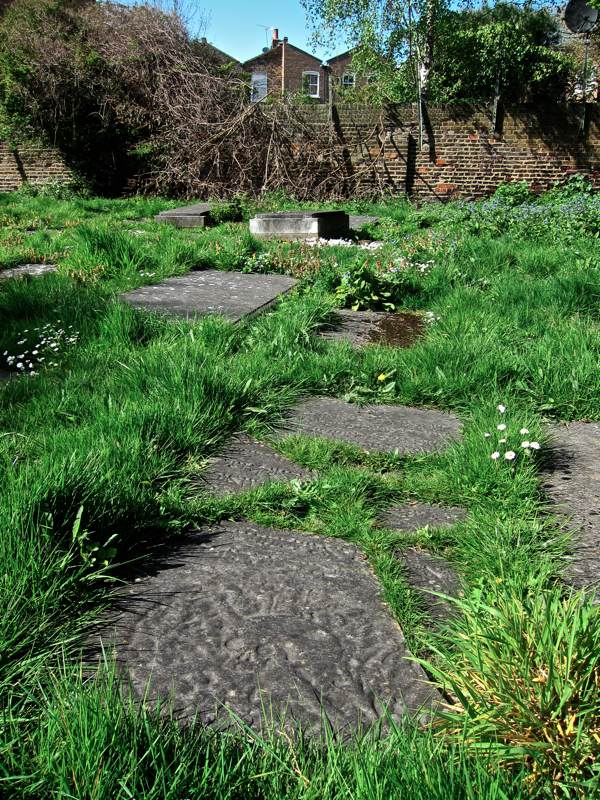
Today, you step into a large walled space approaching the size a of football pitch, with slabs placed in neat lines, yet overturned in places by trees sprouting and overgrown with thick grass and bluebells. Almost all the stones have lost their inscriptions, worn away over time, with just a few images discernible and enough lettering to distinguish Hebrew and Portuguese, reflecting the continental origins of many of those buried here.
An unmarked area contains the remains of plague victims from 1665/66, while the high levels of child mortality demanded that infants were buried in closely-packed rows of three foot graves. Between 1708 and 34, six hundred and thirty children were buried here, almost half of all those interred in that period. By the end of the seventeenth century, the Jewish population in London had grown to between six and seven hundred, with around five hundred Sephardim but, testifying to significant numbers of Ashkenazim, Benjamin Levy purchased adjoining land in Alderney Rd in 1696 for an Ashkenazi Cemetery. And the Velho itself was superseded in the eighteenth century by the Nuevo Cemetery, occupying land to the east purchased in 1724.
Entering the gate in the wall in Alderney Rd, you enter another of the East End’s secret sacred places and the atmosphere is quite different from the Velho. In this smaller, more domestic enclave sheltered by tall trees, you discover elaborate table tombs surrounded by vertical stones, like lines of broken teeth, erupting from the recently cut grass where lilac and fruit trees bloom. A twentieth century monolith lists those famous in death and a handsome warden’s cottage both reflect the recent care expended upon this site, which received burials until 1852 and where the devout still attend regularly to light candles for the most worthy of the departed.
The warmth of the sun and the depth of the shade rendered both cemeteries as welcoming tranquil places – where grief and sadness and loss have ebbed away, and the peace that is unique to the graveyard prevails.

The door to the Velho Cemetery

Tomb of David Nieto – born in Venice, he came to London be Rabbi at Bevis Marks Synagogue and established the first Jewish orphanage in 1713


Plaque of 1684 commemorates the laying of the foundation stone of the boundary wall


Entrance to Alderney Rd Cemetery


Tomb of Samuel Falk, the Cabbalist who died in 1782 and was known as the “Baal Shem of London”


You may also like to read about
The Auriculas Of Spitalfields

An auricula theatre
In horticultural lore, auriculas have always been associated with Spitalfields and writer Patricia Cleveland-Peck has a mission to bring them back again. She believes that the Huguenots brought them here more than three centuries ago, perhaps snatching a twist of seeds as they fled their homeland and then cultivating them in the enclosed gardens of the merchants’ grand houses, and in the weavers’ yards and allotments, thus initiating a passionate culture of domestic horticulture among the working people of the East End which endures to this day.
You only have to cast your eyes upon the wonder of an auricula theatre filled with specimens in bloom in Patricia’s Sussex garden to understand why these most artificial of flowers can hold you in thrall with the infinite variety of their colour and form. “They are much more like pets than plants,” Patricia admitted to me as we stood in her greenhouse surrounded by seedlings,“because you have to look after them daily, feed them twice a week in the growing season, remove offshoots and repot them once a year. Yet they’re not hard to grow and it’s very relaxing, the perfect antidote to writing, because when you are stuck for an idea you can always tend your auriculas.” Patricia taught herself old French and Latin to research the history of the auricula, but the summit of her investigation was when she reached the top of the Kitzbüheler Horn, high in the Austrian Alps where the ancestor plants of the cultivated varieties are to be found.
Auriculas were first recorded in England in the Elizabethan period as a passtime of the elite but it was in the eighteenth and nineteenth centuries that they became a widespread passion amongst horticulturalists of all classes. In 1795, John Thelwall, son of a Spitalfields silk mercer wrote, “I remember the time myself when a man who was a tolerable workman in the fields had generally beside the apartment in which he carried on his vocation, a small summer house and a narrow slip of a garden at the outskirts of the town where he spent his Monday either in flying his pigeons or raising his tulips.” Auriculas were included alongside tulips among those prized species known as the “Floristry Flowers,” plants renowned for their status, which were grown for competition by flower fanciers at “Florists’ Feasts,” the precursors of the modern flower show. These events were recorded as taking place in Spitalfields with prizes such as a copper kettle or a ladle and, after the day’s judging, the plants were all placed upon a long table where the contests sat to enjoy a meal together known as “a shilling ordinary.”
In the nineteenth century, Henry Mayhew wrote of the weavers of Spitalfields that “their love of flowers to this day is a strongly marked characteristic of the class.” and, in 1840, Edward Church who lived in Spital Sq recorded that “the weavers were almost the only botanists of their day in the metropolis.” It was this enthusiasm that maintained a regular flower market in Bethnal Green which eventually segued into the Columbia Rd Flower Market of our day.
Known variously in the past as ricklers, painted ladies and bears’ ears, auriculas come in different classes, show auriculas, alpines, doubles, stripes and borders – each class containing a vast diversity of variants. Beyond their aesthetic appeal, Patricia is interested in the political, religious, cultural and economic history of the auricula, but the best starting point to commence your relationship with this fascinating plant is to feast your eyes upon the dizzying collective spectacle of star performers gathered in an auricula theatre. As Sacheverell Sitwell once wrote, “The perfection of a stage auricula is that of the most exquisite Meissen porcelain or of the most lovely silk stuffs of Isfahan and yet it is a living growing thing.”

Mrs Cairns Old Blue – a border auricula

Glenelg – a show-fancy green-edged auricula

Piers Telford – a gold-centred alpine auricula

Taffetta – a show-self auricula

Seen a Ghost – a show-striped auricula

Sirius – gold-centred alpine auricula

Coventry St – a show-self auricula

M. L. King – show-self auricula

Mrs Herne – gold-centred alpine auricula

Dales Red – border auricula

Pink Gem – double auricula

Summer Wine – gold-centred alpine auricula

McWatt’s Blue – border auricula

Rajah – show-fancy auricula

Cornmeal – show-green-edged auricula

Fanny Meerbeek – show-fancy auricula

Piglet – double auricula

Basuto – gold-centred alpine auricula

Blue Velvet – border auricula

Patricia Cleveland-Peck in her greenhouse.


Patricia Cleveland-Peck’s book Auriculas Through the Ages, is available here
You may also like to take a look at


