
Rose At The Golden Heart
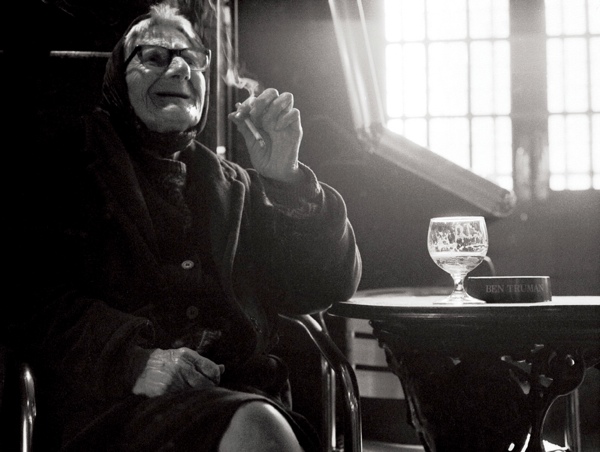
Rose
When Sandra Esqulant, celebrated landlady of The Golden Heart in Commercial St, saw this photo taken by Phil Maxwell of Rose sitting in her barroom twenty-five years ago, she told me the story of an unforgettable character who became one of her most loved regulars.
“I loved Rose. I don’t know what happened to her, she’s got to be dead now hasn’t she?
What happened was – you know how you fall in love with some people? – this woman appeared in the pub one day and I fell in love with her. I just liked her.
She asked for a rum & lemonade, and she never had to pay for a drink in my pub.
I used to have to warn everyone when Rose was coming in because she used to pick up everyone’s cigarettes and put them in her bag.
I used to dance with her.
You might think she was dumb, but she was the most astute person I ever met. She didn’t like my husband while I was there, but when I wasn’t there it was a different story!
My husband liked her a lot.
You know I lost my husband.
When she stopped coming, I went round to the Sally Army in Old Montague St, where she lived, but they told me they didn’t know what happened to her, so I went to the Police Station and they were going to search the morgue. I kept going back to the Sally Army and this Irish woman said to me, ‘Are you looking for Rose? She moved to Commercial Rd.’ So I went round to the Commercial Rd shelter and there was Rose. She was very sad because the Sally Army had put her out after forty years. So I used to send a cab to pick her up and take her back from my pub.
The Sally Army, they should have known how fond I was of her and told me where she had gone.
One Sunday, when I was on my own, she collected all the glasses and the ashtrays and the crisp packets and emptied them over the bar. I didn’t mind, Rose could do anything in my pub.
People like Rose would go into a pub and people wouldn’t serve them, but I had everyone in here – this was the dossers’ bar!
One day, Phil Maxwell asked Rose if he could put her in one of his films and she didn’t like that, but he set his camera on the table and took these pictures. And after that, he always had her picture in his exhibitions.
She must have known I was fond of her.
She did like me.
I know she liked me.
She was lovely.
She used to talk about her daughter, but I sometimes wonder if she ever had a daughter.
At Christmas, she always asked me for a Christmas box and, of course, I always gave her one.
They moved her out after forty years, what a thing to do to someone.
If Rose was here today, I’d let her smoke in my pub – I don’t care about the law.
Very special, she was.”


Photographs copyright © Phil Maxwell
Follow Phil Maxwell’s blog Playground of an East End Photographer
See more of Phil Maxwell’s work here
Phil Maxwell’s Kids on the Street
Phil Maxwell & Sandra Esqulant, Photographer & Muse
More of Phil Maxwell’s Old Ladies
Phil Maxwell’s Old Ladies in Colour
Ivor Weiss, Artist

The Onlooker, 1968
I visited Jermyn St in St James to meet Mark Weiss of the Weiss Gallery to hear about the life of his father, the painter Ivor Weiss (1919-1986) who was born in Stepney. The gallery was filled large bold paintings that possess a soulfulness and tender humanity. These pictures embody the cultural memory of the Jewish East End, speaking eloquently of a long life and a significant talent. Today one of Ivor Weiss’ paintings hangs in Sandys Row Synagogue in Spitalfields where it can be viewed on request.
“My father was one of four children. His parents were both Romanian Jews who came over to London at the end of the nineteenth century. We don’t know the exact dates, we have very little documentation of family history. My father’s father came from quite a well-to-do family in Bucharest. He was one of four or five children and his wife, whose maiden name was Wiseman, came from a very large family of twelve or thirteen. We don’t know when they got married but we do know they lived, as many immigrant Jews did at that time, in Stepney in the East End around Cable St. So my father was born a Cockney in Stepney in 1919.
His father was a Master Furrier and clearly was quite successful, although he was only naturalised in 1929. By that time, he had clearly made some money and was living in 33 Elgin Crescent, Westbourne Grove. My grandfather was a gambler and my father used to say that his mother was in tears at the end of the week because all the money his father had earned had been spent, betting on dogs and horses.
My father enlisted when war broke out in 1939 when he was only twenty years old. As a nice Jewish boy from the East End, he expected to be put into a force that suited him but instead he was enrolled in a Glaswegian regiment which he hated. He ended up in the Royal Corps of Signals and was posted to the North African campaign, ending up in Malta. There his artistic talents were first recognised and he attended an art school, winning a couple of prizes. When he was demobilised he went to Heatherley School of Art in Baker St and then St Martin’s in the Charing Cross Rd, where he met my mother Joan, who was also an art student and a painter. They married very quickly after that in 1949.
My father’s brother was a pilot in the RAF and had been seconded during the war to teach American pilots how to fly fighter planes and he married a Jewish lady in Montgomery, Alabama. There was still rationing after the war in this country and he invited my father over to Alabama to live. So my parents went to start a new life there and opened an art school called the Weiss Gallery. It was not easy for them because they were committed to their school being desegregated. They hated the situation, but they had spent all their money getting out there. I and my brother were born in America and, by 1955, they had saved enough money to return.
My father had an offer to be a stand-in art teacher at Lancing College for six months and then he got a job in a secondary modern in Brightlingsea, Essex, where my sister was born. To supplement his income, he used to teach evening classes. By chance, he was asked by a local lady if he could sell a painting for her, so my father brokered the sale of the picture to a local antique dealer and earned more money than he could make in a month. My parents drifted into art dealing from our home in Brightlingsea and, within a few years, made enough money to buy a big house in Colchester. My father had an intuitive eye, and he had studied Art History and technique, so he was well placed to become an art dealer, and my mother used to do the restoration. They made quite a formidable team and the business grew rapidly.
Yet he still had aspirations for his art and there came a watershed when Mr Weston, of the wealthy family who owned Fortnum & Mason, invited my father to paint for him and his friends in the south of France, but my father said, ‘No, I don’t want to leave my family.’ It was a fork in the road. If he had done that, he might have developed more of a career as a commercial painter. Having made that choice, painting remained a private exercise. He was never that prolific, and painting remained a personal and emotional thing for him. It was difficult, it was not something that came easy – the creation of pictures.
For the rest of his life, he and my mother concentrated on art dealing with him painting privately. But after a series of minor heart attacks, he had triple heart by-pass surgery and it proved the catalyst for him paint Judaic subjects. They are some of his most powerful works, drawing on the traditions he grew up with in the East End among Hassidic Jews.
My father died of a heart attack in 1986, at the time I opened up my gallery in London which we would have run together. His paintings remained hanging in the houses of members of the family and in storage with my mother until she died aged ninety-two. These are quite emotional paintings for us as a family.
I regret that I never asked my father questions about the East End and he never discussed it. Sorting out my mother’s affairs, I could not even find a marriage certificate, and I realised they had never talked about their wedding and I had never asked, and how sad that is. As children, we never questioned our parents about their past. They grew up through the horrors of the Second World War and, the generation before, they endured the First World War. My grandfather served with great distinction, but had a horrendous time and had nightmares about it for the rest of his life. He did not want to talk about it.
My father was remarkable man and one of the things that strikes me, when I think about him, is that he never made enemies – which is a rare thing in this life. He was multi-talented, he taught pottery, he could make enamel jewellery, he could make furniture, all sorts of things.“

The Discussion, 1968

Four Drinkers, 1968

Seated cCouple, fifties

The Anchor Inn, Brightlingsea

The Park Bench, 1967

Woman in Pub, 1981

Boredom, 1964

The Waiting Room, 1964

The Last Supper, 1972

The Elders, 1972
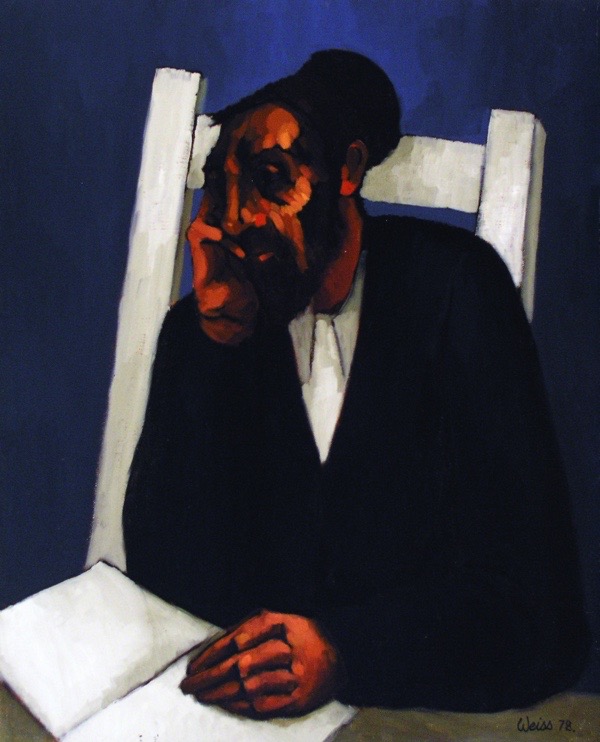
Seated Rabbi, 1972

Approaching Storm, 1966

Wivenhoe Creek, 1966

Ivor & Joan Weiss

In the studio in the fifties

Ivor Weiss painting in the eighties

Ivor Weiss (1919-86), Self Portrait mid-eighties
Paintings copyright © Estate of Ivor Weiss
In & Out The Eagle

On dark nights when the rain beats at my window and the wind moans down my chimney, I dream of leaving the gloomy old house and joining excited crowds, out in their best clothes to witness the spectacular entertainments that London has to offer. The particular theatre I have in mind is The Grecian Theatre attached to the Eagle Tavern in Shepherdess Walk, City Road between Angel and Old St.
The place seems to have developed quite a reputation, as I read recently, “The Grecian Saloon is really a hot house or a black hole, for the number of human beings packed in there every night would induce a supposition there was no other place of entertainment in London. At least two thousand persons were left unable to procure admission.” This was written in 1839, demonstrating that the popular art of having a good time is a noble tradition which has always thrived in the East End, outside the walls of the City of London.
“Up and down the City Road, in and out the Eagle, that’s the way the money goes…” The Eagle public house in the rhyme still exists to this day, though barely anything remains of the elaborate entertainment complex which developed during the nineteenth century – apart from a single scrapbook that I found in the archive of the Bishopsgate Institute. All the balloon ascents, the stick fights, the operas, the wrestling and the wild parties may be over, and the thrill rides closed long ago, but there is enough in this album to evoke the extravagant drama of it all and fire my imagination with thoughts of glamorous nights out on the town.
You only have to imagine walking through Brick Lane and up to Shoreditch on a Saturday night, through the hen parties and gangs of suburban boys out on a bevy, amidst the intoxicated, the drugged and the merely overexcited, to get a glimpse of what it might have been like two hundred years ago when as many as six thousand attended events at the Eagle Tavern.
On the site of the eighteenth century Shepherd & Shepherdess Pleasure Garden, the Grecian Saloon developed at the Eagle Tavern to provide all kinds of entertainments, from religious events to conjuring and equestrian performances. There is a tantalising poetry to the hints that survive of these bygone entertainments, because sentences like “We are glad to find that little Smith has recovered her hoarseness” and “We have little to find fault with save that the maniac was allowed to perambulate the gardens without his keeper” do set the imagination racing.
There are many fine coloured playbills in the cherished album, crammed with enigmatic promises of exotic thrills. I wonder who exactly was the beautiful Giraffe Girl or General Campbell, the smallest man in the world. Amongst so much hyperbole it is disappointing to learn that the central attractions are merely supported by the “artistes of acknowledged talent.”
Elaborate pavilions with all manner of special effects were constructed at the Grecian Saloon, which in turn became the Grecian Theatre in 1858 where Marie Lloyd made her stage debut, aged fifteen. Eventually the building was acquired in 1882 by General William Booth of the Salvation Army and the parties came to an end.
Yet this site saw the transition from eighteenth century pleasure garden to nineteenth century music hall. And when you come to think of the many thousands of souls who experienced so much joy there over all those years, it does impart a certain sacred quality to this location, even if it is now mostly occupied by Shoreditch Police Station.


Images courtesy © Bishopsgate Institute
Frank Derrett, Photographer

Recently I published Frank Derrett’s splendid photographs of the West End in the seventies which Paul Loften rescued from a skip and donated to the Bishopsgate Institute.
At first, these pictures appeared to be anonymous but when I examined the transparencies closely, I found several were annotated by a neat italic hand on the cardboard mount, including a name, F.L. Derrett, and an address, 56 Jessel House, Judd St, WC1.
These notes were upon a poignant set of images of interiors – that I assume are Jessel House – which I find especially fascinating. Taken at Christmas, they record an abundance of cards and festive decorations. Upon closer examination, they reveal an enthusiasm for ballet and there are letters from the Royal household framed upon the wall.
At this point, I called in Vicky Stewart, Spitalfields Life’s own private investigator, who famously discovered the location of Horace Warner’s Spitalfields Nippers a few years ago, to see what she could find about the mysterious F.L. Derrett.
Frank Lionel Derrett was born in 1912 and lived at Jessel House his whole life. Frank worked as a clerk at the British Museum from when he was twenty-seven years old in 1939. His father had been killed in Greece at the age of thirty-four, during the First World War, when Frank was only five. He and his mother lived together in Jessel House through the rest of the century, until Frank’s death in January 1995 at the age of eighty-two. It was shortly after this that Paul Loften saved Frank’s photos.
So now these photographs that Frank took in his sixties are all we have. There is a certain intimacy, even affection, in his colourful pictures, taken by Londoner to whom these locations were familiar. They reveal a delight in a London that was all local for Frank, living in Bloomsbury. It was natural for him to walk to work at the British Museum and then into the West End in search of entertainment. The photographs tell me that Frank loved London.

An enthusiasm for ballet and Lotte Lenya


Letters from the Royal household


Clint Eastwood at Christmas

Whidbourne St

London Wall

The Marie Lloyd in Hoxton

Windmill at Wimbledon

Frank’s florist, Annie in Marchmont St – where he bought flowers for his mother
Images courtesy Bishopsgate Institute
You may also like to take a look at
Shakespeare’s Mulberry To The Rescue!

Click to look inside Shakespeare’s Mulberry as cultivated by David Garrick
Many readers will remember the unhappy day in September 2018 when Tower Hamlets Council voted to approve Crest Nicholson’s appalling London Chest Hospital redevelopment which damages the listed building and entails digging up the historic BETHNAL GREEN MULBERRY.
After two years of bureaucratic rigmarole, that permission has now been formally granted which means we can challenge it in the High Court. Already, we have employed top Environmental Lawyer Susan Ring of Harrison Grant Solicitors who has established there are grounds for Judicial Review and we must raise £10,000 to proceed before November 20th or the ancient Bethnal Green Mulberry will be dug up.
We are doing this with the help of WILLIAM SHAKESPEARE’S MULBERRY. In 1610, the poet planted a Mulberry tree in his garden in Stratford upon Avon. Unfortunately so many tourists came seeking branches as souvenirs that the owners cut it down in 1770. But the great Shakespearian actor David Garrick rescued a cutting which flourishes to this day.
We are offering a cutting of David Garrick’s tree to everyone who contributes £100 or more to our legal fund. This is a once in a lifetime chance to acquire a scion of Shakespeare’s Mulberry and enjoy a living connection to the world’s greatest writer.
Click on the link below to contribute and then send an email to the East End Preservation Society (eastendpsociety@gmail.com). You will receive your rooted cutting next year and together we will Save The Bethnal Green Mulberry.
CLICK HERE TO SAVE THE BETHNAL GREEN MULBERRY

We are delighted to welcome Dame Judi Dench as patron of our campaign

William Hogarth’s painting of Huguenot David Garrick who began the Shakespeare revival by playing Richard III at Goodman Fields Theatre in Aldgate in 1741

My Staffordshire figure of William Shakespeare flanked by Sarah Siddons as Lady Macbeth and her brother John Phillip Kemble as Hamlet

Our logo by Paul Bommer
Click here to read my feature in The Daily Telegraph about the scandal of the Bethnal Green Mulberry
Read more here about the Bethnal Green Mulberry
The Fate of the Bethnal Green Mulberry
The Reckoning With Crest Nicholson
Jemmy Catnach’s Cries Of London
Jemmy (James) Catnach of Monmouth Court was celebrated for publishing ballads, penny awfuls, and children’s farthing and halfpenny chapbooks. As publisher, compositor and poet, he established the Seven Dials Press in 1813.
Notorious for playing fast and loose with the truth, he published a sensational pamphlet in 1818, claiming that a butcher in Drury Lane was selling sausages made of human flesh, and ended up in the Middlesex House of Detention in Clerkenwell.
Such was Catnach’s love for ballads, he kept a fiddler on the premises at one time so that ballad singers could come in and audition their compositions for publication. Of all the Cries of London I have published these are most modestly produced and crudely wrought images, yet I love them for their strong images and graphic vitality.

Clothes Pegs, Props & Lines – Come buy and save your clothes from dirt, they’ll save you washing many a shirt!

Filberts – I sell them for a groat a pound and warrant them all good and sound!
 Sweep – If you rightly understand me, with my brush, broom and my rake, such cleanly work I’ll make…
 Peas & Beans – Come buy my Windsor beans and peas, you’ll see no more this year like these!
 Toys for Girls & Boys – only a penny, or a dirty phial or bottle
 Strawberries – Strawberries & cream are charming and sweet, mix them and try how delightful to eat
 When Good Friday comes, Hot Cross Buns!
 Oranges – I sell them at two for a penny, ripe, juicy and sweet, just fit for to eat, so customers buy a good many
 Milk Below! – Rain, frost or snow, or hot or cold, I travel up and down, the cream & milk you buy from me is the best in town for custards, puddings, or for tea, there’s none like those you’ll buy from me
 Crumpling Codlings – Come buy my Crumpling Codlings, some of them you may eat raw, of the rest make dumplings
 Cherries – Here’s round and sound, black and white heart cherries, twopence a pound!
 Toy Lambs to sell – If I had as much money as I could tell, I never would cry young lambs to sell!
You may also like to take a look at these other sets of the Cries of London I have collected
More John Player’s Cries of London
More Samuel Pepys’ Cries of London
Geoffrey Fletcher’s Pavement Pounders
William Craig Marshall’s Itinerant Traders
H.W.Petherick’s London Characters
John Thomson’s Street Life in London
Aunt Busy Bee’s New London Cries
Marcellus Laroon’s Cries of London
William Nicholson’s London Types
Francis Wheatley’s Cries of London
John Thomas Smith’s Vagabondiana of 1817
John Thomas Smith’s Vagabondiana II
John Thomas Smith’s Vagabondiana III
Thomas Rowlandson’s Lower Orders
More of Thomas Rowlandson’s Lower Orders
Adam Dant’s New Cries of Spittlefields

CLICK TO BUY A SIGNED COPY OF CRIES OF LONDON FOR £20
14 Whitechapel Bell Foundry Poems
The Bell Foundry Public Inquiry continues at 10am today, with live-tweeting at @savethewbf.
CLICK HERE TO WATCH THE INQUIRY
Dan Thompson wrote these fourteen short poems about the Whitechapel Bell Foundry and its bells, as part of his project to write one hundred poems about one hundred places in England. These are complemented with photographs by Charlotte Dew.

The Whitechapel Sound
I
The clapper strikes the place-bell’s rim,
a 1930s tune by Mears and Stainbank.
Down in a spireless church on the coast –
Captain Sophie Littlechild leads the band
in a Kent Treble Bob Major,
ringing a Kentish rag.
The changes are heard up in the Cinque Port.
Eight still bells hold the peace
they’ve kept since before the Great War:
but the bells of St Clements sound,
‘Oranges and lemons, oranges and lemons.’

II
In the Arundel Tower at Canterbury.
Dunstan’s Bell sounds the hour
for pilgrims at the site of the martyr.
Thomas gave his will
to find freedom in the will of god.
He has been killed for his faith:
so we mourn –
he has been elevated to the company of saints:
so we rejoice.
He has been killed:
the bells will be silent for a year.
‘It is only in these our Christian mysteries that we can rejoice and mourn at once for the same reason’.

III
An old signalling-station,
a tower that flies the White Ensign,
the Prime Minister sung in the choir
as the bells brought by boat,
floated down the Estuary,
pealed over war graves
and Bones’ fields.

IV
Along the Estuary, on the hour,
promenaders at Herne Bay,
and pleasure-trippers boarding Thanet wherries,
ghost figures on a ghost pier,
set their watches by the bell in
Mrs Thwaytes’ Clock Tower.
The hour drifts on the tides
to sea forts, pirate radio stations,
across the windfarms.

V
On the line between English and Danish,
Christopher Wren built a church,
German thunderbolts destroyed it –
the spire burning like a candle-
the Royal Air Force restored it.
Sign and countersign, fall and rise –
‘They held out their arms for you to pass under’
The man who burnt
Hamburg and Dresden
stands outside.
‘Lord, do you want us to
call fire down from heaven
to destroy them?’

VI
Two Sticks and Apple,
Ring the Bells at Whitechapple
When I am Rich,
Ring the Bells at Fleetditch
We were made in this place
Ring the Bells at Boniface.

VII
Big Ben in
The Elizabeth Tower,
St Paul’s, Westminster Abbey –
London rings.
The bells in Wren’s
St Mary-le-Bow
would have been heard
six miles to the east,
five miles to the north,
three miles to the south,
four miles to the west.
In St Andrew by the Wardrobe,
the bell rings by itself
when the vicar in Avenbury dies.

VIII
Be not afeard,
the isle is full of the
noise of bells –
Work No 1197:
All The Bells.
The wide bell
rings low and so loud,
nine hundred million people
can hear it.

IX
Before each service,
the tenor rings seventeen times,
once for each of the Lewes martyrs:
one ring more than
the years of protestant
Thomasina Wood’s life.

X
Target 53.
The Kampfgruppe dropped marker flares
at the corners of the city.
From 20,000 feet, a cathedral looks like a factory.
St Michael’s burned, a magnesium flame
melting lead, catching in the oak roof.
The water ran dry before midnight.
Churchill stood on the
Air Ministry roof, waiting
for bombs that never fell on London.
The old Pack & Chapman bells,
‘each bell of good, bold and pleasing tone,
a very fine peal of ten’, recast,
rang as the bombs fell.

XI
Habemus vicarium at Granchester –
‘we have a vicar, we have a vicar’

XII
Wind the handle,
a turn for each day of the year,
and Great Tom will mark the hour.
Cover the fire.
Two bells call the curfew,
one hundred and one rings.
Cover the fire.
Cover the fire.

XIII
The edge, the Borders,
St Andrew’s in Penrith,
where Kathleen Raine
sat out the war.
‘Write
me a piece about the
grave, James Joyce’.
Ken Twentyman will
show you the Fire Bell,
the Market Bell,
the Curfew Bell –
the Morta Bell for death.

XIV
After each round of bells
is a moment of silence,
change, before the bells
ring round again. In the
peace after and before
you can hear Whitechapel.
___________
Footnotes
I St Mary’s, Walmer, Kent: St Peter’s, Sandwich, Kent (where the bells last rung in 1913), St Clement’s
II Quote from TS Eliot Murder In The Cathedral.
III St Peters in Thanet, Broadstairs: the local farmer is Mr Bones.
IV Herne Bay Clocktower
V St Clement Danes, the RAF church. Quote from George Orwell Nineteen Eighty Four and Luke 9:54.
IX St Thomas, Lewes

Dan Thompson, Peace Poet


You may also like to read about
Nigel Taylor, Tower Bell Manager
Hope for The Whitechapel Bell Foundry
A Petition to Save the Bell Foundry


