
List Of Local Shops Open For Business

Leila’s Shop by Sebastian Harding
Every Wednesday, I publish the up to date list of stalwarts that remain open in Spitalfields. Readers are especially encouraged to support small independent businesses who offer an invaluable service to the community. This list confirms that it is possible to source all essential supplies locally without recourse to supermarkets.
Be advised many shops are operating limited opening hours at present, so I recommend you call in advance to avoid risking a wasted journey. Please send any additions or amendments for next week’s list to spitalfieldslife@gmail.com
This week’s illustrations are by Sebastian Harding

Taj Stores
GROCERS & FOOD SHOPS
The Albion, 2/4 Boundary St
Ali’s Mini Superstore, 50d Greatorex St
AM2PM, 210 Brick Lane
As Nature Intended, 132 Commercial St
Banglatown Cash & Carry, 67 Hanbury St
Breid Bakery, Arch 72, Dunbridge St
Brick Lane Minimarket, 100 Brick Lane
The Butchery Ltd, 6a Lamb St (Open Thursdays only)
City Supermarket, 10 Quaker St
Costprice Minimarket, 41 Brick Lane
Faizah Minimarket, 2 Old Montague St
JB Foodstore, 97 Brick Lane
Haajang’s Corner, 78 Wentworth St
Leila’s Shop, 17 Calvert Avenue (Call 0207 729 9789 between 10am-noon on Tuesday-Saturdays to place your order and collect on the same day from 2pm-4pm)
The Melusine Fish Shop, St Katharine Docks
Nisa Local, 92 Whitechapel High St
Pavilion Bakery, 130 Columbia Rd
Rinkoff’s Bakery, 224 Jubilee Street & 79 Vallance Road
Spitalfields City Farm, Buxton St (Order through website)
Sylhet Sweet Shop, 109 Hanbury St
Taj Stores, 112 Brick Lane
Zaman Brothers, Fish & Meat Bazaar, 19 Brick Lane

Burro E Salvia Pastificio
TAKE AWAY FOOD SHOPS
Before you order from a delivery app, why not call the take away or restaurant direct?
Absurd Bird Fried Chicken, 54 Commercial St
Al Badam Fried Chicken, 37 Brick Lane
Allpress Coffee, 58 Redchurch St
Band of Burgers, 22 Osborn St
Beef & Birds, Brick Lane
Beigel Bake, 159 Brick Lane
Beigel Shop, 155 Brick Lane
Bellboi Coffee, 104 Sclater St
Bengal Village, 75 Brick Lane
Big Moe’s Diner, 95 Whitechapel High St
Burro E Salvia Pastificio, 52 Redchurch St
The Carpenters Arms, 73 Cheshire St (Open for take away beers)
China Feng, 43 Commercial St
Circle & Slice Pizza, 11 Whitechapel Rd
Dark Sugars, 45a Hanbury St (Take away ice cream and deliveries of chocolate)
Donburi & Co, Korean & Japanese, 13 Artillery Passage
Duke of Wellington, 12 Toynbee St (Open for take away beers)
Eastern Eye Balti House, 63a Brick Lane
Enso Thai & Japanese, 94 Brick Lane
Exmouth Coffee Shop, 83 Whitechapel High St
Grounded Coffee Shop, 9 Whitechapel Rd
Holy Shot Coffee, 155 Bethnal Green Rd
Hotbox Smoked Meats, 46-48 Commercial St
Jack The Chipper, 74 Whitechapel High St
Jonestown Coffee, 215 Bethnal Green Rd
Laboratorio Pizza, 79 Brick Lane
La Cucina, 96 Brick Lane
Leon, 3 Crispin Place, Spitalfields Market
Madhubon Sweets, 42 Brick Lane
Mooshies Vegan Burgers, 104 Brick Lane
Nude Expresso, The Roastery, 25 Hanbury St
E. Pellicci, 332 Bethnal Green Rd
Pepe’s Peri Peri, 82 Brick Lane
Peter’s Cafe, 73 Aldgate High St
Picky Wops Vegan Pizza, 53 Brick Lane
Quaker St Cafe, 10 Quaker St
Rajmahal Sweets, 57 Brick Lane
Rosa’s Thai Cafe, 12 Hanbury St
Shawarma Lebanese, 84 Brick Lane
Shoreditch Fish & Chips, 117 Redchurch St
Sichuan Folk, 32 Hanbury St
String Ray Globe Cafe, 109 Columbia Road
Sushi Show, 136 Bethnal Green Rd
Vegan Yes, Italian & Thai Fusion, 64 Brick Lane
White Horse Kebab, 336 Bethnal Green Rd
Yuriko Sushi & Bento, 48 Brick Lane

Brick Lane Bikes
OTHER SHOPS & SERVICES
Boots the Chemist, 200 Bishopsgate
Brick Lane Bookshop, 166 Brick Lane (Books ordered by phone or email are delivered free locally)
Brick Lane Bikes, 118 Bethnal Green Rd
Brick Lane Off Licence, 114/116 Brick Lane
Day Lewis Pharmacy, 14 Old Montague St
E1 Cycles, 4 Commercial St
Eden Floral Designs, 10 Wentworth St (Order fresh flowers online for free delivery)
Flashback Records, 131 Bethnal Green Rd (Order records online for delivery)
Harry Brand, 122 Columbia Road (Order gifts online for delivery)
Hussain Tailoring, 64 Hanbury St
iRepair, Phones & Computer, 94 Whitechapel High St
GH Cityprint, 58-60 Middlesex St
Leyland Hardware, 2-4 Great Eastern St
Mobile Clinic & Laptop Repairs, 7 Osborne St
Post Office, 160a Brick Lane
Quality Dry Clean, 151 Bethnal Green Rd
Rose Locksmith & DIY, 149 Bethnal Green Rd
Sid’s DIY, 2 Commercial St
Spitalfields Dry Cleaners, 12 Whites Row

E5 Bakehouse
ELSEWHERE
E5 Bakehouse, Arch 395, Mentmore Terrace (Customers are encouraged to order online and collect in person)
Gold Star Dry Cleaning & Laundry, 330 Burdett Rd
Hackney Essentials, 235 Victoria Park Rd
Quality Dry Cleaners, 16a White Church Lane
Newham Books, 747 Barking Rd (Books ordered by phone or email are posted out)
Region Choice Chemist, 68 Cambridge Heath Rd
Symposium Italian Restaurant, 363 Roman Road (Take away service available)
Thompsons DIY, 442-444 Roman Rd

The Albion
Illustrations copyright © Sebastian Harding
You may like to take a look at these other works by Sebastian Harding

TUESDAY 6th OCTOBER is the new date for the commencement of the PUBLIC INQUIRY into the future of the WHITECHAPEL BELL FOUNDRY called by Secretary of State.
We are delighted that this Public Inquiry is going ahead because the Whitechapel Bell Foundry is a priceless cultural treasure of global significance that must be saved. For several years now, we have been campaigning for it to continue as a proper working foundry rather than the developer’s proposal for bell-themed boutique hotel.
The UK Historic Building Preservation Trust (now known as Re-Form Heritage) is offering to buy the foundry from the developers at market value and re-open it to as a fully operational foundry to cast bells in the East End in perpetuity, just as it has done for over five hundred years.
By definition, a Public Inquiry is open to all. Please put the date in your diary now because it very important that as many people as possible turn up to demonstrate the strength of public opinion to the Government Inspector. This is our one chance to save the Whitechapel Bell Foundry, so we hope all community and cultural groups in the East End will send representatives and take advantage of the opportunity offered by the Public Inquiry to read a statement on behalf of their members.
Commencing at 10am on 6th October, the Public Inquiry will run for eight days and take place under socially-distanced conditions.
Email Development.Control@TowerHamlets.gov.uk to get details and attend. Also please say if you want to speak, either as an individual or as a representative of a group.

You may also like to read about
The Secretary of State steps in
A Letter to the Secretary of State
Rory Stewart Supports Our Campaign
The Fate of the Whitechapel Bell Foundry
Nigel Taylor, Tower Bell Manager
Four Hundred Years at the Whitechapel Bell Foundry
Pearl Binder at Whitechapel Bell Foundry
Dorothy Rendell at Whitechapel Bell Foundry
Hope for The Whitechapel Bell Foundry
A Petition to Save the Bell Foundry
Save the Whitechapel Bell Foundry
A Few Pints With John Claridge
Since all the pubs are shut for the foreseeable future, we must instead draw consolation from John Claridge‘s photography

THE DRINK, E14 1964
Photographer John Claridge claims he is not a drinker, but I was not entirely convinced once I saw this magnificent set of beer-soaked pictures that he lined up on the bar, exploring aspects of the culture of drinking and pubs in the East End. “I used to go along with my mum and dad, and sit outside with a cream soda and an arrowroot biscuit,” John assured me, recalling his first childhood trips to the pub,“…but they might let you have a drop of brown ale.”
Within living memory, the East End was filled with breweries and there were pubs on almost every corner. These beloved palaces of intoxication were vibrant centres for community life, tiled on the outside and panelled on the inside, and offering plentiful opportunities for refreshment and socialising. Consequently, the brewing industry thrived here for centuries, inspiring extremes of joy and grief among its customers. While Thomas Buxton of Truman, Hanbury & Buxton in Spitalfields used the proceeds of brewing to become a prime mover in the abolition of slavery, conversely William Booth was motivated by the evils of alcohol to form the Salvation Army in Whitechapel to further the cause of temperance.
“When I was fifteen, we’d go around the back and the largest one in the group would go up to the bar and get the beers,” John remembered fondly, “We used to go out every weekend, Friday, Saturday and Sunday. We’d all have our suits on and go down to the Puddings or the Beggars, the Deuragon, the Punchbowl, the Aberdeen, the Iron Bridge Tavern or the Bridge House.” Looking at these pictures makes me wish I had been there too.
Thanks to John, we can enjoy a photographic pub crawl through the alcoholic haze of the East End in the last century – when the entertainment was homegrown, the customers were local, smoking and dogs were permitted, and all ages mixed together for a night out. Cheers, everybody!

A SMOKE, E1 1982. – “There was a relaxed atmosphere where you could walk in and talk to anybody.”

THE CONVERSATION, E1 1982. – “Who is he speaking to?”

DARTBOARD, E17 1982. -“I used to be a darts player, just average not particularly good.”

SINGING, E1 1962. -“She’d just come out of the pub…”

THE MEETING, E14, 1982. -“You don’t know what’s going on. There’s a big flash car parked there. Are they doing a piece of business?”

SLEEP, E1 1976. – “They used to club together and get a bottle of VP wine from the off-licence, and mix it with methylated spirits.”

BEERS, E1 1964. – “This is Dickensian. You wonder who’s going to step from that door. Is it the beginning of a story?”

ROUND THE BACK, E3 1963.

DOG, E1 1963. -“Just sitting there while his master went to get another pint of beer.”

EX-ALCHOHOLIC, E1 1982. – “He lived in Booth House and seemed very content that he had pulled himself out of it.”

LIVE MUSIC, E16 1982. -“It was a cold winter’s day and raining, but I had to get this picture. Live music and dancing in a vast expanse of nothing?”

THE BEEHIVE, E14 1964. – “She never stopped giggling and laughing.”
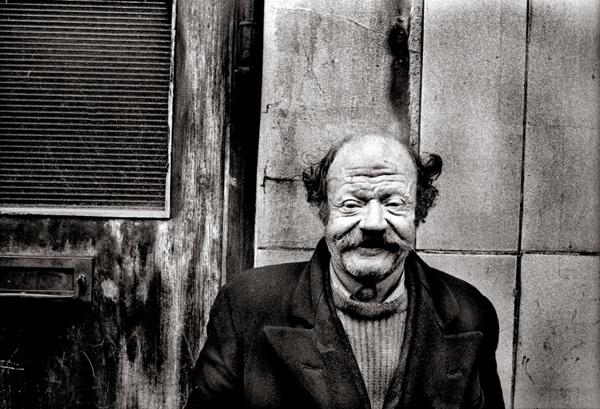
THE SMILE, E2 1962. -“He said, ‘Would you like me to smile?’ He was probably not long for this world, but he was very happy.”

IN THE BAR, E14 1964. -“I’d just got engaged to my first wife and she was one of my ex-mother-in-law’s friends. Full of life!”

THROUGH THE GLASS, E1 1982. -“I think the guy was standing at the cigarette machine.”

THE CALL, E16 1982. -“Terry Lawless’ boxing gym was above this pub. It looks as if everything is collapsing and cracking, and the shadows look like blood pouring from above.”

WHITE SWAN, E14 1982

LIGHT ALE, 1976 -“Four cans of light ale and he was completely out of it.”

CLOSED DOWN, Brick Lane 1982.
Photographs copyright © John Claridge
You may also like to take a look at
Along the Thames with John Claridge
At the Salvation Army with John Claridge
A Few Diversions by John Claridge

On Recovering From The Coronavirus

Recent weeks have passed as if in a dream. I have no more memory of the symptoms of the virus now than if the experience had been itself a dream. Yet I know it was real and I count myself fortunate to have survived and to be here writing to you, lucky to have suffered such a mild version of the symptoms that I am able to recount it placidly from the safety of hindsight.
One day, I was feeling low and so I made myself a hot water bottle and went to bed in the afternoon. That night a fever came upon me and my limbs grew loose until the connection between my body and my self became dislocated. My joints ached as if my shoulders and hips were being wrenched apart like a doll. I took a paracetamol tablet and, twisting and turning in my bed, submitted myself to a slumber so deep that I lost my self entirely.
I was awoken by stomach problems, pacing back and forth to the bathroom endlessly through a day, each time drinking water to replace what I had lost until the clear liquid simply ran through my system as if my body no longer had any substance. I felt cold all over and could not shake off the chills. Daylight hurt my eyes and my feet became sensitive and sore. My head ached and I was overcome with a powerful weariness. After taking a rest on the sofa, on rising I found I did not have the strength to walk to my bedroom and had to wait until I could summon the energy to make it back to bed.
When night came again, the fever returned and I took a second paracetamol tablet. By now, I had a shortness of breath and my throat was sore with the loss of my voice. A few years ago, I had pneumonia and learnt the agony of trying to breathe when your cough reverberates so harshly it bruises your ribs. Now I lay in the dark breathing deliberately, slowly and deeply, fearful that the virus was spreading to my lungs. Without appetite and without eating for two days, feeling the irritation in my chest, I drifted into delirium as if I were possessed by an alien spirit. My loss of self was such that I was passively unaware of the degree or severity of my illness, I was completely in the sway of the virus.
Yet I slept through the night and my stomach problems subsided, even if now my torso was wracked by cramps and aches as well as chills. I lay on my back as weak as I ever felt in my life, dozing with heavy limbs.
How thankful I was for a bowl of soup next day which seemed the most delicious I ever had, soothing my sore throat. After that the fever did not return, instead a midnight craving for cheese on toast surprised and uplifted me, even if it was uncomfortable to digest. That night there was deep sleep without fever, but I awoke with conjunctivitis, my left eye sore and scratchy and watery, the discomfort crowding my consciousness.
For a week I dozed through each day and slept all night without recovering any strength. My shortness of breath and loss of voice persisted and I lay filled with silent anxiety over whether these problems might overwhelm me, taking the breath and the life from me entirely. I realised I was adrift and helpless, a mental paralysis accompanied my physical weakness. Time flew away but there was a stasis in which I was not getting any better.
I recall having influenza as a child and lying in semi-delirium for weeks, enjoying the dreamy otherworldly-ness, secure in the knowledge that recovery would arrive. No such consolation was a available to me with the Coronavirus as I lay waiting to discover whether my condition would deteriorate.
As I have done in the past when afflicted with flu, I took the initiative to recover by rising and doing simple tasks, yet they exhausted me. I recognised I was at the mercy of the virus with no choice but to rest and hope. After ten days, my chest cleared, my voice came back, my eye recovered and my body returned to me. A sense of raw emotionalism and vulnerability remain as if a layer of skin has been removed. Repeatedly, I think of what could have been and what so many have suffered, and how many thousands have died.
Two paracetamol tablets were all I took. Several weeks earlier, I read in the newspaper that this was the necessary medication only to discover that chemists had already sold out. In desperation to be prepared, I visited newsagents and found several selling paracetamol at inflated prices but then another, in Harrow Place off Petticoat Lane, who sold me a whole bottle for one pound and twenty pence. I shall be certain to go back to that shop again.
Now I am – at last – recovered, I look back and appreciate my good fortune to have experienced relatively mild symptoms and been in such good health that I could beat the virus. After this, the beauty of the spring with all the plants sprouting green and shining has overwhelmed me with joy. Each morning, I begin my day by watering the garden and, when I step out of the door into the sunlight, I am startled by the new growth since the day before.
Most of all I am grateful that my fear of catching the virus has ebbed and I hope I may even be immune. I want to get an antibody test to find out, but in the meantime I shall continue to take precautions. Even though I am no longer infectious, I do not want to risk spreading it if I were to become reinfected and, above all, I want to be safe.

You may also like to read
Thomas Bewick’s Cat
When I acquired my volumes of Thomas Bewick’s History of British Birds, I also managed to obtain a copy of his General History of Quadrupeds from 1824 in the Spitalfields Market and – of course – I turned first to his entry upon the domestic cat, from which I publish these excerpts below.

To describe an animal so well known might seem a superfluous task – we shall only, therefore, select some of its peculiarities as are least obvious and may have escaped the notice of inattentive observers.
It is generally remarked that Cats can see in the dark, but though this is not absolutely the case, yet it is certain that they can see with much less light than other animals, owing to the peculiar structure of their eyes – the pupils of which are capable of being contracted or dilated in proportion to the degree of light by which they are affected. The pupil of the Cat, during the day, is perpetually contracted and it is with difficulty that it can see in strong light, but in the twilight the pupil regains its natural roundness, the animal enjoys perfect vision and takes advantage of this superiority to discover and surprise its prey.

The cry of the Cat is loud, piercing and clamorous, and whether expressive of anger or of love is equally violent and hideous. Its call may be heard at a great distance and is so well known to the whole fraternity that, on some occasions, several hundred Cats have been brought together from different parts. Invited by the piercing cries of distress from a suffering fellow creature, they assemble in crowds and with loud squalls and yells express their horrid sympathies. They frequently tear the miserable object to pieces and, with the most blind and furious rage, fall upon each other, killing and wounding indiscriminately, till there is scarcely one left. These terrible conflicts happen only in the night.
The Cat is particularly averse to water, cold and bad smells. It is fond of certain perfumes but is more particularly attracted by the smell of valerian and cat mint – it rubs itself against them and if not prevented will infallibly destroy them.

Though extremely useful in destroying the vermin that infest our houses, the Cat seems little attached to the persons of those who afford it protection. It appears to be under no subjection and acts only for itself.
All its views are confined to the place where it has been brought up. If carried elsewhere, it seems lost and bewildered, and frequently takes the first opportunity of escaping to its former haunts. Frequent instances are recollected of Cats having returned to the place from whence they have been carried, though at many miles distance, and even across rivers, where they could not possibly have any knowledge of the road or the situation that would apparently lead them to it.
In the time of Hoel the Good, King of Wales, who died in the year 948, laws were made to fix the different prices of animals, among which the Cat was included as being at that period of great importance on account if its scarceness and utility. The price of a kitten was fixed at one penny, till proof could be given of its having caught a mouse twopence, after which it was rated as fourpence which was a great sum in those days.
If anyone should steal or kill the Cat that guarded the Prince’s granary, he was either to forfeit a milk ewe, or her fleece and lamb, or as much wheat as when poured on the Cat suspended by its tail would form a heap high enough to cover the tip of the former.

Hence we may conclude that Cats were not originally native of these islands, and from the great care taken to improve and preserve the breed of this prolific creature, we may suppose, were but little known in that period. Whatever credit we may allow to the circumstances of the well known story of Whittington and his Cat, it is another proof of the great value set upon this animal in former times.

You may also like to read about
Blackie, the Last Spitalfields Market Cat
East End Desire Paths
In spite of the lockdown, the desire paths of the East End are back again this year

In Weavers’ Fields
Who can resist the appeal of the path worn solely by footsteps? I was never convinced by John Bunyan’s pilgrim who believed salvation lay in sticking exclusively to the straight path – detours and byways always held greater attraction for me. My experience of life has been that there is more to be discovered by stepping from the tarmac and meandering off down the dusty track, and so I delight in the possibility of liberation offered by these paths which appear year after year, in complete disregard to those official routes laid out by the parks department.
It is commonly believed that the French philosopher Gaston Bachelard invented the notion of “desire paths” (lignes de désir) to describe these pathways eroded by footfall in his book “The Poetics of Space,” in 1958, although, just like the mysterious provenance of these paths themselves, this origin is questioned by others. What is certain is that the green spaces of the East End are scored with them at this time of year. Sometimes, it is because people would rather cut a corner than walk around a right angle, at other times it is because walkers lack patience with elegantly contrived curved paths when they would prefer to walk in a straight line and occasionally it is because there is simply no other path leading where they want to go.
Resisting any suggestion that these paths are by their nature subversive to authority or indicative of moral decline, I prefer to appreciate them as evidence of human accommodation, coming into existence where the given paths fail and the multitude of walkers reveal the footpath which best takes them where they need to go. Yet landscape architects and the parks department refuse to be cowed by the collective authority of those who vote with their feet and, from time to time, little fences appear in a vain attempt to redirect pedestrians back on the straight and narrow.
I find a beauty in these desire paths which are expressions of collective will and serve as indicators of the memory of repeated human actions inscribed upon the landscape. They recur like an annual ritual, reiterated over and over like a popular rhyme, and asserting ownership of the space by those who walk across it every day. It would be an indication of the loss of independent thought if desire paths were no longer created and everyone chose to conform to the allotted pathways instead.
You only have to look at a map of the East End to see that former desire paths have been incorporated into the modern road network. The curved line of Broadway Market joins up with Columbia Rd cutting a swathe through the grid of streets, along an ancient drover’s track herding the cattle from London Fields down towards Smithfield Market, and the aptly named Fieldgate St indicates the beginning of what was once a footpath over the fields down to St Dunstan’s when it was the parish church for the whole of Tower Hamlets.
Each desire path tells a story, whether of those who cut a corner hurrying for the tube through Museum Gardens or of joggers who run alongside the tarmac path in London Fields or of the strange compromise enacted in Whitechapel Waste where an attempt has been made to incorporate desire paths into the landscape design. I am told that in Denmark landscape architects and planners go out after newly-fallen snow to trace the routes of pedestrians as an indicator of where the paths should be. Yet I do not believe that desire paths are a problem which can be solved because desire paths are not a problem, they are a heartening reminder of the irreducible nature of the human spirit that can never be contained and will always be wandering.

The parting of the ways in Museum Gardens.

The allure of the path through the trees.

In Bethnal Green, hungry for literature, residents cut across the rose bed to get to the library.

A cheeky little short cut.

An inviting avenue of plane trees in Weavers’ Fields.

A detour in Florida St.

A byway in Bethnal Green.

Legitimised by mowing in Allen Gardens, Spitalfields.

A pointless intervention in Shadwell.

Which path would you choose?

Over the hills and faraway in Stepney.

The triumph of common sense in Stepney Green.

Half-hearted appropriation by landscape architects on Whitechapel Waste.

A mystery in London Fields.

A dog-eared corner in Stepney.

The beginning of something in Bethnal Green.
Paul Bommer’s Huguenot Plaque

People often stand and gaze in wonder at the beautiful Huguenot Plaque of twenty Delft tiles designed by Artist Paul Bommer on Hanbury Hall in Hanbury St, which was originally built as a Huguenot Chapel in 1719. The plaque was commissioned by the Huguenots of Spitalfields and the tiles tell the story of Britain’s first refugees.


Nicholas Hawksmoor’s Christ Church, Spitalfields

Méreau with a chalice

La Neuve Eglise – now Brick Lane Mosque

Méreau showing the Lamb of God

Méreau showing the Dove of Peace, Shield with Cross of Lorraine & Swan

1598 – Edict of Nantes when Henry IV granted rights to Huguenots

Anna Maria Garthwaite, designer of Spitalfields Silk

1685 – Revocation of the Edict of Nantes which forced Huguenots to flee persecution

Fleur de Lys, méreau with crucifix and hare

Huguenot Silversmiths

Horticulture in Spitalfields

Psalms 9:9 – “The Lord is a refuge for the oppressed, a stronghold in times of trouble…”

Horticulture in Spitalfields

Huguenot Clockmakers

Spitalfields Silk Merchant

Méreau with a cross, a silk bobbin and an oak symbolising Strength & Fidelity

The Huguenot Cross

Méreau with crest of France, canary and oak symbolising Strength & Fidelity

Protestant preaching at La Neuve Eglise

Paul Bommer’s Huguenot plaque on the Hanbury Hall, Hanbury St
Images copyright © Paul Bommer
You may also like to take a look at
More of Paul Bommer’s Delft Tiles
Even More of Paul Bommer’s Delft Tiles
and also read about


