
Summer At Arnold Circus

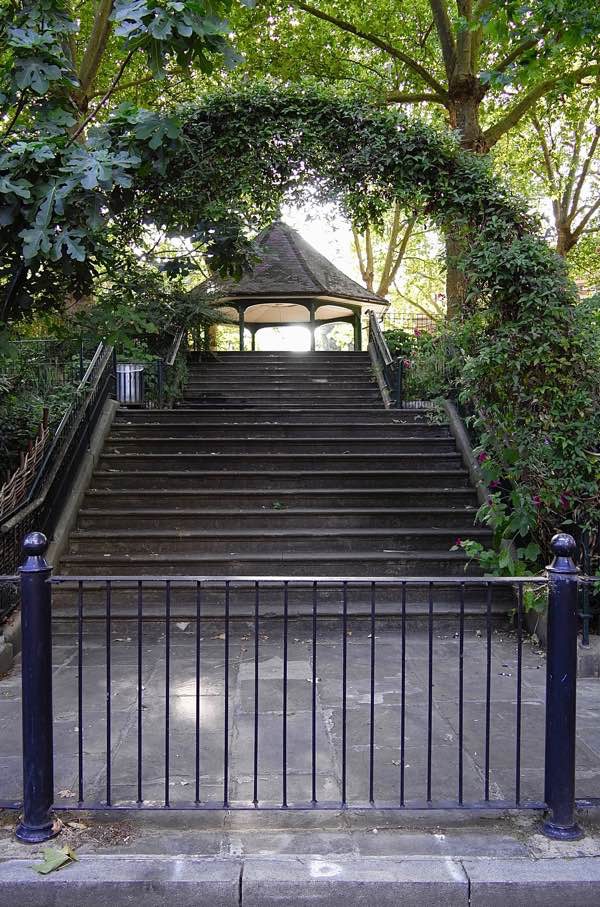
In my opinion, Arnold Circus is the heart of the East End. As you walk up the steps towards the bandstand, with the London plane trees towering overhead, it is as an inspirational space – as if you are entering a vast green cathedral. The depth of the planting enfolding the park is such that you feel a forest has been transplanted into the city.
For more than a decade, the volunteers of the Friends of Arnold Circus have been tending the gardens around the bandstand under the inspirational supervision of gardener Andy Willoughby. It was here that the renewal of the Boundary Estate began when Andy took over the husbandry, enriching the planting with an imaginative range of lush shade-loving varieties. Once the gardens on this once-neglected Estate began to look beautiful again, it encouraged the renovation of the bandstand under the initiative of the Friends.
During the pandemic, funds for the gardens have disappeared and so now the Friends have launched a campaign to raise the money.
Click here to protect the gardens at Arnold Circus


You may also like to read about
Gardening on the Roundabout in Victoria Park
At Waltham Abbey
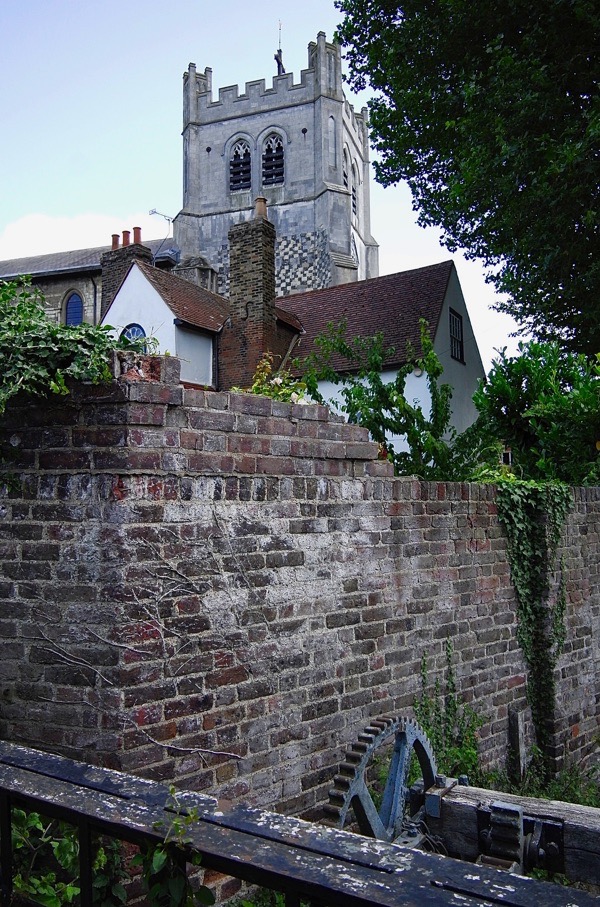
One day last spring – just before the lockdown – I walked along the River Lea as far as Tottenham. Yesterday I returned and continued my journey by bicycle as far as Waltham Abbey. Even from the riverbank I could see the majestic tower rising over the water meadows as the Abbey has done for the past thousand years, commanding the landscape and undiminished in visual authority.
Once you see it, you realise you are following in the footsteps of the innumerable credulous pilgrims who came here in hope of miraculous cures from the holy cross, which had reputedly relieved Harold Godwinson of a paralysis as a child before he became King Harold.
To the south of the Abbey church lies the market square, bordered with appealingly squint timber frame buildings punctuated by handsome eighteenth and nineteenth additions. Despite the proximity of the capital, the place still carries the air of an English market town.
Yet the great wonder is the Abbey itself, founded in the seventh century, built up by King Harold and destroyed by Henry VIII. Despite the ravages of time, the grandeur and scale of the Abbey is still evident in the precincts which have become a public park. Although the church that impresses today is less than half the size of what it was, it is enough to fire your imagination. An imposing stone gateway greets the visitor to the park where long, battered walls outline the former extent of the buildings. A tantalising fragment of twelfth century vaulting, which formerly served as the entrance to the cloisters, encourages the leap to conjure the cloisters themselves where now is merely an empty lawn. A walled garden filled with lavender and climbing roses draws you closest to the spirit of the place.
The outline of the former Abbey church is marked upon the grass and at the eastern end lies a surprise. A plain stone engraved with the words ‘Harold King of England Obit 1066,’ indicating this is where legend has it that he was laid to rest after the Battle of Hastings. I realised that maybe the remains of the man in the tapestry, killed by the arrow in the eye, lay beneath my feet. Coming upon his stone unexpectedly halted me in my tracks.
This was one of those startling moments when there is a possibility of history being real, something tangible, causing me to reflect upon the Norman Conquest. A thousand years ago, their power found its expression in the vast complex of buildings here, which were destroyed five hundred years ago as the expression of another power.
We too live in a time of dramatic transition, still under the shadow of the pandemic while anticipating our country’s divorce from Europe. I cycled from Spitalfields to Waltham Abbey as a respite from this moment, yet here I was confronting it in a mossy green churchyard. The equivocal consolation of the historical perspective is that it reminds us that empires rise and fall, but life always goes on.


Effigy of King Harold

Harold cradles Waltham Abbey in his arm


The Lady Chapel

Victorian villa in the churchyard

The Welsh Harp


These vaults are all that is left of the twelfth century cloisters


Here lies Harold, the last Anglo Saxon King of England

Waltham Abbey
You may also like to read about
At Tim Hunkin’s Workshop
Tim Hunkin’s NOVELTY AUTOMATION is reopening on Saturdays 11-6pm

Tim Hunkin at work on his Small Hadron Collider
Engineer & Cartoonist Tim Hunkin’s workshop sits in a remote spot beside the estuary of the river Blythe in Suffolk. A bumpy ride in Tim’s van along the pot-holed track only served to heighten my expectation as we arrived at the water’s edge, where a vast expanse of mud stretched to the horizon reflecting the dramatic East Anglian sky.
A statue of Michael Faraday, parked beside an enormous clock face, a hen coop and a giant pocket calculator, welcomes you the world of Tim Hunkin. Since 1976, Tim has lived here in a cottage at the end of a long brick farmhouse and worked in a series of venerable black weatherboarded sheds. “Back then, The Observer agreed to pay my train fare to London once a fortnight,” he explained, “and that meant I was able to leave London and come to live out here.”
For decades, Tim contributed his Rudiments of Wisdom cartoon strip to the Sunday magazine, but gradually the slot machines took over and now he has two arcades of them – The Under the Pier Show in Southwold and Novelty Automation in Holborn.
It was a humbling experience to enter the lair of the great inventor and observe him at work. All around were fragments of mechanical devices and intriguing pieces of junk that might one day contribute to one of his creations. Over nearly forty years, Tim has got everything nicely organised, with a wood workshop, a metal workshop, an engineering shop, all kinds of machines, and vast stocks of timber, metal and other stuff.
In spite of the apparent chaos, it is obvious that Tim knows where everything is and can lay his hand upon anything he might require at a moment’s notice. “I’m happiest when I am here in my workshop,” he confided to me and I was startled by the beauty of this unlikely factory, surrounded by trees coming into blossom and all the lush plant growth of summer.
Whenever Tim finds himself at a loose end or in need of inspiration, he jumps into his old van, negotiates the bumpy track and drives over to enjoy the laughter of visitors at his arcade on the pier at Southwold. I had the privilege of accompanying him that day and we met some of Tim’s fans. Most remarkable to me was the woman who took a break from walking her dogs to enjoy the dog-walking machine while her patient husband stood holding the leads. Dumbstruck with wonder, I stood contemplating the profound implication of this curious spectacle.
This woman loved walking her dogs so much that she could not resist Tim’s dog-walking machine which offered a virtual experience of equal or superior quality to actual dog-walking. It was the perfect metaphor of our paradoxical relationship with technology and a personal triumph for Tim.


To the Amusements


Tim solves a problem in Quantum Dynamics on his laptop

Tim searches for a screw

Tim demonstrates his metal pressing machine from Clerkenwell


Tim enjoys a thoughtful moment outside his workshop on the estuary of the river Blythe

At Southwold Pier

A woman takes a break from dog walking


Tim’s water clock

Southwold seen from the pier
NOVELTY AUTOMATION is at 1a Princeton St, Bloomsbury, WC1.
You might also like to read about
Cherishing The Fabric Of Arnold Circus

Original York stone paving and blue granite setts in Boundary St
Use of good quality materials was intrinsic to the Arts & Crafts movement and this principle is evident on the Boundary Estate, built in Shoreditch as Britain’s first council estate. In this development, the choice of materials was part of the ambition of the architects to deliver decent housing that respected and elevated the lives of the residents, in deliberate contrast to the slum which it replaced.
Dan Cruickshank, who is currently writing a book about this visionary endeavour, told me that London County Council spent £36,944 on sewers and paving in constructing the Estate. More than a century later, the legacy of this prudent investment can still be seen in the attractive York paving throughout and the fine blue granite setts in Boundary St.
In recent years, we have seen the successful renovation of the bandstand and the park at the centre of Arnold Circus, thanks to initiative of the Friends of Arnold Circus. Now the park fulfils its original function again, as a peaceful place for residents to meet within the green shade of the magnificent gardens.
Next it is proposed to pedestrianise the road around Arnold Circus as part of Tower Hamlet Council’s Liveable Streets initiative designed to reduce emissions and create more public space for recreation. While this is generally welcomed by the residents, the inferior corporate style designs for street furniture do not reflect the formal dignity of the architecture. And the proposal to use ‘Yorkstone-type pavers’ reveals that the materials intended are of inferior quality to the existing stone pavements.
The original blue granite setts are still visible in Boundary St and Dan Cruickshank believes those in Arnold Circus were simply covered over with asphalt in the twentieth century at the advent of the motorcar. An established technique exists to freeze asphalt and remove it, so the obvious solution is to uncover and repair these setts.
This would be less wasteful than adding new paving and revealing the granite would link all the buildings together visually, as was intended when they constructed the Estate a century ago. Such a heritage-led approach respects the ethos of the surrounding buildings which are all listed and the fact that the Boundary Estate is a Conservation Area. Covent Garden Piazza and the circuses of Edinburgh are granite cobbled public spaces that serve as precedents.
Readers are encouraged to comment on the proposals.
Click here to study the details of the Liveable Streets scheme and download a pdf
Click here to comment – today is the last day to do so online
Alternatively, you can email liveablestreets@towerhamlets.gov.uk

Pedestrianisation proposal for Arnold Circus with corporate street furniture and inferior quality paving

Original granite setts are still visible where Boundary St meets Navarre St

York paving and granite setts in Boundary St

Blue granite setts in Boundary St

South end of Boundary St

North end of Boundary St

Fragment in Navarre St

Glazed bricks and York paving

York paving and blue granite setts

Nearby, at the entrance to Virginia Rd School

Nearby, in Gascoigne Place

Nearby, in Ezra St

Nearby, in Padbury Court

Nearby, in Ebor St

Nearby, in Sclater St

Nearby, in Grimsby St
You may also like to read about
In The Grounds Of Fulham Palace

You enter the park by the Thames and go through a gate in a high wall to find yourself in a beautiful vegetable garden with an elaborate Tudor gate. Beyond the Tudor gate lies Fulham Palace, presenting an implacable classically-proportioned facade across a wide expanse of lawn bordered by tall old trees. You dare to walk across the grass and sneak around to the back of the stately home where you discover a massive Tudor gateway with ancient doors, leading to a courtyard with a fountain dancing and a grand entrance where Queen Elizabeth I once walked in. It was only a short walk from the tube but already you are in another world.
For over a thousand years the Bishops of London lived here until 1975 when it was handed over to the public. But even when Bishop Waldhere (693-c.705) acquired Fulham Manor around the year 700, it was just the most recent dwelling upon a site beside the Thames that had already been in constant habitation since Neolithic times. Our own St Dunstan, who built the first church in Stepney in 952, became Bishop of London in 957 and lived here. By 1392, a document recorded the great ditch that enclosed the thirty-six acres of Britain’s largest medieval moated dwelling.
Time has accreted innumerable layers and the visitor encounters a rich palimpsest of history, here at one of London’s earliest powerhouses. You stand in the Tudor courtyard admiring its rich diamond-patterned brickwork and the lofty tower entrance, all girded with a fragrant border of lavender at this time of year. Behind this sits the Georgian extension, presenting another face to the wide lawn. Yet even this addition evolved from Palladian in 1752 to Strawberry Hill Gothick in 1766, before losing its fanciful crenellations and towers devised by Stiff Leadbetter to arrive at a piously austere elevation, which it maintains to this day, in 1818.
Among the ecclesiastical incumbents were a number of botanically-inclined bishops whose legacy lives on in the grounds, manifest in noteworthy trees and the restored glasshouses where exotic fruits were grown for presentation to the monarch. In the sixteenth century, Bishop Grindal (1559-1570) sent grapes annually to Elizabeth I, and “The vines at Fulham were of that goodness and perfection beyond others” wrote John Strype. As Head of the Church in the American Colonies, Bishop Henry Compton (1675-1753), sent missionaries to collect seeds and cuttings and, in his thirty-eight tenure, he cultivated a greater variety of trees and shrubs than had previously been seen in any garden in England – including the first magnolia in Europe.
At this time of year, the walled garden proposes the focus of popular attention with its lush vegetable beds interwoven with cosmos, nasturtiums, sweet peas and french marigolds. A magnificent wisteria of more than a century’s growth shelters an intricate knot garden facing a curved glasshouse, following the line of a mellow old wall, where cucumber, melons and tomatoes and aubergines are ripening.
The place is a sheer wonder and a rare peaceful green refuge at the heart of the city – and everyone can visit for free .


Cucumbers in the glasshouse


Melon in the glasshouse


Five hundred year old Holme Oak

Coachman’s House by William Butterfield

Lodge House in the Gothick style believed to have been designed by Lady Hooley c. 1815

Tudor buildings in the foreground with nineteenth century additions towards the rear.


Sixteenth century gate with original oak doors

The courtyard entrance

Chapel by William Butterfield

Tudor gables


All Saints, Fulham seen from the walled garden


Freshly harvested carrots and vegetable marrows


Ancient yews preside at All Saints Fulham
Tessa Hunkin In Stoke Newington

In a quiet terraced street in Stoke Newington a new mosaic has appeared, conjured into existence by Tessa Hunkin & Hackney Mosaic Project – as Tessa explained to me.
“The householder had seen our work on Hackney Downs and gave us a brief. They wanted a mosaic path showing their dogs, Pepper & Rocket, chasing a squirrel while a clever fox escaped into their neighbour’s garden. They also gave me a list of local bird life to include – an egret, a kingfisher, a kestrel, a parakeet and a woodpecker. Although it was challenging to fit everything in, this proved a great subject because it is dynamic and mosaic is a medium that expresses movement very well.
It helped that the householder came to our pavilion in the park to make a lot of the path, while Pepper & Rocket supervised. During lockdown, one of our volunteers, Mary Helena, was able to carry on working from home too. She made all the little birds in the porch and the kingfisher, so by the time restrictions had eased it was all ready to be fixed.
As often happens, the fixing was hindered by unexpected showers but my brilliant assistants, including Ken Edwards, carried on working under a tarpaulin while the rain poured down. There was a particularly heavy downpour in the evening of our first day, but luckily the household was on hand to rush out with sponges to dry the mosaic and no harm was done.”
Tessa Hunkin


THE HACKNEY MOSAIC PROJECT is seeking commissions, so if you would like a mosaic please get in touch hackneymosaic@gmail.com
You may also like to read about
Tessa Hunkin’s New Mosaic in Haggerston
The Mosaic Makers of Hackney Downs
The Award-Winning Mosaic Makers of Hackney
Swan Upping On The Thames
For the first time in living memory Swan Upping is cancelled this year

Since before records began, Swan Upping has taken place on the River Thames in the third week of July – chosen as the ideal moment to make a census of the swans, while the cob (as the male swan is known) is moulting and flightless, and before the cygnets of Spring take flight at the end of Summer. This ancient custom stems from a world when the ownership and husbandry of swans was a matter of consequence, and they were prized as roasting birds for special occasions.
Rights to the swans were granted as privileges by the sovereign and the annual Swan Upping was the opportunity to mark the bills of cygnets with a pattern of lines that indicated their provenance. It is a rare practice from medieval times that has survived into the modern era and I have always been keen to see it for myself – as a vision of an earlier world when the inter-relationship of man and beast was central to society and the handling of our fellow creatures was a important skill. So it was my good fortune to join the Swan Uppers of the Worshipful Company of Vintners’ for a day on the river from Cookham to Marlow, just one leg of their seventy-nine mile course from Sunbury to Abingdon over five days. The Vintners Company were granted their charter in 1363 and a document of 1509 records the payment of four shillings to James the under-swanherd “for upping the Master’s swans” at the time of the “great frost” – which means the Vintners have been Swan Upping for at least five hundred years.
Swan Upping would have once been a familiar sight in London itself, but the embankment of the Thames makes it an unsympathetic place for breeding swans these days and so the Swan Uppers have moved upriver. Apart from the Crown, today only the Dyers’ and Vintners’ Companies retain the ownership of swans on the Thames and each year they both send a team of Swan Uppers to join Her Majesty’s Swan Keeper for a week in pursuit of their quarry.
It was a heart-stopping moment when I saw the Swan Uppers for the first time, coming round the bend in the river, pulling swiftly upon their oars and with coloured flags flying, as their wooden skiffs slid across the surface of the water toward me. Attended by a flotilla of vessels and with a great backdrop of willow framing the dark water surrounding them, it was as if they had materialized from a dream. Yet as soon as I shook hands with the Swan Uppers at The Ferry in Cookham, I discovered they were men of this world, hardy, practical and experienced on the water. All but one made their living by working on the Thames as captains of pleasure boats and barges – and the one exception was a trader at the Billingsgate Fish Market.
There were seven in each of the teams, consisting of six rowers spread over two boats, and a Swan Marker. Some had begun on the water at seven or eight years old as coxswain, most had distinguished careers as competitive rowers as high as Olympic level, and all had won their Doggett’s coat and badge, earning the right to call themselves Watermen. But I would call them Rivermen, and they were the first of this proud breed that I had met, with weathered skin and eager brightly-coloured eyes, men who had spent their lives on the Thames and were experts in the culture and the nature of the river.
They were a tight knit crew – almost a family – with two pairs of brothers and a pair of cousins among them, but they welcomed me to their lunch table where, in between hungry mouthfuls, Bobby Prentice, the foreman of the uppers, told me tales of his attempts to row the Atlantic Ocean, which succeeded on the third try. “I felt I had to go back and do it,” he confessed to me, shaking his head in determination, “But, the third time, I couldn’t even tell my wife until I was on my way.” Bobby’s brother Paul told me he was apprenticed to his father, as a lighterman on the Thames at fifteen, and Roger Spencer revealed that after a night’s trading at Billingsgate, there was nothing he liked so much as to snatch an hour’s rowing on the river before going home for an hour’s nap. After such admissions, I realised that rowing up the river to count swans was a modest recreation for these noble gentlemen.
There is a certain strategy that is adopted when swans with cygnets are spotted by the uppers. The pattern of the “swan voyage” is well established, of rowing until the cry of “Aaall up!” is given by the first to spot a family of swans, instructing the crews to lift their oars and halt the boats. They move in to surround the swans and then, with expert swiftness, the birds are caught and their feet are tethered. Where once the bills were marked, now the cygnets are ringed. Then they are weighed and their health is checked, and any that need treatment are removed to a swan sanctuary. Today, the purpose of the operation is conservation, to ensure well being of the birds and keep close eye upon their numbers – which have been increasing on the Thames since the lead fishing weights that were lethal to swans were banned, rising from just seven pairs between London and Henley in 1985 to twenty-eight pairs upon this stretch today.
Swan Upping is a popular spectator sport as, all along the route, local people turn out to line the banks. In these river communities of the upper Thames, it has been witnessed for generations, marking the climax of Summer when children are allowed out of school in their last week before the holidays to watch the annual ritual.
Travelling up river from Cookham, between banks heavy with deep green foliage and fields of tall golden corn, it was a sublime way to pass a Summer’s afternoon. Yet before long, we passed through the lock to arrive in Marlow where the Mayor welcomed us by distributing tickets that we could redeem for pints of beer at the Two Brewers. It was timely gesture because – as you can imagine – after a day’s rowing up the Thames, the Swan Uppers had a mighty thirst.


Martin Spencer, Swan Marker


Foreman of the Uppers, Bobby Prentice


The Swan Uppers of the Worshipful Company of Vintners, 2011

The Swan Uppers of 1900


The Swan Uppers of the nineteen twenties.


In the nineteen thirties.


The Swan Uppers of the nineteen forties.


In the nineteen fifties.

Archive photographs copyright © Vintners’ Company
You may also like to read about


