
Pearl Binder At Whitechapel Bell Foundry
The Bell Foundry Public Inquiry resumes with open submissions at 10am tomorrow (27th October), with live-tweeting at @savethewbf. If you feel there are important things that have not been said, email elizabeth.humphrey@planninginspectorate.gov.uk to register to speak.
CLICK HERE TO WATCH THE INQUIRY
Artist & Writer Pearl Binder (1904-1990) came from Salford in the twenties to live in a hayloft in Whitechapel while studying at Central School of Art. Subsequently, she published ODD JOBS in 1935, a series of illustrated pen portraits including this account of a visit to the Whitechapel Bell Foundry, which was introduced to me by her son Dan Jones.

‘Casting bells is a similar process to making puddings and just as tricky’
In more primitive times, owing to the difficulty of transport, bells had to be cast right outside the church for which they were intended. The bell-founders, like gipsy tinkers, travelling with their tools from one place of worship to the next. As roads and vehicles improved, however, it was found more practical to cast the bells in a static foundry.
The present Whitechapel Bell Foundry dates from 1570 and was built on the site of the old Artichoke Inn. During the last three centuries, carillons of every size have been cast here for churches and cathedrals all over the world – also orchestral bells, fire bells, ship’s bells, cattle bells, hand bells, and even muffin bells. The famous Bow Bells came from here and in 1858 Big Ben was cast in the middle foundry.
During the Great War the foundry ceased to cast church bells and made gun cradles instead.
Today, like any other commodity, bells have to be turned out at cut price to keep pace with modern competitive methods. Nevertheless, the standard of work Mears & Stainbank is still very high.
The head moulder, who has been with the firm over forty years, came to the Whitechapel Bell Foundry as a boy of fourteen to be apprenticed to the head moulder of those days, who himself in the eighteen-seventies had started work in a colliery at the age of eight, beginning every morning at six, with a score of other children, under the supervision of a foreman armed with a whip.
Within living memory one outstanding craftsman has emerged from the crowd of workers employed at the Whitechapel Bell Foundry. A moulder developed extraordinary skill in designing metal founts for the lettering and ornamental devices for the bells, cutting and casting the letters himself in the foundry. These founts are still in use today, long after his death.
A common labourer, Tom Kimber, taught himself in his spare time to draw armorial bearings with exquisite precision. By rights such a man should have been attached to the College of Heraldry. However, he died as he lived, humbly hauling dirt by day for his weekly thirty shillings and copying inscriptions from the bells in the evenings.
For many years, after his ordinary day’s work, he copied the blazon on every bell sent to the foundry for repair, puzzling out for himself the Latin inscriptions. In this way he compiled in several big albums an invaluable record of centuries of ecclesiastical heraldry. Here are a few inscriptions.
This is from a tenor bell twice recast:
JOHN OF COLSALE MANOR MADE MEE IN THE YEAR OF OUR LORD 1409
This is from from an Essex village church:
PRAY WITH GODLY MIND FOR US, O VIRGIN MARY
This is from Berkshire in 1869:
I MOURN THE DEAD, CALL THE PEOPLE AND GRACE FESTIVALS
This is from from Peasenhall Suffolk in 1722:
IN THIS ROOM NOW GABRIEL STRIKE SWEETLY
And this from a Norfolk village:
GODAMENDWHATISAMESANDSENDLOVEWHERENONIS 166
It is good to recall that John Bunyan was a bell ringer.

You enter the Whitechapel Bell Foundry through a sunny courtyard. On a window sill a green plant is thriving in an old bell mould.
The first room is the tuning department. Etiquette ordains a bell shall be cast well on the large side to allow the scraping involved in the process of tuning to be carried out without stinting metal, otherwise the tone would be sharp. The diameter and thickness of the bell determine the tone, a twenty-ton bell having as much as one ton removed in the course of tuning.
A workman guides the knife edge which scrapes the sides of the dish bell (the trade name for orchestra bells) on a revolving platform. With a loud grinding noise, metal chips fly off, glittering like tinsel.
With a hammer encased in felt and several hundred tuning forks, the senior tuner painstakingly tests the pitch of the completed bell before it is passed as perfect.
Once a bell is perfectly tuned, it cannot get out of tune. What does happen is the sides of the bell get flattened by the constant impact of the clapper, and the clapper must be changed around so it hits another spot.
The next room is dimly lit. Here old bells affected by climate are sent to have their corrosion chipped off. Woodwork is painted with lead paint, ironwork with red oxide, and holes are drilled in certain defective clappers and filled with rubber to bring out the note. Here also the strickles (wooden shapes) and the disused moulds of all the old bells are stored.
On the waist of each mould an inscription and the destination of the bell are engraved. When the bell is cast the letters will appear in relief. That monster strickle attached to the high ceiling belongs to Big Ben.
This notice is pinned to the board:

Leading out of this room is the dusty, whitewashed foundry where the biggest castings are made. Those heavy oak beams supporting the ceiling came from Queen Victoria’s Great Exhibition in Hyde park, now mouldering peacefully in Crystal Palace.
In the opposite corner to the big furnace is the drying kiln, carefully watched so that no damp may remain in the moulds.
Purposeful litter crowds this foundry: heaps of coal for the big furnace, heaps of coke for the pot-holes as the small furnaces are called, sanguine bricks, clay burned yellow by repeated firings, empty baskets, piled trestles, sieves of all sizes, spades, casings, and the inevitable earthenware teapot.
Big Ben, which took shape in this room, was actually cast in a clay mould, but for over sixty years now metal casts – perforated to allow the gases to escape – have been in use here. Yet the ancient process of ‘beating’ – softening the clay by continually hand beating with a metal rod – still survives.
Casting bells is a similar process to making puddings and just as tricky. You may use exactly the same ingredients in exactly the same manner as last time, yet the result is by no means calculable. The metal used in casting bells is composed of one part of tin to four parts of copper, a greater proportion of copper rendering the bell softer, a greater proportion of tin making it more brittle.
A carillon of eight bells can ring 5040 different changes. One ringer to one bell is the rule, although there is on record one phenomenal bellringer who could actually ring two different bells at the same time.
At the end of the last workshops glows a row of crucibles used for all except the largest castings.
A secret flight of worn stone steps leads down below to a chain of mouldering windowless cellars where the pot-holes are stored. From the construction and disposition of these cellars, their site on the notorious highway to Colchester in what used to be a notorious neighbourhood of crimping dens, and from the fact that Dick Turpin frequented the old Red Lion Inn, less than a stone’s throw away, it seems reasonably certain that they were once used as a coiner’s den.
The casting is most beautiful to watch. First the molten bell metal is lifted in its vessel from the crucible by ten men pulling steadily together. The orange-hot vessel is tilted, pouring the liquid metal in a dazzling pool into a large beaker and showering bright sparks like fireworks in all directions.
The workmen, in caps, leather aprons, and heavy gloves, stand ready, their serious faces lit by the radiance. Not a word is spoken. They move without instruction, grouping and regrouping with natural unison.
The large beaker is wheeled into the foundry, hoisted into position by pulleys, and tilted to the required angle by manipulating the control wheel. One of the workmen swiftly removes surface cinders from the liquid, as one removes tea leaves from a cup of hot tea, and the glowing metal pours slowly into the bell mould until the bubbling at the riser (hole) indicates that the mould is full.
The laden bell mould is set aside to cool. In a couple of days the emerging bell will be scraped, polished and tuned. And half a century hence perhaps it will wend its way back to the foundry again.

Pearl Binder (1904-1990)


You may also like to read about
Nigel Taylor, Tower Bell Manager
Hope for The Whitechapel Bell Foundry
A Petition to Save the Bell Foundry
Save the Whitechapel Bell Foundry
At The Three Crowns
Philip Cunningham sent me these photographs of The Three Crowns, his favourite pub in the Mile End Rd in the seventies, as fondly remembered through a haze of beer and cigarettes.

“Once upon a time, there were plenty of public houses along the Mile End Rd. On the corner of Globe Rd and Alderney St was The Horn of Plenty. On the corner of Globe Rd and Mile End Rd was The Globe and on the opposite corner was The Kings Arms. A few yards along the Mile End Rd was The White Swan and a few yards further down was The Three Crowns.
When we moved to Stepney in the early seventies, The White Swan had already gone but all the others were open and there were many more pubs within easy walking distance, so I was truly spoilt for choice.
My favourite was The Three Crowns, not only because it was nearest but because a lot of local characters went there, along with staff from the nearby hospitals and Queen Mary College, just down the road. Next door was a gambling club and the members of this spilt over into the pub too. At the entrance was a magnificent tiled picture of The Three Crowns and The Cloth of Gold.
Punters would gamble on anything but my favourite was the running races they had down Mile End Rd. At this time Ada and her dad Alf ran the pub along with Polo and Taweek who served behind the bar. Ada used to get enormous hams and, for half a crown, she made you a doorstep sandwich with thick layers of ham and as much mustard as you wanted.
When Ada retired, the pub was taken over by Terry Green and his wife Brenda. Terry had been a docker and with his severance payment he re-designed the interior in a novel design, including inverted Corinthian columns. I became great friends with Jimmy, his brother, and we wandered around the East End together looking for old buildings, breweries, pubs and places he had once lived.
Jimmy explained to me the intricacies of ‘van dragging.’ ‘What else could we do? We had no food?’ he confessed. Cathy, Terry and Jimmy’s sister, worked behind the bar, she was lovely and always greeted you with a smile.
The Three Crowns was a pub where you could meet and have good chat over a glass of beer. Unfortunately when Terry retired the pub became a music venue and conversation was no longer possible, so I went elsewhere. This incarnation did not last long but, before the incumbents left, they tried to remove the tiles of The Cloth of Gold which broke and when I last saw the ceramic mural it was totally destroyed.
The Mile End Rd is a completely straight road. So how a car could swerve off it, mount the kerb, miss a lamp post and crash into a pub is beyond my understanding. Yet this is what happened at The Three Crowns once in the early hours of the morning.
Cathy told me the full story a couple of weeks later, after the driver’s insurance company informed him of the cost of the damage, and he came round irate and full of complaints. He believed he had only knocked the front door in when, in fact, he had caused serious major structural damage, requiring the front wall of the building to be shored up and the ground floor entirely rebuilt.”
– Philip Cunningham

In the days of Ada & Polo

Snooker in Ada’s day

Brenda the Barmaid

One of Terry’s notorious inverted Corinthian columns

Cathy with two students from Queen Mary University

Jimmy the Photographer, John the Fruit and pal

Brothers Jimmy and Terry (centre) and pals

Jimmy and Terry with Brenda

Terry and a pal

Regulars at The Three Crowns

The Three Crowns

After the car crashed into the saloon bar…
Photographs copyright © Philip Cunningham
You may also like to take a look at
Philip Cunningham’s East End Portraits
More of Philip Cunningham’s Portraits
Dicky Lumskul’s Ramble Through London
Courtesy of the late Mike Henbrey, it is my pleasure to publish this three-hundred-year-old ballad of the London streets and the trades you might expect to find in each of them, as printed and published by J. Pitts, Wholesale Toy & Marble Warehouse, 6 Great St Andrew Street, Seven Dials


Copyright © Mike Henbrey Collection
GLOSSARY
by Spitalfields Life Contributing Slang Lexicographer Jonathon Green
You may also like to read about
Protest To Save Arnold Circus!

We need as many people as possible to join a socially-distanced peaceful protest at 10am this morning (Friday 23rd October) led by Dan Cruickshank to stop damage to the historic fabric of Arnold Circus on the Boundary Estate, Britain’s first Council Estate which is grade II listed.
Tower Hamlets Council have refused to listen to residents’ concerns about the corporate-style pedestrianisation and, this morning, they are pressing ahead with these works without completing the consultation or showing residents the final plans.
The Council are ignoring a demand by the Friends of Arnold Circus who requested that work be halted until final plans are approved. No heritage bodies were consulted about the pedestrianisation and when the Spitalfields Trust wrote expressing concerns on September 4th this was also ignored by the Council until prompted over a month later.
The Friends of Arnold Circus and the Spitalfields Trust welcome the pedestrianisation but question how it is being imposed without any public consensus and without any respect for the heritage.
Already damage has been done on the corner of Navarre St where a group of workmen, who admitted that they were pipe layers not stone masons, were tasked with removing and relaying original York paving that is over a hundred years old. Without skills in this specialist area and without the supervision of a heritage adviser, it is no surprise that stones have been broken and relaid incorrectly.

Proposed corporate style pedestrianisation of Arnold Circus that ignores the historic fabric and symmetry of the architecture


You may also like to read
Rose At The Golden Heart
Rose
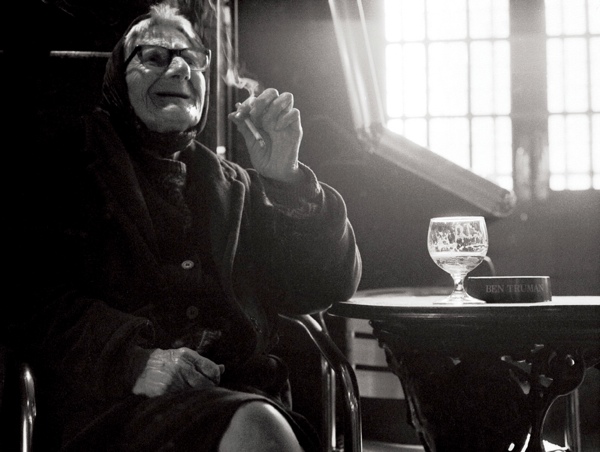
When Sandra Esqulant, celebrated landlady of The Golden Heart in Commercial St, saw this photo taken by Phil Maxwell of Rose sitting in her barroom twenty-five years ago, she told me the story of an unforgettable character who became one of her most loved regulars.
“I loved Rose. I don’t know what happened to her, she’s got to be dead now hasn’t she?
What happened was – you know how you fall in love with some people? – this woman appeared in the pub one day and I fell in love with her. I just liked her.
She asked for a rum & lemonade, and she never had to pay for a drink in my pub.
I used to have to warn everyone when Rose was coming in because she used to pick up everyone’s cigarettes and put them in her bag.
I used to dance with her.
You might think she was dumb, but she was the most astute person I ever met. She didn’t like my husband while I was there, but when I wasn’t there it was a different story!
My husband liked her a lot.
You know I lost my husband.
When she stopped coming, I went round to the Sally Army in Old Montague St, where she lived, but they told me they didn’t know what happened to her, so I went to the Police Station and they were going to search the morgue. I kept going back to the Sally Army and this Irish woman said to me, ‘Are you looking for Rose? She moved to Commercial Rd.’ So I went round to the Commercial Rd shelter and there was Rose. She was very sad because the Sally Army had put her out after forty years. So I used to send a cab to pick her up and take her back from my pub.
The Sally Army, they should have known how fond I was of her and told me where she had gone.
One Sunday, when I was on my own, she collected all the glasses and the ashtrays and the crisp packets and emptied them over the bar. I didn’t mind, Rose could do anything in my pub.
People like Rose would go into a pub and people wouldn’t serve them, but I had everyone in here – this was the dossers’ bar!
One day, Phil Maxwell asked Rose if he could put her in one of his films and she didn’t like that, but he set his camera on the table and took these pictures. And after that, he always had her picture in his exhibitions.
She must have known I was fond of her.
She did like me.
I know she liked me.
She was lovely.
She used to talk about her daughter, but I sometimes wonder if she ever had a daughter.
At Christmas, she always asked me for a Christmas box and, of course, I always gave her one.
They moved her out after forty years, what a thing to do to someone.
If Rose was here today, I’d let her smoke in my pub – I don’t care about the law.
Very special, she was.”


Photographs copyright © Phil Maxwell
Follow Phil Maxwell’s blog Playground of an East End Photographer
See more of Phil Maxwell’s work here
Phil Maxwell’s Kids on the Street
Phil Maxwell & Sandra Esqulant, Photographer & Muse
More of Phil Maxwell’s Old Ladies
Phil Maxwell’s Old Ladies in Colour
Ivor Weiss, Artist

The Onlooker, 1968
I visited Jermyn St in St James to meet Mark Weiss of the Weiss Gallery to hear about the life of his father, the painter Ivor Weiss (1919-1986) who was born in Stepney. The gallery was filled large bold paintings that possess a soulfulness and tender humanity. These pictures embody the cultural memory of the Jewish East End, speaking eloquently of a long life and a significant talent. Today one of Ivor Weiss’ paintings hangs in Sandys Row Synagogue in Spitalfields where it can be viewed on request.
“My father was one of four children. His parents were both Romanian Jews who came over to London at the end of the nineteenth century. We don’t know the exact dates, we have very little documentation of family history. My father’s father came from quite a well-to-do family in Bucharest. He was one of four or five children and his wife, whose maiden name was Wiseman, came from a very large family of twelve or thirteen. We don’t know when they got married but we do know they lived, as many immigrant Jews did at that time, in Stepney in the East End around Cable St. So my father was born a Cockney in Stepney in 1919.
His father was a Master Furrier and clearly was quite successful, although he was only naturalised in 1929. By that time, he had clearly made some money and was living in 33 Elgin Crescent, Westbourne Grove. My grandfather was a gambler and my father used to say that his mother was in tears at the end of the week because all the money his father had earned had been spent, betting on dogs and horses.
My father enlisted when war broke out in 1939 when he was only twenty years old. As a nice Jewish boy from the East End, he expected to be put into a force that suited him but instead he was enrolled in a Glaswegian regiment which he hated. He ended up in the Royal Corps of Signals and was posted to the North African campaign, ending up in Malta. There his artistic talents were first recognised and he attended an art school, winning a couple of prizes. When he was demobilised he went to Heatherley School of Art in Baker St and then St Martin’s in the Charing Cross Rd, where he met my mother Joan, who was also an art student and a painter. They married very quickly after that in 1949.
My father’s brother was a pilot in the RAF and had been seconded during the war to teach American pilots how to fly fighter planes and he married a Jewish lady in Montgomery, Alabama. There was still rationing after the war in this country and he invited my father over to Alabama to live. So my parents went to start a new life there and opened an art school called the Weiss Gallery. It was not easy for them because they were committed to their school being desegregated. They hated the situation, but they had spent all their money getting out there. I and my brother were born in America and, by 1955, they had saved enough money to return.
My father had an offer to be a stand-in art teacher at Lancing College for six months and then he got a job in a secondary modern in Brightlingsea, Essex, where my sister was born. To supplement his income, he used to teach evening classes. By chance, he was asked by a local lady if he could sell a painting for her, so my father brokered the sale of the picture to a local antique dealer and earned more money than he could make in a month. My parents drifted into art dealing from our home in Brightlingsea and, within a few years, made enough money to buy a big house in Colchester. My father had an intuitive eye, and he had studied Art History and technique, so he was well placed to become an art dealer, and my mother used to do the restoration. They made quite a formidable team and the business grew rapidly.
Yet he still had aspirations for his art and there came a watershed when Mr Weston, of the wealthy family who owned Fortnum & Mason, invited my father to paint for him and his friends in the south of France, but my father said, ‘No, I don’t want to leave my family.’ It was a fork in the road. If he had done that, he might have developed more of a career as a commercial painter. Having made that choice, painting remained a private exercise. He was never that prolific, and painting remained a personal and emotional thing for him. It was difficult, it was not something that came easy – the creation of pictures.
For the rest of his life, he and my mother concentrated on art dealing with him painting privately. But after a series of minor heart attacks, he had triple heart by-pass surgery and it proved the catalyst for him paint Judaic subjects. They are some of his most powerful works, drawing on the traditions he grew up with in the East End among Hassidic Jews.
My father died of a heart attack in 1986, at the time I opened up my gallery in London which we would have run together. His paintings remained hanging in the houses of members of the family and in storage with my mother until she died aged ninety-two. These are quite emotional paintings for us as a family.
I regret that I never asked my father questions about the East End and he never discussed it. Sorting out my mother’s affairs, I could not even find a marriage certificate, and I realised they had never talked about their wedding and I had never asked, and how sad that is. As children, we never questioned our parents about their past. They grew up through the horrors of the Second World War and, the generation before, they endured the First World War. My grandfather served with great distinction, but had a horrendous time and had nightmares about it for the rest of his life. He did not want to talk about it.
My father was remarkable man and one of the things that strikes me, when I think about him, is that he never made enemies – which is a rare thing in this life. He was multi-talented, he taught pottery, he could make enamel jewellery, he could make furniture, all sorts of things.“

The Discussion, 1968

Four Drinkers, 1968

Seated cCouple, fifties

The Anchor Inn, Brightlingsea

The Park Bench, 1967

Woman in Pub, 1981

Boredom, 1964

The Waiting Room, 1964

The Last Supper, 1972

The Elders, 1972
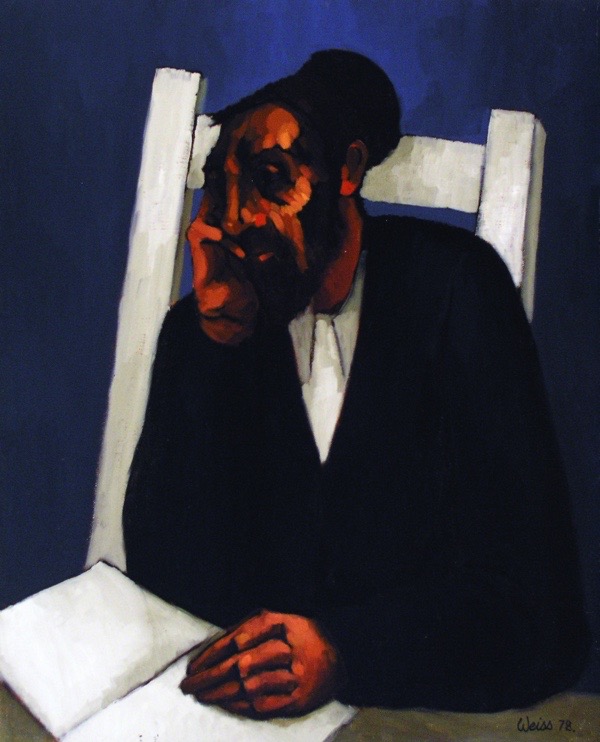
Seated Rabbi, 1972

Approaching Storm, 1966

Wivenhoe Creek, 1966

Ivor & Joan Weiss

In the studio in the fifties

Ivor Weiss painting in the eighties

Ivor Weiss (1919-86), Self Portrait mid-eighties
Paintings copyright © Estate of Ivor Weiss
In & Out The Eagle

On dark nights when the rain beats at my window and the wind moans down my chimney, I dream of leaving the gloomy old house and joining excited crowds, out in their best clothes to witness the spectacular entertainments that London has to offer. The particular theatre I have in mind is The Grecian Theatre attached to the Eagle Tavern in Shepherdess Walk, City Road between Angel and Old St.
The place seems to have developed quite a reputation, as I read recently, “The Grecian Saloon is really a hot house or a black hole, for the number of human beings packed in there every night would induce a supposition there was no other place of entertainment in London. At least two thousand persons were left unable to procure admission.” This was written in 1839, demonstrating that the popular art of having a good time is a noble tradition which has always thrived in the East End, outside the walls of the City of London.
“Up and down the City Road, in and out the Eagle, that’s the way the money goes…” The Eagle public house in the rhyme still exists to this day, though barely anything remains of the elaborate entertainment complex which developed during the nineteenth century – apart from a single scrapbook that I found in the archive of the Bishopsgate Institute. All the balloon ascents, the stick fights, the operas, the wrestling and the wild parties may be over, and the thrill rides closed long ago, but there is enough in this album to evoke the extravagant drama of it all and fire my imagination with thoughts of glamorous nights out on the town.
You only have to imagine walking through Brick Lane and up to Shoreditch on a Saturday night, through the hen parties and gangs of suburban boys out on a bevy, amidst the intoxicated, the drugged and the merely overexcited, to get a glimpse of what it might have been like two hundred years ago when as many as six thousand attended events at the Eagle Tavern.
On the site of the eighteenth century Shepherd & Shepherdess Pleasure Garden, the Grecian Saloon developed at the Eagle Tavern to provide all kinds of entertainments, from religious events to conjuring and equestrian performances. There is a tantalising poetry to the hints that survive of these bygone entertainments, because sentences like “We are glad to find that little Smith has recovered her hoarseness” and “We have little to find fault with save that the maniac was allowed to perambulate the gardens without his keeper” do set the imagination racing.
There are many fine coloured playbills in the cherished album, crammed with enigmatic promises of exotic thrills. I wonder who exactly was the beautiful Giraffe Girl or General Campbell, the smallest man in the world. Amongst so much hyperbole it is disappointing to learn that the central attractions are merely supported by the “artistes of acknowledged talent.”
Elaborate pavilions with all manner of special effects were constructed at the Grecian Saloon, which in turn became the Grecian Theatre in 1858 where Marie Lloyd made her stage debut, aged fifteen. Eventually the building was acquired in 1882 by General William Booth of the Salvation Army and the parties came to an end.
Yet this site saw the transition from eighteenth century pleasure garden to nineteenth century music hall. And when you come to think of the many thousands of souls who experienced so much joy there over all those years, it does impart a certain sacred quality to this location, even if it is now mostly occupied by Shoreditch Police Station.


Images courtesy © Bishopsgate Institute


