
At The Custom House
All titles in the Spitalfields Life Bookshop are half price in our Valentine’s sale. Some are already sold out and others are running low, so – with weeks of lockdown yet to come – this is the ideal opportunity to complete your collection.
Enter the code VALENTINE at checkout to claim your discount.
CLICK HERE TO VISIT THE SPITALFIELDS LIFE BOOKSHOP

Custom House by Robert Smirke, 1825, with elements by David Laing, 1817
I walked down in the frost recently to visit the Custom House. For years, I was unaware of the nature of this enormous austere building which presents an implacable front of Portland stone to the Thames between the Tower of London and old Billingsgate Market. Once I understood its purpose, then its commanding position over the Pool of London became evident.
For more than seven hundred years, this is where all cargoes passing through the Port of London were declared and duties paid, as well as serving as a passport office for migrants, registering upon arrival and departure. Perhaps no building is as central to our history as a seafaring nation than the Custom House. In recent years, we have come to re-evaluate the morality of the creation of Empire and the wealth it delivered. London was the financial capital of the system of slavery and the centre of the sugar trade, and the Custom House was part of this.
The evolution of the Custom House through the centuries follows the growth of Britain’s status as a trading nation, which makes this a pertinent moment to reflect upon the history of the building and the legacy it embodies.
In the eighteenth and nineteenth centuries, the epic Long Room – claimed to be the longest in Europe – at the heart of the Custom House was renowned as a wonder in its own right. Londoners came to observe the variety of races of traders from across the globe who attended to fulfil their obligations in the form of tariffs and taxes.
When Geoffrey Chaucer worked as Comptroller of the Customs of Wools, Skins and Tanned Hides in the Custom House constructed by John Churchman in 1382, duties had formerly been collected since 1203 at Wool Quay just to the east. Tudor expansionism was reflected in an enlarged Custom House of 1559, destroyed a century later by the Great Fire.
The rebuilding of the Custom House was the first priority and it was Christopher Wren who established the pattern of the central Long Room surrounded by smaller offices, which has been maintained in the subsequent buildings each larger than the one before. It is a template that has been replicated in Custom Houses around the world.
Wren’s Custom House was destroyed by fire in 1717, initiating a series of ill-fated replacements that suffered multiple calamities. The next Custom House, designed by Thomas Ripley, caught fire in 1814, resulting in an explosion of gunpowder and spirits that dispersed paperwork as far as the Hackney Marshes. Simultaneously, the unfinished replacement, designed by David Laing, foundered when builder John Peto died unexpectedly leaving the project with insufficient financial backing.
Within two years of completion, Laing’s new Custom House developed structural problems, revealed when the ceiling of the Long Room partially collapsed in 1824. Canny architect Robert Smirke advised occupants to move out of the Long Room two days before it fell down and undertook an investigation which exposed shoddy workmanship and unstable riverfront foundations done on the cheap.
Unsurprisingly, Smirke was employed to rebuild and repair the Custom House, and he replaced the entire central section containing the Long Room in 1825. It is Smirke’s sober sensibility that prevails today, incorporating Laing’s east and west wings into an authoritative frontage of uniformity with an institutional restraint in embellishment and a spare, sombre proportion throughout.
For decades, the Custom House has been inaccessible to the public which is why a building of such central significance has become relatively unnoticed, yet it is publicly-owned. Now Her Majesty’s Revenue & Customs has vacated it and it has been leased to an offshore property developer based in the Bermuda tax haven. They have submitted a planning application for an unsympathetic conversion to a luxury hotel that will be destructive to the fabric of the grade I listed building, erasing its meaning and significance. In particular, suites of Georgian offices which are a unique survival will be destroyed and two light-box bars added to the roof, compromising the river frontage.
Meanwhile, SAVE Britain’s Heritage have prepared an imaginative alternative scheme which takes advantage of its spectacular location and the potential of returning the Long Room as a public space for Londoners. The obvious riverside precedents of Somerset House and Tate Modern demonstrate how the Custom House could be put successfully to public use again.
Readers are encouraged to write to the City of London, objecting to the current planning application to convert the Custom House to a luxury hotel. Below you will find instructions for how to object effectively.

Christopher Wren’s Custom House

“The Custom House, in the uppermost of which is a magnificent room running the whole length of the building. On this spot is a busy concourse of nations who pay their tribute towards the support of Great Britain. In front of this building, ships of three hundred and fifty tons burthen can lie and discharge their cargoes.” From The Microcosm of London by Augustus Pugin & Thomas Rowlandson 1805 (Image courtesy Bishopsgate Institute)

Thomas Ripley’s Custom House from The Microcosm of London by Augustus Pugin & Thomas Rowlandson, 1805

David Laing’s Custom House, 1817

Plan of Laing’s Custom House

“Between London Bridge and the Tower, and – separating it from the Thames – a broad quay that was for long almost the only riverside walk in London open to the public, is the Custom House. Five earlier buildings on the same site were destroyed by fire, and the present structure was erected in 1814-17, the fine facade being designed by Sir R. Smirke. Some 2,000 officials are employed at the Custom House, and in its famous Long Room alone -190 ft by 66 ft – eighty clerks are habitually engaged. This is not surprising, for the trade of the Port of London is by far the greatest of any port in the world. The building, which is entered from Lower Thames St, contains an interesting Smuggling Museum.”
From The Queen’s London: a Pictorial & Descriptive Record of the Streets, Buildings, Parks & Scenery of the Great Metropolis, 1896

Custom House c. 1910 (Image courtesy LAMAS Collection, Bishopsgate Institute)


Boundaries of the parishes of All Hallows by the Tower and St Dunstan in the East, marked on the river wall which was designed by John Rennie, 1819

The Lower Thames St frontage with the main entrance


The Custom House as it appeared before the Great Fire by Wenceslas Hollar, 1647
PROPOSED REDEVELOPMENT OF THE CUSTOMS HOUSE
The offshore leaseholders of the Custom House want to undertake an unsympathetic and destructive conversion of this listed Grade I historic building into a luxury hotel when it should be put back to public use for all Londoners.
- The exclusivity of the luxury hotel development contradicts the City of London’s policy as outlined in the City Plan 2036, which gives preference to ‘office-led cultural use,’ as part of the City’s ambition to open heritage spaces to attract a wider cultural demographic.
- The hotel development will destroy suites of Georgian offices that are a unique survival.
- The hotel development will add two light box pavilions as bars on the roof which will compromise the principal frontage.
HOW TO OBJECT
Lodge an objection to the redevelopment by writing a personal letter to the City of London Corporation as soon as possible.
Please write in your own words and head it OBJECTION.
Quote Planning Applications 20/00632/LBC and 20/00631/FULMAJ
Anyone can object wherever they live. Members of one household can each write separately. You must include your postal address.
Email your objection to Sonia.Williams@cityoflondon.gov.uk and copy it to Alastair.Moss@cityoflondon.gov.uk (Chair of Planning & Transportation Committee)
Or by post to:
The Department of the Built Environment,
City of London,
PO Box 270,
Guildhall,
London,
EC2P 2EJ
Love Tokens From The Thames
We are having a VALENTINE’S SALE with all titles in the Spitalfields Life Bookshop at half price this weekend. Some books are already sold out and others are running out, so – with weeks of lockdown yet to go – this is the opportunity to complete your collection.
Enter the code VALENTINE at checkout to claim your discount.
CLICK HERE TO VISIT THE SPITALFIELDS LIFE BOOKSHOP
On the eve of St Valentine’s, I feature these love tokens that are published in THE GENTLE AUTHOR’S LONDON ALBUM which is included in the sale.

These love tokens are from the collection gathered by my Thames mudlark friend Steve Brooker, widely known as Mud God.
The magical potential of throwing a coin into the water has been recognised by different cultures in different times with all kinds of meanings. Yet since we can never ask those who threw these tokens why they did it, we can only surmise that engraving your beloved’s name upon a coin and throwing it into the water was a gesture to attract good fortune. It was a wish.
With a great river like the Thames racing down towards the ocean, there is a sense of a connection to the infinite. And there is a sweet romance to the notion of a lover secretly throwing a token into the water, feeling that the strength of their emotions connects them to a force larger than themselves.
Naturally, it was not part of the conceit that someone might ever find these coins, centuries later – which gives them a mysterious poetry now, because each one represents a love story we shall never learn. Those who threw them have gone from the earth long ago, and all we can envisage are the coins tossed by unseen hands, flying from the river bank or a from the parapet of a bridge or from a boat, turning over in the air, plip-plopping into the water and spiralling down to lie for centuries in the mud, until Steve Brooker came along to gather them up. Much as we may yearn, we can never trace them back to ask “What happened?”
In the reign of William III, it was the fashion for a young man to give a crooked coin to the object of his affections. The coin was bent both to become an amulet and to prevent it being reused. If the token was kept, it indicated that the affection was reciprocated, but if the coin was discarded then it was a rejection – which casts a different light upon these coins in the river. Are they, each one, evidence of unrequited affections?
From the end of the eighteenth century and until the early twentieth century, smoothed coins were used as love tokens, with the initials of the sender engraved or embossed upon the surface. Sometimes these were pierced, which gave recipient the option to wear it around the neck. In Steve’s collection, the tokens range from heavy silver coins with initials professionally engraved to pennies worn smooth through hours of labour and engraved in stilted painstaking letters. In many examples shown here, the amount of effort expended in working these coins, smoothing, engraving or cutting them is truly extraordinary, which speaks of the longing of the makers.
Steve has found many thousands of coins in the bed of the Thames over the years but it is these worked examples that mean most to him because he recognises the dignity of the human emotion that each one manifests. Those who threw them into the river did not know that Steve was going to be there one day to catch them yet, whatever the outcome of these romances, he ensures that the tokens are kept safe.

Benjamin Claridge.

The reverse of the Benjamin Claridge coin, from the eighteenth century or earlier.

The intials M and W intertwined upon a Georgian silver coin.

The intial W upon the smoothed face of Georgian silver coin, bent into an S shape.

Crooked Georgian silver coin, as the token of a vow or promise.

The initials AMD upon a smoothed coins that has been pierced to wear around the neck.

A copper penny with the letter D.

C.M. Marsh impressed into a penny.

The letter R punched into a penny within a lucky horseshoe.

Pierced coin set with semi-precious stones.

Who was Snod? Is this a lover’s token or a dog tag?

This pierced silver threepence commemorates the date January 11th 1921.

On the reverse of the silver threepence are the initials, L T. Are these the initials of the giver, or does it signify “Love Token”?

A smoothed penny with the name Voilet upon it. A phonetic spelling of the name “Violet”as the beloved spoke it?

Cut coins from the early twentieth century.
Read my stories

Click here to buy a copy of The Gentle Author’s London Album for half price
Snowfall At Bow Cemetery
We are having a VALENTINE’S SALE with all titles in the Spitalfields Life Bookshop at half price this weekend. Some books are already sold out and others are running out, so – with weeks of lockdown yet to go – this is a good opportunity to complete your collection.
Enter the code VALENTINE at checkout to claim your discount.
CLICK HERE TO VISIT THE SPITALFIELDS LIFE BOOKSHOP

A hush was cast upon the East End as the snow came down, taking possession of the territory. Awaking and looking from my bedroom window, the dark boughs of the great yew tree in the yard were weighed down with a heavy covering of white – a bucolic wintry vision filling my gaze, as if the house had been transported in the night and I had woken high in the mountains.
Even as I opened my eyes, I knew I wanted to go to the cemetery, where I pay a visit to admire the precocious bulbs each spring. The appealing irony is that this vast garden of death has become the largest preserve of wildlife in East London. Created once the small parish churchyards filled up, it is where those numberless thousands who made the East End in the nineteenth century are buried. On the Western side of the cemetery, near the main entrance, are fancy tombs and grand monuments but, as you walk East, they diminish and become more uniformly modest until, at the remotest extremity, there are only tiny stones. At first, I thought these were for children when, in fact, they were simply the cheapest option. Yet even these represent an aggrandisement, beyond the majority of those who were buried here in unmarked communal graves.
My spirits lifted to leave the icy mess of the streets and enter the quiet of the cemetery where since 1966, a forest has been permitted to grow. A freezing mist hung beneath the high woodland canopy, and the covering of white served to emphasise the rich green and golden lichen hues of the stones, and subtle brown tones of the tree trunks ascending from among the graves. As on my previous visits, I quickly lost myself in the network of narrow paths, letting the trees surround me in the areas where no human footprint had yet been made upon the snowy coverlet, beneath which the dead lay slumbering in their graves.
Crows called to each other and woodpeckers hammered away high in the tree tops, their sounds echoing in the still air. Thrushes searched for grubs under leaves in the rare patches of uncovered earth beneath stands of holly, and a young fox came by – standing out as a vivid rusty brown against the pale snow – slinking along self-conscious of his exposure. The spring bulbs were evidenced only by sparse green spears, protruding from snow criss-crossed by animal and bird tracks.
It was a very different place from the lush undergrowth of high summer and another place again from the crocus-spangled garden of spring, yet I always discover peace and solitude here – a rare commodity in the East End – and, even in this bleakest season, there was life.


You may also like to read about
List Of Local Shops Open For Business

Boy in Woolworths, Exmouth Market, Clerkenwell, 1954
This is the list of essential shops that are open in Spitalfields and vicinity during the current lockdown. Readers are especially encouraged to support small independent businesses who offer an invaluable service to the community. This list confirms that it is possible to source all essential supplies locally without recourse to supermarkets.
Be advised many shops are operating limited opening hours at present, so I recommend you call in advance to avoid risking a wasted journey. Please send any additions or amendments for next week’s list to spitalfieldslife@gmail.com
This week’s photographs are by Colin O’Brien.

Two women and a baby in Woolworths, Exmouth Market, Clerkenwell, 1954
GROCERS & FOOD SHOPS
The Albion, 2/4 Boundary St
Ali’s Mini Superstore, 50d Greatorex St
AM2PM, 210 Brick Lane
Planet Organic, 132 Commercial St
Banglatown Cash & Carry, 67 Hanbury St
Breid Bakery, Arch 72, Dunbridge St
Brick Lane Minimarket, 100 Brick Lane
The Butchery Ltd, 6a Lamb St
City Supermarket, 10 Quaker St
Costprice Minimarket, 41 Brick Lane
Faizah Minimarket, 2 Old Montague St
JB Foodstore, 97 Brick Lane
Haajang’s Corner, 78 Wentworth St
Leila’s Shop, 17 Calvert Avenue
Nisa Local, 92 Whitechapel High St
Pavilion Bakery, 130 Columbia Rd
Rinkoff’s Bakery, 224 Jubilee Street & 79 Vallance Rd
Sylhet Sweet Shop, 109 Hanbury St
Taj Stores, 112 Brick Lane
Zaman Brothers, Fish & Meat Bazaar, 19 Brick Lane

Girl with ice cream cone, 1963
TAKE AWAY FOOD SHOPS
Before you order from a delivery app, why not call the take away or restaurant direct?
Absurd Bird Fried Chicken, 54 Commercial St
Al Badam Fried Chicken, 37 Brick Lane
Allpress Coffee, 58 Redchurch St
The Association, 10-12 Creechurch Lane
Band of Burgers, 22 Osborn St
Beef & Birds, Brick Lane
Beigel Bake, 159 Brick Lane
Beigel Shop, 155 Brick Lane
Bellboi Coffee, 104 Sclater St
Bengal Village, 75 Brick Lane
Big Moe’s Diner, 95 Whitechapel High St
Burro E Salvia Pastificio, 52 Redchurch St
Cafe 388, 388 Bethnal Green Rd
China Feng, 43 Commercial St
Circle & Slice Pizza, 11 Whitechapel Rd
Crosstown Doughnuts, 157 Brick Lane
Dark Sugars, 45a Hanbury St (Take away ice cream and deliveries of chocolate)
Donburi & Co, Korean & Japanese, 13 Artillery Passage
Eastern Eye Balti House, 63a Brick Lane
Enso Thai & Japanese, 94 Brick Lane
Exmouth Coffee Shop, 83 Whitechapel High St
Grounded Coffee Shop, 9 Whitechapel Rd
Holy Shot Coffee, 155 Bethnal Green Rd
Hotbox Smoked Meats, 46-48 Commercial St
Jack The Chipper, 74 Whitechapel High St
Jonestown Coffee, 215 Bethnal Green Rd
Laboratorio Pizza, 79 Brick Lane
La Cucina, 96 Brick Lane
Leon, 3 Crispin Place, Spitalfields Market
Madhubon Sweets, 42 Brick Lane
Mooshies Vegan Burgers, 104 Brick Lane
Nude Expresso, The Roastery, 25 Hanbury St
E. Pellicci, 332 Bethnal Green Rd
Pepe’s Peri Peri, 82 Brick Lane
Peter’s Cafe, 73 Aldgate High St
Picky Wops Vegan Pizza, 53 Brick Lane
Polo Bar, 176 Bishopsgate
Poppies, 6-8 Hanbury St
Quaker St Cafe, 10 Quaker St
Rajmahal Sweets, 57 Brick Lane
Rosa’s Thai Cafe, 12 Hanbury St
Shawarma Lebanese, 84 Brick Lane
Shoreditch Fish & Chips, 117 Redchurch St
Sichuan Folk, 32 Hanbury St
String Ray Globe Cafe, 109 Columbia Road
Sushi Show, 136 Bethnal Green Rd
Vegan Yes, Italian & Thai Fusion, 64 Brick Lane
The Watch House, 139 Commercial St
White Horse Kebab, 336 Bethnal Green Rd
Yuriko Sushi & Bento, 48 Brick Lane

Clothes shop cat, seventies
OTHER SHOPS & SERVICES
Brick Lane Bookshop, 166 Brick Lane (Books ordered by phone or email are delivered free locally)
Brick Lane Bikes, 118 Bethnal Green Rd
Day Lewis Pharmacy, 14 Old Montague St
E1 Cycles, 4 Commercial St
Eden Floral Designs, 10 Wentworth St (Order fresh flowers online for free delivery)
Flashback Records, 131 Bethnal Green Rd (Order records online for delivery)
GH Cityprint, 58-60 Middlesex St
Harry Brand, 122 Columbia Road (Order gifts online for delivery)
Leyland Hardware, 2-4 Great Eastern St
Newman’s Stationery, 324 Bethnal Green Rd (Call for local delivery)
Post Office, 160a Brick Lane
Rose Locksmith & DIY, 149 Bethnal Green Rd
Sid’s DIY, 2 Commercial St

Girl with pram, Kingsland Rd, eighties
ELSEWHERE
E1 Dry Cleaners, Cannon Street Rd, E1 2LY
E5 Bakehouse, Arch 395, Mentmore Terrace, London Fields (Customers are encouraged to order online and collect in person)
Gold Star Dry Cleaning & Laundry, 330 Burdett Rd
Hackney Essentials, 235 Victoria Park Rd
Quality Dry Cleaners, 16a White Church Lane
Newham Books, 747 Barking Rd (Books ordered by phone or email are posted out)
Old Bank Vault Gallery, 283 Hackney Rd (Order online)
Rajboy, 564 Commercial Rd, E14 7JD (Take away service available)
Region Choice Chemist, 68 Cambridge Heath Rd
Symposium Italian Restaurant, 363 Roman Road (Take away service available)
Thompsons DIY, 442-444 Roman Rd

Woman in a summer dress, Chatsworth Rd, Hackney, eighties
Images copyright @ Estate of Colin O’Brien
You may also like to take a look at
Lew Tassell’s Day Trip
Lew Tassell sent me these pictures that he took on a trip to London at fifteen years old in 1966

Old London Bridge
‘These pictures were taken in March 1966 with my first proper camera, albeit only a Zeiss Ikon Ikonette with a 35mm fixed lens viewfinder that cost me £7 secondhand. I loved that camera and wish I still had it, it had no metering or any features so it taught me a lot.
Film and developing were very expensive, so I had to be frugal with my picture-taking and then wait for them to be developed to see if I had judged the exposure correctly.
I was fifteen years old, living with my parents in South London and just about to leave school. I used to catch a train from Elmers End to Charing Cross – returning via London Bridge – and explore, usually taking in a visit to the National Gallery.’

‘My school friend, Paul, on one of Landseer’s Lions in Trafalgar Sq, he was instantly told to ‘get orf’ by a policeman’

‘I always found Piccadilly Circus magical and ever-changing. There was not much neon during the sixties and the buildings were generally dirty and grey, but the West End was a place with lively streets, especially this spot with the cinemas and theatres.’

The classic Coca-Cola sign

‘Carnaby St was a tremendously exciting place for a teenager to wander about. I didn’t have the money to buy anything but just to be there was enough’

John Stephen’s celebrated menswear shop in Carnaby St, clothes worn by The Who, The Kinks, The Rolling Stones and The Small Faces

‘Spot the Rolls Royce coming round the corner’

‘Spot the sandwich man for ‘Champagne Temps”

Looking across Carnaby St to Foubert’s Place

Lord Kitchener’s Valet sold military uniform as fashion, customers included Jimi Hendrix, John Lennon and Mick Jagger

Crowded pavements in Carnaby St

Old Cannon St Railway Station from Southwark Bridge

Eastcheap corner of Pudding Lane

Guy’s Hospital under construction by London Bridge Station

Tower of London in the mist

Old men sitting by the Tower

Cannons on the waterfront at the Tower

A foggy, soot-stained Tower Bridge

‘In the Pool Of London – one of my earliest memories is standing in this spot with my father, watching the ships being unloaded in the centre of the City’

‘Police launch on the Thames – four years later I joined the City of London Police’
Photographs copyright © Lew Tassell
You may also like to take a look at
On Night Patrol With Lew Tassell
On Top Of Britannic House With Lew Tassell
A Walk Around The Docks With Lew Tassell
Minor Stepney Disasters Of The Seventies
Photographer Philip Cunningham set me this series of minor Stepney disasters of the seventies

Milk spillage in Bancroft Rd
“In the seventies, when I was studying photography, I carried a camera with me most of the time. The East End was a very lively place in those days and all sorts of things happened, both good and bad, all the time. I never sought out disasters, I just stumbled upon them and the wonder is that, as far as I know, nobody was seriously harmed.
The Mile End Rd leads right into the city and it is straight and safe, but drivers took incredible risks. The car crash happened just at the end of Mile End Place where I lived.
The flat fire in Alderney Rd was tragic, I do not know how it started but everything inside was destroyed. The poor occupant was standing in her dressing gown, devastated. Many more people smoked then and fire-proofed furniture had not been heard of.
One day, after I had dropped my daughter off at school in Cephas St and was late for college, I heard a smash of breaking glass. I ran back to discover the milk disaster. I took a few photos but, curiously, the milkman had disappeared. When I returned in the afternoon to collect my daughter from school, everything had been cleared up, not a even a trace of any broken glass or spilt milk.
The dustcart fire was in Harford St. Like the other disasters, it something I just happened to stumble across. The engine had caught fire and the cart was a write-off, but no-one was hurt.”
Philip Cunningham

Fire in Alderney Rd


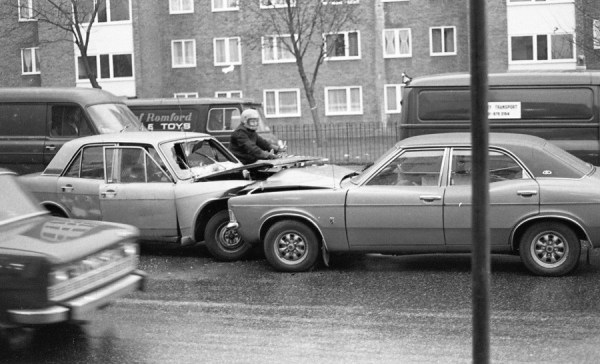
Car crash in Mile End Rd


Dustcart fire in Harford St


Milk spillage in Bancroft Rd


Photographs copyright © Philip Cunningham
You may also like to take a look at
The Juvenile Almanac
Now that we can look forward to life beyond lockdown, I thought this might be a good moment to present this almanac from the eighteen-twenties, published by Hodgson & Co, 10 Newgate St. I am grateful to Sian Rees for drawing my attention to these wonderful images.


Images courtesy University of California Libraries
You may also like to take a look at


