
At Herne Bay

CLICK TO DISCOVER THE GENTLE AUTHOR’S TOUR OF SPITALFIELDS

Reculver Towers
Several years ago, I grew fascinated with a ruin upon the seashore in the background of a photograph of members of the Cambridge & Bethnal Green Boys’ Club taken by Harry Tichener in 1938 . When Maxie Lea, who is featured in the picture, told me that it was taken at Herne Bay, I knew that one day I must go and seek this location for myself.
Yet, when I arrived and walked from the railway station to the deserted seafront, I discovered there were many other attractions that make this secluded corner of the Kent coast worthy of a visit. Set back fifty yards from the shingle beach, sits a magnificent line of grand hotels and seafront villas. Some are whimsical Victorian fripperies and others are elegant bow-fronted Georgian, and it makes an appealing backdrop to the well-kept and newly-renovated municipal gardens, basking in the September sunlight beneath an azure sky flecked with feathery trails.
A proud white stucco gatehouse guards a poignant remnant of what was Britain’s second longest pier in 1896, now just a stub attached to the shore with the far end marooned out at sea, unreachable and distant since the storm of 1978. You can take a stroll past the huts, adorned with saucy paintings in the style of Donald McGill, to reach the end of what remains and join a sparse line of fishermen and senior local residents, casting their eyes wistfully towards the horizon and awaiting a miraculous reconstruction.
Turning my gaze to the east, I could already recognise the towers at Reculver shining white in the far distance and encouraging me to take my leave of the town and seek the coastal path. The outskirts of Herne Bay present a curious mixture of dereliction and some cherished Regency villas, culminating in Marckari’s ice cream parlour where I had my first taste of an authentic Turkish delight ice cream. Thus fortified, I strolled onward upon the broad featureless concrete promenade with the towers reassuringly present, constantly in my vision.
Climbing a winding stairway takes you to the cliff path, lined with sloes and hawthorn, and giving way to meadows that descend towards Reculver. Soon, the towers are no longer an image on the horizon but looming above you. You ascend the path beneath them as a colony of swifts swoop and dive over your head, filling the air with their cries before returning to roosting places high in the turrets. You have arrived upon a raised platform of green, overlooking the sea, where the sweet fragrance of nectar hangs in the air. This was where the Romans built a fort in 42AD, when this was the end of the land and the marshes to the east were open water, known as the Wantsum, a channel that isolated the Isle Of Thanet from the mainland.
St Augustine brought Christianity to Kent at the end of the sixth century and, by AD 669, King Ecgbert gave this land for the foundation of a monastery. A tall church was built upon the Roman ruins, creating a landmark that signalled the spiritual significance of this favoured spot, visible from such a great distance. In 1810, the ruins of this church were reconstructed by Trinity House to create a stable structure that could function as a navigational aid. Once there was a thriving village of Reculver, yet the encroachment of the sea and regular flooding led to its decline until only a couple of houses are left today. Yet it retains a distinctive atmosphere and, after all this time, the imposing sea-battered towers are like natural excrescences of rock.
Setting out across the marshes as the afternoon sun declined, I was entranced by the naturally occurring gardens upon the shingle, where grey-green sea kale grew in star shapes complimenting the pink leaves of sorrel spreading close to the ground and interspersed with curious bushes of yellow poppies that seeded themselves all along the beech. Glancing over my shoulder, the towers of Reculver seemed to get no further away, watching over me now as they had beckoned me earlier.
Nine miles to the east of Herne Bay, I arrived at Birchington – a suburban resort with art deco villas, some dignified austere brick farmhouses and an unexpected half-timbered medieval cottage. My feet were sore and my face was burned from wind and sunshine, and I fell asleep upon the train – only waking again as we drew into London to wonder if the whole excursion had been a dream.

Herne Bay pier was once the second longest in Britain


Bow-fronted Georgian terrace on the seafront


Regency villas in a side street

The path to Reculver

At Reculver


Harry Tichner’s photograph of Maxie Lea (standing right) at Herne Bay in 1938

1685 Map of the lost village of Reculver


At Minnis Bay

Cottage at Birchington-on-Sea
At Gravesend
CLICK TO DISCOVER THE GENTLE AUTHOR’S TOUR OF SPITALFIELDS

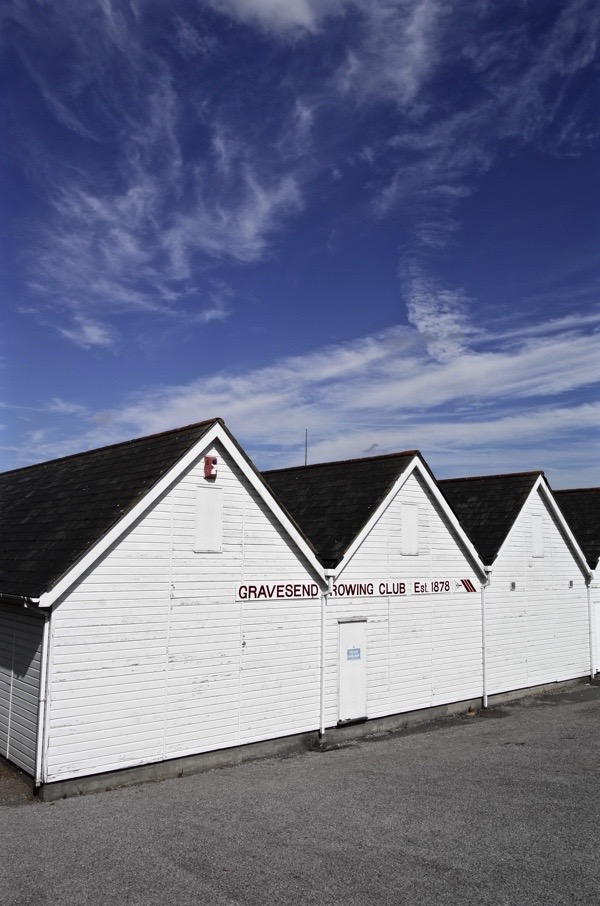
There is an undeniable romance about arriving by boat at a place you have never been before. This was how I arrived at Gravesend. Certainly, the vast terminal for cruise liners at Tilbury encourages a sense of expectation, even if your voyage is not across the ocean but simply over the Thames.
Yet as we approached Gravesend, it was a journey of a more melancholy nature that filled my mind. Since it was here that Pocahontas, one of the very first Americans to visit Europe, landed when illness forced her to abandon her return journey on March 21st 1617. The ship turned from its course before it left the Thames estuary and sought harbour at Gravesend where Pocahontas died just a few hours after coming ashore. Only twenty-one, she experienced much in her short life and left a young son, Thomas. He was taken back to London and completed her aborted journey home in adulthood, while his mother was buried at St George’s church, where today a handsome bronze figure embodies her presence to greet the pilgrims.
My arrival in Gravesend and a brisk walk up the steep High St were sufficient to displace these thoughts, replacing them with astonishment at the number of tattoo parlours and nail bars in such a small stretch of shops. Well-tended hanging baskets of flowers at every turn spoke eloquently of civic pride, while the many high quality buildings from earlier centuries evidenced the former wealth of Gravesend.
The appealing architectural vernacular of this shambolic medieval High St, interspersed by the Victorian grandeur of the Market Hall and the Carnegie Library, enticed me up the hill to the square where a group of senior Sikh gentlemen sat, happily passing the time of day and looking dapper in their turbans of multiple hues of blue.
Before long, hunger beckoned and I set off past Bawley Bay, where families once emigrated to the Antipodes, and St Andrew’s Mission church, built out over the water in 1871, and the Clarendon Royal Hotel, conceived as a palace for James II, and the Customs House of 1812, and the fourteenth century Milton Chantry, the oldest building in Gravesend, and the New Tavern Fort, constructed in expectation of an invasion by the French.
My point of arrival was the Promenade Cafe, an elegant thirties pavilion set back from the sea behind a wide lawn, thronging with customers, young and old, and everyone quite at home. This eastern stretch of Gravesend is where local residents, especially families, come to enjoy their leisure, offering paddling, feeding the swans, dog-walking and the quiet spectacle of passing traffic in the estuary. Among other hungry customers, I sat patiently at my table until a waiter should call out the number of my dinner ticket and deliver my plate of fish and chips.
‘Number Six!’ called the waiter, wielding a tray laden with two steaming fish dinners and inspiring everyone to turn their heads to see who was to be the lucky recipient. ‘Number Six?’ the waiter bawled at the top of his voice. Mystified by lack of any response, ‘Number Six?’ he queried, before returning inside shaking his head in disappointment. Puzzled glances passed between the dinners until a senior gentleman in a corner perked up. ‘Did he say Number Six?’ he asked, speaking his thoughts out loud. Observing nods of assent from neighbouring tables, he leapt to his feet clutching his ticket and hurried inside declaiming, ‘He didn’t speak loud enough, did he?’ and ‘What’s wrong with you, can’t you speak up?’
East of the promenade and over the canal, an atmosphere of extravagant post-industrial decay prevails. I walked for a mile along an overgrown narrow path between huge abandoned factories to emerge in a light industrial estate where small businesses still thrive, mostly in maritime related trades. At the very end, where the Higham Marshes begin sits the Ship & Lobster, occupying a position as the first and last pub on the Thames. Of significant history and in a breathtaking location, it was refreshing to encounter this friendly unpretentious local pub that serves the community of workers from the industrial estate, and has successfully evaded tourism or tarting up.
Before I returned to the ferry and the train back to Fenchurch St, I had one more landmark to discover. Sitting on the hill above Gravesend, the Guru Nanak Darbar Gurdwara Sikh Temple looks for all the world as if had been magically transported there by a genie from the Arabian Nights. Built entirely of gleaming white marble, on an equal scale to a European cathedral, this a compelling piece of architecture rendered even more remarkable by its unexpected location. Approaching through the elaborate gatehouse pavilion, I could not resist crossing the car park and walking right up to it – I should not have been surprised if it had vanished like a mirage.
A woman in long coloured robes hurried towards me. Immediately, I felt that I had trespassed and prepared my apology, but instead she welcomed me openly and invited me inside, explaining where I could find a cloth to cover my head and where I could leave my shoes if I wanted to attend a service. The interior of the temple with its enormous blue dome, lined with mosaic, and ceremonial staircase was no less impressive than the exterior. Yet the atmosphere was relaxed and I found myself reciprocating polite nods with worshippers passing in the hallway. My first foray into the world of the Sikhs.
The shadows were lengthening and my feet were sore when I climbed aboard Tilbury ferry at the end of a memorable excursion, crammed with wonders. I was enchanted by my day trip to Gravesend. Gravesend has so much to recommend it, I thought.

The Gravesend ferry ready to leave from Tilbury

Cruise ship at Tilbury seen from the Gravesend ferry

On the ferry

Looking back to Tilbury from Gravesend

Gravesend has the oldest cast iron pier in Britain

Arrival at Gravesend

St George’s where Pocahontas, one of the first Americans to visit Europe, is buried

Gravesend Market

Former manufacturers

Traditional Undertaker at Gravesend

Customs House


At the Promenade Cafe


Along Wharf Rd


In Mark Lane

The Ship & Lobster, the first and last pub on the Thames. Featured in Great Expectations, this pub was supposedly founded when Charles II and his brother James raced barges here.

Guru Nanak Darbar Gurdwara, Sikh Temple

Plan your trip at www.visitgravesend.co.uk
At Walton On the Naze
CLICK TO DISCOVER THE GENTLE AUTHOR’S TOUR OF SPITALFIELDS

All this time, Walton on the Naze has been awaiting me, nestling like a forgotten jewel cast up on the Essex coast, and less than an hour and a half from Liverpool St Station.
Families with buckets and spades joined the train at every stop, as we made our way eastwards to the point where Essex crumbles into the North Sea at the rate of two metres a year. Yet all this erosion, while reminding us of the force of the mighty elements, also delivers a perfect sandy beach – the colour of Cheddar cheese – that is ideal for sand castles and digging. Stepping from the small train amongst the flurry of pushchairs and picnic bags, at once the sea air transports you and the hazy resort atmosphere enfolds you. Unable to contain yourself, you hurry through the sparse streets of peeling nineteenth century villas and shabby weather-boarded cottages to arrive at a rise overlooking Britain’s third longest pier, begun in 1830.
In spite of the majestic pier, this is a seaside resort on a domestic scale. You will not find any foreign tourists here because Walton on the Naze is a closely guarded secret, it is kept by the good people of Essex for their sole use. At Walton on the Naze everyone is local. You see Essex families running around as if they owned the place, playing upon the beach in flagrant carefree abandon, as if it were their own back yard – which, in a sense, it is.
This sense of ownership is manifest in the culture of the beach huts that line the seafront, layers deep, in higgledy-piggledy terraces receding from the shore. These little wooden sheds are ideal for everyone to indulge their play house and dolls’ house fantasies – painting them in fanciful colours, giving them names like “Ava Rest,” and furnishing the interiors with gas cookers and garish curtains. At the seaside, all are licenced to pursue the fulfilment of residual childhood yearning in harmless whimsy. The seaside offers a place charged with potent emotional memory that we can return to each Summer. It is not simply that people get nostalgic for seaside resorts, but that these seasonal towns become the location of nostalgia itself – because the sea never changes and we revisit our former selves when we come back to the beach.
Walton Pier curls to one side like a great tongue taking a greedy lick from an ocean of ice cream, and the beach curves away in a crooked smile that leads your eye to the “Naze,” or “nose” to give its modern spelling. This vast bulbous proboscis extends from the profile of Essex as if from a patient in need of plastic surgery, provided in the form of relentless abrasion from the sea.
With so many attractions, the first thing to do is to sit down at the tables upon the beach outside Sunray’s Kiosk which serves the best fish & chips in Walton on the Naze. Every single order is battered and cooked separately in this tiny establishment, that also sells paper flags for sandcastles and shrimping nets and all essential beach paraphernalia. From here a path leads past a long parade of beach huts permitting you the opportunity to spy upon these domestic theatres, each with their proud owners lounging outside while their children run back and forth, vacillating between their haven of security and the irresistible wonder of the waves crashing at the shoreline.
Here I joined some girls, excitedly fishing for crabs with hooks and lines off a small jetty. They all screamed when one pulled out a much larger specimen than the tiddlers they had in their buckets, only to be reassured by the woman who was overseeing their endeavour. “Don’t be frightened – it’s just the Mummy!” she declared with a wicked smile, as she held up the struggling creature by a claw. From this jetty, I could see the eighty foot tower built upon the Naze in 1720 as a marker for ships entering the port of Harwich and after a gentle climb up a cliff path, and a strenuous ascent up a spiral staircase, I reached the top. Like a fly perched upon the nose of Essex, I could look North across the estuary of the Orwell towards Suffolk on the far shore and South to the Thames estuary with Kent beyond – while inland I could see the maze of inlets, appealingly known as the Twizzle.
I was blessed with a clear day of sunshine for my holiday. And I returned to the narrow streets of Spitalfields for another year with my skin flushed and buffeted by the elements – grateful to have experienced again the thrall of the shoreline, where the land runs out and the great ocean begins.


Sunray’s Kiosk on the beach, for the best fish & chips in Walton on the Naze.


“On this promontory is a new sea mark, erected by the Trinity-House men, and at the publick expence, being a round brick tower, near eighty foot high. The sea gains so much upon the land here, by the continual winds at S.W. that within the memory of some of the inhabitants there, they have lost above thirty acres of land in one place.” Daniel Defoe, 1722


You may like to read about the Gentle Author’s previous holidays
A Walk Along The Ridgeway
While the Gentle Author takes a holiday, we are celebrating the joys of the season with a HARVEST SALE, selling all our books at half price so you can treat yourself and your friends and family. Simply add code ‘HARVEST’ at checkout to claim your discount.
CLICK HERE TO VISIT THE SPITALFIELDS LIFE BOOKSHOP

They say it is the oldest road in Britain, maybe the oldest in Europe. Starting from the highest navigable point of the Thames in prehistoric times, the Ridgeway follows the hilltops to arrive at Salisbury Plain where once wild cattle and horses roamed. When the valleys were forested and impenetrable, the Ridgeway offered a natural route over the downland and into the heart of this island. Centuries of cattle driving wore a trackway that curved across the hillside, traversing the contours of the landscape and unravelling like a ribbon towards the horizon.
Over thousands of years, the Ridgeway became a trading route extending from coast to coast, as far as Lyme Regis in the west and the Wash in the east, with fortresses and monuments along the way. Yet once the valleys became accessible it was defunct, replaced by the Icknield Way – a lower level path that skirted the foot of the hills – and there are burial mounds which traverse the Ridgeway dated to 2000BC, indicating that the highway was no longer in use by then.
In fact, this obsolescence preserved the Ridgeway because it was never incorporated into the modern road network and remains a green path to this day where anyone can set out and walk in the footsteps of our earliest predecessors in this land. Leaving Spitalfields early and taking the hour’s rail journey to Goring & Streatley from Paddington, I was ascending the hill from the river by eleven and onto the upland by midday. In this section, the flinty path of the Ridgeway is bordered with deep hedges of hawthorn, blackthorn and hazel, giving way to the open downland rich with the pink and blue flowers of late summer, knapweed, scabious and harebells.
A quarter of a century has passed since I first passed this way and yet nothing has changed up there. It is the same huge sky and expansive grassy plain undulating into the distance with barely a building in sight. This landscape dwarfs the human figure, inducing a sense of exhilaration at the dramatic effects of light and cloud, sending patterns travelling fast across the vast grassy wind-blown hills. When I first began to write and London grew claustrophobic, I often undertook this walk through the different seasons of the year. I discovered that the sheer exertion of walking all day, buffeted upon the hilltops and sometimes marching doggedly through driving rain, never failed to clear my mind.
As a consequence, the shape of the journey is graven into memory even though, returning eighteen years since my last visit, the landscape was greater than I had fashioned it in recollection. And this is the quality that fascinates me about such epic terrain, which the mind cannot satisfactorily contain and thus each return offers a renewed acquaintance of wonder at the scale and majesty of the natural world.
In those days, I was in thrall to endurance walking and I would continue until I could go no further, either because of exhaustion or nightfall. This vast elevated downland landscape encouraged such excessive behaviour, leading me on and on along the empty path to discover what lay over the brow and engendering a giddy sense of falling forward, walking through the sky – as if you might take flight. I walked until I thought I could walk no more and then I carried on walking until walking became automatic, like breathing. In this state my body was propelled forward of its own volition and my mind was free.
One day’s walk brings you to Uffington and the famous White Horse, carved into the chalk of the downland. Placed perfectly upon the crest of a ridge within a vast fold of the hills, this sparsely drawn Neolithic figure looks out across the arable farmland of Oxfordshire beyond and can be seen for great distances. A mystery now, a representation that may once have been a symbol for a people lost in time, it retains a primeval charisma, and there is such an intensity of delight to reach this figure at the end of a day’s walking. Breathless and weary of limbs, I stumbled over the hill to sit there alone upon the back of the hundred foot White Horse at dusk, before descending to the village of Bishopstone for the night. There, at Prebendal Farm, Jo Selbourne offers a generous welcome and, as well as the usual bed and breakfast, will show you the exquisitely smoothed ceremonial Neolithic axe head found upon the farm.
The second day’s walk leads through the earthen ramparts of Liddington Hill and Barbary Castle, and on either side of the path the fields are punctuated by clumps of trees indicating the myriad ancient burial mounds scattered upon this bare Wiltshire scenery. It is a more expansive land than the fields of Berkshire where I began my journey, here the interventions made in ancient times still hold their own and the evidence of the modernity is sparser. As I made the final descent from the hill towards Avebury, a village within a massive earthwork and stone circle which was the culmination of my journey, I could not resist the feeling that it was all there for me and I had earned it by walking along the old path which for thousands of years had brought people to arrive at this enigmatic location of pilgrimage.
In two days upon the hilltops I had only passed a dozen lone walkers, and now the crowds, the coach parties, the shops and the traffic were a startling sight to behold. And so I knew my journey had fulfilled its purpose – to reacquaint me freshly with the familiar world and restore a sense of proportion. My feet were sore and my face was flushed by the sun. I began my journey in August and ended it in September. In Berkshire, the ripe fields of corn were standing, in Oxfordshire, they were being harvested and, in Wiltshire, I saw the stubble being ploughed in. It had been a walk to arrive at the end of the summer. It had been a walk through time along the oldest road.

Goring Mill

“Join it at Streatley, the point where it crosses the Thames, at once it strikes you out and away from the habitable world in a splendid purposeful manner, running along the highest ridge of the downs.” Kenneth Grahame, 1898

A ninety-two year old man told me this year is the worst harvest he could remember. “It doesn’t want to come in the barn,” he lamented.


At East Illsley

“A broad green track runs for many a long mile across the downs, now following the ridges, now winding past at the foot of a grassy slope, then stretching away through cornfield and fallow.” Richard Jefferies, 1879

“A rough way, now wide, now narrow, among the hazel, brier and nettle. Sometimes there was an ash in the hedge and once a line of spindly elms followed it round in a curve.” Edward Thomas, 1910

On White Horse Hill

“The White Horse is, I believe, the earliest hill drawing we have in England. It is a piece of design, in another category from the other chalk figures, for it has the lineaments of a work of art. The horse, which is more of a dragon than a horse, is cut on the top of the down’s crest, so that it can only be seen completely from the air, or at a long view, from the surrounding country – but it was precisely this aspect of the Horse design that I found so significant.” Paul Nash, 1938

The Neolithic axe head found at Prebendal Farm, photo by Rob Selbourne.

At Bishopstone


At Barbary Castle


“The origin of the track goes back into the dimmest antiquity: there is evidence that it was a military road when the fierce Dane carried fire and slaughter inland, leaving his nailed bark in the creeks of the rivers, and before that when the Saxons pushed up from the sea. The eagles of old Rome were, perhaps, borne along it and yet earlier the chariots of the Britons may have used it – traces of all have been found: so that for fifteen centuries this track of primitive peoples has maintained its existence through the strange changes of the times, til now in the season the cumbrous steam ploughing engines jolt and strain and pant over the uneven turf.” Richard Jefferies, 1879

Since the man suspected of making crop circles died, his protege has adopted a different style of design.

At Avebury

At Avebury
The Gentle Author’s Tour Of Spitalfields
Map of the Gentle Author’s Tour drawn by Adam Dant
I invite you to join me in an experiment. Over the years, many readers have asked me if I would host walking tours, telling the stories of people I have written about.
It was an idea I was reluctant to pursue until now. What changed my mind was the realisation that there needs to be an engaging alternative to the ghoulish tours that currently dominate Spitalfields, dwelling upon the details of the Whitechapel murders and which are – in effect – premised upon violence against women.

Drawing on my stories published in these pages over the past twelve years, I have devised a new walking tour of Spitalfields. Ramble with me through two thousand years of culture in the heart of London and encounter some of the people and places that make this historic neighbourhood distinctive.
I invite you to join my tour in the footsteps of all those who came before, with a keen eye and an open heart, to discover the manifold wonders of Spitalfields.
Tours will take place on Saturday 18th and Sunday 19th, and on Saturday 25th and Sunday 26th September, hosted by The Gentle Author and starting outside Christ Church, Spitalfields, at noon.
(18th, 19th, 25th & 26th September are sold out)
Two extra tours announced on Saturday 2nd & Sunday 3rd October at noon.
Tickets cost £50 and include a signed copy of one of The Gentle Author’s books as a souvenir.
Email spitalfieldslife@gmail.com to reserve a place. Please give your first and second choice of date and specify which book of mine you would like. Numbers are strictly limited.

Christ Church Spitalfields
The Bethnal Green Mulberry Is Saved Again!
While the Gentle Author takes a holiday, we are celebrating the joys of the season with a HARVEST SALE, selling all our books at half price so you can treat yourself and your friends and family. Simply add code ‘HARVEST’ at checkout to claim your discount.
CLICK HERE TO VISIT THE SPITALFIELDS LIFE BOOKSHOP

After our joyous victory in the High Court in May when we saved the Bethnal Green Mulberry, I was dismayed when developer Crest Nicholson applied to appeal the decision. Consequently, it was a great relief to get the news this week that their application has been denied by Her Majesty’s Court of Appeal and the Lord Justice of Appeal has confirmed that the matter is now concluded.
The Bethnal Green Mulberry is now safe for generations to come. We saved it twice!
If the appeal had been granted, we would have fought it but we would much rather not fight the same battle twice. You can read the complete statement below from the Lord Justice of Appeal and I was particularly delighted by these paragraphs:
6. In my view the judgement was right. A proper reading of 175c of NPPF (National Planning Policy Framework) demonstrates that the concepts of “wholly exceptional circumstances” and a “suitable compensation strategy” are separate. That is the only proper reading of the words “unless there are wholly exception reasons and a suitable compensation strategy exists.” That result gives the only available meaning to the word “and.” It is something additional. It does not say ”including” or “in particular.”
7. Further and in any event, that reading is entirely consistent with the underlying purpose of this part of the NPPF. That makes it clear that because veteran trees are irreplaceable, the priority is that they are not lost. It would undermine that policy entirely if developers thought they could get round it by simply paying compensation to cut down veteran trees. If a suitable compensation strategy was always part of the “wholly exceptional reasons,” then veteran trees could always be lost provided that developers could afford to pay compensation.
8. Furthermore, despite what the appellant/IP says, it is not irrelevant that this interpretation of paragraph 175c is supported both by NPPG and Natural England. I also note that the Judge’s view is supported unequivocally by the Secretary of State.
We are grateful to everyone who supported our campaign, especially our patron Dame Judi Dench, those who signed the petition and those who contributed to our legal fund. I am very much looking forward to distributing the cuttings of Shakespeare Mulberry to our donors this autumn.
We all owe a debt of gratitude to our superlative legal team, Richard Harwood QC, Andrew Parkinson and Susan Ring.
In 2040, the Bethnal Green Mulberry will reach its five hundredth birthday and I hope as many of my readers who can make it will be there will join me in raising a glass in Bethnal Green and celebrate this glorious occasion.


Nurses dancing around the Bethnal Green Mulberry
Click here to read my feature in The Daily Telegraph about the scandal of the Bethnal Green Mulberry
Read more here about the Bethnal Green Mulberry
The Bethnal Green Mulberry Verdict
The Fate of the Bethnal Green Mulberry
At Minto Place, Bethnal Green
While the Gentle Author takes a holiday, we are celebrating the joys of the season with a HARVEST SALE, selling all our books at half price so you can treat yourself and your friends and family. Simply add code ‘HARVEST’ at checkout to claim your discount.
CLICK HERE TO VISIT THE SPITALFIELDS LIFE BOOKSHOP

Joyce Ellis
Billy Reading sent me this memoir by his great aunt Joyce Ellis, recalling her childhood visits to Minto Place, Bethnal Greet, home of her beloved grandfather James Ward (born 1861) and aunt Mary Ward (born 1888)
During the thirties, Mum and I used to visit my grandfather James Ward nearly every week in Bethnal Green, travelling by tram and bus from our home in Leyton. He lived at 5 Minto Place which was part of a terrace of houses whose front door opened straight onto the pavement. It was a rented house and the front upstairs bedroom was sub-let to Mr & Mrs Shave whom we never met.
Steep linoleum-clad stairs led directly up to grandfather’s tiny workroom at the back of the house. His trade was making hand-sewn ballet shoes, made from lovely soft leather, black, red and white, which when finished would dangle streamer-like on hooks from their long laces around the wall. He also made light-soled shoes and I can see him now, using hob and last, cutting, fixing the sole and hammering the tacks into place.
My grandfather sewed ballet shoes with waxed thread using two needles simultaneously which were curved at the ends, one held in each hand. He always wore a well-worn coarse apron, deeply marked with grease and dirt, and his hands bore the evidence of years of hard work. A fire burned in the grate in his work room in winter and it was stifling hot in summer, even when the sash window overlooking the yard and the adjoining grimy rooftops was thrown open wide. Frequently, he stopped for a rolled fag of good British Oak tobacco, which was lit by a homemade bullet-shaped lighter with a huge uncontrollable flame that had to be carefully manoeuvred to avoid singeing his moustache. And he supped large mugs of tea, in which he left the spoon whilst he drank.
Meanwhile, downstairs in the tiny scullery, Aunt Mary managed all the household duties in a quiet detached fashion. There was a coal-burning copper for clothes washing in one corner, with a deep sink and scrubbed wooden drainer attached, beside a small table and a cooker. Everything was spotlessly clean but very basic. When needed, odd slip mats were placed on the linoleum covered floor. Obviously, times were hard yet my Aunt was a wonderful manager, making the best of what was available.
Refreshments with my Aunt were taken in the dark front room. Bread, butter and jam, and quite often soda bread was provided, plus a good solid dripping cake with a handful of dried fruit. The fireplace had an over-mantle with ornaments and framed sepia photographs and, in winter, a coal fire flickered (excellent for making toast) and shone on the china cupboard with its coloured glass and decorated plates. The gas mantle over the fireplace was lit when dusk descended but not before in an effort to keep costs to a minimum. A fire would only be lit in a bedroom if the inhabitant was seriously ill – this was the only exception!
The scullery door led out into a small, walled backyard. It contained the lavatory with its scrubbed wooden seat and newspaper, carefully cut and hung on a string. The communal tap of the house was also in the yard alongside the tin bath hung from a nail on the wall. Jim, the terrier dog, had his kennel in the corner beside the mangle with large wooden rollers.
My grandfather had a disfiguring lump in his back. Apparently, he broke a bone years earlier while climbing a ladder at home but he scorned doctors and paid no attention to it at the time. In later years however, it gave forth an unpleasant discharge, although he never made any fuss about it. A very tough man, as those of his time and circumstances were, he had to survive and any show of weakness was scorned and belittled. His personal remedy for his ailment was ‘a good dose of liquorice powder,’ a tonic which he also administered to his dog.
Aunt Mary dutifully moved into Minto Place to care for my grandfather during his middle to later years. Missionary work in the East End of London was her life’s work and calling. Quite often accommodation went with the job and finally she became a caretaker and companion to a couple at a Jewish Mission close by Bethnal Green station. She always thought of the welfare of others with complete disregard for herself.
My grandfather was an Air Raid Warden during the Blitz and ruled Minto Place and its inhabitants with authority. His ‘local’ was the Lord Canrobert, just around the the corner in Canrobert St, to which made his way with clockwork regularity for a pint of beer. Cribbage was played and I seem to remember money being paid in weekly for various Thrift Clubs, a means of ensuring money was available, however little, when needed. Sometimes an unattended pram would be seen outside with a couple of young children in it, whilst the parents were imbibing, but mostly pubs were male-dominated while the women stayed at home.
Wolverly St playground and the dark satanic school with its high walls faced Minto Place. Neighbours often gathered at their hearthstone doorways, some sitting on chairs in sociable groups, for this was the place to exchange views or just watch life pass by. A cool breeze could be created by leaving the front and back doors wide open the filter air through the house. If you were lucky enough to scrounge an orange box from the market, add a set of old pram wheels, you were much sought after by companions. Home made scooters, were also popular, as well as hoops, tops and whips.
One method of washing was the Bag Wash. Clothes were boiled in vast coppers and taken home, after they had been mangled, to drape over what was available to dry, and irons were permanently kept by the fire to be heated when necessary.
This was the hey-day of the Pawn Broker with three brass balls hanging outside the shop. People in need of money urgently to pay off a debt, usually the rent, pledged whatever they thought might bring forward some ready cash – a suit of clothes, a watch perhaps – in the vain hope that they could pay back the Broker to redeem the items at a later date.
Most streets had a corner shop where such essentials as firewood at a penny a bundle could be bought. Paraffin and Carbolic Acid for drains were dispensed to your own tin or bottle, and Vinegar was stored in wooden casks – everything was sold loose. There were biscuits displayed in tins from which you made your own choice – pick ‘n’ mix – and broken biscuits were much sought after because they were cheaper. Household soap was sold as a long bar, cut to size as required, and stored for a while to harden in order to last longer.
Groups of musicians begged in the streets, frequently ex-service First World War veterans who were quite often limbless or blind and ever hopeful of a penny thrown their way. Unfortunately, most passersby were just as hard up themselves and could not afford to contribute.
East End Sunday mornings were never complete without a visit to crowded Petticoat Lane in Aldgate for shopping and meeting friends. The choice of goods and produce was vast, ranging from home made toffee and cough candies to fruit, flowers and vegetables. Herrings were sold straight out of deep barrels and live eels wriggled in trays until they came under the thud of the cleaver to be chopped into small pieces for the waiting customer. They did not come fresher than that! I shall leave the smell that pervaded the air to your imagination.
Hawkers sold bottles of medicine which they said would cure all your ailments. I well remember one who had the answer to the elimination of worms, which were quite prevalent in those days – I suppose through lack of general hygiene. He would have the offending worms on display, preserved in glass bottles, to support his claims. One had to be careful of bag-snatchers and pick-pockets in such crowds.
Nearby, Club Row was for the sale of livestock – puppies, barely old enough to leave their mothers, chicks to be reared in back yards for much-needed eggs, goldfish to be carried away triumphant in a jam jar. More or less anything could be bought or sold there.
Horse-drawn carts and wagons, both commercial and domestic – including the baker and the milkman – were still the main form of transport. While the carters were in pubs and cafes at lunchtime, horses were given their nosebags containing chaff, usually leaving great drifts of the stuff in the road where they had thrown up their heads to eat the reminder of the bag and spilt the contents. Great long stone drinking troughs were located at busy street corners for their consumption. Someone was always on the look out, ready to rush out armed with a bucket and shovel to sweep up the resultant manure for sale to the few who may have had a postage stamp-sized garden. I think the going rate was a penny a bucket.
My grandfather’s pride and joy was a very heavy bicycle on which he travelled everywhere, lit by a huge acetylene lamp. He had a black cape and sou’wester for wet days. When we lived in Leyton, Chingford and later Ilford, he regularly visited us on Sundays ‘on the bike’ up until his late seventies. His first encounter with a roundabout on the Woodford Avenue completely flummoxed him and he said he went round it the wrong way. Rene & I always received sixpence pocket money on these welcome visits. When we lived at 20 Flempton Rd, Leyton E10, my dad and grandad rented an allotment nearby. They shared the cost of seed, the work and the produce. Grandad cycled his share back to Bethnal Green in a hessian sack tied around his body. Dad built a nice shed with seats on three sides and hooks to keep the tools. A well was sunk and protected with a creosoted wooden lid.
Grandfather died in his mid-eighties after a short illness. Aunt Mary brought us the news – few people had telephones – and I can still remember the shock and emptiness that his death brought me. No more to hear the eagerly-awaited bell ring out on his bike to herald his arrival. No more to hear the latest news of Minto Place and its environs. He was a much-loved hardworking Victorian man, full of character and strength.
Minto Place was patched up many times after bomb attacks and was eventually pulled down for redevelopment. Aunt Mary was temporarily rehoused in a flat in the Guinness Buildings, Victoria Park, Bethnal Green, which was a dreadful depressing old building, long overdue for demolition. It was so dark that the light had permanently to be kept switched on. Lines of washing, secured from the balconies, stretched across courtyards until it was dry. Conversations seemed to echo from every level and the smell and feel of poverty was all around.
Thankfully, she was transferred to a block of flats know as Peabody Buildings in the Cambridge Heath Rd district of Bethnal Green, where she lived for a while, before finally moving as part of a London County Council scheme to relocate people out of London into the countryside at the edge of the Green Belt at Chigwell Row in Essex. It was retired person’s flat but it was not long before she found part-time work, helping the family with housekeeping. I hope they appreciated her fully and thought themselves fortunate to have her services, as there never was a more conscientious or hardworking person. She lived entirely for other people – Church, family and work were her priorities.
Aunt Mary visited us at Babbacombe Gardens, Ilford, once a month, travelling by bus to Gants Hill and changing. When my brother Martin was born in 1953, she took over from my mother at the time of his birth and stayed a couple of weeks to undertake all the household duties to the last detail.
Although she never had much money to spend, Aunt Mary had the magic touch with cookery and was always able to turn basic ingredients into an appetising meal. Her needlework was also born out of making something out of nothing. Invariably, second hand material was used and her stitches were so tiny they could hardly be seen.
BBC Radio Four was her constant companion, enabling her to keep abreast of current affairs, and reading widely was a great joy. The bible was the source of her knowledge, direction and peace of mind yet she was never sanctimonious or forced her faith upon us. Poetry was of particular interest to her and she would sometimes borrow my books to share and read aloud with her friends. I remember the Welsh poet W.H. Davies being one of her many favourites. Perhaps his early days as a tramp appealed to her?
Aunt Mary died aged seventy-six and is buried in Chigwell Row churchyard. Only upon reflection as an adult do I fully realise and appreciate her sterling, selfless qualities and sensitivity which endured unwaiveringly. I feel privileged to have such a dear aunt as my mentor.

James Ward enjoys a trip to the beach dressed in a three piece suit

A family group during the Second World War with James Ward second from right
You may also like to read


