
Piotr Frac, Stained Glass Artist
We are delighted that Bethnal Green stained glass artist Piotr Frac is featured in the newly opened exhibition LONDON MAKING NOW at the Museum of London

Happy in the crypt beneath John Soane’s St John on Bethnal Green of 1828, Piotr Frac works peacefully making beautiful stained glass while the world passes by at this busiest of East End crossroads. Contributing Photographer Sarah Ainslie & I visited Piotr in his subterranean workshop and were delighted to observe his dexterity in action and admire some of his recent creations.
Piotr’s appealingly modest demeanour and soft spoken manner belie the moral courage and determination it has cost him to succeed in this rare occupation. This is to say nothing of his extraordinary skill in the cutting of glass and the melding of lead to fashion such accomplished work, or his creative talent in contriving designs that draw upon the age-old traditions of stained glass but are unmistakably of our own time.
Gripped by a passion for the magic of stained glass at an early age, Piotr always knew this what what he had to do. Yet even to begin to make his way in his chosen profession, Piotr had to leave his home country and find a whole new life, speaking another language in another country.
It is our gain that Piotr brought his talent and capacity for work to London. That he found his spiritual home in the East End is no accident, since he follows in the footsteps of centuries of skilled migrants, starting with the Huguenots in the sixteenth century, who have immeasurably enriched our culture with their creative energies.
“I am from a working class family in Byton, Silesia, in the south of Poland. My interest in stained glass began when I was ten or eleven years old and I went with my school to see Krakow Cathedral. The stained glass was something beautiful and that was the first time in my life I saw it. I was inspired by the colours and the light, it still excites me.
I always had an interest in drawing and painting – so, after high school, I went to a school of sculpture where they taught stained glass restoration. This was more than twenty years ago, but it was the start of my journey with stained glass. After I got my diploma in the restoration of stained glass, I worked on a project at a church for a few weeks before university. I studied art education in Silesia and I learnt painting, sculpture and calligraphy. I believe every artist needs a background in drawing and painting.
My ambition was to do stained glass, but there were hardly any jobs of any kind – I sold fish in the market in winter and I worked in a hospital, I took whatever I could get. Around 2005, I decided to leave the country. I had some Polish friends who had come to London and they helped me find a place to stay in Brixton. In the beginning, it was very difficult for me because of the language barrier. Without English, it was hard for me to communicate and find a job here. I worked on building sites. Every morning I got up at five and I walked around with this piece of paper which told me how to ask for a job. Someone wrote down a phonetic version of the words for me and I asked at building sites. After two weeks, I got a labouring job.
I lived in many places south of the river but seven years ago I moved to East London and I have stayed here ever since. At first I lived in the Hackney Rd near Victoria Park and I am still in that area, close the Roman Rd. I visited stained glass workshops but I could not get a job because I could not communicate. I did not want to work as a labourer forever so I decided to go to language school to learn English and this helped me a lot. At the English school here in the crypt of St John’s Bethnal Green, my teacher asked us to prepare a talk about myself and my interests. So I talked about my profession as a stained glass artist and my teacher introduced me to a stone carver in the crypt workshop. He told me, ‘If you are willing to teach stained glass classes, you are welcome to use the workshop.’ I started eight years ago with one student.
My first commission was to repair a Victorian glass door. Most of my work has been Victorian and Edwardian windows and doors, which has allowed me to survive because there are plenty that need repair or replacement. There are not a lot of creative commissions on offer but sometimes people want something different.
Two years ago, I won a competition to design a window for St John’s Hackney. It took a year for them to approve the design and I am in the middle of working on it now. I need to finish and install it. Also the Museum of London bought a piece of mine. It is gorilla from a triptych of gorillas and it will be displayed there next year.
Once I moved to East London, I felt I belonged to here – not only because I started my workshop but because I met my wife, Akiko, here. In 2016, I become a British citizen so now I am a permanent member of the community.
Stained glass is a wonderful medium to work with and always looks fantastic because it changes all the time with the light, in different times of the day and seasons of the year. I believe there is a great potential for stained glass in modern architecture.
These days I am able to make a living and I would like to become more recognised as a stained glass artist. I am seeking more ambitious commissions.”

Constructing a nineteenth century door panel


A panel from Piotr’s triptych of gorillas


Piotr’s first panel designed and made in London

Piotr with one of his stained glass classes in the crypt of St John’s Bethnal Green


Repairing a Victorian glass door

Restoring nineteenth century church glass

Before repair

After repair

Piotr Frac, Stained Glass Artist
Studio portraits © Sarah Ainslie
Contact Piotr Frac direct to commission stained glass
You may also like to read about
Remembering Jessica Strang
Contributing Writer Rosie Dastgir recalls her friend and neighbour in Whitechapel, the remarkable Jessica Strang, photographer & activist (1938–2021)

Portrait by Mervyn Peake, 1959/60
I first met Jessica Strang, a South African photographer and campaigner, in the late nineties when she became my neighbour round the corner in Whitechapel. The old East End weaver’s house with its light-filled loft, formerly used by workers at their looms, was ideal for Jessica. It was a space filled with a lifetime’s repository of photos, art works, furniture, found objects, postcards and bric-a-brac. She was a magpie for visually interesting and arresting things.
Here was a Basquiat-style painting by one of the neighbours. There was a portrait of an Afghan by Irma Stern, the celebrated South African artist, that had been purchased by her father at a charity auction to raise money for the defence at the 1956 Treason Trial of Nelson Mandela and others in Johannesburg. These works sat happily amongst her dizzying array of things: the little wire bicycle sculptures from South Africa, the beaded red ribbon for AIDS remembrance brooches, the hand-carved wooden gorilla, the clock designed by her son, the plethora of postcards, bottle tops, bags and textiles. Every piece carried a story which she recounted to me.
Jessica was born and grew up in a middle class family in Johannesburg, the daughter of German refugees. She came to London in the late fifties to study Graphic Design at the Central School of Art & Design but attended Mervyn Peake’s Fine Art classes instead. After college, she was one of those who set up the design group that became Pentagram where she worked with architect, Theo Crosby.
She started taking photographs in earnest, creating a library of Crosby’s architectural works, and developing her own work into an astonishingly expansive collection of photography. She was never without a camera in hand, documenting people, places and things wherever she went. Nothing and nobody escaped her eye, it was a compulsion that reflected her zest for capturing life before it outran her. She relished everything and wanted to save it all. She was eager to photograph the home delivery of my first child in a pool, but in the end – luckily for me – she settled for an atmospheric shot outside our house. It was hard to say no to Jessica.
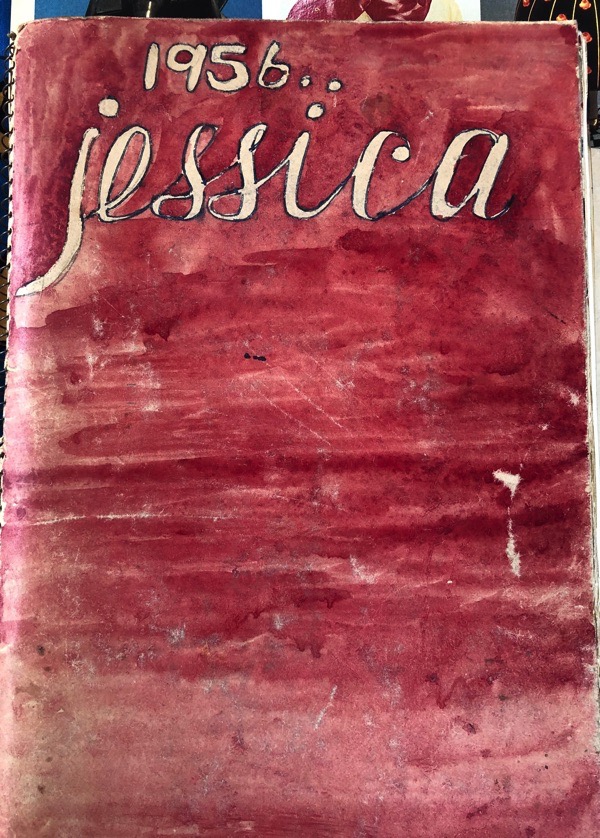
Her hunger for the world existed from early girlhood. That same keen purpose is evident in the scrapbook journals she kept as a teenager, bright collages of glued-in tickets, memos, theatre programmes, souvenirs from her trip to Europe on the BOAC Comet, all carefully collated alongside her pithy entries about her job at Stuttafords, the Johannesburg department store known as the Harrods of South Africa, where she worked to save for her travels abroad.
From the sixties, Jessica was active in the Anti-Apartheid movement, joining regular protests outside the South African embassy in Trafalgar Sq. She and her father, Edward Joseph, raised funds for the London staging in 1961 of the black South African jazz hit musical King Kong starring Miriam Makeba, about the life and times of boxer, Ezekiel Dlamini, set against the backdrop of the township, Sofiatown. Throughout the nineties, Jessica raised scholarships for black South African artists to come to London. This was a harsh time for these artists and she supported and befriended them while in a strange land, arranging space to create their art while sharing the sights and sounds of her adopted city, as well as her own kitchen for suppers and chat.
Jessica first visited Europe in 1952 on the fabled and short lived Comet BOAC aircraft, whose many delights she recorded in one of her journals. She brought fresh fruit from South Africa for her aunt in London, only to be apprehended at customs. In those days, when oranges were prized and seasonal, the prospect of giving them up made her cry so persuasively that the duty officer caved in and waved her through. She never shied away from wrangling her way past an official.
In the early seventies, she bought a small parcel of land on Hereford Rd in Notting Hill and commissioned her old boss from Pentagram to design her a house. In the aftermath of a broken first marriage, she stipulated that it should be a place where nobody could stay for more than two nights. Theo Crosby rose to the challenge. With its tiny spare room and open plan, high ceilings and exposed brick, her little home was ideal for her and her burgeoning work. When Tim Oliver moved in later, she insisted he must share the place with her two cats and, soon afterwards, Cleo was born. By the time their second child Orlando arrived, the space was squeezed so they upped sticks for a bigger house in Ladbroke Grove.
During this phase, she developed her photography by travelling round the world accompanying Tim to medical conferences, and in 1984, her first book came out, Working Women: A Photographic Collection of Women with a Purpose. She also worked as Dick Bruna’s Miffy licensing agent, ensuring that the Dutch rabbit was rendered correctly and not commercially exploited.
It was after her elderly mother’s death and the children had left home, that Jessica and Tim decided to move to the East End, so that Tim, an oncology consultant and professor, could walk to work at the nearby Royal London Hospital after decades of commuting on the Underground. Jessica had been reluctant to move to the area until that point, perhaps because of its associations with her grandfather who had fled from pogroms to London in 1904, only to be orphaned when his parents died in a refugee camp in Goodman’s Fields. He had been sent to live in Leeds with a kindly family who encouraged him to explore his Jewish background and he had emigrated to Bulawayo where he found a small community around the synagogue.
Ever since she left Hereford Rd, Jessica’s wish had been to find another site to design and build a house for her photography collection and her accumulation of artefacts. She searched and searched but it seemed impossible. So she and Tim settled in the Whitechapel weaver’s house on Halcrow St until she discovered Brody House, an Art Deco sequin factory in Aldgate near Petticoat Lane. Her flat there was a sun lit eyrie on the fifth floor, with panoramic views across the East End and a terrace for her olive trees, geraniums, and ferns.
There were frequent visitors, old and new friends, colleagues and neighbours who gathered regularly for suppers and drinks. These were boozy and convivial evenings when her raucous laughter floated out into the night. Jessica was forceful, loving and determined: nobody could resist the broad wingspan of her friendship.
In the first years of this century, Jessica suffered a burst pituitary tumour but recovered remarkably. Thanks to Tim, she kept travelling, walking everywhere and photographing the unfurling world. She visited us in New York City in 2011, after our family left Whitechapel, and she was immediately at home in the hectic streets of Brooklyn. An inveterate traveller and adventurer, she winkled out curiosities in the Atlantic Avenue shops and photographing every sight and incident that caught her eye.
By now, her library of images had increased to over 400,000 images. Tim found a PhD student to help her document and catalogue her photos. Still, her work did not abate, as if some hidden part of her knew what to do and kept going, even after a stroke caused loss of speech and dementia crept up on her in her final years.
Jessica died at home in June with her family around her, surrounded by her life’s work in its dazzling variety. She is survived by her husband Tim, a professor emeritus at Queen Mary University, her daughter, Cleo, a doctor in South London, and her son, Orlando, an architect based in Singapore.



Jessica Strang & Tim Oliver in the seventies

Jessica’s photos of her tiny house in Notting Hill designed by Theo Crosby

Jessica & Tim with their children, Cleo & Orlando

Jessica in Petticoat Lane in recent years

Jessica’s view from the top of a sequin factory in Aldgate
You can see Jessica Strang’s photography on Instagram @ jessicastrang_photolibrary
You may like to read these other stories by Rosie Dastgir
Rosie Dastgir’s Letter From Tokyo
At Tjaden’s Electrical Repair Shop
Gulam Taslim, Funeral Director
Lost Spitalfields

Looking towards Spitalfields from Aldgate East
London can be a grief-inducing city. Everyone loves the London they first knew, whether as the place they grew up or the city they arrived in. As the years pass, this city bound with your formative experience changes, bearing less and less resemblance to the place you discovered. Your London is taken from you. Your sense of loss grows until eventually your memory of the London you remember becomes more vivid than the London you see before you and you become a stranger in the place that you know best. This is what London can do to you.
In Spitalfields, the experience has been especially poignant in recent years with the redevelopment of the Fruit & Vegetable Market, the Fruit & Wool Exchange and Norton Folgate. Yet these photographs reveal another Spitalfields that only a few remember, this is lost Spitalfields.
Spital Sq was an eighteenth century square linking Bishopsgate with the market that was destroyed within living memory, existing now only as a phantom presence in these murky old photographs and in the fond remembrance of senior East Enders. On the eastern side of Spitalfields, the nineteenth century terraces of Mile End New Town were erased in ‘slum clearances’ and replaced with blocks of social housing while, to the north, the vast Bishopsgate Goodsyard was burned to the ground in a fire that lasted for days in 1964.
Yet contemplating the history of loss in Spitalfields sets even these events within a sobering perspective. Only a feint pencil sketch of the tower records the Priory of St Mary which stood upon the site of Spital Sq until Henry VIII ‘dissolved’ it and turned the land into his artillery ground. Constructing the Eastern Counties Railway in the eighteen-thirties destroyed hundreds of homes and those residents who were displaced moved into Shoreditch, creating the overcrowded neighbourhood which became known as the Old Nichol. And it was a process that was repeated when the line was extended down to Liverpool St. Meanwhile, Commercial St was cut through Spitalfields from Aldgate to Shoreditch to transport traffic more swiftly from the docks, wreaking destruction through densely inhabited streets in the mid-nineteenth century.
So look back at these elegiac photos of what was lost in Spitalfields before your time, reconcile yourself to the loss of the past and brace yourself for the future that is arriving.

Spital Sq, only St Botolph’s Hall on the right survives today

Spital Sq photographed in 1909

Church Passage, Spital Sq, 1733, photographed in 1909 – only the market buildings survive.

17 Spital Sq, 1725

25 Spital Sq, 1733

23 Spital Sq, 1733

20 Spital Sq, 1723

20 Spital Sq, 1723

20 Spital Sq, 1732

32 Spital Sq, 1739

32 Spital Sq, 1739

5 Whites Row, 1714

6/7 Spring Walk, 1819

Buxton St, 1850

Buxton St, 1850

Former King Edward Institution, 1864, Deal St

36 Crispin St, 1713

7 Wilkes St, 1722

10 & 11 Norton Folgate, 1810 – photographed in 1909

Norton Folgate Court House, Folgate St, photographed in 1909

52 & 9a Artillery Passage, 1680s

Bishopsgate Goods Station, 1881

Shepherd’s Place arch, 1820, leading to Tenter St – photographed 1909
You may also like to read about
C. A. Mathew, Photographer
Since my walking tour of Spitalfields is fully booked, I am doing two extra walks on Saturday 2nd & Sunday 3rd October at noon. Email spitalfieldslife@gmail.com to book. Click here for full details
On the tour we visit some locations of C. A. Mathew’s photographs

Map of the Gentle Author’s Tour drawn by Adam Dant

In Crispin St, looking towards the Spitalfields Market
On Saturday April 20th 1912, C.A.Mathew walked out of Liverpool St Station with a camera in hand. No-one knows for certain why he chose to wander through the streets of Spitalfields taking photographs that day. It may be that the pictures were a commission, though this seems unlikely as they were never published. I prefer the other theory, that he was waiting for the train home to Brightlingsea in Essex where he had a studio in Tower St, and simply walked out of the station, taking these pictures to pass the time. It is not impossible that these exceptional photographs owe their existence to something as mundane as a delayed train.
Little is known of C.A.Mathew, who only started photography in 1911, the year before these pictures and died eleven years later in 1923 – yet today his beautiful set of photographs preserved at the Bishopsgate Institute exists as the most vivid evocation we have of Spitalfields at this time.
Because C.A.Mathew is such an enigmatic figure, I have conjured my own picture of him in a shabby suit and bowler hat, with a threadbare tweed coat and muffler against the chill April wind. I can see him trudging the streets of Spitalfields lugging his camera, grimacing behind his thick moustache as he squints at the sky to apprise the light and the buildings. Let me admit, it is hard to resist a sense of connection to him because of the generous humanity of some of these images. While his contemporaries sought more self-consciously picturesque staged photographs, C.A.Mathew’s pictures possess a relaxed spontaneity, even an informal quality, that allows his subjects to meet our gaze as equals. As viewer, we are put in the same position as the photographer and the residents of Spitalfields 1912 are peering at us with unknowing curiosity, while we observe them from the reverse of time’s two-way mirror.
How populated these pictures are. The streets of Spitalfields were fuller in those days – doubly surprising when you remember that this was a Jewish neighbourhood then and these photographs were taken upon the Sabbath. It is a joy to see so many children playing in the street, a sight no longer to be seen in Spitalfields. The other aspect of these photographs which is surprising to a modern eye is that the people, and especially the children, are well-dressed on the whole. They do not look like poor people and, contrary to the widespread perception that this was an area dominated by poverty at that time, I only spotted one bare-footed urchin among the hundreds of figures in these photographs.
The other source of fascination here is to see how some streets have changed beyond recognition while others remain almost identical. Most of all it is the human details that touch me, scrutinising each of the individual figures presenting themselves with dignity in their worn clothes, and the children who treat the streets as their own. Spot the boy in the photograph above standing on the truck with his hoop and the girl sitting in the pram that she is too big for. In the view through Spitalfields to Christ Church from Bishopsgate, observe the boy in the cap leaning against the lamppost in the middle of Bishopsgate with such proprietorial ease, unthinkable in today’s traffic.
These pictures are all that exists of the life of C.A.Mathew, but I think they are a fine legacy for us to remember him because they contain a whole world in these few streets, that we could never know in such vibrant detail if it were not for him. Such is the haphazard nature of human life that these images may be the consequence of a delayed train, yet irrespective of the obscure circumstances of their origin, this is photography of the highest order. C.A.Mathew was recording life.

Looking down Brushfield St towards Christ Church, Spitalfields.

Bell Lane looking towards Crispin St.

Looking up Middlesex St from Bishopsgate.

Looking down Sandys Row from Artillery Lane – observe the horse and cart approaching in the distance.

Looking down Frying Pan Alley towards Crispin St.

Looking down Middlesex St towards Bishopsgate.

Widegate St looking towards Artillery Passage.

In Spital Square, looking towards the market.

At the corner of Sandys Row and Frying Pan Alley.

At the junction of Seward St and Artillery Lane.

Looking down Artillery Lane towards Artillery Passage.

An enlargement of the picture above reveals the newshoarding announcing the sinking of the Titanic, confirming the date of this photograph as 1912.

Spitalfields as C.A.Mathew found it, Bacon’s “Citizen” Map of the City of London 1912.
Photographs courtesy of Bishopsgate Institute
You may also like to read about
London, The Ever-Changing City
Distinguished Historian Gillian Tindall offers an ambivalent history of the development of London over the last five hundred years. Gillian’s books include The House by the Thames and A Tunnel Through Time, A New Route for an Old London Journey.

‘London Going Out of Town’ or ‘The March of Bricks & Mortar’ by George Cruikshank, 1829
“I remember when it was all fields round here.” How many of us have heard these words spoken by an older person describing some outer district of London? The huge spread of our metropolis is often seen as a modern evil but the truth is that each successive generation has lamented it for hundreds of years. EM Forster in his pre-First World War novel Howards End, writing of the ‘red rust’ of bricks advancing across meadows far from the main streets of the capital, was just another voice in a long, long tradition.
The red rust has been held at bay since the Town & Country Planning Act of 1934 and then by the establishment of the Green Belt. Yet the new Planning Act proposed by our present government looks set to unleash another wave of bricks. There is nothing new in attempts to curb the growth of our capital but less comforting is the fact that, although these attempts have often succeeded in moderating and organising London’s growth, they have hardly ever stopped it.
The first who tried to was Elizabeth I, by issuing a proclamation in 1580 forbidding any new house to be built within three miles of the gates of London. It did not work. Thirteen years later, the same order was reissued with objections to ‘converting great houses into several tenements… and the erecting of new buildings between London and Westminster.’ Suburban sprawl had begun.
The reference to the gates of London is significant. Like all European cities, London was a close-knit hub of small streets lined with houses, many with walled gardens behind. All was contained within the City wall and accessible only through eight fortified gates that were shut at night. But by Elizabeth’s time, England had not been invaded by for five hundred years and even the Peasants’ Revolt – when the City of London was stormed by the poor and angry – had taken place two hundred years earlier. The walls and gates were more symbolic than useful.
Before Elizabeth came to the throne, in Henry VIII’s reign, a suburb had developed beyond the Lud Gate and the Fleet River, on the slopes of what were to become Fleet St and High Holborn. To the north, Clerkenwell was still open country with just a couple of monastic houses set in fields and the other end of the City, beyond the Tower and Aldgate, was the same. But fifty years later, Elizabeth’s contemporary, John Stow, mourned encroachment upon the pastures by the Tower, where he had played as a child and fetched milk from cow-keepers.
“…this common field, all which ought to be open and free for all men… being sometime the beauty of this city on that part, is so encroached upon by the building of filthy cottages… and with other enclosures and laystalls… that in some places it scarce remaineth a sufficient highway…”
To the east, Whitechapel was already developing the utilitarian character it would maintain for several centuries while grander citizens sought to build their homes to the west. Another favoured but more distant suburb, a true out-of-town destination, was Hackney, the green and flowery village where the wealthy built themselves fine houses.
Forty years later, Civil War fortifications were constructed beyond the walls. These ditches and ramparts would have proved ineffectual defence though, as it turned out, they were never tested. Once the Commonwealth was over and Charles II was restored in triumph to the throne, the gates were opened wide, and left that way.
Quite soon, blocks of stones were being hacked out of the walls to construct houses. In 1666, when the Fire destroyed much of the City, many of those who lost their homes moved further out to Spitalfields, Shoreditch and Bethnal Green to the east, or westward to Holborn and St Giles, to Soho and St James’s. The City was becoming part of a far bigger conurbation than that which today is known as Central London.
For the next two centuries, there was a natural limitation to growth. As long all vehicles were horse-drawn, the metropolis was as dependent on fodder as the modern city is upon fuel for lorries and cars. Hay was as essential as petrol today. While London was still a small walled city, it was not hard to provide it. Those green meadows Stow wrote about had been just over the door-step, or rather the gate-step, and in distant rural districts such as St Pancras or Stepney there was so much space for grass that a range of other arable crops such as wheat and barley were also grown. But by the end of Elizabeth’s reign the demand for hay had increased to the level that all the fields as far as Highgate were given over to its production.
Two hundred years later, when London had grown a great deal more, swallowing Islington and Knightsbridge, and creating Camden Town, all the land as far as Watford was said to be ‘down to hay.’ Yet there is a limit to how far a horse-drawn cart can travel in a day to bring fodder back to the metropolis. In early nineteenth century London, developers filled in all the space between the villages and old urban suburbs, such as Shoreditch, were crammed with ever more people.
The true explosion in London’s size could not happen until horsepower was superseded. When railways began arriving in the eighteen-forties, deliveries of hay or anything else from much further afield became possible. In 1863, the Metropolitan Underground Railway opened as the first in the world, offering the possibility of ‘living in the country and working in town.’ For centuries, most employees had walked back and forth between work and home each day. Many of them adopted the new way of life encouraged by cheap workmen’s fares. Within a generation, the country where the new houses were being built turned into suburbia – ‘Metroland’ – and then inexorably into an outlying part of the ever-expanding capital. EM Forster’s ‘red rust’ became manifest.
Yet the fodder-for-horses problem remained until vehicles could be powered by another fuel and until electricity replaced steam power to run the Underground, permitting deeper tunnels and more destinations. Both these transformative developments happened within a few years of each other.
Much of our present Underground was built between 1900 and 1910. Meanwhile street traffic, which was almost entirely horse-drawn at the turn of the century, became dominated by horseless-carriages within a decade. The last horse bus in London ran on the eve of the First World War and the last horse-tram eight months later. During the War, those who still had traditional status as ‘carriage people’ sold off their horses and bought motorcars. Livery stables shut all over the capital as garages opened.
By the end of the century, most Londoners were dependent on their motor cars and ancient road-systems were crudely transformed to accommodate this twentieth century monster. Yet now the assumptions that made King Car dominant for the last hundred years are unravelling. The question of how London must adapt once again is huge. The only certainty is change.

John Stow, the first historian of London, grieved over the redevelopment of the city in his lifetime
Photograph © Estate of Colin O’Brien
You may like to read these other stories by Gillian Tindall
Memories of Ship Tavern Passage
At Captain Cook’s House in Mile End
Henrietta Barnett & The Workhouse Children
John Walker author of Out of Sight, Out of Mind – Abuse, Neglect and Fire in a London Children’s Workhouse, 1854-1907 explores the forgotten achievements of Henrietta Barnett

Photograph by Henrietta Barnett
Aspects of the work of Samuel & Henrietta Barnett as social reformers are well-documented. Samuel is remembered for founding Toynbee Hall and the Whitechapel Gallery, while Henrietta is celebrated chiefly for establishing Hampstead Garden Suburb.
Yet new evidence reveals Henrietta’s humanitarian achievements in fighting to ameliorate the plight of tens of thousands of workhouse children. Her work easily matches her husband’s in improving conditions for Whitechapel’s poor.
Henrietta Rowlands married the recently-ordained Samuel Barnett in 1873 when she was just twenty-two. They were both from comfortably middle-class backgrounds tinged with significant elements of social concern and reforming zeal. They sought a new parish, away from subrban London, where they could pursue their missionary ambitions. The Bishop of London posted them to St Jude’s, Spitalfields, which he described as “the worst parish in my diocese, inhabited largely by criminals.”
Much of the credit for their subsequent achievements is given to Samuel, his status enhanced by a two-volume biography written by Henrietta. By contrast, Henrietta’s autobiography remains incomplete, an unpublished manuscript gathering dust in the London Metropolitan Archives. If she been as assiduous in publicising her own achievements, perhaps the story that follows would have been appreciated more widely?
One of Samuel’s first actions, on arriving in Spitalfields, was to get himself appointed to the Board of Guardians which was responsible for the large workhouse on Vallance Rd. The Poor Law regime at the time, encouraged by local Guardians, offered no cushion in the form of welfare payments or ‘outdoor relief’ for those who fell on hard times. Destitution meant the workhouse and Whitechapel had one of London’s largest.
In the eighteen-fifties, Whitechapel’s Guardians built a children’s workhouse in Forest Gate to separate the youngsters from what they regarded as the feckless behaviour and bad example of their indolent parents. Many of the buildings survive today and can almost be seen beside the railway line between Forest Gate and Maryland from trains passing from Essex towards Liverpool Street.
This ‘school’ soon housed as many as nine hundred pupils from the ages of two up to fourteen or fifteen years old. Within a few years Whitechapel was subletting places to the Guardians of Hackney and Poplar to accommodate their children. In the second half of the nineteenth century, an estimated fifty thousand East End youngsters passed through.
Conditions were harsh. Children were forcibly taken from their parents and would be lucky to see them for two hours in three months. On arrival at the school, most were separated from their siblings, never to see them again until they left. They were shaven, given soulless uniforms and subsisted upon inadequate diets.
For the first fifty years, the establishment was run by ex-military personnel, whose focus was on discipline and cost-saving rather than child care. Classes of up to ninety pupils were taught largely by unqualified teachers. All activity was undertaken in silence and the dormitories were overcrowded. In modern terminology, it was a ‘total institution’ from which children were permitted no escape. In all but name it was a prison, yet the inmates’ only crime was being born into poverty.
The Forest Gate District School, as it was officially known, was an institution of the kind sometimes called industrial schools, promoted as establishments that taught children trades to keep them from poverty in adulthood. But this was one of many lies. The average age of children was a little over ten years and official reports condemned the ‘industrial’ training as inadequate. In reality, children were employed as free labour – scrubbing acres of floors, peeling tons of potatoes and mending tattered garments – to save staff wages.
After witnessing the conditions at the Forest Gate School, Samuel arranged for Henrietta to become a Poor Law Guardian, as only the second woman to do so. She was immediately appointed an unpaid governor of the school, as the first woman in England to hold such a post. And there she remained, as the only female governor, for the next twenty years.
Henrietta set out to humanise the system, particularly for girls, emphasising that a caring upbringing would have beneficial effects on their own children. Yet her pleas for reform were ignored, met with hostility and dismissed in the words of one patronising school inspector as ‘sentimental follies.’
In response, Henrietta abandoned governors’ meetings and sought to effect change by direct action. She took great delight in ensuring that the matron – the inappropriately named ‘Miss Perfect’ – address all the girls by their first names, rather than by numbers or the all-purpose ‘girl.’ She knew that subjecting girls to whole days polishing a floor or washing uniforms was not adequate training for the occupation most would face on leaving – domestic service. She and Samuel opened another home in Hampstead, where they took a dozen girls at a time and trained them in domestic service skills, in preparation for future employment.
Henrietta acknowledged the hazards girls might face when placed into service as young as fourteen. She was at the forefront in establishing the Metropolitan Association for the Befriending of Young Servants in the eighteen-seventies. Girls were visited annually in their places of employment, until the age of twenty-one, to ensure they were not physically or sexually abused or exploited, and were assisted in moving to new positions if necessary.
She led Sunday walks across Wanstead Flats and encourage her middle-class friends to visit and read with the children, bringing books to the library and supplying toys. She promoted a London-wide scheme to fund pictures for the bare walls of District Schools. She established the Children’s Country Holiday Fund, obtaining royal patronage in order to raise funds to send children on camping holidays in Essex.
Incrementally and almost by stealth, Henrietta Barnett humanised the conditions, particularly for girls, during her first fifteen years as a governor. But it was in the final five years of her governorship that she was to have her greatest impact on the school and the conditions of all workhouse children.
On New Year’s Eve 1890, twenty-six boys died in a fire in the school and the incident drew national condemnation, leading to changes in fire regulations for workhouses. Henrietta befriended one of the heroes of the fire, Henry Elliott, a porter who rescued other boys from the smoke-filled dormitories.
Although there was an inquest at which the superintendent of the school was praised for his swift action in minimising fatalities, it only later transpired – revealed in Henrietta’s writings – that the children had been locked in their dormitories so the staff could go out to celebrate New Year.
Worse followed three years later when an outbreak of food poisoning swept through the school, killing two children and seriously affecting up to a hundred-and-fifty others. At the inquest, Henry Elliott, hero of the fire, condemned the management for substituting fresh meat with the maggot-ridden meat which caused the poisoning. The governors suspended him as a trouble-maker and, even though his whistle-blowing was proven to be accurate, they fired him.
When the corrupt behaviour of the management which led to both the fire and food poisoning went unpunished, Henrietta Barnett drew upon her personal connections to effect change. Her brother-in-law, Ernest Hart, was editor of the British Medical Journal. Working with Henrietta, he undertook a two-year campaign against what became known as Barrack Schools, and the Forest Gate establishment in particular, which gained traction and attention in decision-making circles.
As her second line of attack, Henrietta provoked a Parliamentary Inquiry into Barrack Schools, led by former Liberal Minister, Anthony Mundella. His 1896 report was condemning, calling for closure and replacement with more child-centric, parent-led institutions. The force of the accumulated evidence was such that the President of the Local Government Board, the government department with oversight of Poor Law establishments, had no choice but to accept the recommendations.
Henrietta’s governorship at the school ended when the Mundella Report was published. But as she left, two of the country’s first working-class guardians and workhouse school governors arrived to complete her work.
They were Poplar’s Will Crooks, a former workhouse boy, and George Lansbury. Both later became Labour MPs but each cut his public service teeth, battling locally and nationally to get the Forest Gate District School shut down. Their plan was to move the children to more suitable accommodation in separate houses run by houseparents in Brentwood. Although cricitised for their extravagance, the homes they established later gained acclaim and royal patronage, becoming the model for twentieth-century children’s homes.
Henrietta Barnett deserves to be credited for this change. Frustrated by years of slow reform, she realised that the abolition of Barrack Schools was the only solution. She pursed the cause with a dedication and determination that changed the lives of tens of thousands of children for the better in East London and far beyond.
In a collection of essays published in 1933, Henrietta summarised what she found at Forest Gate and why it had to change.
“Children in the schools soon develop a stigma. … The whole life is too much like that of a prison or a convent. … the children who are brought up in such dread and artificial surroundings are ill-prepared to fit into a world where growth and change are universal laws.”
The abolition legacy is hers.

Photograph of boys at the Forest Gate District School in the eighteen-eighties by Henrietta Barnett

The Forest Gate District School

Images of the fire at the school from the Illustrated London News, 1891

Hutton Poplars, the replacement for the Forest Gate District School

Henrietta Barnett
You may also like to read about
The Return Of Benjamin Shapiro

Ben Shapiro
In the East End, you are constantly reminded of the people who have left and of the countless thousands who never settled but for whom the place only offered a contingent existence at best, as a staging post on their journey to a better life elsewhere. Ben Shapiro has lived much of his life outside this country, since he left as a youth with his family to go to America where they found the healthier existence they sought, and escaped the racism and poor housing of the East End. Yet now, in later life, after working for many years as a social worker and living in several different continents, he has chosen to return to the country of his formative experience. “I’ve discovered I like England,” he admitted to me simply, almost surprised by his own words.
“I was born in the London Hospital, Whitechapel, in 1934. My mother, Rebecca, was born in Manchester but her parents came from Romania and my father, Isaac (known as Jack), was born in Odessa. He left to go to Austria and met my mother in Belgium. He was a German soldier in World War I and, in 1930, he come to London and worked as a cook and kosher caterer. I discovered that immediately after the war, he went to Ellis Island but he was sent home. In the War, he had been a radio operator whose lungs had been damaged by gas. He spoke four or five languages and became a chef, cooking in expensive hotels and it was from him I learnt never to sign a contract, that a man’s word is his bond. He had an unconscionable temper and by today’s standards we would be called abused children. I once asked my mother if she would leave him and she said, ‘Where would I go with three children?’ I have a younger brother, Charles, who lives in New York now and a younger sister, Frieda, who died three years ago in Los Angeles.
My parents lived in a flat in Brick Lane opposite the Mayfair Cinema, until they got bombed out in World War II. We got bombed out three times. My first school was the Jewish Free School, I went to it until I was four and the war broke out when I was five. My father was in Brick Lane when Mosley tried to march through in 1936 and the Battle of Cable St happened. He remembered throwing bricks at the police. When the war broke, we became luggage tag children and one of my earliest memories was travelling on a train with hundreds of other children to Wales. We lived with a coal miner’s family and, at four or five, he would come home covered in coal dust. His wife would prepare a tin bath of hot water and he would sit in it and she would wash him clean, and then we could all have supper.
Me and my brother were sent back to London when the Blitz was in full swing, but my sister stayed in Aylesbury for the entire duration of the war and the family wanted to adopt her. When I returned with her fifty years later, she met the daughter of the family, her ‘step-sister’ – for the first time since then – and they recognised each other immediately, and fell into each other’s arms.
In London, the four of us lived in a two bedroom flat and my brother and I slept together in one bed. My parents talked Yiddish but they never taught me. In the raids, we took shelter in Whitechapel Underground but my father would never go. He said, ‘I’ve been through one war – if I’m going to die, I’ll die in my bed.’ My father gave me sixpence once to go and see ‘For Whom The Bell Tolls’ at the cinema, but we got to the steps just as the siren sounded and I waited thirty years to see that film.
Then I was sent off again, evacuated to a Jewish family in Liverpool. On the train there, I met a boy and we decided to ask to be billeted together. We were eight or nine years old and we slept together and, every night, he wet the bed. So we had to hang out our mattress and pyjamas every day to dry them, they didn’t get washed just dried. Once Liverpool became a target for bombing, I got sent home again. After the war, he contacted me and said, he’d had an operation to correct his bladder.
I have distant memories of being sent away again to the countryside, to Ely. When we got to the village green at Haddenham, a man came up to me and asked, ‘Are you Jewish’ and I said, ‘No’ so he said, ‘You can come and live with me then.’ All the children in the school knew I was Jewish and asked ‘Where’s your horns?‘ but I was well cared for and didn’t want to leave in the end. My father never visited or wrote letters, I think it was because he had been in World War I and he was familiar with death, and he could have been killed in the Blitz at any time. If he died, I would have stayed. We were always well fed and I have a theory that my father sent them Black Market food.
Towards end of the war, we were housed by London County Council in Cookham Buildings on the Boundary Estate. I remember looking out of the window and seeing German planes coming overhead. There was flat that was turned into a shelter but we all realised that it would not protect us and, if a bomb dropped, we should all be killed. Above us, there was an obese woman with two children and she never got to the shelter before the all clear sounded.
Our flat was damp due to bomb damage and I caught Rheumatic Fever, and was admitted to the Mildmay Mission Hospital and was at death’s door for two months, and then sent to Greyshall Manor, a convalescent home. After that, we qualified for rehousing and we were the first tenants to move into the newly-built Wheler House in Quaker St in 1949. It was comfortable and centrally heated and we had a bathroom. From there, at fourteen years old, I went to Deal St School. It was where I first experienced racial intimidation and bullying, so I told the teacher and he said, ‘You’re a Jew, aren’t you?’ Eventually, I became Head Prefect, which gave me carte blanche to discipline the other pupils.
During the years at Wheler House, I became friendly with the bottling girls from the Truman Bewery who walked past at six in the morning and six at night. I knew some of the Draymen too and they let me feed the horses. Soon after we moved in, my father wouldn’t give me any pocket money, he said, ‘You’ve got to earn it.’ I went down Brick Lane and enquired at a couple of stalls for a job and I had a strong voice, so a trader said, ‘I need a barker,’ and, for about a year, I became a barker each weekend in Petticoat Lane, crying ‘Get your lovely toys here!’ I was opposite the plate man who threw crockery in the air and next to the chicken plucker.
I worked in the City of London as a junior clerk in Gracechurch St, near the Monument, but I feel – if I had stayed – I would still be junior clerk.
The lady next door, she had a friend from America and she sponsored my brother to go there. So then we all wanted to go and, on June 6th 1953, we went down to Southampton and took a boat to New York and then travelled to Los Angeles. It was for health reasons. My mother had been unwell and my father said it would be a better life, which it turned out to be. I was seventeen years old.”

c.1900, Odessa – My father Isaac is sitting in the centre, he was born around 1896 and left in 1906, during the last great pogrom, to go to Vienna

c. 1920, London – My mother Rebecca is on the right with her sister on the left. Her parents were known as Yetta & Maurice

Ben on the left, aged seventeen years old, photographed with his family on the boat going to a new life in America in 1953

Ben and his family were the first people to move into this flat in Wheler House, Quaker St, when the building was newly completed in 1949


