
George Cruikshank’s Festive Season
As we brace ourselves for the forthcoming festive season, let us contemplate George Cruikshank‘s illustrations of yuletide in London 1838-53 from his Comic Almanack which remind us how much has changed and also how little has changed. (You can click on any of these images to enlarge)

A swallow at Christmas

Christmas Eve

Christmas Eve

Christmas dining

Christmas bustle

Boxing day

Hard frost

A picture in the gallery

Theatrical dinner

The Parlour & the Cellar

New Year’s Eve

New Year’s birth

Twelfth Night – Drawing characters

January – Last year’s bills
You may also enjoy
George Cruikshank’s Comic Alphabet
Robson Cezar’s Wooden Houses From Whitechapel
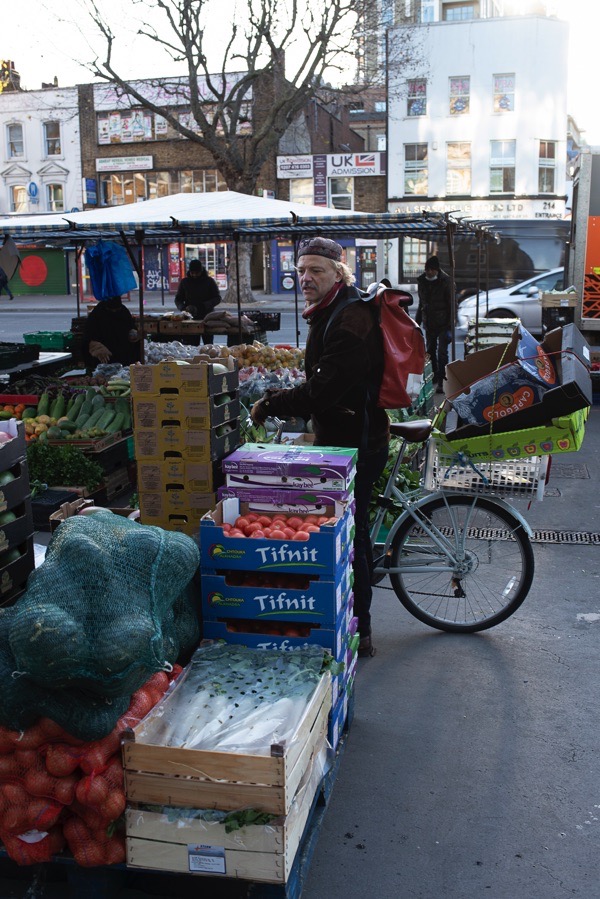
In recent weeks, you may have spotted Spitalfields artist Robson Cezar collecting wooden fruit crates in Whitechapel Market on the way to his studio in Bow, where he has been making them into wooden houses for sale at next weekend’s BLOOMSBURY JAMBOREE on 11th & 12th December at the Art Workers’ Guild. Each one is different and many are recognisable as inspired by buildings around the East End.
Contributing Photographer Sarah Ainslie accompanied Robson last week to document the process.

Brady and Robson

Mohammed and Robson

Mohammed shelters by a heater in his truck

Robson packs the crates in his bicycle


These fruit crates are the raw material

Cutting up the crates

Some trial versions


Arranging the houses to make a city, each with an LED light inside

Robson Cezar’s wooden houses from Whitechapel will be for sale at the Bloomsbury Jamboree
Photographs copyright © Sarah Ainslie
You may also like to read about
My East End Vernacular Lecture
My illustrated lecture on EAST END VERNACULAR, Artists Who Painted London’s East End Streets in the 20th Century, including all the artists whose works are below, at the BLOOMSBURY JAMBOREE at the Art Workers Guild on 11th December at noon is SOLD OUT so I am doing an EXTRA LECTURE on Sunday 12th December at 11:10am.
Also, I shall be reading CHRISTMAS STORIES on 12th December at 3pm, including my account of a midnight walk through London on Christmas Eve and my memoir of childhood Christmases past.

Click here to order a copy of EAST END END VERNACULAR for £25

John Allin – Spitalfields Market, 1972

S.R Badmin – Wapping Pier Head, 1935

Pearl Binder – Aldgate, 1932 (Courtesy of Bishopsgate Institute)

Dorothy Bishop – Looking towards the City of London from Morpeth School, 1961

James Boswell – Petticoat Lane (Courtesy of David Buckman)

Roland Collins – Brushfield St, Spitalfields, 1951-60 (Courtesy of Museum of London)

Alfred Daniels – Gramophone Man on Wentworth St

Anthony Eyton , Christ Church Spitalfields, 1980

Doreen Fletcher – Turner’s Rd, 1998

Geoffrey Fletcher – D.Bliss, Alderney Rd 1979 (Courtesy of Tower Hamlets Local History Library & Archives)

Barnett Freedman– Street Scene. 1933-39 (Courtesy of Tate Gallery)

Noel Gibson – Hessel St (Courtesy of Tower Hamlets Local History Library & Archives)

Charles Ginner – Bethnal Green Allotment, 1947 (Courtesy of Manchester City Art Gallery)

Lawrence Gowing – Mare St, 1937

Harry T. Harmer – St Botolph’s Without Aldgate, 1963 (Courtesy of Tower Hamlets Local History Library & Archives)

Elwin Hawthorne – Trinity Green Almshouses, 1935

Rose Henriques – Coronation Celebrations in Challis Court, 1937 (Courtesy of Tower Hamlets Local History Library & Archives)

Nathaniel Kornbluth – Butcher’s Row, Aldgate 1934 (Courtesy of Tower Hamlets Local History Library & Archives)

Dan Jones – Brick Lane, 1977
 Leon Kossoff – Christ Church Spitalfields, 1987

James Mackinnon – Twilight at London Fields

Cyril Mann – Christ Church seen over bombsites from Redchurch St, 1946 (Courtesy of Piano Nobile Gallery)

Jock McFadyen – Aldgate East

Ronald Morgan – Salvation Army Band Bow, 1978 (Courtesy of Tower Hamlets Local History Library & Archives)

Grace Oscroft – Old Houses in Bow, 1934

Peri Parkes – House in the East, 1980-81

Henry Silk – Snow, Rounton Rd, Bow

Harold Steggles – Old Ford Rd c.1932

Walter Steggles – Old Houses, Bethnal Green 1929

Albert Turpin, Columbia Market, Bethnal Green

Take a look at some of the artists featured in East End Vernacular
Sights Of Wonderful London
It is my pleasure to publish these splendid pictures selected from the three volumes of Wonderful London edited by St John Adcock and produced by The Fleetway House in the nineteen-twenties. Not all the photographers were credited – though many were distinguished talents of the day, including East End photographer William Whiffin (1879-1957).

Roman galley discovered during the construction of County Hall in 1910

Liverpool St Station at nine o’clock six mornings a week

Bridge House in George Row, Bermondsey – constructed over a creek at Jacob’s Island

The Grapes at Limehouse

Wharves at London Bridge

Old houses in the Strand

The garden at the Bank of England that was lost in the reconstruction

In Huggin Lane between Victoria St and Lower Thames St by Andrew Paterson

Inigo Jones’ gate at Chiswick House at the time it was in use as a private mental hospital

Hoop & Grapes in Aldgate by Donald McLeish

Book stalls in the Farringdon Rd by Walter Benington
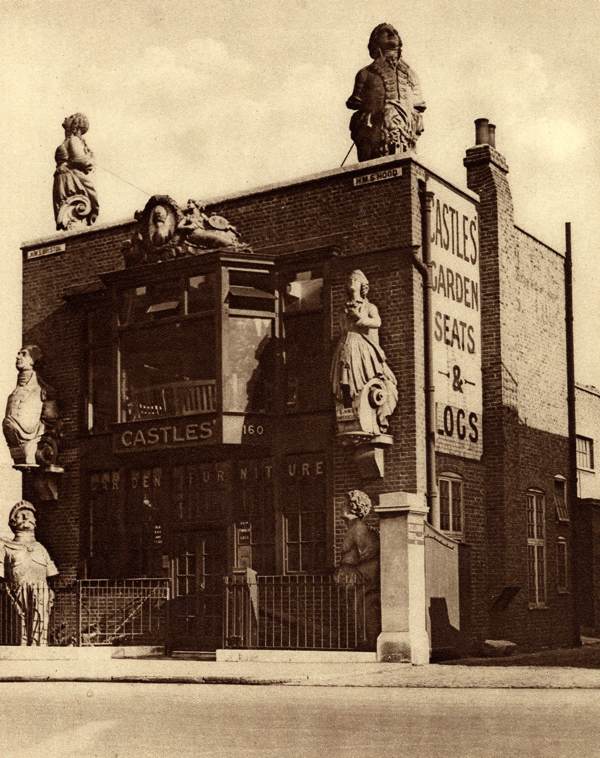
Figureheads of fighting ships in the Grosvenor Rd by William Whiffin

The London Stone by Donald McLeish

Dirty Dick’s in Bishopsgate

Poplar Almshouses by William Whiffin

Old signs in Lombard St by William Whiffin

Penny for the Guy!

Puddledock Blackfriars

Punch & Judy show at Putney

Eighteenth century houses at Borough Market by William Whiffin

A plane tree in Cheapside

Wapping Old Stairs by William Whiffin

Houndsditch Old Clothes Market by William Whiffin

Bunhill Fields

The Langbourne Club for women who work in the City of London

On the deck of a Thames Sailing Barge by Walter Benington

Piccadilly Circus in the eighteen-eighties

Leadenhall Poultry Market by Donald McLeish

London by Alfred Buckham, pioneer of aerial photography. Despite nine crashes he said, “If one’s right leg is tied to the seat with a scarf or a piece of rope, it is possible to work in perfect security.”
Photographs courtesy Bishopsgate Institute
You may also like to take a look at
The Return Of Sail Cargo To The Thames
At the BLOOMSBURY JAMBOREE at the Art Workers’ Guild on 11th & 12th December we will be featuring produce from small farmers delivered to London by sail boat.
At 1:30pm on Sunday 12th December you can hear Gareth Maeer of Raybel Charters talk about the resurgence of sail cargo, explaining where this environmentally-inspired movement originated and the challenges that lie ahead.
Click here to book for THE RETURN OF SAIL CARGO

The Gallant arrives in Greenwich
Photographer Rachel Ferriman & I were at the shore to welcome the first sailing ship in more than a generation arriving at the London Docks with a cargo of provisions from overseas. We hope this will become a regular sight on the Thames with the Gallant bringing produce from Portugal and the Caribbean. Although it is a small beginning, we were inspired by this visionary endeavour which sets out to connect farmers directly with customers and make the delivery by sail power.
On board, we met Alex Geldenhuys who explained how she started this unique project.
“We are very excited because this is our first visit to London and we believe this cargo has not been delivered here by sail for forty years or more. We have olive oil, olives, almonds, honey, port wine from Portugal and chocolate and coffee from the Caribbean.
At first, we were working with ships crossing the Atlantic once a year bringing chocolate, coffee and rum but then I started the European voyages three years ago. We do two or three voyages a year which means we are learning more quickly.
With the captains, we decide when and where we will go and what we will pick up. We started in Portugal and most of our suppliers are based in the north of the country, small family farms producing olive oil. They give the best care for the land and contribute most to the local community. These farmers do mixed agriculture and so they also produce honey, almonds and chestnuts.
We look forward to working with Thames barges, meeting the Gallant in the estuary after the long distance voyage and delivering the cargo to London, just as they were designed to do. We will be back in the spring and customers can order online and then come down to the dock to collect their produce.”
The Gallant is a handsome schooner and we were delighted to explore this fine vessel moored in the shadow of Tower Bridge while the tanned and scrawny crew were unloading crates of olive oil, coffee and rum, loading them onto bicycle panniers for transport to the warehouse in Euston.
Down in the cabin, we met captains Guillaume Roche & Jean Francois Lebleu, studying charts of the estuary in preparation for their journey to Great Yarmouth, the next port of call. Guillaume began by telling me the story of the Gallant and revealing his ambition and motives for the undertaking.
“I am co-owner of the ship with Jean Francois, we take it in turns to be captain. The Gallant was built as a fishing boat in Holland in 1916, but, when we bought her two years ago to use her as a cargo vessel, she had been converted to carry passengers so we had to build a hatch for loading and enlarge the hold.
We are both professional seamen who have worked on big ships in the merchant navy and we want to do something about Climate Change, but the only thing we know is how to sail a ship. As well as delivering cargo by sail, we want to spread the word to encourage others so this can be the beginning of something bigger.”
Jean Francois outlined the pattern of their working year, making me wish that I could stow away on the Gallant.
“This summer we did two voyages to northern Europe from Portugal, two ports in France, a lot of ports in England – Bristol, Penzance, Newhaven, Ramsgate, London and Great Yarmouth. Next we go to Holland to deliver cargo there.
Over the winter, we will do maintenance before we sail across the Atlantic to the Caribbean and Central America to load rum, chocolate, coffee, mezcal and spices, and stop off in the Azores on the return voyage to pick up honey and tea. And we will bring this cargo back to London next year.”


The crew of the Gallant

Alex Geldenhuys, founder of New Dawn Traders

Guillaume Roche & Jean Francois Lebleu, Captains of the Gallant

Celestin, First Mate of Gallant

Davide, Deck Hand


The cargo is delivered to the warehouse by pedal power
Photographs copyright @ Rachel Ferriman
You may also like to read about
The Thames Of Old London

There is a dark and glistening river that flows through my dreams – it is the Thames of old London, carrying away the filth and debris of the city and, in return, delivering the riches of the world upon the flood tide rising. How much I should like to have known London as it is recorded in these photographs – with a strong current of maritime life at its heart.
The broad expanse of water in central London is curiously empty today, yet a century ago when many of these magic lantern slides from the Bishopsgate Institute were taken for the London & Middlesex Archaeological Society, it was a teeming thoroughfare with wharves and jetties lining the banks. In the (reversed) glass slide above, you see barges unloading their cargo next to the Houses of Parliament and you might deduce that this method of transport could provide an answer to the congestion problems of our own era, if it were not for the fact that all the wharves have gone long ago.
Each day the tide goes up and down by twenty feet. For half the day, the water flows in one direction and for the other half in the other direction, with a strange moment of stillness in between while the tide turns. Such is the surge engendered that the force of the current at the centre presents a formidable challenge to a lone rower and would defeat any swimmer. In spite of our attempt to tame it with the flood barrier, the Thames manifests a force of nature that deserves our respect, especially as the water level rises year by year.
You might think that the river has become merely a conduit for drainage and an itinerary for tourist trips these days, yet do not forget that this mighty river is the very reason for the location of London, here on the banks of the Thames.

Shipping near Tower Bridge, c. 1910

St Paul’s Cathedral from the river, c. 1920

Tower of London from the river, c. 1910

Wandsworth Creek, c, 1920

Off Woolwich, c.1920

Greenwich pier, c. 1920

Steamboat pier at Chelsea, c. 1870

St Paul’s Cathedral from Bankside, c. 1920

Billingsgate Market, c. 1910

Houses of Parliament from South Bank, c. 1910

Tower of London from the Thames, c.1910

Ice floes on the Thames, c. 1920

St Paul’s Cathedral from Bankside, c. 1910

Victoria Embankment, c. 1920

Oxford & Cambridge Boat Race at Putney Bridge, c. 1910

St Paul’s Cathedral from Waterloo Bridge, c. 1920

London Docks, c. 1920

Customs House, c. 1910

Lots Rd and Battersea Bridge, c. 1910

Somerset House was on the riverfront until the Victoria Embankment was constructed in 1870.
Images courtesy Bishopsgate Institute
You may also like to take a look at
Marion Elliot, Printmaker & Illustrator
I am delighted to introduce the work of Marion Elliot which will be featured at the BLOOMSBURY JAMBOREE. We hope you will come along and meet Marion at her stall on 11th & 12th December at the Art Workers’ Guild.

‘I have a great love of folk culture and popular art. I love shop fronts, fairgrounds, hand-painted signage, advertising imagery and typography, tattoos, workers’ guild banners, mottos, catch-phrases, religious iconography and paper ephemera.
I use printmaking techniques to produce densely-textured papers for my collage work and I am very fond of paper cutting, so my collage has developed from experiments with this technique.
I like collage because it offers me freedom to move all the elements around until I feel that the design looks right. I find creating the collages very contemplative, rather like making a large jigsaw puzzle and I can get lost for hours just moving bits around.’
Marion Elliot

Sailor’s pincushion
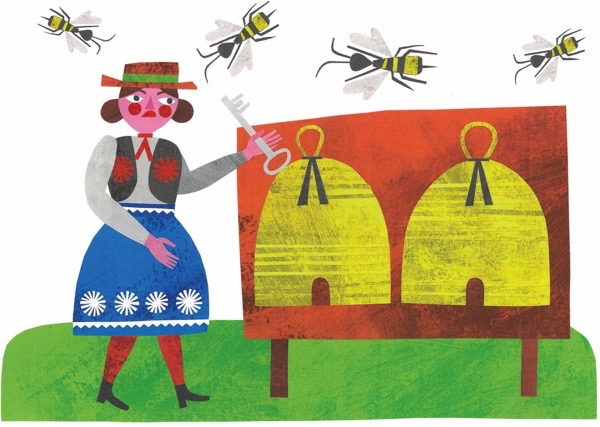
Telling the bees

Lammas Day

The Straw Bear

The ‘Obby ‘Oss

The Wicker Man

Fortune Teller

Wonder Cat

Perseverance

Prepare ye to meet thy God

Judy makes tea

Judy calls the police

Nuits de Paris

Hot Club

Mother and me

Bal-Musette

The sailor’s return
Illustrations copyright © Marion Elliot


