
A New Sculpture For Frank Dobson Sq
Please support our JANUARY BOOK SALE. We only have nine titles left in the warehouse and some are on the brink of going out of print, so you can assist us clear the shelves by buying copies at half price to complete your collection, or as gifts for family and friends.
Click here and enter code ‘2022’ at checkout to get 50% discount

Woman & Fish by Frank Dobson in situ
Frank Dobson Sq in Whitechapel, where Cambridge Heath Rd meets Cephas St, was constructed in 1963 and named after the Clerkenwell-born sculptor whose ‘Woman & Fish’ formed the handsome centrepiece of the Cleveland Estate. Dobson’s sculpture of two figures entitled ‘London Pride’ situated outside the National Theatre serves a similar function on the South Bank. He is also remembered as the teacher of Henry Moore, whose ‘Draped Seated Woman’ currently sits in Canary Wharf prior to installation in Whitechapel outside the new Tower Hamlets Town Hall.
Twenty years ago, Dobson’s sculpture was removed from its plinth in Whitechapel following a series of vandalisations which damaged it beyond repair, leaving a gaping hole in the streetscape to this day. Then, in 2006, Tower Hamlets Council commissioned Antonio Lopez Reche to make a bronze replica, cast at a foundry in Limehouse, but it was installed in Millwall Park on the Isle of Dogs in 2007.
The original installation of Frank Dobson’s sculpture at the Cleveland Estate celebrated the work of a major British sculptor in the year of his death and embodied a progressive belief in the importance of high quality public art as a means to improve the urban environment.
In 2017, residents of Whitechapel launched a Bring Back Our Statue campaign to return ‘Woman & Fish’ to the empty plinth in Frank Dobson Sq with improved lighting and security cameras to ensure its safety, restoring a cherished East End landmark to its rightful place.
After five years of campaigning, there is good news. Tower Hamlets Council have now confirmed the replacement of the statue and the refurbishment of Frank Dobson Sq as part of the local infrastructure plan. Dobson’s art trust is working with the council to recast one of his sculptures in bronze that can be placed upon the empty plinth. Works under consideration include ‘The Fount’ and one of Dobson’s other studies of ‘Woman with Fish’. We will keep you posted on progress.

The plinth in Cambridge Heath Rd has been empty since 2002

Twenty years after the removal of his sculpture, it is still ‘Frank Dobson Sq’

Bronze replica by Antonio Lopez Reche in Millwall Park on the Isle of Dogs

Woman & Fish
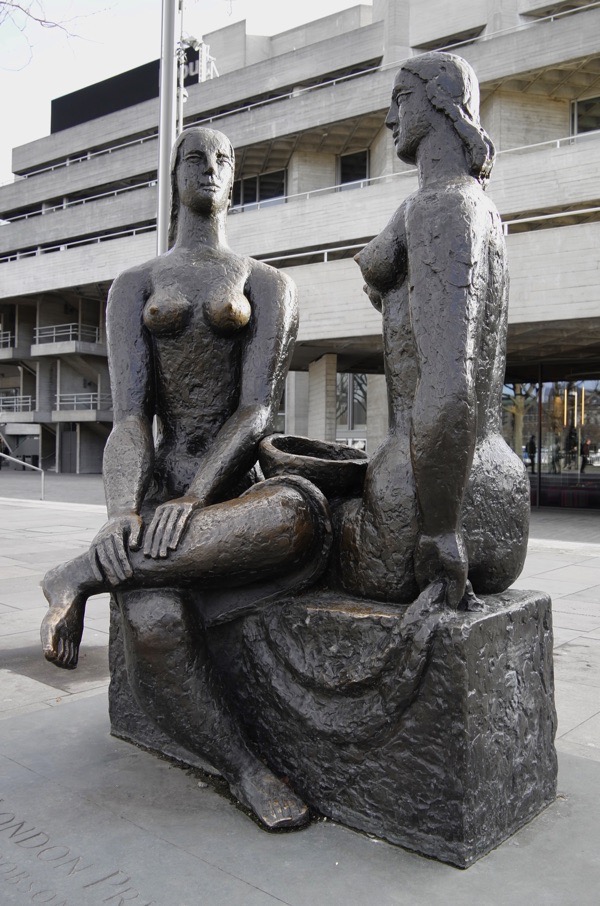
London Pride by Frank Dobson outside the National Theatre on the South Bank
You may also like to read about
Franta Belska’s Sculpture in Bethnal Green
Malcolm Tremain’s Spitalfields In Colour
Please support our JANUARY BOOK SALE. We only have nine titles left in the warehouse and some are on the brink of going out of print, so you can assist us clear the shelves by buying copies at half price to complete your collection, or as gifts for family and friends.
Click here and enter code ‘2022’ at checkout to get 50% discount
Today I publish Malcolm Tremain’s evocative colour photographs of Spitalfields in the early eighties.

In Liverpool St Station

Goulston St

Brushfield St

Brushfield St

Crispin St

Railing of the night shelter in Crispin St

Brune St

Holland Estate

Artillery Lane

Looking towards the city from the Spitalfields Market car park

Looking south towards Brushfield St

Looking north towards Spital Sq

Goulston St

Goulston St

Middlesex St

Middlesex St

Alley at Liverpool St Station

Sun Passage

Tunnel at Liverpool St Station

Old Broad St Station

Old Broad St Station

Old Broad St Station under demoliton

Old Broad St Station

Old Broad St Station

Old Broad St Station

Abandoned cafeteria at Old Broad St Station


Pedley St Bridge looking towards Cheshire St

Pedley St Bridge

Pedley St

Pedley St
Photographs copyright © Malcolm Tremain
You may also like to take a look at
Malcolm Tremain’s Spitalfields
Malcom Tremain’s Spitalfields Then & Now
Malcolm Tremain’s City & East End
Philip Marriage’s Spitalfields
The Gates Of The City Of London
Please support our JANUARY BOOK SALE. We only have nine titles left in the warehouse and some are on the brink of going out of print, so you can assist us clear the shelves by buying copies at half price to complete your collection, or as gifts for family and friends.
Click here and enter code ‘2022’ at checkout to get 50% discount

The City Gates As They Appeared Before They Were Torn Down, engraved for Harrison’s History of London 1775
As we enter a new year, I am delighted to show you this eighteenth century print that I came across in the Spitalfields Market for a couple of pounds with the plangent title “The City Gates As They Appeared Before They Were Torn Down.”
Printed in 1775, this plate recorded venerable edifices that had been demolished in recent decades and was reproduced in Harrison’s History of London, a publication notable for featuring Death and an Hourglass upon the title page as if to emphasise the mutable, ever-changing nature of the capital and the brief nature of our residence in it.

Moorgate (demolished 1761)

Aldgate (demolished 1761)

Bishopsgate (demolished 1760)

Cripplegate (demolished 1760)

Ludgate (demolished 1760)

Newgate (demolished 1767)

Aldersgate (demolished 1617)

Bridgegate (demolished 1762)

Sixteenth century figures of King Lud and his sons that formerly stood upon Ludgate, and stowed ever since in an alley at the side of St Dunstan in the West, Fleet St
You may also like to take a look at
January Book Sale
In 2022, we plan to commence publishing books again and we already have several exciting new titles in the pipeline.
You can help us on our way by supporting our JANUARY BOOK SALE. We only have nine titles left in the warehouse and some are on the brink of going out of print, so you can assist us clear the shelves by buying copies at half price to complete your collection, or as gifts for family and friends.
Click here and enter code ‘2022’ at checkout to get 50% discount

“As if I were being poked repeatedly in the eye with a blunt stick, I cannot avoid becoming increasingly aware of a painfully cynical trend in London architecture which threatens to turn the city into the backlot of an abandoned movie studio.”
The Gentle Author presents a humorous analysis of facadism – the unfortunate practice of destroying an old building apart from the front wall and constructing a new building behind it – revealing why it is happening and what it means.
As this bizarre architectural fad has spread across the capital, The Gentle Author has photographed the most notorious examples, collecting an astonishing gallery of images guaranteed to inspire both laughter and horror in equal measure.

Around 1900, photographer Horace Warner took a series of portraits of some of the poorest people in London – creating relaxed, intimate images that gave dignity to his subjects and producing great photography that is without comparison in his era.
Only seen by members of Warner’s family for more than a century, almost all of these breathtaking photographs are published here for the first time.
This unique collection of pictures revolutionises our view of Londoners at the end of the nineteenth century, by bringing them startlingly close and permitting us to look them in the eye.
With an introduction by The Gentle Author

“a timely reminder of all that modern Britishness encompasses” The Observer
In this first London Sikh biography, Suresh Singh tells the candid and sometimes surprising story of his father Joginder Singh who came to Spitalfields in 1949.
Joginder sacrificed a life in the Punjab to work in Britain and send money home, yet he found himself in his element living among the mishmash of people who inhabited the streets around Brick Lane.
Born and bred in London, his son Suresh became the first Punjabi punk, playing drums for Spizzenergi and touring with Siouxsie & the Banshees.
In the book, chapters of biography are alternated with Sikh recipes by Jagir Kaur.

Between the covers of this magnificent red album with a gilded cover you will discover more than 600 of the Gentle Author’s favourite pictures of London in print for the first time, setting the wonders of our modern metropolis against the pictorial delights of the ancient city, and celebrating the infinite variety of life in the capital.
This is London seen from an easterly direction – as the centre of gravity in the city has shifted, the Gentle Author of Spitalfields Life has amassed a wealth of extraordinary pictures of London with a special emphasis upon the East End.
Among the multiplicity of visual pleasures to be savoured, garnered from four centuries including our own, enjoy the ostentatious trade cards of Georgian London, the breathtaking lantern slides of Victorian London, the bizarre car crashes of Clerkenwell, the heroic Spitalfields nippers, the soulful dogs of old London, Aaron Biber, London’s oldest barber, and Barn the Spoon, the spoon carver.
Take a walk through time with the Gentle Author as your guide – be equally amazed at what has been lost of old London and charmed by the unfamiliar marvels of London today.

The Gentle Author presents a magnificent selection of pictures – many never published before – revealing the evolution of painting in the East End and tracing the changing character of the streets through the twentieth century.
“A fragment of the riches flowing from a continued fascination with London’s topography” – Evening Standard
“Harvested from the thirties to the present day, Spitalfields Life’s gorgeous collection of East End paintings is more knees-up than misery-fest” – Hackney Citizen
Among the artists included are: John Allin, S R Badmin, Pearl Binder, James Boswell, Roland Collins, Alfred Daniels, Anthony Eyton, Doreen Fletcher, Geoffrey Fletcher, Barnett Freedman, Noel Gibson, Charles Ginner, Lawrence Gowing, Harry T. Harmer, Elwin Hawthorne, Rose Henriques, Dan Jones, Nathaniel Kornbluth, Leon Kossoff, James Mackinnon, Cyril Mann, Jock McFadyen, Ronald Morgan, Grace Oscroft, Peri Parkes, Henry Silk, Harold Steggles, Walter Steggles & Albert Turpin.

A handsome photography book collecting together Colin O’Brien’s portraits of the travellers’ children in London Fields.
“These pictures record an extraordinary meeting between a photographer and a group of Irish Travellers’ children in London Fields in 1987, yet the subject of Colin O’Brien’s tender and clear-eyed photographs is no less than the elusive drama of childhood itself.”

“This small, beautiful book is an elegy to companionship. Encompassing both the everyday and the profound, it should be judged no less valid for the fact that the friend in question is a cat.” Times Literary Supplement
Anyone that has a cat will recognise the truth of this tender account by The Gentle Author.
“I was always disparaging of those who doted over their pets, as if this apparent sentimentality were an indicator of some character flaw. That changed when I bought a cat, just a couple of weeks after the death of my father. “
Filled with sentiment yet never sentimental, THE LIFE & TIMES OF MR PUSSY is a literary hymn to the intimate relationship between humans and animals.

AS Jasper’s tender memoir of growing up in the East End of London at the beginning of the twentieth century was immediately acclaimed as a classic when it was described by the Observer as ‘Zola without the trimmings.’
In this definitive new edition, A Hoxton Childhood is accompanied by the first publication of the sequel detailing the author’s struggles and eventual triumph in the cabinet-making trade, The Years After.
Illustrated with line drawings by James Boswell and Joe McLaren

The Gentle Author assembles a choice selection of CRIES OF LONDON, telling the stories of the artists and celebrated traders, and revealing the unexpected social realities contained within these cheap colourful prints produced for the mass market.
For centuries, these lively images of familiar hawkers and pedlars have been treasured by Londoners. In the capital, those who had no other means of income could always sell wares in the street and, by turning their presence into performance through song, they won the hearts of generations and came to embody the spirit of London itself.
Click here and enter code ‘2022’ at checkout to get 50% discount
Chapter 9. A Shallow Grave

John Williams was buried here outside The Crown & Dolphin at the junction of Cannon St Rd and Cable St on 31st December 1811. It was a tradition for a murderer who committed suicide while awaiting execution to be buried at the crossroads nearest the scene of their crime, with a wooden stake driven through the heart – and this was the ultimate fate of John Williams.
This practice – which was not unusual at the time – had its roots in folklore and the superstitious belief that only by driving a stake through the heart could the ghost of the murderer be prevented from returning to earth to plague the living. Even if the spirit were able to break free of the impaling stake, it would hover eternally irresolute at the crossroads. Although there was no legal authority for this custom, it was in this instance sanctioned personally by the Home Secretary, along with permission for a procession displaying the body publicly, prior to burial.
Londoners had been cheated of the spectacle of a public execution, so instead they were able to enjoy a parade. On the night before, the Deputy Constable of St George’s-in-the-East sat alone in a hackney coach with the dead body, transporting it from Coldbath Fields Prison in Clerkenwell over to Shadwell. The blinds of the coach were shut because if the body were exposed to the eyes of the mob there was little chance that it would survive intact. It must have been a grim ride.
On the morning of New Year’s Eve, John Williams’ body was attached to a cart specially rigged with a raked platform allowing maximum exposure to the crowd, and with the maul and the chisel displayed on either side of his head. Above his head was affixed the iron bar used to kill Mr Williamson and at the back of the neck, the sharpened stake was placed ready for use at the burial. Travelling along the Ratcliffe Highway past the Marrs’ draper’s shop, the procession set out on a journey around Wapping, taking in The Pear Tree and The King’s Arms along the way. When the cart reached the draper’s shop it halted because Williams’ head lurched unexpected to one side, as if he were taking a last look at the scene of his crime. Once someone had climbed up and straightened the head, the procession went on its way. It was estimated that ten thousand people turned out to witness the parade and although the Home Secretary feared the crowd might seize the body to exact direct physical vengeance, he was mistaken because the entire proceeding passed off in macabre silence.
At the crossroads, a grave four feet deep, three feet long and two feet wide had been dug and once John Williams’ body was tumbled into this hole – made deliberately too small – one of the escorts drove the stake through his heart. As the stake entered John Williams’ heart, the silence of the crowd was finally broken and cathartic shouts and cheers filled the air. A quantity of quick lime was thrown into the hole, it was hastily filled up with earth, and the paving stones were replaced and hammered down at once.
As darkness fell upon East London, people at last felt more comfortable to venture from their homes into the dark streets of Wapping, Shadwell, Whitechapel and Spitalfields as the New Year’s celebrations got underway. But the confident verdict of the Shadwell Bench, that John Williams was the sole murderer of both the Marrs’ and Williamsons’ families, could have deceived no-one for long.
Early in the New Year, you may expect the final report on this case.

The procession passes The King’s Arms.

The procession arrives at the crossroads with The Crown & Dolphin in the background.

Click on Paul Bommer’s map of the Ratcliffe Highway Murders to explore further
I am indebted to PD James’ ‘The Maul & The Peartree’ which stands as the authoritative account of these events. Thanks are also due to the Bishopsgate Institute and Tower Hamlets Local History Archive.
You may like to read the earlier instalments of this serial which runs throughout December
My Panto Years

Longer ago than I care to admit, fortune led me to an old theatre in the Highlands of Scotland. Only now am I able to reveal some of my experiences there and you will appreciate that discretion prevents me publishing any names lest those who are still alive may read my account.
It was a magnificent nineteenth century theatre, adorned with gilt and decorative plasterwork. Since this luxurious auditorium with boxes, red drapes and velvet seating was quite at odds with the austere stone buildings of the town, it held a cherished place in the affections of local theatregoers who crowded the foyers nightly, seeking drama and delight.
Although it is inexplicable to me now, at that time in my life I was stage struck and entirely in thrall to the romance of theatre. Perhaps it was because of my grandfather the conjurer who died before I was born? Or my love of puppets and toy theatres as a child? When I left college at the beginning of my twenties, I refused to return home again and I did not know how to make my way in London. So I was overjoyed when I landed a job at a theatre in the north of Scotland. I packed my possessions in cardboard boxes, took the overnight train and arrived in the frosty dawn to commence my adult life.
As soon as it was discovered I had a literary education, I was assigned the task of organising the script and writing the ‘poetry’ for the annual pantomime, which that year was Dick Whittington. In the theatre safe I found a stash of tattered typescripts dating back over a century, rewritten each time they were performed. These documents were fascinating yet barely intelligible, and filled with gaps where comedians would supply their own patter. I discovered that the immortals, in this case Fairy Bow Bells and Old King Rat, spoke in rhyming couplets. Yet to my heightened critical faculties, weaned on Shakespeare and Chaucer, these examples were lame. So I resolved to write better ones and set to work at once.
Fairy Bow Bells:
In the deepest, bleakest Wintertime,
I welcome you to Pantomime.
Here is Colour! Here is Magic!
Here is Love and naught that’s Tragic.
‘You are here to learn the art of compromise, and how to pour a decent gin and tonic, darling,’ the director informed me at commencement with a significant nod of amusement when I submitted my work. I tried to raise an amenable smile as I served the drinks, but it was a line delivered primarily for the benefit of the principals gathered in the tiny office for a production meeting. These were veterans of musical comedy and summer variety who played pantomime every year, forceful personalities who each brought demands and expectations in proportion to their place in the professional hierarchy, with the ageing comedian playing Dame Fitzwarren as the star. Next came the cabaret singer and dancer playing Dick Whittington and then the television personality playing Tommy the Cat.
It was my responsibility to manage auditions for the chorus of boy and girl dancers, sifting through thousands of curriculum vitae and head-shots to select the most promising candidates. Those granted the opportunity were given ten minutes to impress the musical director and the choreographer with a show tune and a short dance sequence. Shepherding them in and out of the room and handling their raw emotions proved a challenge when they lost their voices, broke into tears or forgot their routines – or all of these.
The cast convened for a read-through in the low-ceilinged rehearsal room in a portacabin in the theatre car park. Once everyone had shaken hands and a cloud of tobacco filled the room, the director wished everyone good luck and, turning to me before leaving the room, declared loudly ‘Don’t worry, darling, they know what to do!’, employing the same significant nod I had seen in the production meeting and catching the eye of each of the principals again.
We all sat down, I handed round the scripts and the cast turned to the first page. The principals gasped in horror, exchanging glances of disbelief and reaching for their cigarettes in alarm. Dame Fitzwarren blushed, tore out a handful of pages and spread them out on the table, muttering, ‘No, no, no,’ to himself in condemnation. I sat in humiliated silence as, in the ensuing half hour, my sequence of pages was entirely rearranged with some volatile horse trading and angry words. Was this the art of compromise the director had referred to? I had organised the scenes in order of the story – no-one had explained to me that in pantomime the sequence of opening scenes are a device to introduce the principals in order of status from the newcomers to the seasoned stars. Yet even if I had understood this, it would have made little difference since the cast were all unknown to me.
On the second day, the floor of the portacabin was marked with coloured tapes which indicated the placing of the scenery and it was my job to take the cast through their moves. Dame Fitzwarren was keen to teach his comedy kitchen sequence to the two young actors playing the broker’s men. Once he had walked them through, I suggested we should give it a go. ‘No,’ he said, ‘That was it, we did it.’ I understood that, in pantomime, comedians only rehearse their sequences once as a matter of honour.
The little theatre owed its existence to the wealth of the whisky distilleries which comprised the main industry in the town and many of the directors of these distilleries were members of the theatre board. In particular, I remember a diminutive fellow who made up for his lack of height with an abrasive nature. He confronted me on the opening night, asking ‘Is this going to be good, laddie?’ My timid reply was, ‘It’s not for me say, is it?’ ‘It had better be good because your career depends upon it,’ was his harsh response, poking me in the gut with his finger.
In fact, Dick Whittington – in common with all the pantomimes at that theatre – was a tremendous success, playing to packed houses from mid-December until the end of January. The frantic energy of the cast was winning and the production suited the mechanics of the building beautifully, with brightly coloured flying scenery, drop-cloths and gauzes. The audience gasped in wonder when Fairy Bow Bells waved her wand to conjure the transformation scene and booed in delight when Old King Rat popped up through a trap door in a puff of smoke. They loved the familiar faces of the comedians and laughed at their routines, even if they were not actually funny.
Given the punishing routine of three shows a day, the collective boredom of the run and the fact that they were away from home, the pantomime cast occupied themselves with a rollercoaster of affairs and liaisons which only drew to an end at the final curtain. Once Dick Whittington unexpectedly stuck her tongue down my throat in the backstage corridor on New Year’s Eve and Dame Fitzwarren locked the door of the star dressing room from the inside, subjecting me to his wandering hands when I came to discuss potential cuts in the light of the stage manager’s timings. I found myself entering and leaving the building through the warren of staircases and exit doors in order to avoid unwanted attention of this nature. The gender reversals and skimpy costumes contributed to an uncomfortably sexualised environment which found its expression on stage in the relentless innuendo and lewd references, all within an entertainment supposedly directed at children. ‘Thirty miles to London and no sign of Dick yet!’
I shall never forget the musical director rehearsing the little girls in tutus from a local stage school who supplied us with choruses of sylphs on a rota to accompany Fairy Bow Bells. ‘Come along, girls,’ he instructed the children, thrusting his chest forward and baring his dentures in a frozen smile of enthusiasm,’ Tits and teeth, tits and teeth,’ using the same exhortation he gave to the adult dancers.
Our version of Dick Whittington contained an underwater sequence, when Dick’s ship was wrecked, permitting the characters to ‘swim’ through a deep sea world which was given greater reality by the use of ultra-violet light and projecting an aquarium film onto a gauze. This was also the moment in the show when we undertook a chase through the audience, weaving along the rows. Drawing on the familiar tradition of pantomime cows and horses – and perhaps inspired by the predatory nature of the environment – I devised the notion of a pantomime shark in a foam rubber costume that could chase the characters through the front stalls and around the circle to the accompaniment of the theme from Jaws. I had no idea of the pandemonium that this would unleash but, each night, I made a point of popping in to stand at the back to enjoy the mass-hysteria engendered by my shark.
The actor playing Old King Rat had previously been cast as Adolphus Cousins in Major Barbara, so I decided to exploit his classical technique by writing a death speech for him. It was something that had never been done before and this is the speech I wrote.
Old King Rat:
This is the death of Old King Rat,
Foiled at last by Tommy the Cat.
No more nibbles, no more creeping,
No more fun now all is sleeping.
This is the instant at which I die,
Off to that rathole in the sky…
Naturally this was accompanied by extended death-throes, with King Rat expiring and getting up again several times. Later, I learnt my speech had been pirated by other productions of Dick Whittington, which is the greatest accolade in pantomime. Maybe it is even now being performed somewhere this season?
In subsequent years, I was involved in productions of Cinderella and Aladdin, but strangely I recall little of these. I did not realise I was participating in the final years of a continuous theatrical tradition which had survived over a century in that theatrical backwater. I did not keep copies of the scripts and the fragments above are all I can remember now. I do not know if I learnt the art of compromise but I certainly learnt how to pour a stiff gin and tonic. And I learnt that in any theatre there is always more drama offstage than onstage.

You may also like to read about
The Ghosts Of Old London

Click to enlarge this photograph
To dispel my disappointment that I cannot rent that Room to Let in Old Aldgate, I find myself returning to scrutinise the collection of pictures taken by the Society for Photographing the Relics of Old London held in the archive at the Bishopsgate Institute. It gives me great pleasure to look closely and see the loaves of bread in the window and read the playbills on the wall in this photograph of a shop in Macclesfield St in 1883. The slow exposures of these photographs included fine detail of inanimate objects, just as they also tended to exclude people who were at work and on the move but, in spite of this, the more I examine these pictures the more inhabited they become.
On the right of this photograph, you see a woman and a boy standing on the step. She has adopted a sprightly pose of self-presentation with a jaunty hand upon the hip, while he looks hunched and ill at ease. But look again, another woman is partially visible, standing in the shop doorway. She has chosen not to be portrayed in the photograph, yet she is also present. Look a third time – click on the photograph above to enlarge it – and you will see a man’s face in the window. He has chosen not to be portrayed in the photograph either, instead he is looking out at the photograph being taken. He is looking at the photographer. He is looking at us, returning our gaze. Like the face at the window pane in “The Turn of the Screw,” he challenges us with his visage. Unlike the boy and the woman on the right, he has not presented himself to the photographer’s lens, he has retained his presence and his power. Although I shall never know who he is, or his relationship to the woman in the doorway, or the nature of their presumed conversation, yet I cannot look at this picture now without seeing him as the central focus of the photograph. He haunts me. He is one of the ghosts of old London.
It is the time of year when I think of ghosts, when shadows linger in old houses and a silent enchantment reigns over the empty streets. Let me be clear, I am not speaking of supernatural agency, I am speaking of the presence of those who are gone. At Christmas, I always remember those who are absent this year, and I put up all the cards previously sent by my mother and father, and other loved ones, in fond remembrance. Similarly, in the world around me, I recall the indicators of those who were here before me, the worn step at the entrance to the former night shelter in Crispin St and the eighteenth century graffiti at the entrance to St Paul’s Cathedral, to give but two examples. And these photographs also provide endless plangent details for contemplation, such as the broken windows and the shabby clothing strung up to dry at the Oxford Arms, both significant indicators of a certain way of life.
To me, these fascinating photographs are doubly haunted. The spaces are haunted by the people who created these environments in the course of their lives, culminating in buildings in which the very fabric evokes the presence of their inhabitants, because many are structures worn out with usage. And equally, the photographs are haunted by the anonymous Londoners who are visible in them, even if their images were incidental to the purpose of these photographs as an architectural record.
The pictures that capture people absorbed in the moment touch me most – like the porter resting his basket at the corner of Friday St – because there is a compelling poetry to these inconsequential glimpses of another age, preserved here for eternity, especially when the buildings themselves have been demolished over a century ago. These fleeting figures, many barely in focus, are the true ghosts of old London and if we can listen, and study the details of their world, they bear authentic witness to our past.

Two girls lurk in the yard behind this old house in the Palace Yard, Lambeth.

A woman turns the corner into Wych St.

A girl watches from a balcony at the Oxford Arms while boys stand in the shadow below.

At the Oxford Arms, 1875.


At the entrance to the Oxford Arms – the Society for Photographing the Relics of Old London was set up to save the Oxford Arms, yet it failed in the endeavour, preserving only this photographic record.

A relaxed gathering in Drury Lane.

A man turns to look back in Drury Lane, 1876.

At the back of St Bartholomew’s, Smithfield, 1877.

In Gray’s Inn Lane.

A man peers from the window of a chemists’ at the corner of Lower James St and Brewer St.

A lone policeman on duty in High Holborn, 1878.

A gentleman in Barnard’s Inn.

At White Hart Inn yard.

At Queen’s Inn yard.

A woman lingers in front of the butcher in Borough High St, Southwark.

In Aldgate.

A porter puts down his basket in the street at the corner of Cheapside and Friday St.

In Fleet St.

The Old Bell, Holborn

At the corner of Fore St and Milton St.

Doorways on Lawrence Pountney Hill.

A conversation at the entrance to Inner Temple, Fleet St.
Images courtesy Bishopsgate Institute
You can see more pictures from the Society for Photographing the Relics of Old London here In Search of Relics of Old London


