
From Old Bedlam To Liverpool St
Bookings for THE GENTLE AUTHOR’S TOURS are now open for June & July

Liverpool St Station
Novelist & Historian Gillian Tindall, author of A Tunnel Through Time, A New Route for an Old London Journey, introduces the Elizabeth line.
The central section of the Elizabeth line carries passengers from Paddington Station in the west to Liverpool St in the east with only three stations in between. Yet while Paddington is one of the oldest of London’s main termini – there has been a station there since the eighteen-thirties – Liverpool St Station is the newest. When the first Metropolitan line train made its way triumphantly from Paddington as far as Farringdon in the eighteen-sixties, it could – for a brief while – go no further, because the heart of old London was a railway-free area, as the City fathers wanted it.
But in a Victorian era obsessed with progress and modernity this could not last. Once a North London Line commuter station had been built in an inconspicuous side street north of London Wall that was inappropriately called Broad St, the Eastern Counties Railway saw its chance. By 1870, the Company had acquired a large swathe of adjoining land as a site for a new station in another minor side street. This was Liverpool St, a cobbled lane which had for centuries been called ‘Old Bedlam’ after the mental hospital that had originally stood there, but it had been re-named in the late eighteen-twenties after the Prime Minister of the time. Soon the two stations stood side by side, occupying a huge space – about seven hundred feet long and four hundred feet wide.
Underneath the shunting lines and coaling bays disappeared a Tudor mansion, a theatre, a gas works, breweries, a grid of tiny, ancient streets, and the trading places and homes of the small businesses and artisans that had been settled there for two centuries. Bishopsgate was forever changed, losing its traditional identity, and becoming an annex to the City, which by-and-by absorbed it.
So, through sheer chance, the City of London’s mainline station is called after a forgotten politician and stuck with the name of a west coast port at the other end of the country. Liverpool St Station has traditionally served east coast ports, notably Harwich, Yarmouth and Grimsby, but you cannot – of course – go from it to Liverpool which is far away in the north west. I am sure I am not the only person who, as a child, was confused by this. On my youthful mental map of Britain, I vaguely located Liverpool somewhere up the coast from Skegness. On the rare occasions I was taken to the station, it always seemed to smell of fish and comprised two separate parts, so that it was difficult to find your way around. What a pity the name of the cobbled side street along side its frontage was ever changed. ‘Old Bedlam Station’ would have been a much more resonant name.
As those who followed the Elizabeth line excavations will know, this cobbled side-street hid, till recently, the last remnant of a large cemetery. The newspapers were full of ‘discoveries’ there, although the Museum of London archaeologists employed by the Elizabeth line knew quite well that they would find human remains – the only question had been ‘How many?’ In fact, there were two-and-a-half thousand bodies in this small segment of land, considerably more than predicted. Clearly the cemetery had been used and reused since it first opened the times of Elizabeth I. Not for mad paupers, as some of the lurid tales would have us believe, but simply as an extra graveyard for ordinary parishioners of the City churches, generation after generation.
Ever since the station was built, the cab rank had been located inside Liverpool St itself but now the cabs line up outside. Old photographs show a line of horse-drawn vehicles which, by the early twentieth century, were known in cabbies’ slang as droshkis. At that time, many cab-drivers were Russian-Jewish immigrants. They or their families had sought refuge in England from the pogroms that were visited upon the Jews of Poland, the Baltic States, Belarus and the Ukraine.
A generation later, motor-taxis replaced the horses, but the Jewish tradition of London cab-driving persisted. One dark evening early in 1939, a line of taxis was waiting as usual. The evening rush-hour was over. Most customers had already returned hours ago to their suburban homes or were up in the West End for an evening out, and some of the drivers were thinking of heading home to Hackney or Homerton. Then they noticed, standing around in the entrance to the station, a group of about thirty children aged from early teens down to four and five year olds. They did not look like street-children – they were respectably dressed, many wearing hats, and carrying small suitcases, knapsacks or bags.
The cabbies conferred across one front-of-cab to the next. They were well aware what was going on in Europe that year and they guessed who the children were at once. They had caught sight of these groups before, but always being shepherded from the station by adults. Eventually, after some muted discussion, the driver who spoke Yiddish best (having being brought up by his grandmother) approached the group and addressed the eldest-looking girl.
“We think you are Jewish children arriving off the boat-train from Harwich. We are taxi drivers and many of us are Jewish too. Were you expecting someone to come and meet you?”
They were. But it had not happened. Some mistake, some message not getting through. Perhaps they were not expected after all? Perhaps not wanted? The children were stoical. They had been urged to behave well on their long journey across Europe but they looked very tired, and some of the smaller ones had dirty faces and been crying. The taxi-drivers conferred. One of them went to telephone his rabbi. The rabbi phoned another, who phoned someone he knew who worked with the Council for German Jewry. This had been set up in 1936 as an off-shoot from the Central British Fund that assisted immigration to Israel, when it was becoming clear that getting children away from Nazi persecution was a matter of urgency.
Wheels began to turn slowly. Someone, the drivers were told, would soon be on his way, though as he lived in Finchley it might take a little while… Meanwhile, the children were cold and hungry. A posse of drivers awaited the hastily-summoned ‘Someone’ to offer free transport as necessary, while another posse had a whip-round and took the children to a kosher café for something to eat.
So there was a happy end to this particular kindertransport story. The children were finally scooped up, sheltered for the night and distributed to foster homes. They must all be old, the ones that are still alive. Statues commemorating them and over ten thousand other children saved in those years by the Central British Fund and the Council for German Jewry, by Save the Children, and by the free-lance efforts of the late Nicholas Winton in Prague, are to be found in Liverpool St Station today. Some of their actual baggage, including cherished stuffed toys and especially precious objects, such as a pair of skates, are preserved in the Imperial War Museum.
The cabbies involved must, I assume, all be dead and gone by now. I first heard this story years ago from a friend of Whitechapel Jewish origin, now deceased, who had heard it as a child. Then, a few years ago, by chance I heard someone recounting it on BBC Radio, but I did not catch the details that would enable me find any names or date it exactly – so, if anyone can tell me more about those taxi drivers, I would be glad to hear.


Für das Kind by Flor Kent, 2003

The children of the Kindertransport (Courtesy of Imperial War Museum)

Lore’s rucksack (Courtesy of Imperial War Museum)

Stephie’s puppet (Courtesy of Imperial War Museum)

Herbert’s skates (Courtesy of Imperial War Museum)

Arriving in the snow (Courtesy of Imperial War Museum)

Kindertransport – The Arrival by Frank Meisler, 2006

You may also like to read about
Gillian Tindall On The Elizabeth Line
Bookings for THE GENTLE AUTHOR’S TOURS are now open for June & July

Novelist & Historian of London Gillian Tindall, author of A Tunnel Through Time, A New Route for an Old London Journey, introduces the Elizabeth Line.
The Elizabeth Line, through the heart of Central London and out a long way on both sides, opens this week. Thus, with its promise of streamlined trains and light-filled stations, one more chapter will be added to the saga of London’s subterranean passageways – yet even this part of the story is already over a hundred and fifty years old.
London’s first Underground railway had its ceremonial opening early in 1863. A party of top-hatted movers-&-shakers went on a trip in open wagons, and to a grand dinner on tables laid out next to the tunnel at Farringdon where the line terminated. The very same month, the first manuscript version of what became Alice in Wonderland was produced, illustrated by the Lewis Carroll himself and called Alice’s Adventures Under Ground. Carroll, for all that he appeared to be a shy and unworldly academic, had tapped directly into the feeling of the times. For this first Underground – arriving long before New York’s Subway or the Paris Métro – aroused not just a lot of public interest but also anxiety.
Tales of secret underground passages as routes for smugglers, criminals or escaping members of persecuted royal families, had always been the stuff of romantic and scary stories, yet railways themselves had only arrived in London over the previous twenty-five years, so they still seemed new and invasive. They also made the capital a dirtier place. Consequently, it was not surprising the the City Corporation refused to let any of the train companies build a main station right in the centre, which is why Euston and Kings Cross, soon to be joined by St Pancras, stood glaring wistfully across the main road that separated them from Bloomsbury. Twenty years before, a railway line to and from the docks had been allowed to insert itself into Fenchurch St in the far eastern corner of the City, near the Tower, but nothing had yet been allowed in from the north. Broad St Station was soon to be built, well outside old London wall, but in 1863 no Liverpool St Station was there yet, just a terminus up at Shoreditch where the contested Bishopsgate Viaduct still stands.
So the point of the new Underground line, snaking from Paddington along to Kings Cross and then down the path of the Fleet river to what became Farrington Station, was to bring trains as near as possible to the City without actually entering its fiercely-guarded square mile. This first Metropolitan Railway was the brain-child of the City’s official Solicitor, Charles Pearson, a man of advanced ideas. Its trains were, of course, to be pulled by steam engines – it would be thirty-odd years before the electric tube became a possibility – so there was no difference in kind between trains shuttling back and forth along the new line and the ones carrying passengers much further out to the north and west. The idea of City workers being able to ‘commute’ (then an unknown word) from homes in the country began as an idealistic notion in Pearson’s active imagination.
The new line functioned like a branch of the main lines, diving down into a tunnel, or rather into a series of tunnels interrupted by openings to let the steam out and the air in. Unlike a modern tube, which is constructed by deep boring, it was built by cut-and-cover, with the whole area of each section laid bare for the track-laying and then roofed over again when complete. These hugely disruptive works were sited wherever possible along existing roadways, mainly along the Marylebone-Euston Rd.
Naturally, people living near the route fussed that all this digging might make their houses unstable. When Crossrail was first announced, the very same anxieties surfaced though – like the other deep tube lines – it is unlikely to cause a tremor even in the deepest foundations. The real losers in the eighteen-sixties were the poor living in ancient and ramshackle houses alongside the Fleet. At the time, Punch was full of jokes about slum dwellers gleefully leasing out their cellars for the trains, but – in fact – these houses were demolished and only the landlords got any compensation. It would be many years before anyone showed concern about dispossessed tenants, although one journalist, John Hollingshead, wrote more imaginatively – “the ancient ways upon which our forefathers stood, made bargains, drank, feasted, and trained their children, are to be deserted, closed, built upon, transformed or utterly destroyed… plastered over with the bills of some authorised auctioneer to be sold as ‘old rubbish’… carted off in a hundred wagons leaving not a trace behind.”
Most of the criticism of the line, before it opened, centred on the issue of smoke. Surely, it was said, people would be asphyxiated in the tunnels, and chemists’ shops along the route would be besieged by white-facing, gasping travellers seeking restoratives? There was also a more fundamental criticism of digging down into the earth, traditionally regarded as the domain of the Underworld. Even some clergymen joined in this fear, suggesting that the Almighty might be minded to punish both railway developers and users for such feckless, Devil-tempting behaviour. And when a shored-up embankment gave way near Farringdon six months before the line was due to open, spewing out Fleet waters mixed with dead bodies from a pauper graveyard, the religious constituency felt entirely justified.
However, once more money was raised, the line opened almost on time, ran without a hitch and was a success with customers from the beginning. The Illustrated London News wrote – “the tunnels, instead of being close, dark, damp and offensive, are wide, spacious, clean and luminous, and more like a well-kept street at night than a subterranean passage.”
London took the Metropolitan line to its heart and, within a couple of years, the network was expanding – into what became the Circle line round inner London, and eastwards to Moorgate and Liverpool St on the same trajectory that Crossrail is taking today. It also linked up with the London, Chatham & Dover line, London’s first ever railway, via an obtrusive viaduct across Ludgate Hill obscuring the view of St Paul’s – the viaduct remained there till 1990. The City fathers do not seem to have realised that by keeping railway stations at a distance from the sacred heart of the capital they might be creating other eyesores.
Charles Pearson died just before his great project opened but, if he came back now, I think he would be delighted to see that his dream of a central interchange is at last being realised in Farringdon. For a long time, it was an old-fashioned and little-regarded station on an ageing minor line, with buddleia sprouting from its sooty walls as if the Fleet river were trying to reclaim its lost bed. Farringdon Station has doubled in size to carry the Elizabeth Line as well as the north-south railway line through London to Brighton, offering a direct route to five different international airports – Stansted & Luton in the north, City Airport to the east, Gatwick in the south and Heathrow in the west. The narrow rabbit-hole really has turned into Wonderland, of a kind.

Lewis Carroll’s Alice’s Adventures Underground tapped into the fascination with subterrannea

The Fleet seen from the back of the Red Lion

Back of the Red Lion seen from the Fleet

Works on the Fleet tunnel February 1862

Collapse of the Fleet tunnel, June 1862

The first trip on the Underground, 1863

The railway viaduct that obstructed the view of St Paul’s Cathedral until 1990
You may also like to take a look at
The Crossrail Drillers
Bookings for THE GENTLE AUTHOR’S TOURS are now open for June & July

The Elizabeth Line opens today and it will change the capital in ways that we cannot yet imagine. Here is my account of how it all began with a small hole in a car park in Whitechapel, written on October 31st 2009.
Over the last week, there have been scenes worthy of nineteenth century California enacted in the car park of Sainsburys, Whitechapel. Deeper than Neville’s Turkish Baths in Bishopsgate, far deeper than the Charnel House in Bishops Sq, deeper even than the Central Line, something is stirring.
Preparations are underway for the largest engineering project in Europe, building a monster tunnel from here to the future. Crossrail will extend right across London, from Shenfield in the east to Maidenhead in the west with a central underground tunnel over thirteen miles long, due for completion in 2017. So many skilled tunnellers are required that a Tunnelling Academy is being created in Newham.
As you may now have surmised, the men with the derrick in Sainsburys’ car park are not prospecting for oil – although their primitive drilling rig would be recognised by the prospectors of a century ago – they are extracting samples to discover what is beneath, so that the challenge of digging the tunnel may be quantified.
I took the liberty of asking some questions and the men explained that they were drilling thirty five metres down. The first few metres are the hardest because the car park is on the site of the former Albion Brewery and when the entire structure was flattened, it filled the cellars with a dense layer of rubble. Beneath this is a deeper layer of Thames valley sediment and then sand until you reach the bedrock.
In the midst of our conversation, as we discussed the vast ambition of the project, I could not resist a sense of awe at this extraordinary undertaking. First there is the notion of digging so deep beyond the layers of recorded history into geological time, then there is immensity of the construction project and the logistics of organising it, and finally speculation at the transformation it will bring upon our neighbourhood – this place will change for ever as Crossrail pulls us closer to the centre of London and to Heathrow Airport too.
I was becoming overawed, when I saw that – although these men were simply doing a routine job of work, drilling holes in Sainsburys’ car park – they were themselves excited and proud to be the harbingers of such a monumental and wondrous enterprise. I realised I had witnessed a moment of history.

Visit The Secret Gardens Of Spitalfields
Bookings for THE GENTLE AUTHOR’S TOURS are now open for June & July

Gardens in Spitalfields are open for visitors on Saturday 11th June from 10am – 4pm. Find details at the website of the National Gardens Scheme.


You may also like to read about
John Claridge’s Spent Moments
Bookings for THE GENTLE AUTHOR’S TOURS are now open for June & July

Self-Portrait with Keith (standing behind with cigarette), E7 (1961).
“We still meet up for a drink and put the world to rights.”
Here is the young photographer John Claridge at seventeen years of age in 1961, resplendent in a blue suede jacket from Carnaby St worn with a polo neck sweater and pair of Levis, and bearing more than a passing resemblance to the character played by David Hemmings in ‘Blow-Up’ five years later.
On the evidence of this set of photographs alone it is apparent that John loves people, because each picture is the outcome of spending time with someone and records the tender moment of connection that resulted. Every portrait repays attention, since on closer examination each one deepens into a complex range of emotions. In particularly intimate examples – such as Mr Scanlan 1966 and the cheeky lady of 1982 – the human soul before John’s lens appears to shimmer like a candle flame in a haze of emotionalism. The affection that he shows for these people, as one who grew up among them in the East End, colours John’s pictures with genuine sentiment.
Even in those instances – such as the knife grinder in 1963 and the lady on the box in Spitalfields 1966 – in which the picture records a momentary encounter and the subjects retain a distance from the lens, presenting themselves with a self-effacing dignity, there is an additional tinge of emotionalism. In other pictures – such as the dance poster of 1964 and the windows in E1 of 1966 – John set out to focus on the urban landscape and the human subjects created the photographic moment that he cherished by walking into the frame unexpectedly. From another perspective, seeing the picture of the mannequin in the window, we share John’s emotional double-take on discovering that the female nude which drew his eager gaze is, in fact, a shop dummy.
For John, these photographs are not images of loss but moments of delight, savouring times well spent. If it were not for photography, John might only have flickering memories of the East End in his youth, yet these pictures capture the people that drew his eye and those that he loved half a century ago, fixing their images eternally.

Across the Street, E1 (1982) – “I did a double-take when I first saw this. In fact, it was a mannequin in the window. Still looked good.”

School Cap, Spitalfields (1963) – “I just found this surreal. It was as if the man behind was berating a nine-year-old who couldn’t care less.”

Two Friends, Spitalfields (1968) – “They were walking along sharing one piece of bread.”

The Box, Spitalfields(1960) – “I came across this lady sitting on an orange box, there was nothing else around. Then she got up and walked off with her box.”

Labour Exchange, E13 (1963) – “Never an uncommon sight.”

Ex-Middleweight Boxer, Cable St (1960) – “We were talking about boxing when he just gave me the thumps-up.”

Knife Grinder, E13 (1966) – “Every few weeks he would appear at the end of the street. Quite a cross-section of people had their knives sharpened!”

Mr Scanlon, E13 (1966) – “My next door neighbour. Always with a wicked sense of humour and an equally wicked smile.”

The Doorway, E2 (1962) – “To this day I would still like to know where her thoughts were.”

Crane Driver, E16 (1975) – “He could balance a crushed car on half a crown and still give you change.”

59 Club, E9 (1973) – “The noise of the pinball machines with the sound of the jukebox playing Jerry Lee.”

A 7/6 Jacket, E13 (1969) – “He had a small shed where he sold anything he could find, which he collected in a small handcart.”

A Portrait, E1 (1982) – “This special lady asked me ‘Why do you want to photo me?’ I replied ‘Because you look cheeky.’ This is the picture.”

Scrap Dealer, E16 (1975) – “This was shot in Canning Town, near the Terry Lawless boxing gym.”

The Step, Spitalfields (1963) – “A kid at play.”

Dance Poster, E2 (1964) – “I was taking a picture of the distressed posters when he glided past.”

The Windows, Spitalfields (1960) – “Behind every window.”

My Mum & Dad, Plaistow (1964) – “Taken in the backyard.”

Fallen Angel, E7 (1960) – “There were a lot of fallen angels in the East End.”
Photographs copyright © John Claridge
You may also like to take a look at
Jimmy Huddart, Spitalfields Market Porter
Bookings for THE GENTLE AUTHOR’S TOURS are now open for June & July

A market porter of forty years standing, Jimmy Huddart is proud to display the clothing of his trade. He keeps this apron pristine for ceremonial occasions now, but it is of the traditional design made of the full width of strong canvas, with leather straps and reinforcement across the front where the boxes cause most wear. In use, an apron like this would quickly acquire a brown tinge yet provide its owner with at least two years of wear, with prudent repairs. In the pocket, Jimmy always kept his porter’s knife and string to sew up broken sacks. And the offcuts from these aprons were used to make “cotchel” bags, which held all the fruit and vegetables that the porter might acquire for his own use, gathering it in the lining of his coat as he went about his work. “Cotchelling up,” they called it – and today, although employees in the market now get a vegetable box to take home, it is still referred to as a “cotchel.”
The most significant item in the outfit is the porter’s licence, indicated by the enamel badge. Throughout Jimmy’s time in the market, you could only work as a porter if you had one of these and it was a badge of office, denoting its own rights and privileges which had to be earned. At first, young men entered the market as “empty boys,” collecting and sorting empty wooden boxes and claiming the deposits, until they had earned the right to become licenced porters. Before the introduction of fork-lift trucks, this was intense physical work, manhandling crates of fruit and sacks of vegetables, and manoeuvring the heavy wooden barrows piled high with produce which had a life of their own once you set them going.
“I grew up in Bethnal Green, Brady St, and, at the age of twelve, I used to go to the market to watch all the tussle and bustle, and all the porters with their barrows. At school, I was very much interested in carpentry but I couldn’t get an apprenticeship, although by then I had already been introduced to the market. I loved to go up the Spitalfields with my Uncle Bill, he worked for a haulage company and we used to go around the farms in Kent to collect the English plums and apples and deliver them to the market. There was something about it, the atmosphere and the characters – a love of it developed inside me – and I wanted to become a porter. If you worked in the market or the docks you earned better than the average salary.
When I was fifteen, my uncle got me a job with Percy Dalton at the corner of Crispin St and Brushfield St. He was a well-dressed Jewish man, softly spoken, who had started his business with a barrow selling roast peanuts and he took me under his wing. The first day I started working for Percy Dalton, he showed me how to sweep the shop. He was that sort of person, hands on. He had a fruit shop at the front and in the warehouse there’d be eight people roasting peanuts. The peanut factory backed onto the alley where the lorries came, he had these red vans with Percy Dalton on the side that you always saw outside dog meetings and football matches. He was a likeable man, very popular, and people often came to him for advice. If you were in trouble you could go and speak to him, he would lend you money if you needed it. He always said, get a corner shop and you get two premises for the price of one.
I used to go out with the drivers all around the London Docks to pick up the fruit and make deliveries. I looked forward to it among my duties – being a boy, they took care of me and bought me breakfast, and they taught me how to stack a lorry. But I wanted to be a porter, so I asked in the market if I could work as an empty boy until I came of age. A job come up as a banana boy for Ruby Mollison, helping him to ripen the bananas, hanging them up in the ripening room. I used to wear a leather glove when I had to put my hand under the banana stalk because I was frightened of the spiders. When you cut a bunch of bananas, you cut a “v” shape and they come away from the stalk, and that’s where your spider might be. They could be very dangerous, especially if they were pregnant, and if you were bitten you’d have to go to hospital because your arm could get paralysed by the poison.
Then a chance came up at Gibson Pardoe as an empty boy with the view of getting a licence, and I worked with them for a year until Alf Hayes of the porters’ union came to me and said, “There’s an opportunity to work in the flower market as a porter, would you be interested?” and I was issued a porter’s licence at twenty-one. But there was decline in the fruit trade in the nineteen seventies and they brought in fork-lift trucks. The job changed, it became less physical and where you once needed four porters now you only needed two. I can recall the first time I was given an electric truck. It was one of two milk floats all sprayed up without a scratch on them and they said to me, “treat it like it was new-born baby.” My first trip with it was to go over to Commercial St, and I was making a delivery there when a forty-ton truck came past and clipped it, taking half the fibre-glass roof with it. Luckily, I wasn’t seriously injured, only shaken up. I explained to governor what happened, that it was an accident and he said, “Did you get the number plate ?” He never asked if I was hurt or injured in any way. I suppose you could say, that’s the market sense of humour.
I became elected to the union. In life, I always believed in fairness and I recognise there has to be give and take. I had to build up trust from my members and in dealing with the traders too, yet most of the problems were solved over a cup of tea and a handshake. I was the porters’ representative for ten years but Alf Hayes, who was my inspiration, he had been porters’ representative for forty years before me. The porters’ union was founded in the depression of the twenties and thirties. Although they had to keep it a secret, they invented a form of recognition so they could discuss it – it was “union” backwards, “you’ve got none.” It was lost on those who weren’t in the know, and the union became fully recognised in the late nineteen thirties.
My sport was road running and thirty-five of us formed the Spitalfields Market Runners. Celebrating the tercentenary of the market in 1982, we were supported by the traders and greengrocers and porters in a relay from the Spitalfields Market to Southend Pier and back. We each ran ten miles and the whole of the market came together to do something for charity.“
Jimmy remembers when unemployed porters once waited for work under the clock at the centre of the Spitalfields Market and how the union acquired an office so that traders seeking a porter could telephone, thereby saving the humiliation of the porters. Yet now, in common with the other London markets, the porters are becoming deregulated, losing their licences as the balance in the labour market shifts again. However, after forty years as a porter, Jimmy chooses to remain positive – because experience has granted him a broad perspective upon the endlessly shifting culture and politics of communal endeavour in market life.

Jimmy’s Huddart’s porter’s licence.

The final year of the licenced porters.

Jimmy’s first year as a porter at twenty-one years old.

Jimmy (right) with his predecessor in the porter’s union Alf Hayes, photographed in the 1980s.

Jimmy Huddart, Honorary Fruit Porter to the Worshipful Society of Fruiterers
You may also like to read about
Peter Thomas, Fruit & Vegetable Supplier
Ivor Robins, Fruit & Vegetable Purveyor
John Olney, Donovan Brothers Ltd
Jim Heppel, New Spitalfields Market
Blackie, the Last Spitalfields Market Cat
and take a look at these galleries of pictures
The Inescapable Melancholy Of Phone Boxes
Bookings for THE GENTLE AUTHOR’S TOURS are now open for June & July

Red phone boxes are a cherished feature of my personal landscape because, in my childhood, we never had a telephone at home and, when I first made a phone call at the age of fifteen, it was from a box. In fact, for the major part of my life, all my calls were made from boxes – thus telephone calls and phone boxes were synonymous for me. I grew up with the understanding that you went out to make a phone call just as you went out to post a letter.
Yet the culture of mobile phones is now so pervasive I was shocked to discover I had hardly noticed as the red telephone boxes have vanished from our streets and those few that remain stand redundant and unused. So I set out with my camera to photograph the last of them, lest they should disappear without anybody noticing. It was a curious and lonely pilgrimage because, whereas they were once on every street, they have now almost all gone and I had to walk miles to find enough specimens to photograph.
Reluctantly, I must reveal that on my pitiful quest in search of phone boxes, I never saw anyone use one though I did witness the absurd spectacle of callers standing beside boxes to make calls on their mobiles several times. The door has fallen off the one in Spitalfields, which is perhaps for the best as it has been co-opted into service as a public toilet while the actual public toilet nearby is closed forever.
Although I must confess I have not used one myself for years, I still appreciate phone boxes as fond locations of emotional memory where I once experienced joy and grief at life-changing news delivered down the line. But like the horse troughs that accompany them on Clerkenwell Green and outside Christ Church, Spitalfields, phone boxes are now vestiges of a time that has passed forever. I imagine children must ask their mothers what these quaint red boxes are for.
The last phone boxes still stand proud in their red livery but like sad clowns they are weeping inside. Along with pumps, milestones, mounting blocks and porters’ rests these redundant pieces of street furniture serve now merely as arcane reminders of a lost age – except that era was the greater part of my life. This is the inescapable melancholy of phone boxes.

Redundant in Whitechapel

Ignored in Whitechapel

Abandoned in Whitechapel

Rejected in Bow

Abused in Spitalfields

Irrelevant in Bethnal Green

Shunned in Bethnal Green

Empty outside York Hall
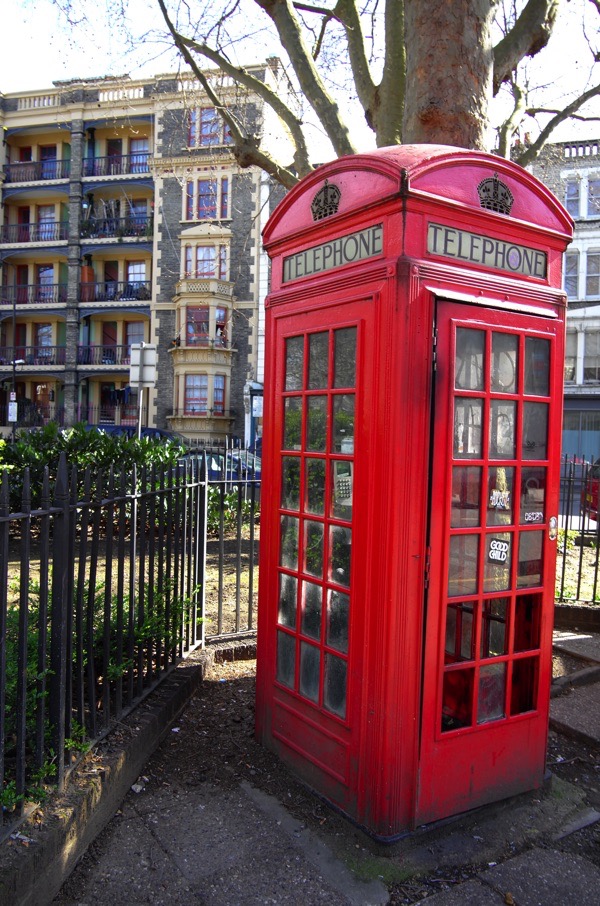
Desolate in Hackney Rd

Pointless in St John’s Sq

Unwanted on Clerkenwell Green

Invisible in Smithfield

Forgotten outside St Bartholomew’s Hospital

In service outside St Paul’s as a quaint location for tourist shots
You may also like to take a look at


