
Happy Families
On Twelfth Night, when we celebrate the Feast of Misrule on the last day of Christmas and all the decorations come down, I dug out these gleefully grotesque picture cards from an old parlour game to amuse you – and to celebrate the old trades and small family businesses which were once part of the East End. Happy Families – A Most Diverting Game for Juveniles, Beautifully Coloured & Made at the Spear Works, Enfield, England.


You may also like to take a look at
At The Blessing Of The River
The annual blessing of the River Thames takes place this Sunday 9th January at 12:20pm. Below is my account of a visit with Colin O’Brien. Click here for more information

Photographer Colin O’Brien & I arrived at St Magnus the Martyr to encounter the Bishop of London illuminated by shafts of winter sunlight as he emerged from a cloud of incense to bless a bowl of chalk, thus enabling the parishioners to mark their houses in advance of the imminent arrival of the three kings. Yet this exercise of spiritual power was a mere prelude to the main event – the annual blessing of the river, as a celebration of the baptism of Jesus.
The lavish brocade robes of the priests gleamed as they processed along Lower Thames St and up through the gloomy underpass – where the incense conveniently masked a noxious smell – before they emerged onto London Bridge in splendour. From the other side, the Bishop of Southwark led another procession and the two parties met in the centre to exchange greetings and declaim prayers.
Invoking Noah and the waters of Jordan, the Bishop of London blessed the Thames and – after checking no boat was passing underneath – the bishops tossed a wooden cross off the parapet. Then the congregation was sprinkled with holy water, while I watched the crucifix float away down the muddy river.


Photographs copyright © Estate of Colin O’Brien
You may also like to read about
Beating the Bounds at the Tower of London
Hot Cross Buns at St Bartholomew the Great
Charles Keeping, Illustrator

The illustrations of Charles Keeping (1924–1988) burned themselves into my consciousness as a child and I have loved his work ever since. A major figure in British publishing in the last century, Keeping illustrated over one hundred books (including the entire novels of Dickens) and won the Kate Greenaway and Carnegie Medals for his superlative talent.
In 1975, Keeping published ‘Cockney Ding Dong,’ in which he collected songs he remembered sung at home as a child. Illustrated with tender portraits of his extended family, the book is an unusual form of autobiography, recreating an entire cultural world through drawing and popular song.
I visited the Keeping Gallery at Shortlands in Kent to meet Vicky and Sean Keeping who talked to me about their father’s work, as we sat in the family home where they grew up and where much of his work is now preserved and displayed for visitors. You can read my interview at the end of this selection of illustrations from ‘Cockney Ding Dong.’


Illustrations copyright © Estate of Charles Keeping
The Gentle Author – So why did your father create ‘Cockney Ding Dong’ ?
Vicky Keeping – We come from a family – he came from a family – where they all got together. They’d have their beer, they enjoyed their beer, and their Guinness – some of the women drank Guinness – and they would all sing and his Uncle Jack would play the piano. And everybody had their own song, so people would give their song and Dad loved that. We still know them all still, because we loved it, and people didn’t say, ‘Oh no, I’m not going to do it!’ They just got up and sang, and it was lovely and the songs were all from the music hall.
The Gentle Author – But he wasn’t a Cockney – where was he was from?
Vicky Keeping – He was from Vauxhall and he was born in Vauxhall Walk, Lambeth. He was very much brought up by the female side of his family. His father passed away when he was ten, he had a burst ulcer. He was a driver on the Daily Star.
Sean Keeping – Before that, his father had been a professional boxer between about 1912 and 1922. He had many professional fights. I know he definitely fought the British champion at the time and won! A chap called Ernie Rice.
His father came from a very poor family and he was orphaned. They had a watercress stall in Lambeth Walk but they died in the workhouse. His mother’s family were also Londoners from Lambeth who came from a nautical background – his grandfather had been a sailor in the Merchant Navy. In the eighteenth century, they had come up to London from the West Country. Like many families, they had not originated in London.
Vicky Keeping – His grandfather was very important to Dad, because he was a great storyteller and would tell stories from his voyages and the different people he met and he was – I suppose – a bit ahead of his time because he was welcoming to all and would speak very positively about the people he met around the world. Dad loved hearing his stories, so he learnt from his grandfather that storytelling was important. That came through to us as well – when we sat round the family tea table we were encouraged to tell stories.
Very sadly, Dad’s dad and Dad’s grandfather passed away in the same year – in 1934 – when Dad was ten. It left Dad and his sister Grace and their mum Eliza very poorly off, but they lived in this extended family with Dad’s granny who was a very strong influence. Dad idolised her and his aunties, and they thought he was the blonde blue-eyed boy and they loved him dearly.
Sean Keeping – They lived in a small terraced house in 74 Vauxhall Walk, which was right alongside the market, and Dad’s early influences were not just his family but also the characters in Vauxhall Market – those often crop up in his books.
Vicky Keeping – One of the things that Dad loved to do in the garden was to look through a little knot hole to see the Schweppes bottling plant and the workhorses and that was something that never left him, that memory of horses.
There was no obvious creativeness in his background, but Dad said his father used to come home – because he worked in print – and bring home paper, and Dad’s sister Grace used to write a story and Dad would illustrate it.
Sean Keeping – He was not a child who would have gone running around the streets, they were children who would sit at home writing a story and drawing. From a very young age, Dad showed a fantastic aptitude for drawing and we’ve got some drawings of his from when he was twelve and thirteen, and they are really fantastic – showing a London of working horses and working people, that’s what he was trying to depict in his drawings.
Vicky Keeping – He was called up in the Second World War but he worked for Clowes the printers when he left school at thirteen. He was not a particularly great scholar at school. One of the things was that he found difficult was that he was left-handed and the teachers would try to get him to write with his right hand.
Sean Keeping – Working for Clowes the printers, he would go around on a horse & cart delivering paper, and that was where he met one of the characters who had a great influence on him – Tom Cherry. Many of the burly-looking men driving a horse through London in Dad’s pictures – they’re Tom Cherry, and usually he drew a little boy sitting next to him which was Dad. Tom had a great influence, telling him stories about London and the people of London.
Vicky Keeping – Dad became a Telegrapher on a frigate and he was on the boat at D-Day. After the war, he tried to get into Art College but that was very difficult, so he worked collecting pennies from gas meters. He worked for the Gas Light & Coke Company and he would go around on a bicycle, with a big sack on his shoulder with all the pennies in it, going from door to door in North Kensington. He used to tell us funny stories. At that time, North Kensington was a poor area and I think he got a lot out of the characters he met there, but he hated working for a company, for a boss, and he decided he wanted to do something better.
He went to night classes at the Regent St Polytechnic but, because he left school at thirteen with no formal qualifications and had been through the war, it was very difficult for him to get in at first. He tried and tried, and eventually he spent time in a psychiatric hospital due to his experiences in the War. I think it was also to do with his father. When his father and his grandfather died in the same year, they were laid out in the front room and – as a ten year old – Dad had to go and kiss them. That had a profound effect on him. He spent six months in a psychiatric hospital and two weeks of those were in a deep sleep. Yet he talked about the great characters he met there and there was a Psychiatrist, Dr Sargent, who knew Dad should go to Art College and he supported him in writing letters – and eventually that’s what happened.
Sean Keeping – When Dad went to Art College, he had to fight hard to get a grant because, at that stage, his mother had been widowed for a number of years and she had a job cleaning, so there was not a lot of money around. But eventually, he got a grant to go to Regent St Polytechnic. Right after the war, there were two types of students – those that had just come out of the forces who were much more mature and those who had come directly from school. So it was an interesting mix of people and mix of cultures.
The Gentle Author – How did he set out to make an income as an illustrator?
Sean Keeping – Dad was not motivated by making a career or making money or even motivated – I think – by success. Dad was motivated by one thing and that was doing what he wanted to do – drawing pictures of things that he wanted to draw pictures of – so he never really thought about a career. But then he got a job on the Daily Herald, drawing the strip cartoon and that started to pay very well, and from that he was able to move out of the council flat that he lived in with his mother in Kennington and buy a small terraced house in Crystal Palace.
When they were looking for houses, once he was making money from the strip cartoon, they looked in two areas – one was Crystal Palace and the other was Chelsea. Now the idea that you might choose Crystal Palace or Chelsea to look for a house nowadays is an strange idea, but they decided on Crystal Palace!
(Transcription by Rachel Blaylock)

Visit The Keeping Gallery at Shortlands in Kent where you can see the work of both Charles & Renate Keeping preserved in their family home. Visits are by appointment arranged through the website and Shortlands is a short train ride from Victoria.
Mat Hughes’ East Enders of 1984

Mat Hughes sent me these fine portraits of the East Enders of 1984 from Australia where he lives today. They are published here for the first time and we hope readers can perhaps identify the subjects. Last year, we published Mat’s photographs of East End streets and there is another set to come of his pictures of the Spitalfields Market.
“Back in 1984, I was a nineteen-year-old student studying photography at the Plymouth College of Art & Design. For my final assignment, I visited Whitechapel and spent two days in April walking the streets taking these photographs. I remember the first day was wet and rainy, and the second day was hot and bright.
In all honesty, I had no plan and in the end my assignment was never fully realised. I had too many pictures to print, it was expensive and I had no real story to tell or way of displaying them. Out of several hundred exposures, only a dozen were printed.
When I read about the controversial redevelopment of the Truman Brewery, it prompted me to dig out my 35mm negatives. Initially, I scanned one or two out of curiosity but I found myself captivated.
Time has given these photographs a context that I was unable to provide. Photographs that thirty-nine years ago I might have discarded have become treasures. Thank goodness I did not have a delete button back then.”
Mat Hughes


Photographs copyright © Mat Hughes
You may also like to take a look at
The Gates Of Old London
Today I present these handsome Players Cigarette Cards from the Celebrated Gateways series published in 1907. As we contemplate the going-out of the old year and the coming-in of the new, they give me the perfect opportunity to send you my wishes for your happiness in 2023.


You may also like to take a look at these other sets of cigarette cards
Learn To Write A Blog This Spring

HOW TO WRITE A BLOG THAT PEOPLE WILL WANT TO READ: 25th-26th March 2023
Spend a weekend in an eighteenth century weaver’s house in Spitalfields this spring and learn how to write a blog with The Gentle Author.
This course is suitable for writers of all levels of experience – from complete beginners to those who already have a blog and want to advance.
We will examine the essential questions which need to be addressed if you wish to write a blog that people will want to read.
“Like those writers in fourteenth century Florence who discovered the sonnet but did not quite know what to do with it, we are presented with the new literary medium of the blog – which has quickly become omnipresent, with many millions writing online. For my own part, I respect this nascent literary form by seeking to explore its own unique qualities and potential.” – The Gentle Author
COURSE STRUCTURE
1. How to find a voice – When you write, who are you writing to and what is your relationship with the reader?
2. How to find a subject – Why is it necessary to write and what do you have to tell?
3. How to find the form – What is the ideal manifestation of your material and how can a good structure give you momentum?
4. The relationship of pictures and words – Which comes first, the pictures or the words? Creating a dynamic relationship between your text and images.
5. How to write a pen portrait – Drawing on The Gentle Author’s experience, different strategies in transforming a conversation into an effective written evocation of a personality.
6. What a blog can do – A consideration of how telling stories on the internet can affect the temporal world.
SALIENT DETAILS
Courses will be held at 5 Fournier St, Spitalfields on 25th-26th March, running from 10am-5pm on Saturday and 11am-5pm on Sunday.
Lunch will be catered with and tea, coffee & cakes by the Townhouse included within the course fee of £300.
Email spitalfieldslife@gmail.com to book a place on a course.
Please note we do not give refunds if you are unable to attend or if the course is postponed for reasons beyond our control.

Comments by students from courses tutored by The Gentle Author
“I highly recommend this creative, challenging and most inspiring course. The Gentle Author gave me the confidence to find my voice and just go for it!”
“Do join The Gentle Author on this Blogging Course in Spitalfields. It’s as much about learning/ appreciating Storytelling as Blogging. About developing how to write or talk to your readers in your own unique way. It’s also an opportunity to “test” your ideas in an encouraging and inspirational environment. Go and enjoy – I’d happily do it all again!”
“The Gentle Author’s writing course strikes the right balance between addressing the creative act of blogging and the practical tips needed to turn a concept into reality. During the course the participants are encouraged to share and develop their ideas in a safe yet stimulating environment. A great course for those who need that final (gentle) push!”
“I haven’t enjoyed a weekend so much for a long time. The disparate participants with different experiences and aspirations rapidly became a coherent group under The Gentle Author’s direction in a gorgeous house in Spitalfields. There was lots of encouragement, constructive criticism, laughter and very good lunches. With not a computer in sight, I found it really enjoyable to draft pieces of written work using pen and paper.Having gone with a very vague idea about what I might do I came away with a clear plan which I think will be achievable and worthwhile.”
“The Gentle Author is a master blogger and, happily for us, prepared to pass on skills. This “How to write a blog” course goes well beyond offering information about how to start blogging – it helps you to see the world in a different light, and inspires you to blog about it. You won’t find a better way to spend your time or money if you’re considering starting a blog.”
“I gladly traveled from the States to Spitalfields for the How to Write a Blog Course. The unique setting and quality of the Gentle Author’s own writing persuaded me and I was not disappointed. The weekend provided ample inspiration, like-minded fellowship, and practical steps to immediately launch a blog that one could be proud of. I’m so thankful to have attended.”
“I took part in The Gentle Author’s blogging course for a variety of reasons: I’ve followed Spitalfields Life for a long time now, and find it one of the most engaging blogs that I know; I also wanted to develop my own personal blog in a way that people will actually read, and that genuinely represents my own voice. The course was wonderful. Challenging, certainly, but I came away with new confidence that I can write in an engaging way, and to a self-imposed schedule. The setting in Fournier St was both lovely and sympathetic to the purpose of the course. A further unexpected pleasure was the variety of other bloggers who attended: each one had a very personal take on where they wanted their blogs to go, and brought with them an amazing range and depth of personal experience. “
“I found this bloggers course was a true revelation as it helped me find my own voice and gave me the courage to express my thoughts without restriction. As a result I launched my professional blog and improved my photography blog. I would highly recommend it.”
“An excellent and enjoyable weekend: informative, encouraging and challenging. The Gentle Author was generous throughout in sharing knowledge, ideas and experience and sensitively ensured we each felt equipped to start out. Thanks again for the weekend. I keep quoting you to myself.”
“My immediate impression was that I wasn’t going to feel intimidated – always a good sign on these occasions. The Gentle Author worked hard to help us to find our true voice, and the contributions from other students were useful too. Importantly, it didn’t feel like a ‘workshop’ and I left looking forward to writing my blog.”
“The Spitafields writing course was a wonderful experience all round. A truly creative teacher as informed and interesting as the blogs would suggest. An added bonus was the eclectic mix of eager students from all walks of life willing to share their passion and life stories. Bloomin’ marvellous grub too boot.”
“An entertaining and creative approach that reduces fears and expands thought”
“The weekend I spent taking your course in Spitalfields was a springboard one for me. I had identified writing a blog as something I could probably do – but actually doing it was something different! Your teaching methods were fascinating, and I learnt a lot about myself as well as gaining very constructive advice on how to write a blog. I lucked into a group of extremely interesting people in our workshop, and to be cocooned in the beautiful old Spitalfields house for a whole weekend, and plied with delicious food at lunchtime made for a weekend as enjoyable as it was satisfying. Your course made the difference between thinking about writing a blog, and actually writing it.”
“After blogging for three years, I attended The Gentle Author’s Blogging Course. What changed was my focus on specific topics, more pictures, more frequency, more fun. In the summer I wrote more than forty blogs, almost daily from my Tuscan villa on village life and I had brilliant feedback from my readers. And it was a fantastic weekend with a bunch of great people and yummy food.”
“An inspirational weekend, digging deep with lots of laughter and emotion, alongside practical insights and learning from across the group – and of course overall a delightfully gentle weekend.”
“The course was great fun and very informative, digging into the nuts and bolts of writing a blog. There was an encouraging and nurturing atmosphere that made me think that I too could learn to write a blog that people might want to read. – There’s a blurb, but of course what I really want to say is that my blog changed my life, without sounding like an idiot. The people that I met in the course were all interesting people, including yourself. So thanks for everything.”
“This is a very person-centred course. By the end of the weekend, everyone had developed their own ideas through a mix of exercises, conversation and one-to-one feedback. The beautiful Hugenot house and high-calibre food contributed to what was an inspiring and memorable weekend.”
“It was very intimate writing course that was based on the skills of writing. The Gentle Author was a superb teacher.”
“It was a surprising course that challenged and provoked the group in a beautiful supportive intimate way and I am so thankful for coming on it.”
“I did not enrol on the course because I had a blog in mind, but because I had bought TGA’s book, “Spitalfields Life”, very much admired the writing style and wanted to find out more and improve my own writing style. By the end of the course, I had a blog in mind, which was an unexpected bonus.”
“This course was what inspired me to dare to blog. Two years on, and blogging has changed the way I look at London.”
Amy Merrick At Dennis Severs’ House
All our books are on sale at half price until New Year and we are including a free copy of THE MAP OF THE GENTLE AUTHOR’S TOUR OF SPITALFIELDS with every order. Simply add the code BOXINGDAYSALE at checkout to get 50% discount.
CLICK HERE TO VISIT THE SPITALFIELDS LIFE BOOKSHOP

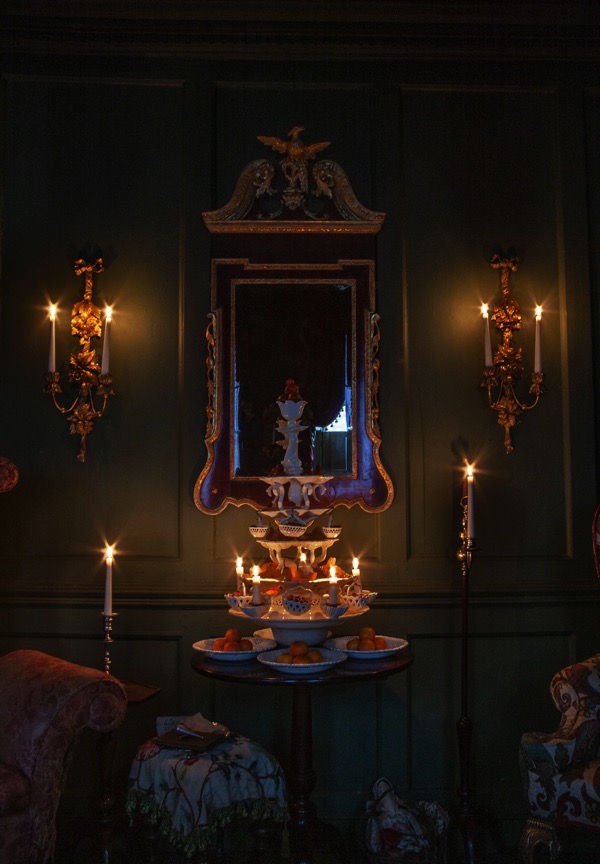
Behold the spirit of Christmas present! This is Amy Merrick, the sylph who waved her wand and conjured the magic of the festive season at Dennis Severs’ House. The decorations have always been applauded as among the best in London but this year Amy brought her own distinctive imaginative creativity to the task, as she explains below.
For those of you unable to get a ticket before Twelfth Night, Contributing Photographer Lucinda Douglas Menzies has recorded the magnificence for your enjoyment.
‘This was far and away the best project of my year – decorating the Dennis Severs’ House for Christmas was an utter delight. The plan was to breathe fresh life into Dennis’ original vision and strike a balance between tradition and something a bit more playful, in a homespun spirit that I hope he would have liked. I made garlands of fir and pine to festoon the hallway, and wove mossy evergreen wreaths with foraged holly, yew and bay leaves, attaching a few hidden snail shells from the innumerable vacant ones in my Whitechapel garden to amuse the observant visitor.
Paper chains bring such a wholesome, jovial charm to Christmas, so I made miles of them from pretty coloured art paper to hang from the windows and ceilings. It took most nights of a week to glue them all but with a glass of sherry to hand and a fire burning, it was a pleasure.
All of the new ornaments for the tree were made around my kitchen table – plaited corn dollies from wheat, woven hearts and pleated pinwheels from antique marble paper which also wrapped a mountain of presents to go under the tree. The Victorian dolls were restored, wigs sorted, limbs reattached and their dresses cleaned. I even replaced the beards on the nutcrackers.
Remaking the eighteenth century sugar loaf – the original of which Dennis obtained from Tate & Lyle – was much easier once I had the brilliant new mould made by Dennis’ friend Jim Howett. Through trial and error, I worked out a recipe: two kilogrammes of granulated sugar, moistened with ten tablespoons of water, packed like a sandcastle, flipped upside down and left to dry.
From my girlhood, I remember the blue-wrapped cones in the general store of Colonial Williamsburg in Virginia and bookbinder Charles Gledhill, who supplied me with stacks of beautiful papers for the project, confirmed that in his trade they still refer to that style as ‘sugar paper’. He gave me samples of different handmade blues which I looked at under candlelight to choose the right shade.
I could not help but make handmade sugar mice to encircle the sugar loaf, shop bought just would not do. If anyone is struggling to find the spirit of Christmas, I strongly recommend spending a quiet evening making pomanders. There is almost nothing that scent alone cannot soothe.
Working to install everything in the house did propose unusual challenges, with the winter darkness creeping in around two in the afternoon and the lack of electric lighting. I had never worked by torchlight before but by the end of the project it felt more natural. It is one thing to make something beautiful in daylight, another thing entirely to set a scene by candlelight.
I found myself making crystallised grapes, then placing them close to votive candles to sparkle and hanging Dennis’ delicate paper-cut strings of dolls, expertly reproduced by Ai Murata, so their shadows would be cast long across the low-slung kitchen ceiling.
So much of the magic of the house is in the marriage of flame, shadow and fragrance. Working with all these elements to imbue the house with Christmas was a thrill.’
Amy Merrick




Photographs copyright © Lucinda Douglas Menzies
You may also like to read


