
Booker T. Washington In Petticoat Lane
JOIN ME FOR FOR A WALK THROUGH SPITALFIELDS THIS EASTER!
CLICK HERE TO BOOK FOR SPRING & SUMMER TOURS

Portrait by Frances Benjamin Johnston, 1895
Spokesman and leader of African American people in the USA, Booker T. Washington came to London in 1910 to study the living conditions of the poor on this side of the Atlantic by comparison with his own country. On arrival in London, his first destination was Petticoat Lane Market, as he described in his book The Man Farthest Down, The Struggle of European Toilers, written with the collaboration of sociologist Robert E. Park and published in 1912.
‘The first thing about London that impressed me was its size, the second was the wide division between the different elements in the population.
London is not only the largest city in the world, it is also the city in which the segregation of the classes has gone farthest. The West End, for example, is the home of the King and the Court. Here are the Houses of Parliament, Westminster Abbey, the British Museum, most of the historical monuments, the art galleries, and nearly everything that is interesting, refined, and beautiful in the lives of seven millions of people who make up the inhabitants of the city.
If you take a cab at Trafalgar Square, however, and ride eastward down the Strand through Fleet Street, where all the principal newspapers of London are published, past the Bank of England, St. Paul’s Cathedral, and the interesting sights and scenes of the older part of the city, you come, all of a sudden, into a very different region, the centre of which is the famous Whitechapel.
The difference between the East End and the West End of London is that East London has no monuments, no banks, no hotels, theatres, art galleries; no history – nothing that is interesting and attractive but its poverty and its problems. Everything else is drab and commonplace.
It is, however, a mistake, as I soon learned, to assume that East London is a slum. It is, in fact, a city by itself, and a very remarkable city, for it has, including what you may call its suburbs, East Ham and West Ham, a population of something over two millions, made up for the most part of hard-working, thrifty labouring people. It has its dark places, also, but I visited several parts of London during my stay in the city which were considerably worse in every respect than anything I saw in the East End.
Nevertheless, it is said that more than one hundred thousand of the people in this part of the city, in spite of all the efforts that have been made to help them, are living on the verge of starvation. So poor and so helpless are these people that it was, at one time, seriously proposed to separate them from the rest of the population and set them off in a city by themselves, where they could live and work entirely under the direction of the state. It was proposed to put this hundred thousand of the very poor under the direction and care of the state because they were not able to take care of themselves, and because it was declared that all the service which they rendered the community could be performed by the remaining portion of the population in their leisure moments, so that they were, in fact, not a help but a hindrance to the life of the city as a whole.
I got my first view of one of the characteristic sights of the East End life at Middlesex Street, or Petticoat Lane, as it was formerly called. Petticoat Lane is in the centre of the Jewish quarter, and on Sunday morning there is a famous market in this street. On both sides of the thoroughfare, running northward from Whitechapel Road until they lose themselves in some of the side streets, one sees a double line of pushcarts, upon which every imaginable sort of ware, from wedding rings to eels in jelly, is exposed for sale. On both sides of these carts and in the middle of the street a motley throng of bargain-hunters are pushing their way through the crowds, stopping to look over the curious wares in the carts or to listen to the shrill cries of some hawker selling painkiller or some other sort of magic cure-all.
Nearly all of the merchants are Jews, but the majority of their customers belong to the tribes of the Gentiles. Among others I noticed a class of professional customers. They were evidently artisans of some sort or other who had come to pick out from the goods exposed for sale a plane or a saw or some other sort of second-hand tool, there were others searching for useful bits of old iron, bolts, brass, springs, keys, and other things of that sort which they would be able to turn to some use in their trades.
I spent an hour or more wandering through this street and the neighbouring lane into which this petty pushcart traffic had overflowed. Secondhand clothing, secondhand household articles, the waste meats of the Saturday market, all kinds of worn-out and cast-off articles which had been fished out of the junk heaps of the city or thrust out of the regular channels of trade, find here a ready market.
I think that the thing which impressed me most was not the poverty, which was evident enough, but the sombre tone of the crowd and the whole proceeding. It was not a happy crowd, there were no bright colours, and very little laughter. It was an ill-dressed crowd, made up of people who had long been accustomed to live, as it were, at second-hand and in close relations with the pawnbroker.
In the Southern States it would be hard to find a coloured man who did not make some change in his appearance on Sunday. The Negro labourer is never so poor that he forgets to put on a clean collar or a bright necktie or something out of the ordinary out of respect for the Sabbath. In the midst of this busy, pushing throng it was hard for me to remember that I was in England and that it was Sunday. Somehow or other I had got a very different notion of the English Sabbath.
Petticoat Lane is in the midst of the “sweating” district, where most of the cheap clothing in London is made. Through windows and open doors I could see the pale faces of the garment-makers bent over their work. There is much furniture made in this region, also, I understand. Looking down into some of the cellars as I passed, I saw men working at the lathes. Down at the end of the street was a barroom, which was doing a rushing business. The law in London is, as I understand, that travellers may be served at a public bar on Sunday, but not others. To be a traveller, a bona-fide traveller, you must have come from a distance of at least three miles. There were a great many travellers in Petticoat Lane on the Sunday morning that I was there.
This same morning I visited Bethnal Green, another and a quite different quarter of the East End. There are a number of these different quarters of the East End, like Stepney, Poplar, St. George’s in the East, and so forth. Each of these has its peculiar type of population and its own peculiar conditions. Whitechapel is Jewish, St. George’s in the East is Jewish at one end and Irish at the other, but Bethnal Green is English. For nearly half a mile along Bethnal Green Road I found another Sunday market in full swing, and it was, if anything, louder and more picturesque than the one in Petticoat Lane.
It was about eleven o’clock in the morning; the housewives of Bethnal Green were out on the street hunting bargains in meat and vegetables for the Sunday dinner. One of the most interesting groups I passed was crowded about a pushcart where three sturdy old women, shouting at the top of their lungs, were reeling off bolt after bolt of cheap cotton cloth to a crowd of women gathered about their cart.
At another point a man was “knocking down” at auction cheap cuts of frozen beef from Australia at prices ranging from 4 to 8 cents a pound. Another was selling fish, another crockery, and a third tinware, and so through the whole list of household staples.
The market on Bethnal Green Road extends across a street called Brick Lane and branches off again from that into other and narrower streets. In one of these there is a market exclusively for birds, and another for various sorts of fancy articles not of the first necessity. The interesting thing about all this traffic was that, although no one seemed to exercise any sort of control over it, somehow the different classes of trade had managed to organize themselves so that all the wares of one particular sort were displayed in one place and all the wares of another sort in another, everything in regular and systematic order. The streets were so busy and crowded that I wondered if there were any people left in that part of the town to attend the churches.
One of the marvels of London is the number of handsome and stately churches. One meets these beautiful edifices everywhere, not merely in the West End, where there is wealth sufficient to build and support them, but in the crowded streets of the business part of the city, where there are no longer any people to attend them. Even in the grimiest precincts of the East End, where all is dirt and squalor, one is likely to come unexpectedly upon one of these beautiful old churches, with its quiet churchyard and little space of green, recalling the time when the region, which is now crowded with endless rows of squalid city dwellings, was, perhaps, dotted with pleasant country villages. These churches are beautiful, but as far as I could see they were, for the most part, silent and empty. The masses of the people enjoy the green spaces outside, but do not as a rule, I fear, attend the services on the inside. They are too busy.
It is not because the churches are not making an effort to reach the people that the masses do not go to them. One has only to read the notices posted outside of any of the church buildings in regard to night schools, lectures, men’s clubs and women’s clubs, and many other organizations of various sorts, to know that there is much earnestness and effort on the part of the churches to reach down and help the people. The trouble seems to be that the people are not at the same time reaching up to the church. It is one of the results of the distance between the classes that rule and the classes that work. It is too far from Whitechapel to St. James’s Park.’

Petticoat Lane by Charles Chusseau-Flaviens, 1911. Photograph courtesy George Eastman House


Booker T. Washington speaking in Atlanta in 1895
Click here to read ‘The Man Farthest Down, The Struggle of European Toilers’
You may also like to take a look at
Dennis Anthony’s Petticoat Lane
Laurie Allen of Petticoat Lane
The Wax Sellers of Wentworth St
The Streets Of Old London
JOIN ME FOR FOR A WALK THROUGH SPITALFIELDS THIS EASTER!
CLICK HERE TO BOOK FOR SPRING & SUMMER TOURS

Piccadilly, c. 1900
In my mind, I live in old London as much as I live in the contemporary London of here and now. Maybe I have spent too much time looking at photographs of old London – such as these glass slides once used for magic lantern shows by the London & Middlesex Archaeological Society at the Bishopsgate Institute?
Old London exists to me through photography almost as vividly as if I had actual memory of a century ago. Consequently, when I walk through the streets of London today, I am especially aware of the locations that have changed little over this time. And, in my mind’s eye, these streets of old London are peopled by the inhabitants of the photographs.
Yet I am not haunted by the past, rather it is as if we Londoners in the insubstantial present are the fleeting spirits while – thanks to photography – those people of a century ago occupy these streets of old London eternally. The pictures have frozen their world forever and, walking in these same streets today, my experience can sometimes be akin to that of a visitor exploring the backlot of a film studio long after the actors have gone.
I recall my terror at the incomprehensible nature of London when I first visited the great metropolis from my small city in the provinces. But now I have lived here long enough to have lost that diabolic London I first encountered in which many of the great buildings were black, still coated with soot from the days of coal fires.
Reaching beyond my limited period of residence in the capital, these photographs of the streets of old London reveal a deeper perspective in time, setting my own experience in proportion and allowing me to feel part of the continuum of the ever-changing city.

Ludgate Hill, c. 1920

Holborn Viaduct, c. 1910

Trinity Almshouses, Mile End Rd, c. 1920
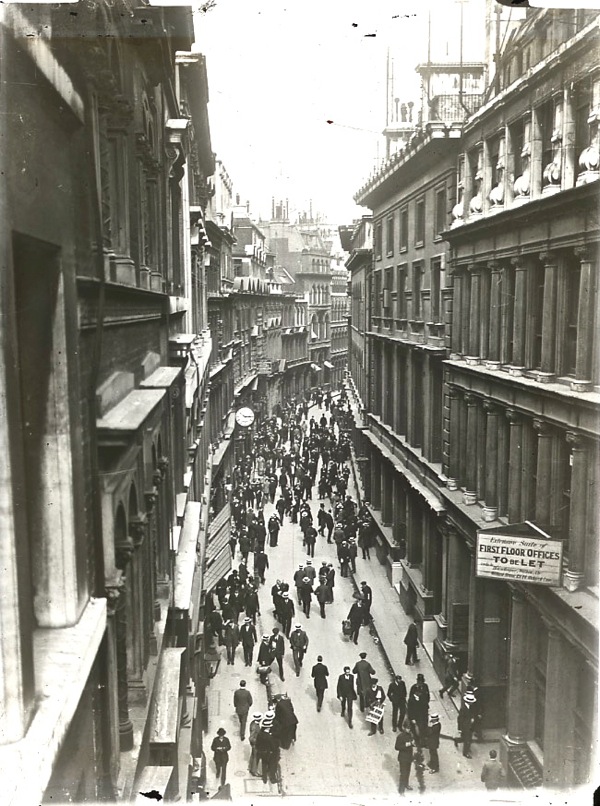
Throgmorton St, c. 1920

Highgate Forge, Highgate High St, 1900

Bangor St, Kensington, c. 1900

Ludgate Hill, c. 1910

Walls Ice Cream Vendor, c. 1920

Ludgate Hill, c. 1910

Strand Yard, Highgate, 1900
 Eyre St Hill, Little Italy, c. 1890

Muffin man, c. 1910

Seven Dials, c. 19o0

Fetter Lane, c. 1910

Piccadilly Circus, c. 1900

St Clement Danes, c. 1910
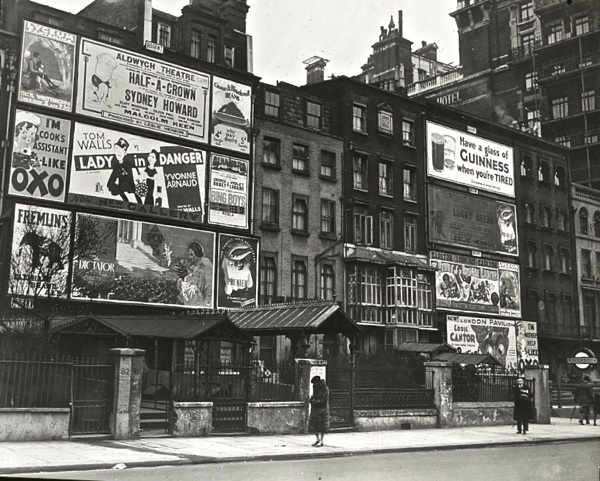
Hoardings in Knightsbridge, c. 1935

Wych St, c.1890

Dustcart, c. 1910

At the foot of the Monument, c. 1900
 Pageantmaster Court, Ludgate Hill, c. 1930

Holborn Circus, 1910

Cheapside, 1890

Cheapside ,1892

Cheapside with St Mary Le Bow, 1910

Regent St, 1900
Glass slides copyright © Bishopsgate Institute
You may also like to take a look at
In William Blake’s Lambeth
JOIN ME FOR FOR A WALK THROUGH SPITALFIELDS THIS SATURDAY 11TH MARCH
CLICK HERE TO BOOK FOR SPRING & SUMMER TOURS

Glad Day in Lambeth
If you wish to visit William Blake’s Lambeth, just turn left outside Waterloo Station, walk through the market in Lower Marsh, cross Westminster Bridge Rd and follow Carlisle Lane under the railway arches. Here beneath the main line into London was once the house and garden, where William & Catherine Blake were pleased to sit naked in their apple tree.
Yet in recent years, William Blake has returned to Lambeth. Within the railway arches leading off Carlisle Lane, a large gallery of mosaics based upon his designs has been installed, evoking his fiery visions in the place where he conjured them. Ten years work by hundreds of local people have resulted in dozens of finely-wrought mosaics bringing Blake’s images into the public realm, among the warehouses and factories where they may be discovered by the passerby, just as he might have wished. Trains rumble overhead with a thunderous clamour that shakes the ancient brickwork and cars roar through these dripping arches, creating a dramatic and atmospheric environment in which to contemplate his extraordinary imagination.
On the south side of the arches is Hercules Rd, site of the William Blake Estate today, where he lived between 1790 and 1800 at 13 Hercules Buildings, a three-storey terrace house demolished in 1917. Blake passed ten productive and formative years on the south bank, that he recalled as ‘Lambeth’s vale where Jerusalem’s foundations began.’ By contrast with Westminster where he grew up, Lambeth was almost rural two hundred years ago and he enjoyed a garden with a fig tree that overlooked the grounds of the bishop’s palace. This natural element persists in the attractively secluded Archbishop’s Park on the north side of the arches in the former palace grounds.
To enter these sonorous old arches that span the urban and pastoral is to discover the resonant echo chamber of one of the greatest English poetic imaginations. When I visited I found myself alone at the heart of Lambeth yet in the presence of William Blake, and it is an experience I recommend to my readers.


‘There is a grain of sand in Lambeth that Satan cannot find”


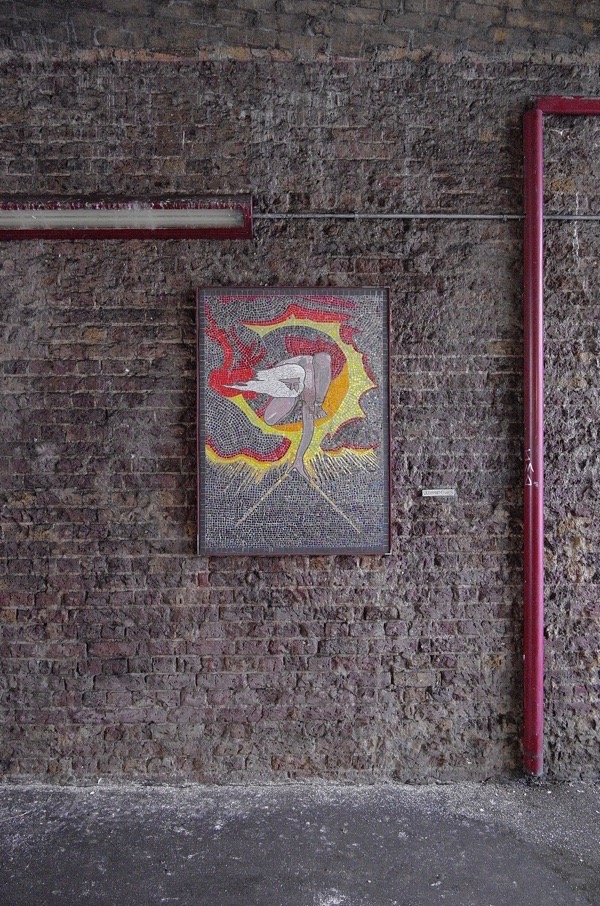


These mosaics were created by South Bank Mosaics which is now The London School of Mosaic
You may also like to take a look
Eleanor Crow’s East End Cafes
JOIN ME FOR FOR A WALK THROUGH SPITALFIELDS THIS SATURDAY 11TH MARCH
CLICK HERE TO BOOK FOR SPRING & SUMMER TOURS

Syd’s Coffee Stall, Shoreditch High St
(Gone but not forgotten)
Illustrator Eleanor Crow made this set of watercolour portraits of cafes as a tribute to those cherished institutions which incarnate the essence of civility in the East End. “It’s because they’re individual concerns, often owned by families across generations who get to know all their customers,” admitted Eleanor, revealing the source of her devotion to cafe culture ,“I like the frontages because each is designed uniquely for that café with wonderful sign-writing or lettering and eye-catching colours. Some of these cafés have been here for a very long time and everyone in the area is familiar with them, and is very fond of them. They make the streets into a better place and are landmarks upon the landscape of the East End.”

E. Pellicci, Bethnal Green Rd

Savoy, Norton Folgate (Gone but not forgotten)

Time for Tea, Shoreditch High St (Gone but not forgotten)

Dalston Lane Cafe

Paga Cafe, Lea Bridge Rd

Lennies Snack Bar, Calvert Avenue (Gone but not forgotten)

Marina Cafe, Mare St

Kingsland Cafe, Kingsland Rd

Grab & Go, Blackhorse Lane

Gina’s Restaurant, Bethnal Green Rd (Gone but not forgotten)

Copper Grill, Eldon St

Billy Bunter’s Snack Bar, Mile End Rd (Gone but not forgotten)

Beppe’s Cafe, West Smithfield

B.B. Cafe, Lea Bridge Rd

Savoy Cafe, Graham Rd

A.Gold, Brushfield St (Gone but not forgotten)

Arthur’s Cafe, Kingsland Rd (Gone but not forgotten)

Cafe Bliss, Dalston Lane

Cafe Rodi, Blackhorse Lane
 Rossi Restaurant, Hanbury St (Gone but not forgotten)

Eleanor Crow at E.Pellicci
Drawings copyright © Eleanor Crow
Portrait copyright © Colin O’Brien
You may also like to read
Dorothy Bishop, Artist & Teacher
DESPITE THE CHILL TODAY, I AM DELIGHTED TO REPORT THAT A BALMY 14 DEGREES IS FORECAST FOR MY WALK THROUGH SPITALFIELDS NEXT SATURDAY 11TH MARCH
CLICK HERE TO BOOK FOR SPRING & SUMMER TOURS

Looking towards the City of London from Morpeth School, 1961
This painting shows the view from the art room at the top of the school in Bethnal Green where Dorothy Bishop taught for twenty years. It was a formative experience that Dorothy treasured and this painting – which her friend Ruth Richardson kindly brought to my attention – is one of only a few pictures of hers that are known to exist. Although she painted throughout her life, she did not consider herself a professional artist.
Born in Brockley, Dorothy lived with her parents, her elder sister and younger brother for most of her life. After training as an Art teacher, she taught at a school in the north west of England for the duration of the war, returning south to live in Harefield, Uxbridge with her parents afterwards. In 1947, Dorothy took a job teaching evening classes Stewart Headlam Recreational Evening Institute in Morpeth St, an employment which was to occupy her until 1968. Recording her memory of these years, Dorothy wrote a diary of her impressions of the people and the place from which we include these excerpts.
“I was there for twenty-one years and it was one of the best things in my life. Now I am old and I must lead a quiet life, I would give much to be back at Stewart Headlam School. I really loved the cockney boys and girls, especially the wit and vitality of the boys. The whole atmosphere was full of life and rough kindness. I loved the wildness of the boys, once it had snowed and they made for me with snowballs and I saw their dark eyes dancing with joy, shining in the lamplight. They did enjoy things. The layabout boys tended to come to Art as in football training you had to do something, whereas in Art you could just sit and exercise your wit on the teacher and thus show off to your friends. The girls then were almost a different tribe and provided me often with members of the class who would work and were also friendly. They always supported me in any trouble with the boys and, on the whole, sex solidarity was more powerful than class solidarity.”
“The class was from 7:30pm to 9:30pm with a quarter of an hour’s break to go to the canteen for a cup of tea. The second half of the class was the most difficult as the boys would become restless, even to throw pencils. Sometimes I was utterly exhausted at the end and thought, ‘Why am I doing this?’ but then I thought, ‘Why should they drive me out?’ also I really loved them and there were some gentle quiet boys and girls who would talk to me. The next week they would be quite different and ask, ‘Did we upset you, Miss? We was only having a bit of a giggle.’”
“I was not approved of by the L.C.C. inspectors. Once they found my class copying Mickey Mouse and painting him in bright colours. I told them I could not change the taste of Bethnal Green for such things, but did not add – as I thought – that it would be impertinent to try to do so. In their report they said I was ‘defeatist’. I got a letter which said, ‘While your qualifications remain at their present level you are not suitable for employment by the L.C.C.” I was devastated. I was not terrific but I had had a full art training. As to drawing Mickey Mouse, the Pop Artists were doing this a few years later.”

Dorothy Bishop (1913-2005)
Painting copyright © Estate of Dorothy Bishop
(With thanks to Esther North, Dorothy’s niece)
The Cabbies Shelters Of Old London
DESPITE THE CHILL TODAY, I AM DELIGHTED TO REPORT THAT A BALMY 14 DEGREES IS FORECAST FOR MY WALK THROUGH SPITALFIELDS NEXT SATURDAY 11TH MARCH
CLICK HERE TO BOOK FOR SPRING & SUMMER TOURS

Thurloe Place, SW7
Created between 1875 and 1914, sixty of these structures were built by the Cabmen’s Shelter Fund established by the Earl of Shaftesbury to enable cabbies to get a meal without leaving their cabs unattended and were no larger than a horse and cart so they might stand upon the public highway.
Today, only thirteen remain but all are grade II listed and, on my strange pilgrimage around London, I found them welcoming homely refuges where a cup of tea can still be had for just 50p.

Embankment Place, Wc2
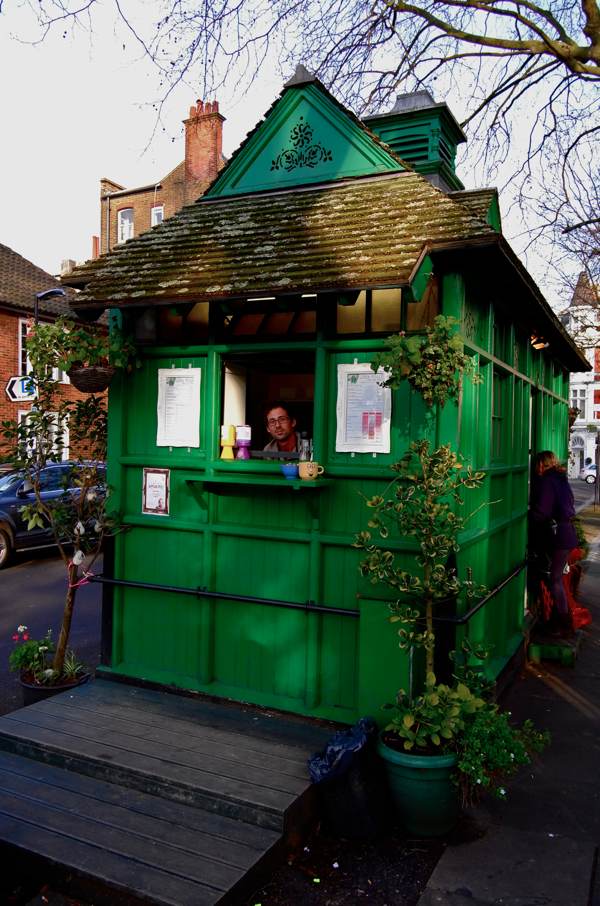
Wellington Place, NW8

Chelsea Embankment, SW3

Grosvenor Gardens, SW1

St Georges Sq, SW1

Kensington Park Rd, W11

Temple Place, WC2

Warwick Ave, W9

Russell Sq, WC1

Kensington Rd, W8

Pont St, SW1

The shelter attendant at Wellington Place has spoon-bending powers
You may also like to read about
Gillian Tindall In Stepney, 1963
I AM DELIGHTED TO REPORT THAT A BALMY 14 DEGREES IS FORECAST FOR MY WALK THROUGH SPITALFIELDS NEXT SATURDAY 11TH MARCH
CLICK HERE TO BOOK FOR SPRING & SUMMER TOURS

Old Montague St
Contributing writer Gillian Tindall’s memoir of her first visits to Stepney in 1963 is accompanied by photographs of the East End taken in that era by her husband Richard Lansdown.
The number of people who actually remember the Blitz that struck the East End between 1940 and 1944 is fast diminishing, yet everyone has heard of it. Today, it is generally assumed that the acres and acres of undistinguished post-war flats that are now the dominant architecture of much of the East End are the result of post-Blitz rebuilding. In fact, the truth is rather different
It was twenty years after the worst of the Blitz that I first got to know Whitechapel and Stepney, Tower Hamlets’ ancient heartlands. It was 1963, the summer after the coldest winter for a century and so long ago that I can almost see – separate from my present self – the girl that I was then. She wears a checked cotton dress she made herself on a sewing machine and her plait of hair is pinned up. She is walking rapidly round the area with a pack of index cards from the Stepney Old People’s Welfare Association in a small basket. In her flat sandals, she is exploring the East End for the first time.
In those days, a pungent scent of hops from Charringtons’ Anchor Brewery enveloped a stretch of the Mile End Rd, and sometimes a dray cart pulled by huge shire horses rolled sonorously past and turned in at the great gates. The jingling harness and the rhythmic clopping of heavy, whiskered hooves, were an assertion of a long tradition that in only a few years would become extinct, but the girl who was me did not know that. Nor could she guess that the small shops in Whitechapel with Jewish names over the doors, selling kosher meat or Fancy Trimmings or jellied eels, were in their final years too. You do not know much when you are young.
I was employed by the Welfare Association, on a casual basis, to find out how many of several thousand old ladies on their books, and a smaller number of old gentlemen, were still at their recorded addresses, and how well – or not – they were managing. Their children, I learnt from conversations with them, had usually moved to London’s northern suburbs, or to Dagenham or Basildon – or had been ‘relocated’ more recently under The Greater London Plan. The old people’s cards mostly showed birth-dates in the 1880s, some even in the 1870s. Some had been widowed ever since the War of 1914-18, and one or two were even old enough to have lost sons in that war. Often, when I was invited into their houses, the mantlepieces in their front rooms were dressed with the bobbled chenille runners of the Victorian age, with symmetric ornaments at each end – a décor almost extinct today but commemorated in the two china dogs that are the symbol of Spitalfields Life Books.
Some of them would try to detain me with sagas of ancient achievements or griefs, to which I listened with a guilty awareness that I had many more names to visit in the next two hours. Today, how much I would like to have these garrulous old people back, even for one afternoon! They spoke of happy times past, of ‘nice shops’ and good markets and celebrations for forgotten victories and jubilees, of synagogues and Baptist Sunday schools, a world of neighbourliness which they perceived as dispersed and lost. To prolong the chat they would offer me very strong tea, to which very sweet, tinned milk was automatically added. Then I would be taken to see the place in the cracked wall of the kitchen or the upstairs bedroom where “you can see the daylight through it, darlin’, can’t you?”, and the privy in the backyard with the perennially leaking roof – “It isn’t very nice, you see, ‘specially when it rains. My husband, he could have fixed that, but now I’m on me owney-oh…”
I would assure them that the Old People’s Welfare would try to do something about these things. It took me a while to discover the extent to which the forces of bureaucracy were preventing such simple, ad hoc improvements from being carried out. Not long before, Stepney Council had specifically refused a landlord permission to make good minor damage to three houses in White Horse Rd, near Stepney Green. ‘The carrying out of substantial works of repair to this old and obsolete type of property would seriously prejudice the Council planning proposals for the redevelopment for residential purposes of this part of Stepney and Poplar Reconstruction Area.’
These post-war plans were not dreamed up by individual Councils. The Greater London Plan was imposed by the London County Council (the fore-runner of the Greater London Council), but the local authorities had adopted its assumptions with blinkered enthusiasm. As early as 1946, warning local voices had been raised, especially about the way the envisaged Brave New Stepney of high-rise blocks set in ‘green spaces’ did not seem to allow any place for the small businesses that had long been the life-blood of the East End. The truth was that Labour thinking in those years had an aversion to small businesses. And so carried away were the Council by the prospect of reducing the borough’s population substantially by moving half of them out of London (a key element of the Plan) that the views of the inhabitants themselves counted for little. An early, enthusiastic description of the Plan in a popular illustrated magazine shocks the reader of today by its Stalinist disregard for the population’s own preferences:
‘A New East End for London… will create a new and better London, of town planning on scientific lines… [It] will make a clean sweep of two-thirds of Stepney and one-third of the neighbouring borough of Poplar… More than 1,960 acres will be transformed… 3 ½ miles long and 1 1/2 miles wide.’
I noticed that among all the old people I visited, whether in snug little houses that only need the roof mended and a bathroom added to the back or in multi-occupied, once-elegant terraces or in serviceable Victorian tenements, the refrain was “Oh, it’s all coming down round here, dear.” I could tell that though they were acquiescent about the change, believing it to be in some way inevitable, they felt hurt at a profound, inarticulate level by what was being done. It became clear to me that something terrible was happening, a social assault that went far beyond any rational response to the Blitz.
It was true that to the east of St Dunstan’s church, in the ancient heart of Stepney, the war had left a scene of devastation. The bombs arrived here in battalions, aiming at the gasholders and the docks, although the church itself was hardly touched. But why, over twenty years later, was the place still a wilderness reminiscent of Ypres just after World War I? On what must once have been a street corner, the remains of a shoe-shop stood, apparently untouched since it was set alight by an incendiary bomb in 1940. Burnt shoes still littered the dank interior of the shop, among other rain-sodden rubbish.
On the west side of the church, running towards Jubilee St, there was still whole grid of streets standing, solid, liveable homes, many of which seemed hardly touched by bomb-blast – indeed the London County Council’s own contemporary maps of bomb-damage show that to have been the case. But not long after I first walked those streets they had almost all been boarded up. Other streets were already being supplanted by long fences of corrugated iron, with just the occasional public house left isolated on a corner without anyone to go to it. Here, I was told, was where a ‘green space’ was arbitrarily planned. Yet it could have been sited to the east of the church without destroying a whole neighbourhood, reducing to worthlessness in the eyes of the dispossessed inhabitants what had been the fabric of their existence. All coming down – people’s memories, the meaning of their lives.
The Welfare Association’s annual report for that year had lots to report on gifts, fuel grants, outings, chiropody and meals-on-wheels but – perhaps diplomatically – on the subject of ‘relocation’ it had little to say.
Walking back up Stepney Green, an ancient curving route with trees and grass down the centre of it, a few runs of substantial old houses were still standing. I dreaded that, next time I came past, the iron screens would have taken over here too. In fact, this did not happen. Stepney Green itself was saved in the nick of time and rehabilitated. Unknown to me in that summer of 1963, a rebellious Conservation movement was beginning to grind into action. Post-war doctrines about the State knowing what was best for its citizens were at last being questioned, on the political Left as well as the Right. The ‘slum-clearing’ obsession, fixated on the need to destroy the architecture of the past in order to eradicate the poverty of that past, as if the streets themselves were somehow the source of urban ills, was at last perceived to be false. On the contrary, when whole districts were laid waste, crime and vandalism increased. By the seventies articles in illustrated magazines were not about a future of radiant towers but had titles such as ‘An Indictment of Bad Planning’. As the distinguished commentator Ian Nairn put it, the East End had not been destroyed so much by the War but had been ‘broken on the planners’ wheel’.
Today, it lives again in another form. The synagogues and Baptist chapels have been replaced by mosques, the Kosher butchers by Halal butchers. Whitechapel market is full of sarees and bright scarves. The Welfare Association is no longer in the same headquarters under the same name, but survives as Tower Hamlets Friends & Neighbours. We can at least be grateful for what has been saved – or re-born.

Old Montague St

Fruit Stall in Bow

Jubilee St

Jubilee St

Jubilee St

Jubilee St

Off Mile End Rd

Buxton St

Artillery Lane

Cheshire St

Bombsite at Club Row

Club Row Animal Market
Photographs copyright © Richard Lansdown
You may also like to read these other stories by Gillian Tindall


